Unstructured Mesh Tools for Fusion Energy System Design
Pith reviewed 2026-06-27 17:21 UTC · model grok-4.3
The pith
Accurate fusion energy simulations depend on meshing critical component geometries and coupling physics codes to engineering tools.
A machine-rendered reading of the paper's core claim, the machinery that carries it, and where it could break.
Core claim
The central claim is that the execution of accurate simulations of fusion energy systems requires appropriate representation of critical component geometries together with the coupling of complex fusion physics codes with one another and with engineering analysis tools, and that existing geometric modeling and meshing technologies can support the construction of such analysis geometries while enabling the required couplings.
What carries the argument
Unstructured mesh construction and meshing of fusion component geometries, combined with mechanisms for coupling particle and continuum modeling methods across fusion physics and engineering codes.
If this is right
- Existing fusion research codes can be fully leveraged inside commercial CAE environments.
- Geometry construction and meshing steps become feasible for complex fusion components using current technologies.
- Workflows can simultaneously handle particle-based and continuum-based modeling methods.
- Coupling between fusion physics codes and engineering analysis tools becomes practical.
Where Pith is reading between the lines
- Similar mesh-based coupling strategies could extend to other multi-physics engineering domains that combine particle and continuum models.
- Adoption would reduce the need for custom geometry tools in fusion design loops.
- The approach implies that validation efforts can focus on physics coupling rather than on basic meshing capability.
Load-bearing premise
That available geometric modeling and meshing technologies can be directly applied to fusion component geometries without substantial new development or validation specific to fusion conditions.
What would settle it
A case in which standard meshing tools produce invalid or incomplete meshes for a documented fusion component geometry that then causes coupled simulation results to deviate measurably from reference data.
Figures
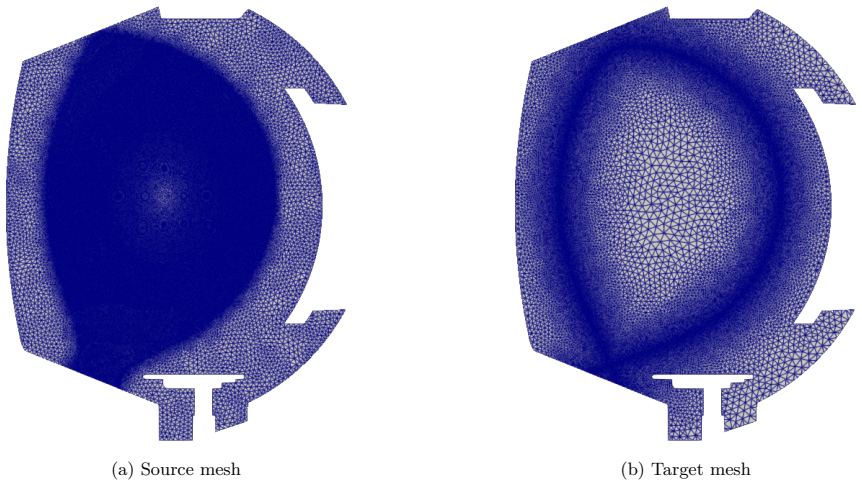
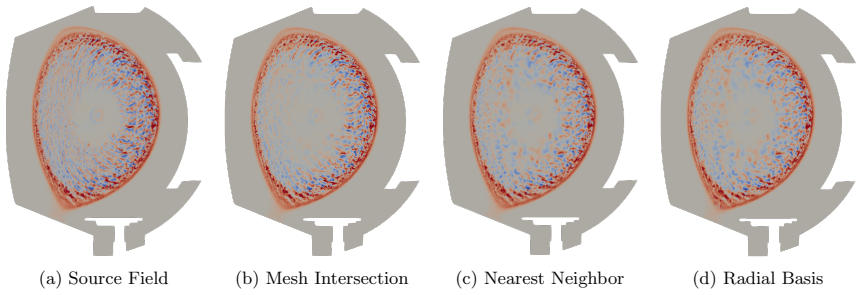
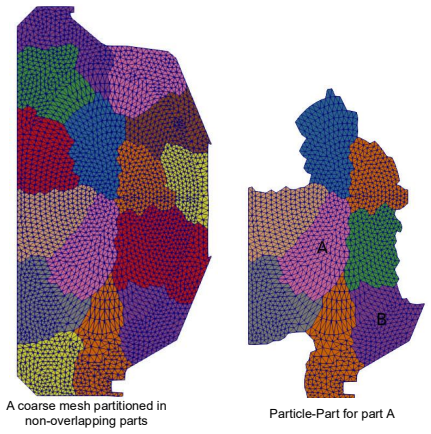
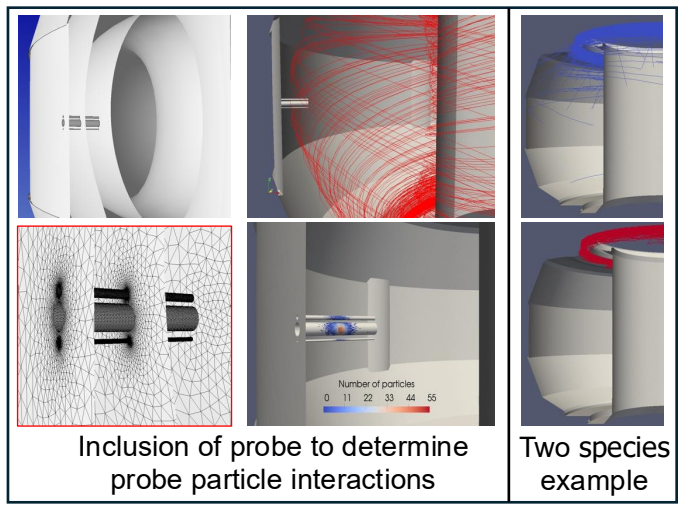
read the original abstract
The execution of accurate simulations of fusion energy systems requires the appropriate representation of critical component geometries as well as the coupling of complex fusion physics codes with one another and with engineering analysis tools. This paper examines the challenges of creating simulation workflows that fully leverage existing fusion research codes while integrating them with commercial computer-aided engineering (CAE) software. Key areas addressed include: (a) the construction and meshing of analysis geometries taking full advantage of available geometric modeling and meshing technologies; (b) the effective coupling of fusion physics and engineering analysis codes; and (c) the support for simulation workflows that couple particle and continuum modeling methods.
Editorial analysis
A structured set of objections, weighed in public.
Referee Report
Summary. The manuscript states that accurate simulations of fusion energy systems require faithful representation of component geometries together with coupling of fusion physics codes to one another and to engineering analysis tools. It examines three challenge areas: (a) construction and meshing of analysis geometries that exploit existing geometric modeling and meshing technologies, (b) effective coupling of fusion physics and engineering analysis codes, and (c) workflows that couple particle and continuum modeling methods, all while leveraging existing fusion research codes and commercial CAE software.
Significance. The topic is relevant to fusion energy system design. If the full manuscript supplies concrete, reproducible examples of geometry workflows, coupling interfaces, or particle-continuum hand-offs that are shown to work on representative fusion components, the work could usefully document practical integration paths. The supplied abstract, however, advances only a statement of requirements and an enumeration of challenge areas rather than new methods, validation data, or performance metrics.
minor comments (2)
- The title refers to 'Unstructured Mesh Tools' yet the abstract contains no description of any specific tool, algorithm, or implementation; clarify whether the manuscript presents new tools or is limited to a requirements discussion.
- No references, software names, or example geometries are mentioned in the abstract; the full text should include at least one concrete case (component, mesh type, coupled codes) to make the examination actionable.
Simulated Author's Rebuttal
We thank the referee for reviewing our manuscript. The work examines practical challenges in fusion simulation workflows and documents how existing geometric modeling, meshing, and code-coupling technologies can be applied, rather than introducing new algorithms or performance benchmarks.
read point-by-point responses
-
Referee: The supplied abstract, however, advances only a statement of requirements and an enumeration of challenge areas rather than new methods, validation data, or performance metrics.
Authors: The manuscript scope is an examination of integration challenges across geometry construction, physics code coupling, and particle-continuum hand-offs while leveraging existing fusion codes and commercial CAE tools. Concrete workflow examples for representative fusion components are described in the body; the abstract was intentionally concise to reflect this focus on requirements and challenge areas rather than novel contributions. We can revise the abstract to better signal the presence of these examples if the editor requests. revision: partial
Circularity Check
No significant circularity
full rationale
The paper is an engineering discussion of simulation challenges for fusion systems, focusing on geometry representation, meshing, and multi-code coupling. It contains no equations, fitted parameters, predictions, or derivation chains. The central statements are requirements statements and descriptions of workflow issues rather than claims that reduce to self-defined inputs or self-citations. No load-bearing steps match any of the enumerated circularity patterns.
Axiom & Free-Parameter Ledger
Reference graph
Works this paper leans on
-
[1]
, author=
Accessing CAD Geometry for Mesh Generation. , author=. Proceeding of Int. Meshing Roundtable , year=
-
[2]
A general topology-based mesh data structure , author=. Int. J. Numer. Meth. Eng. , volume=. 1997 , publisher=
1997
-
[3]
Journal of Parallel and Distributed Computing , volume=
PUMIPic: A mesh-based approach to unstructured mesh Particle-In-Cell on GPUs , author=. Journal of Parallel and Distributed Computing , volume=. 2021 , publisher=
2021
-
[4]
Physics of Plasmas , volume=
DESC: a stellarator equilibrium solver , author=. Physics of Plasmas , volume=. 2020 , publisher=
2020
-
[5]
2022 , howpublished =
2022
-
[6]
Journal of parallel and distributed computing , volume=
Kokkos: Enabling manycore performance portability through polymorphic memory access patterns , author=. Journal of parallel and distributed computing , volume=. 2014 , publisher=
2014
-
[7]
M. R. Rodríguez , title=
-
[8]
International journal for numerical methods in engineering , volume=
Gmsh: A 3-D finite element mesh generator with built-in pre-and post-processing facilities , author=. International journal for numerical methods in engineering , volume=. 2009 , publisher=
2009
-
[9]
Christophe Geuzaine and Jean-François Remacle , title=
-
[10]
Godoy, William F. and Podhorszki, Norbert and Wang, Ruonan and Atkins, Chuck and Eisenhauer, Greg and Gu, Junmin and Davis, Philip and Choi, Jong and Germaschewski, Kai and Huck, Kevin and Huebl, Axel and Kim, Mark and Kress, James and Kurc, Tahsin and Liu, Qing and Logan, Jeremy and Mehta, Kshitij and Ostrouchov, George and Parashar, Manish and Poeschel,...
-
[11]
Nuclear Fusion , volume=
A framework for discrete optimization of stellarator coils , author=. Nuclear Fusion , volume=. 2025 , publisher=
2025
-
[12]
arXiv preprint arXiv:2504.19048 , year=
GPU Acceleration of Monte Carlo Tallies on Unstructured Meshes in OpenMC with PUMI-Tally , author=. arXiv preprint arXiv:2504.19048 , year=
-
[13]
1983 , institution=
Steepest descent moment method for three-dimensional magnetohydrodynamic equilibria , author=. 1983 , institution=
1983
-
[14]
Ibanez, D. A. and Seol, E. S. and Smith, C. W. and Shephard, M. S. , journal=. 2016 , publisher=
2016
-
[15]
Ibanez, D. A. , title =
-
[16]
2004 , journal =
Common-Refinement-Based Data Transfer between Non-Matching Meshes in Multiphysics Simulations , author =. 2004 , journal =
2004
-
[17]
The International Journal of High Performance Computing Applications , volume=
Efficient exascale discretizations: High-order finite element methods , author=. The International Journal of High Performance Computing Applications , volume=. 2021 , publisher=
2021
-
[18]
and Chang,C
Ku,S. and Chang,C. S. and Hager,R. and Churchill,R. M. and Tynan,G. R. and Cziegler,I. and Greenwald,M. and Hughes,J. and Parker,S. E. and Adams,M. F. and D'Azevedo,E. and Worley,P. , title =. Physics of Plasmas , volume =. 2018 , doi =
2018
-
[19]
arXiv preprint arXiv:2601.14471 , note =
Understanding Carbon Sourcing and Transport Originating from the Helicon Antenna Surfaces During High-Power Helicon Discharge in DIII-D Tokamak , author=. arXiv preprint arXiv:2601.14471 , note =
-
[20]
Journal of Open Source Software , volume=
SIMSOPT: a flexible framework for stellarator optimization , author=. Journal of Open Source Software , volume=. 2021 , doi =
2021
-
[21]
Nuclear fusion , volume=
Reconstruction of current profile parameters and plasma shapes in tokamaks , author=. Nuclear fusion , volume=. 1985 , publisher=
1985
-
[22]
2020 , institution=
Stellopt , author=. 2020 , institution=
2020
-
[23]
Plasma Physics and Controlled Fusion , volume=
STELLOPT modeling of the 3D diagnostic response in ITER , author=. Plasma Physics and Controlled Fusion , volume=. 2013 , publisher=
2013
-
[24]
Computer methods in applied mechanics and engineering , volume=
3D anisotropic mesh adaptation by mesh modification , author=. Computer methods in applied mechanics and engineering , volume=. 2005 , publisher=
2005
-
[25]
arXiv preprint arXiv:2510.18838 , year=
PCMS: Parallel Coupler For Multimodel Simulations , author=. arXiv preprint arXiv:2510.18838 , year=
-
[26]
arXiv preprint arXiv:2603.00538 , year=
A Stochastic Conservative Field Transfer Method for Black-box Multiscale and Multiphysics Coupling , author=. arXiv preprint arXiv:2603.00538 , year=
-
[27]
Frontiers in Nuclear Engineering , volume=
ParaStell: parametric modeling and neutronics support for stellarator fusion power plants , author=. Frontiers in Nuclear Engineering , volume=. 2024 , publisher=
2024
-
[28]
Computer Physics Communications , volume=
A 3D unstructured mesh based particle tracking code for impurity transport simulation in fusion tokamaks , author=. Computer Physics Communications , volume=. 2023 , publisher=
2023
-
[29]
Contributions to Plasma Physics , volume=
A GPU-Accelerated 3D Unstructured Mesh Based Particle Tracking Code for Multi-Species Impurity Transport Simulation in Fusion Tokamaks , author=. Contributions to Plasma Physics , volume=. 2025 , publisher=
2025
-
[30]
Annals of Nuclear Energy , volume=
OpenMC: A state-of-the-art Monte Carlo code for research and development , author=. Annals of Nuclear Energy , volume=. 2015 , publisher=
2015
-
[31]
Computer Physics Communications , volume=
Modeling and meshing for tokamak edge plasma simulations , author=. Computer Physics Communications , volume=. 2024 , publisher=
2024
-
[32]
Physics of Plasmas , volume=
Summary report from the mini-conference on Digital Twins for Fusion Research , author=. Physics of Plasmas , volume=. 2025 , publisher=
2025
-
[33]
1995 , publisher=
Parametric and feature-based CAD/CAM: concepts, techniques, and applications , author=. 1995 , publisher=
1995
-
[34]
Computer Physics Communications , volume=
Adaptive workflow for simulation of RF heaters , author=. Computer Physics Communications , volume=. 2022 , publisher=
2022
-
[35]
Engineering with Computers , volume=
Unstructured mesh tools for magnetically confined fusion system simulations , author=. Engineering with Computers , volume=. 2024 , publisher=
2024
-
[36]
, year =
Slattery, Stuart R. , year =. Mesh-Free Data Transfer Algorithms for Partitioned Multiphysics Problems:. Journal of Computational Physics , volume =
-
[37]
2018 , institution=
Unstructured mesh technologies for massively parallel simulation and data analysis of magnetically confined plasmas , author=. 2018 , institution=
2018
-
[38]
IEEE Comput
Edge-based data structures for solid modeling in curved-surface environments , author=. IEEE Comput. graphics Appl. , volume=. 1985 , publisher=
1985
-
[39]
Martin Banduch , title=
-
[40]
Weiler, K. J. , title=. Geometric modeling for CAD applications , year=
-
[41]
Weiler, K. J. , title =
-
[42]
Engineering with Computers , volume=
A parallel interface tracking approach for evolving geometry problems , author=. Engineering with Computers , volume=. 2022 , publisher=
2022
-
[43]
and Green, D
Younkin, T.R. and Green, D. L. and Simpson, A. B. and Wirth, B. D. , journal=. 2021 , publisher=
2021
-
[44]
Pomraning, G. C. , Edition =. Linear Kinetic Theory and Particle Transport in Stochastic Mixtures , Year =
-
[45]
Adams, M. L. and Larsen, E. W. and Pomraning, G. C. , Journal =. Benchmark Results for Particle Transport in a Binary Markov Statistical Medium , Volume =
-
[46]
Zimmerman, G. B. and Adams, M. L. , Journal =. Algorithms for Monte-Carlo Particle Transport in Binary Statistical Mixtures , Volume =
-
[47]
Donovan, T. J. and Danon, Y. , Journal =. Application of Monte Carlo Chord-Length Sampling Algorithms to Transport Through a Two-Dimensional Binary Stochastic Mixture , Volume =. doi:https://doi.org/10.13182/NSE03-A2332 , Year =
-
[48]
, Keywords =
Vasques, R. , Keywords =. A Review of Particle Transport Theory in a Binary Stochastic Medium , School =
-
[49]
Fichtl, E. D. , Keywords =. Stochastic Methods for Uncertainty Quantification in Radiation Transport , School =
-
[50]
Brantley, B. S. , title =. Proc. Int. Conf. on Mathematics, Computational Methods and Reactor Physics (M&C2009) , month =. 2009 , address =
2009
-
[51]
Pautz, S. D. and Franke, B. C. , Institution =. The Levermore--Pomraning and Atomic Mix Closures for n-ary Stochastic Materials , Year =
-
[52]
Computer Physics Communications , volume=
Development of an unstructured mesh gyrokinetic particle-in-cell code for exascale fusion plasma simulations on GPUs , author=. Computer Physics Communications , volume=. 2023 , publisher=
2023
discussion (0)
Sign in with ORCID, Apple, or X to comment. Anyone can read and Pith papers without signing in.