High-dimensional inverse design of inertial fusion implosions via differentiable simulation
Pith reviewed 2026-06-27 17:33 UTC · model grok-4.3
The pith
Automatic differentiation through a differentiable implosion model supplies gradients for optimizing 500-parameter laser pulses in fusion targets.
A machine-rendered reading of the paper's core claim, the machinery that carries it, and where it could break.
Core claim
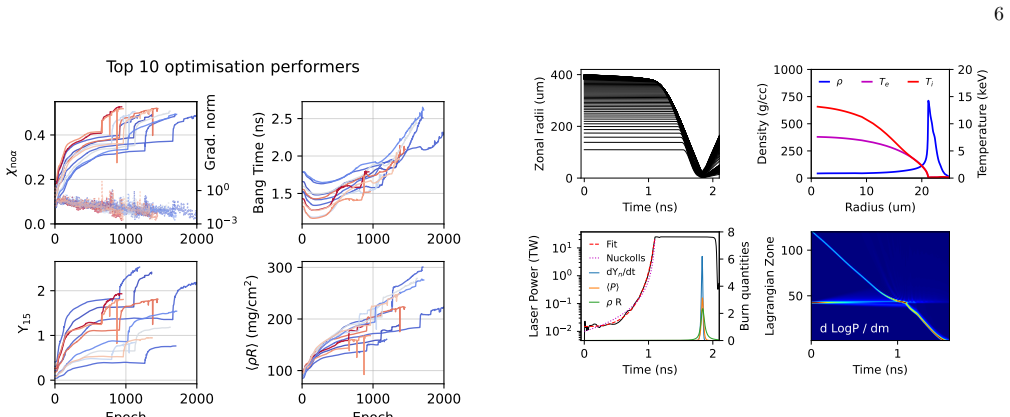
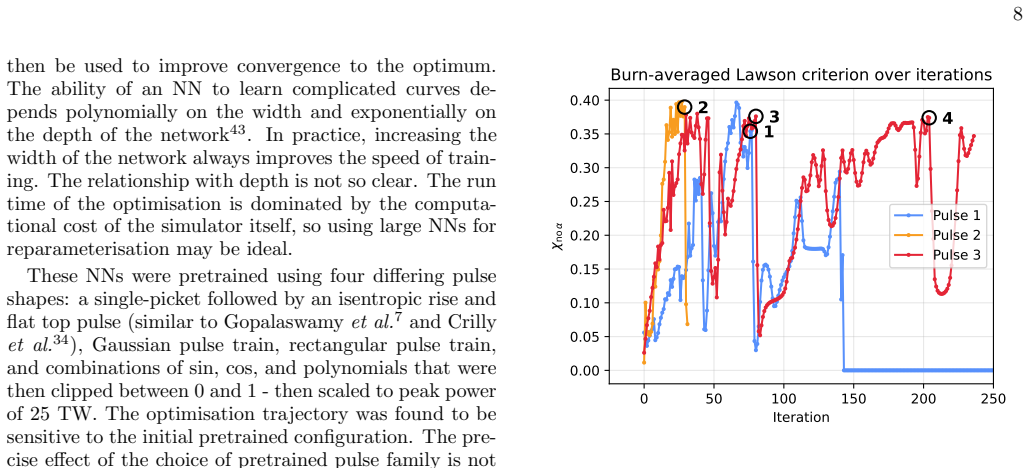
Automatic differentiation through a differentiable implosion physics model, driven by an external pressure pulse, provides gradients of implosion objectives with respect to design parameters, enabling gradient-based optimisation of 500-parameter laser pulses for 25 kJ OMEGA-scale direct-drive implosions. The optimised pulse recovers a near-isoentropic rise to peak power without that structure being imposed. Neural-network pulse parameterisations are additionally explored as a means of accelerating design-space exploration.
What carries the argument
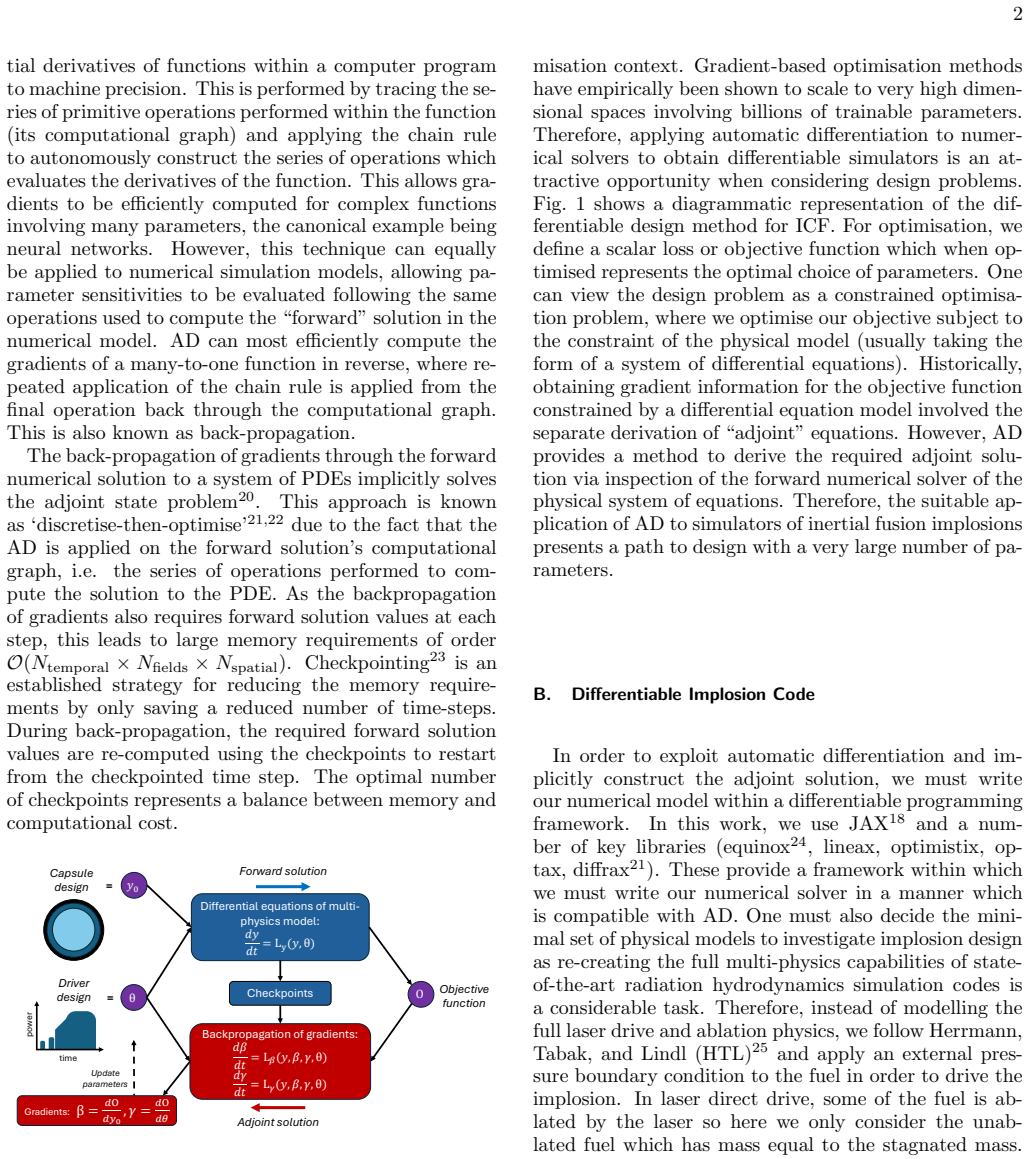
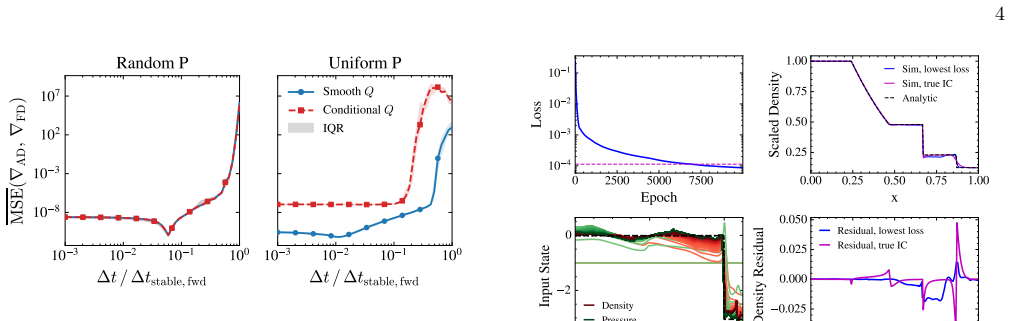
Automatic differentiation through a differentiable implosion physics model driven by an external pressure pulse, which supplies exact gradients of objectives such as yield or convergence with respect to laser-pulse parameters.
If this is right
- Gradient-based search scales to design spaces of 500 parameters for OMEGA-scale direct-drive targets.
- An optimized pulse can produce near-isentropic compression without that feature being manually prescribed.
- Neural-network pulse representations reduce the cost of exploring families of target geometries.
- The same differentiable framework applies across sampled target geometries at fixed 25 kJ drive energy.
- Further development of adjoint methods and higher-fidelity differentiable simulators is required to increase relevance.
Where Pith is reading between the lines
- If the same automatic-differentiation pipeline were coupled to a more complete radiation-hydrodynamics solver, joint optimization of target dimensions and driver parameters could become routine.
- The natural emergence of isentropic behavior suggests the optimization landscape contains attractors aligned with physical stability criteria that may generalize to other drive energies.
- Derivative-free methods such as genetic algorithms or Bayesian optimization would face exponentially higher sample costs in the same 500-dimensional space, making the gradient route a concrete efficiency gain.
- The approach could be tested on existing OMEGA shot data by checking whether the recovered pulse shapes match or improve upon manually designed pulses used in prior campaigns.
Load-bearing premise
The simplified differentiable implosion physics model driven by an external pressure pulse sufficiently captures the coupled target-driver physics so that optimized designs remain relevant to real experiments.
What would settle it
Executing the 500-parameter optimized pulses in a full non-differentiable radiation-hydrodynamics code and verifying whether the predicted stagnation conditions and performance metrics agree with the differentiable model's objectives to within experimental tolerances.
Figures

read the original abstract
Inertial confinement fusion implosion design requires simultaneous optimisation of strongly coupled target and driver parameters across high-dimensional design spaces. Existing automated design approaches typically rely on non-differentiable radiation-hydrodynamics codes treated as black boxes, making optimisation increasingly expensive as dimensionality grows. In this work, we present a differentiable simulation approach for high-dimensional inverse design of inertial confinement fusion implosions. Automatic differentiation through a differentiable implosion physics model, driven by an external pressure pulse, provides gradients of implosion objectives with respect to design parameters, enabling gradient-based optimisation. The framework is applied to 25 kJ OMEGA-scale direct-drive implosions, optimising 500-parameter laser pulses across sampled target geometries. The optimised pulse recovers a near-isoentropic rise to peak power without that structure being imposed. Neural-network pulse parameterisations are additionally explored as a means of accelerating design-space exploration. These results establish differentiable implosion modelling as a promising tool for ICF design, while motivating further work on adjoint robustness and higher-fidelity differentiable simulators.
Editorial analysis
A structured set of objections, weighed in public.
Referee Report
Summary. The manuscript presents a differentiable simulation framework for high-dimensional inverse design of inertial confinement fusion (ICF) implosions. Automatic differentiation is applied through an implosion physics model driven by an external pressure pulse to compute gradients of implosion objectives with respect to design parameters. This enables gradient-based optimization of 500-parameter laser pulses for 25 kJ OMEGA-scale direct-drive targets across sampled geometries. The optimized pulses recover near-isentropic rise to peak power without explicit imposition of that structure. Neural-network pulse parameterizations are also explored to accelerate design-space exploration. The work positions differentiable modeling as a promising tool for ICF design while noting the need for higher-fidelity simulators.
Significance. If the gradients from the reduced model are reliable and the optimized designs translate to experiment, the approach would represent a meaningful advance over black-box radiation-hydrodynamics optimization by enabling efficient scaling to hundreds of parameters. The recovery of isentropic structure without imposition and the exploration of neural-network parameterizations are positive features. However, the significance is tempered by the reliance on a proxy model whose fidelity to full laser-plasma physics remains to be demonstrated.
major comments (2)
- [Abstract and method description] The central optimization results rest on a model driven by an external pressure pulse rather than explicit laser ray-tracing, inverse bremsstrahlung, or cross-beam energy transfer. No section provides a quantitative mapping from the optimized pressure pulse to realizable laser pulse parameters or a comparison of the resulting implosion metrics against a full-physics code; this directly affects whether the 500-parameter designs are relevant to OMEGA-scale direct-drive experiments.
- [Abstract] The abstract states that the framework is applied to 'optimising 500-parameter laser pulses' yet the model is driven by an external pressure pulse. Without an explicit section detailing how the pressure-pulse parameterization corresponds to laser intensity, pulse shape, and beam geometry, it is unclear whether the gradient-based optimization actually optimizes laser parameters or only a proxy driver.
minor comments (1)
- [Abstract] The abstract refers to 'higher-fidelity differentiable simulators' as future work; a brief discussion of the specific physics omitted in the current external-pressure model (e.g., laser imprint, CBET) would help readers assess the scope of the present results.
Simulated Author's Rebuttal
We thank the referee for their careful reading and constructive feedback on our manuscript. We address each major comment below and outline the revisions we will make to improve clarity.
read point-by-point responses
-
Referee: [Abstract and method description] The central optimization results rest on a model driven by an external pressure pulse rather than explicit laser ray-tracing, inverse bremsstrahlung, or cross-beam energy transfer. No section provides a quantitative mapping from the optimized pressure pulse to realizable laser pulse parameters or a comparison of the resulting implosion metrics against a full-physics code; this directly affects whether the 500-parameter designs are relevant to OMEGA-scale direct-drive experiments.
Authors: We agree that the model employs an external pressure pulse as a simplified driver rather than incorporating explicit laser-plasma physics such as ray-tracing, inverse bremsstrahlung absorption, or cross-beam energy transfer. This choice was made to maintain differentiability and enable gradient-based optimization in high dimensions. The 500-parameter designs optimize the temporal profile of this pressure pulse, which is intended as a proxy for the ablation pressure produced by a shaped laser pulse. No quantitative mapping to specific laser intensity, beam geometry, or full-physics code comparisons is provided in the current work. We will revise the manuscript to explicitly discuss this modeling choice and its implications as a limitation in the methods and conclusions sections, thereby clarifying that the results demonstrate the differentiable framework rather than claiming direct experimental applicability of the specific designs. revision: yes
-
Referee: [Abstract] The abstract states that the framework is applied to 'optimising 500-parameter laser pulses' yet the model is driven by an external pressure pulse. Without an explicit section detailing how the pressure-pulse parameterization corresponds to laser intensity, pulse shape, and beam geometry, it is unclear whether the gradient-based optimization actually optimizes laser parameters or only a proxy driver.
Authors: The referee correctly notes an inconsistency between the abstract wording and the model description. The pressure-pulse parameterization is constructed to allow flexible temporal shapes analogous to those achievable with laser pulse shaping on OMEGA, but it does not directly optimize laser intensity or account for beam geometry effects. We will revise the abstract to specify 'optimising 500-parameter pressure pulses that serve as proxies for laser pulses' and add a short clarifying paragraph in the methods section describing the intended correspondence between the pressure pulse and laser drive. These changes will resolve the ambiguity without altering the technical content of the optimization results. revision: yes
Circularity Check
No significant circularity; derivation is self-contained
full rationale
The paper introduces automatic differentiation through a differentiable implosion physics model (driven by external pressure pulse) to enable gradient-based optimization of high-dimensional laser pulse parameters. No load-bearing step reduces by construction to its own inputs: the optimization produces designs within the stated model, without claiming external predictions from fitted parameters or renaming known results. No self-citation chains or uniqueness theorems are invoked to force the central result. The framework is presented as a new methodological tool, with explicit caveats on model fidelity, confirming the derivation chain stands independently.
Axiom & Free-Parameter Ledger
Reference graph
Works this paper leans on
-
[1]
SoftwareX , volume=
ExactPack: A python library of exact analytic solutions , author=. SoftwareX , volume=. 2023 , publisher=
2023
-
[2]
Physics of Plasmas , volume=
Approaching hydro-equivalent ignition in laser direct-drive via target design optimization using novel statistical modeling , author=. Physics of Plasmas , volume=. 2025 , publisher=
2025
-
[3]
2025 , url=
Christopher Rackauckas , title=. 2025 , url=
2025
-
[4]
2021 , journal=
Patrick Kidger and Cristian Garcia , title=. 2021 , journal=
2021
-
[5]
Risk , volume=
Smoking adjoints: Fast monte carlo greeks , author=. Risk , volume=
-
[6]
arXiv preprint arXiv:1902.10298 , year=
Anode: Unconditionally accurate memory-efficient gradients for neural odes , author=. arXiv preprint arXiv:1902.10298 , year=
Pith/arXiv arXiv 1902
-
[7]
arXiv preprint arXiv:2202.02435 , year=
On neural differential equations , author=. arXiv preprint arXiv:2202.02435 , year=
-
[8]
Physics of Plasmas , volume=
An experimentally informed design process for future inertial confinement fusion facilities , author=. Physics of Plasmas , volume=. 2025 , publisher=
2025
-
[9]
James Bradbury and Roy Frostig and Peter Hawkins and Matthew James Johnson and Yash Katariya and Chris Leary and Dougal Maclaurin and George Necula and Adam Paszke and Jake Vander
-
[10]
The journal of chemical physics , volume=
Equation of state calculations by fast computing machines , author=. The journal of chemical physics , volume=. 1953 , publisher=
1953
-
[11]
2009 , publisher=
The elements of statistical learning , author=. 2009 , publisher=
2009
-
[12]
Physics of Plasmas , volume=
Comparison of tungsten versus molybdenum for double shell capsules using machine learning design optimization , author=. Physics of Plasmas , volume=. 2025 , publisher=
2025
-
[13]
Physics of Plasmas , volume=
Coupling 1D xRAGE simulations with machine learning for graded inner shell design optimization in double shell capsules , author=. Physics of Plasmas , volume=. 2021 , publisher=
2021
-
[14]
Statistical Analysis and Data Mining: The ASA Data Science Journal , volume=
Bayesian batch optimization for molybdenum versus tungsten inertial confinement fusion double shell target design , author=. Statistical Analysis and Data Mining: The ASA Data Science Journal , volume=. 2024 , publisher=
2024
-
[15]
Physics of Plasmas , volume=
Particle swarm optimization of 1D isochoric compression designs for fast ignition , author=. Physics of Plasmas , volume=. 2025 , publisher=
2025
-
[16]
Journal of Physics: Conference Series , volume=
Simulations and experiments of the growth of the “tent” perturbation in NIF ignition implosions , author=. Journal of Physics: Conference Series , volume=. 2016 , organization=
2016
-
[17]
O'Neill, S. T. and Appelbe, B. D. and Crilly, A. J. and Walsh, C. A. and Strozzi, D. J. and Moody, J. D. and Chittenden, J. P. , title =. Physics of Plasmas , volume =. 2025 , month =. doi:10.1063/5.0242215 , url =
-
[18]
Physics of Plasmas , volume=
A mechanism for reduced compression in indirectly driven layered capsule implosions , author=. Physics of Plasmas , volume=. 2022 , publisher=
2022
-
[19]
Physics of Plasmas , volume=
Modeling ablator defects as a source of mix in high-performance implosions at the National Ignition Facility , author=. Physics of Plasmas , volume=. 2024 , publisher=
2024
-
[20]
Physics of Plasmas , volume=
Instability seeding mechanisms due to internal defects in inertial confinement fusion targets , author=. Physics of Plasmas , volume=. 2022 , publisher=
2022
-
[21]
2013 , publisher=
Laser-plasma interactions and applications , author=. 2013 , publisher=
2013
-
[22]
2013 , school=
Active learning for level set estimation , author=. 2013 , school=
2013
-
[23]
Journal of the Royal Statistical Society: Series B (Statistical Methodology) , volume=
Bayesian calibration of computer models , author=. Journal of the Royal Statistical Society: Series B (Statistical Methodology) , volume=. 2001 , publisher=
2001
-
[24]
Proceedings of the Royal Society A: Mathematical, Physical and Engineering Sciences , volume=
Nonlinear information fusion algorithms for data-efficient multi-fidelity modelling , author=. Proceedings of the Royal Society A: Mathematical, Physical and Engineering Sciences , volume=. 2017 , publisher=
2017
-
[25]
Optical Engineering , volume=
The national ignition facility , author=. Optical Engineering , volume=. 2004 , publisher=
2004
-
[26]
doi:10.5281/zenodo.14507040 , url =
Beckett, George and Beech-Brandt, Josephine and Leach, Kieran and Payne, Zöe and Simpson, Alan and Smith, Lorna and Turner, Andy and Whiting, Anne , title =. doi:10.5281/zenodo.14507040 , url =
-
[27]
Physics of Plasmas , volume=
A pushered capsule implosion as an alternate approach to the ignition regime for inertial confinement fusion , author=. Physics of Plasmas , volume=. 2021 , publisher=
2021
-
[28]
Plasma Physics and Controlled Fusion , volume=
Energy gain of wetted-foam implosions with auxiliary heating for inertial fusion studies , author=. Plasma Physics and Controlled Fusion , volume=. 2023 , publisher=
2023
-
[29]
Physics of Plasmas , volume=
A future of inertial confinement fusion without laser-plasma instabilities , author=. Physics of Plasmas , volume=. 2025 , publisher=
2025
-
[30]
Conference on robot learning , pages=
Rethinking optimization with differentiable simulation from a global perspective , author=. Conference on robot learning , pages=. 2023 , organization=
2023
-
[31]
arXiv preprint arXiv:2504.10680 , year=
Affordable, manageable, practical, and scalable (AMPS) high-yield and high-gain inertial fusion , author=. arXiv preprint arXiv:2504.10680 , year=
-
[32]
Exploring the parameter space of MagLIF implosions using similarity scaling. II. Current scaling , author=. Physics of Plasmas , volume=. 2023 , publisher=
2023
-
[33]
Fusion science and technology , volume=
Progress in 2 mm glow discharge polymer mandrel development for NIF , author=. Fusion science and technology , volume=. 2004 , publisher=
2004
-
[34]
Fusion Science and Technology , volume=
Metrology Feasibility Study in Support of the National Direct-Drive Program , author=. Fusion Science and Technology , volume=. 2018 , publisher=
2018
-
[35]
Physics of Plasmas , volume=
Impact of stalk on directly driven inertial confinement fusion implosions , author=. Physics of Plasmas , volume=. 2020 , publisher=
2020
-
[36]
Nature Physics , volume=
Inertially confined fusion plasmas dominated by alpha-particle self-heating , author=. Nature Physics , volume=. 2016 , publisher=
2016
-
[37]
Nuclear Fusion , volume=
A 3D dynamic model to assess the impacts of low-mode asymmetry, aneurysms and mix-induced radiative loss on capsule performance across inertial confinement fusion platforms , author=. Nuclear Fusion , volume=. 2018 , publisher=
2018
-
[38]
Physical Review Letters , volume=
Hohlraum reheating from burning NIF implosions , author=. Physical Review Letters , volume=. 2024 , publisher=
2024
-
[39]
Physics of Plasmas , volume=
Growth rates of the ablative Rayleigh--Taylor instability in inertial confinement fusion , author=. Physics of Plasmas , volume=. 1998 , publisher=
1998
-
[40]
The Physics of fluids , volume=
Self-consistent growth rate of the Rayleigh--Taylor instability in an ablatively accelerating plasma , author=. The Physics of fluids , volume=. 1985 , publisher=
1985
-
[41]
Physics of Plasmas , volume=
Progress toward a self-consistent set of 1D ignition capsule metrics in ICF , author=. Physics of Plasmas , volume=. 2018 , publisher=
2018
-
[42]
The distribution of points in a cube and the accurate evaluation of integrals (in Russian) Zh , author=. Vychisl. Mat. i Mater. Phys , volume=
-
[43]
Crilly, Aidan , title =
-
[44]
Computers & Chemical Engineering , volume=
Combining multi-fidelity modelling and asynchronous batch Bayesian Optimization , author=. Computers & Chemical Engineering , volume=. 2023 , publisher=
2023
-
[45]
Advances in Neural Information Processing Systems , volume=
Unexpected improvements to expected improvement for bayesian optimization , author=. Advances in Neural Information Processing Systems , volume=
-
[46]
Synthetic Biology: Methods and Protocols , pages=
Machine Learning for Biological Design , author=. Synthetic Biology: Methods and Protocols , pages=. 2024 , publisher=
2024
-
[47]
arXiv preprint arXiv:1711.05101 , year=
Decoupled weight decay regularization , author=. arXiv preprint arXiv:1711.05101 , year=
-
[48]
Advances in neural information processing systems , volume=
BoTorch: A framework for efficient Monte-Carlo Bayesian optimization , author=. Advances in neural information processing systems , volume=
-
[49]
Advances in neural information processing systems , volume=
Pytorch: An imperative style, high-performance deep learning library , author=. Advances in neural information processing systems , volume=
-
[50]
Advances in neural information processing systems , volume=
Simple and scalable predictive uncertainty estimation using deep ensembles , author=. Advances in neural information processing systems , volume=
-
[51]
Machine learning , volume=
Random forests , author=. Machine learning , volume=. 2001 , publisher=
2001
-
[52]
URL https://www
The kernel cookbook: Advice on covariance functions , author=. URL https://www. cs. toronto. edu/duvenaud/cookbook , year=
-
[53]
2003 , publisher=
The design and analysis of computer experiments , author=. 2003 , publisher=
2003
-
[54]
2006 , publisher=
Gaussian processes for machine learning , author=. 2006 , publisher=
2006
-
[55]
Information Sciences , volume=
Dropout injection at test time for post hoc uncertainty quantification in neural networks , author=. Information Sciences , volume=. 2023 , publisher=
2023
-
[56]
Physical Review Letters , volume=
Effects of laser bandwidth in direct-drive high-performance DT-layered implosions on the OMEGA laser , author=. Physical Review Letters , volume=. 2023 , publisher=
2023
-
[57]
Physics of Plasmas , volume=
Shock timing technique for the National Ignition Facility , author=. Physics of Plasmas , volume=. 2001 , publisher=
2001
-
[58]
Physical Review Letters , volume=
Linear stability analysis of laser-driven spherical implosions , author=. Physical Review Letters , volume=. 1974 , publisher=
1974
-
[59]
Physics of Plasmas , volume=
A model of laser imprinting , author=. Physics of Plasmas , volume=. 2000 , publisher=
2000
-
[60]
Physics of Plasmas , volume=
Irradiation uniformity for high-compression laser-fusion experiments , author=. Physics of Plasmas , volume=. 1999 , publisher=
1999
-
[61]
Journal of Applied Physics , volume=
Uniformity of energy deposition for laser driven fusion , author=. Journal of Applied Physics , volume=. 1983 , publisher=
1983
-
[62]
Physics of Plasmas , volume=
A wave-based model for cross-beam energy transfer in direct-drive inertial confinement fusion , author=. Physics of Plasmas , volume=. 2017 , publisher=
2017
-
[63]
Moloney, Philip , title =
-
[64]
Physics of Plasmas , volume=
Data-driven prediction of scaling and ignition of inertial confinement fusion experiments , author=. Physics of Plasmas , volume=. 2024 , publisher=
2024
-
[65]
Nature Physics , volume=
Inertial-confinement fusion with lasers , author=. Nature Physics , volume=. 2016 , publisher=
2016
-
[66]
Design of an inertial fusion experiment exceeding the Lawson criterion for ignition , author =. Phys. Rev. E , volume =. 2022 , month =. doi:10.1103/PhysRevE.106.025201 , url =
-
[67]
Experimental achievement and signatures of ignition at the National Ignition Facility , author =. Phys. Rev. E , volume =. 2022 , month =. doi:10.1103/PhysRevE.106.025202 , url =
-
[68]
arXiv preprint arXiv:2207.00093 , year=
Infuence of mass ablation on ignition and burn propagation in layered fusion capsules , author=. arXiv preprint arXiv:2207.00093 , year=
-
[69]
Physics of Plasmas , volume=
Biermann battery magnetic fields in ICF capsules: Total magnetic flux generation , author=. Physics of Plasmas , volume=. 2021 , publisher=
2021
-
[70]
Physics of Plasmas , volume=
Magnetic field transport in propagating thermonuclear burn , author=. Physics of Plasmas , volume=. 2021 , publisher=
2021
-
[71]
1992 , publisher=
User's reference guide for odrpack version 2.01: Software for weighted orthogonal distance regression , author=. 1992 , publisher=
1992
-
[72]
arXiv preprint arXiv:2211.16464 , year=
SpK: A fast atomic and microphysics code for the high-energy-density regime , author=. arXiv preprint arXiv:2211.16464 , year=
-
[73]
Journal of Applied Physics , volume=
A generalized forward fit for neutron detectors with energy-dependent response functions , author=. Journal of Applied Physics , volume=. 2020 , publisher=
2020
-
[74]
Foreman-Mackey, Daniel and Hogg, David W. and Lang, Dustin and Goodman, Jonathan , year=. emcee: The MCMC Hammer , volume=. Publications of the Astronomical Society of the Pacific , publisher=. doi:10.1086/670067 , number=
-
[75]
Review of Scientific Instruments , volume=
The five line-of-sight neutron time-of-flight (nToF) suite on the National Ignition Facility (NIF) , author=. Review of Scientific Instruments , volume=. 2021 , publisher=
2021
-
[76]
Measurements of the temperature and velocity of the dense fuel layer in inertial confinement fusion experiments , author =. Phys. Rev. E , volume =. 2022 , month =. doi:10.1103/PhysRevE.105.055205 , url =
-
[77]
Physics of Plasmas , volume=
Neutron backscatter edges as a diagnostic of burn propagation , author=. Physics of Plasmas , volume=. 2022 , publisher=
2022
-
[78]
Hurricane,O. A. and Maclaren,S. A. and Rosen,M. D. and Hammer,J. H. and Springer,P. T. and Betti,R. , title =. Physics of Plasmas , volume =. 2021 , doi =
2021
-
[79]
Bulletin of the American Physical Society , volume=
Hotspot power balance in alpha-particle dominated ICF implosions , author=. Bulletin of the American Physical Society , volume=. 2021 , publisher=
2021
-
[80]
Nature , volume=
Burning plasma achieved in inertial fusion , author=. Nature , volume=. 2022 , publisher=
2022
discussion (0)
Sign in with ORCID, Apple, or X to comment. Anyone can read and Pith papers without signing in.