Before You Scroll Again: Predicting Regretful Social Media Sessions from In-the-Wild Contextual and Wearable Sensing
Pith reviewed 2026-06-27 15:14 UTC · model grok-4.3
The pith
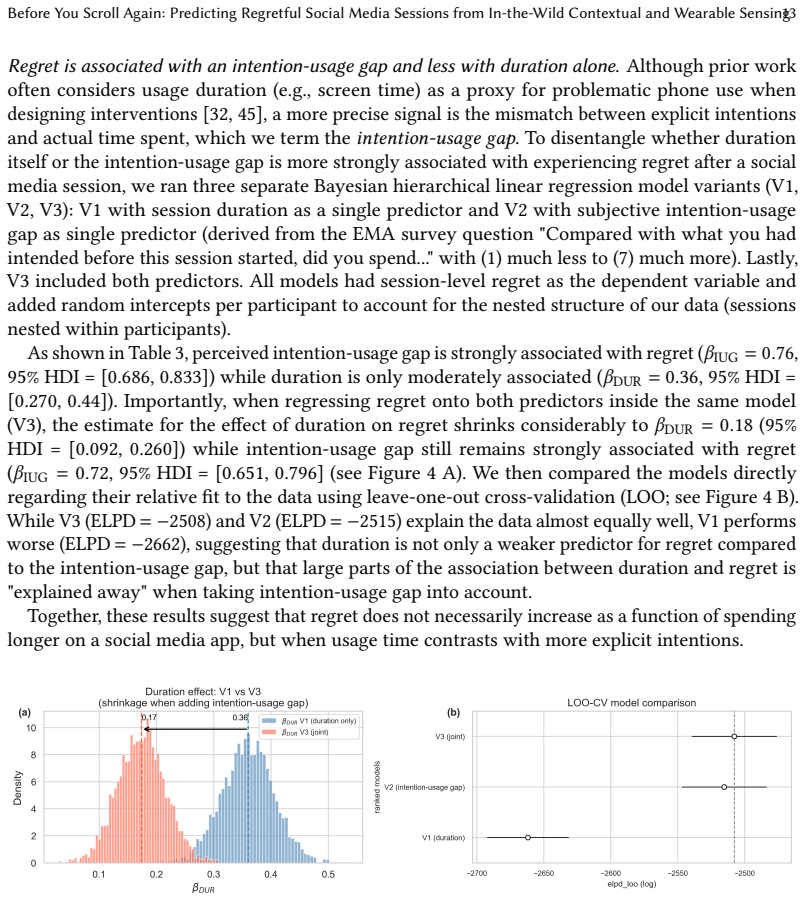
The gap between intended and actual social media use predicts regret far more strongly than session duration.
A machine-rendered reading of the paper's core claim, the machinery that carries it, and where it could break.
Core claim
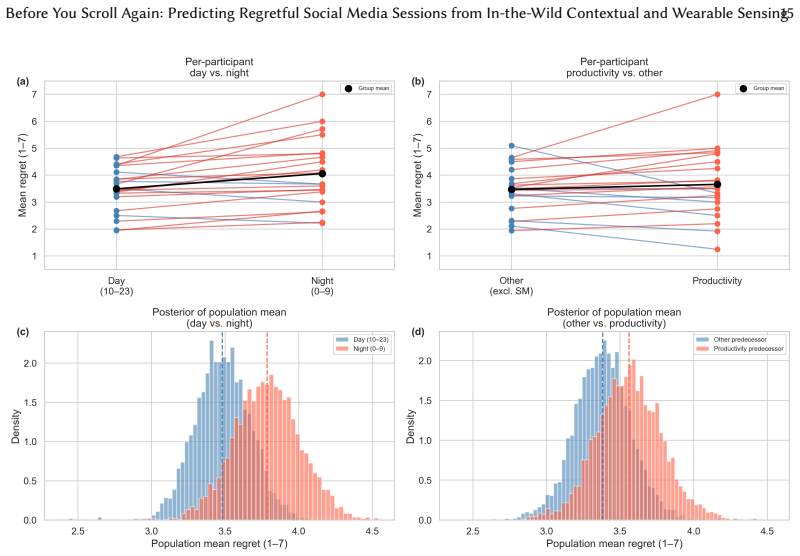
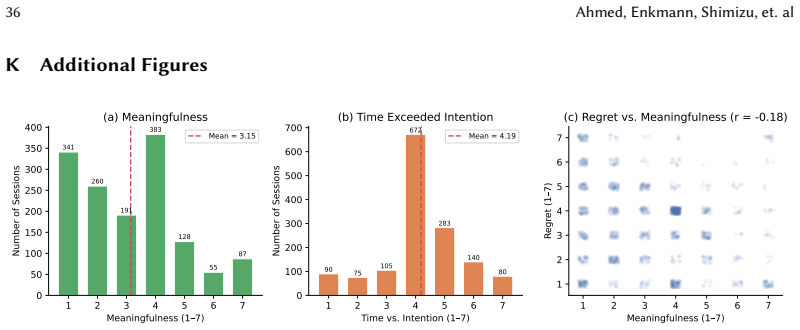
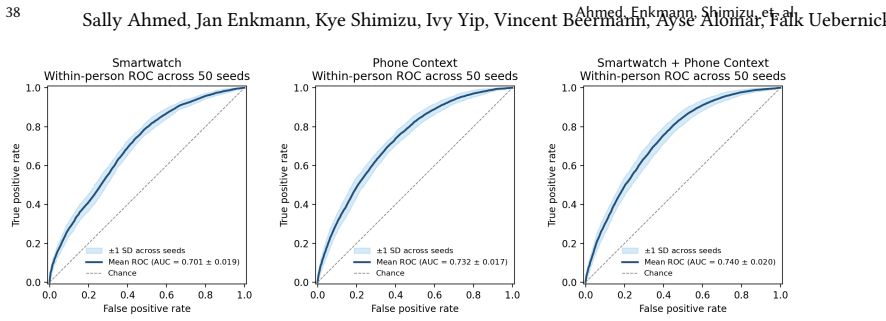
The gap between intended and actual use predicts regret far more strongly than session duration, with duration's apparent effect collapsing once intention is modeled. Regret is amplified when sessions displace a valued alternative, particularly at night and following productivity-app use. Pre-session contextual features generalize across participants while physiological signals add person-specific lift, pointing toward a two-layer architecture for just-in-time adaptive interventions.
What carries the argument
The intention-actual use gap measured through pre- and post-session surveys, combined with phone context logs and low-cost wearable signals to forecast regret before the session ends.
If this is right
- Interventions should target closing the intention-use gap rather than imposing uniform time limits.
- Higher-risk sessions occur at night and after productivity-app use when they displace other activities.
- Contextual phone features can serve as a general first layer while wearable data supplies personalized lift.
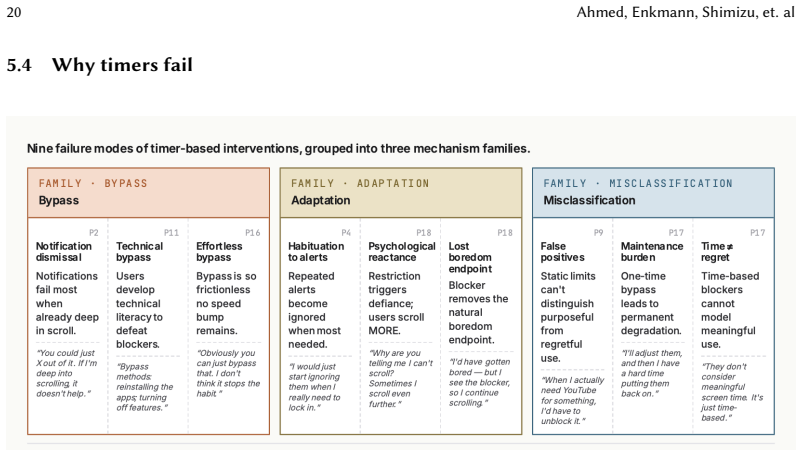
- Designs need to address scrolling-as-avoidance and time blindness instead of relying only on timers.
Where Pith is reading between the lines
- Apps could surface a quick intention prompt before social media opens to reduce later regret.
- The same intention-gap logic might apply to other compulsive phone behaviors such as short-form video or gaming.
- Longer deployments could test whether repeated intention alignment lowers cumulative regret and improves daily well-being.
Load-bearing premise
Participants' self-reported intentions and post-session regret ratings in the experience-sampling surveys accurately capture their true experiences and are not heavily biased by recall or social-desirability effects.
What would settle it
A study that directly logs or manipulates actual behavior against reported intentions and measures regret through non-self-report indicators would falsify the claim if the intention gap loses predictive power.
Figures
read the original abstract
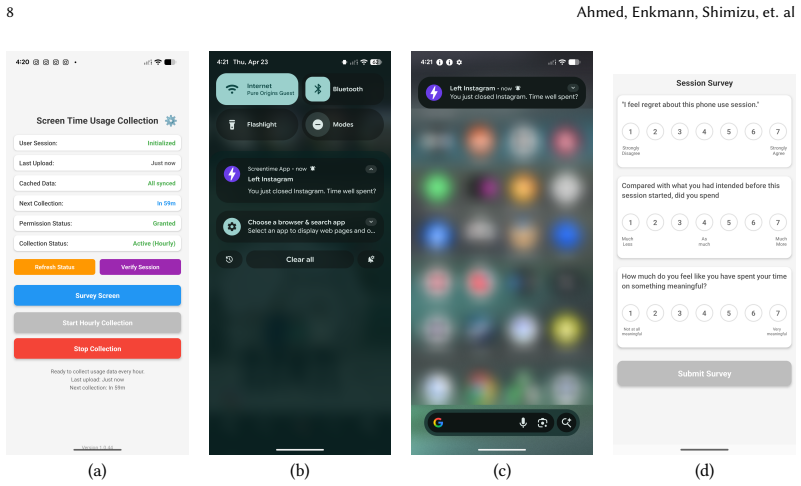
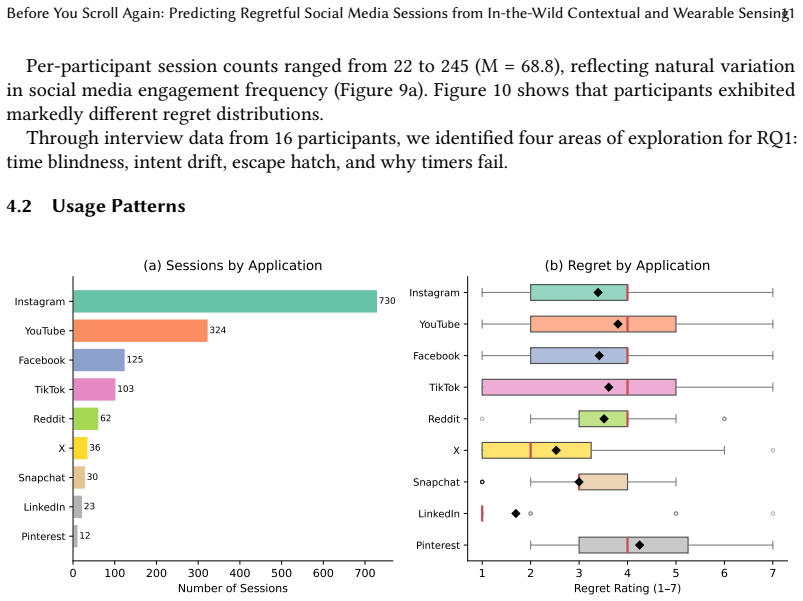
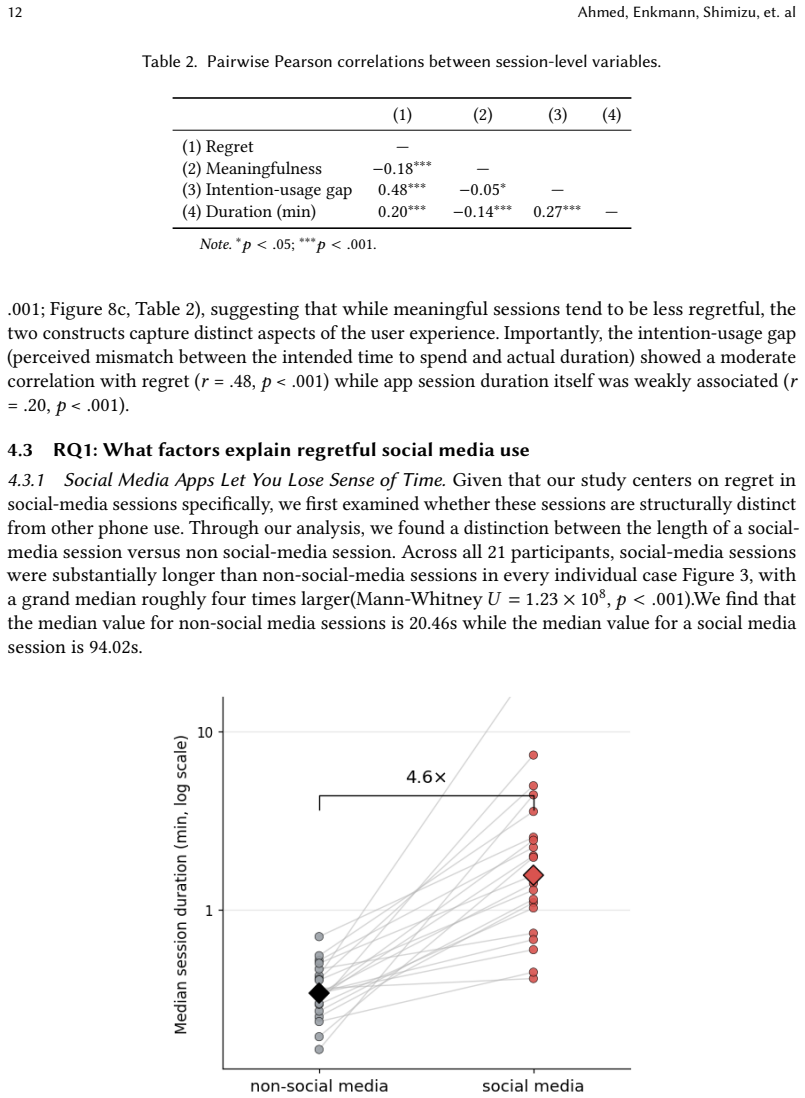
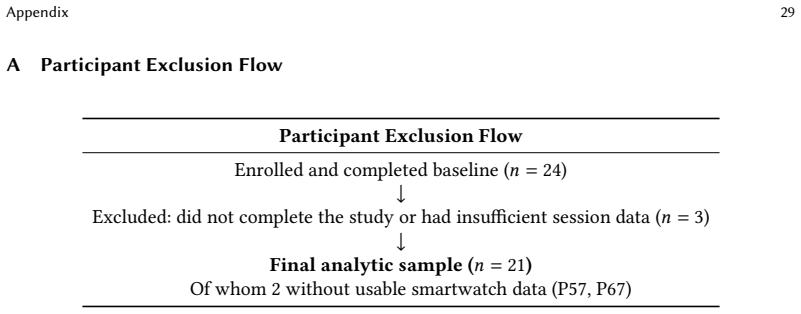
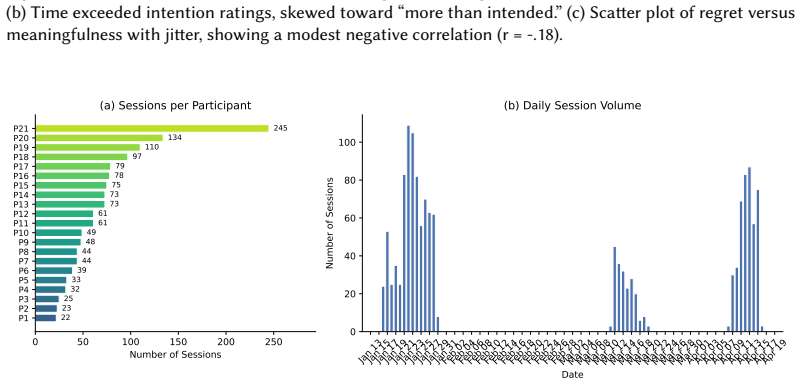
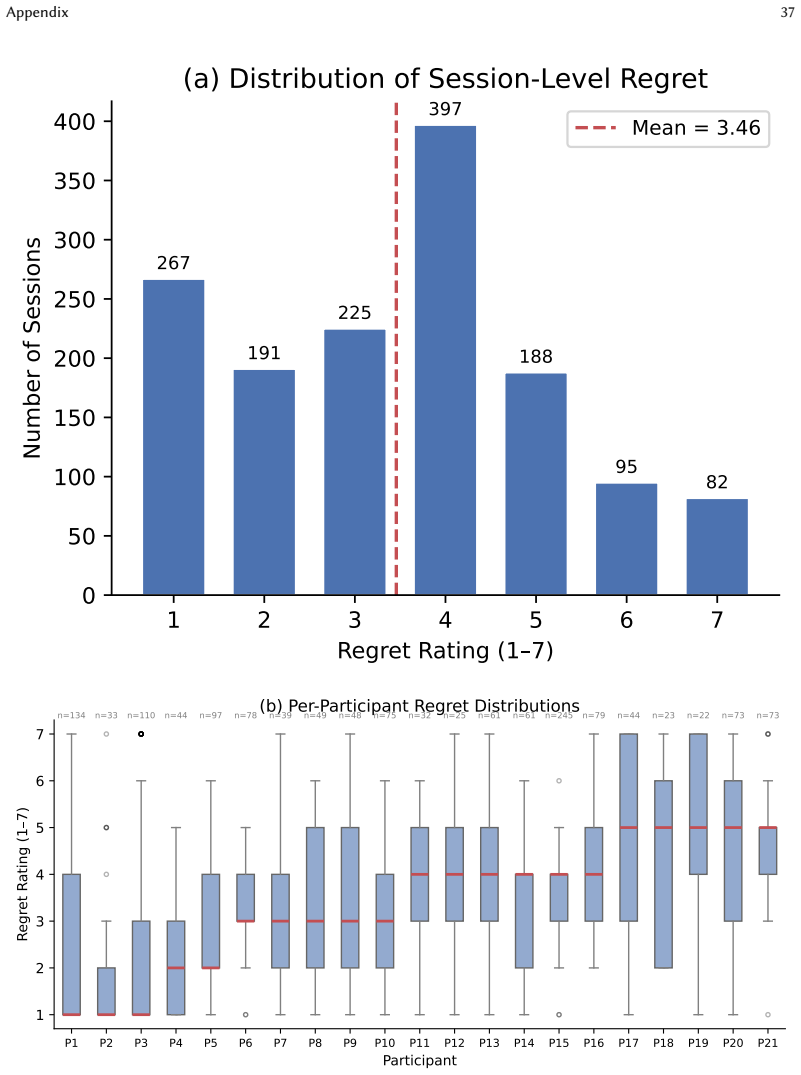
Users often feel regret after using social media, making regret a more ecologically valid target than screen time for understanding when phone use becomes problematic. Existing self-monitoring tools cannot anticipate regret before it occurs, and prior physiological work on social media use has been confined to the lab with research-grade sensors and curated content, leaving the question of in-the-wild prediction open. We deployed a 7-day in-the-wild experience sampling study with 21 participants, combining passive smartphone logging, a low-cost consumer smartwatch (Bangle.js 2, \$80), session-level surveys (1,445 sessions), and exit interviews to investigate when and why social media sessions become regretful, and whether regret can be anticipated before a session begins. Three findings stand out: (i) the gap between intended and actual use predicts regret far more strongly than session duration, with duration's apparent effect collapsing once intention is modeled; (ii) regret is amplified when sessions displace a valued alternative, particularly at night and following productivity-app use; and (iii) pre-session contextual features generalize across participants while physiological signals add person-specific lift, pointing toward a two-layer architecture for just-in-time adaptive interventions. Interview themes of scrolling-as-avoidance and time blindness contextualize these patterns and surface design opportunities beyond timer-based interventions.
Editorial analysis
A structured set of objections, weighed in public.
Referee Report
Summary. The paper reports results from a 7-day in-the-wild experience-sampling study with 21 participants yielding 1,445 social media sessions. Passive smartphone logging, Bangle.js 2 smartwatch data, pre- and post-session surveys, and exit interviews are used to predict regret. The three main claims are: (i) the gap between intended and actual use predicts regret more strongly than session duration (with duration's effect collapsing once intention is included); (ii) regret increases when sessions displace valued alternatives, especially at night or after productivity-app use; (iii) pre-session contextual features generalize across users while physiological signals provide person-specific predictive lift, supporting a two-layer JITAI architecture. Interview themes on scrolling-as-avoidance and time blindness are used to contextualize the quantitative patterns.
Significance. If the central regression results survive checks for self-report bias, the work advances HCI by treating regret (rather than screen time) as the ecologically valid target and by showing that low-cost consumer wearables can support in-the-wild, anticipatory intervention. The multi-modal design, combination of passive logging with experience sampling, and qualitative grounding are clear strengths. The study supplies concrete design implications beyond timer-based tools.
major comments (3)
- [Abstract and Results section on intention gap] Abstract and Results (intention-gap regression): the claim that the intention-use gap predicts regret far more strongly than duration, causing duration's apparent effect to collapse, is the paper's strongest and most load-bearing result. Because both the predictor (pre-session intended duration) and the outcome (post-session regret) are participant self-reports while actual duration is logged, the analysis must explicitly test for correlated measurement error or post-hoc rationalization; the manuscript should report survey timing, wording, any validation against objective proxies, and sensitivity analyses that partial out shared method variance.
- [Results section on displacement effects] Results (displacement analysis): the claim that regret is amplified when sessions displace a valued alternative (particularly at night and after productivity-app use) requires the operational definition of 'valued alternative,' the exact survey items used to elicit it, and the full regression specification including interaction terms and controls; without these details the interaction result cannot be evaluated for robustness.
- [Results section on model generalization] Results (generalization and physiological lift): the assertion that contextual features generalize while physiological signals add person-specific lift, supporting a two-layer architecture, must be accompanied by the precise cross-validation scheme (e.g., leave-one-participant-out), performance metrics (AUC/F1 with confidence intervals or standard errors), and a direct comparison of the two layers; with only 21 participants these numbers are essential to substantiate the generalization claim.
minor comments (2)
- [Methods] Methods: provide the exact wording and response scales of the pre-session intention and post-session regret items so that the experience-sampling protocol can be replicated.
- [Figures] Figures: ensure all regression plots include error bars or confidence bands and clearly label participant-level vs. aggregate lines.
Simulated Author's Rebuttal
We thank the referee for the constructive comments emphasizing methodological transparency. We address each point below and will incorporate the requested details and analyses in the revision.
read point-by-point responses
-
Referee: [Abstract and Results section on intention gap] Abstract and Results (intention-gap regression): the claim that the intention-use gap predicts regret far more strongly than duration, causing duration's apparent effect to collapse, is the paper's strongest and most load-bearing result. Because both the predictor (pre-session intended duration) and the outcome (post-session regret) are participant self-reports while actual duration is logged, the analysis must explicitly test for correlated measurement error or post-hoc rationalization; the manuscript should report survey timing, wording, any validation against objective proxies, and sensitivity analyses that partial out shared method variance.
Authors: We agree this is a load-bearing result and that self-report concerns merit explicit treatment. Pre-session intention was collected immediately before each session via ESM prompt; regret was collected immediately after. In revision we will add exact item wording, timing details, and sensitivity analyses that control for logged duration and test shared method variance. We will also note the limitation regarding possible post-hoc rationalization. revision: yes
-
Referee: [Results section on displacement effects] Results (displacement analysis): the claim that regret is amplified when sessions displace a valued alternative (particularly at night and after productivity-app use) requires the operational definition of 'valued alternative,' the exact survey items used to elicit it, and the full regression specification including interaction terms and controls; without these details the interaction result cannot be evaluated for robustness.
Authors: We will expand the Methods to define 'valued alternative' (post-session ESM item asking whether the session displaced a planned or otherwise valued activity) and quote the exact items. The revised Results will include the complete regression specification with all interaction terms (displacement × time-of-day, displacement × prior productivity-app use) and controls. revision: yes
-
Referee: [Results section on model generalization] Results (generalization and physiological lift): the assertion that contextual features generalize while physiological signals add person-specific lift, supporting a two-layer architecture, must be accompanied by the precise cross-validation scheme (e.g., leave-one-participant-out), performance metrics (AUC/F1 with confidence intervals or standard errors), and a direct comparison of the two layers; with only 21 participants these numbers are essential to substantiate the generalization claim.
Authors: We employed leave-one-participant-out cross-validation. The revision will report AUC and F1 (with SEs) for the context-only model versus the context-plus-physiology model, plus a direct comparison of the two layers. We acknowledge the modest participant count (n=21) but note the 1,445 sessions supply substantial within-person data for the person-specific layer. revision: yes
Circularity Check
No circularity: empirical observational study with independent data patterns
full rationale
This paper reports an in-the-wild experience-sampling study combining passive smartphone logging, wearable sensors, and session-level surveys to examine statistical associations between contextual features, intention-actual use gap, duration, and post-session regret. No equations, derivations, or model specifications are described that reduce any prediction to a fitted parameter or self-reported quantity by construction. Central claims rest on measured data relationships rather than definitional identities, self-citation chains, or renamed empirical patterns. The analysis is self-contained against external benchmarks with no load-bearing self-referential steps.
Axiom & Free-Parameter Ledger
axioms (1)
- domain assumption Self-reported intention and regret ratings collected after each session accurately reflect participants' internal states without substantial recall bias or social-desirability effects
Reference graph
Works this paper leans on
-
[1]
Adler, Dror Ben-Zeev, Vincent W.-S
Daniel A. Adler, Dror Ben-Zeev, Vincent W.-S. Tseng, John M. Kane, Rachel Brian, Andrew T. Campbell, Marta Hauser, Emily A. Scherer, and Tanzeem Choudhury. 2020. Predicting Early Warning Signs of Psychotic Relapse From Passive Sensing Data: An Approach Using Encoder-Decoder Neural Networks.JMIR mHealth and uHealth8, 8 (2020), e19962. doi:10.2196/19962
-
[3]
Cecilie Schou Andreassen, Joël Billieux, Mark D. Griffiths, Daria J. Kuss, Zsolt Demetrovics, Elvis Mazzoni, and Ståle Pallesen. 2016. The relationship between addictive use of social media and video games and symptoms of psychiatric disorders: A large-scale cross-sectional study.Psychology of Addictive Behaviors30, 2 (March 2016), 252–262. doi:10.1037/adb0000160
-
[4]
Android Developers. 2024. AccessibilityService. https://developer.android.com/reference/android/accessibilityservice/ AccessibilityService. Accessed: 2024
2024
-
[5]
Android Developers. 2024. UsageStatsManager. https://developer.android.com/reference/android/app/usage/ UsageStatsManager. Accessed: 2024
2024
-
[6]
Android Developers. 2024. WorkManager. https://developer.android.com/reference/androidx/work/WorkManager. Accessed: 2024
2024
-
[7]
Adams, Md Mahbubur Rahman, Megan Battles Lau, Syed Monowar Hossain, William T
Rambabu Bari, Rummana J. Adams, Md Mahbubur Rahman, Megan Battles Lau, Syed Monowar Hossain, William T. Riley, et al. 2020. Automated Detection of Stressful Conversations Using Wearable Physiological and Inertial Sensors. Proceedings of the ACM on Interactive, Mobile, Wearable and Ubiquitous Technologies4, 4 (2020)
2020
-
[8]
Samuel Battalio et al. 2021. Sense2Stop: A Micro-Randomized Trial Using Wearable Sensors to Optimize a Just-in- Time-Adaptive Stress Management Intervention for Smoking Relapse Prevention.Contemporary Clinical Trials109 (2021)
2021
-
[9]
Roy F. Baumeister, Kathleen D. Vohs, and Dianne M. Tice. 2007. The Strength Model of Self-Control.Current Directions in Psychological Science16, 6 (2007), 351–355. doi:10.1111/j.1467-8721.2007.00534.x
-
[10]
Joseph B. Bayer, Ian A. Anderson, and Robert S. Tokunaga. 2022. Building and Breaking Social Media Habits.Current Opinion in Psychology45 (2022), 101303. doi:10.1016/j.copsyc.2022.101303
-
[11]
Elliot T. Berkman, Cendri A. Hutcherson, Jordan L. Livingston, Lauren E. Kahn, and Michael Inzlicht. 2017. Self-Control as Value-Based Choice.Current Directions in Psychological Science26, 5 (2017), 422–428. doi:10.1177/0963721417704394 , Vol. 1, No. 1, Article . Publication date: June 2026. 24 Ahmed, Enkmann, Shimizu, et. al
-
[13]
Virginia Braun and Victoria Clarke. 2006. Using thematic analysis in psychology.Qualitative Research in Psychology 3, 2 (2006), 77–101. doi:10.1191/1478088706qp063oa
-
[14]
Virginia Braun and Victoria Clarke. 2019. Reflecting on reflexive thematic analysis.Qualitative Research in Sport, Exercise and Health11, 4 (2019), 589–597. doi:10.1080/2159676X.2019.1628806
-
[15]
Yekta Said Can, Niaz Chalabianloo, Deniz Ekiz, and Cem Ersoy. 2019. Continuous Stress Detection Using Wearable Sensors in Real Life: Algorithmic Programming Contest Case Study.Sensors19, 8 (2019), 1849. doi:10.3390/s19081849
-
[16]
Hyunsung Cho, Daeun Choi, Donghwi Kim, Wan Ju Kang, Eun Kyoung Choe, and Sung-Ju Lee. 2021. Reflect, Not Regret: Understanding Regretful Smartphone Use with App Feature-Level Analysis.Proceedings of the ACM on Human-Computer Interaction5, CSCW2 (2021), 1–28. doi:10.1145/3479600
-
[17]
Terry Connolly and Marcel Zeelenberg. 2002. Regret in Decision Making.Current Directions in Psychological Science 11, 6 (2002), 212–216. doi:10.1111/1467-8721.00203
-
[18]
Danielle Cosme, Rita M. Ludwig, and Elliot T. Berkman. 2019. Comparing Two Neurocognitive Models of Self-Control During Dietary Decisions.Social Cognitive and Affective Neuroscience14, 9 (2019), 957–966. doi:10.1093/scan/nsz068
-
[19]
Ruixuan Dai, Chenyang Lu, Linda Yun, Eric J. Lenze, Michael S. Avidan, and Thomas Kannampallil. 2021. Comparing Stress Prediction Models Using Smartwatch Physiological Signals and Participant Self-Reports.Computer Methods and Programs in Biomedicine208 (2021), 106207. doi:10.1016/j.cmpb.2021.106207
-
[20]
Duckworth, Tamar Szabó Gendler, and James J
Angela L. Duckworth, Tamar Szabó Gendler, and James J. Gross. 2016. Situational Strategies for Self-Control. Perspectives on Psychological Science11, 1 (2016), 35–55. doi:10.1177/1745691615623247
-
[21]
Daniel A. Epstein, Jennifer H. Kang, Laura R. Pina, James Fogarty, and Sean A. Munson. 2016. Reconsidering the Device in the Drawer: Lapses as a Design Opportunity in Personal Informatics. InProceedings of the 2016 ACM International Joint Conference on Pervasive and Ubiquitous Computing (UbiComp ’16). Association for Computing Machinery, New York, NY, USA...
-
[22]
Espruino. 2024. Bangle.js 2. https://www.espruino.com/Bangle.js2. Accessed: 2024
2024
-
[23]
Maèva Flayelle, Damien Brevers, Daniel L. King, Pierre Maurage, José C. Perales, and Joël Billieux. 2023. A Taxonomy of Technology Design Features That Promote Potentially Addictive Online Behaviours.Nature Reviews Psychology2, 3 (2023), 136–150. doi:10.1038/s44159-023-00153-4
-
[24]
Freeyourgadget. 2024. Gadgetbridge. https://codeberg.org/Freeyourgadget/Gadgetbridge/. Accessed: 2024
2024
-
[25]
Enrique Garcia-Ceja et al. 2018. Unobtrusive Assessment of Students’ Emotional Engagement during Lectures Using Electrodermal Activity Sensors.Proceedings of the ACM on Interactive, Mobile, Wearable and Ubiquitous Technologies 2, 3 (2018). doi:10.1145/3264913
-
[26]
Christoph Gebhardt, Andreas Brombach, Tiffany Luong, Otmar Hilliges, and Christian Holz. 2024. Detecting Users’ Emotional States during Passive Social Media Use.Proceedings of the ACM on Interactive, Mobile, Wearable and Ubiquitous Technologies8, 2 (May 2024), 1–30. doi:10.1145/3659606
-
[27]
Thomas Gilovich and Victoria Husted Medvec. 1995. The Experience of Regret: What, When, and Why.Psychological Review102, 2 (1995), 379–395. doi:10.1037/0033-295X.102.2.379
-
[28]
David J. Grüning, Frederik Riedel, and Philipp Lorenz-Spreen. 2023. Directing smartphone use through the self-nudge app one sec.Proceedings of the National Academy of Sciences120, 8 (Feb. 2023), e2213114120. doi:10.1073/pnas. 2213114120
-
[29]
Longjie Guo, Yue Fu, Xiran Lin, Xuhai Xu, Yung-Ju Chang, and Alexis Hiniker. 2025. What Social Media Use Do People Regret? An Analysis of 34K Smartphone Screenshots with Multimodal LLM. InProceedings of the 2025 CHI Conference on Human Factors in Computing Systems. ACM, Yokohama Japan, 1–23. doi:10.1145/3706598.3713724
-
[30]
Ross Harper and Joshua Southern. 2019. End-To-End Prediction of Emotion from Heartbeat Data Collected by a Consumer Fitness Tracker. InProceedings of the 8th International Conference on Affective Computing and Intelligent Interaction (ACII). 1–7. doi:10.1109/acii.2019.8925520
-
[31]
Hickey, Taryn Chalmers, Phillip Newton, Chin-Teng Lin, David Siber, Han Sean Leng, et al
Brian A. Hickey, Taryn Chalmers, Phillip Newton, Chin-Teng Lin, David Siber, Han Sean Leng, et al. 2021. Smart Devices and Wearable Technologies to Detect and Monitor Mental Health Conditions and Stress: A Systematic Review. Sensors21, 10 (2021), 3461. doi:10.3390/s21103461
-
[32]
Alexis Hiniker, Sungsoo (Ray) Hong, Tadayoshi Kohno, and Julie A. Kientz. 2016. MyTime: Designing and Evaluating an Intervention for Smartphone Non-Use. InProceedings of the 2016 CHI Conference on Human Factors in Computing Systems (CHI ’16). ACM, New York, NY, USA, 4746–4757. doi:10.1145/2858036.2858403
-
[33]
Baumeister, Georg Förster, and Kathleen D
Wilhelm Hofmann, Roy F. Baumeister, Georg Förster, and Kathleen D. Vohs. 2012. Everyday Temptations: An Experience Sampling Study of Desire, Conflict, and Self-Control.Journal of Personality and Social Psychology102, 6 (2012), 1318–1335. doi:10.1037/a0026545
-
[34]
Wilhelm Hofmann, Malte Friese, and Fritz Strack. 2009. Impulse and Self-Control From a Dual-Systems Perspective. Perspectives on Psychological Science4, 2 (2009), 162–176. doi:10.1111/j.1745-6924.2009.01116.x , Vol. 1, No. 1, Article . Publication date: June 2026. Before You Scroll Again: Predicting Regretful Social Media Sessions from In-the-Wild Context...
-
[35]
David W. Hosmer and Stanley Lemeshow. 2000.Applied Logistic Regression(2 ed.). John Wiley & Sons, New York. doi:10.1002/0471722146
-
[36]
Karen Hovsepian, Mustafa al Absi, Emre Ertin, Thomas Kamarck, Motohiro Nakajima, and Santosh Kumar. 2015. cStress: Towards a Gold Standard for Continuous Stress Assessment in the Field Using Body Sensor Networks. Proceedings of the ACM International Joint Conference on Pervasive and Ubiquitous Computing(2015), 493–504. doi:10.1145/2750858.2807526
-
[37]
Chiungjung Huang. 2022. A Meta-Analysis of the Problematic Social Media Use and Mental Health.International Journal of Social Psychiatry68, 1 (2022), 12–33. doi:10.1177/0020764020978434
-
[38]
Michael Inzlicht, Kaitlyn M. Werner, Julia L. Briskin, and Brent W. Roberts. 2021. Integrating Models of Self-Regulation. Annual Review of Psychology72 (2021), 319–345. doi:10.1146/annurev-psych-061020-105721
-
[39]
Natasha Jaques, Ognjen Rudovic, Sara Taylor, Akane Sano, and Rosalind Picard. 2017. Predicting Tomorrow’s Mood, Health, and Stress Level Using Personalized Multitask Learning and Domain Adaptation. InProceedings of IJCAI 2017 Workshop on Artificial Intelligence in Affective Computing (Proceedings of Machine Learning Research, Vol. 66). PMLR, 17–33
2017
-
[40]
Natasha Jaques, Sara Taylor, Asaph Azaria, Asma Ghandeharioun, Akane Sano, and Rosalind Picard. 2015. Predicting Students’ Happiness from Physiology, Phone, Mobility, and Behavioral Data. InProceedings of the 2015 International Conference on Affective Computing and Intelligent Interaction (ACII). 222–228. doi:10.1109/ACII.2015.7344575
-
[41]
Yaqi Jiang, Zhihao Yan, and Zeyang Yang. 2025. Losing Track of Time on TikTok? An Experimental Study of Short Video Users’ Time Distortion.Behavioral Sciences15, 7 (2025), 930. doi:10.3390/bs15070930
-
[42]
Nikoletta-Anna Kapogianni, Angeliki Sideraki, and Christos-Nikolaos Anagnostopoulos. 2025. Using Smartwatches in Stress Management, Mental Health, and Well-Being: A Systematic Review.Algorithms18, 7 (2025), 419. doi:10. 3390/a18070419
2025
-
[43]
Inyeop Kim and Uichin Lee. 2024. Navigating User-System Gaps: Understanding User-Interactions in User-Centric Context-Aware Systems for Digital Well-being Intervention. InProceedings of the CHI Conference on Human Factors in Computing Systems. ACM, Honolulu HI USA, 1–15. doi:10.1145/3613904.3641979
-
[44]
Minhyung Kim, Inyeop Kim, and Uichin Lee. 2021. Beneficial Neglect: Instant Message Notification Handling Behaviors and Academic Performance.Proceedings of the ACM on Interactive, Mobile, Wearable and Ubiquitous Technologies5, 1 (2021), 1–26. doi:10.1145/3448089
-
[45]
Minsam Ko, Subin Yang, Joonwon Lee, Christian Heizmann, Jinyoung Jeong, Uichin Lee, Daehee Shin, Koji Yatani, Junehwa Song, and Kyong-Mee Chung. 2015. NUGU: A Group-based Intervention App for Improving Self-Regulation of Limiting Smartphone Use. InProceedings of the 18th ACM Conference on Computer Supported Cooperative Work & Social Computing (CSCW ’15). ...
-
[46]
Hiroki P. Kotabe and Wilhelm Hofmann. 2015. On Integrating the Components of Self-Control.Perspectives on Psychological Science10, 5 (2015), 618–638. doi:10.1177/1745691615593382
-
[47]
Kurt Kroenke, Robert L. Spitzer, and Janet B. W. Williams. 2001. The PHQ-9: Validity of a brief depression severity measure.Journal of General Internal Medicine16, 9 (Sept. 2001), 606–613. doi:10.1046/j.1525-1497.2001.016009606.x
-
[48]
Hansoo Lee, Taehyeon Park, Youngji Koh, Jae-Gil Lee, and Uichin Lee. 2025. Leveraging Smartphone Human Interaction Routine Behavior Task Mining and Modeling for Daily Stress Monitoring.Proceedings of the ACM on Interactive, Mobile, Wearable and Ubiquitous Technologies9, 4 (2025), 1–45. doi:10.1145/3770644
-
[49]
Joe Li and Peter Y. Washington. 2024. A Comparison of Personalized and Generalized Approaches to Emotion Recognition Using Consumer Wearable Devices: Machine Learning Study.JMIR AI3 (2024), e52171. doi:10.2196/52171
-
[50]
Xuefei Lin et al . 2025. Beyond Detection: Towards Actionable Sensing Research in Clinical Mental Healthcare. Proceedings of the ACM on Interactive, Mobile, Wearable and Ubiquitous Technologies(2025). doi:10.1145/3699755
-
[51]
Schultner, Allen Chang, Philippe N
Björn Lindström, Martin Bellander, David T. Schultner, Allen Chang, Philippe N. Tobler, and David M. Amodio. 2021. A Computational Reward Learning Account of Social Media Engagement.Nature Communications12, 1 (2021), 1311. doi:10.1038/s41467-020-19607-x
-
[52]
Adaptable Commitment Interfaces
Kai Lukoff, Ulrik Lyngs, Karina Shirokova, Raveena Rao, Larry Tian, Himanshu Zade, Sean A. Munson, and Alexis Hiniker. 2023. SwitchTube: A Proof-of-Concept System Introducing “Adaptable Commitment Interfaces” as a Tool for Digital Wellbeing. InProceedings of the 2023 CHI Conference on Human Factors in Computing Systems. doi:10.1145/3544548.3580703
-
[53]
Kai Lukoff, Cissy Yu, Julie Kientz, and Alexis Hiniker. 2018. What Makes Smartphone Use Meaningful or Meaningless? Proceedings of the ACM on Interactive, Mobile, Wearable and Ubiquitous Technologies2, 1 (March 2018), 1–26. doi:10. 1145/3191754
2018
-
[54]
Lundberg and Su-In Lee
Scott M. Lundberg and Su-In Lee. 2017. A Unified Approach to Interpreting Model Predictions. InAdvances in Neural Information Processing Systems, Vol. 30. 4765–4774
2017
-
[55]
Ulrik Lyngs, Kai Lukoff, Petr Slovak, William Seymour, Helena Webb, Marina Jirotka, Jun Zhao, Max Van Kleek, and Nigel Shadbolt. 2020. ‘I Just Want to Hack Myself to Not Get Distracted’: Evaluating Design Interventions for , Vol. 1, No. 1, Article . Publication date: June 2026. 26 Ahmed, Enkmann, Shimizu, et. al Self-Control on Facebook. InProceedings of ...
-
[56]
Claudia Marino, Natale Canale, Fiordalisa Melodia, Marcantonio M. Spada, and Alessio Vieno. 2021. The Overlap Between Problematic Smartphone Use and Problematic Social Media Use: A Systematic Review.Current Addiction Reports8, 4 (2021), 469–480. doi:10.1007/s40429-021-00398-0
-
[57]
Lakmal Meegahapola, William Droz, Peter Kun, Amalia De Gotzen, Chaitanya Nutakki, Shyam Diber, George Rubin, et al. 2023. Generalization and Personalization of Mobile Sensing-Based Mood Inference Models: An Analysis of College Students in Eight Countries.Proceedings of the ACM on Interactive, Mobile, Wearable and Ubiquitous Technologies6, 4 (2023). doi:10...
-
[58]
Abhinav Mehrotra, Veljko Pejović, Jo Vermeulen, Robert Hendley, and Mirco Musolesi. 2016. My Phone and Me: Understanding People’s Receptivity to Mobile Notifications. InProceedings of the 2016 CHI Conference on Human Factors in Computing Systems (CHI ’16). Association for Computing Machinery, New York, NY, USA, 1021–1032. doi:10.1145/2858036.2858566
-
[59]
Varun Mishra et al. 2021. Detecting Receptivity for mHealth Interventions in the Natural Environment.Proceedings of the ACM on Interactive, Mobile, Wearable and Ubiquitous Technologies5, 2 (2021)
2021
-
[60]
Christian Montag, Elisa Wegmann, Rayna Sariyska, Zsolt Demetrovics, and Matthias Brand. 2021. How to Overcome Taxonomical Problems in the Study of Internet Use Disorders and What to Do with “Smartphone Addiction”?Journal of Behavioral Addictions9, 4 (2021), 908–914. doi:10.1556/2006.8.2019.59
-
[61]
D’Mello, Munmun De Choudhury, Gregory D
Mehrab Bin Morshed, Koustuv Saha, Richard Li, Sidney K. D’Mello, Munmun De Choudhury, Gregory D. Abowd, and Thomas Plötz. 2019. Prediction of Mood Instability with Passive Sensing.Proceedings of the ACM on Interactive, Mobile, Wearable and Ubiquitous Technologies3, 3 (2019). doi:10.1145/3351233
-
[62]
Inbal Nahum-Shani and Susan A. Murphy. 2025. Just-in-Time Adaptive Interventions: Where Are We Now and What Is Next?Annual Review of Psychology(Sept. 2025). doi:10.1146/annurev-psych-121024-044244
-
[64]
Adiba Orzikulova, Han Xiao, Zhipeng Li, Yukang Yan, Yuntao Wang, Yuanchun Shi, Marzyeh Ghassemi, Sung- Ju Lee, Anind K. Dey, and Xuhai "Orson" Xu. 2024. Time2Stop: Adaptive and Explainable Human-AI Loop for Smartphone Overuse Intervention. InProceedings of the CHI Conference on Human Factors in Computing Systems. 1–20. doi:10.1145/3613904.3642747 arXiv:24...
-
[65]
Antti Oulasvirta, Tye Rattenbury, Lingyi Ma, and Eeva Raita. 2012. Habits Make Smartphone Use More Pervasive. Personal and Ubiquitous Computing16, 1 (2012), 105–114. doi:10.1007/s00779-011-0412-2
-
[66]
Serguei V. S. Pakhomov, Paul D. Thuras, Raymond Finzel, Jerika Eppel, and Michael Kotlyar. 2020. Using consumer- wearable technology for remote assessment of physiological response to stress in the naturalistic environment.PLOS ONE15, 3 (2020), e0229942. doi:10.1371/journal.pone.0229942
-
[67]
Sungkyu Park, Marios Constantinides, Luca Maria Aiello, Daniele Quercia, and Paul van Gent. 2020. WellBeat: A Framework for Tracking Daily Well-Being Using Smartwatches.IEEE Internet Computing24, 5 (2020), 10–17. doi:10.1109/mic.2020.3017867
-
[68]
Veljko Pejović and Mirco Musolesi. 2014. InterruptMe: Designing Intelligent Prompting Mechanisms for Pervasive Applications. InProceedings of the 2014 ACM International Joint Conference on Pervasive and Ubiquitous Computing. 897–908. doi:10.1145/2632048.2632062
-
[69]
Rosalind W. Picard. 1997.Affective Computing. MIT Press, Cambridge, MA
1997
-
[70]
Picard, Elias Vyzas, and Jennifer Healey
Rosalind W. Picard, Elias Vyzas, and Jennifer Healey. 2001. Toward Machine Emotional Intelligence: Analysis of Affective Physiological State.IEEE Transactions on Pattern Analysis and Machine Intelligence23, 10 (2001), 1175–1191. doi:10.1109/34.954607
-
[71]
Juan Carlos Quiroz, Elena Geangu, and Min Hooi Yong. 2018. Emotion recognition using smart watch sensor data: Mixed-design study.JMIR Mental Health5, 3 (2018), e10153. doi:10.2196/10153
-
[72]
Md Mafijul Islam Rashid et al. 2024. A Reproducible Stress Prediction Pipeline with Mobile Sensor Data.Proceedings of the ACM on Interactive, Mobile, Wearable and Ubiquitous Technologies8, 3 (2024). doi:10.1145/3678578
-
[73]
Leonard Reinecke and Wilhelm Hofmann. 2016. Slacking Off or Winding Down? An Experience Sampling Study on the Drivers and Consequences of Media Use for Recovery versus Procrastination.Human Communication Research 42, 3 (2016), 441–461. doi:10.1111/hcre.12082
-
[74]
Jan Ole Rixen, Luca-Maxim Meinhardt, Michael Glöckler, Marius-Lukas Ziegenbein, Anna Schlothauer, Mark Colley, Enrico Rukzio, and Jan Gugenheimer. 2023. The Loop and Reasons to Break It: Investigating Infinite Scrolling Behaviour in Social Media Applications and Reasons to Stop.Proceedings of the ACM on Human-Computer Interaction 7, MHCI, Article 228 (Sep...
-
[75]
Terry E. Robinson and Kent C. Berridge. 2025. The Incentive-Sensitization Theory of Addiction 30 Years On.Annual Review of Psychology76 (2025), 29–58. doi:10.1146/annurev-psych-011624-024031
-
[76]
Alberto Monge Roffarello and Luigi De Russis. 2023. Achieving Digital Wellbeing Through Digital Self-control Tools: A Systematic Review and Meta-analysis.ACM Transactions on Computer-Human Interaction30, 4 (Aug. 2023), 1–66. doi:10.1145/3571810
-
[77]
Mintra Ruensuk, Eunyong Cheon, Hwajung Hong, and Ian Oakley. 2020. How Do You Feel Online: Exploiting Smartphone Sensors to Detect Transitory Emotions during Social Media Use.Proceedings of the ACM on Interactive, Mobile, Wearable and Ubiquitous Technologies4, 4 (Dec. 2020), 1–32. doi:10.1145/3432223
-
[78]
Daniel W. Russell. 1996. UCLA Loneliness Scale (Version 3): Reliability, Validity, and Factor Structure.Journal of Personality Assessment66, 1 (Feb. 1996), 20–40. doi:10.1207/s15327752jpa6601_2
-
[79]
Stanislaw Saganowski, Przemyslaw Kazienko, Maciej Dziezyc, Patrycja Jakimow, Joanna Komoszynska, Weronika Michalska, Anna Dutkowiak, Adam Polak, Adam Dziadek, and Michal Ujma. 2020. Consumer Wearables and Affective Computing for Wellbeing Support. InProceedings of the 17th EAI International Conference on Mobile and Ubiquitous Systems (MobiQuitous). 482–48...
-
[80]
Polak, and Przemyslaw Kazienko
Stanislaw Saganowski, Bartosz Perz, Adam G. Polak, and Przemyslaw Kazienko. 2023. Emotion Recognition for Everyday Life Using Physiological Signals From Wearables: A Systematic Literature Review.IEEE Transactions on Affective Computing14, 3 (2023), 1876–1897. doi:10.1109/TAFFC.2022.3176135
-
[81]
Akane Sano, Sara Taylor, Andrew W. McHill, Andrew J. K. Phillips, Laura K. Barger, Elizabeth Klerman, and Rosalind Picard. 2018. Identifying Objective Physiological Markers and Modifiable Behaviors for Self-Reported Stress and Mental Health Status Using Wearable Sensors and Mobile Phones: Observational Study.Journal of Medical Internet Research20, 6 (2018...
-
[82]
Zhanna Sarsenbayeva, Gabriele Marini, Niels van Berkel, Chu Luo, Weiwei Jiang, Kangning Yang, Greg Wadley, Tilman Dingler, Vassilis Kostakos, and Jorge Goncalves. 2020. Does smartphone use drive our emotions or vice versa? A causal analysis. InProceedings of the 2020 CHI Conference on Human Factors in Computing Systems. ACM, 1–15. doi:10.1145/3313831.3376163
-
[83]
Berrenur Saylam and Özlem Durmaz İncel. 2023. Quantifying Digital Biomarkers for Well-Being: Stress, Anxiety, Positive and Negative Affect via Wearable Devices and Their Time-Based Predictions.Sensors23, 21 (2023), 8987. doi:10.3390/s23218987
discussion (0)
Sign in with ORCID, Apple, or X to comment. Anyone can read and Pith papers without signing in.