Revisiting mesoscopic traffic flow simulation in SUMO: Limitations, analysis, and an alternative
Pith reviewed 2026-06-27 15:35 UTC · model grok-4.3
The pith
The current mesoscopic model in SUMO underestimates congestion because it incompletely models queue dynamics and backward wave propagation.
A machine-rendered reading of the paper's core claim, the machinery that carries it, and where it could break.
Core claim
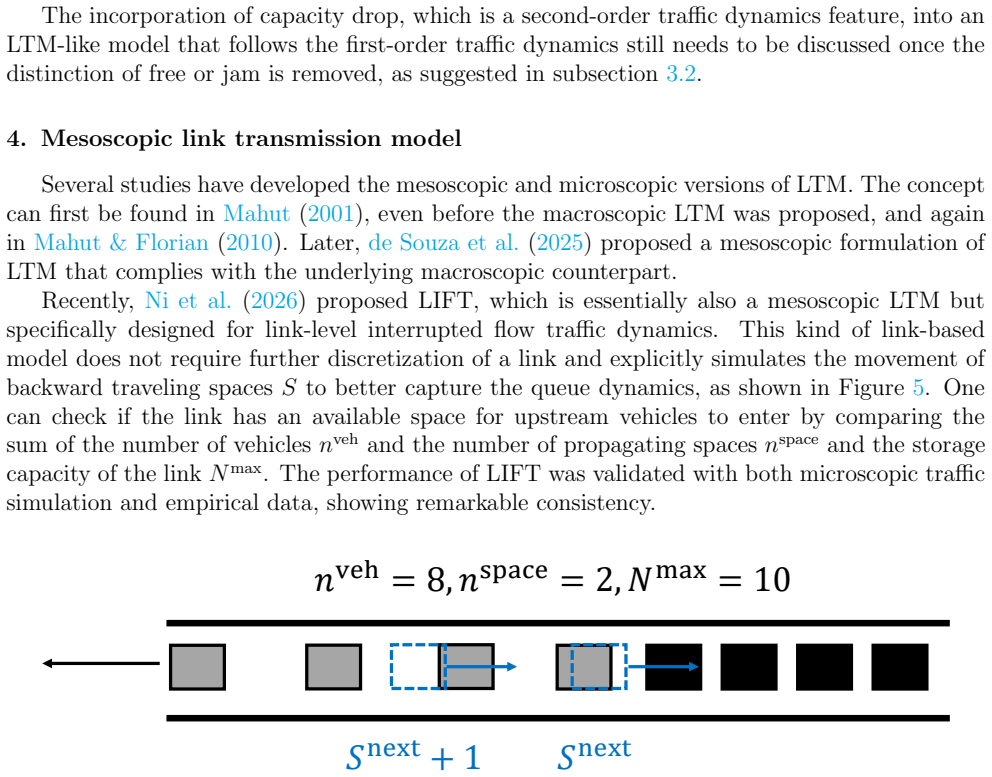
The mesoscopic model proposed by Eissfeldt (2004) is used in SUMO but does not fully comply with the principle of the LWR model. Problems include incomplete consideration of queue dynamics and limited implementation of backward traveling spaces, causing unrealistic onset and recovery of congestion and underestimation of its magnitude. The proposed proper mesoscopic discrete-time implementation of the link transmission model follows the LWR principle by explicitly incorporating backward traveling spaces to capture queue spillback phenomena, providing a more precise representation of congestion dynamics with link density outputs consistent with the kinematic wave theory and the microscopic tra
What carries the argument
A discrete-time mesoscopic implementation of the link transmission model that incorporates explicit backward traveling spaces to capture queue spillback.
If this is right
- Link density outputs become consistent with kinematic wave theory.
- Onset and recovery patterns of congestion become realistic rather than underestimated.
- Queue spillback phenomena are captured through the added backward traveling spaces.
- The model retains mesoscopic computational speed while matching microscopic results.
Where Pith is reading between the lines
- The same backward-space mechanism could be added to other mesoscopic simulators that currently rely on dynamic headways.
- Network-level predictions of spillback blocking at intersections would become more reliable once the local link model is corrected.
- Real-time traffic control applications that use SUMO outputs could see reduced error in estimated travel times during peak periods.
Load-bearing premise
The two case study scenarios are representative enough to show that the identified problems are the main causes of unrealistic patterns and that the new implementation resolves them without introducing other artifacts.
What would settle it
Run the proposed model on the two case-study networks and compare its link-density time series against both the predictions of kinematic wave theory and the outputs of the existing microscopic SUMO simulator; any systematic mismatch would falsify the consistency claim.
Figures

read the original abstract
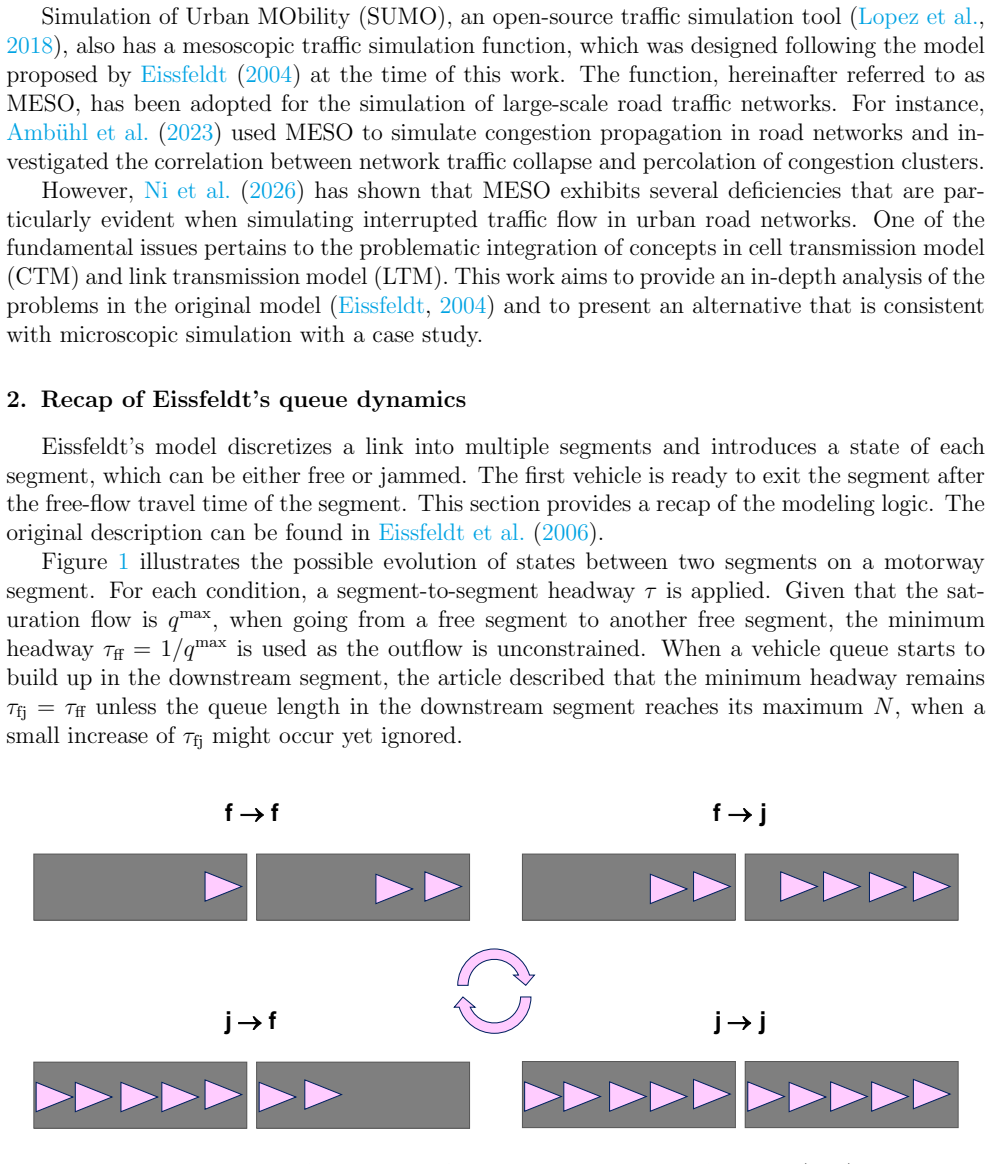
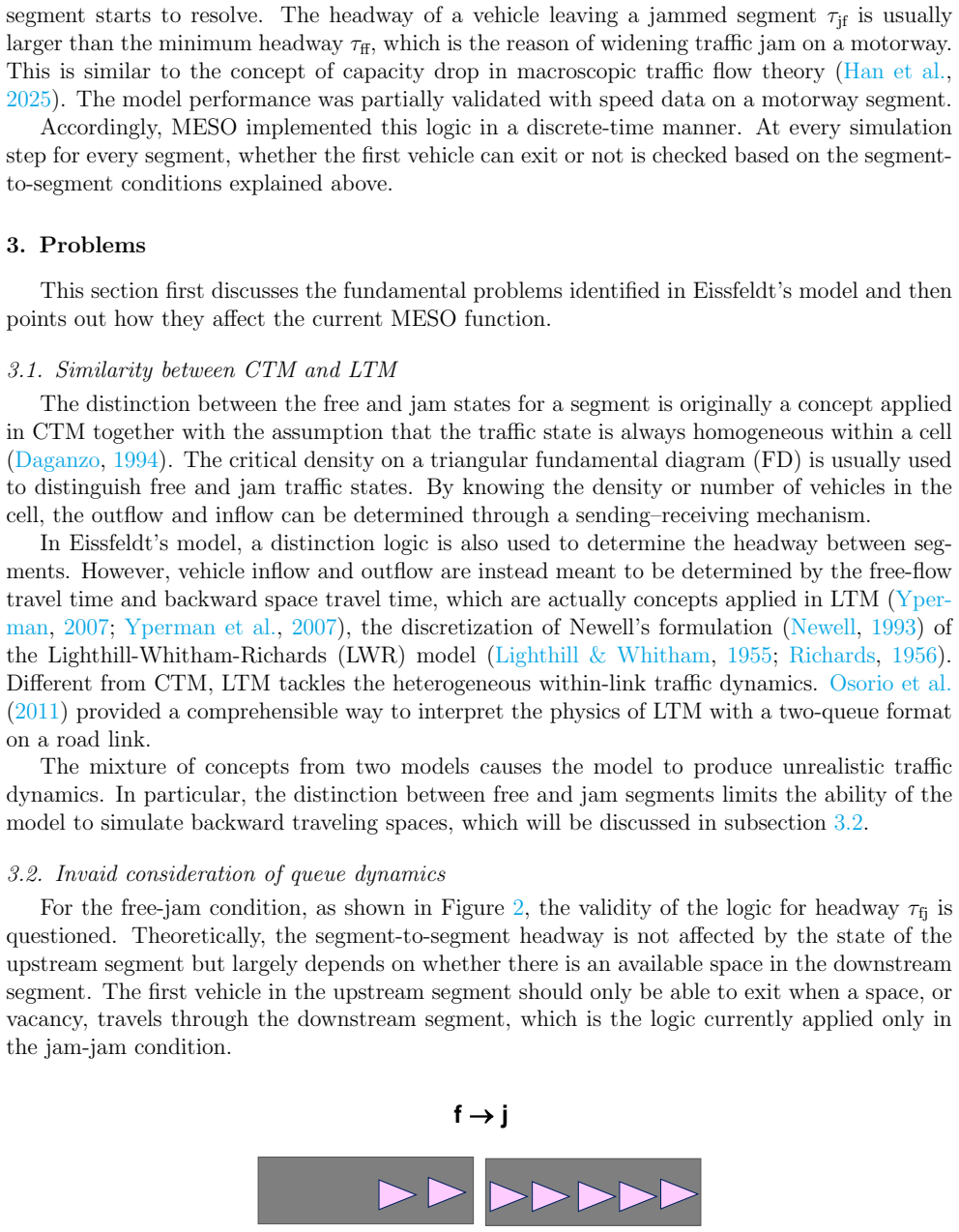
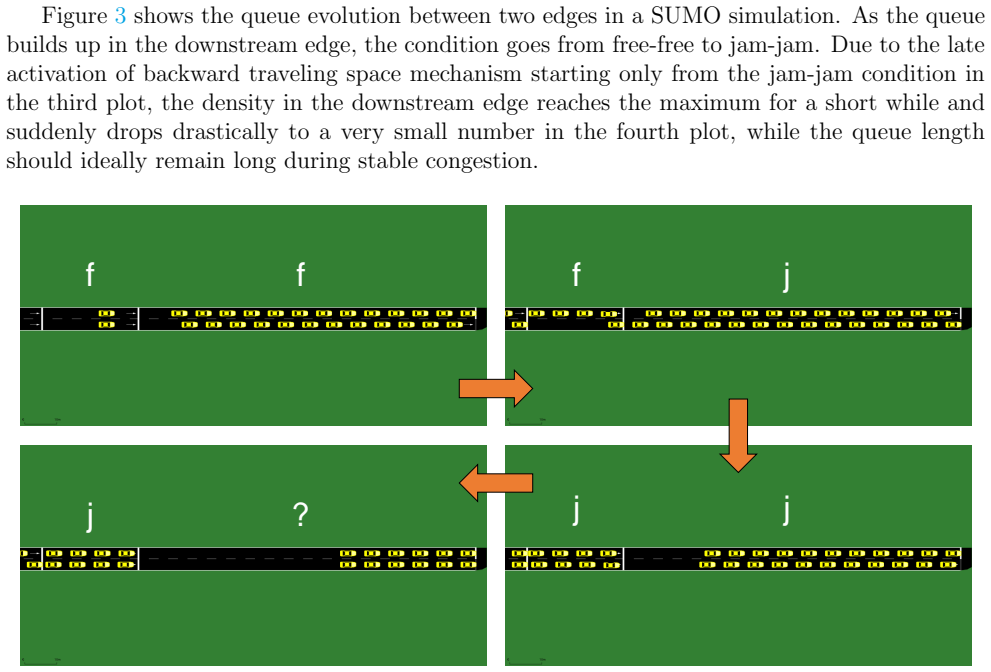
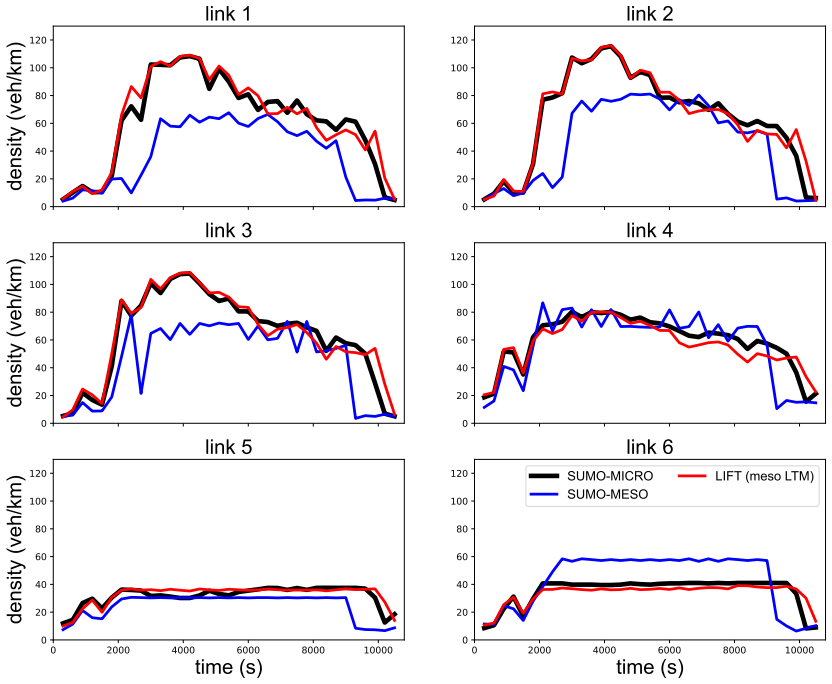
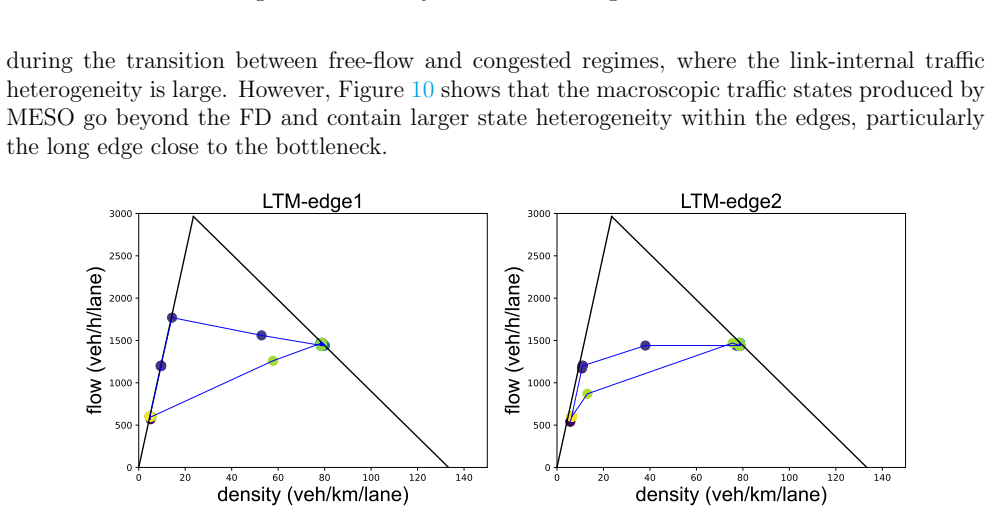
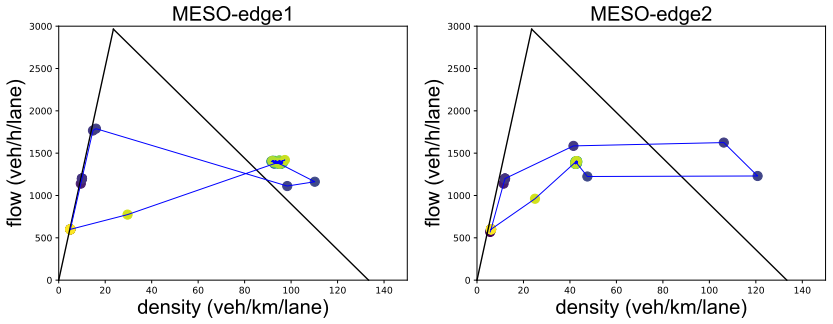
Mesoscopic traffic flow models combines the merits of both macroscopic and microscopic models by capturing individual vehicle behavior in great detail and remaining the computational efficiency. At the time of this study, the mesoscopic model proposed by Eissfeldt (2004) is used in Simulation of Urban MObility (SUMO). The movement of vehicles is governed by dynamic headways between edges. However, the model does not fully comply with the principle of the Lighthill-Whitham-Richards (LWR) model. Several problems are identified, including the incomplete consideration of queue dynamics and the limited implementation of backward traveling spaces. Two case study scenarios demonstrate that the problems lead to unrealistic onset and recovery pattern of congestion. The magnitude of congestion is generally underestimated with this model. To address these drawbacks, a proper mesoscopic discrete-time implementation of link transmission model, which follows the LWR principle, is proposed. By explicitly incorporating backward traveling spaces to capture queue spillback phenomena, the proposed model provides a more precise representation of congestion dynamics. The link density outputs are consistent with the kinematic wave theory and the microscopic traffic simulation in SUMO, thus verifying its theoretical accuracy.
Editorial analysis
A structured set of objections, weighed in public.
Referee Report
Summary. The paper identifies limitations in the Eissfeldt (2004) mesoscopic model implemented in SUMO, including incomplete queue dynamics and limited backward traveling spaces that violate LWR principles. Two case studies illustrate resulting unrealistic congestion onset/recovery patterns and underestimation of congestion magnitude. It proposes an alternative discrete-time link transmission model (LTM) implementation that explicitly incorporates backward traveling spaces, claiming that the resulting link densities are consistent with kinematic wave theory and SUMO microscopic simulations.
Significance. A correctly implemented mesoscopic LTM in SUMO could improve computational efficiency while better capturing spillback and congestion dynamics for network-level applications. The paper's identification of specific model shortcomings is useful, but the absence of quantitative validation metrics limits the assessed impact.
major comments (3)
- [Abstract] Abstract: the central claim that 'the link density outputs are consistent with the kinematic wave theory and the microscopic traffic simulation in SUMO' is presented without any quantitative metrics, error norms, or comparison tables, so the degree of consistency cannot be evaluated.
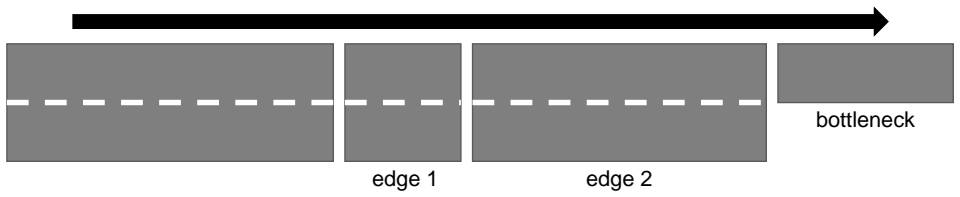
- [Case studies] Case studies (implied in abstract): reliance on only two scenarios to establish that the identified problems are the primary causes of unrealistic patterns and that the new implementation resolves them without introducing compensating artifacts is load-bearing for the verification claim; no evidence is given that these scenarios cover multi-link spillback timing or arbitrary network topologies.
- [Proposed model] Proposed model (abstract): no parameter-free derivation or exhaustive analytical check is supplied showing that the discrete-time scheme exactly reproduces the LWR solution; the consistency statement therefore rests entirely on the two scenarios rather than on a general proof.
minor comments (1)
- [Abstract] The abstract refers to 'dynamic headways between edges' without defining the term or contrasting it with standard LWR supply/demand functions.
Simulated Author's Rebuttal
We thank the referee for the constructive comments, which help clarify the presentation of our results. We address each major comment below and indicate the corresponding revisions.
read point-by-point responses
-
Referee: [Abstract] Abstract: the central claim that 'the link density outputs are consistent with the kinematic wave theory and the microscopic traffic simulation in SUMO' is presented without any quantitative metrics, error norms, or comparison tables, so the degree of consistency cannot be evaluated.
Authors: We agree that quantitative metrics are needed to substantiate the consistency claim. In the revised version we will add mean absolute percentage error and root-mean-square error between the proposed LTM densities, the analytical LWR solution, and SUMO microscopic outputs for both case studies, together with a comparison table of peak densities and queue lengths. revision: yes
-
Referee: [Case studies] Case studies (implied in abstract): reliance on only two scenarios to establish that the identified problems are the primary causes of unrealistic patterns and that the new implementation resolves them without introducing compensating artifacts is load-bearing for the verification claim; no evidence is given that these scenarios cover multi-link spillback timing or arbitrary network topologies.
Authors: The two scenarios were deliberately chosen to isolate the effects of incomplete queue dynamics and limited backward-traveling spaces. We acknowledge that they do not exhaustively cover multi-link spillback timing or arbitrary topologies. The revision will include an explicit limitations paragraph discussing these scope restrictions and will add one additional multi-link example demonstrating spillback propagation across three links. revision: partial
-
Referee: [Proposed model] Proposed model (abstract): no parameter-free derivation or exhaustive analytical check is supplied showing that the discrete-time scheme exactly reproduces the LWR solution; the consistency statement therefore rests entirely on the two scenarios rather than on a general proof.
Authors: The discrete-time LTM follows the standard Godunov-type discretization of the link transmission model, which is known to converge to the LWR solution under CFL conditions. The current manuscript relies on numerical verification rather than a full analytical proof. We will insert a short derivation subsection showing that the scheme satisfies the LWR entropy condition in the continuum limit and will cite the relevant LTM convergence results. revision: yes
Circularity Check
No significant circularity; new LTM implementation follows standard LWR principles with external validation.
full rationale
The paper identifies limitations in the existing Eissfeldt (2004) mesoscopic model used in SUMO, then proposes a discrete-time link transmission model implementation that explicitly incorporates backward traveling spaces to align with LWR/kinematic wave theory. The central claim of improved congestion dynamics and consistency with KWT and SUMO microsimulation is established through direct comparison in two case study scenarios, not through any reduction of outputs to fitted parameters, self-definitions, or self-citation chains. No equations or claims in the provided text equate a 'prediction' to its own inputs by construction, and the proposal is presented as an alternative implementation rather than a derived result from within-paper data fitting. This is a standard modeling-and-validation structure with no load-bearing circular steps.
Axiom & Free-Parameter Ledger
axioms (1)
- domain assumption The Lighthill-Whitham-Richards (LWR) model principles must be followed for realistic queue dynamics and spillback in mesoscopic traffic simulation.
Reference graph
Works this paper leans on
-
[1]
and Gao, Song and Wei, Zheng and Wen, Yang , month =
Ben-Akiva, Moshe E. and Gao, Song and Wei, Zheng and Wen, Yang , month =. 2012 , journal =. doi:10.1016/j.trc.2012.02.006 , issn =
-
[2]
2007 , booktitle =
Yperman, Isaak and Tamp. 2007 , booktitle =
2007
-
[3]
de Souza, Felipe and Verbas, Omer and Auld, Joshua and Tamp. 2025 , journal =. doi:10.1016/j.simpat.2025.103088 , issn =
-
[4]
Newell, G.F. , number =. 1993 , journal =. doi:10.1016/0191-2615(93)90038-C , issn =
-
[5]
Han, Yu and Wu, Jiarui and Ding, Fan and Li, Zhibin and Liu, Pan and Leclercq, Ludovic , month =. 2025 , journal =. doi:10.1016/j.trb.2025.103218 , issn =
-
[6]
Osorio, Carolina and Fl. 2011 , journal =. doi:10.1016/j.trb.2011.05.014 , issn =
-
[7]
Gayah, Vikash V. and Daganzo, Carlos F. , number =. 2011 , journal =. doi:10.3141/2249-03 , issn =
-
[8]
2018 , booktitle =
Lopez, Pablo Alvarez and Wiessner, Evamarie and Behrisch, Michael and Bieker-Walz, Laura and Erdmann, Jakob and Flotterod, Yun-Pang and Hilbrich, Robert and Lucken, Leonhard and Rummel, Johannes and Wagner, Peter , month =. 2018 , booktitle =
2018
-
[9]
Lighthill, Michael James and Whitham, Gerald Beresford , number =. 1955 , journal =. doi:10.1098/rspa.1955.0089 , issn =
-
[10]
Richards, Paul I. , number =. 1956 , journal =. doi:10.1287/opre.4.1.42 , issn =
-
[11]
Ni, Ying-Chuan and Kouvelas, Anastasios and Makridis, Michail A. , month =. 2026 , journal =. doi:10.1016/j.simpat.2026.103252 , issn =
-
[12]
Daganzo, Carlos F. , number =. 1994 , journal =. doi:10.1016/0191-2615(94)90002-7 , issn =
-
[13]
Mahut, Michael and Florian, Michael , editor =. 2010 , booktitle =. doi:10.1007/978-1-4419-6142-6
-
[14]
Amb. 2023 , journal =. doi:10.1038/s42005-023-01144-w , issn =
discussion (0)
Sign in with ORCID, Apple, or X to comment. Anyone can read and Pith papers without signing in.