Justification and structure- and asymptotic-preserving discretizations of a hyperbolized Cahn-Hilliard equation
Pith reviewed 2026-06-27 15:37 UTC · model grok-4.3
The pith
Discretizations of a hyperbolized Cahn-Hilliard equation converge to stable schemes for the original model as the relaxation parameter vanishes.
A machine-rendered reading of the paper's core claim, the machinery that carries it, and where it could break.
Core claim
The hyperbolized Cahn-Hilliard equation recovers the original model in the relaxation limit. Energy-stable semidiscretizations based on upwind summation-by-parts operators and IMEX Runge-Kutta time stepping are asymptotic preserving, meaning they converge to a stable discretization of the Cahn-Hilliard equation when the relaxation parameter tends to zero. The relative energy framework provides both the justification for the continuous limit and a priori error estimates that guide the discrete parameter choices.
What carries the argument
Upwind summation-by-parts spatial operators combined with additive IMEX Runge-Kutta methods on a convex-concave splitting, justified via the relative energy framework.
If this is right
- The discretization converges to the CH discretization as the relaxation parameter goes to zero.
- Energy stability is preserved in both the hyperbolized and limit cases.
- A priori error estimates derived from the relative energy guide parameter choice.
- Formal asymptotic expansions confirm the limit behavior.
Where Pith is reading between the lines
- Similar hyperbolization and discretization strategies could be applied to other fourth-order parabolic equations.
- The asymptotic-preserving property may allow robust numerical treatment of stiff relaxation limits without artificial viscosity.
- Error estimates could be used to adaptively choose the relaxation parameter based on desired accuracy.
Load-bearing premise
The hyperbolization admits a relaxation limit recovering the Cahn-Hilliard equation and the relative energy framework carries over to the discrete setting.
What would settle it
Numerical experiments where, for small relaxation parameters, the computed solutions diverge from or fail to approach the solutions obtained by directly discretizing the Cahn-Hilliard equation with the same spatial and temporal methods.
Figures
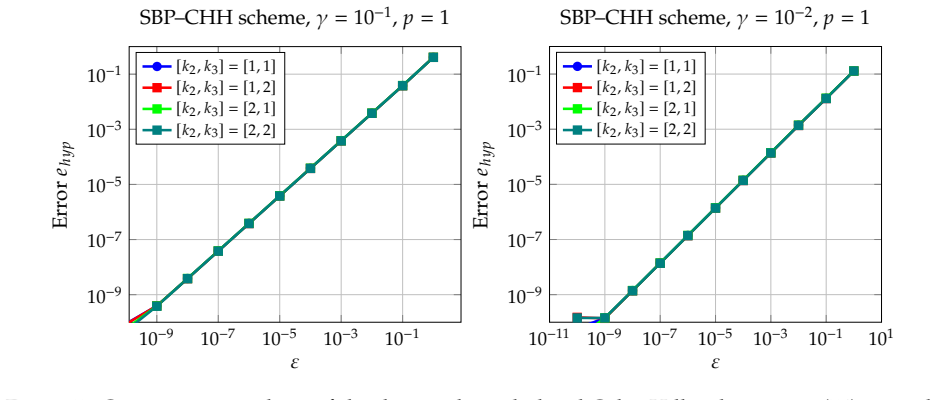
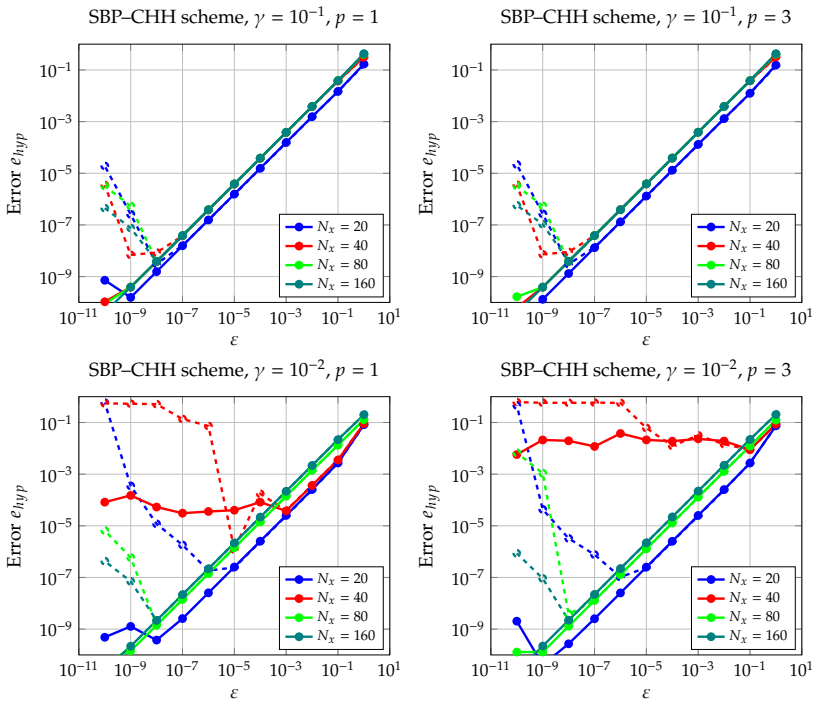
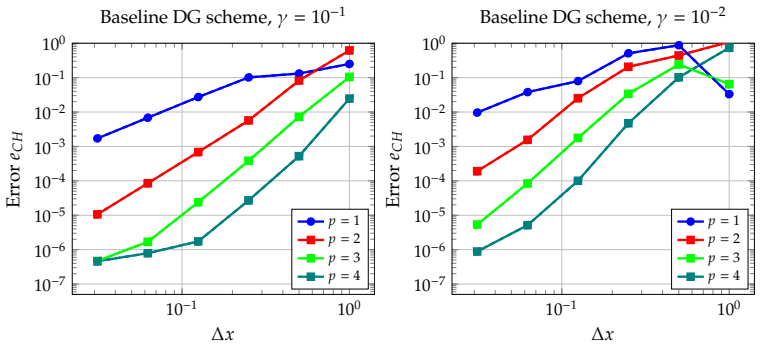
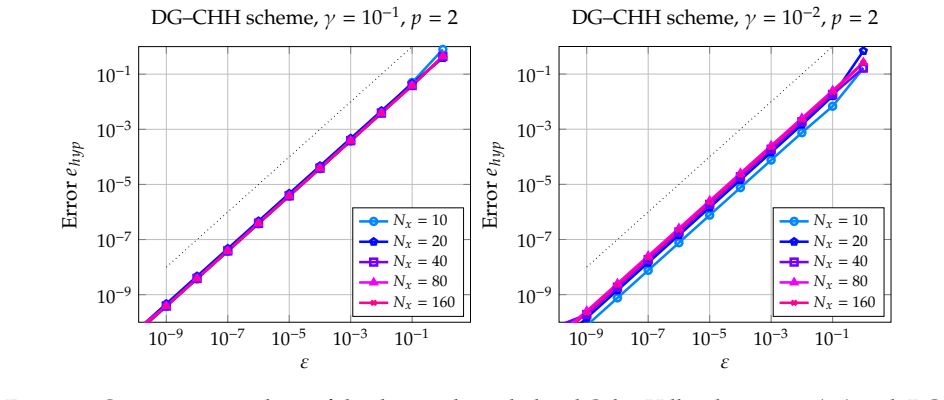
read the original abstract
We study a hyperbolic approximation ("hyperbolization") of the Cahn-Hilliard (CH) equation, originally proposed by Dhaouadi, Dumbser, and Gavrilyuk (2025, DOI: 10.1098/rspa.2024.0606) and study its convergence towards the CH model in a relaxation limit both via formal asymptotic expansions and, for a slightly modified approximation, via the relative energy framework. Moreover, we develop energy-stable semidiscretizations of the CH equation and of this hyperbolization using upwind summation-by-parts operators in space. Subsequently, we combine them with (additive) implicit-explicit (IMEX) Runge-Kutta methods based on a convex-concave splitting. We show that the resulting method is asymptotic preserving, i.e., it converges in the limit of the relaxation parameter to a stable discretization of the original CH equation. The choice of the necessary parameters is guided by the a priori error estimate based on the relative energy framework.
Editorial analysis
A structured set of objections, weighed in public.
Referee Report
Summary. The paper studies a hyperbolic approximation of the Cahn-Hilliard equation from Dhaouadi et al. (2025), establishes its relaxation limit to the original CH model via formal asymptotics and (for a slightly modified version) relative-energy estimates, constructs energy-stable semidiscretizations of both models via upwind summation-by-parts operators, pairs them with IMEX Runge-Kutta time integrators based on convex-concave splitting, and proves that the resulting scheme is asymptotic-preserving with parameters selected from the a priori relative-energy estimate.
Significance. If the relative-energy estimates and the discrete asymptotic-preservation property hold rigorously, the work supplies a coherent structure-preserving discretization framework that inherits the relaxation limit, which is a useful contribution to numerical methods for stiff phase-field models.
major comments (2)
- [relative-energy analysis and discrete error estimate] The central claim that the discretization is asymptotic preserving rests on the relative-energy framework being applicable to both the continuous hyperbolized model and its SBP-IMEX discretization; the manuscript must supply the full derivations and error bounds (currently only asserted in the abstract) to confirm that no post-hoc parameter adjustments invalidate the estimates.
- [justification of the hyperbolized model] The proof of the relaxation limit and asymptotic preservation is given only for a slightly modified hyperbolization; it is necessary to verify that this modification does not alter the formal asymptotic expansion or the stability properties recovered in the limit ε o0.
minor comments (2)
- Clarify the precise definition of the relaxation parameter and its relation to the upwind SBP operators in the semidiscrete system.
- Add explicit statements of the convex-concave splitting used in the IMEX-RK scheme and confirm that the splitting is consistent with the energy dissipation structure.
Simulated Author's Rebuttal
We thank the referee for the careful reading and constructive comments on the manuscript. We address the major comments point by point below.
read point-by-point responses
-
Referee: [relative-energy analysis and discrete error estimate] The central claim that the discretization is asymptotic preserving rests on the relative-energy framework being applicable to both the continuous hyperbolized model and its SBP-IMEX discretization; the manuscript must supply the full derivations and error bounds (currently only asserted in the abstract) to confirm that no post-hoc parameter adjustments invalidate the estimates.
Authors: We agree that the manuscript asserts the applicability of the relative-energy framework to both the continuous and discrete settings without supplying the full derivations. In the revised version we will include the complete relative-energy estimates, including all error bounds, for the hyperbolized model and the SBP-IMEX discretization. These derivations will explicitly confirm that the parameter choices follow directly from the a priori estimates. revision: yes
-
Referee: [justification of the hyperbolized model] The proof of the relaxation limit and asymptotic preservation is given only for a slightly modified hyperbolization; it is necessary to verify that this modification does not alter the formal asymptotic expansion or the stability properties recovered in the limit ε→0.
Authors: The modification is introduced solely to enable the relative-energy analysis. We will add a short verification subsection demonstrating that the formal asymptotic expansion remains identical to that of the original hyperbolization and that the stability properties recovered in the limit ε→0 are unchanged. This will be shown by direct comparison of the leading-order terms. revision: yes
Circularity Check
No significant circularity; derivation self-contained
full rationale
The paper cites an external hyperbolization (Dhaouadi et al. 2025) and applies the relative-energy framework to both the continuous relaxation limit and the discrete SBP-IMEX scheme. The asymptotic-preserving property follows directly from showing that the discrete scheme inherits the limit behavior already established for the continuous model. Parameter selection is described as guided by the a priori estimate derived in the paper itself, which is standard and does not reduce any claim to a fitted input renamed as prediction or to a self-citation chain. No self-definitional loops, uniqueness theorems imported from the authors' prior work, or ansatzes smuggled via citation appear in the stated construction. The central claims rest on independent energy estimates and stability analysis.
Axiom & Free-Parameter Ledger
axioms (1)
- domain assumption The relative energy framework applies to the hyperbolized Cahn-Hilliard equation and its discretizations
Reference graph
Works this paper leans on
-
[1]
Thermodynamically consistent, frame indifferent dif- fuse interface models for incompressible two-phase flows with different densities
H. Abels, H. Garcke, and G. Grün. “Thermodynamically consistent, frame indifferent dif- fuse interface models for incompressible two-phase flows with different densities.” In: Mathematical Models and Methods in Applied Sciences22.3 (2012), pp. 1150013, 40.doi:10. 1142/S0218202511500138. 36
2012
-
[2]
AnalysisoftheSBP-SATStabilization for Finite Element Methods Part I: Linear problems
R.Abgrall,J.Nordström,P.Öffner,andS.Tokareva.“AnalysisoftheSBP-SATStabilization for Finite Element Methods Part I: Linear problems.” In:Journal of Scientific Computing85.2 (2020), pp. 1–29.doi:10.1007/s10915-020-01349-z. arXiv:1912.08108 [math.NA]
-
[3]
An asymptotic pre- serving scheme satisfying entropy stability for the barotropic Euler system
M. Anandan, M. Lukáčová-Medvid’ová, and S. V. Raghurama Rao. “An asymptotic pre- serving scheme satisfying entropy stability for the barotropic Euler system.” In:SeMA Journal. Boletin de la Sociedad Española de Matemática Aplicada82.4 (2025), pp. 541–569.doi: 10.1007/s40324-025-00395-7
-
[4]
DispersiveNonlinearShallow-WaterEqua- tions
MAntuono,VLiapidevskii,andM.Brocchini.“DispersiveNonlinearShallow-WaterEqua- tions.” In:Studies in Applied Mathematics122.1 (2009), pp. 1–28.doi:10 . 1111 / j . 1467 - 9590.2008.00422.x
arXiv 2009
-
[5]
UnifiedAnalysisofdiscontinuous Galerkin Methods for elliptic problems
D.N.Arnold,F.Brezzi,B.Cockburn,andL.D.Marini.“UnifiedAnalysisofdiscontinuous Galerkin Methods for elliptic problems.” In:SIAM Journal on Numerical Analysis39 (2002), pp. 1749–1779
2002
-
[6]
Implicit-explicit Runge-Kutta methods for time- dependent partial differential equations
U. M. Ascher, S. Ruuth, and R. Spiteri. “Implicit-explicit Runge-Kutta methods for time- dependent partial differential equations.” In:Applied Numerical Mathematics25 (1997), pp. 151–167.doi:10.1016/S0168-9274(97)00056-1
-
[7]
Implicit-Explicit Methods for Time-Dependent Partial Differential Equations
U. M. Ascher, S. Ruuth, and B. Wetton. “Implicit-Explicit Methods for Time-Dependent Partial Differential Equations.” In:SIAM Journal on Numerical Analysis32 (1995), pp. 797– 823
1995
- [8]
-
[9]
F. Bassi and S. Rebay. “A high-order accurate discontinuous finite element method for the numerical solution of the compressible Navier-Stokes equations.” In:Journal of Computa- tional Physics131.2 (1997), pp. 267–279.doi:10.1006/jcph.1996.5572
-
[10]
Perfectly Matched Layers Methods for Mixed Hyperbolic-Dispersive Equations
C. Besse, S. Gavrilyuk, M. Kazakova, and P. Noble. “Perfectly Matched Layers Methods for Mixed Hyperbolic-Dispersive Equations.” In:Water Waves4.3 (2022), pp. 313–343.doi: 10.1007/s42286-022-00069-1
-
[11]
IMEX large time step finitevolumemethodsforlowFroudenumbershallowwaterflows
G. Bispen, K. R. Arun, M. Lukáčová-Medvid’ová, and S. Noelle. “IMEX large time step finitevolumemethodsforlowFroudenumbershallowwaterflows.”In:Communicationsin Computational Physics16 (2014), pp. 307–347
2014
-
[13]
S. Bleecke, A. Biswas, D. I. Ketcheson, H. Ranocha, and J. Schütz.Asymptotic-preserving and energy-conserving methods for a hyperbolic approximation of the BBM equation. 2025. arXiv: 2511.10044 [math.NA]
arXiv 2025
-
[14]
Error Analysis of IMEX Runge-Kutta Methods Derived from Differential- Algebraic Systems
S. Boscarino. “Error Analysis of IMEX Runge-Kutta Methods Derived from Differential- Algebraic Systems.” In:SIAM Journal on Numerical Analysis45 (2007), pp. 1600–1621. 37
2007
-
[15]
Boscarino, L
S. Boscarino, L. Pareschi, and G. Russo.Implicit-explicit methods for evolutionary partial dif- ferentialequations.Vol.24.MathematicalModelingandComputation.SocietyforIndustrial and Applied Mathematics (SIAM), Philadelphia, PA, [2025]©2025, pp. ix+323
2025
-
[16]
On a class of uniformly accurate IMEX Runge-Kutta schemes and applications to hyperbolic systems with relaxation
S. Boscarino and G. Russo. “On a class of uniformly accurate IMEX Runge-Kutta schemes and applications to hyperbolic systems with relaxation.” In:SIAM Journal on Scientific Computing31.3 (2009), pp. 1926–1945
2009
-
[17]
All Mach number second order semi-implicit scheme for the Euler equations of gas dynamics
S. Boscarino, G. Russo, and L. Scandurra. “All Mach number second order semi-implicit scheme for the Euler equations of gas dynamics.” In:Journal of Scientific Computing77.2 (2018), pp. 850–884.doi:10.1007/s10915-018-0731-9
-
[18]
Asymptotic preserving methods for quasilinear hyperbolic systems with stiff relaxation: a review
S. Boscarino and G. Russo. “Asymptotic preserving methods for quasilinear hyperbolic systems with stiff relaxation: a review.” In:SeMA Journal. Boletin de la Sociedad Española de Matemática Aplicada81.1 (2024), pp. 3–49.doi:10.1007/s40324-024-00351-x
-
[20]
Free Energy of a Nonuniform System. I. Interfacial Free Energy
J. W. Cahn and J. E. Hilliard. “Free Energy of a Nonuniform System. I. Interfacial Free Energy.”In:TheJournalofChemicalPhysics28.2(1958),pp.258–267.doi:10.1063/1.1744102
-
[21]
M. H. Carpenter, T. C. Fisher, E. J. Nielsen, and S. H. Frankel. “Entropy Stable Spectral Collocation Schemes for the Navier-Stokes Equations: Discontinuous Interfaces.” In:SIAM Journal on Scientific Computing36.5 (2014), B835–B867.doi:10.1137/130932193
-
[22]
M. H. Carpenter, D. Gottlieb, and S. Abarbanel. “Time-Stable Boundary Conditions for Finite-Difference Schemes Solving Hyperbolic Systems: Methodology and Application to High-Order Compact Schemes.” In:Journal of Computational Physics111.2 (1994), pp. 220– 236.doi:10.1006/jcph.1994.1057
-
[23]
Sur une forme de l’équation de la chaleur éliminant le paradoxe d’une prop- agation instantanée
C. Cattaneo. “Sur une forme de l’équation de la chaleur éliminant le paradoxe d’une prop- agation instantanée.” In:Comptes rendus hebdomadaires des séances de l’Académie des sciences 247 (3 1958), pp. 431–433
1958
-
[24]
First order hyperbolic approach for anisotropic diffusion equation
A. S. Chamarthi, H. Nishikawa, and K. Komurasaki. “First order hyperbolic approach for anisotropic diffusion equation.” In:Journal of Computational Physics396 (2019), pp. 243–263. doi:10.1016/j.jcp.2019.06.064
-
[25]
A.Christlieb,K.Promislow,andZ.Xu.“Ontheunconditionallygradientstableschemefor the Cahn-Hilliard equation and its implementation with Fourier method.” In:Communica- tions in Mathematical Sciences11.2 (2013), p. 345.doi:10.4310/CMS.2013.v11.n2.a1
-
[26]
C.Christoforou,M.Galanopoulou,andA.E.Tzavaras.“Asymmetrizableextensionofpoly- convex thermoelasticity and applications to zero-viscosity limits and weak-strong unique- ness.” In:Communications in Partial Differential Equations43.7 (2018), pp. 1019–1050.doi: 10.1080/03605302.2018.1456551
-
[27]
SuperconvergentdiscontinuousGalerkinmethods for second-order elliptic problems
B.Cockburn,J.Guzmán,andH.Wang.“SuperconvergentdiscontinuousGalerkinmethods for second-order elliptic problems.” In:Mathematics of Computation78.265 (2009), pp. 1–24. doi:10.1090/S0025-5718-08-02146-7. 38
-
[28]
A time-adaptive finite volume method for the Cahn- Hilliard and Kuramoto-Sivashinsky equations
L. Cueto-Felgueroso and J. Peraire. “A time-adaptive finite volume method for the Cahn- Hilliard and Kuramoto-Sivashinsky equations.” In:Journal of Computational Physics227.24 (2008), pp. 9985–10017.doi:10.1016/j.jcp.2008.07.024
-
[29]
Thesecondlawofthermodynamicsandstability
C.M.Dafermos.“Thesecondlawofthermodynamicsandstability.”English.In:Archivefor Rational Mechanics and Analysis70 (1979), pp. 167–199.doi:10.1007/BF00250353
-
[30]
AllspeedschemeforthelowMachnumberlimitoftheIsentropic Euler equation
P.DegondandM.Tang.“AllspeedschemeforthelowMachnumberlimitoftheIsentropic Euler equation.” In:Communications in Computational Physics10 (2011), pp. 1–31
2011
-
[31]
A first-order hyperbolic reformulation of the Cahn-Hilliard equation
F. Dhaouadi, M. Dumbser, and S. Gavrilyuk. “A first-order hyperbolic reformulation of the Cahn-Hilliard equation.” In:Proceedings A. Vol. 481. 2312. The Royal Society. 2025, p. 20240606.doi:10.1098/rspa.2024.0606
-
[32]
Stability and convergence of a second-order mixed finiteelementmethodfortheCahn-Hilliardequation
A. E. Diegel, C. Wang, and S. M. Wise. “Stability and convergence of a second-order mixed finiteelementmethodfortheCahn-Hilliardequation.”In:IMAJournalofNumericalAnalysis 36.4 (2016), pp. 1867–1897.doi:10.1093/imanum/drv065
-
[33]
Studyofanewasymptoticpreservingscheme fortheEulersysteminthelowMachnumberlimit
G.Dimarco,R.Loubère,andM.-H.Vignal.“Studyofanewasymptoticpreservingscheme fortheEulersysteminthelowMachnumberlimit.”In:SIAMJournalonScientificComputing 39.5 (2017), A2099–A2128
2017
-
[34]
Asymptotic Preserving Implicit-Explicit Runge–Kutta Meth- ods for Nonlinear Kinetic Equations
G. Dimarco and L. Pareschi. “Asymptotic Preserving Implicit-Explicit Runge–Kutta Meth- ods for Nonlinear Kinetic Equations.” In:SIAM Journal on Numerical Analysis51.2 (2013), pp. 1064–1087
2013
-
[35]
Numerical methods for kinetic equations
G. Dimarco and L. Pareschi. “Numerical methods for kinetic equations.” In:Acta Numerica 23 (2014), pp. 369–520.doi:10.1017/S0962492914000063
-
[36]
Uniquenessofsolutionstohyperbolicconservationlaws
R.J.DiPerna.“Uniquenessofsolutionstohyperbolicconservationlaws.”English.In:Indiana University Mathematics Journal28 (1979), pp. 137–188.doi:10.1512/iumj.1979.28.28011
-
[37]
Convex-concave splitting for the Allen-Cahn equation leads to𝜀 2-slow movement of interfaces
P. Dondl, A. Onwunta, L. Striet, and S. Wojtowytsch. “Convex-concave splitting for the Allen-Cahn equation leads to𝜀 2-slow movement of interfaces.” In:J. Comput. Phys.562 (2026), Paper No. 114982.doi:10.1016/j.jcp.2026.114982
-
[38]
L. Dovgilovich and I. Sofronov. “High-accuracy finite-difference schemes for solving elas- todynamic problems in curvilinear coordinates within multiblock approach.” In:Applied Numerical Mathematics93 (2015), pp. 176–194.doi:10.1016/j.apnum.2014.06.005
-
[39]
Rigorous justification of the Favrie-Gavrilyuk approximation to the Serre- Green-Naghdi model
V. Duchene. “Rigorous justification of the Favrie-Gavrilyuk approximation to the Serre- Green-Naghdi model.” In:Nonlinearity32 (2019), pp. 3772–3797.doi:10 . 1088 / 1361 - 6544/ab22fb
2019
-
[40]
Stability and asymptotic analysis for instationary gas trans- portviarelativeenergyestimates
H. Egger and J. Giesselmann. “Stability and asymptotic analysis for instationary gas trans- portviarelativeenergyestimates.”English.In:NumerischeMathematik153.4(2023),pp.701– 728.doi:10.1007/s00211-023-01349-9
-
[41]
A second order splitting method for the Cahn-Hilliardequation
C. M. Elliott, D. A. French, and F. A. Milner. “A second order splitting method for the Cahn-Hilliardequation.”In:NumerischeMathematik54.5(1989),pp.575–590.doi:10.1007/ BF01396363. 39
1989
-
[42]
An efficient hyperbolic relaxation system for dispersive non-hydrostatic water waves and its solution with high order discontinuous Galerkin schemes
C. Escalante, M. Dumbser, and M. J. Castro. “An efficient hyperbolic relaxation system for dispersive non-hydrostatic water waves and its solution with high order discontinuous Galerkin schemes.” In:Journal of Computational Physics394 (2019), pp. 385–416.doi:10 . 1016/j.jcp.2019.05.035
2019
-
[43]
Unconditionally Gradient Stable Time Marching the Cahn-Hilliard Equation
D. J. Eyre. “Unconditionally Gradient Stable Time Marching the Cahn-Hilliard Equation.” In:MRS Proceedings529 (1998), p. 39.doi:10.1557/PROC-529-39
-
[44]
N Favrie and S Gavrilyuk. “A rapid numerical method for solving Serre–Green–Naghdi equations describing long free surface gravity waves.” In:Nonlinearity30.7 (2017), p. 2718. doi:10.1088/1361-6544/aa712d
-
[45]
Review of summation-by-parts operators with simultaneous approximation terms for the numerical solution of partial differential equations
D. C. D. R. Fernández, J. E. Hicken, and D. W. Zingg. “Review of summation-by-parts operators with simultaneous approximation terms for the numerical solution of partial differential equations.” In:Computers & Fluids95 (2014), pp. 171–196.doi:10 . 1016 / j . compfluid.2014.02.016
2014
-
[46]
Aclassofasymptotic-preservingschemesforkineticequationsandre- latedproblemswithstiffsources
F.FilbetandS.Jin.“Aclassofasymptotic-preservingschemesforkineticequationsandre- latedproblemswithstiffsources.”In:JournalofComputationalPhysics229.20(2010),pp.7625– 7648
2010
-
[47]
F. Frank, A. Rupp, and D. Kuzmin. “Bound-preserving flux limiting schemes for DG dis- cretizations of conservation laws with applications to the Cahn-Hilliard equation.” In: Computer Methods in Applied Mechanics and Engineering359 (2020), pp. 112665, 25.doi: 10.1016/j.cma.2019.112665
-
[48]
Cahn-Hillard andKeller-Segelsystemsashigh-frictionlimitsofEuler-KortewegandEuler-Poissonequa- tions
D. Gallenmüller, P. Gwiazda, A. Świerczewska-Gwiazda, and J. Woźnicki. “Cahn-Hillard andKeller-Segelsystemsashigh-frictionlimitsofEuler-KortewegandEuler-Poissonequa- tions.” English. In:Calculus of Variations and Partial Differential Equations63.2 (2024). Id/No 47, p. 27.doi:10.1007/s00526-023-02656-7
-
[49]
G.J.Gassner.“ASkew-SymmetricDiscontinuousGalerkinSpectralElementDiscretization and Its Relation to SBP-SAT Finite Difference Methods.” In:SIAM Journal on Scientific Computing35.3 (2013), A1233–A1253.doi:10.1137/120890144
-
[50]
J. Giesselmann, J. Keim, F. Leotta, and C. Rohde.Justification of a Relaxation Approximation for the Navier-Stokes-Cahn-Hilliard System. 2026. arXiv:2601.18463 [math.NA]
arXiv 2026
-
[51]
Relative energy for the Korteweg theory and related Hamiltonian flows in gas dynamics
J. Giesselmann, C. Lattanzio, and A. E. Tzavaras. “Relative energy for the Korteweg theory and related Hamiltonian flows in gas dynamics.” English. In:Archive for Rational Mechanics and Analysis223.3 (2017), pp. 1427–1484.doi:10.1007/s00205-016-1063-2
-
[52]
Convergence of hyperbolic approximations to higher- order PDEs for smooth solutions
J. Giesselmann and H. Ranocha. “Convergence of hyperbolic approximations to higher- order PDEs for smooth solutions.” In:The SMAI Journal of Computational Mathematics12 (Mar. 2026), pp. 75–102.doi:10.5802/jcm.144. arXiv:2508.04112 [math.NA]
-
[53]
Hyperbolic relaxation technique for solvingthedispersiveSerre-Green-Naghdiequationswithtopography
J.-L. Guermond, C. Kees, B. Popov, and E. Tovar. “Hyperbolic relaxation technique for solvingthedispersiveSerre-Green-Naghdiequationswithtopography.”In:JournalofCom- putational Physics450 (2022), p. 110809.doi:10.1016/j.jcp.2021.110809
-
[54]
Well-balanced second-order convex limiting technique for solving the Serre-Green-Naghdi equations
J.-L. Guermond, C. Kees, B. Popov, and E. Tovar. “Well-balanced second-order convex limiting technique for solving the Serre-Green-Naghdi equations.” In:Water Waves4.3 (2022), pp. 409–445.doi:10.1007/s42286-022-00062-8. 40
-
[55]
R. Guo, F. Filbet, and Y. Xu. “Efficient high order semi-implicit time discretization and local discontinuous Galerkin methods for highly nonlinear PDEs.” In:Journal of Scientific Computing68.3 (2016), pp. 1029–1054.doi:10.1007/s10915-016-0170-4
-
[56]
Anall-speedasymptotic-preservingmethodfortheisentropic Euler and Navier-Stokes equations
J.Haack,S.Jin,andJ.-G.Liu.“Anall-speedasymptotic-preservingmethodfortheisentropic Euler and Navier-Stokes equations.” In:Communications in Computational Physics12 (2012), pp. 955–980
2012
-
[57]
D. Han and X. Wang. “A second order in time, uniquely solvable, unconditionally stable numerical scheme for Cahn-Hilliard-Navier-Stokes equation.” In:Journal of Computational Physics290 (2015), pp. 139–156.doi:10.1016/j.jcp.2015.02.046
-
[58]
Onlargetime-steppingmethodsfortheCahn-Hilliardequation
Y.He,Y.Liu,andT.Tang.“Onlargetime-steppingmethodsfortheCahn-Hilliardequation.” In:Applied Numerical Mathematics57.5-7 (2007), pp. 616–628.doi:10.1016/j.apnum.2006. 07.026
-
[59]
Constructing stable, high-order finite-difference operators on point clouds over complex geometries
J. Hicken, G. Yan, and S. Kaur. “Constructing stable, high-order finite-difference operators on point clouds over complex geometries.” In:Journal of Computational Physics532 (2025), p. 113940.doi:10.1016/j.jcp.2025.113940
-
[60]
Entropy-stable, high-order summation-by-parts discretizations without in- terfacepenalties
J. E. Hicken. “Entropy-stable, high-order summation-by-parts discretizations without in- terfacepenalties.”In:JournalofScientificComputing82.2(2020),p.50.doi:10.1007/s10915- 020-01154-8
-
[61]
Multidimensional Summation-By- Parts Operators: General Theory and Application to Simplex Elements
J. E. Hicken, D. C. D. R. Fernández, and D. W. Zingg. “Multidimensional Summation-By- Parts Operators: General Theory and Application to Simplex Elements.” In:SIAM Journal on Scientific Computing38.4 (2016), A1935–A1958.doi:10.1137/15M1038360
-
[62]
M.IslamandR.K.Sinha.“AnalysisofalocaldiscontinuousGalerkinmethodfortheCahn- Hilliard equation using convex-concave decomposition.” In:Calcolo63.1 (2026), Paper No. 3, 54.doi:10.1007/s10092-025-00676-7
-
[63]
Asymptotic Preserving (AP) Schemes for multiscale kinetic and hyperbolic equa- tions: A review
S. Jin. “Asymptotic Preserving (AP) Schemes for multiscale kinetic and hyperbolic equa- tions: A review.” In:Rivista di Matematica della Universita Parma3 (2012), pp. 177–216
2012
-
[64]
Efficient Asymptotic-Preserving (AP) schemes for some multiscale kinetic equa- tions
S. Jin. “Efficient Asymptotic-Preserving (AP) schemes for some multiscale kinetic equa- tions.” In:SIAM Journal on Scientific Computing21 (1999), pp. 441–454
1999
-
[65]
Asymptotic-preservingschemesformultiscalephysicalproblems
S.Jin.“Asymptotic-preservingschemesformultiscalephysicalproblems.”In:ActaNumerica 31 (2022), pp. 415–489.doi:10.1017/S0962492922000010
-
[66]
Jüngel.Entropy methods for diffusive partial differential equations
A. Jüngel.Entropy methods for diffusive partial differential equations. English. SpringerBriefs Math.Cham:Springer;Bilbao:BCAM–BasqueCenterforAppliedMathematics,2016.doi: 10.1007/978-3-319-34219-1
-
[67]
J. Keim, H.-C. Konan, and C. Rohde. “A note on hyperbolic relaxation of the Navier- Stokes-Cahn-Hilliard system for incompressible two-phase flows.” In:Sixth Workshop on CompressibleMultiphaseFlows:Derivation,Closurelaws,Thermodynamics.Vol.78.ESAIMProc. Surveys. EDP Sci., Les Ulis, 2025, pp. 188–212.doi:10.1051/proc/202578188
-
[68]
Additive Runge-Kutta schemes for convection- diffusion-reaction equations
C. A. Kennedy and M. H. Carpenter. “Additive Runge-Kutta schemes for convection- diffusion-reaction equations.” In:Applied Numerical Mathematics44 (2003), pp. 139–181. 41
2003
-
[69]
D. I. Ketcheson and A. Biswas. “Approximation of arbitrarily high-order PDEs by first- order hyperbolic relaxation.” In:Nonlinearity38.5 (2025), p. 055002.doi:10.1088/1361- 6544/adc6e8
-
[70]
Numerical analysis of a hybridized discontinuous GalerkinmethodfortheCahn-Hilliardproblem
K. L. A. Kirk, B. Riviere, and R. Masri. “Numerical analysis of a hybridized discontinuous GalerkinmethodfortheCahn-Hilliardproblem.”In:IMAJournalofNumericalAnalysis44.5 (2024), pp. 2752–2792.doi:10.1093/imanum/drad075
-
[71]
Semi-ImplicitExtensionofaGodunov-TypeSchemeBasedonLowMachNumber Asymptotics I: One-Dimensional Flow
R.Klein.“Semi-ImplicitExtensionofaGodunov-TypeSchemeBasedonLowMachNumber Asymptotics I: One-Dimensional Flow.” In:Journal of Computational Physics121 (1995), pp. 213–237
1995
-
[72]
FiniteElementandFiniteDifferenceMethodsforHyperbolic PartialDifferentialEquations
H.-O.KreissandG.Scherer.“FiniteElementandFiniteDifferenceMethodsforHyperbolic PartialDifferentialEquations.”In:MathematicalAspectsofFiniteElementsinPartialDifferential Equations. Ed. by C. de Boor. New York: Academic Press, 1974, pp. 195–212
1974
-
[73]
Asymptotic properties of a class of linearly implicit schemes for weakly compressible Euler equations
V. Kučera, M. Lukáčová-Medvid’ová, S. Noelle, and J. Schütz. “Asymptotic properties of a class of linearly implicit schemes for weakly compressible Euler equations.” In:Numerische Mathematik150 (2021), pp. 79–103
2021
-
[74]
A robust first order meshfree method for time-dependent nonlinear conservationlaws
S. Kwan and J. Chan. “A robust first order meshfree method for time-dependent nonlinear conservationlaws.”In:AdvancesinComputationalScienceandEngineering6(2025),pp.1–24. doi:10.3934/acse.2025021
-
[75]
From gas dynamics with large friction to gradient flows describingdiffusiontheories
C. Lattanzio and A. E. Tzavaras. “From gas dynamics with large friction to gradient flows describingdiffusiontheories.”In:CommunicationsinPartialDifferentialEquations42.2(2017), pp. 261–290.doi:10.1080/03605302.2016.1269808
-
[76]
J. Manzanero, G. Rubio, D. A. Kopriva, E. Ferrer, and E. Valero. “A free–energy stable nodal discontinuous Galerkin approximation with summation-by-parts property for the Cahn-Hilliard equation.” In:Journal of Computational Physics403 (2020), p. 109072.doi: 10.1016/j.jcp.2019.109072
-
[77]
Diagonal-norm upwind SBP operators
K. Mattsson. “Diagonal-norm upwind SBP operators.” In:Journal of Computational Physics 335 (2017), pp. 283–310
2017
-
[78]
High-orderaccuratecomputations forunsteadyaerodynamics
K.Mattsson,M.Svärd,M.Carpenter,andJ.Nordström.“High-orderaccuratecomputations forunsteadyaerodynamics.”In:Computers&Fluids36.3(2007),pp.636–649.doi:10.1016/ j.compfluid.2006.02.004
2007
-
[79]
A first-order hyperbolic system approach for dispersion
A. Mazaheri, M. Ricchiuto, and H. Nishikawa. “A first-order hyperbolic system approach for dispersion.” In:Journal of Computational Physics321 (2016), pp. 593–605.doi:10.1016/ j.jcp.2016.06.001
2016
-
[80]
Finite volume approximations and strict stability for hyper- bolic problems
J. Nordström and M. Björck. “Finite volume approximations and strict stability for hyper- bolic problems.” In:Applied Numerical Mathematics38.3 (2001), pp. 237–255.doi:10.1016/ S0168-9274(01)00027-7
2001
-
[81]
OnthestabilityofIMEXupwindgSBPschemesfor1Dlinearadvection-diffusion equations
S.Ortleb.“OnthestabilityofIMEXupwindgSBPschemesfor1Dlinearadvection-diffusion equations.” In:Communications on Applied Mathematics and Computation7 (2025), pp. 1195– 1224.doi:10.1007/s42967-023-00296-4. 42
-
[82]
FrontmigrationinthenonlinearCahn-Hilliardequation
R.L.Pego.“FrontmigrationinthenonlinearCahn-Hilliardequation.”In:Proceedingsofthe Royal Society of London. A. Mathematical and Physical Sciences422.1863 (Apr. 1989), pp. 261– 278.doi:10.1098/rspa.1989.0027
discussion (0)
Sign in with ORCID, Apple, or X to comment. Anyone can read and Pith papers without signing in.