Benjamin-Feir spectrum of hydroelastic Stokes waves
Pith reviewed 2026-06-27 15:38 UTC · model grok-4.3
The pith
An explicit closed-form index governs the Benjamin-Feir spectrum of hydroelastic Stokes waves and determines their local spectral stability.
A machine-rendered reading of the paper's core claim, the machinery that carries it, and where it could break.
Core claim
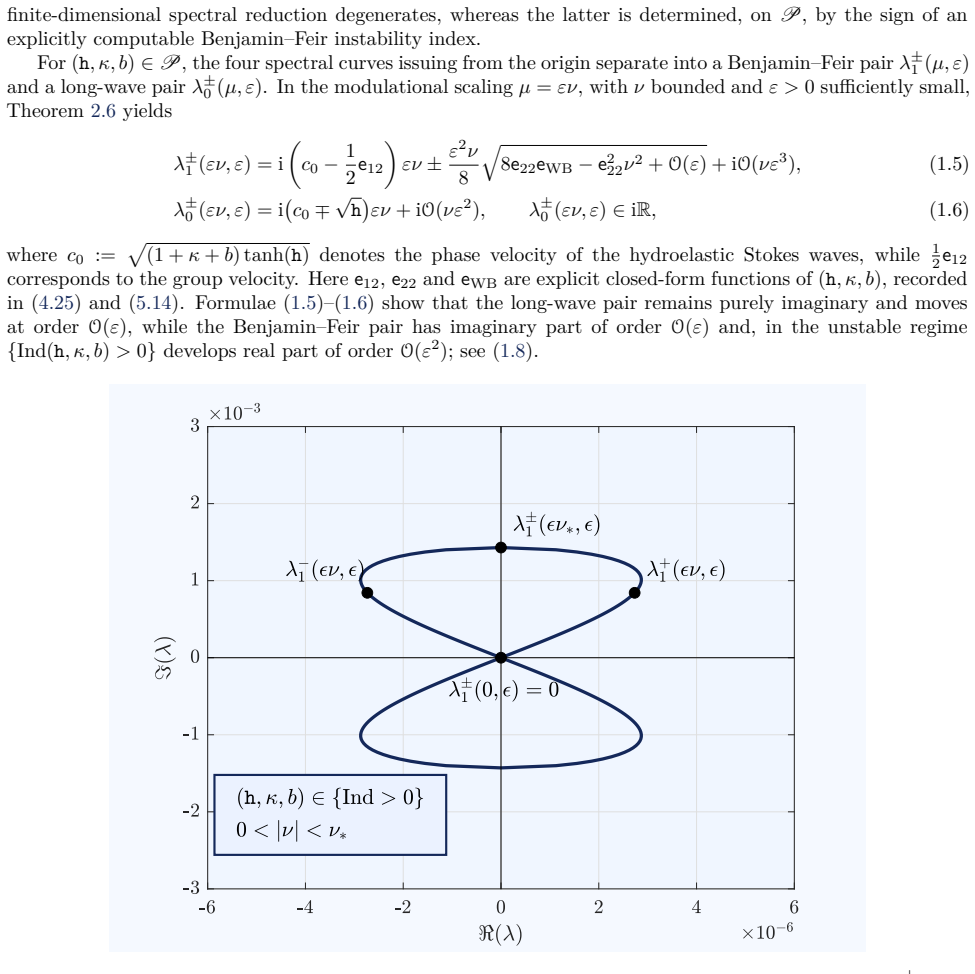
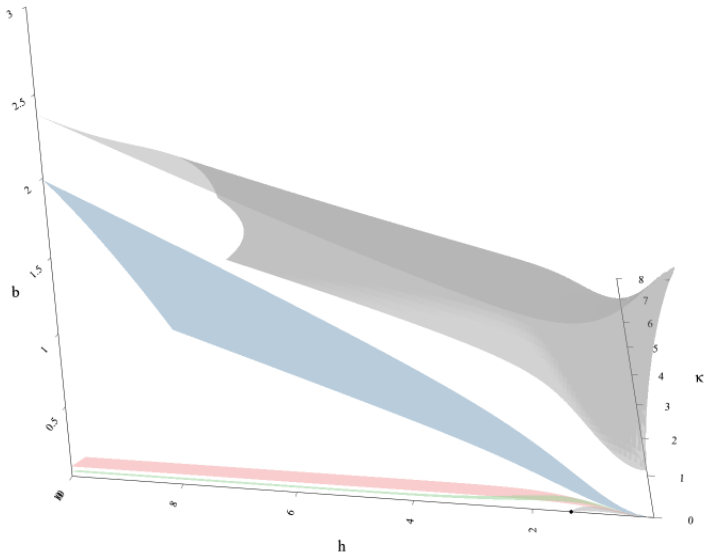
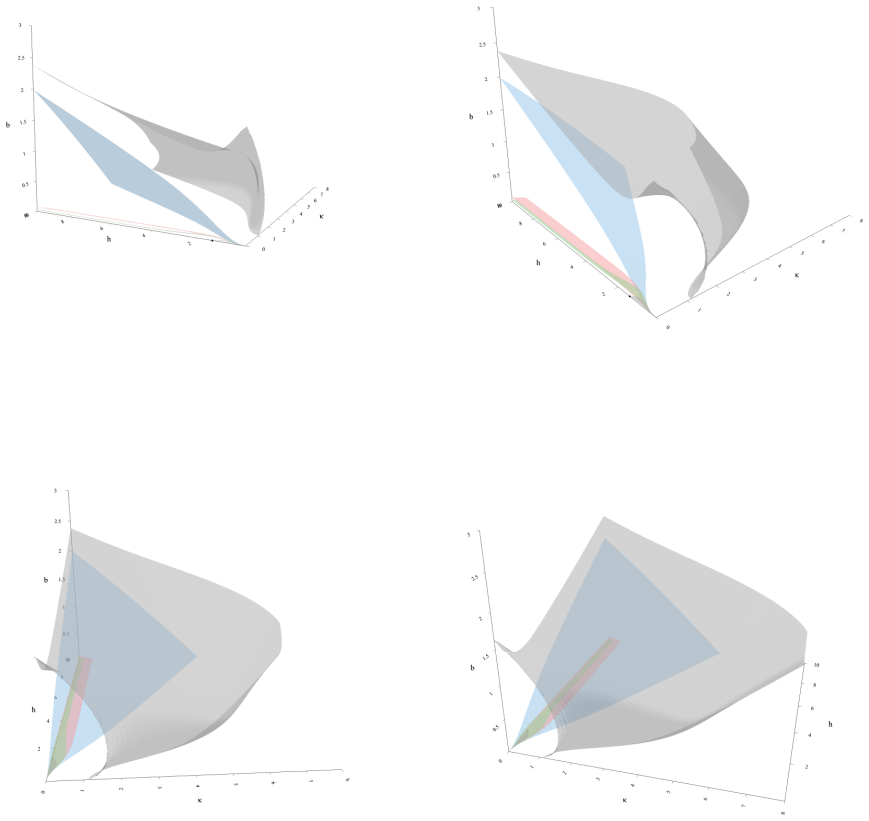
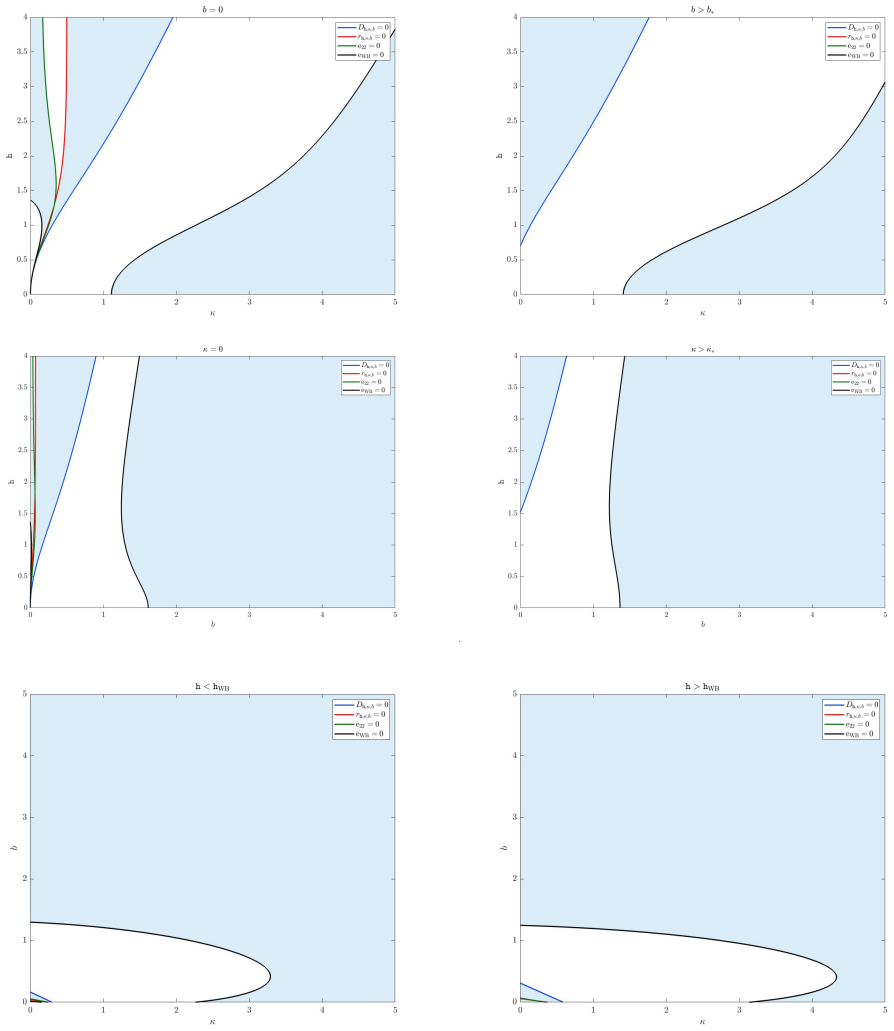
For the non-resonant Stokes branch and away from D, all four Bloch eigenvalues bifurcating from the origin are resolved. The long-wave pair remains purely imaginary while the Benjamin-Feir pair is governed by the explicit instability index Ind(h,κ,b): positive index yields a local figure-eight spectral curve with nonzero real part, negative index keeps all four small eigenvalues purely imaginary. This index with the Wilton-type resonance loci and D yields the three-parameter spectral-stability diagram.
What carries the argument
The instability index Ind(h,κ,b) that determines the nature of the Benjamin-Feir spectral pair after reduction of the Bloch operator to a four-dimensional subspace.
If this is right
- Positive value of the index produces a figure-eight spectral curve with nonzero real part indicating instability.
- Negative value keeps the four small eigenvalues purely imaginary, indicating stability in that regime.
- The diagram recovers the classical pure-gravity critical-depth limit and the gravity-capillary stability diagram on zero-bending boundary.
- All Wilton-type resonances disappear when bending rigidity b is at least 1/14 or surface tension kappa at least 1/2.
Where Pith is reading between the lines
- Similar reduction techniques may apply to other hydroelastic or capillary-gravity wave problems with additional restoring forces.
- The stability diagram could guide numerical simulations of wave evolution in hydroelastic settings to test predicted instabilities.
- The vanishing of resonances for large b or kappa suggests a threshold beyond which certain nonlinear interactions are suppressed.
Load-bearing premise
The reduction of the linearized Bloch operator to the four-dimensional spectral subspace and its conjugation to Benjamin-Feir and long-wave blocks requires the Hamiltonian and reversible structure together with the wave being on the non-resonant branch away from the collision surface D.
What would settle it
Numerical computation of the four small Bloch eigenvalues for a specific choice of h, κ, b where the index is positive should show a figure-eight curve, while for negative index they should all lie on the imaginary axis.
Figures
read the original abstract
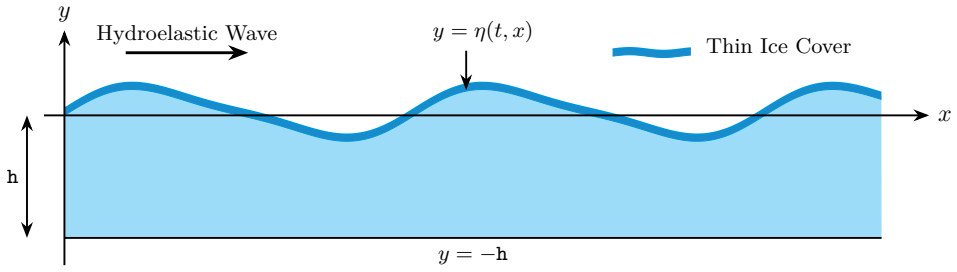
We determine the complete Benjamin-Feir spectrum near the origin for small-amplitude hydroelastic Stokes waves of the two-dimensional finite-depth irrotational Euler equations with surface tension and elastic bending. For the non-resonant Stokes branch and away from an intrinsic characteristic-collision surface $\mathfrak D$, we resolve all four Bloch eigenvalues bifurcating from the origin in the long-wave Floquet regime. Exploiting the Hamiltonian and reversible structure of the problem, we reduce the linearized Bloch operator to the four-dimensional spectral subspace bifurcating from the generalized kernel at the origin and conjugate the resulting matrix to the direct sum of a Benjamin-Feir block and a long-wave block. The long-wave pair remains purely imaginary, whereas the Benjamin-Feir pair is governed by an explicit closed-form instability index $\operatorname{Ind}(\mathtt{h},\kappa,b)$: a positive index produces a local figure-eight spectral curve with nonzero real part, while a negative index implies that all four small eigenvalues remain purely imaginary. Together with the Wilton-type resonance loci and the characteristic-collision surface $\mathfrak D$, this index yields a three-parameter spectral-stability diagram in the depth $\mathtt{h}$, surface tension $\kappa$, and bending rigidity $b$. The diagram recovers the classical pure-gravity critical-depth limit and, on the zero-bending boundary, the gravity--capillary stability diagram. It also reveals a genuinely hydroelastic phenomenon: all Wilton-type resonances disappear whenever $b\geq 1/14$ or $\kappa\geq 1/2$. This provides the first complete rigorous characterization of the local Benjamin-Feir spectrum for a hydroelastic free-boundary problem.
Editorial analysis
A structured set of objections, weighed in public.
Referee Report
Summary. The paper claims to resolve the complete local Benjamin-Feir spectrum near the origin for small-amplitude hydroelastic Stokes waves of the 2D finite-depth irrotational Euler equations with surface tension and elastic bending. For the non-resonant branch away from the characteristic-collision surface D, it reduces the linearized Bloch operator to the 4D generalized kernel subspace via the Hamiltonian and reversible structure, conjugates the resulting matrix to the direct sum of a Benjamin-Feir block and a long-wave block, and obtains an explicit closed-form instability index Ind(h,κ,b) whose sign determines whether the Benjamin-Feir eigenvalues acquire nonzero real part (producing a figure-eight curve) or remain purely imaginary. Combined with Wilton-type resonance loci and D, this yields a three-parameter spectral-stability diagram in depth h, surface tension κ, and bending rigidity b that recovers the classical pure-gravity and gravity-capillary cases and identifies regimes (b≥1/14 or κ≥1/2) where all Wilton resonances disappear.
Significance. If the reduction, conjugation, and explicitness of Ind(h,κ,b) are fully rigorous, the work supplies the first complete local stability diagram for a hydroelastic free-boundary problem, extending known gravity and gravity-capillary results while revealing genuinely hydroelastic phenomena. The explicit index and the three-parameter diagram constitute a concrete, falsifiable advance in the modulational stability theory of Hamiltonian free-boundary problems.
major comments (2)
- [reduction and conjugation argument (near the statement of the four-dimensional reduction)] The central reduction step (reduction of the linearized Bloch operator to the 4D spectral subspace followed by conjugation to the direct sum of Benjamin-Feir and long-wave blocks) is load-bearing for the claim that the sign of Ind(h,κ,b) controls the real part of the bifurcating eigenvalues. The manuscript must supply the explicit order-by-order calculation (or error estimates) showing that all cross-block terms vanish at the amplitude orders that determine the sign of the index; without this, residual coupling could alter whether a positive index produces nonzero real parts.
- [definition of Ind(h,κ,b) and the subsequent spectral-stability diagram] The assertion that Ind(h,κ,b) is an explicit closed-form expression (independent of post-hoc fitting or implicit solution of auxiliary equations) must be verified by displaying the final formula and confirming that every term is written in terms of the parameters h, κ, b and the underlying Stokes-wave quantities without further implicit dependence; the current outline leaves open whether the index reduces by construction to a quantity already determined by prior equations.
minor comments (2)
- [introduction of the three-parameter diagram] Notation: the symbol ℜ for the characteristic-collision surface should be introduced with a brief reminder of its definition when first used in the stability diagram.
- [discussion of limiting cases] The recovery of the classical pure-gravity critical-depth limit and the gravity-capillary diagram on the zero-bending boundary should be stated as a corollary with a short verification that the index reduces to the known expressions in those limits.
Simulated Author's Rebuttal
We thank the referee for their detailed and constructive report. We address each major comment below and indicate the revisions that will be made to strengthen the manuscript.
read point-by-point responses
-
Referee: The central reduction step (reduction of the linearized Bloch operator to the 4D spectral subspace followed by conjugation to the direct sum of Benjamin-Feir and long-wave blocks) is load-bearing for the claim that the sign of Ind(h,κ,b) controls the real part of the bifurcating eigenvalues. The manuscript must supply the explicit order-by-order calculation (or error estimates) showing that all cross-block terms vanish at the amplitude orders that determine the sign of the index; without this, residual coupling could alter whether a positive index produces nonzero real parts.
Authors: The reduction and conjugation are performed using the Hamiltonian and reversible structure of the linearized Bloch operator, which forces the cross-block coupling terms to vanish identically at the orders relevant to the instability index. The manuscript outlines this argument via the structural properties, but we acknowledge that an explicit order-by-order verification would remove any ambiguity. In the revised version we will add a dedicated appendix containing the full perturbative expansion of the conjugated matrix entries through the requisite amplitude orders, together with remainder estimates confirming that no residual coupling affects the sign of Ind(h,κ,b). revision: yes
-
Referee: The assertion that Ind(h,κ,b) is an explicit closed-form expression (independent of post-hoc fitting or implicit solution of auxiliary equations) must be verified by displaying the final formula and confirming that every term is written in terms of the parameters h, κ, b and the underlying Stokes-wave quantities without further implicit dependence; the current outline leaves open whether the index reduces by construction to a quantity already determined by prior equations.
Authors: Ind(h,κ,b) is obtained directly from the (1,1) and (2,2) entries of the reduced 2×2 Benjamin-Feir block after conjugation; each entry is an explicit algebraic combination of the Stokes-wave coefficients (themselves explicit functions of h, κ, b) and the parameters. No auxiliary equations remain to be solved. To make this fully transparent we will insert the complete closed-form expression for Ind(h,κ,b) into the main text immediately after the statement of the reduced matrix, with every term written out in terms of h, κ, b and the known Stokes quantities. revision: yes
Circularity Check
Hamiltonian/reversible reduction to 4D Bloch subspace yields explicit Ind(h,κ,b) without self-referential inputs
full rationale
The derivation reduces the linearized Bloch operator to the 4D generalized kernel via the problem's Hamiltonian and reversible structure on the non-resonant branch away from D, then conjugates the resulting matrix to a direct sum of a Benjamin-Feir block (governed by the closed-form index) and a long-wave block that remains imaginary. No step in the provided abstract or description equates the index or eigenvalue resolution to a fitted parameter, a self-citation chain, or an ansatz imported from prior author work; the index is presented as an explicit output of the conjugation. The result is therefore self-contained against external benchmarks and receives score 0.
Axiom & Free-Parameter Ledger
axioms (2)
- domain assumption The hydroelastic problem possesses Hamiltonian and reversible structure
- domain assumption Small-amplitude Stokes waves exist on the non-resonant branch away from the characteristic-collision surface D
Reference graph
Works this paper leans on
-
[1]
Ahmad and M.D
R. Ahmad and M.D. Groves. Spatial dynamics and solitary hydroelastic surface waves . Water Waves. 6, 1, 5–47, 2024
2024
-
[2]
Akers, D.M
B.F. Akers, D.M. Ambrose, D.W. Sulon. Periodic traveling interfacial hydroelastic waves with or without mass . Zeitschrift für angewandte Mathematik und Physik. 68, 6, 141, 2017
2017
-
[3]
Akers, D.M
B.F. Akers, D.M. Ambrose, D.W. Sulon. Periodic travelling interfacial hydroelastic waves with or without mass II: multiple bifurcations and ripples . European Journal of Applied Mathematics. 30, 4, 756–790, 2019
2019
-
[4]
Baldi, M
P. Baldi, M. Berti, E. Haus, and R. Montalto. Time quasi-periodic gravity water waves in finite depth , Inventiones Math. Volume 214 Number 2, pp. 739-911, 2018
2018
-
[5]
Baldi, J.F
P. Baldi, J.F. Toland Steady periodic water waves under nonlinear elastic membranes , J. Reine Angew. Math. Volume 652, pp. 67–112, 2011
2011
-
[6]
Benjamin
T. Benjamin. Instability of periodic wavetrains in nonlinear dispersive systems , Proc. R. Soc. Lond. Ser. A Math. Phys. Eng. Sci. Volume 299 Issue 1456, 1967
1967
-
[7]
Benjamin and J
T. Benjamin and J. Feir. The disintegration of wave trains on deep water , Part 1. Theory. J. Fluid Mech. 27(3): 417-430, 1967
1967
-
[8]
Berti, L
M. Berti, L. Corsi, A. Maspero, P. Ventura. Infinitely many isolas of modulational instability of Stokes waves. arXiv, 2024
2024
- [9]
-
[10]
Berti, A
M. Berti, A. Maspero and P. Ventura. Full description of Benjamin–Feir instability of Stokes waves in deep water , Inventiones Math., 230, 651–711, 2022
2022
-
[11]
Berti, A
M. Berti, A. Maspero and P. Ventura. On the analyticity of the Dirichlet-Neumann operator and Stokes waves , Rend. Lincei Mat. Appl., 33, 611–650, 2022
2022
-
[12]
Berti, A
M. Berti, A. Maspero and P. Ventura. Benjamin-Feir instability of Stokes waves in finite depth , Arch. Rational Mech. Anal. 247, 91, 2023
2023
-
[13]
Berti, A
M. Berti, A. Maspero and P. Ventura. Stokes waves at the critical depth are modulationally unstable , Comm. Math. Phys., 405:56, 2024
2024
-
[14]
M. Berti, A. Maspero and P. Ventura. First isola of modulational instability of Stokes waves in deep water , EMS Surv. Math. Sci. 12, 79–122, European Mathematical Society DOI 10.4171/EMSS/91, 2025
-
[15]
R. Bianchini, A. Maspero and S. Pasquali. Instabilities of internal gravity waves in the two-dimensional Boussinesq system. ArXiv:2507.10390, 2025. 53
-
[16]
Bridges and A
T. Bridges and A. Mielke. A proof of the Benjamin-Feir instability. Arch. Rational Mech. Anal. 133(2): 145–198, 1995
1995
-
[17]
Byrnes, B
E. Byrnes, B. Deconinck and A. Semenova Stokes Waves in Water of Finite Depth. Journal of Nonlinear Waves, 2, e7, 2026
2026
-
[18]
Chen and Q
G. Chen and Q. Su. Nonlinear modulational instability of the Stokes waves in 2d full water waves. Commun. Math. Phys, 1345–1452, 2023
2023
-
[19]
Craig and C
W. Craig and C. Sulem. Numerical simulation of gravity waves. J. Comput. Phys., 108(1): 73–83, 1993
1993
-
[20]
Creedon, B
R. Creedon, B. Deconinck. A High-Order Asymptotic Analysis of the Benjamin-Feir Instability Spectrum in Arbitrary Depth , J. Fluid Mech. 956, A29, 2023
2023
-
[21]
Creedon, B
R. Creedon, B. Deconinck., O. Trichtchenko. High-Frequency Instabilities of Stokes Waves , J. Fluid Mech. 937, A24, 2022
2022
-
[22]
R. P. Creedon, H. Q. Nguyen, and W. A. Strauss. Proof of the transverse instability of Stokes waves , Annals of PDE, 11:4, 2025
2025
- [23]
-
[24]
Dammann, M.A
D.O. Dammann, M.A. Johnson, A.R. Mahoney, and E.R. Fedders First observations of sea ice flexural–gravity waves with ground-based radar interferometry in Utqiaġvik, Alaska. The Cryosphere. 17, 4, 1609–1622, 2023
2023
-
[25]
Davys, R.J
J.W. Davys, R.J. Hosking, and A.D. Sneyd. Waves due to a steadily moving source on a floating ice plate. J. Fluid Mech. 158, 269–287, 1985
1985
-
[26]
Deconinck and K
B. Deconinck and K. Oliveras. The instability of periodic surface gravity waves. J. Fluid Mech., 675: 141–167, 2011
2011
-
[27]
Deike, J.-C
L. Deike, J.-C. Bacri, and E. Falcon Nonlinear waves on the surface of a fluid covered by an elastic sheet , Journal of Fluid Mechanics. 733, 394–413, 2013
2013
-
[28]
Deike, M
L. Deike, M. Berhanu, and E. Falcon Experimental observation of hydroelastic three-wave interactions , Physical Review Fluids. 2, 6, 064803, 2017
2017
-
[29]
Ewing and A.P
M. Ewing and A.P. Crary. Propagation of elastic waves in ice. Part II. Physics. 5, 7, 181–184, 1934
1934
-
[30]
Groves, B
M. Groves, B. Hewer, and E. Wahlén. Variational existence theory for hydroelastic solitary waves. Comptes Rendus Mathe- matique. 354, 11, 1078–1086, 2016
2016
-
[31]
Guyenne and E.I
P. Guyenne and E.I. Părău. Computations of fully nonlinear hydroelastic solitary waves on deep water. Journal of Fluid Mechanics, 713, 307–329, 2012
2012
-
[32]
Haragus, T
M. Haragus, T. Truong and E. Wahlén. Transverse Dynamics of Two-Dimensional Traveling Periodic Gravity–Capillary Water Waves. Water Waves 5, 65–99, 2023
2023
-
[33]
Hur and Z
V. Hur and Z. Yang. Unstable Stokes waves . Arch. Rational Mech. Anal. 247, 62, 2023
2023
-
[34]
Stable and unstable capillary-gravity waves
V. Hur and Z. Yang. Unstable capillary-gravity waves . arXiv:2311.01368, 2023
work page internal anchor Pith review Pith/arXiv arXiv 2023
-
[35]
T.-Y. Hsiao. Unstable Stokes waves in constant vorticity flows . (Doctoral dissertation, University of Illinois at Urbana- Champaign) 2024
2024
-
[36]
T.-Y. Hsiao and A. Maspero. Full Benjamin-Feir instability of capillary-gravity Stokes waves in finite depth . arXiv:2510.23456, 2025
-
[37]
Spectral structure of the Benjamin-Feir instability in deep-water gravity-capillary Stokes waves
T.-Y. Hsiao and X. Wang. Spectral structure of the Benjamin-Feir instability in deep-water gravity-capillary Stokes waves . arXiv:2604.16724, 2026
work page internal anchor Pith review Pith/arXiv arXiv 2026
-
[38]
Jiao, L.M
Z. Jiao, L.M. Rodrigues, C. Sun, Z. Yang. Small-amplitude finite-depth Stokes waves are transversally unstable , Comm. Math. Phys., 406, pages 255, 2025
2025
-
[39]
T. Kato. Perturbation theory for linear operators. Die Grundlehren der mathematischen Wissenschaften, Band 132 Springer- Verlag New York, Inc., New York, 1966
1966
-
[40]
Korobkin, E.I
A. Korobkin, E.I. Părău, and J.-M. Vanden-Broeck The mathematical challenges and modelling of hydroelasticity , Philosoph- ical Transactions of the Royal Society A: Mathematical, Physical and Engineering Sciences. 369, 1947, 2803–2812, 2011
1947
-
[41]
Transfer of energy for pure-gravity water waves with constant vorticity
B. Langella, A. Maspero, F. Murgante, S. Terracina. Transfer of energy for pure-gravity water waves with constant vorticity , ArXiv:2604.08343, 2026
work page internal anchor Pith review Pith/arXiv arXiv 2026
-
[42]
D. Lannes. Well-posedness of the water-waves equations, J. Amer. Math. Soc. 18 , pp. 605-654, 2005
2005
-
[43]
D. Lannes. The water waves problem. Mathematical analysis and asymptotics. Mathematical Surveys and Monographs 188. American Mathematical Society, Providence, RI, 2013. xx+321 pp
2013
-
[44]
Levi-Civita
T. Levi-Civita. Détermination rigoureuse des ondes permanentes d’ ampleur finie, Math. Ann. 93 , pp. 264-314, 1925
1925
-
[45]
M. J. Lighthill. Contribution to the theory of waves in nonlinear dispersive systems , IMA Journal of Applied Mathematics, 1, 3, 269-306, 1965
1965
-
[46]
Martin, E.I
C.-I. Martin, E.I. Părău Travelling hydroelastic waves in constant vorticity flows with stagnation points , Proceedings of the Royal Society A: Mathematical, Physical and Engineering Sciences. 482, 2329, 2026
2026
-
[47]
J. W. McLean. Instabilities of finite-amplitude water waves , J. Fluid Mech. 114, 315-330, 1982
1982
-
[48]
J. W. McLean. Instabilities of finite-amplitude gravity waves on water of infinite depth , J. Fluid Mech. 114, 331-341, 1982
1982
-
[49]
Milewski, J.-M
P.A. Milewski, J.-M. Vanden-Broeck, and Z. Wang Hydroelastic solitary waves in deep water , J. Fluid Mech. 679, 628–640, 2011
2011
-
[50]
Nekrasov
A. Nekrasov. On steady waves . Izv. Ivanovo-Voznesenk. Politekhn. 3, 1921
1921
-
[51]
Nguyen and W
H. Nguyen and W. Strauss. Proof of modulational instability of Stokes waves in deep water . Comm. Pure Appl. Math., Volume 76, Issue 5, 899–1136, 2023
2023
-
[52]
Ono-dit-Biot, M
J.-C. Ono-dit-Biot, M. Trejo, E. Loukiantcheko, M. Lauch, E. Raphaël, K. Dalnoki-Veress, Kari, and T. Salez. Hydroelastic wake on a thin elastic sheet floating on water . Physical Review Fluids. 4, 1, 014808, 2019. 54
2019
-
[53]
Plotnikov and J.F
P.I. Plotnikov and J.F. Toland. Modelling nonlinear hydroelastic waves . Philosophical Transactions of the Royal Society A: Mathematical, Physical and Engineering Sciences. 369, 1947, 2942–2956, 2011
1947
-
[54]
Plotnikov and J.F
P.I. Plotnikov and J.F. Toland. Strain-gradient theory of hydroelastic travelling waves and young measures of their singular limits. Calculus of Variations and Partial Differential Equations. 44, 1, 153–197, 2012
2012
-
[55]
I. M. Prasad and H. Behera. Hydroelastic waves induced by initial disturbances in ice-covered waters with currents . Scientific Reports. 16, 4257, 2026
2026
-
[56]
M. Reed, B. Simon Methods of modern mathematical physics. IV. Analysis of operators, Academic Press [Harcourt Brace Jovanovich Publishers], New York, 1978
1978
-
[57]
Reeder, M
J. Reeder, M. Shinbrot. Analytic Branches of Resonant Waves. , ARMA 77, 289–309, 1981
1981
-
[58]
Squire Of ocean waves and sea-ice revisited
V.A. Squire Of ocean waves and sea-ice revisited . Cold Regions Science and Technology. 49, 2, 110–133, 2007
2007
-
[59]
Squire, J.P
V.A. Squire, J.P. Dugan, P. Wadhams, P. Rottier, and A.K. Liu Of ocean waves and sea ice . Annual Review of Fluid Mechanics. 27, 1, 115–168, 1995
1995
-
[60]
G. Stokes. On the theory of oscillatory waves . Trans. Cambridge Phil. Soc. 8: 441–455, 1847
-
[61]
D. Struik. Détermination rigoureuse des ondes irrotationelles périodiques dans un canal á profondeur finie . Math. Ann. 95: 595–634, 1926
1926
- [62]
-
[63]
J.F. Toland. Steady periodic hydroelastic waves , Archive for rational mechanics and analysis. 189, 2, 325–362, 2008
2008
-
[64]
Trichtchenko, P
O. Trichtchenko, P. Milewski, E. Părău, and J.-M. Vanden-Broeck. Stability of periodic traveling flexural-gravity waves in two dimensions, Studies in Applied Mathematics. 142, 1, 65–90, 2019
2019
- [65]
-
[66]
J.R. Wilton. On ripples. The London, Edinburgh, and Dublin Philosophical Magazine and Journal of Science (6), 29(173), 688–700, 1915
1915
-
[67]
G.B. Whitham. Non-linear dispersion of water waves . J. Fluid Mech, volume 26 part 2 pp. 399-412, 1967
1967
-
[68]
Zakharov
V. Zakharov. Stability of periodic waves of finite amplitude on the surface of a deep fluid . J. Appl. Mech. Tech. Phys. 9, 190-194, 1968
1968
-
[69]
Zakharov
V. Zakharov. Stability of periodic waves of finite amplitude on the surface of deep fluid . Zhurnal Prikladnoi Mekhaniki i Teckhnicheskoi Fiziki 9(2): 86–94, 1969
1969
-
[70]
Zakharov and V
V. Zakharov and V. Kharitonov. Instability of monochromatic waves on the surface of a liquid of arbitrary depth . J Appl Mech Tech Phys 11, 747-751, 1970. 55
1970
discussion (0)
Sign in with ORCID, Apple, or X to comment. Anyone can read and Pith papers without signing in.