Topological Triplons in the Pinwheel Valence Bond Solid on the Kagome Lattice
Pith reviewed 2026-06-27 14:44 UTC · model grok-4.3
The pith
Dzyaloshinskii-Moriya interactions and an external magnetic field endow triplon bands with nontrivial Chern numbers in the pinwheel valence-bond solid on the deformed kagome lattice.
A machine-rendered reading of the paper's core claim, the machinery that carries it, and where it could break.
Core claim
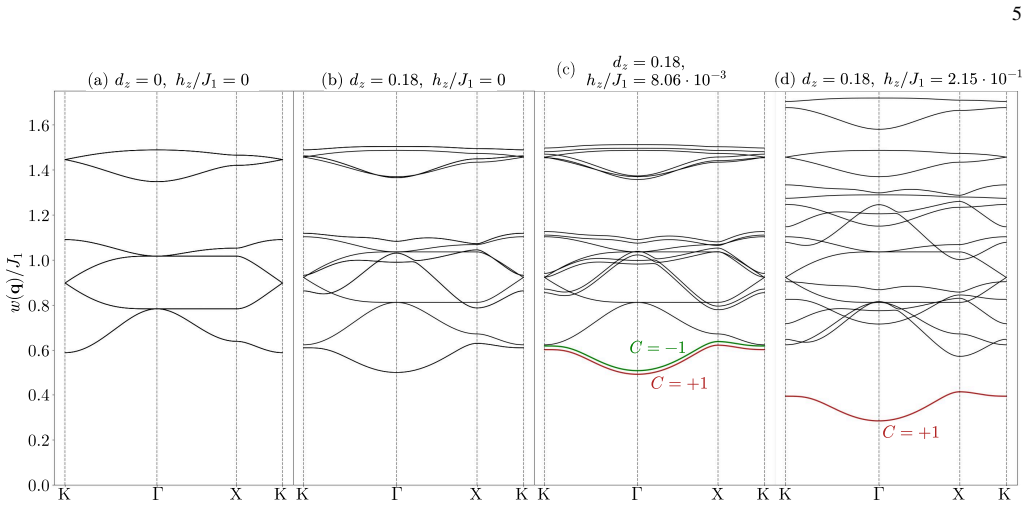
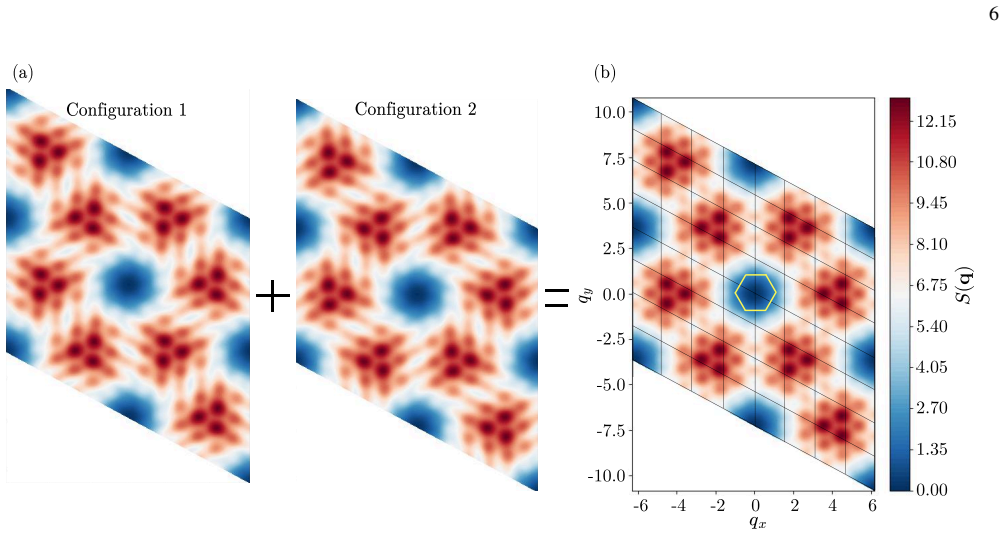
Using bond-operator mean-field theory, the triplon band structure of the pinwheel valence-bond-solid phase on the deformed kagome lattice acquires nontrivial Chern numbers due to Dzyaloshinskii-Moriya interactions and an applied magnetic field. An external field can isolate the lowest Chern band, resulting in a tunable thermal Hall conductivity observable at accessible temperatures and fields. The low-energy dynamical structure factor agrees qualitatively with neutron-scattering experiments.
What carries the argument
Bond-operator mean-field theory for triplon excitations, with Dzyaloshinskii-Moriya interactions and Zeeman field included to generate Berry curvature and Chern numbers.
If this is right
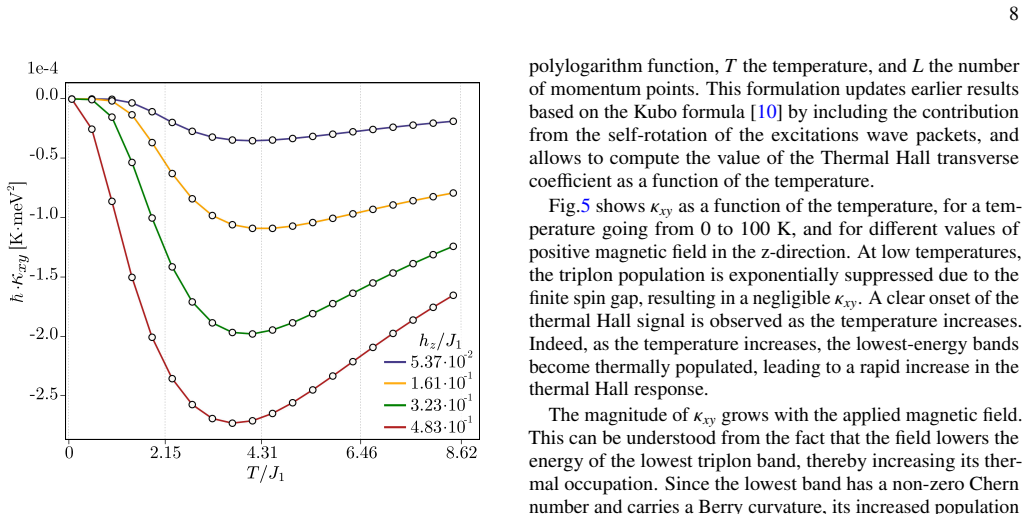
- An applied magnetic field isolates the lowest triplon Chern band and produces a tunable thermal Hall conductivity at accessible temperatures and fields.
- The low-energy dynamical structure factor matches neutron-scattering measurements qualitatively.
- The deformed kagome pinwheel valence-bond solid becomes a platform for realizing topological triplon physics.
Where Pith is reading between the lines
- Similar DM-driven Chern bands may appear in other valence-bond solids once an external field is applied.
- Direct measurement of the thermal Hall effect in Rb2Cu3SnF12 at moderate fields would test the predicted isolation of the lowest Chern band.
- The same mean-field treatment could be applied to related frustrated magnets to predict additional topological responses in their excitation spectra.
Load-bearing premise
Bond-operator mean-field theory supplies a quantitatively reliable triplon spectrum and Berry curvature, so that higher-order fluctuation corrections leave the Chern numbers unchanged.
What would settle it
A measured thermal Hall conductivity whose field and temperature dependence deviates from the isolated lowest Chern band prediction, or neutron data showing a triplon dispersion incompatible with the calculated Chern bands.
Figures
read the original abstract
We investigate the triplon excitations of the pinwheel valence-bond-solid phase on the deformed kagome lattice compound Rb2Cu3SnF12. Using bond-operator mean-field theory, we compute the triplon band structure, dynamical structure factor, Berry curvatures and the associated thermal Hall response. We show that the presence of Dzyaloshinskii-Moriya interactions and an external magnetic field are key for endowing triplon bands with nontrivial Chern numbers. We find good qualitative agreement of the low-energy dynamical structure factor with neutron-scattering experiments. An applied magnetic field can isolate the lowest triplon Chern band leading to a tunable thermal Hall conductivity for accessible temperature and field regimes. Our results establish the deformed kagome pinwheel valence-bond solid as a promising platform for topological triplon physics and for observing the associated thermal Hall effect.
Editorial analysis
A structured set of objections, weighed in public.
Referee Report
Summary. The paper applies bond-operator mean-field theory to the deformed kagome Heisenberg model with Dzyaloshinskii-Moriya interactions and external field to study triplon excitations in the pinwheel valence-bond-solid phase of Rb2Cu3SnF12. It computes the triplon dispersion, dynamical structure factor (showing qualitative agreement with neutron data), Berry curvatures, Chern numbers, and thermal Hall conductivity, arguing that DM terms plus field produce nontrivial topology and that field tuning can isolate the lowest Chern band for accessible thermal Hall response.
Significance. If the mean-field treatment reliably determines the triplon topology, the work identifies a concrete material platform for topological triplons and tunable thermal Hall conductivity in experimentally relevant regimes, adding to the literature on magnon/triplon Chern bands.
major comments (3)
- [§III B] §III B (Bond-operator mean-field): the quadratic bosonic Hamiltonian obtained after saddle-point decoupling is diagonalized to yield bands whose Berry curvature is integrated for Chern numbers; no 1/S correction, fluctuation analysis, or small-cluster benchmark is supplied to show that residual interactions cannot close gaps or flip Chern numbers, which is load-bearing for the central claim of nontrivial topology.
- [§IV B] §IV B (Berry curvature and Chern numbers): the reported nontrivial Chern numbers rest on the mean-field spectrum; the qualitative match of the dynamical structure factor to neutron data constrains spectral weights but provides no direct constraint on integrated Berry curvature, leaving the topological assignment unverified.
- [§IV C] §IV C (Thermal Hall response): the proposal that an applied field isolates the lowest Chern band for tunable thermal Hall assumes the mean-field gaps and curvatures remain accurate under field; no check is given that field-induced mixing or higher-order terms preserve the isolation or the quantized contribution.
minor comments (2)
- [§II] The values chosen for the DM strength (a free parameter) should be stated explicitly with a brief justification or sensitivity test, as they directly control the gap and Berry curvature.
- [Fig. 2] Figure captions for the dynamical structure factor plots could include a direct overlay or quantitative metric of agreement with the cited neutron data to strengthen the comparison.
Simulated Author's Rebuttal
We thank the referee for the careful reading and constructive comments. We respond to each major comment below.
read point-by-point responses
-
Referee: [§III B] §III B (Bond-operator mean-field): the quadratic bosonic Hamiltonian obtained after saddle-point decoupling is diagonalized to yield bands whose Berry curvature is integrated for Chern numbers; no 1/S correction, fluctuation analysis, or small-cluster benchmark is supplied to show that residual interactions cannot close gaps or flip Chern numbers, which is load-bearing for the central claim of nontrivial topology.
Authors: We agree that explicit 1/S corrections or cluster benchmarks are not provided. Bond-operator mean-field theory is the standard controlled approximation for triplon spectra in VBS phases and has been benchmarked against exact diagonalization and series expansion in related models; the qualitative match to the measured dynamical structure factor further supports the accuracy of the gaps that enter the Chern-number calculation. We will add a short paragraph in §III B discussing these limitations and citing prior validations of the method for topological quantities. revision: yes
-
Referee: [§IV B] §IV B (Berry curvature and Chern numbers): the reported nontrivial Chern numbers rest on the mean-field spectrum; the qualitative match of the dynamical structure factor to neutron data constrains spectral weights but provides no direct constraint on integrated Berry curvature, leaving the topological assignment unverified.
Authors: The dynamical structure factor is computed from the same mean-field eigenvectors that determine the Berry curvature, so consistency with neutron data indirectly constrains the wave-function content. Direct experimental access to Berry curvature is not available, but the topology is a robust consequence of the DM terms and field within the model. We will incorporate the discussion added to §III B to make this dependence explicit; no further revision is required. revision: partial
-
Referee: [§IV C] §IV C (Thermal Hall response): the proposal that an applied field isolates the lowest Chern band for tunable thermal Hall assumes the mean-field gaps and curvatures remain accurate under field; no check is given that field-induced mixing or higher-order terms preserve the isolation or the quantized contribution.
Authors: The field enters the mean-field Hamiltonian by shifting the triplon energies while preserving the form of the eigenvectors; within the parameter range shown, the lowest band remains isolated. We acknowledge that higher-order corrections could modify this at stronger fields. We will add a clarifying sentence in §IV C stating the mean-field assumptions under applied field. revision: yes
Circularity Check
No circularity in derivation chain
full rationale
The paper applies bond-operator mean-field theory to a deformed kagome Heisenberg model augmented by explicit DM interactions and external field as independent inputs. The resulting quadratic bosonic Hamiltonian yields triplon bands whose Berry curvature is integrated to obtain Chern numbers; these quantities are computed outputs rather than redefined inputs. No step equates a prediction to a fitted parameter by construction, renames a known result, or relies on a load-bearing self-citation whose validity reduces to the present work. The thermal Hall conductivity follows directly from the isolated Chern band under applied field. The derivation remains self-contained against external benchmarks such as neutron scattering spectra.
Axiom & Free-Parameter Ledger
free parameters (2)
- DM interaction strength
- Magnetic field value
axioms (1)
- domain assumption Bond-operator mean-field theory accurately captures triplon dispersion and Berry curvature.
Reference graph
Works this paper leans on
-
[1]
(3) and (5))
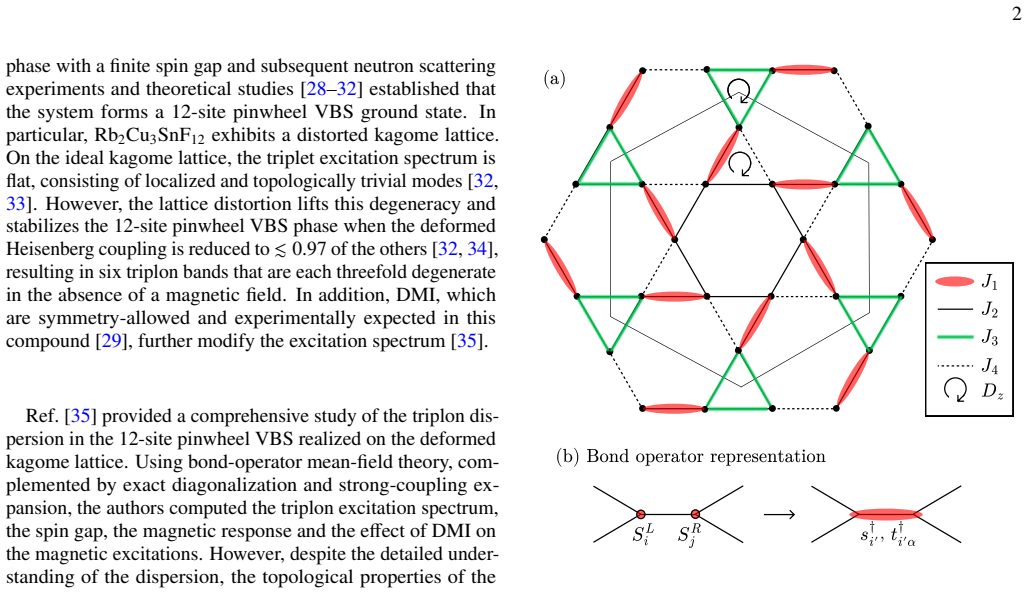
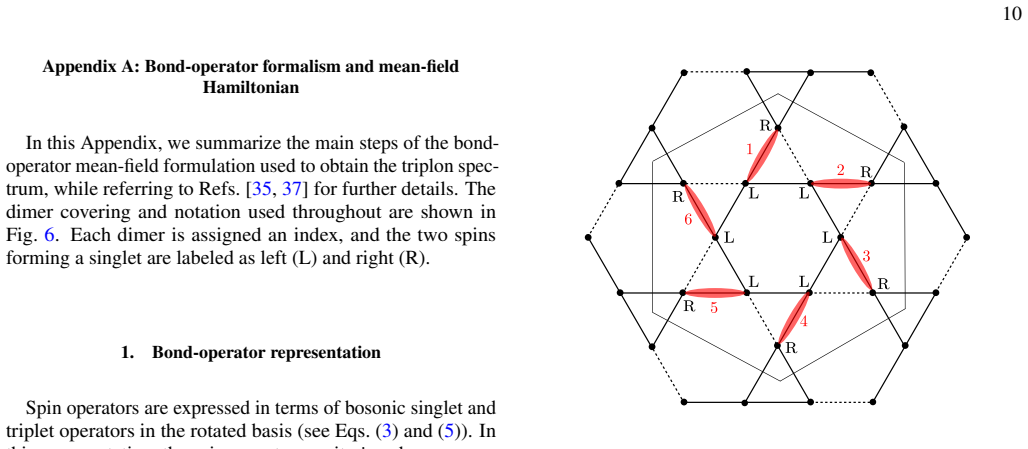
Bond-operator representation Spin operators are expressed in terms of bosonic singlet and triplet operators in the rotated basis (see Eqs. (3) and (5)). In this representation, the spin operator on siteireads S α i = i 2(ci( ˜s†tα cosθ+ ˜t† z tα sinθ−h.c.)− E αβγt† βtγ), (A1) with ci = +1 (−1) for right (left) spins, and the original triplet operators are...
-
[2]
The singlet operator is replaced by its expectation value ˜s→¯s, and quartic terms are decoupled using the mean fields defined in Eq
Mean-field approximation Quartic triplon interactions are treated within a Hartree–Fock mean-field approximation. The singlet operator is replaced by its expectation value ˜s→¯s, and quartic terms are decoupled using the mean fields defined in Eq. (10). The parameters µ and ¯sare determined self-consistently from the saddle-point equations: * ∂HMF ∂µ + =0...
-
[3]
Momentum-space formulation Denotingqthe momentum in the first BZ, the Hamiltonian is Fourier transformed using X r t† iα(r)t jβ(r+R)= X q e−iq·Rt† iα(q)t jβ(q),(A7) X r tiα(r)t jβ(r+R)= X q eiq·Rtiα(q)t jβ(−q).(A8) The various contributions to the Hamiltonian reduce to the following forms. HDimer +H µ = Ns 2 (Es ¯s2 +µ(1−¯s 2))+ X q,α Eα −µ 2 (e−iq·Rt† iα...
-
[4]
Bosonic Bogoliubov Diagonalisation Due to the presence of anomalous terms tiαt jβ and t† iαt† jβ, the Hamiltonian is diagonalized using a bosonic Bogoliubov–de Gennes (BdG) formalism. Writing Ht = X q Ψ† qM(q)Ψq (A12) with the bosonic operators gathered in a Nambu spinor, Ψq =(t 1x(q)t1y(q)...t6z(q)t† 1x(−q)t† 1y(−q)...)T (A13) and where the BdG matrixM( ...
-
[5]
Spins are expressed using bond operators and only quadratic and quartic triplon terms are kept
Imaginary-time susceptibility The imaginary-time spin susceptibility is defined as χαα′(⃗q, τ)= 1 N X i,j ei⃗q(⃗R j−⃗Ri) D TτS α i (τ)S α′ j (0) E = 1 N X i,j ei⃗q(⃗r j−⃗ri) Z β 0 dτe iωnτ D TτS α i (τ)S α′ j (0) E (B2) 12 where Tτ is the time-ordering operator and which can be ex- panded in Matsubara frequencies. Spins are expressed using bond operators ...
-
[6]
U(αa),mU∗ (α′b),m iνn −E m − V(αa),mV∗ (α′b),m iνn +E m # ,(B8) Fαα′ ab (⃗q,iν n)= X m
Matsubara Green functions The normal and anomalous Green functions are defined as Gαα′ ab (⃗q,iν n)= Z β 0 dτe iνnτGαα′ ab (⃗q, τ) (B4) =− Z β 0 dτe iνnτ⟨Tτ tαa(⃗q, τ)t † α′b(⃗q,0)⟩,(B5) Fαα′ ab (⃗q,iν n)= Z β 0 dτe iνnτFαα′ ab (⃗q, τ) (B6) =− Z β 0 dτe iνnτ⟨Tτ tαa(−⃗q, τ)t α′b(⃗q,0)⟩,(B7) where we then take β→ ∞ . Using the Bogoliubov transfor- mation gi...
-
[7]
After analytic continuation iωn →ω + i0+, we obtain the retarded susceptibility
Quadratic (one-triplon) contribution Substituting the above Green functions in the quadratic con- tribution of the susceptibility yields χ(2) αα(⃗q,iω n)= ¯s2 48 X i,j,m C(1) i j,αei⃗q(⃗r j−⃗ri) " Aα i′ j′,m(−⃗q) iωn −E m(−⃗q) − (Aα i′ j′,m(⃗q))∗ iωn +E m(⃗q) # , (B10) withA α i′ j′,m(⃗q)= Ui′α,m − V∗ i′α,m U∗ j′α,m − V j′α,m . After analytic continuation...
-
[8]
The result is shown in Fig
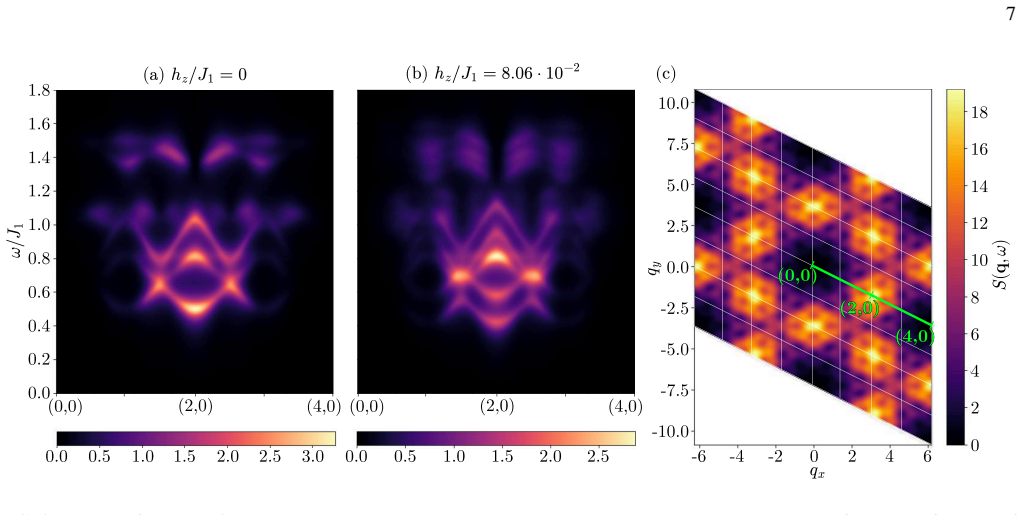
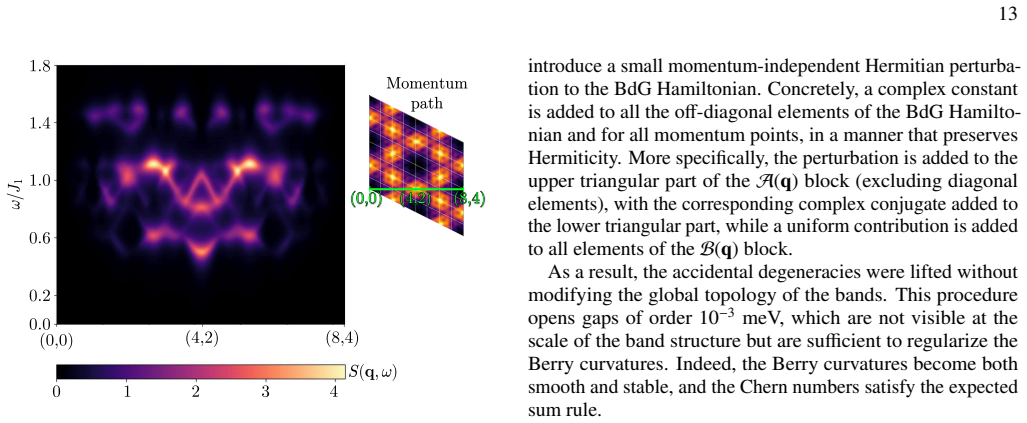
Additional dynamical structure factor result along one-dimensional path In addition to the dynamical structure factor results pre- sented in the main text, we also compute the spectral intensity along an alternative one-dimensional momentum path. The result is shown in Fig. 7 for dz =0 .18 and in the absence of a magnetic field. The chosen path, highlight...
-
[9]
Raghu and F
S. Raghu and F. D. M. Haldane, Analogs of quantum-hall-effect edge states in photonic crystals, Physical Review A—Atomic, Molecular, and Optical Physics78, 033834 (2008)
2008
-
[10]
Petrescu, A
A. Petrescu, A. A. Houck, and K. Le Hur, Anomalous hall effects of light and chiral edge modes on the kagomé lattice, Physical Review A—Atomic, Molecular, and Optical Physics86, 053804 (2012)
2012
-
[11]
M. C. Rechtsman, J. M. Zeuner, Y . Plotnik, Y . Lumer, D. Podol- sky, F. Dreisow, S. Nolte, M. Segev, and A. Szameit, Photonic floquet topological insulators, Nature496, 196 (2013)
2013
-
[12]
Hafezi, S
M. Hafezi, S. Mittal, J. Fan, A. Migdall, and J. Taylor, Imaging topological edge states in silicon photonics, Nature Photonics7, 1001 (2013)
2013
-
[13]
Zhang, J
L. Zhang, J. Ren, J.-S. Wang, and B. Li, Topological nature of the phonon hall effect, Physical review letters105, 225901 (2010)
2010
-
[14]
Zhang, J
L. Zhang, J. Ren, J.-S. Wang, and B. Li, The phonon hall effect: theory and application, Journal of Physics: Condensed Matter 23, 305402 (2011)
2011
-
[15]
T. Qin, J. Zhou, and J. Shi, Berry curvature and the phonon hall effect, Physical Review B—Condensed Matter and Materials Physics86, 104305 (2012)
2012
-
[16]
Shindou, R
R. Shindou, R. Matsumoto, S. Murakami, and J.-i. Ohe, Topolog- ical chiral magnonic edge mode in a magnonic crystal, Physical Review B—Condensed Matter and Materials Physics87, 174427 (2013)
2013
-
[17]
Zhang, J
L. Zhang, J. Ren, J.-S. Wang, and B. Li, Topological magnon insulator in insulating ferromagnet, Physical Review B—Condensed Matter and Materials Physics87, 144101 (2013)
2013
-
[18]
Katsura, N
H. Katsura, N. Nagaosa, and P. A. Lee, Theory of the thermal hall effect in quantum magnets, Physical review letters104, 066403 (2010)
2010
-
[20]
A. Mook, J. Henk, and I. Mertig, Magnon hall effect and topol- ogy in kagome lattices: A theoretical investigation, Physical Review B89, 134409 (2014)
2014
-
[21]
Chisnell, J
R. Chisnell, J. Helton, D. Freedman, D. Singh, R. Bewley, D. No- cera, and Y . Lee, Topological magnon bands in a kagome lattice ferromagnet, Physical review letters115, 147201 (2015)
2015
-
[22]
P. A. McClarty, Topological magnons: A review, Annual Review of Condensed Matter Physics13, 171 (2022)
2022
-
[23]
Romhányi, K
J. Romhányi, K. Penc, and R. Ganesh, Hall effect of triplons in a dimerized quantum magnet, Nature communications6, 6805 (2015)
2015
-
[24]
P. A. McClarty, F. Krüger, T. Guidi, S. Parker, K. Refson, A. Parker, D. Prabhakaran, and R. Coldea, Topological triplon modes and bound states in a shastry–sutherland magnet, Nature Physics13, 736 (2017)
2017
-
[26]
d’Ornellas and J
P. d’Ornellas and J. Knolle, Kitaev-heisenberg model on the star lattice: From chiral majorana fermions to chiral triplons, Physical Review B109, 094421 (2024)
2024
-
[27]
N. Esaki, Y . Akagi, K. Penc, and H. Katsura, Spin nernst and thermal hall effects of topological triplons in quantum dimer magnets on the maple-leaf and star lattices (2025), arXiv preprint arXiv:2505.09420 10.1103/1yv1-wtx8
-
[28]
Zhang, Y
X.-T. Zhang, Y . H. Gao, and G. Chen, Thermal hall effects in quantum magnets, Physics Reports1070, 1 (2024)
2024
-
[29]
Malki and K
M. Malki and K. Schmidt, Magnetic chern bands and triplon hall effect in an extended shastry-sutherland model, Physical Review B95, 195137 (2017)
2017
-
[30]
H. Sun, P. Sengupta, D. Nam, and B. Yang, Negative thermal hall conductance in a two-dimer shastry-sutherland model with aπ-flux dirac triplon, Physical Review B103, L140404 (2021)
2021
-
[31]
Bhowmick and P
D. Bhowmick and P. Sengupta, Weyl triplons in srcu 2 (bo 3) 2, Physical Review B104, 085121 (2021)
2021
-
[32]
Suetsugu, T
S. Suetsugu, T. Yokoi, K. Totsuka, T. Ono, I. Tanaka, S. Kasa- hara, Y . Kasahara, Z. Chengchao, H. Kageyama, and Y . Matsuda, Intrinsic suppression of the topological thermal hall effect in an exactly solvable quantum magnet, Physical Review B105, 024415 (2022)
2022
-
[33]
L. P. Cairns, J.-P. Reid, R. Perry, D. Prabhakaran, and A. Hux- 14 ley, Thermal hall effect of topological triplons in srcu2 (bo3) 2, inProceedings of the International Conference on Strongly Correlated Electron Systems (SCES2019)(2020) p. 011089
2020
-
[34]
Habel, A
J. Habel, A. Mook, J. Willsher, and J. Knolle, Breakdown of chiral edge modes in topological magnon insulators, Physical Review B109, 024441 (2024)
2024
-
[35]
Heinsdorf, D
N. Heinsdorf, D. G. Joshi, H. Katsura, and A. P. Schnyder, Fate of bosonic topological edge modes in the presence of many-body interactions, Physical Review Letters135, 146702 (2025)
2025
-
[36]
Morita, M
K. Morita, M. Yano, T. Ono, H. Tanaka, K. Fujii, H. Uekusa, Y . Narumi, and K. Kindo, Singlet ground state and spin gap in s=1/2 kagomé antiferromagnet rb2cu3snf12, Journal of the Physical Society of Japan77, 043707 (2008)
2008
-
[37]
Matan, T
K. Matan, T. Ono, Y . Fukumoto, T. J. Sato, J. Yamaura, M. Yano, K. Morita, and H. Tanaka, Pinwheel valence-bond solid and triplet excitations in the two-dimensional deformed kagome lattice, Nature Physics6, 865 (2010)
2010
-
[38]
T. Ono, K. Morita, M. Yano, H. Tanaka, K. Fujii, H. Uekusa, Y . Narumi, and K. Kindo, Magnetic susceptibilities in a fam- ily of s=1 2 kagome antiferromagnets, Physical Review B—Condensed Matter and Materials Physics79, 174407 (2009)
2009
-
[39]
Nikolic and T
P. Nikolic and T. Senthil, Physics of low-energy singlet states of the kagome lattice quantum heisenberg antiferromagnet, Physi- cal Review B68, 214415 (2003)
2003
-
[40]
Yang and Y
B.-J. Yang and Y . B. Kim, Valence bond solid phases on de- formed kagome lattices: Application to rb 2 cu 3 snf 12, Phys- ical Review B—Condensed Matter and Materials Physics79, 224417 (2009)
2009
-
[41]
Zeng and V
C. Zeng and V . Elser, Quantum dimer calculations on the spin- 1/2 kagomé heisenberg antiferromagnet, Physical Review B51, 8318 (1995)
1995
-
[42]
R. R. Singh and D. A. Huse, Ground state of the spin-1/2 kagome-lattice heisenberg antiferromagnet, Physical Review B—Condensed Matter and Materials Physics76, 180407 (2007)
2007
-
[43]
Hwang, K
K. Hwang, K. Park, and Y . B. Kim, Influence of dzyaloshinskii- moriya interactions on magnetic structure of a spin-1 2 deformed kagome lattice antiferromagnet, Physical Review B—Condensed Matter and Materials Physics86, 214407 (2012)
2012
-
[44]
Kageyama, M
H. Kageyama, M. Nishi, N. Aso, K. Onizuka, T. Yosihama, K. Nukui, K. Kodama, K. Kakurai, and Y . Ueda, Direct evidence for the localized single-triplet excitations and the dispersive multitriplet excitations in srcu 2 (bo 3) 2, Physical review letters 84, 5876 (2000)
2000
-
[45]
Sachdev and R
S. Sachdev and R. Bhatt, Bond-operator representation of quan- tum spins: Mean-field theory of frustrated quantum heisenberg antiferromagnets, Physical Review B41, 9323 (1990)
1990
-
[46]
Fukui, Y
T. Fukui, Y . Hatsugai, and H. Suzuki, Chern numbers in dis- cretized brillouin zone: Efficient method of computing (spin) hall conductances, Journal of the Physical Society of Japan74, 1674 (2005)
2005
-
[47]
Matsumoto and S
R. Matsumoto and S. Murakami, Theoretical prediction of a rotating magnon wave packet in ferromagnets, Physical review letters106, 197202 (2011)
2011
-
[48]
Koyama and J
S. Koyama and J. Nasu, Impact of triplon damping on ther- mal hall conductivity in shastry-sutherland model, inJournal of Physics: Conference Series, V ol. 3161 (IOP Publishing, 2026) p. 012017
2026
-
[49]
Koyama and J
S. Koyama and J. Nasu, Thermal hall effect incorporating magnon damping in localized spin systems, Physical Review B 109, 174442 (2024)
2024
-
[50]
Kotov, O
V . Kotov, O. Sushkov, Z. Weihong, and J. Oitmaa, Novel ap- proach to description of spin-liquid phases in low-dimensional quantum antiferromagnets, Physical review letters80, 5790 (1998)
1998
-
[51]
Sushkov and V
O. Sushkov and V . Kotov, Bound states of magnons in the s=1/2 quantum spin ladder, Physical review letters81, 1941 (1998)
1941
-
[52]
Mangeolle and J
L. Mangeolle and J. Knolle, Extrinsic contribution to bosonic thermal hall transport, Physical Review X16, 011048 (2026)
2026
discussion (0)
Sign in with ORCID, Apple, or X to comment. Anyone can read and Pith papers without signing in.