An information-geometric framework for mapping maximum potential biodiversity
Pith reviewed 2026-06-27 19:40 UTC · model grok-4.3
The pith
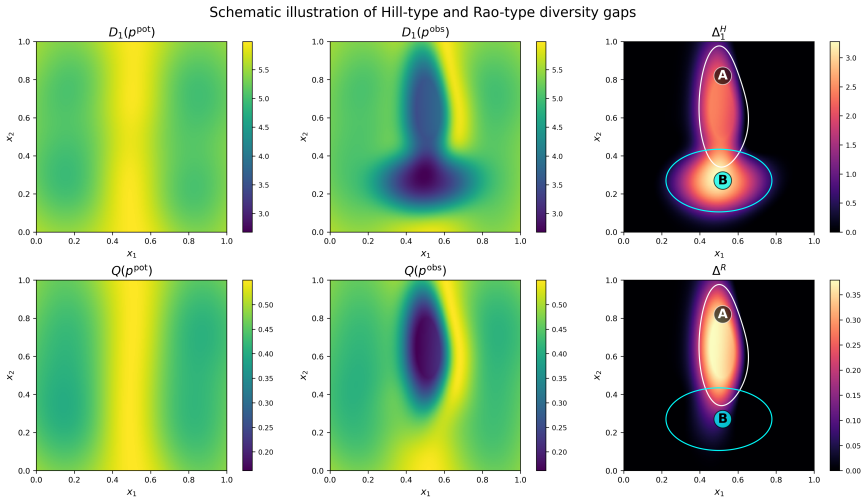
A constrained variational principle on the species simplex defines a potential composition that benchmarks the diversity gap separately from observed diversity.
A machine-rendered reading of the paper's core claim, the machinery that carries it, and where it could break.
Core claim
The central claim is that potential composition p^pot is obtained by a constrained variational principle using escort constraints, capacity constraints, and divergence projections in a spatial point-process interpretation of local ecological capacities; the diversity gap is then the comparison of a diversity functional at p^obs and p^pot. This supplies a unified way to define nontrivial benchmarks beyond the uniform distribution and applies to both Hill-type diversity and Rao's quadratic entropy.
What carries the argument
The pair of probability vectors p^obs and p^pot on the species simplex, where p^pot is generated by a constrained variational principle that encodes local ecological capacities before the mapping to the simplex.
If this is right
- The framework applies uniformly to Hill-type diversity, which captures abundance and evenness, and to Rao's quadratic entropy, which incorporates trait or phylogenetic dissimilarities.
- It supplies a continuous, abundance-weighted formulation that connects to the ecological notion of dark diversity.
- A dynamic extension follows in which capacities, species migration, and climate-driven shifts can vary over time.
- The spatial point-process interpretation allows local ecological capacities to be defined before projection onto the simplex.
Where Pith is reading between the lines
- The separation of observed diversity from the gap to potential could support conservation prioritization that targets unrealized capacity rather than current state alone.
- The variational construction might be combined with spatial statistical models to generate maps of biodiversity gaps at large scales.
- Validation could proceed by comparing the derived p^pot against independent estimates of dark diversity or maximum observed richness in well-sampled regions.
Load-bearing premise
That a constrained variational principle using escort constraints, capacity constraints, and divergence projections can define a meaningful potential composition that represents local ecological capacities in a spatial point-process sense.
What would settle it
Independent field measurements or ecological models of maximum realizable species abundances at a site that systematically fail to match the p^pot obtained from the variational principle would falsify the claim that the construction yields an admissible local benchmark.
Figures
read the original abstract
Biodiversity measures are often used descriptively: one computes a diversity index from an observed or estimated community composition and maps the resulting values across space. Conservation planning, however, also requires a site-specific benchmark against which the observed community can be compared. This chapter develops an information-geometric framework for such \emph{potential diversity} and the associated \emph{diversity gap}. The central object is a pair of probability vectors on the species simplex: an observed or realized composition \(p^{\mathrm{obs}}\), and a potential composition \(p^{\mathrm{pot}}\) obtained by a constrained variational principle. The gap is then defined by comparing a diversity functional at these two compositions. The framework is developed for both Hill-type diversity, which measures abundance and evenness, and Rao's quadratic entropy, which incorporates trait, phylogenetic, or ecological dissimilarities among species. A spatial point-process interpretation clarifies how local ecological capacities can be defined before passing to the simplex. Escort constraints, capacity constraints, and divergence projections then provide a unified way to define nontrivial benchmarks beyond the uniform distribution. The resulting formulation separates two distinct questions: how diverse a community is, and how far it is from a locally admissible potential benchmark. It also connects the ecological idea of dark diversity with a continuous, abundance-weighted comparison on the probability simplex. We also outline a dynamic extension in which capacities, species migration, and climate-driven shifts vary over time. Empirical implementation with large-scale citizen-science biodiversity data and trait databases is left for future work.
Editorial analysis
A structured set of objections, weighed in public.
Referee Report
Summary. The paper presents an information-geometric framework for mapping maximum potential biodiversity. It defines a potential composition p^pot on the species simplex using constrained variational principles (escort constraints, capacity constraints, divergence projections) informed by a spatial point-process interpretation of local ecological capacities. The diversity gap is then defined by comparing diversity functionals (Hill-type and Rao's quadratic entropy) at the observed p^obs and p^pot. The framework aims to separate realized diversity from distance to a local benchmark and connects to the concept of dark diversity. A dynamic extension is sketched, with empirical applications left for future work.
Significance. If the variational constructions can be explicitly formulated and validated, the framework could offer a rigorous, continuous, abundance-weighted approach to benchmarking biodiversity against local potentials, extending dark diversity ideas into information geometry and potentially improving conservation planning by distinguishing descriptive diversity measures from gap-based assessments.
major comments (2)
- [Abstract] Abstract: The central objects p^pot and the diversity gap are defined via new constrained variational constructions, but no explicit equations, objective functions, or derivations are provided to show how these reduce to quantities from data or demonstrate the claimed separation of questions.
- [Abstract] Abstract: The spatial point-process interpretation is invoked to define local ecological capacities before mapping to the simplex, but no details on how this step interfaces with the variational principle or ensures the benchmark is 'locally admissible' are given, which is load-bearing for the framework's applicability.
minor comments (2)
- The manuscript would benefit from including at least one concrete example or toy calculation illustrating the variational principle.
- Notation for the diversity functionals and the gap should be introduced with explicit formulas even if the full derivation is deferred.
Simulated Author's Rebuttal
We thank the referee for the detailed and constructive report. The comments correctly identify areas where the abstract and framework presentation can be strengthened for clarity. We address each major comment below and will incorporate revisions to provide the requested explicit formulations and interfaces.
read point-by-point responses
-
Referee: [Abstract] Abstract: The central objects p^pot and the diversity gap are defined via new constrained variational constructions, but no explicit equations, objective functions, or derivations are provided to show how these reduce to quantities from data or demonstrate the claimed separation of questions.
Authors: We agree that the abstract, as a high-level summary, omits explicit equations for the variational constructions defining p^pot (via escort and capacity constraints plus divergence projection) and the subsequent diversity gap. The main text sketches these using information geometry but does not derive them step-by-step from data or explicitly contrast the two questions (realized diversity vs. distance to benchmark). In revision we will expand the abstract to include the core objective function (e.g., the constrained minimization of a divergence subject to local capacity constraints) and a sentence illustrating the separation. This addresses the concern without altering the conceptual scope. revision: yes
-
Referee: [Abstract] Abstract: The spatial point-process interpretation is invoked to define local ecological capacities before mapping to the simplex, but no details on how this step interfaces with the variational principle or ensures the benchmark is 'locally admissible' are given, which is load-bearing for the framework's applicability.
Authors: The manuscript invokes the point-process view only to motivate capacity constraints that render p^pot locally admissible, but provides no explicit mapping from intensity functions to the constraint set or proof that the resulting projection remains feasible on the simplex. We acknowledge this interface is load-bearing and currently underspecified. In the revised manuscript we will add a dedicated paragraph (or short subsection) deriving how point-process capacities translate into linear or escort-type constraints and verifying admissibility via the geometry of the simplex. revision: yes
Circularity Check
No significant circularity
full rationale
The paper is a conceptual proposal that introduces p^pot via new constrained variational principles (escort constraints, capacity constraints, divergence projections) on the species simplex after a spatial point-process step. These are defined as original constructions rather than reductions of the paper's own equations to fitted inputs, prior data, or self-citations. The central separation of realized diversity from distance to a benchmark follows directly from the definitions without the quantities collapsing by construction. No load-bearing step reduces to a fit or self-citation chain; empirical implementation is explicitly deferred. This is self-contained against external benchmarks.
Axiom & Free-Parameter Ledger
axioms (1)
- domain assumption The potential composition p^pot is obtained by a constrained variational principle on the species simplex.
invented entities (1)
-
potential composition p^pot
no independent evidence
Reference graph
Works this paper leans on
-
[1]
Cichocki, Andrzej, Cruces, Sergio, and Amari, Shun-ichi
doi: 10.1146/annurev-ecolsys-120213-091540. Cichocki, Andrzej, Cruces, Sergio, and Amari, Shun-ichi. Families of α-, β- and γ-divergences; flexible and robust measures of similarity.Entropy, 12(6):1532–1569,
-
[2]
Information geometry for maximum diversity distributions.Sankhya A, pages 1–32, 2025a
Eguchi, Shinto. Information geometry for maximum diversity distributions.Sankhya A, pages 1–32, 2025a. in press. Eguchi, Shinto. Robust inference using density-powered stein operators.arXiv preprint arXiv:2511.03963, 2025b. Elith, Jane and Leathwick, John R. Species distribution models: Ecological explanation and prediction across space and time.Annual Re...
-
[3]
Elith, Jane, Phillips, Steven J., Hastie, Trevor, Dudík, Miroslav, Chee, Yung En, and Yates, Colin J
doi: 10.1146/annurev.ecolsys.110308.120159. Elith, Jane, Phillips, Steven J., Hastie, Trevor, Dudík, Miroslav, Chee, Yung En, and Yates, Colin J. A statistical explanation of MaxEnt for ecologists.Diversity and Distributions, 17(1):43–57,
-
[4]
21 Fithian, William and Hastie, Trevor
doi: 10.1111/j.1472-4642.2010.00725.x. 21 Fithian, William and Hastie, Trevor. Finite-sample equivalence in statistical models for presence-only data.The Annals of Applied Statistics, 7(4):1917–1939,
-
[5]
doi: 10.1214/13-AOAS667. Hill, Mark O. Diversity and evenness: A unifying notation and its consequences. Ecology, 54(2):427–432,
-
[6]
doi: 10.2307/1934352. Jost, Lou. Entropy and diversity.Oikos, 113(2):363–375,
-
[7]
doi: 10.1111/j.2006. 0030-1299.14714.x. Kelling, Steve, Johnston, Alison, Bonn, Aletta, Fink, Daniel, Ruiz-Gutierrez, Viviana, Bonney, Rick, Fernandez, Miguel, Hochachka, Wesley M., Julliard, Romain, Kraemer, Roland, and Guralnick, Robert. Using semistructured surveys to improve citizen science data for monitoring biodiversity.BioScience, 69(3):170–179,
-
[8]
Pärtel, Meelis, Szava-Kovats, Robert, and Zobel, Martin
doi: 10.1093/biosci/biz010. Pärtel, Meelis, Szava-Kovats, Robert, and Zobel, Martin. Dark diversity: shedding light on absent species.Trends in Ecology & Evolution, 26(3):124–128,
-
[9]
Phillips, Steven J., Anderson, Robert P., and Schapire, Robert E
doi: 10.1016/j.tree.2010.12.004. Phillips, Steven J., Anderson, Robert P., and Schapire, Robert E. Maximum entropy modeling of species geographic distributions.Ecological Modelling, 190(3–4):231–259,
-
[10]
doi: 10.1016/j.ecolmodel.2005.03.026. Rao, C. Radhakrishna. Diversity and dissimilarity coefficients: A unified approach. Theoretical Population Biology, 21(1):24–43,
-
[11]
doi: 10.1016/0040-5809(82) 90004-1. Royle, J Andrew. N-mixture models for estimating population size from spatially replicated counts.Biometrics, 60(1):108–115,
-
[12]
doi: 10.1214/10-AOAS331. 22
discussion (0)
Sign in with ORCID, Apple, or X to comment. Anyone can read and Pith papers without signing in.