Decadal pre-explosion activity and circumstellar interaction in a supernova
Pith reviewed 2026-06-27 15:23 UTC · model grok-4.3
The pith
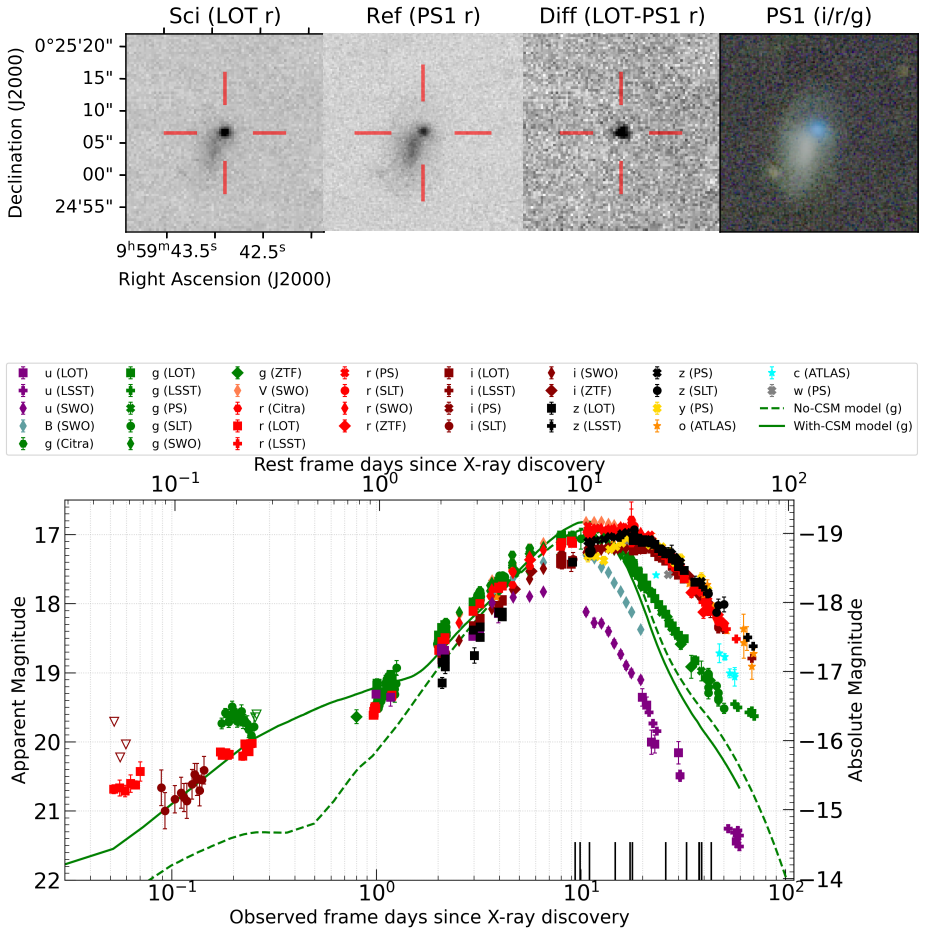
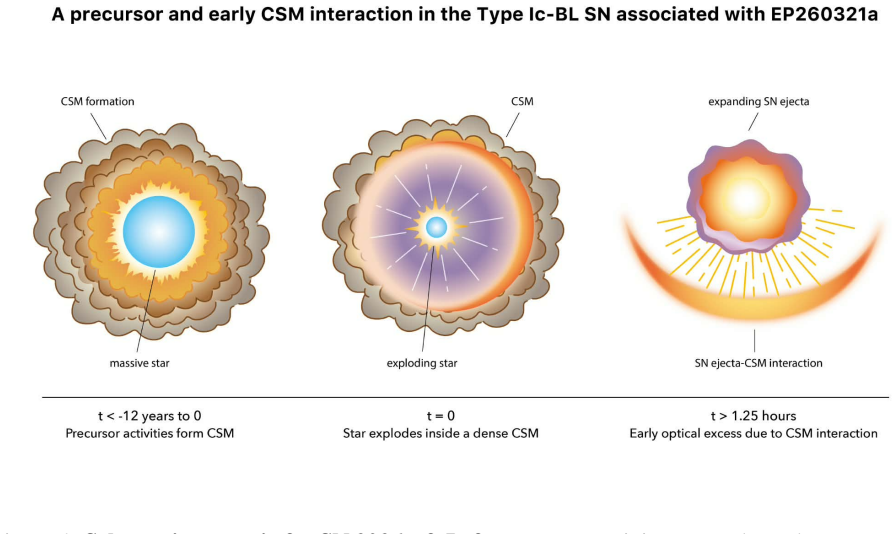
Interaction with 0.02 solar masses of circumstellar material powers the early excess in SN 2026gzf while archival images show 12 years of pre-explosion brightening.
A machine-rendered reading of the paper's core claim, the machinery that carries it, and where it could break.
Core claim
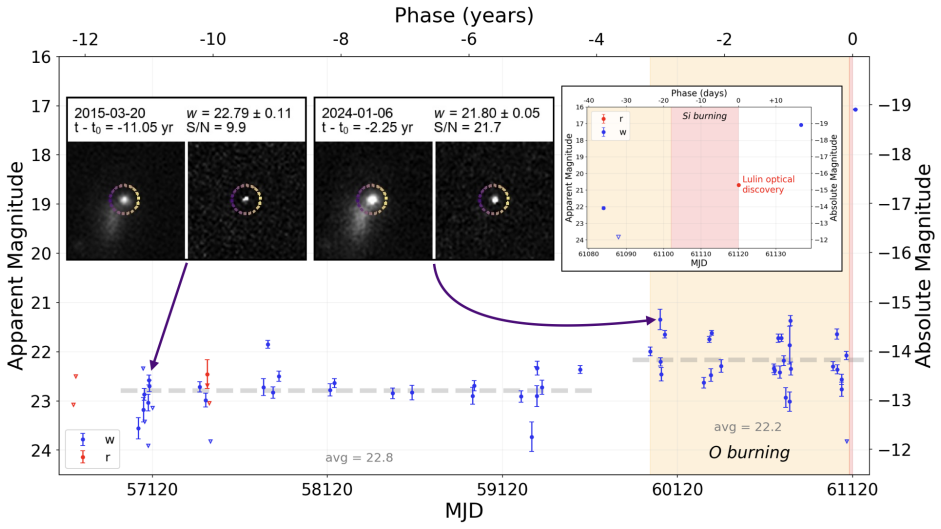
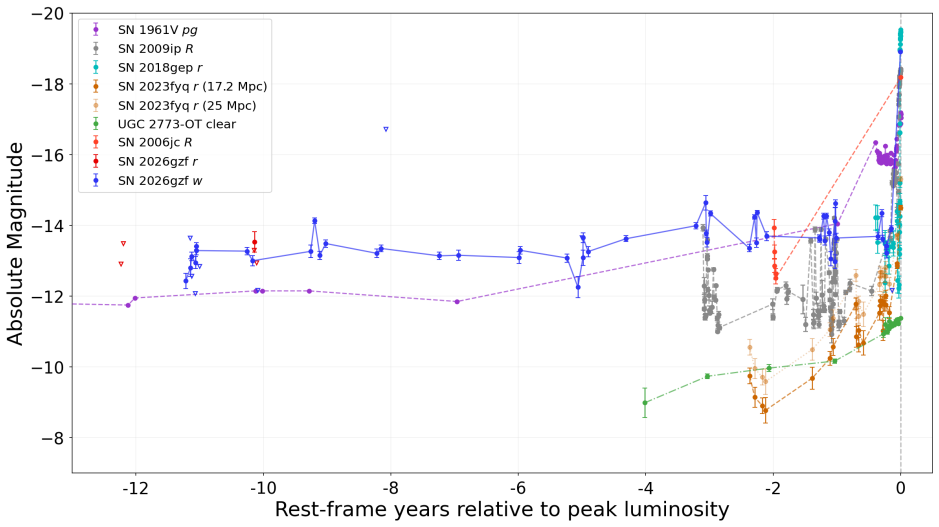
Interaction between the ejecta and approximately 0.02 solar masses of circumstellar material accounts for the early optical excess in SN 2026gzf. Archival Pan-STARRS images show variability at the explosion site over the previous 12 years, with the source brightening by a factor of approximately 1.5 in the final 3 years before explosion. This provides evidence for pre-explosion activity in a stripped-envelope progenitor system, with the precursor brightening indicating enhanced eruptive mass loss during late-stage oxygen burning before core collapse.
What carries the argument
Ejecta interaction with a compact shell of approximately 0.02 solar masses of circumstellar material, detected through the first-day optical excess and supported by long-term archival photometric variability at the explosion site.
If this is right
- The precursor brightening indicates enhanced eruptive mass loss during oxygen burning in the final years before core collapse.
- An additional silicon-burning episode shortly before explosion likely produced the compact circumstellar material that generated the X-ray shock-breakout signal.
- Stripped-envelope progenitors can modify their immediate environment through mass loss on timescales of years to a decade before death.
- The combination of early circumstellar interaction and archival variability links the explosion mechanism to observable pre-explosion changes in the progenitor.
Where Pith is reading between the lines
- Deep archival surveys of other nearby core-collapse sites could reveal similar late-stage variability in additional stripped-envelope events.
- The inferred circumstellar mass suggests that eruptive episodes may occur frequently enough to affect the light curves of a measurable fraction of Type Ic supernovae.
- X-ray transients detected by wide-field monitors may commonly be followed by optical excesses when the progenitor has shed material in the years before explosion.
Load-bearing premise
The variability recorded in archival Pan-STARRS images comes from the progenitor star itself rather than unrelated background sources, variable seeing, or photometric artifacts.
What would settle it
Independent re-reduction of the same Pan-STARRS archival frames showing no variability at the exact supernova position, or spectroscopy and imaging at the site after the supernova fades that reveal a different source responsible for the pre-explosion flux changes.
Figures
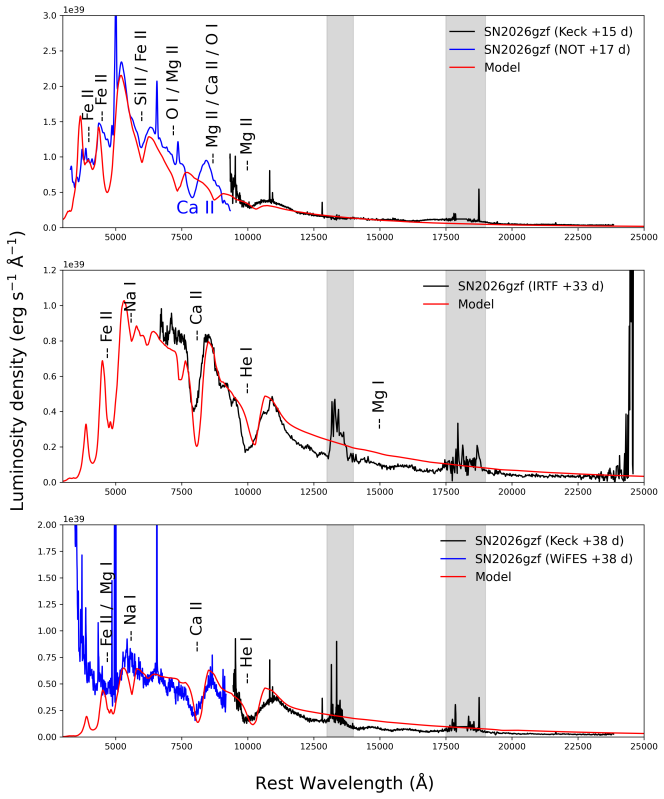
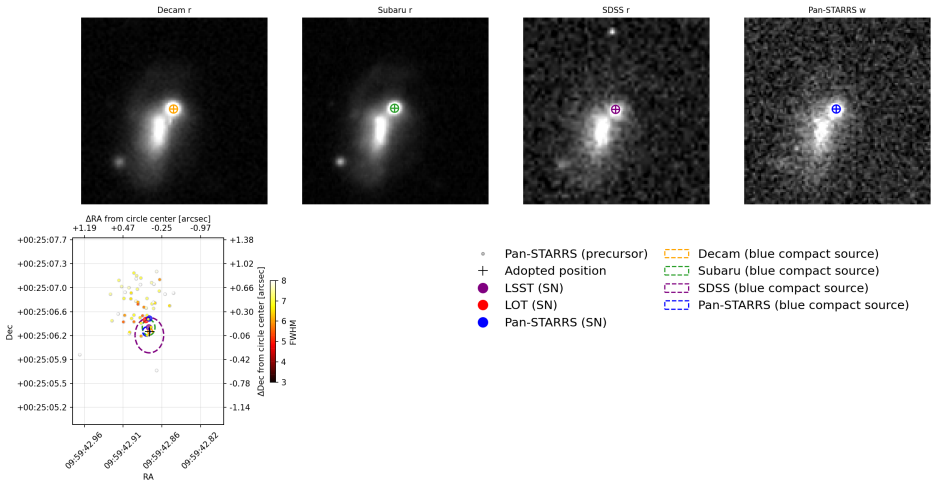
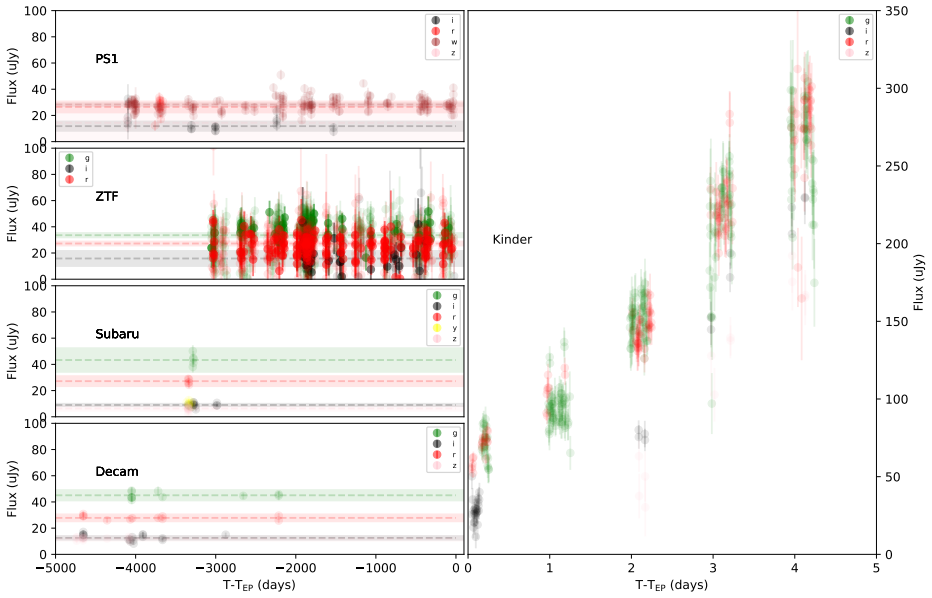
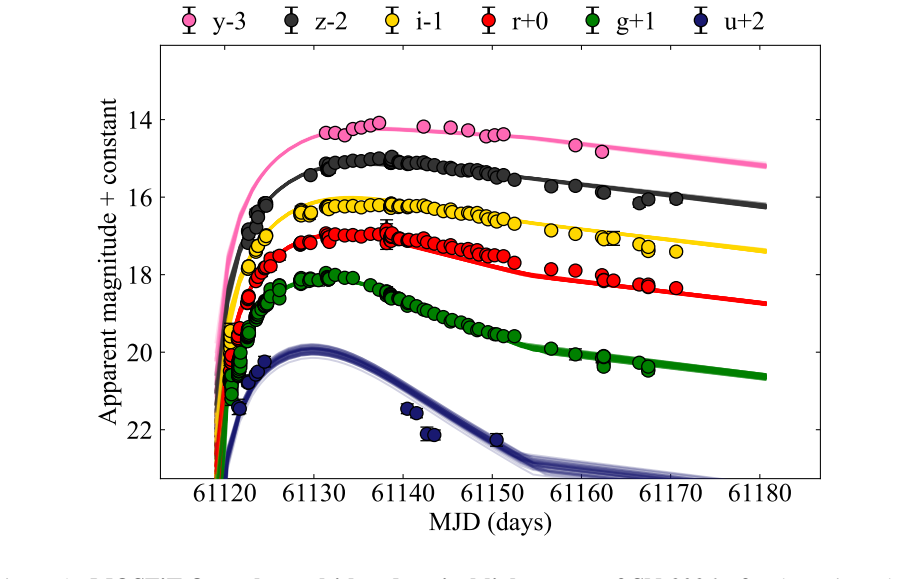
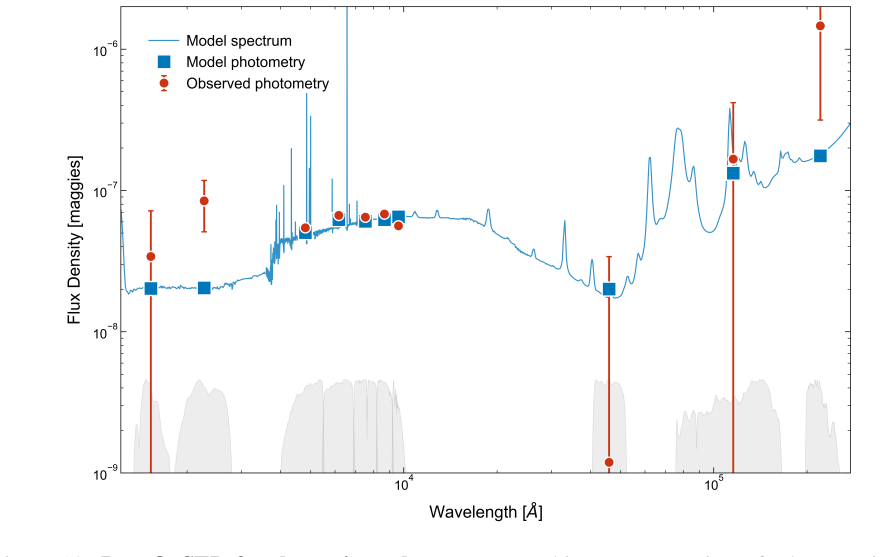
read the original abstract
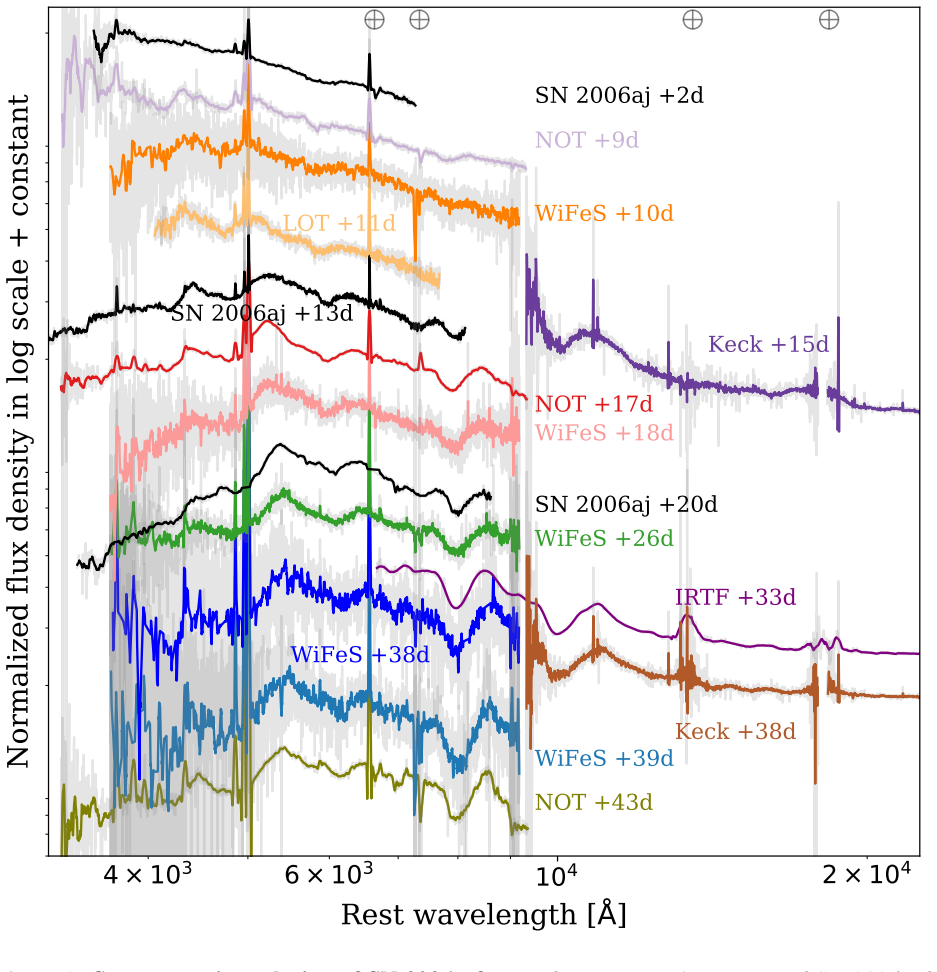
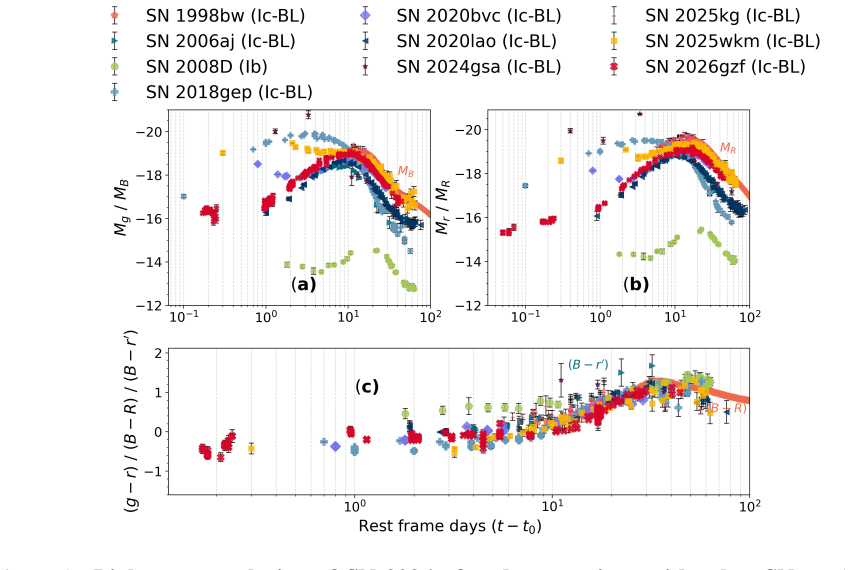
When a massive star explodes as a supernova, crucial information about its immediate environment is lost within hours. Here we report rapid optical observations from Lulin Observatory of the broad-lined Type Ic supernova SN 2026gzf, beginning 1.25 hours after Einstein Probe detected the X-ray transient EP260321a. Our data led to the discovery of the optical counterpart and showed a luminous blue first-day excess that cannot be reproduced by standard radioactive models. We find that interaction between the ejecta and $\approx 0.02$ M$_{\odot}$ of circumstellar material accounts for the early excess. Archival Panoramic Survey Telescope and Rapid Response System (Pan-STARRS) images show variability at the explosion site over the previous $\sim 12$ years, with the source brightening by a factor of $\sim 1.5$ in the final $\sim 3$ years before explosion, providing rare evidence for pre-explosion activity in a stripped-envelope progenitor system. The precursor brightening suggests enhanced eruptive mass loss during late-stage oxygen burning before core collapse, while an additional silicon-burning episode shortly before explosion may have created the compact nearby material responsible for the X-ray shock-breakout signal. SN 2026gzf therefore offers the first view of how a stripped progenitor modifies its immediate environment shortly before death, linking long-term precursor variability, circumstellar interaction and the explosion itself.
Editorial analysis
A structured set of objections, weighed in public.
Referee Report
Summary. The manuscript reports rapid optical follow-up of broad-lined Type Ic SN 2026gzf beginning 1.25 hours after the X-ray transient EP260321a, revealing a luminous blue first-day excess. This excess is attributed to ejecta interaction with ≈0.02 M⊙ of circumstellar material. Archival Pan-STARRS imaging shows variability at the site over ~12 years, including a factor ~1.5 brightening in the final ~3 years, interpreted as evidence for pre-explosion eruptive mass loss during oxygen burning in a stripped-envelope progenitor; an additional silicon-burning episode is suggested to explain the compact CSM responsible for the X-ray signal.
Significance. If the archival variability is confirmed to originate from the progenitor, the work supplies rare observational linkage between long-term precursor activity, compact CSM, and the explosion in a stripped-envelope system, with implications for late-stage mass loss and progenitor evolution. The multi-epoch, multi-wavelength dataset (X-ray to optical plus archival) strengthens the case for such connections when the central assumptions hold.
major comments (2)
- [Archival Pan-STARRS analysis] Archival Pan-STARRS photometry section: the interpretation that the reported ~1.5× brightening over the final ~3 years (and variability over ~12 years) traces enhanced eruptive mass loss by the progenitor is load-bearing for the 'rare evidence for pre-explosion activity' claim, yet the manuscript provides no explicit validation (difference imaging, reference-star light curves, or PSF positional coincidence) to exclude background sources, variable seeing, or reduction artifacts at the explosion site.
- [CSM interaction modeling] Early-excess modeling (results section): the statement that interaction with ≈0.02 M⊙ of CSM accounts for the luminous blue excess is presented as the preferred solution, but the manuscript does not detail the full parameter space explored, the assumed CSM density profile, the quantitative exclusion of alternative energy sources, or the formal uncertainty on the fitted mass; this value is explicitly a fit rather than a first-principles derivation.
minor comments (2)
- [Abstract] Abstract and text: the supernova is referred to as SN 2026gzf while the X-ray transient is EP260321a; ensure consistent naming and cross-referencing throughout.
- [Discussion] The claim of providing the 'first view' of a stripped progenitor modifying its environment should be tempered with appropriate literature citations if analogous cases have been reported.
Simulated Author's Rebuttal
We thank the referee for the constructive comments on our manuscript. We address each major point below and will revise the paper accordingly to improve clarity and robustness.
read point-by-point responses
-
Referee: [Archival Pan-STARRS analysis] Archival Pan-STARRS photometry section: the interpretation that the reported ~1.5× brightening over the final ~3 years (and variability over ~12 years) traces enhanced eruptive mass loss by the progenitor is load-bearing for the 'rare evidence for pre-explosion activity' claim, yet the manuscript provides no explicit validation (difference imaging, reference-star light curves, or PSF positional coincidence) to exclude background sources, variable seeing, or reduction artifacts at the explosion site.
Authors: We agree that the archival section would be strengthened by explicit validation steps. In the revised manuscript we will add difference imaging results for the Pan-STARRS epochs, light curves of nearby reference stars demonstrating photometric stability, and a quantitative check confirming that the variable source is coincident with the supernova position to within the local PSF. These additions will directly address concerns about possible artifacts or unrelated background variability. revision: yes
-
Referee: [CSM interaction modeling] Early-excess modeling (results section): the statement that interaction with ≈0.02 M⊙ of CSM accounts for the luminous blue excess is presented as the preferred solution, but the manuscript does not detail the full parameter space explored, the assumed CSM density profile, the quantitative exclusion of alternative energy sources, or the formal uncertainty on the fitted mass; this value is explicitly a fit rather than a first-principles derivation.
Authors: We will expand the early-excess modeling subsection to include the explored parameter ranges, the adopted CSM density profile (a steady wind with ρ ∝ r^{-2}), a quantitative comparison showing why radioactive heating or shock-cooling models fail to reproduce the observed blue color and rapid rise, and the formal 1σ uncertainties returned by the fitting procedure. While the quoted mass is indeed obtained from model fitting, these additions will make the analysis and its limitations fully transparent. revision: yes
Circularity Check
No significant circularity; observational claims rest on direct data and standard fitting
full rationale
The paper reports new observations of SN 2026gzf starting 1.25 hours post-detection and analyzes archival Pan-STARRS images for variability over ~12 years. The CSM mass of ≈0.02 M⊙ is obtained by fitting an interaction model to the early luminous excess, presented explicitly as an accounting for the data rather than a first-principles derivation or renamed prediction. No self-citations, uniqueness theorems, or ansatzes from prior author work are invoked to support the central claims about pre-explosion activity or CSM interaction. The chain is self-contained against external benchmarks (light-curve data and imaging), with the variability attribution treated as an interpretive step rather than a constructed equivalence.
Axiom & Free-Parameter Ledger
free parameters (1)
- CSM mass =
0.02 M_sun
axioms (1)
- domain assumption Standard radioactive-decay supernova light-curve models are sufficient to rule out a purely radioactive origin for the early excess.
Forward citations
Cited by 2 Pith papers
-
Pinning Down the Geometry of the Type Ic Broad-Line Supernova 2026gzf
Spectropolarimetry of SN 2026gzf indicates mostly spherical ejecta with axisymmetric Ca distribution viewed at ~40° from symmetry axis.
-
Discovery of a Supernova Following the Einstein Probe Transient EP250302a at z = 1.131
The paper identifies supernova emission matching a scaled SN 1998bw template in the late-time light curve of EP250302a at z=1.131, with early data constraining the jet Lorentz factor above 25.
Reference graph
Works this paper leans on
-
[1]
Nature442, 1008–1010 (2006).astro-ph/0603279
Campana, S.et al.The association of GRB 060218 with a supernova and the evolution of the shock wave. Nature442, 1008–1010 (2006).astro-ph/0603279
Pith/arXiv arXiv 2006
-
[9]
Lee, M.-H.et al.EP260321a: Kinder observations detect a blue variable star and set limits on a source from the z =0.034 galaxy within the error circle.GRB Coordinates Network44070, 1 (2026)
2026
-
[11]
MNRAS328, 1039–1063 (2001).astro-ph/0106498
Colless, M.et al.The 2dF Galaxy Redshift Survey: spectra and redshifts. MNRAS328, 1039–1063 (2001).astro-ph/0106498
Pith/arXiv arXiv 2001
-
[23]
G.et al.The Sloan Digital Sky Survey: Technical Summary
York, D. G.et al.The Sloan Digital Sky Survey: Technical Summary. AJ120, 1579–1587 (2000).astro-ph/0006396
Pith/arXiv arXiv 2000
-
[26]
E., Heger, A
Woosley, S. E., Heger, A. & Weaver, T. A. The evolution and explosion of massive stars. Reviews of Modern Physics74, 1015–1071 (2002)
2002
-
[27]
S.et al.Supernova progenitors, their variability and the Type IIP Supernova ASASSN-16fq in M66
Kochanek, C. S.et al.Supernova progenitors, their variability and the Type IIP Supernova ASASSN-16fq in M66. MNRAS467, 3347–3360 (2017).1609.00022
Pith/arXiv arXiv 2017
-
[29]
& Katz, B
Waxman, E. & Katz, B. Shock Breakout Theory. In Alsabti, A. W. & Murdin, P. (eds.) Handbook of Supernovae, 967 (2017)
2017
-
[30]
Owocki, S. P., Gayley, K. G. & Shaviv, N. J. A Porosity-Length Formalism for Photon-Tiring-limited Mass Loss from Stars above the Eddington Limit. ApJ616, 525–541 (2004).astro-ph/0409573
Pith/arXiv arXiv 2004
-
[31]
Fuller, J. & Ro, S. Pre-supernova outbursts via wave heating in massive stars - II. Hydrogen-poor stars. MNRAS476, 1853–1868 (2018).1710.04251
Pith/arXiv arXiv 2018
-
[32]
Hamidani, H.et al.EP240414a: A Gamma-Ray Burst Jet Weakened by an Extended Circumstellar Material. ApJ986, L4 (2025).2503.16243
arXiv 2025
-
[33]
Zheng, J.-H., Zhu, J.-P., Lu, W. & Zhang, B. EP240414a: Off-axis View of a Jet-cocoon System from an Expanded Progenitor Star. ApJ985, 21 (2025).2503.24266
arXiv 2025
-
[41]
A&A 617, A105 (2018).1806.10613
Japelj, J.et al.Host galaxies of SNe Ic-BL with and without long gamma-ray bursts. A&A 617, A105 (2018).1806.10613
Pith/arXiv arXiv 2018
-
[42]
ApJ892, 153 (2020).1901
Modjaz, M.et al.Host Galaxies of Type Ic and Broad-lined Type Ic Supernovae from the Palomar Transient Factory: Implications for Jet Production. ApJ892, 153 (2020).1901. 00872
2020
-
[43]
Srivastav, S.et al.Identification of the Optical Counterpart of the Fast X-Ray Transient EP240414a. ApJ978, L21 (2025).2409.19070. 17 Methods 1 X-ray shock breakout Einstein Probe (EP)[6] is a space X-ray mission designed to monitor the soft X-ray sky for transient phenomena and to perform rapid onboard follow-up of newly discovered events. By combining t...
arXiv 2025
-
[44]
& Ling, Z
Yuan, W., Zhang, C., Chen, Y . & Ling, Z. The Einstein Probe Mission. In Bambi, C. & Sangangelo, A. (eds.)Handbook of X-ray and Gamma-ray Astrophysics, 86 (2022)
2022
-
[45]
J.et al.EP260321a: Einstein Probe detection of an X-ray transient.GRB Coordinates Network44068, 1 (2026)
Huang, Q. J.et al.EP260321a: Einstein Probe detection of an X-ray transient.GRB Coordinates Network44068, 1 (2026)
2026
-
[46]
J.et al.EP260321a: refined analysis of the EP-WXT and EP-FXT observations, implying a possible supernova shock breakout candidate.GRB Coordinates Network44075, 1 (2026)
Huang, Q. J.et al.EP260321a: refined analysis of the EP-WXT and EP-FXT observations, implying a possible supernova shock breakout candidate.GRB Coordinates Network44075, 1 (2026)
2026
-
[47]
Lee, M.-H.et al.EP260321a: Kinder observations detect a blue variable star and set limits on a source from the z =0.034 galaxy within the error circle.GRB Coordinates Network 44070, 1 (2026)
2026
-
[48]
N.et al.EP260321a: SVOM/VT optical upper limit.GRB Coordinates Network 44074, 1 (2026)
Ma, Y . N.et al.EP260321a: SVOM/VT optical upper limit.GRB Coordinates Network 44074, 1 (2026)
2026
-
[49]
Aguilar-Ruiz, E.et al.EP260321a: COLIBR ´I optical upper limit on any supernova shock breakout emission.GRB Coordinates Network44076, 1 (2026)
2026
-
[50]
& Sand, D
Liang, R., Li, W., Arcavi, I., Keinan, I. & Sand, D. EP260321a: Las Cumbres upper limit. GRB Coordinates Network44079, 1 (2026)
2026
-
[51]
Aryan, A.et al.EP260321a: further Kinder optical observations.GRB Coordinates Network 44081, 1 (2026)
2026
-
[52]
Moran, S.et al.EP260321a: GOTO detection of blue variable source.GRB Coordinates Network44083, 1 (2026)
2026
-
[53]
J., Perley, D
Ahumada, T., Hall, X. J., Perley, D. A. & the Zwicky Transient Facility. EP260321a: ZTF and Rubin detections of the candidate optical counterpart to EP260321a.GRB Coordinates Network44084, 1 (2026)
2026
-
[54]
GRB Coordinates Network44087, 1 (2026)
Liu, X.et al.EP260321a: Early TRT rising followed by JinShan decaying and then re-rising. GRB Coordinates Network44087, 1 (2026). 49
2026
-
[55]
K, A.et al.EP260321a: Continued brightening from Kinder follow-up of the emerging supernova candidate.GRB Coordinates Network44089, 1 (2026)
Sankar. K, A.et al.EP260321a: Continued brightening from Kinder follow-up of the emerging supernova candidate.GRB Coordinates Network44089, 1 (2026)
2026
-
[56]
R.et al.EP260321a: VLT imaging and spectroscopy show the variable source to be at z = 0.0343.GRB Coordinates Network44082, 1 (2026)
Tanvir, N. R.et al.EP260321a: VLT imaging and spectroscopy show the variable source to be at z = 0.0343.GRB Coordinates Network44082, 1 (2026)
2026
-
[57]
Xu, D.et al.EP260321a / AT2026gzf: VLT/X-shooter detection of supernova-like spectral features at z = 0.0344.GRB Coordinates Network44092, 1 (2026)
2026
-
[58]
Corcoran, G.et al.EP260321a: VLT/FORS2 spectroscopy confirmation of an associated type Ic-BL supernova SN 2026gzf.GRB Coordinates Network44105, 1 (2026)
2026
-
[59]
& Ahumada, T
Rastinejad, J., Srinivasaragavan, G. & Ahumada, T. EP260321a: Gemini-South confirmation of a supernova.GRB Coordinates Network44107, 1 (2026)
2026
-
[60]
Yaron, O. & Gal-Yam, A. WISeREP—An Interactive Supernova Data Repository. PASP 124, 668 (2012).1204.1891
Pith/arXiv arXiv 2012
-
[61]
Planck Collaborationet al.Planck 2018 results. VI. Cosmological parameters. A&A641, A6 (2020).1807.06209
Pith/arXiv arXiv 2018
-
[62]
Schlafly, E. F. & Finkbeiner, D. P. Measuring Reddening with Sloan Digital Sky Survey Stellar Spectra and Recalibrating SFD. ApJ737, 103 (2011).1012.4804
Pith/arXiv arXiv 2011
-
[63]
Chen, T.-W.et al.Discovery and Extensive Follow-up of SN 2024ggi, a Nearby Type IIP Supernova in NGC 3621. ApJ983, 86 (2025).2406.09270
arXiv 2025
-
[64]
C.et al.The Pan-STARRS1 Surveys.arXiv e-printsarXiv:1612.05560 (2016)
Chambers, K. C.et al.The Pan-STARRS1 Surveys.arXiv e-printsarXiv:1612.05560 (2016). 1612.05560
Pith/arXiv arXiv 2016
-
[66]
L.et al.The ATLAS All-Sky Stellar Reference Catalog
Tonry, J. L.et al.The ATLAS All-Sky Stellar Reference Catalog. ApJ867, 105 (2018). 1809.09157
Pith/arXiv arXiv 2018
-
[67]
L.et al.The Pan-STARRS1 Photometric System
Tonry, J. L.et al.The Pan-STARRS1 Photometric System. ApJ750, 99 (2012).1203. 0297. 50
2012
-
[68]
A.et al.Pan-STARRS Photometric and Astrometric Calibration
Magnier, E. A.et al.Pan-STARRS Photometric and Astrometric Calibration. ApJS251, 6 (2020).1612.05242
arXiv 2020
-
[69]
A.et al.The Pan-STARRS Data-processing System
Magnier, E. A.et al.The Pan-STARRS Data-processing System. ApJS251, 3 (2020). 1612.05240
arXiv 2020
-
[70]
Z.et al.Pan-STARRS Pixel Processing: Detrending, Warping, Stacking
Waters, C. Z.et al.Pan-STARRS Pixel Processing: Detrending, Warping, Stacking. ApJS 251, 4 (2020).1612.05245
arXiv 2020
-
[71]
L.et al.ATLAS: A High-cadence All-sky Survey System
Tonry, J. L.et al.ATLAS: A High-cadence All-sky Survey System. PASP130, 064505 (2018).1802.00879
Pith/arXiv arXiv 2018
-
[72]
W.et al.Design and Operation of the ATLAS Transient Science Server
Smith, K. W.et al.Design and Operation of the ATLAS Transient Science Server. PASP 132, 085002 (2020).2003.09052
arXiv 2020
-
[73]
Shingles, L.et al.Release of the ATLAS Forced Photometry server for public use.Transient Name Server AstroNote7, 1–7 (2021)
2021
-
[74]
Ivezi ´c, ˇZ.et al.LSST: From Science Drivers to Reference Design and Anticipated Data Products. ApJ873, 111 (2019).0805.2366
Pith/arXiv arXiv 2019
-
[75]
W.et al.Lasair: The Transient Alert Broker for LSST:UK.Research Notes of the American Astronomical Society3, 26 (2019)
Smith, K. W.et al.Lasair: The Transient Alert Broker for LSST:UK.Research Notes of the American Astronomical Society3, 26 (2019)
2019
-
[76]
C.et al.The Zwicky Transient Facility: System Overview, Performance, and First Results
Bellm, E. C.et al.The Zwicky Transient Facility: System Overview, Performance, and First Results. PASP131, 018002 (2019).1902.01932
Pith/arXiv arXiv 2019
-
[77]
J.et al.The Zwicky Transient Facility: Science Objectives
Graham, M. J.et al.The Zwicky Transient Facility: Science Objectives. PASP131, 078001 (2019).1902.01945
Pith/arXiv arXiv 2019
-
[78]
Dopita, M.et al.The Wide Field Spectrograph (WiFeS). Ap&SS310, 255–268 (2007). 0705.0287
arXiv 2007
-
[79]
J., V ogt, F
Childress, M. J., V ogt, F. P. A., Nielsen, J. & Sharp, R. G. PyWiFeS: a rapid data reduction pipeline for the Wide Field Spectrograph (WiFeS). Ap&SS349, 617–636 (2014).1311. 2666. 51
2014
-
[80]
Djupvik, A. A. & Andersen, J. The Nordic Optical Telescope. In Diego, J. M., Goicoechea, L. J., Gonz´alez-Serrano, J. I. & Gorgas, J. (eds.)Highlights of Spanish Astrophysics V, vol. 14 ofAstrophysics and Space Science Proceedings, 211 (2010).0901.4015
Pith/arXiv arXiv 2010
-
[81]
Holmbo, S.et al.NUTS2 spectroscopic classification of ASASSN-19jy (AT2019dke) as a young Type II supernova.The Astronomer’s Telegram12661, 1 (2019)
2019
-
[82]
The Astronomer’s Telegram14441, 1 (2021)
Burns, C.et al.Introducing POISE: Precision Observations of Infant Supernova Explosions. The Astronomer’s Telegram14441, 1 (2021)
2021
-
[83]
Krisciunas, K.et al.The Carnegie Supernova Project. I. Third Photometry Data Release of Low-redshift Type Ia Supernovae and Other White Dwarf Explosions. AJ154, 211 (2017). 1709.05146
Pith/arXiv arXiv 2017
-
[84]
C.et al.Mass producing an efficient NIR spectrograph
Wilson, J. C.et al.Mass producing an efficient NIR spectrograph. In Moorwood, A. F. M. & Iye, M. (eds.)Ground-based Instrumentation for Astronomy, vol. 5492 ofSociety of Photo-Optical Instrumentation Engineers (SPIE) Conference Series, 1295–1305 (2004)
2004
-
[85]
T.et al.SpeX: A Medium-Resolution 0.8-5.5 Micron Spectrograph and Imager for the NASA Infrared Telescope Facility
Rayner, J. T.et al.SpeX: A Medium-Resolution 0.8-5.5 Micron Spectrograph and Imager for the NASA Infrared Telescope Facility. PASP115, 362–382 (2003)
2003
-
[86]
Medler, K.et al.The Hawaii Infrared Supernova Study (HISS): Spectroscopic Data Release
-
[87]
ApJS281, 28 (2025).2505.18507
arXiv 2025
-
[88]
B.et al.Seeing the Outer Edge of the Infant Type Ia Supernova 2024epr in the Optical and Near Infrared.The Open Journal of Astrophysics8, 120 (2025).2502
Hoogendam, W. B.et al.Seeing the Outer Edge of the Infant Type Ia Supernova 2024epr in the Optical and Near Infrared.The Open Journal of Astrophysics8, 120 (2025).2502. 17556
2025
-
[89]
B.et al.Early and Extensive Ultraviolet through Near Infrared Observations of the Intermediate-luminosity Type Iax Supernovae 2024pxl
Hoogendam, W. B.et al.Early and Extensive Ultraviolet through Near Infrared Observations of the Intermediate-luminosity Type Iax Supernovae 2024pxl. ApJ988, 209 (2025).2505. 04610
2025
-
[90]
Medler, K.et al.JWST Observations of SN 2023ixf. II. The Panchromatic Evolution between 250 and 720 Days after the Explosion. ApJ993, 191 (2025).2507.19727
arXiv 2025
-
[91]
PASJ70, S1 (2018)
Miyazaki, S.et al.Hyper Suprime-Cam: System design and verification of image quality. PASJ70, S1 (2018). 52
2018
-
[92]
2018, PASJ, 70, S4, doi: 10.1093/pasj/psx066
Aihara, H.et al.The Hyper Suprime-Cam SSP Survey: Overview and survey design.Publications of the Astronomical Society of Japan70(2017). URLhttps:// doi.org/10.1093/pasj/psx066. S4,https://academic.oup.com/pasj/ article-pdf/70/SP1/S4/23692189/psx066.pdf
work page internal anchor Pith review doi:10.1093/pasj/psx066 2017
-
[93]
PASJ74, 247–272 (2022).2108.13045
Aihara, H.et al.Third data release of the Hyper Suprime-Cam Subaru Strategic Program. PASJ74, 247–272 (2022).2108.13045
arXiv 2022
-
[94]
Flaugher, B.et al.The Dark Energy Camera. AJ150, 150 (2015).1504.02900
Pith/arXiv arXiv 2015
-
[95]
AJ157, 168 (2019).1804
Dey, A.et al.Overview of the DESI Legacy Imaging Surveys. AJ157, 168 (2019).1804. 08657
2019
-
[96]
Sonbas, E.et al.Stellar-wind envelope around the massive supernova progenitor XRF/GRB 060218/SN 2006aj.Astrophysical Bulletin63, 228–243 (2008).0805.2657
Pith/arXiv arXiv 2008
-
[97]
ApJ645, L21–L24 (2006).astro-ph/0603377
Modjaz, M.et al.Early-Time Photometry and Spectroscopy of the Fast Evolving SN 2006aj Associated with GRB 060218. ApJ645, L21–L24 (2006).astro-ph/0603377
Pith/arXiv arXiv 2006
-
[98]
Nature 442, 1011–1013 (2006).astro-ph/0603530
Pian, E.et al.An optical supernova associated with the X-ray flash XRF 060218. Nature 442, 1011–1013 (2006).astro-ph/0603530
Pith/arXiv arXiv 2006
-
[99]
Kerzendorf, W. E. & Sim, S. A. A spectral synthesis code for rapid modelling of supernovae. MNRAS440, 387–404 (2014).1401.5469
Pith/arXiv arXiv 2014
-
[100]
Nature565, 324–327 (2019).1901.05500
Izzo, L.et al.Signatures of a jet cocoon in early spectra of a supernova associated with a γ-ray burst. Nature565, 324–327 (2019).1901.05500
Pith/arXiv arXiv 2019
-
[101]
A.et al.Ultraviolet Spectroscopy and TARDIS Models of the Broad-lined Type Ic Supernova 2014ad
Kwok, L. A.et al.Ultraviolet Spectroscopy and TARDIS Models of the Broad-lined Type Ic Supernova 2014ad. ApJ937, 40 (2022).2204.03716
arXiv 2022
-
[102]
Hachinger, S.et al.How much H and He is ’hidden’ in SNe Ib/c? - I. Low-mass objects. MNRAS422, 70–88 (2012).1201.1506
Pith/arXiv arXiv 2012
-
[103]
Boyle, A., Sim, S. A., Hachinger, S. & Kerzendorf, W. Helium in double-detonation models of type Ia supernovae. A&A599, A46 (2017).1611.05938
Pith/arXiv arXiv 2017
-
[104]
Williamson, M., Kerzendorf, W. & Modjaz, M. Modeling Type Ic Supernovae with TARDIS: Hidden Helium in SN 1994I? ApJ908, 150 (2021).2010.10528. 53
arXiv 2021
-
[105]
ApJ1002, L11 (2026)
Lu, J.et al.Traces of Helium Detected in Type Ic Supernova 2014L. ApJ1002, L11 (2026)
2026
-
[106]
SCAMP: Automatic astrometric and photometric calibration.ASCL1010, 063 (2006)
Bertin, E. SCAMP: Automatic astrometric and photometric calibration.ASCL1010, 063 (2006)
2006
-
[107]
Bertin, E.et al.The TERAPIX pipeline.ASPC281, 228 (2002)
2002
-
[108]
Brennan, S. J. & Fraser, M. The AUTOmated Photometry Of Transients pipeline (AutoPhOT). A&A667, A62 (2022).2201.02635
arXiv 2022
-
[109]
Lang, D., Hogg, D. W., Mierle, K., Blanton, M. & Roweis, S. Astrometry.net: Blind astrometric calibration of arbitrary astronomical images.AJ139, 1782–1800 (2010). 0910.2233
Pith/arXiv arXiv 2010
-
[110]
Summary of the content and survey properties
Gaia Collaborationet al.Gaia Data Release 3. Summary of the content and survey properties. A&A674, A1 (2023).2208.00211
arXiv 2023
discussion (0)
Sign in with ORCID, Apple, or X to comment. Anyone can read and Pith papers without signing in.