Thermal X-rays breaking out from pre-explosion ejecta of a dying massive star
Pith reviewed 2026-06-27 15:24 UTC · model grok-4.3
The pith
Soft thermal X-rays show a shock breaking out from a shell ejected by a massive star about a month before its supernova.
A machine-rendered reading of the paper's core claim, the machinery that carries it, and where it could break.
Core claim
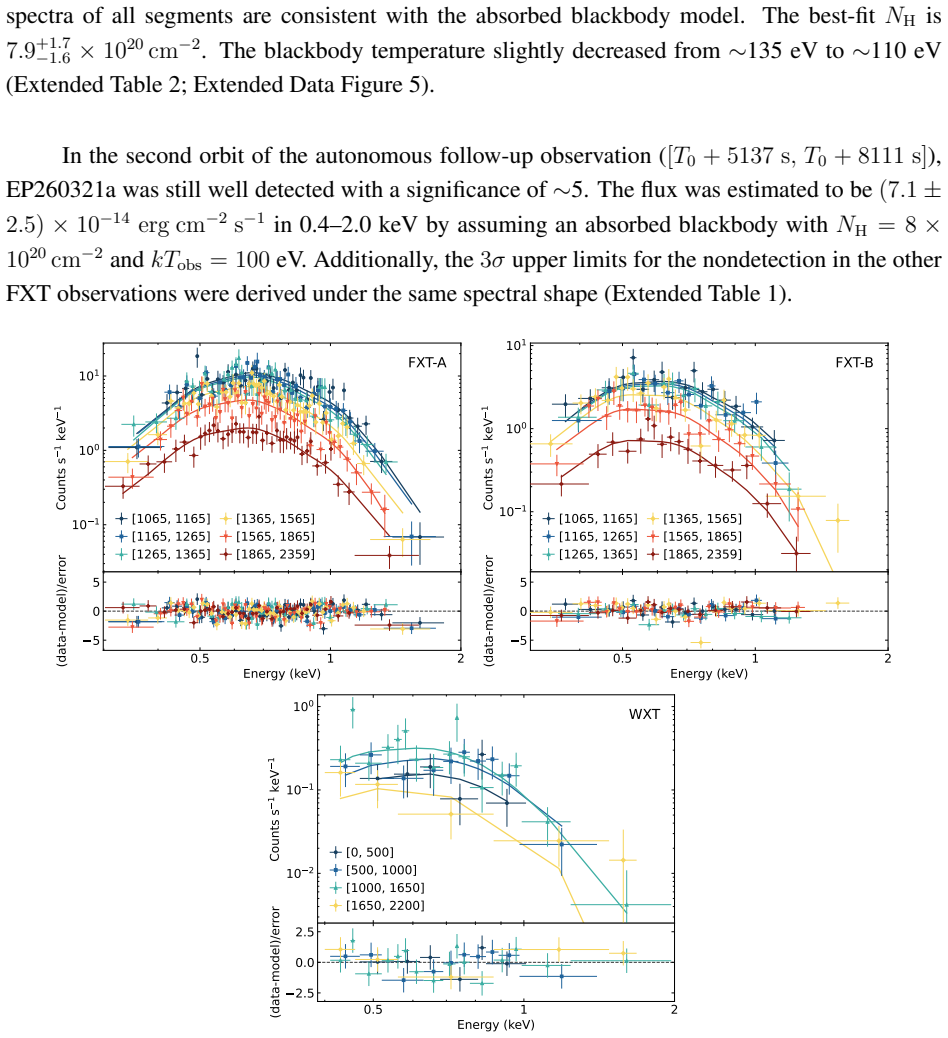
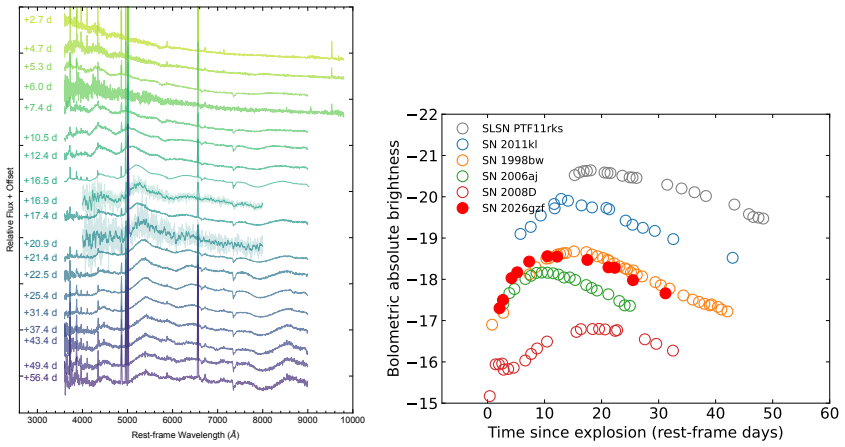
The central claim is that EP260321a constitutes a bona fide shock-breakout event whose thermal spectrum, duration, and fluence indicate breakout from pre-explosion ejecta at approximately 300 solar radii. The subsequent appearance of an SN Ic-BL identifies the progenitor as a Wolf-Rayet star whose hydrogen and helium envelopes had already been stripped. The inferred shell radius supplies direct evidence of abrupt mass ejection within roughly one month prior to core collapse.
What carries the argument
Shock-breakout scaling relations that convert the observed duration and fluence of the thermal X-ray emission into an inferred breakout radius outside the progenitor surface.
If this is right
- Core collapse can be timed to within hours or days from the X-ray detection.
- Efficient targeted searches for associated neutrinos and gravitational-wave signals become possible.
- Timely multi-wavelength observations can probe the immediate pre-explosion environment of the star.
- Intense pre-explosion mass ejection is indicated as a feature of at least some massive-star deaths.
Where Pith is reading between the lines
- Other fast X-ray transients lacking clear supernova counterparts may also arise from late-stage mass ejection rather than surface breakouts.
- The 300-solar-radii shell radius implies specific ejection velocities and timescales that hydrodynamic models could test with future events.
- A statistical sample of such detections could quantify how common abrupt pre-collapse mass loss is among stripped progenitors.
Load-bearing premise
The X-ray spectrum is assumed to be pure unmodified thermal blackbody emission whose duration and energy map directly onto the breakout radius via standard scaling relations.
What would settle it
An X-ray spectrum containing a clear non-thermal power-law component or an independent radius measurement from radio or optical observations that differs significantly from 300 solar radii would falsify the pre-explosion-shell interpretation.
Figures
read the original abstract
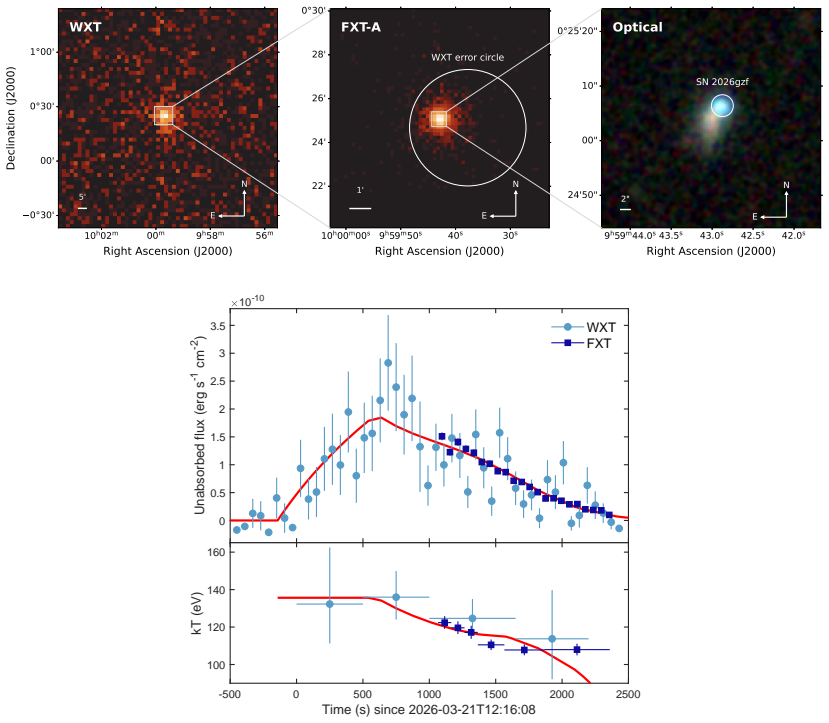
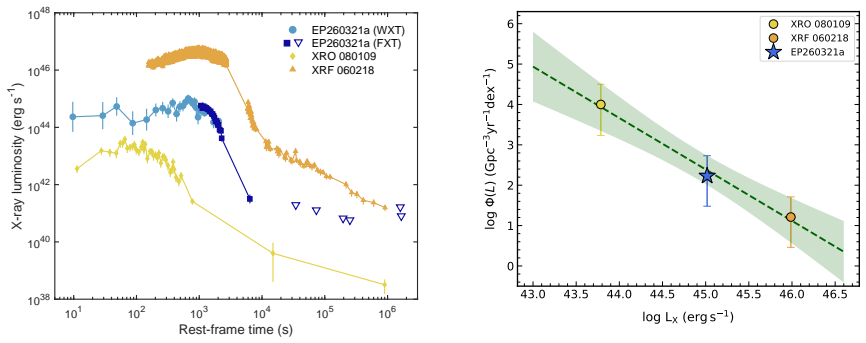
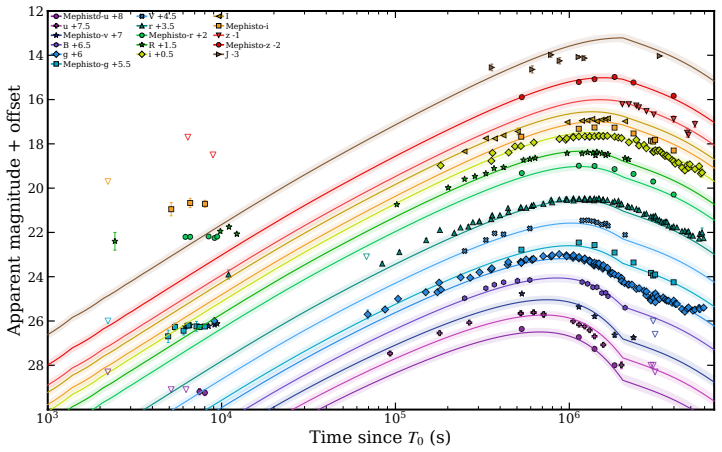
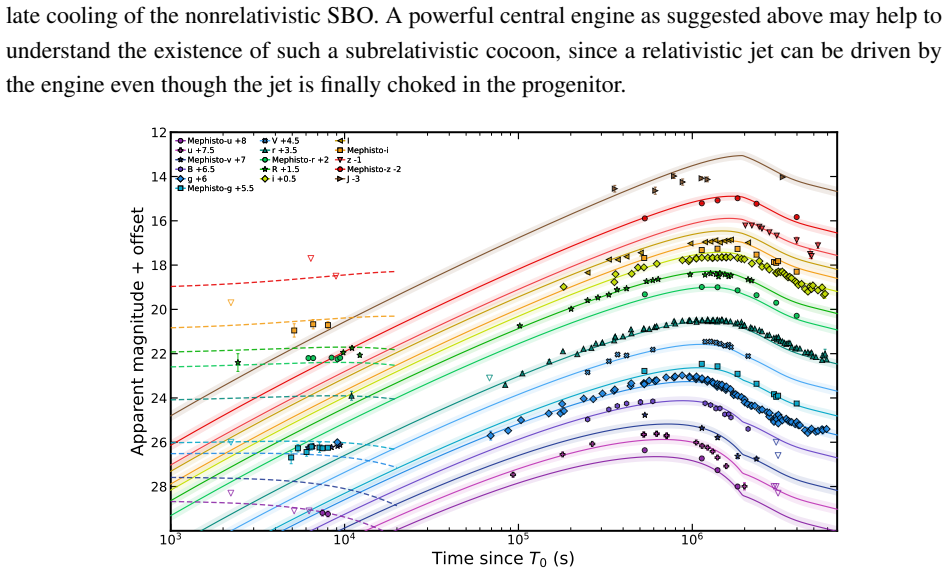
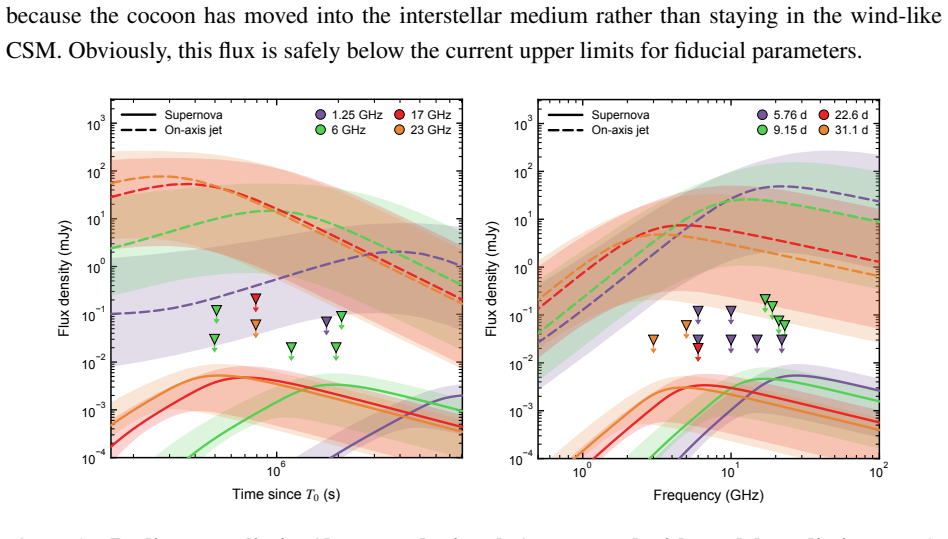
Massive stars die as energetic supernova explosions, but the physical processes during and before such explosions are poorly studied observationally. The first electromagnetic signals from core-collapse events are predicted to be a flash of soft X-ray and ultraviolet (UV) light, produced as a result of a shock wave breaking out of the star and its surrounding medium. Such shock breakout (SBO) events often carry essential information about the explosion energetics, the progenitor star, and its immediate environment. However, they are difficult to catch because of their very short durations and a historical lack of sensitive wide-field monitors. Only two SBO events have been detected so far in X-rays, but their emission spectra are modified from the simple thermal form by complicated physical factors, however. Here we report the discovery of a fast X-ray transient, EP260321a, followed by a broad-lined Type Ic supernova (SN Ic-BL) emerging days later, suggesting its progenitor as a Wolf-Rayet star with its hydrogen and helium envelopes stripped. Its X-ray emission is soft and best modeled by blackbody radiation, making it a bona fide SBO. The observed long duration and large total energy output of the X-ray event jointly indicate a shock breaking out from a surrounding shell at a radius of about 300 solar radii, rather than from the progenitor star's surface. This provides direct evidence of abrupt mass ejection within a month prior to core collapse, suggesting intense pre-explosion activity for a massive star. The real-time detection of SBOs yields precise timing of stellar core-collapse, allowing for efficient searches for associated neutrinos and potential gravitational-wave signals. These, together with timely multi-wavelength observations, may uncover how massive stars end their lives.
Editorial analysis
A structured set of objections, weighed in public.
Referee Report
Summary. The paper reports the discovery of the fast X-ray transient EP260321a, which is followed days later by a broad-lined Type Ic supernova. The X-ray emission is interpreted as a genuine shock breakout (SBO) event from a pre-explosion shell at ~300 R_⊙ surrounding a stripped Wolf-Rayet progenitor. The spectrum is stated to be soft and best fit by a blackbody, with the observed duration and total energy used via standard SBO scaling relations to infer the large breakout radius rather than the stellar surface, thereby providing evidence for abrupt mass ejection within a month before core collapse.
Significance. If the central interpretation is robust, the result would be significant for supernova progenitor studies: it supplies direct evidence of intense pre-explosion mass loss in a massive star and demonstrates the utility of real-time SBO detections for timing core collapse and enabling multi-messenger follow-up. The association with an SN Ic-BL also strengthens links between stripped progenitors and certain transients.
major comments (3)
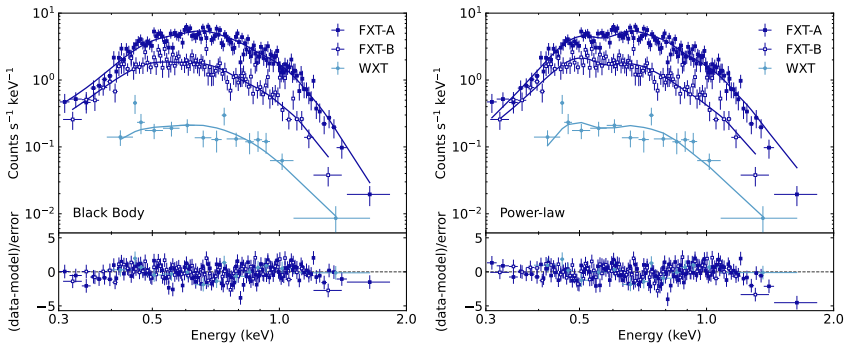
- [Spectral analysis] Spectral analysis section: the claim that the X-ray spectrum 'is soft and best modeled by blackbody radiation' is presented without any reported fit statistics (χ², degrees of freedom, null-hypothesis probability), parameter uncertainties, or explicit comparison to alternative models (e.g., absorbed power law or Comptonized spectra). This is load-bearing for the 'bona fide SBO' classification.
- [Radius inference] Radius inference section: the ~300 R_⊙ shell radius is derived from observed duration and fluence using standard analytic SBO scaling relations (light-crossing or diffusion time) under the assumption of unmodified thermal blackbody emission. No quantitative propagation of uncertainties from possible non-thermal tails, line-of-sight absorption, or deviations from the assumed scaling is shown, which directly affects whether the data require an extended shell rather than a stellar-surface breakout.
- [Data reduction] Data reduction and light-curve section: no details are provided on background subtraction, pile-up corrections, or the precise fluence integration used to obtain the total energy output that enters the radius calculation.
minor comments (2)
- [Abstract] The abstract and introduction would benefit from a brief statement of the instrument (EP) and the precise time delay between the X-ray transient and the optical SN discovery.
- [Introduction] Notation for the breakout radius (R) should be defined explicitly when first introduced and kept consistent with any equations in the scaling-relation derivation.
Simulated Author's Rebuttal
We thank the referee for the detailed and constructive report. The comments highlight areas where additional quantitative details will strengthen the presentation. We address each point below and will revise the manuscript to incorporate the requested information while preserving the core interpretation.
read point-by-point responses
-
Referee: [Spectral analysis] Spectral analysis section: the claim that the X-ray spectrum 'is soft and best modeled by blackbody radiation' is presented without any reported fit statistics (χ², degrees of freedom, null-hypothesis probability), parameter uncertainties, or explicit comparison to alternative models (e.g., absorbed power law or Comptonized spectra). This is load-bearing for the 'bona fide SBO' classification.
Authors: We agree that explicit fit statistics are required to support the blackbody classification. In the revised manuscript we will add a table or expanded text reporting χ², degrees of freedom, null-hypothesis probability, and 1σ parameter uncertainties for the blackbody model. We will also present direct statistical comparisons (e.g., Δχ² or F-test results) against an absorbed power-law and a Comptonized model, demonstrating that the blackbody remains the preferred description. These additions will be placed in the spectral analysis section. revision: yes
-
Referee: [Radius inference] Radius inference section: the ~300 R_⊙ shell radius is derived from observed duration and fluence using standard analytic SBO scaling relations (light-crossing or diffusion time) under the assumption of unmodified thermal blackbody emission. No quantitative propagation of uncertainties from possible non-thermal tails, line-of-sight absorption, or deviations from the assumed scaling is shown, which directly affects whether the data require an extended shell rather than a stellar-surface breakout.
Authors: We will add a new paragraph in the radius-inference section that performs explicit uncertainty propagation. Using both analytic error propagation and a Monte-Carlo resampling of the observed duration and fluence (including conservative allowances for a possible non-thermal tail at the 10–20 % level and variable absorption columns), we will show the resulting radius distribution. Even under the most conservative assumptions the lower bound remains well above the expected Wolf-Rayet stellar radius (~few R_⊙), thereby preserving the requirement for an extended pre-explosion shell. revision: yes
-
Referee: [Data reduction] Data reduction and light-curve section: no details are provided on background subtraction, pile-up corrections, or the precise fluence integration used to obtain the total energy output that enters the radius calculation.
Authors: We will expand the data-reduction subsection to describe the background-subtraction method (including the source-free regions used), any pile-up assessment and correction applied to the EP data, and the exact energy band, time interval, and integration procedure used to derive the fluence. These details will enable full reproducibility of the total energy that enters the radius calculation. revision: yes
Circularity Check
No significant circularity; radius inferred via external standard SBO scalings on observed duration/fluence
full rationale
The derivation infers breakout radius (~300 R_sun) directly from measured X-ray duration and total energy using standard analytic shock-breakout relations (light-crossing or diffusion time) applied to an assumed pure blackbody spectrum. This step is not a fit to the same dataset, not self-definitional, and does not rely on load-bearing self-citations or prior author uniqueness theorems. The chain remains independent of the target conclusion about pre-explosion ejection.
Axiom & Free-Parameter Ledger
axioms (2)
- domain assumption The observed X-ray spectrum is produced by unmodified thermal blackbody emission from a shock-breakout surface.
- domain assumption Standard analytic shock-breakout scaling relations map observed duration and total energy directly to breakout radius without additional physical corrections.
Forward citations
Cited by 2 Pith papers
-
Pinning Down the Geometry of the Type Ic Broad-Line Supernova 2026gzf
Spectropolarimetry of SN 2026gzf indicates mostly spherical ejecta with axisymmetric Ca distribution viewed at ~40° from symmetry axis.
-
Discovery of a Supernova Following the Einstein Probe Transient EP250302a at z = 1.131
The paper identifies supernova emission matching a scaled SN 1998bw template in the late-time light curve of EP250302a at z=1.131, with early data constraining the jet Lorentz factor above 25.
Reference graph
Works this paper leans on
-
[1]
Colgate, S. A. Early Gamma Rays from Supernovae.Astrophys. J.187, 333–336 (1974)
1974
-
[2]
& Katz, B
Waxman, E. & Katz, B. Shock Breakout Theory. In Alsabti, A. W. & Murdin, P. (eds.) Handbook of Supernovae,967 (2017)
2017
-
[3]
Chevalier, R. A. & Irwin, C. M. Shock Breakout in Dense Mass Loss: Luminous Supernovae. Astrophys. J. Let.729, L6 (2011).1101.1111
Pith/arXiv arXiv 2011
-
[4]
Campana, S.et al.The association of GRB 060218 with a supernova and the evolution of the shock wave.Nature442, 1008–1010 (2006).astro-ph/0603279
Pith/arXiv arXiv 2006
-
[5]
A.et al.A neutron-star-driven X-ray flash associated with supernova SN 2006aj
Mazzali, P. A.et al.A neutron-star-driven X-ray flash associated with supernova SN 2006aj. Nature442, 1018–1020 (2006).astro-ph/0603567
Pith/arXiv arXiv 2006
-
[6]
M.et al.An extremely luminous X-ray outburst at the birth of a supernova
Soderberg, A. M.et al.An extremely luminous X-ray outburst at the birth of a supernova. Nature453, 469–474 (2008).0802.1712
Pith/arXiv arXiv 2008
-
[7]
Mazzali, P. A.et al.The Metamorphosis of Supernova SN 2008D/XRF 080109: A Link Between Supernovae and GRBs/Hypernovae.Science321, 1185 (2008).0807.1695
Pith/arXiv arXiv 2008
-
[8]
& Ling, Z
Yuan, W., Zhang, C., Chen, Y . & Ling, Z. The Einstein Probe Mission. In Bambi, C. & Sangangelo, A. (eds.)Handbook of X-ray and Gamma-ray Astrophysics,86 (2022)
2022
-
[9]
Yuan, W.et al.Science objectives of the Einstein Probe mission.Science China Physics, Mechanics, and Astronomy68, 239501 (2025).2501.07362
arXiv 2025
-
[11]
Lee, M.-H.et al.EP260321a: Kinder observations detect a blue variable star and set limits on a source from the z =0.034 galaxy within the error circle.GRB Coordinates Network 44070, 1 (2026)
2026
-
[12]
J.et al.EP260321a: Einstein Probe detection of an X-ray transient.GRB Coordinates Network44068, 1 (2026)
Huang, Q. J.et al.EP260321a: Einstein Probe detection of an X-ray transient.GRB Coordinates Network44068, 1 (2026)
2026
-
[13]
J.et al.EP260321a: refined analysis of the EP-WXT and EP-FXT observations, implying a possible supernova shock breakout candidate.GRB Coordinates Network44075, 1 (2026)
Huang, Q. J.et al.EP260321a: refined analysis of the EP-WXT and EP-FXT observations, implying a possible supernova shock breakout candidate.GRB Coordinates Network44075, 1 (2026)
2026
-
[14]
& Troja, E
O’Connor, B. & Troja, E. EP260321a: Chandra X-ray Non-detection.GRB Coordinates Network44250, 1 (2026). 27
2026
-
[15]
Willingale, R., Starling, R. L. C., Beardmore, A. P., Tanvir, N. R. & O’Brien, P. T. Calibration of X-ray absorption in our Galaxy.Mon. Not. R. Astron. Soc.431, 394–404 (2013)
2013
-
[16]
Sun, H.et al.A fast X-ray transient from a weak relativistic jet associated with a type Ic-BL supernova.Nature Astronomy9, 1073–1085 (2025).2410.02315
arXiv 2025
-
[17]
Li, W.-X.et al.An extremely soft and weak fast X-ray transient associated with a luminous supernova.arXiv e-printsarXiv:2504.17034 (2025).2504.17034
arXiv 2025
-
[18]
Yang, Y .-P.et al.Multiband Simultaneous Photometry of Type II SN 2023ixf with Mephisto and the Twin 50 cm Telescopes.Astrophys. J.969, 126 (2024).2405.08327
arXiv 2024
-
[19]
Chen, X.et al.Early-phase Simultaneous Multiband Observations of the Type II Supernova SN 2024ggi with Mephisto.Astrophys. J. Let.971, L2 (2024).2405.07964
arXiv 2024
-
[20]
T.-W.et al.Decadal pre-explosion activity and circumstellar interaction in a supernova.in preparation(2026)
Chen, J. T.-W.et al.Decadal pre-explosion activity and circumstellar interaction in a supernova.in preparation(2026)
2026
-
[21]
Martin-Carrillo, A.et al.Lack of jet signatures in the supernova associated with ep260321a located in an extreme environment.in preparation(2026)
2026
-
[22]
Pian, E.et al.An optical supernova associated with the X-ray flash XRF 060218.Nature 442, 1011–1013 (2006).astro-ph/0603530
Pith/arXiv arXiv 2006
-
[23]
W., Panagia, N., Montes, M
Weiler, K. W., Panagia, N., Montes, M. J. & Sramek, R. A. Radio Emission from Supernovae and Gamma-Ray Bursters.Annu. Rev. Astron. Astrophys.40, 387–438 (2002)
2002
-
[24]
Chandra, P. & Frail, D. A. A Radio-selected Sample of Gamma-Ray Burst Afterglows. Astrophys. J.746, 156 (2012).1110.4124
Pith/arXiv arXiv 2012
-
[25]
Nakar, E. A Unified Picture for Low-luminosity and Long Gamma-Ray Bursts Based on the Extended Progenitor of llGRB 060218/SN 2006aj.Astrophys. J.807, 172 (2015). 1503.00441
Pith/arXiv arXiv 2015
-
[27]
Zheng, J.-H. & Lu, W. Fast X-Ray Transients Produced by Off-axis Jet Cocoons from Long Gamma-Ray Bursts.Astrophys. J. Let.1003, L19 (2026).2603.09674. 28
Pith/arXiv arXiv 2026
-
[28]
Katz, B., Budnik, R. & Waxman, E. Fast Radiation Mediated Shocks and Supernova Shock Breakouts.Astrophys. J.716, 781–791 (2010).0902.4708
Pith/arXiv arXiv 2010
-
[29]
Crowther, P. A. Physical Properties of Wolf-Rayet Stars.Annu. Rev. Astron. Astrophys.45, 177–219 (2007).astro-ph/0610356
Pith/arXiv arXiv 2007
-
[30]
Nakar, E. & Sari, R. Early Supernovae Light Curves Following the Shock Breakout.Astro- phys. J.725, 904–921 (2010).1004.2496
Pith/arXiv arXiv 2010
-
[31]
Quataert, E. & Shiode, J. Wave-driven mass loss in the last year of stellar evolution: setting the stage for the most luminous core-collapse supernovae.Mon. Not. R. Astron. Soc.423, L92–L96 (2012).1202.5036
Pith/arXiv arXiv 2012
-
[32]
Fuller, J. & Ro, S. Pre-supernova outbursts via wave heating in massive stars - II. Hydrogen- poor stars.Mon. Not. R. Astron. Soc.476, 1853–1868 (2018).1710.04251
Pith/arXiv arXiv 2018
-
[33]
Leung, S.-C., Wu, S. & Fuller, J. Wave-driven Mass Loss of Stripped Envelope Massive Stars: Progenitor-dependence, Mass Ejection, and Supernovae.Astrophys. J.923, 41 (2021). 2110.01565
arXiv 2021
-
[34]
Wu, S. & Fuller, J. A Diversity of Wave-driven Presupernova Outbursts.Astrophys. J.906, 3 (2021).2011.05453
arXiv 2021
-
[35]
Wu, S. C. & Fuller, J. Wave-driven Outbursts and Variability of Low-mass Supernova Pro- genitors.Astrophys. J.930, 119 (2022).2205.03319
arXiv 2022
-
[36]
Liu, L.-D.et al.TransFit: An Efficient Framework for Transient Light-curve Fitting with Time-dependent Radiative Diffusion.Astrophys. J.992, 20 (2025).2505.13825
arXiv 2025
-
[37]
Hammer, N. J., Janka, H.-T. & M ¨uller, E. Three-dimensional Simulations of Mixing Insta- bilities in Supernova Explosions.Astrophys. J.714, 1371–1385 (2010).0908.3474
Pith/arXiv arXiv 2010
-
[38]
Wongwathanarat, A., M ¨uller, E. & Janka, H.-T. Three-dimensional simulations of core- collapse supernovae: from shock revival to shock breakout.Astron. Astrophys.577, A48 (2015).1409.5431
Pith/arXiv arXiv 2015
-
[39]
Aguilera-Dena, D. R., Langer, N., Moriya, T. J. & Schootemeijer, A. Related Progenitor Models for Long-duration Gamma-Ray Bursts and Type Ic Superluminous Supernovae.As- trophys. J.858, 115 (2018).1804.07317. 29
Pith/arXiv arXiv 2018
-
[40]
Lyman, J. D.et al.Bolometric light curves and explosion parameters of 38 stripped-envelope core-collapse supernovae.Mon. Not. R. Astron. Soc.457, 328–350 (2016).1406.3667
Pith/arXiv arXiv 2016
-
[41]
Analysis of stripped-envelope supernova light curves.Astron
Taddia, F.et al.The Carnegie Supernova Project I. Analysis of stripped-envelope supernova light curves.Astron. Astrophys.609, A136 (2018).1707.07614
Pith/arXiv arXiv 2018
-
[42]
Nakar, E. & Piran, T. The Observable Signatures of GRB Cocoons.Astrophys. J.834, 28 (2017).1610.05362
Pith/arXiv arXiv 2017
-
[43]
Hamidani, H.et al.EP240414a: A Gamma-Ray Burst Jet Weakened by an Extended Circumstellar Material.Astrophys. J. Let.986, L4 (2025).2503.16243
arXiv 2025
-
[44]
Zheng, J.-H., Zhu, J.-P., Lu, W. & Zhang, B. EP240414a: Off-axis View of a Jet-cocoon System from an Expanded Progenitor Star.Astrophys. J.985, 21 (2025).2503.24266
arXiv 2025
-
[45]
M.et al.Shock breakout and early light curves of type II-P supernovae observed with Kepler.Astrophys
Garnavich, P. M.et al.Shock breakout and early light curves of type II-P supernovae observed with Kepler.Astrophys. J.820, 23 (2016).1603.05657
Pith/arXiv arXiv 2016
-
[46]
C.et al.A surge of light at the birth of a supernova.Nature554, 497–499 (2018).1802.09360
Bersten, M. C.et al.A surge of light at the birth of a supernova.Nature554, 497–499 (2018).1802.09360
Pith/arXiv arXiv 2018
-
[47]
Li, G.et al.A shock flash breaking out of a dusty red supergiant.Nature627, 754–758 (2024).2311.14409
arXiv 2024
-
[48]
Kotake, K., Sato, K. & Takahashi, K. Explosion mechanism, neutrino burst and gravitational wave in core-collapse supernovae.Reports on Progress in Physics69, 971–1143 (2006). astro-ph/0509456
Pith/arXiv arXiv 2006
-
[49]
A.et al.An online repository of Swift/XRT light curves ofγ-ray bursts.Astron
Evans, P. A.et al.An online repository of Swift/XRT light curves ofγ-ray bursts.Astron. Astrophys.469, 379–385 (2007).0704.0128
Pith/arXiv arXiv 2007
-
[50]
Evans, P. A.et al.Methods and results of an automatic analysis of a complete sample of Swift-XRT observations of GRBs.Mon. Not. R. Astron. Soc.397, 1177–1201 (2009). 0812.3662
Pith/arXiv arXiv 2009
-
[51]
Modjaz, M.et al.From Shock Breakout to Peak and Beyond: Extensive Panchromatic Ob- servations of the Type Ib Supernova 2008D Associated with Swift X-ray Transient 080109. Astrophys. J.702, 226–248 (2009).0805.2201
Pith/arXiv arXiv 2009
-
[52]
Cheng, H.et al.Ground calibration result of the wide-field X-ray telescope (WXT) onboard the Einstein probe.Experimental Astronomy60, 15 (2025).2505.18939. 30
arXiv 2025
-
[53]
Experimental Astronomy57, 10 (2024).2312.06964
Cheng, H.et al.Ground calibration result of the Lobster Eye Imager for Astronomy. Experimental Astronomy57, 10 (2024).2312.06964
arXiv 2024
-
[54]
Chen, Y .et al.Design and development of the follow-up X-ray telescope onboard Einstein Probe in China: a review.Radiation Detection Technology and Methods9, 198–207 (2025)
2025
-
[55]
Parameter estimation in astronomy through application of the likelihood ratio
Cash, W. Parameter estimation in astronomy through application of the likelihood ratio. Astrophys. J.228, 939–947 (1979)
1979
-
[56]
Estimating the Dimension of a Model.Annals of Statistics6, 461–464 (1978)
Schwarz, G. Estimating the Dimension of a Model.Annals of Statistics6, 461–464 (1978)
1978
-
[57]
Yang, Y .-P.et al.Multiband Simultaneous Photometry of Type II SN 2023ixf with Mephisto and the Twin 50 cm Telescopes.ApJL969, 126 (2024)
2024
-
[58]
Chen, X.et al.Early-phase Simultaneous Multiband Observations of the Type II Supernova SN 2024ggi with Mephisto.ApJL971, L2 (2024)
2024
-
[59]
Wang, X.et al.Optical and Near-Infrared Observations of the Highly Reddened, Rapidly Expanding Type Ia Supernova SN 2006X in M100.Astrophys. J.675, 626–643 (2008). 0708.0140
Pith/arXiv arXiv 2008
-
[60]
Schlafly, E. F. & Finkbeiner, D. P. Measuring Reddening with Sloan Digital Sky Survey Stellar Spectra and Recalibrating SFD.Astrophys. J.737, 103 (2011)
2011
-
[61]
W., Mierle, K., Blanton, M
Lang, D., Hogg, D. W., Mierle, K., Blanton, M. & Roweis, S. Astrometry.net: Blind Astro- metric Calibration of Arbitrary Astronomical Images.Astron. J.139, 1782–1800 (2010)
2010
-
[62]
Automatic Astrometric and Photometric Calibration with SCAMP
Bertin, E. Automatic Astrometric and Photometric Calibration with SCAMP. In Gabriel, C., Arviset, C., Ponz, D. & Enrique, S. (eds.)Astronomical Data Analysis Software and Systems XV,vol. 351 ofAstronomical Society of the Pacific Conference Series,112 (2006)
2006
-
[63]
The IRAF Data Reduction and Analysis System
Tody, D. The IRAF Data Reduction and Analysis System. In Crawford, D. L. (ed.)Instru- mentation in astronomy VI,vol. 627 ofSociety of Photo-Optical Instrumentation Engineers (SPIE) Conference Series,733 (1986)
1986
-
[64]
SWarp: Resampling and Co-adding FITS Images Together
Bertin, E. SWarp: Resampling and Co-adding FITS Images Together. Astrophysics Source Code Library, record ascl:1010.068 (2010).1010.068
2010
-
[65]
& Arnouts, S
Bertin, E. & Arnouts, S. SExtractor: Software for source extraction.A&AS117, 393–404 (1996). 31
1996
-
[66]
Huang, B.et al.A Comprehensive Correction of the Gaia DR3 XP Spectra.Astrophys. J. Supp.271, 13 (2024)
2024
-
[67]
Xiao, K.et al.J-PLUS: Photometric Recalibration with the Stellar Color Regression Method and an Improved Gaia XP Synthetic Photometry Method.Astrophys. J. Supp.269, 58 (2023)
2023
-
[68]
A.et al.The Pan-STARRS1 Database and Data Products.Astrophys
Flewelling, H. A.et al.The Pan-STARRS1 Database and Data Products.Astrophys. J. Supp.251, 7 (2020)
2020
-
[69]
HOTPANTS: High Order Transform of PSF ANd Template Subtraction
Becker, A. HOTPANTS: High Order Transform of PSF ANd Template Subtraction. Astro- physics Source Code Library, record ascl:1504.004 (2015).1504.004
2015
-
[70]
J.et al.First Results from the Catalina Real-Time Transient Survey.Astrophys
Drake, A. J.et al.First Results from the Catalina Real-Time Transient Survey.Astrophys. J.696, 870–884 (2009).0809.1394
Pith/arXiv arXiv 2009
-
[71]
M.et al.Las Cumbres Observatory Global Telescope Network.Publ
Brown, T. M.et al.Las Cumbres Observatory Global Telescope Network.Publ. Astron. Soc. Pac.125, 1031 (2013).1305.2437
Pith/arXiv arXiv 2013
-
[72]
Lawrence, A.et al.The UKIRT Infrared Deep Sky Survey (UKIDSS).Mon. Not. R. Astron. Soc.379, 1599–1617 (2007).astro-ph/0604426
Pith/arXiv arXiv 2007
-
[73]
Astrophysics Source Code Library, record ascl:1609.011 (2016).1609.011
Bradley, L.et al.Photutils: Photometry tools. Astrophysics Source Code Library, record ascl:1609.011 (2016).1609.011
2016
-
[74]
IRAF in the Nineties
Tody, D. IRAF in the Nineties. In Hanisch, R. J., Brissenden, R. J. V . & Barnes, J. (eds.) Astronomical Data Analysis Software and Systems II,vol. 52 ofAstronomical Society of the Pacific Conference Series,173 (1993)
1993
-
[75]
Oke, J. B. Faint Spectrophotometric Standard Stars.Astron. J.99, 1621 (1990)
1990
-
[76]
Fan, Z.et al.The Xinglong 2.16-m Telescope: Current Instruments and Scientific Projects. Publ. Astron. Soc. Pac.128, 115005 (2016).1605.09166
Pith/arXiv arXiv 2016
-
[77]
Appenzeller, I.et al.Successful commissioning of FORS1 - the first optical instrument on the VLT.The Messenger94, 1–6 (1998)
1998
-
[78]
Cikota, A., Patat, F., Cikota, S. & Faran, T. Linear spectropolarimetry of polarimetric standard stars with VLT/FORS2.Mon. Not. R. Astron. Soc.464, 4146–4159 (2017). 1610.00722. 32
Pith/arXiv arXiv 2017
-
[79]
J.902, 46 (2020).1903
Yang, Y .et al.The Young and Nearby Normal Type Ia Supernova 2018gv: UV-optical Observations and the Earliest Spectropolarimetry.Astrophys. J.902, 46 (2020).1903. 10820
2020
-
[80]
Patat, F. & Romaniello, M. Error Analysis for Dual-Beam Optical Linear Polarimetry.Publ. Astron. Soc. Pac.118, 146–161 (2006).astro-ph/0509153
Pith/arXiv arXiv 2006
-
[81]
Chevalier, R. A. & Soker, N. Asymmetric Envelope Expansion of Supernova 1987A.Astro- phys. J.341, 867 (1989)
1989
-
[82]
Piro, A. L., Haynie, A. & Yao, Y . Shock Cooling Emission from Extended Material Revisited. Astrophys. J.909, 209 (2021).2007.08543
arXiv 2021
discussion (0)
Sign in with ORCID, Apple, or X to comment. Anyone can read and Pith papers without signing in.