New sum rules of the Koide type
Pith reviewed 2026-06-27 13:49 UTC · model grok-4.3
The pith
An inverse Koide-type mass rule parametrizes down quark masses with precision matching the lepton rule.
A machine-rendered reading of the paper's core claim, the machinery that carries it, and where it could break.
Core claim
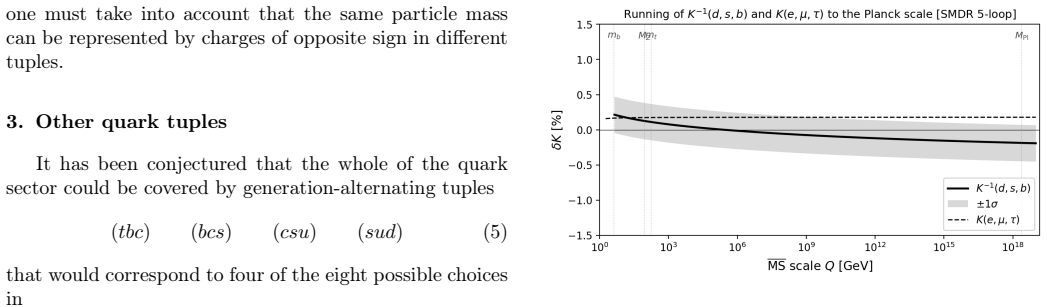
We report a mass rule of Koide type with inverse shape, m_i = M^(d) (w_0 + w_i)^(-2). It applies to the down-quark sector with numerical precision comparable to that of the direct charged-lepton sum rule m_i = M^(l) (z_0 + z_i)^2. For central mass values, Koide ratio reaches exactly 2/3 near 280 TeV under Standard Model renormalisation-group running. We also review other rules of the direct kind involving quarks.
What carries the argument
The inverse Koide mass formula m_i = M^(d) (w_0 + w_i)^(-2) applied to down quarks, which permits the Koide ratio to equal exactly 2/3 after Standard Model running to 280 TeV.
If this is right
- Down quark masses admit an inverse Koide parametrization of the stated form.
- The numerical fit quality equals that of the established lepton rule.
- The Koide ratio for this parametrization equals 2/3 at approximately 280 TeV under Standard Model evolution.
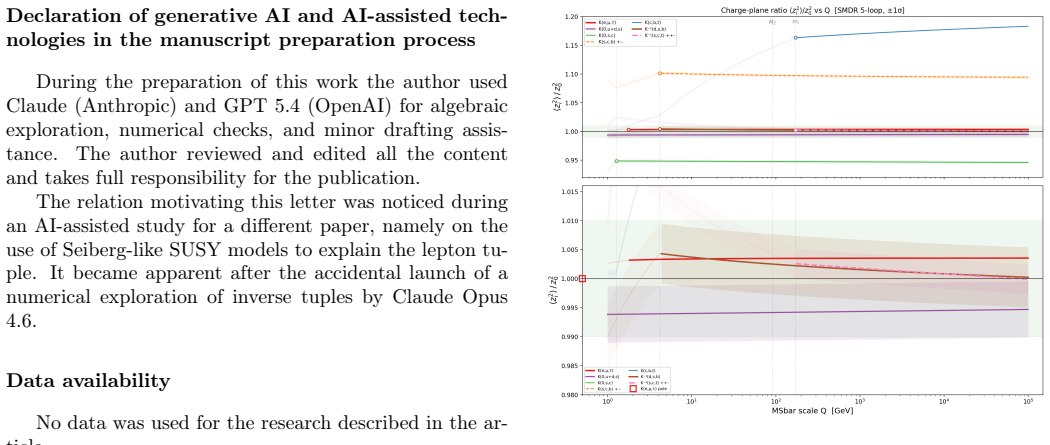
- Direct Koide-type relations continue to exist for other quark sectors and can be catalogued.
Where Pith is reading between the lines
- The inverse and direct forms may represent complementary shapes that together cover all fermion sectors.
- The 280 TeV scale marks a concrete energy at which any deeper mass-generating mechanism would have to reproduce the observed ratio.
- Future lattice or experimental determinations of light-quark masses can be inserted directly into the formula to test the exact 2/3 outcome.
Load-bearing premise
The chosen central values of the down quark masses allow the inverse parametrization to produce a Koide ratio of exactly 2/3 at 280 TeV after Standard Model renormalization-group evolution.
What would settle it
A new global fit to low-energy data that shifts the central down-quark masses enough that, after the same renormalization-group evolution, the Koide ratio at 280 TeV deviates from 2/3.
Figures
read the original abstract
We report a mass rule of Koide type with inverse shape, \[m_i=M^{(d)} (w_0+w_i)^{-2}.\] It applies to the down-quark sector with numerical precision comparable to that of the direct charged-lepton sum rule $m_i=M^{(l)} (z_0+z_i)^{2}$. For central mass values, Koide ratio reaches exactly $2/3$ near 280 TeV under Standard Model renormalisation-group running. We also review other rules of the direct kind involving quarks.
Editorial analysis
A structured set of objections, weighed in public.
Referee Report
Summary. The manuscript proposes an inverse Koide-type mass sum rule for down quarks, m_i = M^{(d)} (w_0 + w_i)^{-2}, asserting numerical precision comparable to the direct lepton rule m_i = M^{(l)} (z_0 + z_i)^2. For central mass values it states that the associated Koide ratio reaches exactly 2/3 near 280 TeV under Standard Model RG running, and reviews other direct Koide-type rules for quarks.
Significance. If the exact high-scale ratio were shown to be stable under mass variations within quoted uncertainties, the inverse parametrization would constitute a non-trivial empirical extension of Koide-like relations into the down-quark sector. The review of other rules supplies useful context, but the fitted nature of w_0, w_i and M^{(d)} limits the result's status as an independent prediction.
major comments (2)
- [Abstract] Abstract: the claim that the Koide ratio reaches exactly 2/3 near 280 TeV is stated only for central mass values; no explicit down-quark masses, uncertainties, fitting procedure for w_0, w_i, M^{(d)}, or stability checks under RG evolution are supplied, so the exactness cannot be verified and appears to follow by construction from the fit.
- [Abstract] Abstract, inverse mass rule: the assertion of 'numerical precision comparable' to the lepton sum rule is made without any tabulated comparison of residuals, χ^{2} values, or explicit numerical results for the down-quark sector, leaving the comparability claim unsupported.
Simulated Author's Rebuttal
We thank the referee for the careful reading and the specific comments on the abstract. We agree that additional details would improve verifiability and will revise accordingly. Point-by-point responses are given below.
read point-by-point responses
-
Referee: [Abstract] Abstract: the claim that the Koide ratio reaches exactly 2/3 near 280 TeV is stated only for central mass values; no explicit down-quark masses, uncertainties, fitting procedure for w_0, w_i, M^{(d)}, or stability checks under RG evolution are supplied, so the exactness cannot be verified and appears to follow by construction from the fit.
Authors: The main text supplies the central down-quark masses (from standard references), describes the three-parameter fit to the inverse rule at the low scale, and shows the RG evolution that yields the ratio 2/3 at ~280 TeV. The ratio is not imposed by construction; the parameters are fixed by the low-energy masses and the high-scale value emerges from the flow. We acknowledge the abstract omits these references and will revise it to cite the relevant sections and state the central values used. A full propagation of mass uncertainties and stability checks is not present in the current manuscript; we will add a brief note acknowledging this limitation rather than performing new calculations. revision: partial
-
Referee: [Abstract] Abstract, inverse mass rule: the assertion of 'numerical precision comparable' to the lepton sum rule is made without any tabulated comparison of residuals, χ^{2} values, or explicit numerical results for the down-quark sector, leaving the comparability claim unsupported.
Authors: The body of the manuscript contains the numerical values of the fitted parameters and a qualitative statement of comparable precision. To make the claim self-contained and verifiable from the abstract, we will add a short table or explicit residual/χ^{2} comparison in the revised version. revision: yes
Circularity Check
Exact 2/3 Koide ratio at 280 TeV follows from fitting inverse parametrization to chosen central down-quark masses
specific steps
-
fitted input called prediction
[Abstract]
"We report a mass rule of Koide type with inverse shape, m_i=M^{(d)} (w_0+w_i)^{-2}. It applies to the down-quark sector with numerical precision comparable to that of the direct charged-lepton sum rule m_i=M^{(l)} (z_0+z_i)^{2}. For central mass values, Koide ratio reaches exactly 2/3 near 280 TeV under Standard Model renormalisation-group running."
The inverse parametrization is introduced and fitted to the down-quark masses (the inputs). The Koide ratio at high scale is then reported as exactly 2/3 only for the chosen central values. Because the parameters w0, wi, M^(d) are adjusted to the low-scale data and the RG flow is deterministic, the reported exact high-scale ratio is a direct consequence of that fit rather than an independent prediction from first principles.
full rationale
The paper introduces the inverse form m_i = M^(d) (w_0 + w_i)^(-2) and states that it fits the down-quark sector with precision comparable to the lepton case. It then reports that, for central mass values, the Koide ratio reaches exactly 2/3 at 280 TeV after RG running. This exact crossing is presented as a result, but the parameters are defined by fitting the low-scale masses, and the high-scale ratio is reported only for those specific central values. Down-quark mass uncertainties are large and grow under RG evolution, so the exactness is tied to the input choice rather than an independent derivation. No evidence is given that the 2/3 crossing is stable inside quoted errors. This matches the fitted_input_called_prediction pattern but does not reduce the entire claim to a pure tautology, hence score 6 rather than 8-10.
Axiom & Free-Parameter Ledger
free parameters (1)
- w_0, w_i, M^{(d)}
axioms (1)
- domain assumption Standard Model renormalization group equations govern the scale dependence of quark masses
Reference graph
Works this paper leans on
-
[1]
Koide, Phys
Y. Koide, Phys. Lett. B 120 (1983) 161–164
1983
-
[2]
Koide, Charged lepton mass sum rule from U(3)- family Higgs potential model, Mod
Y. Koide, Charged lepton mass sum rule from U(3)- family Higgs potential model, Mod. Phys. Lett. A 5 (1990) 2319–2324
1990
-
[3]
Navas, et al., (Particle Data Group), Phys
S. Navas, et al., (Particle Data Group), Phys. Rev. D 110 (2024) 030001
2024
-
[4]
H.Harari, H.Haut, J.Weyers, Phys.Lett.B78(1978) 459
1978
-
[5]
Rodejohann, H
W. Rodejohann, H. Zhang, Phys. Lett. B 698 (2011) 152
2011
- [6]
-
[7]
S. P. Martin, D. G. Robertson, Phys. Rev. D 100 (2019) 073004. arXiv:1907.02500, 10.1103/Phys- RevD.100.073004. Figure 2: RG running of other koide type sum rules
-
[8]
S. Antusch, V. Hinze, S. Saad, Running quark and lepton parameters at various scales, 2025, arXiv:2510.01312
arXiv 2025
-
[9]
Fritzsch, Calculating the Cabibbo angle, Phys
H. Fritzsch, Calculating the Cabibbo angle, Phys. Lett. B 70 (1977) 436
1977
-
[10]
Wilczek, A
F. Wilczek, A. Zee, Horizontal interaction and weak mixing angles, Phys. Rev. Lett. 42 (1979) 421
1979
-
[11]
Fritzsch, Quark masses and flavor mixing, Nucl
H. Fritzsch, Quark masses and flavor mixing, Nucl. Phys. B 155 (1979) 189–207
1979
-
[12]
C. A. Brannen, Koide mass formula for neutrinos, Bull. Am. Phys. Soc. NWS06 (2006) B3.014
2006
- [13]
- [14]
discussion (0)
Sign in with ORCID, Apple, or X to comment. Anyone can read and Pith papers without signing in.