Radio precursors of monster shocks: a mechanism for fast radio bursts from SGR 1935+2154
Pith reviewed 2026-06-27 15:12 UTC · model grok-4.3
The pith
Magnetar kilohertz disturbances launch monster shocks that produce self-regulated GHz radio precursors explaining FRBs from SGR 1935+2154.
A machine-rendered reading of the paper's core claim, the machinery that carries it, and where it could break.
Core claim
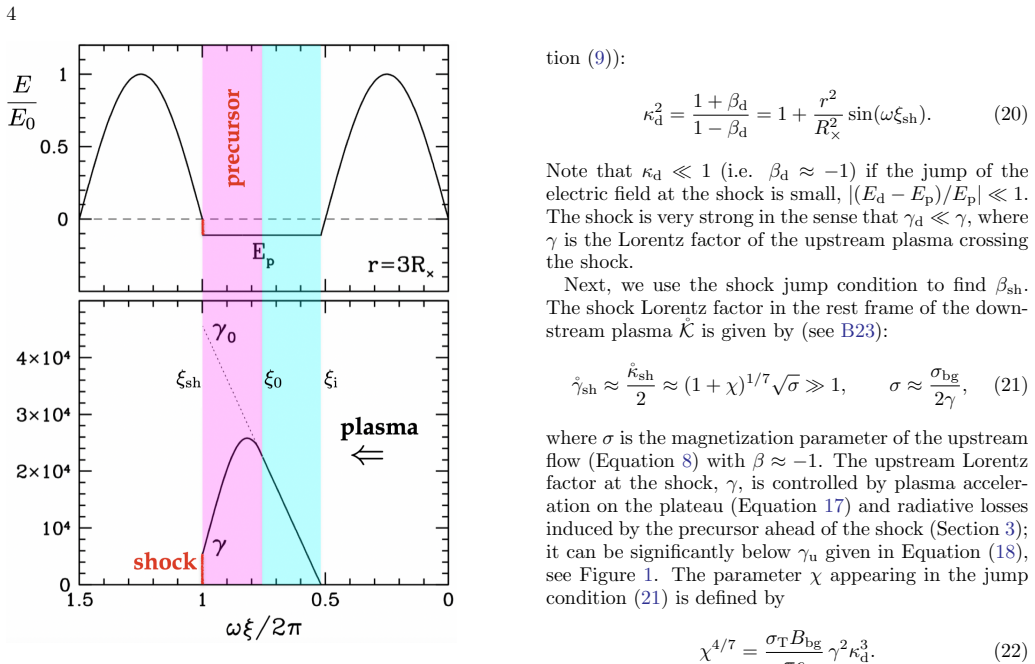
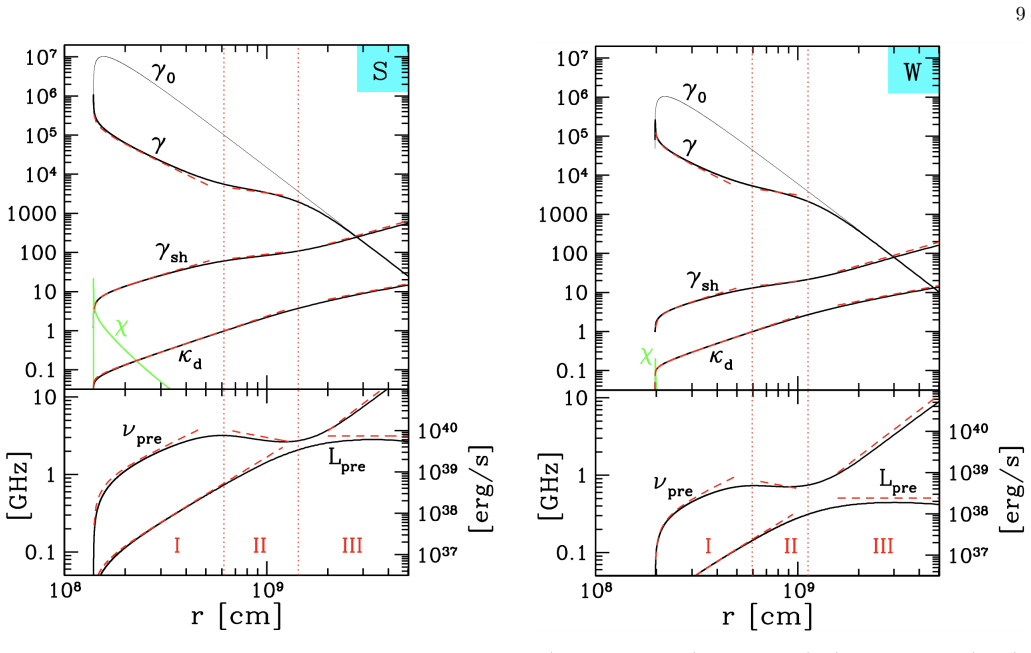
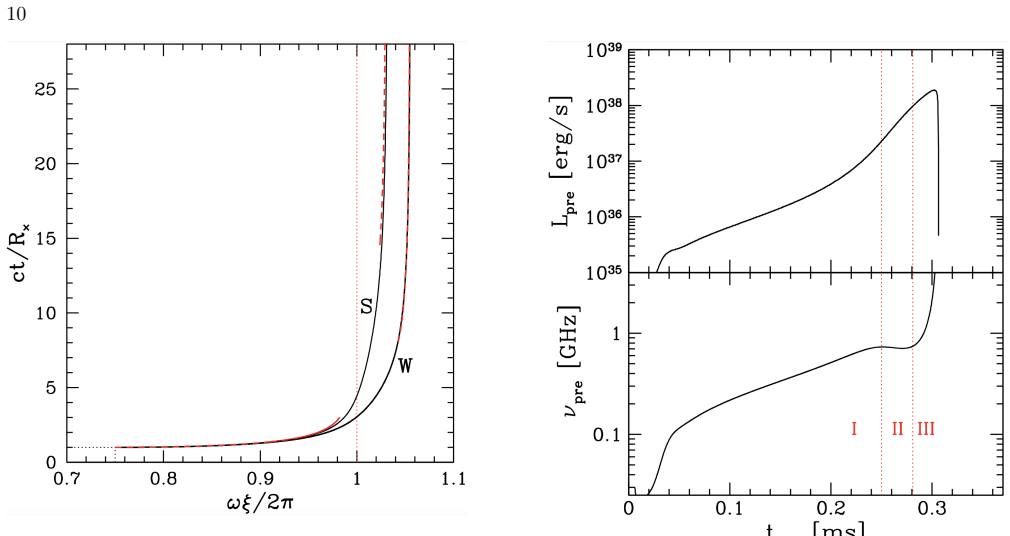
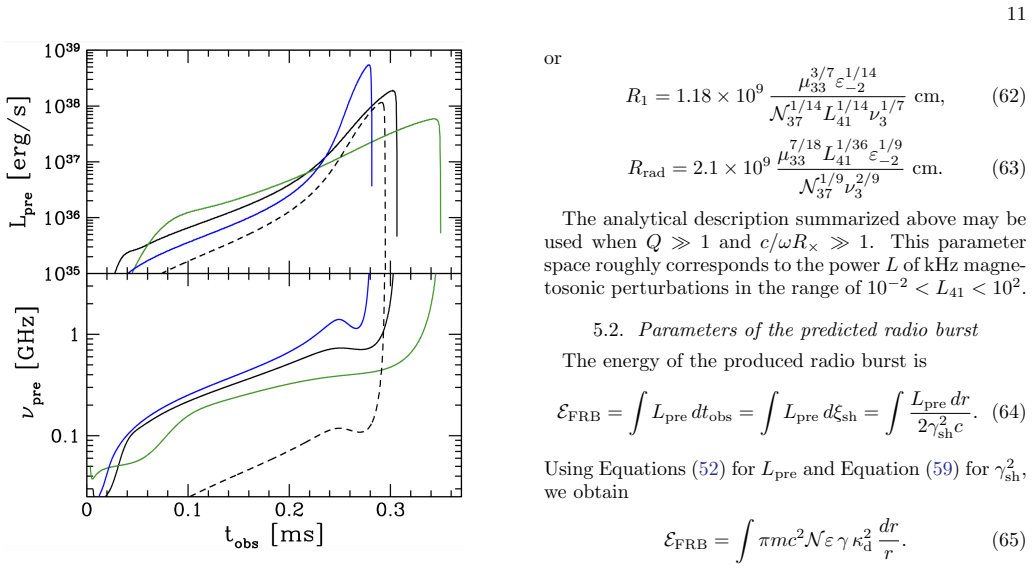
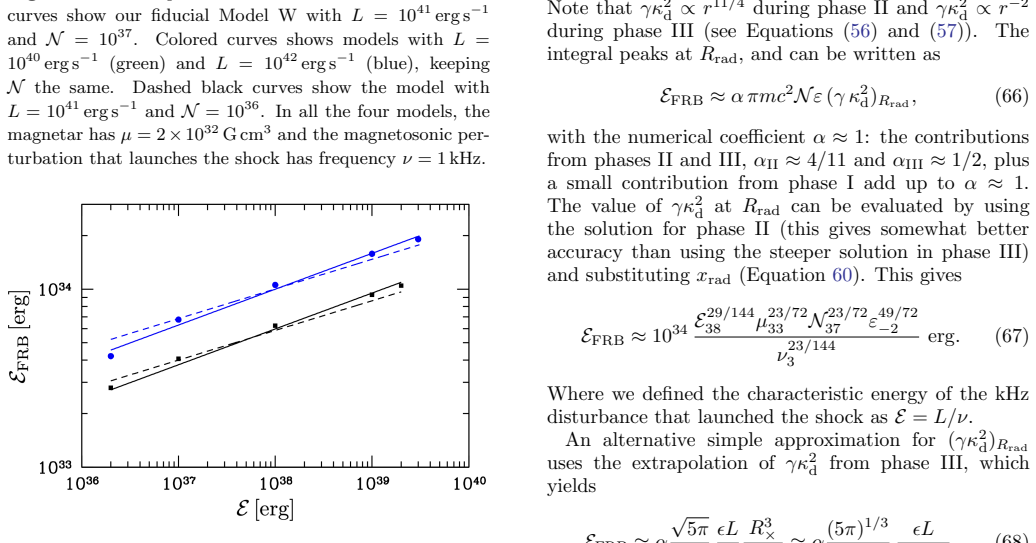
Kilohertz perturbations in active magnetars evolve into monster radiative shocks at radii r∼10^8 cm. The shock generates X-rays and a semi-coherent radio precursor, which strongly interacts with the magnetospheric plasma ahead of the shock. We show that this interaction self-regulates the precursor emission and find its self-consistent frequency and luminosity. The precursor frequency falls in the GHz band and its production peaks when the shock expands to r≈10^9 cm. The resulting GHz burst has a sub-millisecond duration and energy E_FRB≈10^34 E_38^0.2 erg where E is the energy of the primary magnetosonic disturbance that launched the shock.
What carries the argument
Self-regulation of the radio precursor through its strong interaction with magnetospheric plasma ahead of the expanding shock, which fixes the emission frequency and luminosity.
If this is right
- The GHz burst faces absorption at the light cylinder and escapes only if local plasma density is sufficiently low.
- X-ray emission from the shock arrives at the observer with a millisecond delay after the radio waves.
- Disturbances carrying energies around 10^38 erg produce X-ray and radio bursts matching those observed from SGR 1935+2154.
- The radio emission has sub-millisecond duration and reaches maximum production when the shock reaches r≈10^9 cm.
Where Pith is reading between the lines
- The mechanism requires specific magnetospheric conditions that may occur only intermittently, explaining why not every magnetar outburst produces an observable FRB.
- Similar kilohertz-driven shocks could be searched for in other active magnetars through coordinated radio and X-ray timing observations.
- The model predicts that FRB visibility depends on variable plasma density profiles that could be tested with multi-wavelength campaigns.
- Primary disturbances are likely magnetosonic waves at kilohertz frequencies carrying energies near 10^38 erg.
Load-bearing premise
The radio precursor interacts with the magnetospheric plasma in a self-regulating manner that produces consistent GHz frequency and luminosity peaking at r≈10^9 cm, together with the requirement that plasma density at the light cylinder is about 30 times lower than typical expectations.
What would settle it
Detection of an FRB from SGR 1935+2154 without the predicted millisecond-delayed X-ray counterpart, or direct measurement showing plasma density at R_LC not reduced by a factor of ~30 while still observing the radio burst.
Figures
read the original abstract
Kilohertz perturbations in active magnetars evolve into monster radiative shocks at radii $r\sim 10^8$ cm. The shock generates X-rays and a semi-coherent radio precursor, which strongly interacts with the magnetospheric plasma ahead of the shock. We show that this interaction self-regulates the precursor emission and find its self-consistent frequency and luminosity. The precursor frequency falls in the GHz band and its production peaks when the shock expands to $r\approx 10^9$ cm. The resulting GHz burst has a sub-millisecond duration and energy ${\cal E}_{\rm FRB}\approx 10^{34}{\cal E}_{38}^{0.2}$ erg where ${\cal E}$ is the energy of the primary magnetosonic disturbance that launched the shock. As the GHz burst propagates to the light cylinder $R_{\rm LC}\sim 10^{10}$ cm, it faces a threat of being absorbed by the magnetosphere. The burst escapes if the local plasma density at $R_{\rm LC}$ is $\sim 30$ times lower than typically expected for active magnetars, so distant observers need some luck to see the radio burst. The shock X-rays follow the radio waves with a millisecond delay. Shocks from kilohertz disturbances with energies ${\cal E}\sim 10^{38}$ erg generate X-ray and radio bursts similar to the activity detected in SGR 1935+2154.
Editorial analysis
A structured set of objections, weighed in public.
Referee Report
Summary. The paper proposes that kilohertz perturbations in active magnetars evolve into radiative shocks at r ~ 10^8 cm. These shocks produce X-rays and a semi-coherent radio precursor whose interaction with the ahead plasma self-regulates to a GHz frequency and luminosity that peaks at r ≈ 10^9 cm. The resulting sub-ms burst has energy E_FRB ≈ 10^34 E_38^0.2 erg. Escape to distant observers requires the plasma density at the light cylinder (R_LC ~ 10^10 cm) to be ~30 times lower than standard magnetar expectations; otherwise the precursor is absorbed. X-rays follow the radio with a millisecond delay. The mechanism is offered as an explanation for the radio and X-ray activity observed from SGR 1935+2154.
Significance. If the self-regulation calculation and escape condition can be placed on a firmer footing, the work supplies a concrete, falsifiable link between magnetar magnetosonic disturbances and FRB-like radio emission with explicit energy scaling, duration, and time delay. The attempt to derive a self-consistent frequency and luminosity from the precursor-plasma interaction is a positive feature of the approach.
major comments (2)
- [Abstract] Abstract: the requirement that plasma density at R_LC must be ~30 times lower than typically expected is introduced as a necessary condition for the GHz precursor to escape, yet no derivation of this reduction factor from the shock dynamics, pair-cascade physics, or self-regulation mechanism is provided. This makes the factor a free parameter that is load-bearing for the claimed connection to observed FRBs.
- [Abstract] Abstract: the scaling E_FRB ≈ 10^34 E_38^0.2 erg is presented as an output of the self-regulated precursor, but without the explicit derivation it is impossible to determine whether the 0.2 exponent follows from the stated plasma-interaction physics or incorporates external benchmarks or choices in the model.
minor comments (1)
- [Abstract] The notation {\cal E} for energy is used without explicit definition in the abstract; a brief clarification of symbols would improve readability.
Simulated Author's Rebuttal
We thank the referee for the careful reading and the positive assessment of the work's significance. We address the two major comments below, clarifying the origins of the quoted results from the model calculations while agreeing that the abstract can be improved for clarity.
read point-by-point responses
-
Referee: [Abstract] Abstract: the requirement that plasma density at R_LC must be ~30 times lower than typically expected is introduced as a necessary condition for the GHz precursor to escape, yet no derivation of this reduction factor from the shock dynamics, pair-cascade physics, or self-regulation mechanism is provided. This makes the factor a free parameter that is load-bearing for the claimed connection to observed FRBs.
Authors: The factor of ~30 is not a free parameter but follows from the self-regulation calculation. In the model, the precursor-plasma interaction (detailed in the main text) sets a local density at the emission site such that the plasma frequency matches the GHz band. Propagating this density outward to R_LC under the assumption of conserved particle number per flux tube then yields a value ~30 times below the standard Goldreich-Julian expectation for active magnetars. We agree the abstract would benefit from a short clause indicating this origin and will revise it accordingly. revision: yes
-
Referee: [Abstract] Abstract: the scaling E_FRB ≈ 10^34 E_38^0.2 erg is presented as an output of the self-regulated precursor, but without the explicit derivation it is impossible to determine whether the 0.2 exponent follows from the stated plasma-interaction physics or incorporates external benchmarks or choices in the model.
Authors: The exponent 0.2 is obtained directly from the self-regulation equations without external benchmarks. The peak emission occurs when the shock reaches r ≈ 10^9 cm; the radiated energy then follows from the dependence of the interaction optical depth and the shock Lorentz factor on the initial disturbance energy E, producing the weak E^0.2 scaling. We will revise the abstract to note that this scaling is an output of the precursor-plasma interaction calculation. revision: yes
Circularity Check
No significant circularity detected.
full rationale
The paper derives the GHz precursor frequency, luminosity, and E_FRB scaling from the claimed self-regulation of the radio precursor interacting with magnetospheric plasma ahead of the shock, with the scaling presented as following from that interaction at r≈10^9 cm. The ~30× density reduction at R_LC is explicitly framed as a necessary condition for escape rather than a derived prediction or output. No quoted step reduces by construction to a fitted input, self-definition, or self-citation chain; the derivation chain is self-contained against external benchmarks with independent physical content.
Axiom & Free-Parameter Ledger
free parameters (1)
- plasma density reduction factor
axioms (1)
- domain assumption Kilohertz perturbations evolve into monster radiative shocks at r ~ 10^8 cm that generate a semi-coherent radio precursor interacting with ahead plasma.
Reference graph
Works this paper leans on
-
[1]
Beloborodov, A. M. 2017, ApJL, 843, L26, doi: 10.3847/2041-8213/aa78f3 —. 2020, ApJ, 896, 142, doi: 10.3847/1538-4357/ab83eb —. 2022, PhRvL, 128, 255003, doi: 10.1103/PhysRevLett.128.255003 —. 2023, ApJ, 959, 34, doi: 10.3847/1538-4357/acf659 —. 2024, ApJ, 975, 223, doi: 10.3847/1538-4357/ad698c —. 2026, ApJ, 1000, 157, doi: 10.3847/1538-4357/ae4692
-
[2]
Bernardi, D., Yuan, Y., & Chen, A. Y. 2025, PhRvL, 135, 265201, doi: 10.1103/y9p7-1zms
-
[3]
Bochenek, C. D., Ravi, V., Belov, K. V., et al. 2020, Nature, 587, 59, doi: 10.1038/s41586-020-2872-x
-
[4]
Y., Yuan, Y., Li, X., & Mahlmann, J
Chen, A. Y., Yuan, Y., Li, X., & Mahlmann, J. F. 2022, arXiv e-prints, arXiv:2210.13506, doi: 10.48550/arXiv.2210.13506 CHIME/FRB Collaboration, Andersen, B. C., Bandura, K. M., et al. 2020, Nature, 587, 54, doi: 10.1038/s41586-020-2863-y
-
[5]
Thompson, C., & Most, E. R. 2026, arXiv e-prints, arXiv:2602.21290, doi: 10.48550/arXiv.2602.21290
-
[6]
2017, ApJ, 840, 52, doi: 10.3847/1538-4357/aa6d6f
Iwamoto, M., Amano, T., Hoshino, M., & Matsumoto, Y. 2017, ApJ, 840, 52, doi: 10.3847/1538-4357/aa6d6f
-
[7]
2020, MNRAS, 498, 1397, doi: 10.1093/mnras/staa2450
Lu, W., Kumar, P., & Zhang, B. 2020, MNRAS, 498, 1397, doi: 10.1093/mnras/staa2450
-
[8]
2014, MNRAS, 442, L9, doi: 10.1093/mnrasl/slu046 —
Lyubarsky, Y. 2014, MNRAS, 442, L9, doi: 10.1093/mnrasl/slu046 —. 2018, MNRAS, 474, 1135, doi: 10.1093/mnras/stx2832
-
[9]
Mahlmann, J. F., Philippov, A. A., Mewes, V., et al. 2023, ApJL, 947, L34, doi: 10.3847/2041-8213/accada
-
[10]
Margalit, B., Beniamini, P., Sridhar, N., & Metzger, B. D. 2020, ApJL, 899, L27, doi: 10.3847/2041-8213/abac57
-
[11]
2020, ApJL, 898, L29, doi: 10.3847/2041-8213/aba2cf
Mereghetti, S., Savchenko, V., Ferrigno, C., et al. 2020, ApJL, 898, L29, doi: 10.3847/2041-8213/aba2cf
-
[12]
Parfrey, K., Beloborodov, A. M., & Hui, L. 2013, ApJ, 774, 92, doi: 10.1088/0004-637X/774/2/92
-
[13]
Petroff, E., Hessels, J. W. T., & Lorimer, D. R. 2019, A&A Rv, 27, 4, doi: 10.1007/s00159-019-0116-6
-
[14]
2019, MNRAS, 485, 3816, doi: 10.1093/mnras/stz640
Plotnikov, I., & Sironi, L. 2019, MNRAS, 485, 3816, doi: 10.1093/mnras/stz640
-
[15]
Sironi, L., Plotnikov, I., N¨ attil¨ a, J., & Beloborodov, A. M. 2021, PhRvL, 127, 035101, doi: 10.1103/PhysRevLett.127.035101
-
[16]
2025, PhRvE, 112, 065208, doi: 10.1103/1b36-qn66
Sobacchi, E. 2025, PhRvE, 112, 065208, doi: 10.1103/1b36-qn66
-
[17]
2025, PhRvL, 134, 035201, doi: 10.1103/PhysRevLett.134.035201
Vanthieghem, A., & Levinson, A. 2025, PhRvL, 134, 035201, doi: 10.1103/PhysRevLett.134.035201
-
[18]
Yuan, Y., Beloborodov, A. M., Chen, A. Y., & Levin, Y. 2020, ApJL, 900, L21, doi: 10.3847/2041-8213/abafa8
discussion (0)
Sign in with ORCID, Apple, or X to comment. Anyone can read and Pith papers without signing in.