Performance of the Eos detector with water
Pith reviewed 2026-06-27 14:14 UTC · model grok-4.3
The pith
The Eos detector's water data agrees with simulations calibrated from multiple optical and radioactive sources at varied positions and rotations.
A machine-rendered reading of the paper's core claim, the machinery that carries it, and where it could break.
Core claim
The Eos detector, operating with water, permits a series of calibrations with optical and radioactive sources that constrain the detector response. Simulations that incorporate these calibrated models are compared to data collected across different calibration source types, source positions, and rotations, showing agreement that validates the performance of the hybrid detector approach.
What carries the argument
Deployed optical and radioactive calibration sources that constrain the detector response model in water, supporting direct data-to-simulation comparisons.
If this is right
- The detector response model is ready for scintillator deployment without major residual systematics from the water phase.
- Reconstruction algorithms tested on Cherenkov events can be extended to scintillator events.
- Hybrid detector performance is demonstrated in a controlled medium before full operation.
- Systematics established here can be propagated to later neutrino detection studies.
Where Pith is reading between the lines
- The same source-based calibration sequence could reduce optical uncertainties in other hybrid detectors before scintillator fill.
- Agreement in water isolates the effects of the medium itself, which may help separate scintillation-specific properties in follow-on tests.
- If the model holds, larger-scale hybrid detectors could adopt similar pre-calibration steps to limit overall systematics in neutrino measurements.
Load-bearing premise
The water target produces only well-understood Cherenkov light with no significant unmodeled backgrounds or optical effects.
What would settle it
A persistent mismatch between data and calibrated simulations for one or more source configurations that exceeds expected uncertainties.
Figures
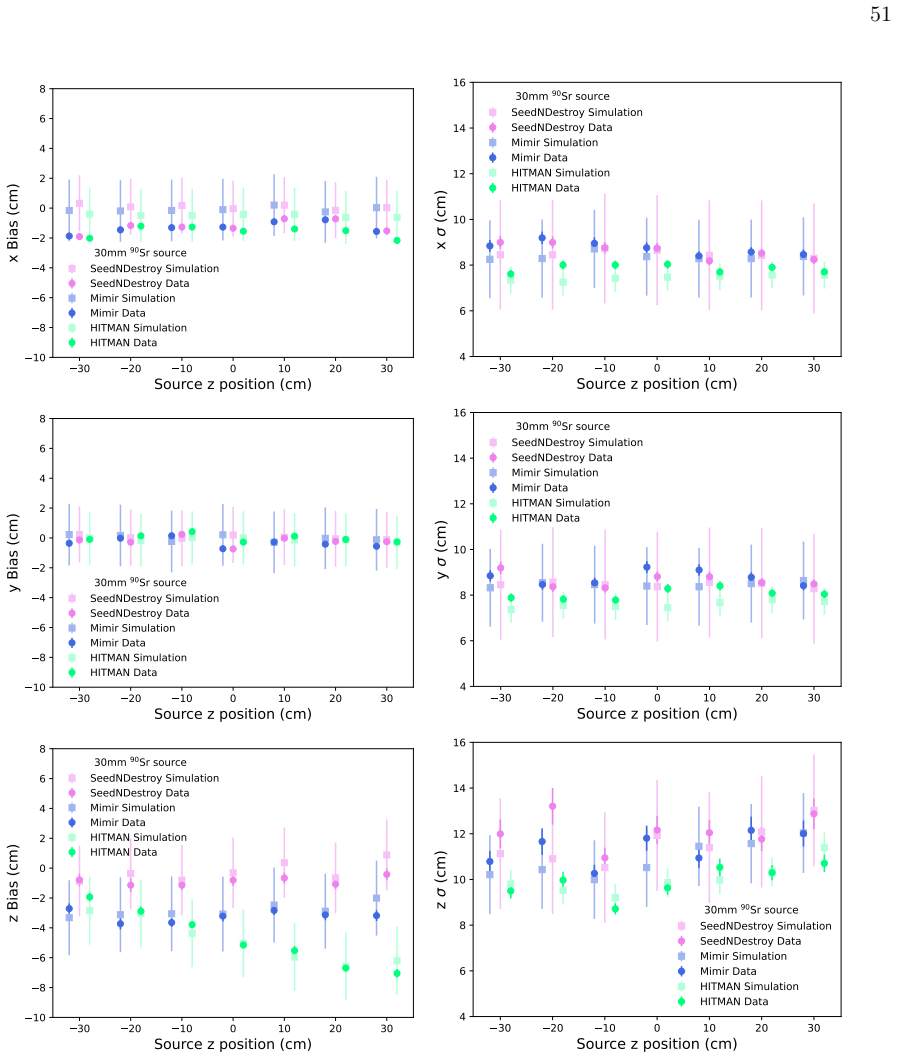
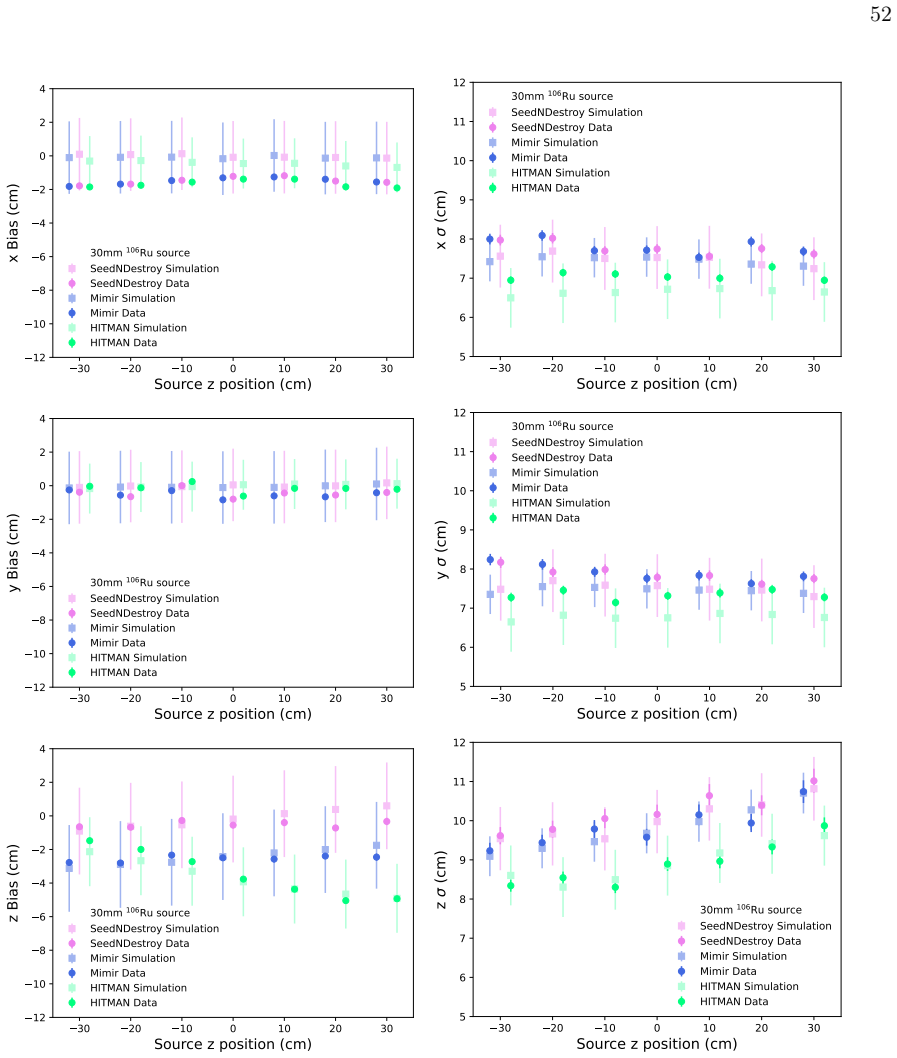
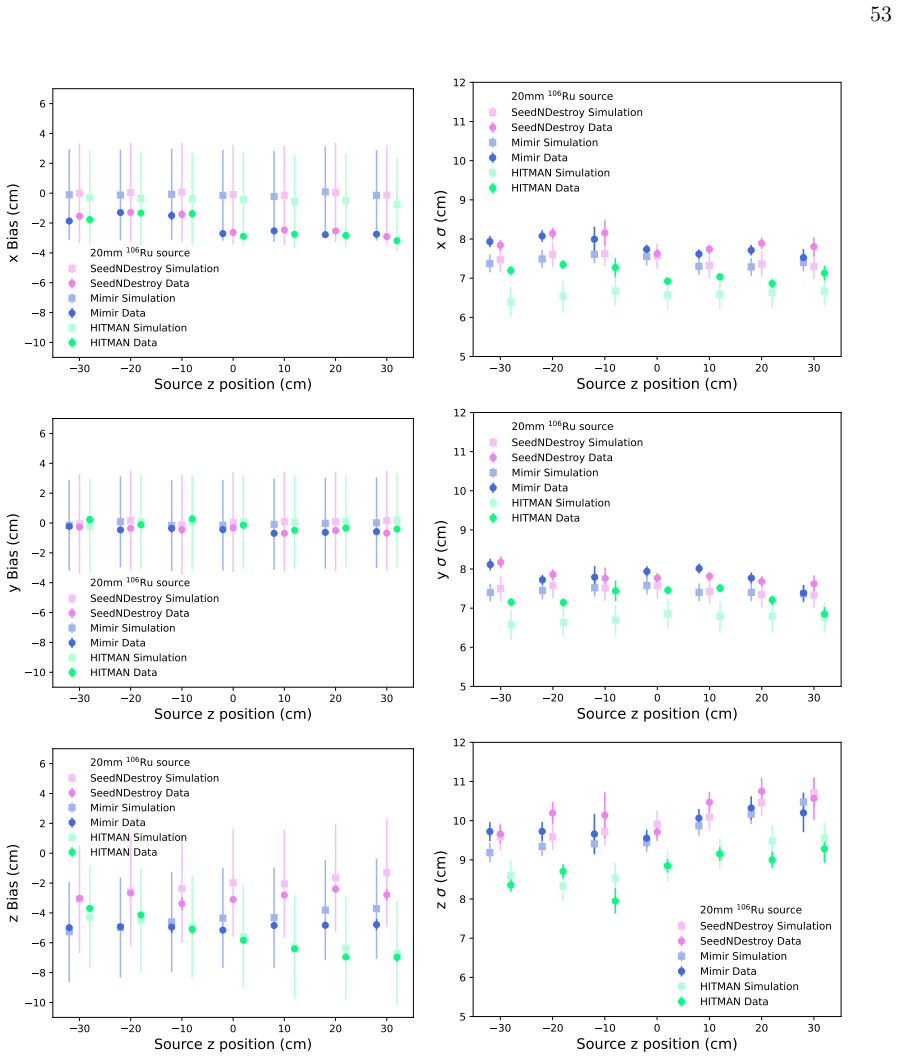
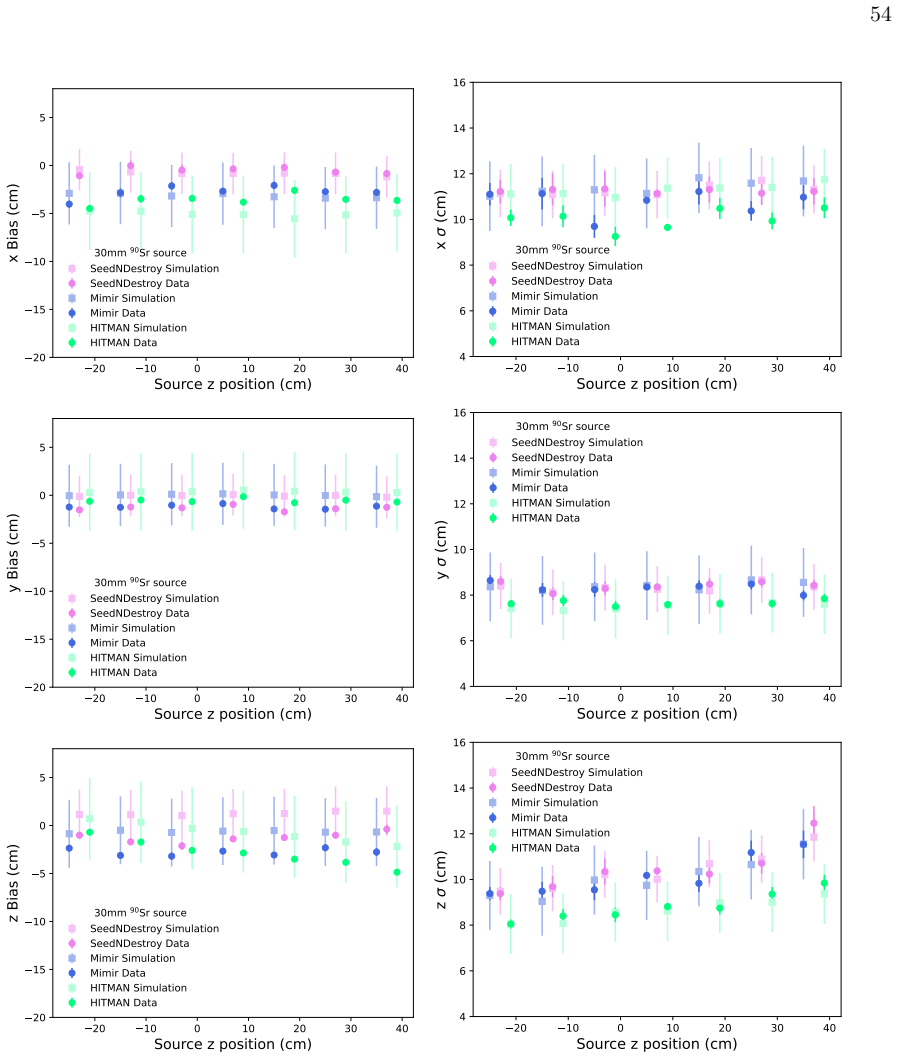
read the original abstract
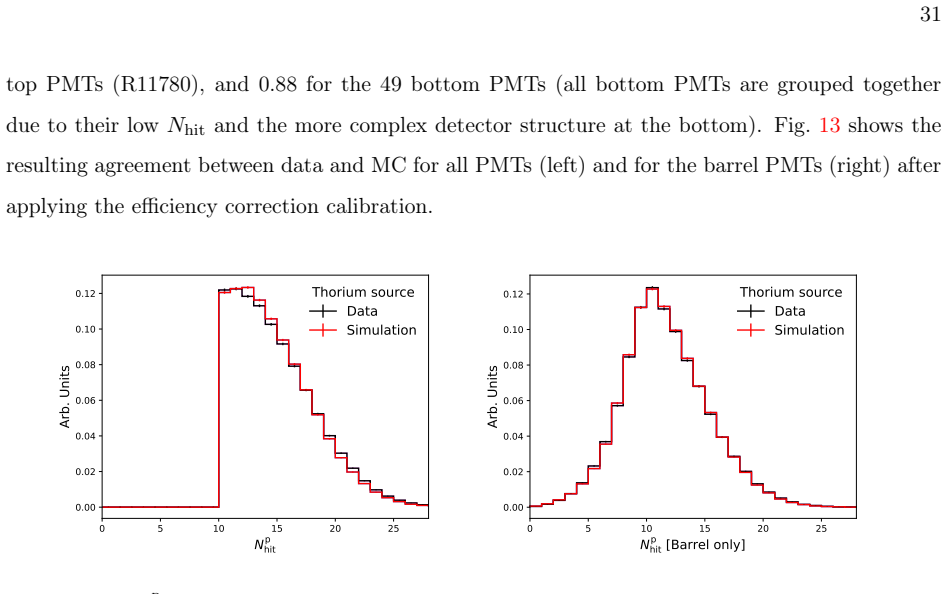
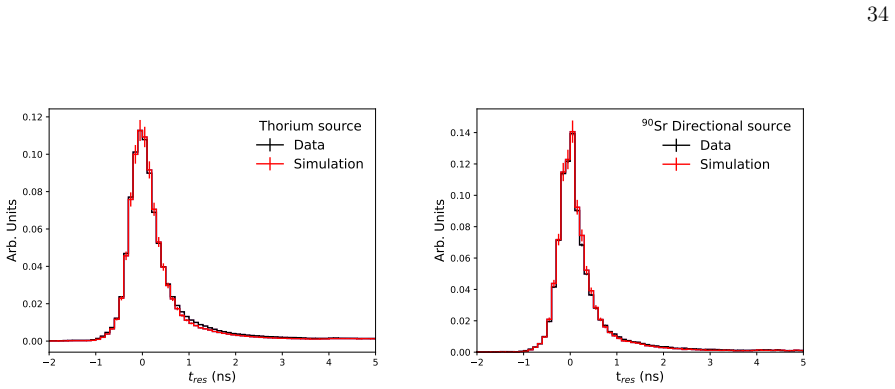
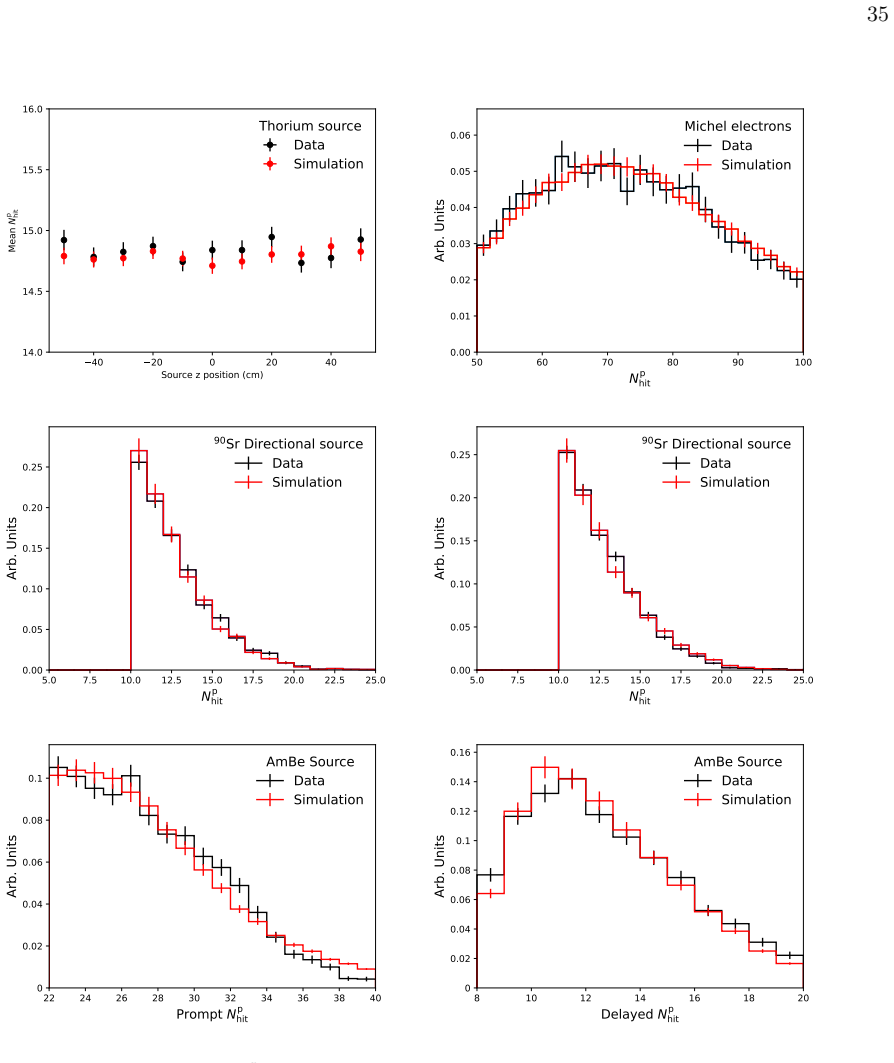
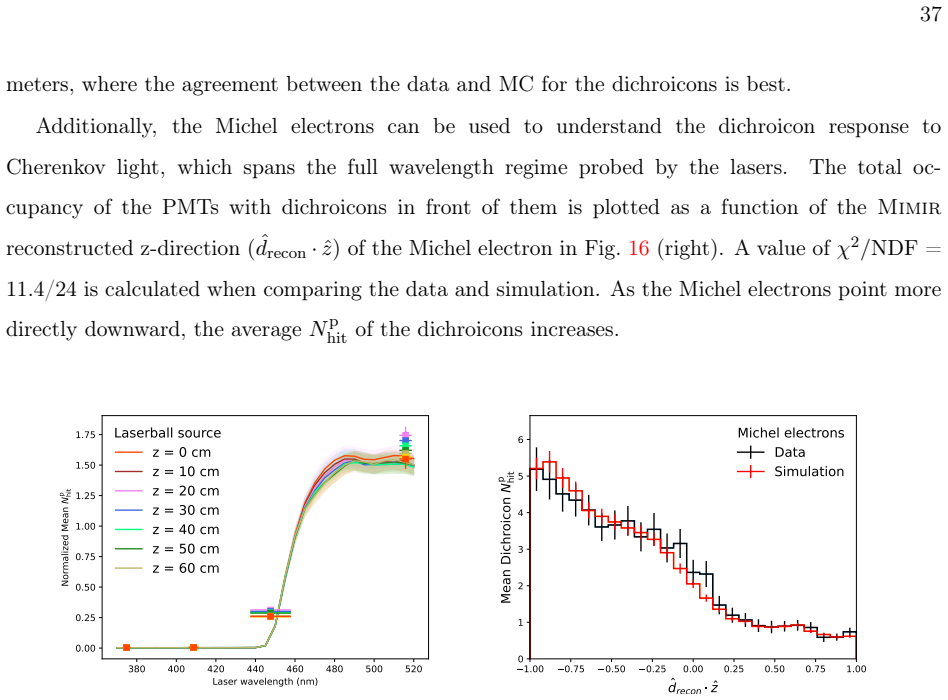
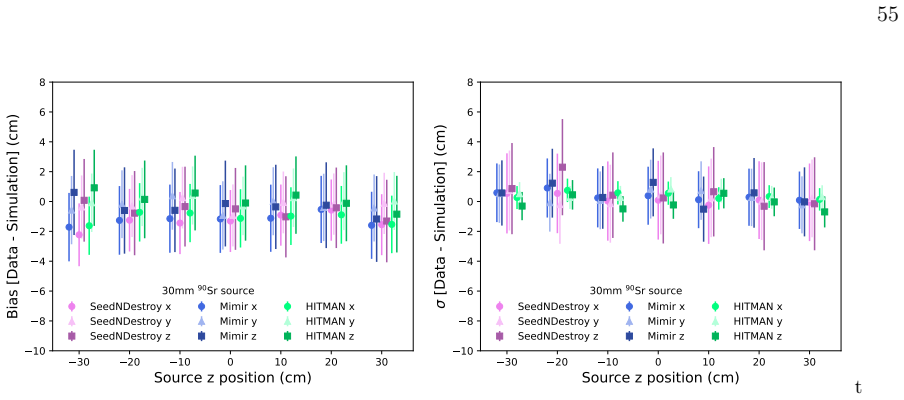
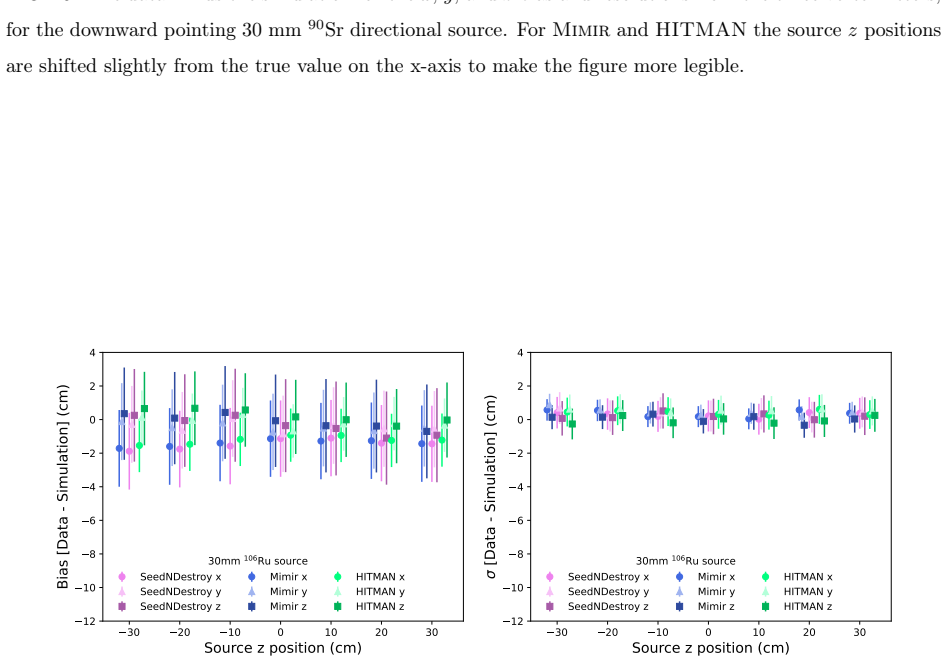
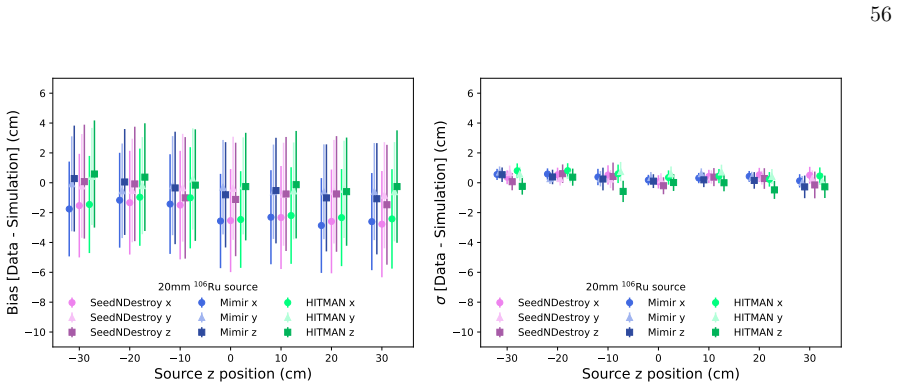
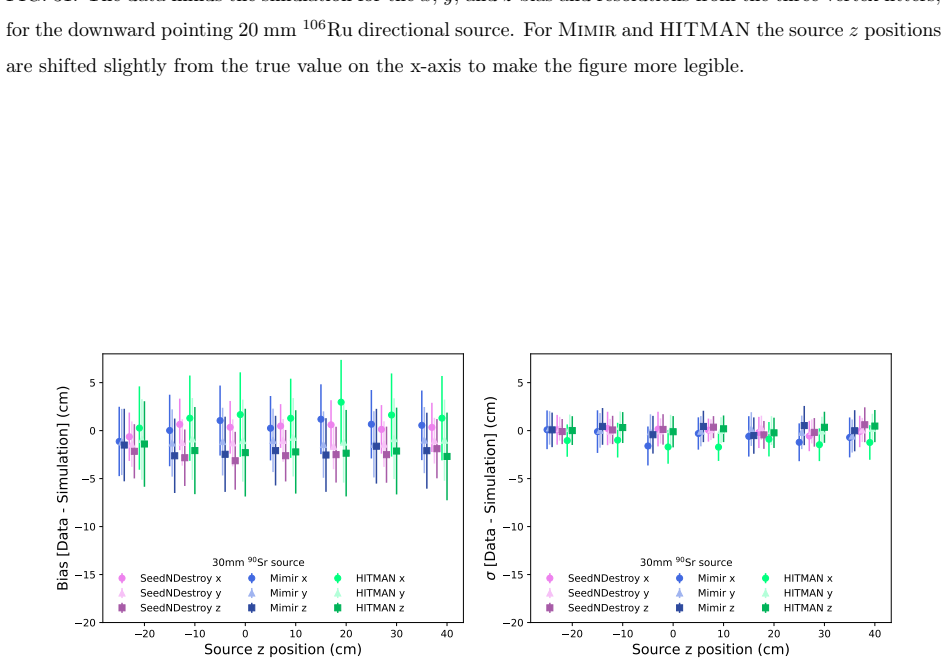
In this manuscript we present the first results from Eos, a four tonne optical detector located at the University of California, Berkeley. The primary goal of Eos is to demonstrate the performance capabilities of scintillation-based, 'hybrid' detector technology for future neutrino detectors. The data presented were collected while both the inner target vessel and the outer buffer vessel were filled with water. The water target acts as a well-understood medium that produces only Cherenkov light, which can be used to calibrate and develop the detector model and reconstruction algorithms prior to the deployment of scintillating material. Using deployed optical and radioactive calibration sources, a series of detailed detector calibrations are performed. These enable a suite of tests for various reconstruction algorithms. Simulations that use calibrated models are compared with the data across a variety of different types of calibration sources, source positions, and rotations.
Editorial analysis
A structured set of objections, weighed in public.
Referee Report
Summary. The manuscript reports the first results from the Eos four-tonne optical detector at UC Berkeley, operated with water in the inner target and outer buffer vessels. It describes performing detailed calibrations using deployed optical and radioactive sources to develop the detector model and reconstruction algorithms, followed by comparisons of calibrated simulations to data across multiple source types, positions, and rotations. The water phase serves as a preparatory step using well-understood Cherenkov light before scintillator deployment in hybrid neutrino detectors.
Significance. If the reported simulation-data comparisons hold with good agreement, this provides a necessary benchmark for the detector response model in a Cherenkov-only medium. Such validation is standard and load-bearing for commissioning hybrid detectors, as it tests the robustness of calibrations and algorithms across varied configurations prior to introducing scintillation effects.
major comments (1)
- Abstract: the description of the calibration workflow and comparison to simulation supplies no quantitative results, error bars, or data figures; this prevents assessment of whether the claimed agreements between calibrated simulations and data are actually achieved or statistically meaningful.
Simulated Author's Rebuttal
We thank the referee for their careful review and constructive feedback on our manuscript. We address the single major comment below.
read point-by-point responses
-
Referee: Abstract: the description of the calibration workflow and comparison to simulation supplies no quantitative results, error bars, or data figures; this prevents assessment of whether the claimed agreements between calibrated simulations and data are actually achieved or statistically meaningful.
Authors: We agree that the abstract would benefit from quantitative indicators of the data-simulation agreement to allow readers to assess the strength of the validation. In the revised manuscript we will expand the abstract to include specific metrics (e.g., position and energy resolution values with uncertainties, and representative agreement levels such as pull distributions or χ^{2} per degree of freedom) drawn from the results already presented in the body of the paper. This change is straightforward and does not alter any scientific conclusions. revision: yes
Circularity Check
No significant circularity
full rationale
This is an experimental calibration report on the Eos water-phase commissioning. The central claim is that deployed sources enable comparison of calibrated simulations to data across source types, positions, and rotations. No equations, fitted parameters, or derivations are presented; the work is descriptive and preparatory for later scintillator deployment. The assumption that water produces only well-understood Cherenkov light is standard and externally falsifiable, with no self-citation chains, self-definitional loops, or fitted inputs renamed as predictions. The derivation chain is therefore self-contained against external benchmarks.
Axiom & Free-Parameter Ledger
Reference graph
Works this paper leans on
-
[1]
Theaveragedirectionalgorithmhastheadvantagesofbeing fast and robust, and thus can be used to seed the direction of the likelihood-based fitting algorithms
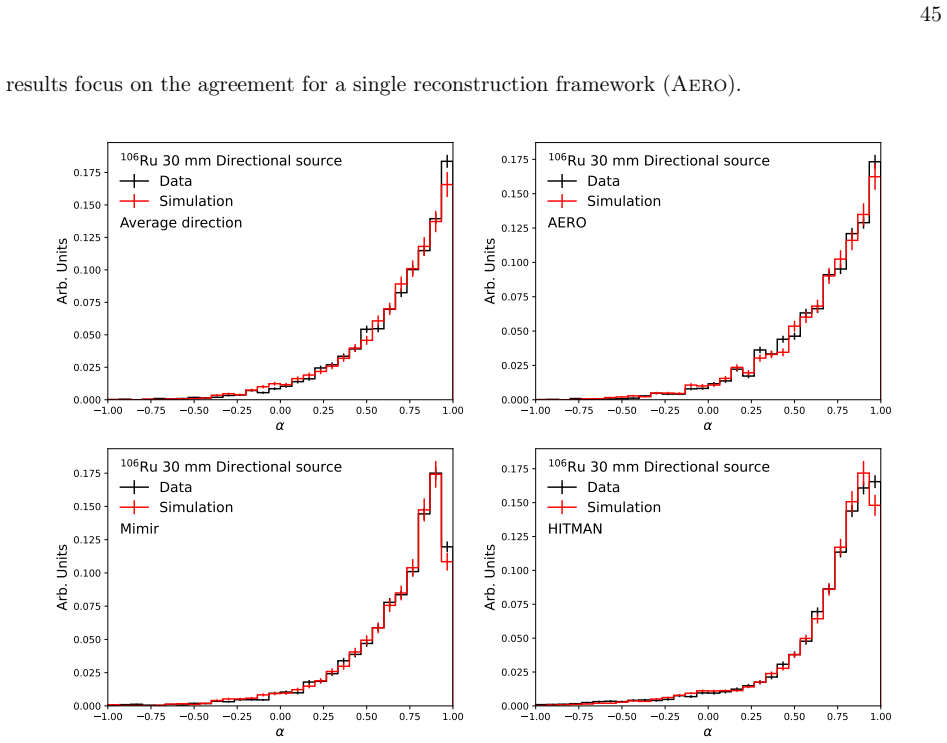
Average direction The average direction fitter takes the average direction of the vectors that point from an input eventpositiontothehitPMTpositions. Theaveragedirectionalgorithmhastheadvantagesofbeing fast and robust, and thus can be used to seed the direction of the likelihood-based fitting algorithms. The event position input for the average direction ...
-
[2]
This is accomplished by training a classifier to distinguish correlated simulation pairs {x,θ}from uncorrelated pairs, approximating the likelihood-to-evidence ratio [43]
Neural Ratio Estimation Unlike regression models that typically provide point estimates, the NRE learns the entire likeli- hood function. This is accomplished by training a classifier to distinguish correlated simulation pairs {x,θ}from uncorrelated pairs, approximating the likelihood-to-evidence ratio [43]. To efficiently handle sparse, variable-sized PM...
-
[3]
normalizedNp hit
Implementation and Parameter Estimation For the water phase analysis, the hypothesisθincludes seven parameters: initial vertex (x, y, z), time (trecon), direction (ϕ, ϑ), and energy (E). The networks are comprised of dense layers with Mish activations [44], trained on 20 million simulated electron events (0.5–15.0 MeV) described in Sec. VI. Network inputs...
2000
-
[4]
Fukudaet al.(Super-Kamiokande), Phys
Y. Fukudaet al.(Super-Kamiokande), Phys. Rev. Lett.81, 1562 (1998), arXiv:hep-ex/9807003
Pith/arXiv arXiv 1998
-
[5]
Q. R. Ahmadet al.(SNO), Phys. Rev. Lett.89, 011301 (2002), arXiv:nucl-ex/0204008
Pith/arXiv arXiv 2002
-
[6]
R. Bonventre and G. D. Orebi Gann, Eur. Phys. J. C78, 435 (2018), arXiv:1803.07109 [physics.ins-det]
Pith/arXiv arXiv 2018
-
[7]
S. Andringaet al.(SNO+), Adv. High Energy Phys.2016, 6194250 (2016), arXiv:1508.05759 [physics.ins-det]
Pith/arXiv arXiv 2016
-
[8]
Agostiniet al.(BOREXINO), Phys
M. Agostiniet al.(BOREXINO), Phys. Rev. Lett.128, 091803 (2022), arXiv:2112.11816 [hep-ex]
arXiv 2022
-
[9]
A. Allegaet al.(SNO+), Phys. Rev. D109, 072002 (2024), arXiv:2309.06341 [hep-ex]
arXiv 2024
-
[10]
M. Askinset al.(Theia), Eur. Phys. J. C80, 416 (2020), arXiv:1911.03501 [physics.ins-det]
arXiv 2020
-
[11]
Sawatzki, M
J. Sawatzki, M. Wurm, and D. Kresse, Phys. Rev. D103, 023021 (2021)
2021
-
[12]
Askinset al.(WATCHMAN), arXiv:1502.01132 [physics.ins-det] (2015)
M. Askinset al.(WATCHMAN), arXiv:1502.01132 [physics.ins-det] (2015)
Pith/arXiv arXiv 2015
-
[13]
A. Bat, E. Tiras, V. Fischer, and M. Kamislioglu, Eur. Phys. J. C82, 734 (2022), arXiv:2112.03418 [physics.ins-det]
arXiv 2022
-
[14]
Yehet al., Nucl
M. Yehet al., Nucl. Instrum. Meth. A660, 51 (2011)
2011
-
[15]
S.D.Biller, E.J.Leming,andJ.L.Paton,Nucl.Instrum.Meth.A972,164106(2020),arXiv:2001.10825 [physics.ins-det]
arXiv 2020
-
[16]
Z. Guo, M. Yeh, R. Zhang, D.-W. Cao, M. Qi, Z. Wang, and S. Chen, Astroparticle Physics109, 33 (2019)
2019
-
[17]
H. T. J. Steigeret al., JINST19(09), P09015, arXiv:2405.01100 [physics.ins-det]
-
[18]
A. V. Lyashenkoet al., Nucl. Instrum. Meth. A958, 162834 (2020), arXiv:1909.10399 [physics.ins-det]
arXiv 2020
-
[19]
T. Kaptanoglu, E. J. Callaghan, M. Yeh, and G. D. O. Gann, Eur. Phys. J. C82, 169 (2022), arXiv:2110.13222 [physics.ins-det]
arXiv 2022
-
[20]
T. Kaptanoglu, M. Luo, and J. Klein, JINST14(05), T05001, arXiv:1811.11587 [physics.ins-det]
-
[21]
T. Kaptanoglu, M. Luo, B. Land, A. Bacon, and J. Klein, Phys. Rev. D101, 072002 (2020), arXiv:1912.10333 [physics.ins-det]
arXiv 2020
-
[22]
A. Elagin, H. Frisch, B. Naranjo, J. Ouellet, L. Winslow, and T. Wongjirad, Nucl. Instrum. Meth. A849, 102 (2017), arXiv:1609.09865 [physics.ins-det]
Pith/arXiv arXiv 2017
-
[23]
A. A. Aguilar-Arevaloet al.(CCM), Phys. Rev. Lett.135, 171804 (2025), arXiv:2507.08886 [physics.ins- det]
arXiv 2025
-
[24]
Andersonet al., JINST18(02), P02009, arXiv:2211.11969 [physics.ins-det]
T. Andersonet al., JINST18(02), P02009, arXiv:2211.11969 [physics.ins-det]
-
[25]
pdf(2022), [Accessed Oct
Hamamatsu, Photomultiplier Tube R14688/R14688-100,https://www.hamamatsu.com/content/dam/ hamamatsu-photonics/sites/documents/99_SALES_LIBRARY/etd/R14688_R14688-100_TPMH1385E. pdf(2022), [Accessed Oct. 27, 2022]
2022
-
[26]
T. Kaptanoglu, A. Rincon, M. Duce, S. Kaplan, J. Koplowitz, S. Lynch, H. J. Ryoo, and G. Orebi Gann, JINST19(02), P02032, arXiv:2311.05080 [physics.ins-det]. 59
-
[27]
J. Bracket al., Nucl. Instrum. Meth. A712, 162 (2013), arXiv:1210.2765 [physics.ins-det]
Pith/arXiv arXiv 2013
-
[28]
27, 2022]
Hamamatsu, Large Area Photocathode Photomultiplier Tubes,https://www.hamamatsu.com/ content/dam/hamamatsu-photonics/sites/documents/99_SALES_LIBRARY/etd/LARGE_AREA_PMT_ TPMH1376E.pdf(2022), [Accessed Oct. 27, 2022]
2022
-
[29]
Andersonet al.(Eos), The eos detector: a demonstrator of hybrid optical detector technology (Publication in progress.)
T. Andersonet al.(Eos), The eos detector: a demonstrator of hybrid optical detector technology (Publication in progress.)
-
[30]
22, 2025]
CAEN, CAEN V1730,https://www.caen.it/products/v1730/(2025), [Accessed Jan. 22, 2025]
2025
-
[31]
Seibertet al., Ratpac-two User’s Guide,https://ratpac.readthedocs.io/en/latest/(2025), [Ac- cessed Jan
S. Seibertet al., Ratpac-two User’s Guide,https://ratpac.readthedocs.io/en/latest/(2025), [Ac- cessed Jan. 15, 2025]
2025
-
[32]
Agostinelliet al.(GEANT4), Nucl
S. Agostinelliet al.(GEANT4), Nucl. Instrum. Meth. A506, 250 (2003)
2003
-
[33]
Geant4 Collaboration, Guide for physics lists,https://geant4-userdoc.web.cern.ch/UsersGuides/ PhysicsListGuide/BackupVersions/V11.1b/html/index.html(2023)
2023
-
[34]
Warburton and W
W. Warburton and W. Hennig, IEEE Transactions on Nuclear SciencePP, 1 (2017)
2017
- [35]
- [36]
-
[37]
Akashi-Ronquestet al., Astropart
M. Akashi-Ronquestet al., Astropart. Phys.65, 40 (2015), arXiv:1408.1914 [physics.ins-det]
Pith/arXiv arXiv 2015
-
[38]
J. Tang, T. Xiao, X. Tang, and Y. Huang, JINST20(03), P03019, arXiv:2411.07620 [physics.ins-det]
-
[39]
Xuet al., JINST17(06), P06040, arXiv:2112.06913 [physics.ins-det]
D. Xuet al., JINST17(06), P06040, arXiv:2112.06913 [physics.ins-det]
-
[40]
Daimon and A
M. Daimon and A. Masumura, Appl. Opt.46, 3811 (2007)
2007
-
[41]
Coulter,Modelling and reconstruction of events in SNO+ related to future searches for lepton and baryon number violation, Ph.D
I. Coulter,Modelling and reconstruction of events in SNO+ related to future searches for lepton and baryon number violation, Ph.D. thesis, Oxford (2013)
2013
-
[42]
S. G. Johnson, The NLopt nonlinear-optimization package,https://github.com/stevengj/nlopt (2007)
2007
-
[43]
T. H. Rowan,Functional stability analysis of numerical algorithms, Ph.D. thesis, Department of Com- puter Science, University of Texas at Austin, Austin, TX (1990)
1990
-
[44]
James and M
F. James and M. Roos, Comput. Phys. Commun.10, 343 (1975)
1975
-
[45]
K. M. Gorski, E. Hivon, A. J. Banday, B. D. Wandelt, F. K. Hansen, M. Reinecke, and M. Bartelmann, The Astrophysical Journal622, 759 (2005), astro-ph/0409513
Pith/arXiv arXiv 2005
-
[46]
Hermans, V
J. Hermans, V. Begy, and G. Louppe, inInternational conference on machine learning(PMLR, 2020) pp. 4239–4248
2020
-
[47]
Misra, arXiv preprint arXiv:1908.08681 (2019)
D. Misra, arXiv preprint arXiv:1908.08681 (2019)
arXiv 1908
-
[48]
Bacon, B
A. Bacon, B. Harris, and J. Klein, Journal of Instrumentation20(09), P09012
-
[49]
B. Aharmimet al.(SNO), Phys. Rev. C81, 055504 (2010), arXiv:0910.2984 [nucl-ex]
Pith/arXiv arXiv 2010
-
[50]
A. Allegaet al.(SNO+), Phys. Rev. D110, 122003 (2024), arXiv:2407.17595 [hep-ex]. 60
arXiv 2024
-
[51]
Abeet al.(Super-Kamiokande), Phys
K. Abeet al.(Super-Kamiokande), Phys. Rev. D94, 052010 (2016), arXiv:1606.07538 [hep-ex]
arXiv 2016
-
[52]
M. R. Andersonet al.(SNO+), JINST16(05), P05009, arXiv:2011.12924 [physics.ins-det]
arXiv 2011
-
[53]
Suzukiet al., Phys
T. Suzukiet al., Phys. Rev. C35, 2212 (1987)
1987
-
[54]
T. H. Burnettet al., Phys. Rev. Lett.30, 937 (1973)
1973
discussion (0)
Sign in with ORCID, Apple, or X to comment. Anyone can read and Pith papers without signing in.