SIDInspector: A Mapping-First Diagnostic Resource for Semantic-ID Tokenizers
Pith reviewed 2026-06-27 11:54 UTC · model grok-4.3
The pith
Semantic-ID tokenizers require separate mapping probes for full-code aliasing and for prefix co-occurrence alignment.
A machine-rendered reading of the paper's core claim, the machinery that carries it, and where it could break.
Core claim
SIDInspector defines a small contract over item mappings, metadata, and optional traces, then emits profile reports that reveal coverage gaps, aliasing, weak prefixes, tail compression, and fan-out before downstream training begins; cross-domain and fixed-reranker checks confirm that prefix alignment functions as a candidate-exposure signal while final ranking quality remains a separate model question.
What carries the argument
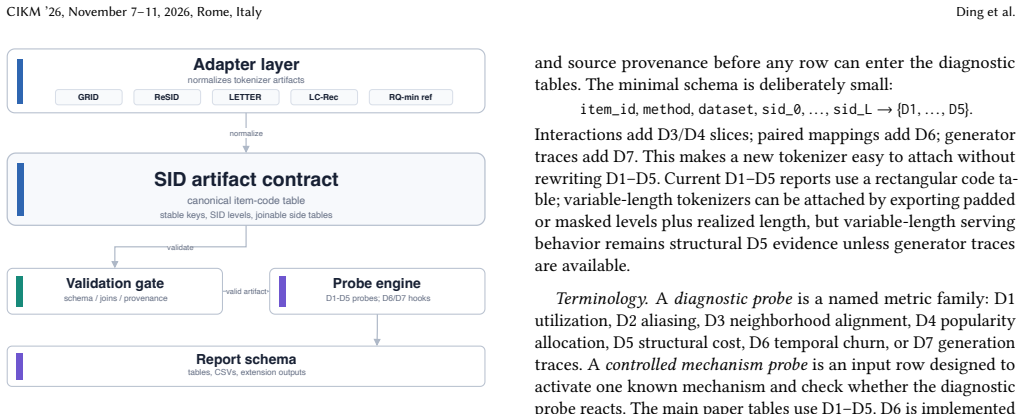
SIDInspector's mapping-first probe suite (utilization, aliasing rate, prefix-co-occurrence alignment, popularity allocation, structural cost) applied to exported item-to-code tables.
If this is right
- A tokenizer export can be alias-free yet still produce poor prefix alignment with observed co-occurrences.
- Deterministic category-based prefix assignment can outperform learned mappings on prefix alignment even when the learned mappings have lower aliasing.
- Addressability (unique full codes, no collisions) and behavioral prefix quality are orthogonal properties that require independent checks.
- The same probe set can be applied to LETTER and LC-Rec artifacts to surface the same diagnostic contrasts across domains.
Where Pith is reading between the lines
- If prefix alignment is a stronger signal of candidate exposure than full-code uniqueness, tokenizer design may shift emphasis toward controllable prefix construction rather than pure quantization.
- Releasing the inspector alongside future SID artifacts would let practitioners reject mappings that pass aliasing checks but fail prefix alignment before any training run.
- The separation of mapping inspection from generator training suggests a two-stage evaluation pipeline in which mapping quality is certified first and only then passed to sequence-model experiments.
Load-bearing premise
The mapping-level statistics reliably predict which tokenizers will produce better downstream generator performance.
What would settle it
A controlled experiment that trains identical sequence generators on the same item set using each tokenizer's exported mapping and measures whether the observed ranking metrics track the reported aliasing rates and prefix-alignment scores.
Figures
read the original abstract
Semantic-ID (\sid) tokenizers are increasingly reused as standalone artifacts in generative recommendation: an exported item-to-code mapping becomes the address space that a later sequence generator must use. These mappings rarely come with a common inspection interface, so coverage gaps, full-code aliasing, behaviorally weak prefixes, tail compression, and prefix fan-out are often found only after downstream training. We present \tool, a mapping-first diagnostic resource for \sid tokenizer artifacts. \tool defines a small adapter contract over item mappings, metadata, interactions, and optional generator traces; validates the contract; and reports mapping-level probes for utilization, aliasing, neighborhood alignment, popularity allocation, and structural cost, with hooks for temporal churn and generator traces. \tool reports inspectable artifact profiles before downstream leaderboard scores. The released resource covers four tokenizer artifact lines: a same-item GRID/RQ-KMeans-style and ReSID/GAOQ contrast on 23,742 Musical items, plus released LETTER and LC-Rec item-index artifacts. In the Musical contrast, the GRID-style feature-text export has 3,749 unique full codes and a 0.977 full-code aliasing rate, while ReSID/GAOQ is aliasing-free in its exported mapping. Yet the strongest prefix--co-occurrence alignment comes from a deterministic category-prefix control, not from either learned export row (0.447 versus 0.154 and 0.055--0.080), showing that addressability and behaviorally meaningful prefixes should be inspected separately. Cross-domain, fixed-reranker, and mechanism-probe checks support the same diagnostic direction: prefix alignment is a candidate-exposure signal, while final ranking quality remains a downstream model question.
Editorial analysis
A structured set of objections, weighed in public.
Referee Report
Summary. The paper introduces SIDInspector, a mapping-first diagnostic resource for Semantic-ID tokenizers reused as address spaces in generative recommendation. It defines a small adapter contract over item mappings, metadata, interactions, and optional traces; validates the contract; and reports mapping-level probes for utilization, aliasing, neighborhood alignment, popularity allocation, and structural cost. Demonstrated on four tokenizer artifact lines including a 23,742-item Musical contrast (GRID-style export: 3,749 unique full codes and 0.977 aliasing rate; ReSID/GAOQ: aliasing-free) plus LETTER and LC-Rec artifacts, with prefix-co-occurrence alignment highest for a deterministic category-prefix control (0.447) versus learned exports (0.154 and 0.055-0.080). The tool is positioned to surface issues before downstream leaderboard scores, with cross-domain and fixed-reranker checks supporting separation of addressability from prefix meaningfulness.
Significance. If the probes are adopted, the work supplies a standardized inspection interface for SID mappings that are otherwise inspected only after training. Strengths include the released resource covering multiple tokenizer lines, concrete reported metrics that illustrate the contrasts, and explicit separation of candidate-exposure signals (prefix alignment) from downstream ranking quality. The absence of claimed correlation between probes and generator performance is consistent with the paper's framing and does not undermine the inspection-utility claim.
minor comments (1)
- [Abstract] Abstract: the reference to 'mechanism-probe checks' supporting the diagnostic direction would benefit from a brief parenthetical on what those checks consist of (e.g., which metrics or controls were used).
Simulated Author's Rebuttal
We thank the referee for their positive review, detailed summary of the contribution, and recommendation to accept the manuscript.
Circularity Check
No circularity: tool definition plus empirical reporting on released artifacts
full rationale
The paper introduces SIDInspector as a diagnostic adapter and reports mapping-level metrics (utilization, aliasing, prefix alignment) on four tokenizer artifacts. No derivation chain, equations, fitted parameters renamed as predictions, or load-bearing self-citations appear. The Musical contrast and cross-domain checks are direct empirical observations, not reductions to inputs by construction. This is the common honest non-finding for a resource paper.
Axiom & Free-Parameter Ledger
axioms (1)
- domain assumption Item-to-code mappings from Semantic-ID tokenizers can be treated as standalone artifacts that are inspectable independently of any downstream generator model.
invented entities (1)
-
SIDInspector adapter contract
no independent evidence
Reference graph
Works this paper leans on
-
[1]
Donini, and Tommaso Di Noia
Vito Walter Anelli, Alejandro Bellogin, Antonio Ferrara, Daniele Malitesta, Fe- lice Antonio Merra, Claudio Pomo, Francesco M. Donini, and Tommaso Di Noia
-
[2]
Elliot: A Comprehensive and Rigorous Framework for Reproducible Rec- ommender Systems Evaluation. InProceedings of the 44th International ACM SIGIR Conference on Research and Development in Information Retrieval (SIGIR ’21). Association for Computing Machinery, New York, NY, USA, 2405–2414. doi:10.1145/3404835.3463245
-
[3]
Vladimir Baikalov, Iskander Bagautdinov, and Sergey Muravyov. 2026. Mitigating Collaborative Semantic ID Staleness in Generative Retrieval. arXiv:2604.13273 [cs.IR] Accepted by SIGIR 2026
Pith/arXiv arXiv 2026
-
[4]
Wei Chen, Xingyu Guo, Shuang Li, Fuwei Zhang, Meng Yuan, Jing Fan, Zhao Zhang, Deqing Wang, and Fuzhen Zhuang. 2026. SynGR: Unleash- ing the Potential of Cross-Modal Synergy for Generative Recommendation. arXiv:2605.18920 [cs.IR] Accepted by ICML 2026. 4 SIDInspector : A Mapping-First Diagnostic Resource for Semantic-ID Tokenizers CIKM ’26, November 7–11,...
Pith/arXiv arXiv 2026
-
[5]
Wenzhuo Cheng, Menghang Gong, Qixin Guo, Hang Zheng, Zhaobin Yang, Jianguo Lou, and Zhengwei Zheng. 2026. CapsID: Soft-Routed Variable-Length Semantic IDs for Generative Recommendation. arXiv:2605.05096 [cs.IR]
Pith/arXiv arXiv 2026
-
[6]
Patrick John Chia, Jacopo Tagliabue, Federico Bianchi, Chloe He, and Brian Ko. 2022. Beyond NDCG: Behavioral Testing of Recommender Systems with RecList. InCompanion Proceedings of the ACM Web Conference 2022 (WWW ’22 Companion). Association for Computing Machinery, New York, NY, USA, 99–104. doi:10.1145/3487553.3524215
-
[7]
CIKM 2026 Organizing Committee. 2026. CIKM 2026 Resource Papers. https: //cikm2026.diag.uniroma1.it/resource-papers/. Accessed 2026-05-19
2026
-
[8]
Yuebo Feng, Jiahao Liu, Mingzhe Han, Dongsheng Li, Hansu Gu, Peng Zhang, Tun Lu, and Ning Gu. 2026. Drift-Aware Continual Tokenization for Generative Recommendation. arXiv:2603.29705 [cs.IR]
arXiv 2026
-
[9]
Junchen Fu, Xuri Ge, Alexandros Karatzoglou, Ioannis Arapakis, Suzan Ver- berne, Joemon M. Jose, and Zhaochun Ren. 2026. Differentiable Semantic ID for Generative Recommendation. arXiv:2601.19711 [cs.IR] Accepted by SIGIR 2026
Pith/arXiv arXiv 2026
-
[10]
Yupeng Hou, Haven Kim, Clark Mingxuan Ju, Eduardo Escoto, Neil Shah, and Julian McAuley. 2026. Expressiveness Limits of Autoregressive Semantic ID Generation in Generative Recommendation. arXiv:2605.06331 [cs.IR]
Pith/arXiv arXiv 2026
-
[11]
Peiyu Hu, Wayne Lu, and Jia Wang. 2025. From IDs to Semantics: A Genera- tive Framework for Cross-Domain Recommendation with Adaptive Semantic Tokenization. arXiv:2511.08006 [cs.IR] Accepted by AAAI 2026
arXiv 2025
-
[12]
Zheng Hu, Yuxin Chen, Yongsen Pan, Xu Yuan, Yuting Yin, Daoyuan Wang, Boyang Xia, Zefei Luo, Hongyang Wang, Songhao Ni, Dongxu Liang, Jun Wang, Shimin Cai, Tao Zhou, Fuji Ren, and Wenwu Ou. 2026. Stop Treating Collisions Equally: Qualification-Aware Semantic ID Learning for Recommendation at Industrial Scale. arXiv:2603.00632 [cs.IR]
arXiv 2026
-
[13]
Wenyue Hua, Shuyuan Xu, Yingqiang Ge, and Yongfeng Zhang. 2023. How to Index Item IDs for Recommendation Foundation Models. InProceedings of the Annual International ACM SIGIR Conference on Research and Development in Information Retrieval in the Asia Pacific Region (SIGIR-AP ’23). Association for Computing Machinery, New York, NY, USA, 195–204. doi:10.11...
-
[14]
Bin Huang, Xin Wang, Junwei Pan, Yongqi Zhou, Yifeng Zhou, Zhixiang Feng, Shudong Huang, Haijie Gu, and Wenwu Zhu. 2026. Asymmetric Generative Recommendation via Multi-Expert Projection and Multi-Faceted Hierarchical Quantization. arXiv:2605.14512 [cs.IR]
Pith/arXiv arXiv 2026
-
[15]
Clark Mingxuan Ju, Liam Collins, Leonardo Neves, Bhuvesh Kumar, Louis Yufeng Wang, Tong Zhao, and Neil Shah. 2025. Generative Recommendation with Semantic IDs: A Practitioner’s Handbook. arXiv:2507.22224 [cs.IR]
arXiv 2025
-
[16]
Clark Mingxuan Ju, Tong Zhao, Leonardo Neves, Liam Collins, Bhuvesh Kumar, Jiwen Ren, Lili Zhang, Wenfeng Zhuo, Vincent Zhang, Xiao Bai, Jinchao Li, Karthik Iyer, Zihao Fan, Yilun Xu, Yiwen Chen, Peicheng Yu, Manish Malik, and Neil Shah. 2026. Semantic IDs for Recommender Systems at Snapchat: Use Cases, Technical Challenges, and Design Choices. arXiv:2604...
Pith/arXiv arXiv 2026
-
[17]
Guowen Li, Yuepeng Zhang, Shunyu Zhang, Yi Zhang, Xiaoze Jiang, Yi Wang, and Jingwei Zhuo. 2026. SID-Coord: Coordinating Semantic IDs for ID-based Ranking in Short-Video Search. arXiv:2604.10471 [cs.IR] Accepted by SIGIR 2026
Pith/arXiv arXiv 2026
-
[18]
Yongqi Li, Xinyu Lin, Wenjie Wang, Fuli Feng, Liang Pang, Wenjie Li, Liqiang Nie, Xiangnan He, and Tat-Seng Chua. 2024. A Survey of Generative Search and Recommendation in the Era of Large Language Models. arXiv:2404.16924 [cs.IR]
arXiv 2024
-
[19]
Yu Liang, Zhongjin Zhang, Yuxuan Zhu, Kerui Zhang, Zhiluohan Guo, Wen- hang Zhou, Zonqi Yang, Kangle Wu, Yabo Ni, Anxiang Zeng, Cong Fu, Jianxin Wang, and Jiazhi Xia. 2026. Rethinking Generative Recommender To- kenizer: Recsys-Native Encoding and Semantic Quantization Beyond LLMs. arXiv:2602.02338 [cs.IR]
arXiv 2026
-
[20]
Enze Liu, Bowen Zheng, Cheng Ling, Lantao Hu, Han Li, and Wayne Xin Zhao
-
[21]
Generative Recommender with End-to-End Learnable Item Tokenization. InProceedings of the 48th International ACM SIGIR Conference on Research and Development in Information Retrieval (SIGIR ’25). Association for Computing Machinery, New York, NY, USA, 729–739. doi:10.1145/3726302.3729989
-
[22]
Yongsen Pan, Yuxin Chen, Zheng Hu, Xu Yuan, Daoyuan Wang, Yuting Yin, Songhao Ni, Hongyang Wang, Jun Wang, Fuji Ren, and Wenwu Ou. 2026. Be- yond Static Collision Handling: Adaptive Semantic ID Learning for Multimodal Recommendation at Industrial Scale. arXiv:2604.23522 [cs.IR]
Pith/arXiv arXiv 2026
-
[23]
Gustavo Penha, Edoardo D’Amico, Marco De Nadai, Enrico Palumbo, Alexandre Tamborrino, Ali Vardasbi, Max Lefarov, Shawn Lin, Timothy Heath, Francesco Fabbri, and Hugues Bouchard. 2025. Semantic IDs for Joint Generative Search and Recommendation. arXiv:2508.10478 [cs.IR] Accepted by RecSys 2025 Late- Breaking Results track
arXiv 2025
-
[24]
Keshavan, Trung Vu, Lukasz Heldt, Lichan Hong, Yi Tay, Vinh Q
Shashank Rajput, Nikhil Mehta, Anima Singh, Raghunandan H. Keshavan, Trung Vu, Lukasz Heldt, Lichan Hong, Yi Tay, Vinh Q. Tran, Jonah Samost, Maciej Kula, Ed H. Chi, and Maheswaran Sathiamoorthy. 2023. Recom- mender Systems with Generative Retrieval. InAdvances in Neural Informa- tion Processing Systems, Vol. 36. Curran Associates, Inc., Red Hook, NY, USA...
2023
-
[25]
Anima Singh, Trung Vu, Nikhil Mehta, Raghunandan Keshavan, Maheswaran Sathiamoorthy, Yilin Zheng, Lichan Hong, Lukasz Heldt, Li Wei, Devansh Tandon, Ed H. Chi, and Xinyang Yi. 2023. Better Generalization with Semantic IDs: A Case Study in Ranking for Recommendations. arXiv:2306.08121 [cs.IR]
arXiv 2023
-
[26]
Huimu Wang, Xingzhi Yao, Yiming Qiu, Qinghong Zhang, Haotian Wang, Yufan Cui, Songlin Wang, Sulong Xu, and Mingming Li. 2026. Towards Efficient and Generalizable Retrieval: Adaptive Semantic Quantization and Residual Knowl- edge Transfer. InProceedings of the 49th International ACM SIGIR Conference on Research and Development in Information Retrieval (SIG...
-
[27]
Wenjie Wang, Honghui Bao, Xinyu Lin, Jizhi Zhang, Yongqi Li, Fuli Feng, See- Kiong Ng, and Tat-Seng Chua. 2024. Learnable Item Tokenization for Generative Recommendation. InProceedings of the 33rd ACM International Conference on Information and Knowledge Management (CIKM ’24). Association for Computing Machinery, New York, NY, USA, 2400–2409. doi:10.1145/...
-
[28]
Ye Wang, Jiahao Xun, Minjie Hong, Jieming Zhu, Tao Jin, Wang Lin, Haoyuan Li, Linjun Li, Yan Xia, Zhou Zhao, and Zhenhua Dong. 2024. EAGER: Two-Stream Generative Recommender with Behavior-Semantic Collaboration. InProceedings of the 30th ACM SIGKDD Conference on Knowledge Discovery and Data Mining (KDD ’24). Association for Computing Machinery, New York, ...
-
[29]
Yibiao Wei, Jie Zou, Pengfei Zhang, Xiao Ao, Weikang Guo, Zeyu Ma, and Yang Yang. 2026. CARD: Non-Uniform Quantization of Visual Semantic Unit for Generative Recommendation. arXiv:2604.26427 [cs.IR]
Pith/arXiv arXiv 2026
-
[30]
Ming Xia, Zhiqin Zhou, Guoxin Ma, and Dongmin Huang. 2026. Un- leash the Potential of Long Semantic IDs for Generative Recommendation. arXiv:2602.13573 [cs.IR]
arXiv 2026
-
[31]
Qiuling Xu, Ko-Jen Hsiao, and Moumita Bhattacharya. 2026. To- wards Generalizable and Efficient Large-Scale Generative Recommenders. arXiv:2605.23312 [cs.IR]
Pith/arXiv arXiv 2026
-
[32]
Chenyi Yan, Ruocong Tang, Xing Fang, Yang Huang, He Guo, and Jing Wang
-
[33]
From Head to Tail: Asymmetric Knowledge Transfer in Long-tail Recom- mendation with Generative Semantic IDs. arXiv:2605.23310 [cs.IR]
-
[34]
Aoran Zhang, Yu-Bin Yang, and Yonghong Yu. 2026. Hyperbolic RQ-VAE en- hanced Generative Recommendation with Differential-Length Codebook Strategy. ICML 2026. https://icml.cc/virtual/2026/poster/65614 Official ICML 2026 poster record
2026
-
[35]
Qian Zhang, Lech Szymanski, Haibo Zhang, and Jeremiah D. Deng. 2026. How Re- liable Are Semantic-ID Tokenizer Comparisons in Generative Recommendation? arXiv:2605.25330 [cs.IR]
Pith/arXiv arXiv 2026
-
[36]
Bowen Zheng, Yupeng Hou, Hongyu Lu, Yu Chen, Wayne Xin Zhao, Ming Chen, and Ji-Rong Wen. 2024. Adapting Large Language Models by Integrating Collaborative Semantics for Recommendation. In2024 IEEE 40th International Conference on Data Engineering (ICDE). IEEE, Piscataway, NJ, USA, 1435–1448. doi:10.1109/ICDE60146.2024.00118
-
[37]
Jieming Zhu, Mengqun Jin, Qijiong Liu, Zexuan Qiu, Zhenhua Dong, and Xiu Li
-
[38]
InProceedings of the 18th ACM Conference on Recommender Systems (RecSys ’24)
CoST: Contrastive Quantization based Semantic Tokenization for Genera- tive Recommendation. InProceedings of the 18th ACM Conference on Recommender Systems (RecSys ’24). Association for Computing Machinery, New York, NY, USA, 969–974. 5
discussion (0)
Sign in with ORCID, Apple, or X to comment. Anyone can read and Pith papers without signing in.