From Electroculture to Plasma Agriculture: A Three-Century Arc Bridging Bertholon's Legacy with Contemporary Farming Advances
Pith reviewed 2026-06-27 11:03 UTC · model grok-4.3
The pith
Abbé Bertholon's 18th-century experiments with atmospheric electricity prefigure contemporary plasma agriculture.
A machine-rendered reading of the paper's core claim, the machinery that carries it, and where it could break.
Core claim
The central discovery is that plasma agriculture can transform an Enlightenment intuition of a 'vivifying electricity' into a reproducible experimental framework for sustainable agriculture and food safety, with Abbé Bertholon's contributions reassessed as those of a methodological precursor whose ideas resonate with modern cold-plasma science.
What carries the argument
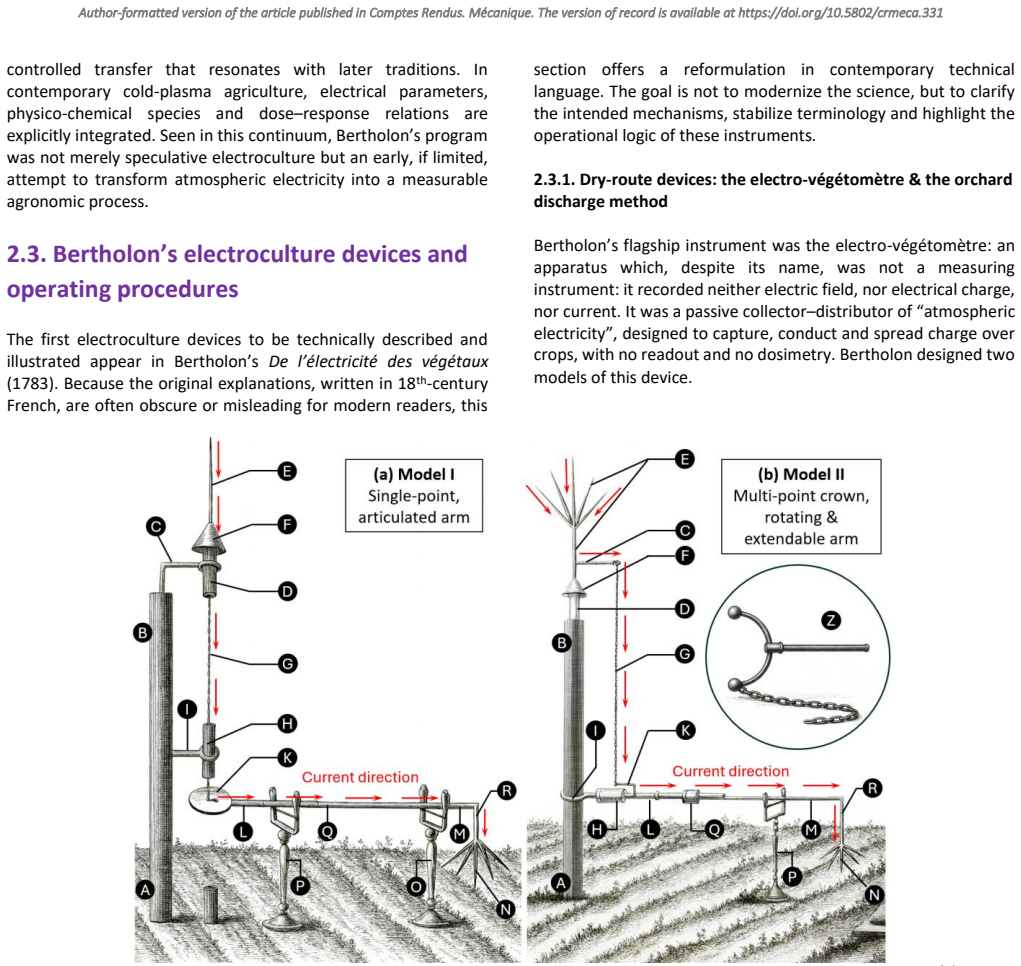
The historical trajectory from Bertholon's electro-végétomètre and the concept of controlled transfer of electrical energy to plants, which evolves into cold-plasma applications integrating electrical, chemical, radiative, thermal, and fluid-mechanical effects.
If this is right
- Seed treatment through preconditioning and priming becomes feasible with plasma technology.
- Stimulation of plant growth is enabled by the combined effects of plasma.
- Soil and water treatment as well as decontamination of agri-food products are supported applications.
- The framework advances sustainable agriculture and enhances food safety.
Where Pith is reading between the lines
- Historical analysis of this type could uncover precursors for other modern technologies in different domains.
- Researchers might explore direct simulations of atmospheric electricity to compare with plasma outcomes.
- Integration with other sustainable practices could amplify the benefits for global food systems.
Load-bearing premise
Early experiments without quantitative dosimetry or rigorous methodology can still be seen as meaningfully foreshadowing modern plasma technologies across a large historical gap.
What would settle it
Finding no resonance or mechanistic link between the electrical effects Bertholon described and the outcomes observed in cold-plasma treatments of plants would undermine the reassessment of his role as precursor.
Figures

read the original abstract
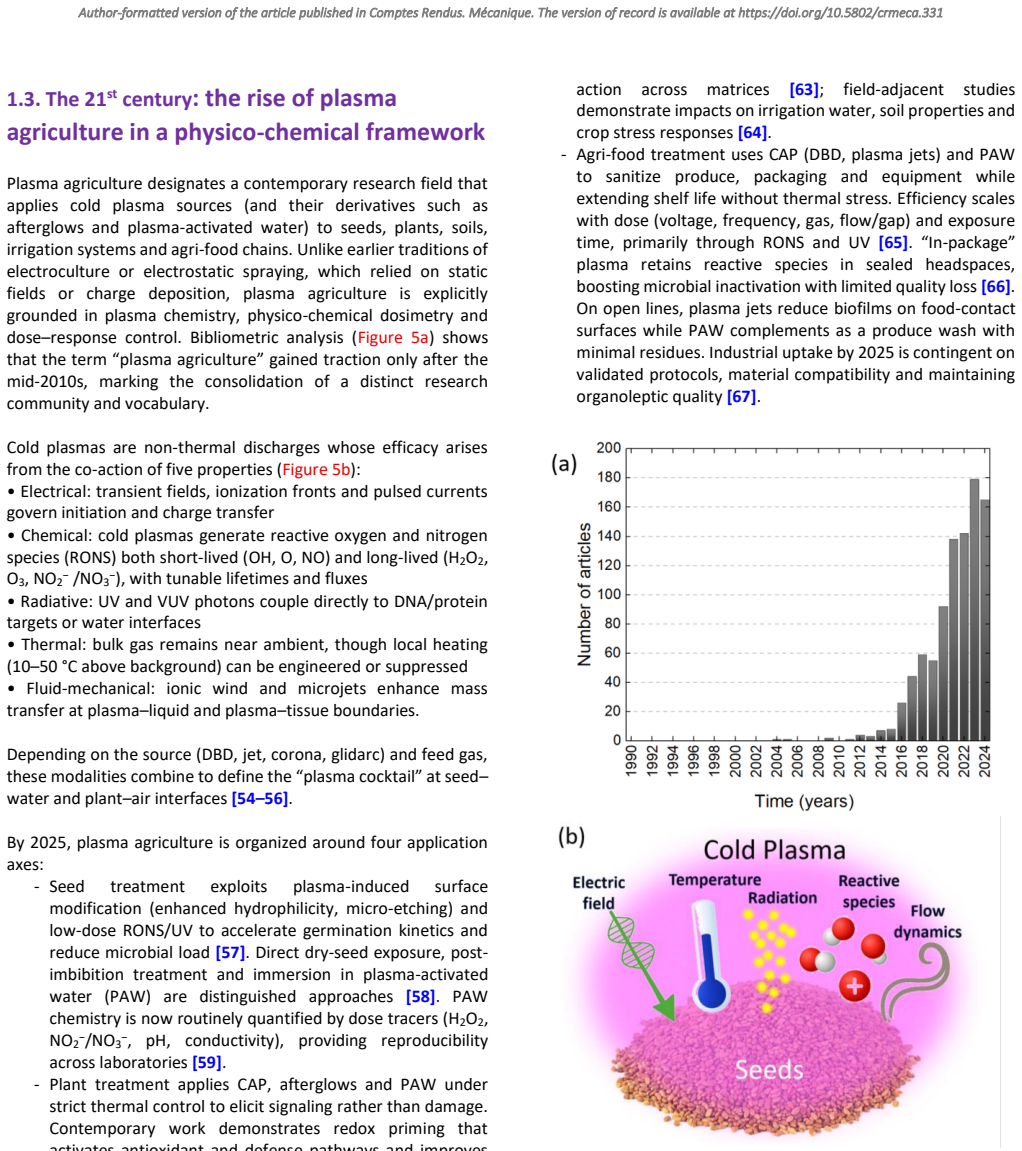
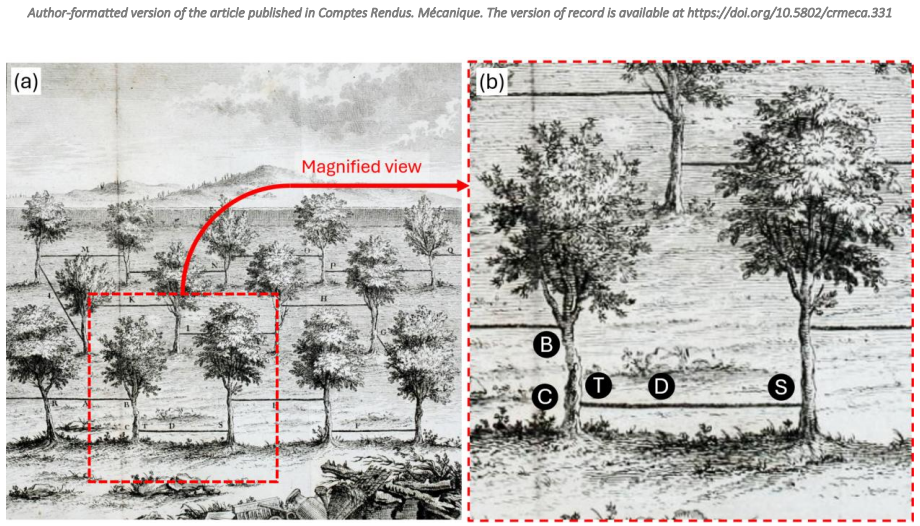
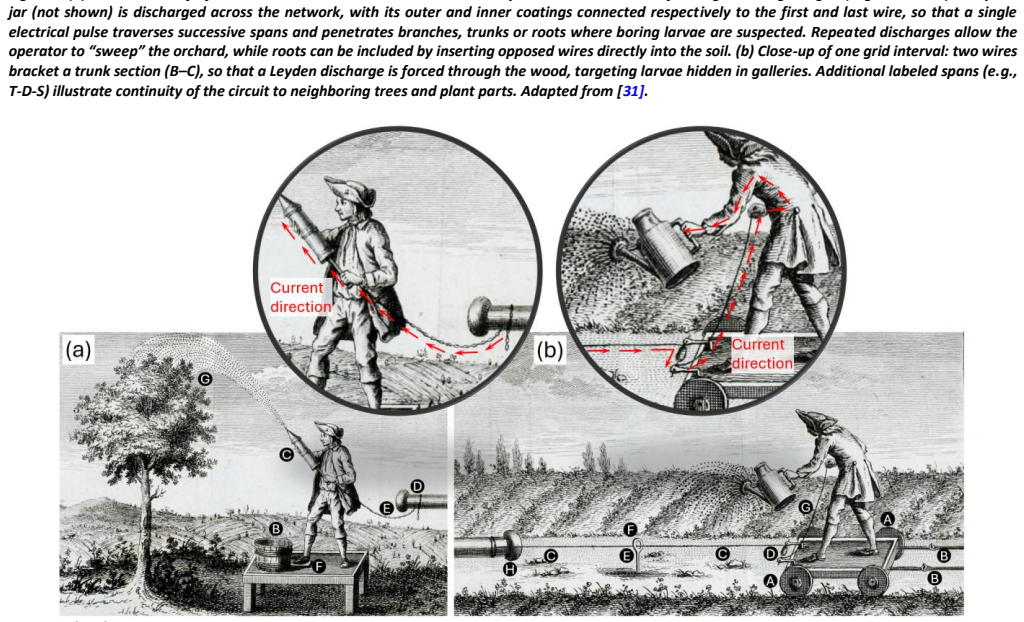
This review traces the historical trajectory of electricity in agriculture, from the earliest observations of electrical phenomena to the emergence of cold plasmas. Looking back to Antiquity and then to the Enlightenment, it underlines Abb\'e Bertholon's 18th-century efforts to channel atmospheric electricity to stimulate crops, using devices such as the electro-v\'eg\'etom\`etre. Although these early electroculture experiments relied on neither quantitative dosimetry nor rigorous methodology, they foreshadowed the idea of a controlled transfer of electrical energy to plants. Then the review examines the historical development of galvanism, electrochemistry, and the physics of gaseous discharges throughout the 19th and 20th centuries, which collectively laid the foundations for contemporary cold-plasma technologies. In the 21st century, plasma agriculture has emerged as an interdisciplinary approach integrating electrical, chemical, radiative, thermal, and fluid-mechanical effects. Applications include seed treatment (preconditioning, seed priming), stimulation of plant growth, soil and water treatment, and decontamination of agri-food products. The review thus reassesses Abb\'e Bertholon's contributions as those of a methodological precursor and shows how his intuition of a "vivifying electricity" resonates with modern cold-plasma science. Finally, it argues that plasma agriculture can transform an Enlightenment intuition into a reproducible experimental framework for sustainable agriculture and food safety.
Editorial analysis
A structured set of objections, weighed in public.
Referee Report
Summary. The paper is a historical review tracing the use of electricity in agriculture from ancient observations through Abbé Bertholon's 18th-century electroculture experiments (e.g., the electro-végétomètre) and subsequent developments in galvanism, electrochemistry, and gaseous discharges to modern cold-plasma applications in seed treatment, plant growth stimulation, soil/water treatment, and agri-food decontamination. It reassesses Bertholon's work as a methodological precursor whose intuition of 'vivifying electricity' resonates with contemporary plasma science, arguing that plasma agriculture converts this Enlightenment-era idea into a reproducible experimental framework for sustainable agriculture and food safety.
Significance. If the historical connections and citations are verified as accurate, the review could usefully contextualize plasma agriculture within a longer arc of electrical applications in farming, potentially aiding interdisciplinary understanding and highlighting the shift from qualitative to quantitative methods. The absence of free parameters or derivations is appropriate for a narrative history, but the value hinges on the strength of the documented continuity.
major comments (2)
- [Abstract] Abstract: The claim that Bertholon's experiments constitute a 'methodological precursor' is in direct tension with the paper's explicit statement that these experiments 'relied on neither quantitative dosimetry nor rigorous methodology'. The precursor status is left resting only on the generic notion of 'controlled transfer of electrical energy to plants', without demonstrated continuity in measurement, control parameters, or causal mechanisms that would distinguish it from independent later developments.
- [Abstract] Abstract (and corresponding historical sections): The asserted resonance between Bertholon's 'vivifying electricity' intuition and modern cold-plasma effects (integrating electrical, chemical, radiative, thermal, and fluid-mechanical effects) is stated without specific comparisons of methods, dosimetry, or outcomes, leaving the bridge between 18th-century qualitative work and 21st-century quantitative plasma agriculture unsupported in detail.
minor comments (1)
- [Abstract] Abstract: Historical claims lack even summary citations, which reduces verifiability for a review paper; adding key references (e.g., to Bertholon's original texts or standard histories of electroculture) would strengthen the narrative.
Simulated Author's Rebuttal
We thank the referee for their constructive comments on our historical review. The points raised help sharpen the characterization of Bertholon's contributions and the nature of the historical bridge to modern plasma agriculture. We respond to each major comment below.
read point-by-point responses
-
Referee: [Abstract] Abstract: The claim that Bertholon's experiments constitute a 'methodological precursor' is in direct tension with the paper's explicit statement that these experiments 'relied on neither quantitative dosimetry nor rigorous methodology'. The precursor status is left resting only on the generic notion of 'controlled transfer of electrical energy to plants', without demonstrated continuity in measurement, control parameters, or causal mechanisms that would distinguish it from independent later developments.
Authors: We acknowledge the tension identified by the referee. The phrasing 'methodological precursor' was chosen to indicate that Bertholon introduced a deliberate, device-based approach to applying electricity to plants, even if the execution remained qualitative. To eliminate ambiguity, we will revise the abstract and the corresponding historical sections to describe Bertholon's role as a conceptual precursor whose work first framed the controlled transfer of electrical energy to vegetation as an experimental objective, while retaining the explicit statement that the experiments lacked quantitative dosimetry and rigorous controls. This revision will also note that later quantitative continuity emerged only with 19th- and 20th-century developments in galvanism and plasma physics. revision: yes
-
Referee: [Abstract] Abstract (and corresponding historical sections): The asserted resonance between Bertholon's 'vivifying electricity' intuition and modern cold-plasma effects (integrating electrical, chemical, radiative, thermal, and fluid-mechanical effects) is stated without specific comparisons of methods, dosimetry, or outcomes, leaving the bridge between 18th-century qualitative work and 21st-century quantitative plasma agriculture unsupported in detail.
Authors: The manuscript is structured as a narrative history tracing the long arc of electrical applications in agriculture rather than as a technical comparison of dosimetry or mechanisms. The resonance is therefore presented at the level of the shared objective of using electrical phenomena to influence plant vitality. We agree that the connection would benefit from greater specificity and will add, in the revised version, brief illustrative references to modern plasma studies whose reported effects on seed germination or growth align conceptually with Bertholon's reported outcomes, while preserving the review's historical focus and avoiding claims of direct methodological lineage. revision: partial
Circularity Check
Narrative historical review with no derivations or self-referential reductions
full rationale
The paper is a historical review tracing electricity in agriculture from Antiquity through Bertholon to modern plasma applications. It contains no equations, no fitted parameters, no predictions, and no derivation chain. The reassessment of Bertholon as methodological precursor is presented as an interpretive historical conclusion drawn from cited primary sources rather than any self-definitional loop, fitted-input prediction, or load-bearing self-citation. The explicit admission that early experiments lacked quantitative dosimetry does not create circularity; it is simply part of the narrative framing. No step reduces by construction to the paper's own inputs.
Axiom & Free-Parameter Ledger
Reference graph
Works this paper leans on
-
[4]
De Lapidibus
Theophrastus. De Lapidibus. Edited with introduction, translation and commentary by D. E. Eichholz. Oxford, At the Clarendon Press (1965). https://stuff.mit.edu/afs/athena/course/21/21h.401/www/local/theophr astus_on.stones.eng.pdf?
1965
-
[5]
Natural History
Pliny the Elder. Natural History. Book 37, sections 1-106. Translated by D.E. Eichholz (1962). Attalus/LOEB. https://www.attalus.org/translate/pliny_hn37a.html?
1962
-
[6]
J. Francis, J. Dingley. Electroanaesthesia - from torpedo fish to TENS. Anaesthesia, Vol. 70, Issue 1, pp. 93 -103 (2015). https://www.doi.org/10.1111/anae.12887
-
[7]
On gagate/jet
A. Magnus, in De mineralibus, Book II (“On gagate/jet” and “On succinum/electrum [amber]”) (D. Wyckoff, ed.), Clarendon Press: Oxford,
-
[8]
Passages: pp
Albertus Magnus: Book of Minerals. Passages: pp. 71 –73 (jet), pp. 105–107 (amber)
-
[9]
Magia naturalis (1558, éd
Giambattista della Porta. Magia naturalis (1558, éd. augmentée 1589), Livre VII, chap. 16 (pierres et propriétés d’attraction). Édition : English translation by Natural Magick, London: Thomas Young. 1658. https://archive.org/details/magianaturalis00dell
-
[10]
De subtilitate, Book VII
Girolamo Cardano. De subtilitate, Book VII. Edition: Opera Omnia, Lyon,
-
[11]
https://gallica.bnf.fr/ark:/12148/bpt6k50540x
-
[12]
W. Gilbert. De Magnete (1600). https://archive.org/details/1600- william-gilbert-de-magnete?
-
[13]
Guericke’s sulphur globe
N. H. de V. Heathcote, “Guericke’s sulphur globe”, Ann. Sci. 6 (1950), no. 3, pp. 293–305. https://nationalmaglab.org/magnet-academy/history- of-electricity-magnetism/museum/sulfur-globe-1660/?
1950
-
[14]
Hauksbee
F. Hauksbee. Physico-Mechanical Experiments on Various Subjects (1709). Fac-similé, Internet Archive. https://archive.org/details/b30512839?
-
[15]
S. Gray. A letter to Cromwell Mortimer, M. D. Secr. R. S. containing several experiments concerning electricity. Philosophical Transactions, Vol. 37, Issue 417, 1731-32. https://doi.org/10.1098/rstl.1731.0005
-
[16]
C.-F. Du Fay. Vitreous/Resinous Electricity. Note historiographique : Nature 144 (1939): 105. https://www.doi.org/10.1038/144105b0
-
[17]
A propos de l'invention de la bouteille de Leyde
Heilbron John L. A propos de l'invention de la bouteille de Leyde. In: Revue d'histoire des sciences et de leurs applications, tome 19, n°2, 1966. pp. 133-142. https://doi.org/10.3406/rhs.1966.2485
-
[18]
Dorsman, C., & Crommelin, C. A. « The invention of the Leyden jar ». (PDF, étude historique avec sources primaires). https://ia904602.us.archive.org/23/items/39002010411123.med.yale.ed u/39002010411123.med.yale.edu.pdf?
-
[19]
Priestley, The History and Present State of Electricity
J. Priestley, The History and Present State of Electricity. London, 1767 pp. 179 -181. Online publication 2015. Cambridge University Press. https://doi.org/10.1017/CBO9781139866309
-
[20]
E. Nairne. Experiments on electricity being an attempt to shew the advantage of elevated pointed conductors. London, printed by J. Nichols (1779)
-
[21]
W. D. Hackmann. The researches of Dr. Martinus Van Marum (1750 -
-
[22]
on the influence of electricity on animals and plants. Medical History, Vol. 16 , Issue 1, pp. 11 -26 (1972). https://doi.org/10.1017/S0025727300017221
-
[23]
J.-A. Nollet. Lettres sur l’électricité. A Paris, chez Hippolyte-Louis Guérin & Louis-François Delatour, rue S. Jacques, vis -à-vis les Mathurins, à Saint - Thomas d’Aquin (1753)
-
[24]
Nollet, Essai sur l’Electricité des Corps, Frères Guérin: Paris, 1765
J.-A. Nollet, Essai sur l’Electricité des Corps, Frères Guérin: Paris, 1765
-
[25]
Pike, Pike’s Illustrated Descriptive Catalogue of Optical, Mathematical and Phylosophical Instruments, 2nd edition, vol
B. Pike, Pike’s Illustrated Descriptive Catalogue of Optical, Mathematical and Phylosophical Instruments, 2nd edition, vol. 1, 1856, pp. 260 and 269. New York
-
[26]
A. Ganot. Traité élémentaire de physique expérimentale et appliquée et de météorologie. Livre I de la matière, des forces et du mouvement, p. 567 & p. 691. 9 th edition (1860). A Paris, chez l’auteur -éditeur. Rue de l’éperon, 12
-
[27]
Franklin
B. Franklin. Experiments and observations on electricity,made at Philadelphia in America. Communicated in several letters to Mr. P. Collinson of London, F.R.S. LONDON, printed and sold by E. Cave, at St John's gate. 1751. https://www.gutenberg.org/files/45515/45515- h/45515-h.htm?
-
[28]
E. P. Krider. Benjamin Franklin and lightning rods Free. Physics Today, Vol. 59 (1), pp. 42-48 (2006). https://doi.org/10.1063/1.2180176
-
[29]
T. Lane. XLIV. Description of an electrometer invented by Mr. Lane; with an account of some experiments made by him with it: In a letter to Benjamin Franklin, LL. D. F. R. S. Phil. Trans. R. Soc. 57:451 -460 (1767). https://doi.org/10.1098/rstl.1767.0046
-
[31]
LXII, Lockyer Davis: Holbourn, London, 1772, p
Philosophical Transactions Giving Some Account of the Present Undertakings, Studies and Labours of the Ingenious, in Many Considerable Parts of the World, vol. LXII, Lockyer Davis: Holbourn, London, 1772, p. 359. Online at https://archive.org/details/bim_eighteenth- century_philosophical-transactio_royal-society- great-bri_1789_79
-
[32]
J. Lacki. The Physical Tourist. Geneva: From the Science of the Enlightenment to CERN. In: Physics in Perspective, 2007, Vol. 9, N°2, pp. 231-252. https://www.doi.org/10.1007/s00016-007-0327-5
-
[33]
C. A. Coulomb. Mémoires sur l’électricité et le magnétisme. Extraits des Mémoires de l’Académie Royale des Sciences de Paris, publiés dans les années 1785 à 1789, avec planches et tableaux. Premier mémoire, pp. 569- 577 (1785). Paris, chez Bachelier, libra ire, quai des Augustins, N°55. https://library.si.edu/digital-library/book/mmoiressurllectr00coul
-
[34]
Priestley, The History and Present State of Electricity with Original Experiments
J. Priestley, The History and Present State of Electricity with Original Experiments. The second edition, corrected and enlarged. London. Printed by J. Dodsley in Pall-Mall, J. Johnson and J. Payne in Pater-Noster Row and T. Cadell in the Strand (1769)
-
[35]
T. Cavallo. A complete treatise of electricity in theory and practice : with original experiments. Third edition. London : printed for C. Dilly, In The Poultry (1786)
-
[36]
Beccaria
G. Beccaria. Dell'elettricismo artificiale e naturale libri due di Giambatista Beccaria de' CC. RR. delle Scuole pie. Publisher : Nella stampa di Filippo Antonio Campana (1753)
-
[37]
De l’électricité des végétaux
Bertholon. De l’électricité des végétaux. A Paris, chez P. F. Didot Jeune, quai des Augustins (1783)
-
[38]
L. Fabbrizzi. Strange Case of Signor Volta and Mister Nicholson: How Electrochemistry Developed as a Consequence of an Editorial Misconduct. Angewandte, Vol. 58, Issue 18, pp. 5810 -5822 (2019). https://doi.org/10.1002/anie.201813519
-
[39]
J. C. Bose, Comparative Electro-Physiology, Longmans, Green, and Co.: New York, Bombay and Calcutta, 1907
1907
-
[40]
W. Crookes. On radiant matter. American Journal of Science, Vol. s3 - 18, Issue 106 (1879). https://doi.org/10.2475/ajs.s3-18.106.241
-
[41]
W. von Siemens. Ueber die elektrostatische Induction und die Verzögerung des Stroms in Flaschendrähten. Annalen der Physik, 178(9), pp. 66-122 (1857). https://www.doi.org/10.1002/andp.18571780905
-
[42]
M. Faraday. XXVIII. Experimental researches in electricity. —fifth series. Philosophical Transactions, Vol. 123 (1833). https://doi.org/10.1098/rstl.1833.0030
-
[43]
J. Burdon -Sanderson, « Note on the Electrical Phenomena which accompany Irritation of the Leaf of Dionaea muscipula », Proc. Royal Society, 1873. https://doi.org/10.1098/rspl.1872.0092
-
[44]
F. Paschen. Ueber die zum Funkenübergang in Luft, Wasserstoff und Kohlensäure bei verschiedenen Drucken erforderliche Potentialdifferenz. Annalen der Physik, 1889. https://doi.org/10.1002/andp.18892730505
-
[45]
The conductivity produced in gases by the motion of negatively charged ions
J.S. Townsend. “The conductivity produced in gases by the motion of negatively charged ions”, Nature 62 (1900), pp. 340–341
1900
-
[46]
J.S. Townsend. The Theory of Ionization of Gases by Collision. London, Constable, 1901. https://doi.org/10.5962/bhl.title.22810
-
[47]
Dr. Heinrich Geissler
A. W. Hofmann, “Dr. Heinrich Geissler”, Ber. Dtsch. Chem. Ges. 12 (1879), pp. 147–148
-
[48]
I. Langmuir. Oscillations in Ionized Gases. Proc. Natl. Acad. Sci., (1928). https://doi.org/10.1073/pnas.14.8.627
-
[49]
von Sonntag, U
C. von Sonntag, U. von Gunten. Chemistry of ozone in water and wastewater treatment: from basic principles to applications. Ed. Iwa Publishing, London, 2012. ISBN 9781780400839
2012
-
[50]
C. Gottschalk, J. A. Libra, A. Saupe. Ozonation of water and waste water. Wiley-VCH, Weinheim, 2010. https://www.doi.org/10.1002/9783527628926
-
[51]
Kr. Birkeland. Trans. Faraday Soc., Vol. 2, pp. 98 -116 (1906). https://doi.org/10.1039/TF9060200098
-
[52]
A. M. W. Downing, T. P. Blunt. Researches on the effect of light upon Bacteria and other organisms. Proceedings of the Royal Society of London, Vol. 26, Issue 179-184 (1878). https://doi.org/10.1098/rspl.1877.0068
-
[53]
Luckiesh, L
M. Luckiesh, L. Holladay. Applications of Germicidal, Erythemal and Infrared Energy. New York, D. Van Nostrand company, inc.; 1946 Library Catalog ; MMS ID 991555293406676; NLM Unique ID 09720620R
1946
-
[54]
(1942) Bactericidal Action of Ultraviolet Radiation (air)
Rentschler, H. (1942) Bactericidal Action of Ultraviolet Radiation (air). https://www.doi.org/10.1128/JB.44.1.85-94.1942
-
[55]
Electrician
S. Lemström, Electricity in Agriculture and Horticulture . The "Electrician" printing & Publishing company, LTD., Salisbury court Fleet Street London (1904)
1904
-
[56]
Christofleau, Electroculture - Fertilisation des terres par l'électricité atmosphérique: Captée par l'Électro -Magnétique-Terro-Céleste ( 1925)
J. Christofleau, Electroculture - Fertilisation des terres par l'électricité atmosphérique: Captée par l'Électro -Magnétique-Terro-Céleste ( 1925). Editions Permafutur. ISBN-10 2959323726
1925
-
[57]
M.S. Kyi, J. Holton, G.L. Ridgway. Assessment of the efficacy of a low temperature hydrogen peroxide gas plasma sterilization system. The Journal of Hospital Infection. Vol. 31, Issue 4, p. 275 -284 (1995). https://www.doi.org/10.1016/0195-6701(95)90206-6
-
[58]
W. A. Rutala, M. F. Gergen, D. J. Weber. Comparative evaluation of the sporicidal activity of new low -temperature sterilization technologies: Ethylene oxide, 2 plasma sterilization systems and liquid peracetic acid. American Journal of Infection Control, Vol. 26, Issue 4, pp. 393-398 (1998). https://doi.org/10.1016/S0196-6553(98)70034-3
-
[59]
M. Laroussi. Sterilization of contaminated matter with an atmospheric pressure plasma. IEEE Transactions on Plasma Science, Vol. 24, No. 3, pp. 1188-1191 (1996). https://www.doi.org/10.1109/27.533129
-
[60]
I. Adamovich, S. D. Baalrud, A. Bogaerts et al. The 2017 Plasma Roadmap: Low temperature plasma science and technology. Journal of Physics D: Applied Physics, Vol. 50, No. 32, 323001 (2017). https://www.doi.org/10.1088/1361-6463/aa76f5
-
[61]
P. Ranieri, N. Sponsel, J. Kizer, M. Rojas -Pierce, R. Hernández, L. Gatiboni, A. Grunden, K. Stapelmann. Plasma agriculture: Review from the perspective of the plant and its ecosystem. Plasma Processes & Polymers, Vol. 18, Issue 1, 2000162 (2021). https://doi.org/10.1002/ppap.202000162
-
[62]
D. B. Graves. The emerging role of reactive oxygen and nitrogen species in redox biology and some implications for plasma applications to medicine and biology. Journal of Physics D: Applied Physics, Vol. 45, No. 26, 263001 (2012). https://www.doi.org/10.1088/0022-3727/45/26/263001
-
[63]
D. Yan, L. Lin, M. Zvansky, L. Kohanzadeh, S. Taban, S. Chriqui, M. Keidar. Improving Seed Germination by Cold Atmospheric Plasma. Plasma, Vol. 5, Issue 1, pp. 98 -110 (2022). https://www.doi.org/10.3390/plasma5010008
-
[64]
M. A. Benabderrahim, I. Bettaie, H. Hannachi, M. Rejili, T. Dufour. Cold plasma treatment boosts barley germination and seedling vigor: Insights into soluble sugar, starch and protein modifications. Journal of Cereal Science, Vol. 116, 103852 (2024). https://doi.org/10.1016/j.jcs.2024.103852
-
[65]
K. S. Wong, N. S. L. Chew , M. Low, M. K. Tan. Plasma-Activated Water: Physicochemical Properties, Generation Techniques and Applications. Processes, Vol. 11, Issue 7, 2213 (2023). https://www.doi.org/10.3390/pr11072213
-
[66]
E. Cortese, A. G. Settimi, S. Pettenuzzo, L. Cappellin, A. Galenda, A. Famengo, M. Dabalà, V. Antoni, L. Navazio. Plasma-Activated Water Triggers Rapid and Sustained Cytosolic Ca2+ Elevations in Arabidopsis Author-formatted version of the article published in Comptes Rendus. Mécanique. The version of record is available at https://doi.or g/10.5802/crmeca....
-
[67]
S. M. E. Sultan, A. F. Yousef, W. M. Ali, A. A. A. Mohamed, A. -R. M. Ahmed, M. E. Shalaby, I. I. Teiba, A. M. Hassan, N. A. Younes, E. F. Kotb. Cold atmospheric plasma enhances morphological and biochemical attributes of tomato seedlings. BMC Plant Biology, Vol. 24, No. 420 (2024). https://doi.org/10.1186/s12870-024-04961-5
-
[68]
Y. Zambon, N. Contaldo, R. Laurita, E. Várallyay, A. Canel, M. Gherardi, V. Colombo, A. Bertaccini. Plasma activated water triggers plant defence responses. Scientific Reports, Vol. 10, No. 19211 (2020). https://doi.org/10.1038/s41598-020-76247-3
-
[69]
Y. Gao, K. Francis, X. uehua Zhang. Review on formation of cold plasma activated water (PAW) and the applications in food and agriculture. Food Research International, Vol. 157, 111246 (2022). https://doi.org/10.1016/j.foodres.2022.111246
-
[70]
J. Šimečková, F. Krčma, D. Klofáč , L. Dostál, Z. Kozáková. Influence of Plasma-Activated Water on Physical and Physical-Chemical Soil Properties. Water, Vol. 12, Issue 9, 2357 (2020). https://doi.org/10.3390/w12092357
-
[71]
B. A. Niemira. Cold Plasma Decontamination of Foods. Annual Review of Food Science and Technology, Vol. 3, pp. 125 -142 (2012). https://doi.org/10.1146/annurev-food-022811-101132
-
[72]
Misra, Sonal Patil, Tamara Moiseev, Paula Bourke, J.P
N.N. Misra, Sonal Patil, Tamara Moiseev, Paula Bourke, J.P. Mosnier, K.M. Keener, P.J. Cullen. In-package atmospheric pressure cold plasma treatment of strawberries. Journal of Food Engineering, Vol. 125, pp. 131- 138 (2014). https://doi.org/10.1016/j.jfoodeng.2013.10.023
-
[73]
M. Bayati, M. N. Lund, B. K. Tiwari, M. M. Poojary. Chemical and physical changes induced by cold plasma treatment of foods: A critical review. Compr Rev Food Sci Food Saf, Vol. 23, Issue 4, e13376 (2024). https://www.doi.org/10.1111/1541-4337.13376
-
[74]
François, F
M. François, F. Fourmaux . Note on Abbé Pierre Bertholon de Saint Lazare. Committee for Historical and Scientific Works (CTHS): Institute affiliated with the École nationale des chartes. Online entry consulted on: 13/08/2024. Entry created on 14/04/2011 - Last updated on 05/09/2023. https://cths.fr/an/savant.php?id=104741
2024
-
[75]
L. Dulieu. Le mouvement scientifique montpelliérain au XVIIIe siècle. In: Revue d'histoire des sciences et de leurs applications, Tome 11, N°3, pp. 227-249 (1958). https://doi.org/10.3406/rhs.1958.3648
-
[76]
l’Abbé Bertholon
M. l’Abbé Bertholon. De l’électricité du corps humain dans l’état de santé et de maladie. A Paris, chez P. F. Didot le jeune, Libraire, quai des Augustins (1780)
-
[77]
l’Abbé Bertholon, M
M. l’Abbé Bertholon, M. Goyer. La nature considérée sous ses différents aspects ou journal d’histoire naturelle. Tome Premier. A Paris, chez Périsse, libraire, Pont Saint-Michel au Soleil d’Or (1787)
-
[78]
J. Priestley. XXVI. An account of a new electrometer, contrived by Mr. William Henly and of several electrical experiments, made by him, in a letter from Dr. Priestley, F. R. S. to Dr. Franklin, F. R. S. Philosophical Transactions, Vol. 62 (1772). https://doi.org/10.1098/rstl.1772.0027
-
[79]
Guillemin
A. Guillemin. Electricity & Magnetism. Revised and edited by Silvanus P. Thompson, D.Sc., B. A., F.R.S. London MacMillan And Co. and New York. 1891
-
[80]
C. A. Coulomb. Mémoires sur l’électricité et le magnétisme. Extraits des Mémoires de l’Académie Royale des Sciences de Paris, publiés dans les années 1785 à 1789, avec planches et tableaux. Deuxième mémoire, pp. 577 -611 (1785). Paris, chez Bachelier, lib raire, quai des Augustins, N°55. https://doi.org/10.5479/sil.304245.39088000647479
-
[81]
A. Martinez. Replication of Coulomb's Torsion Balance Experiment. Arch. Hist. Exact Sci., Vol. 60, pp. 517 -563 (2006). https://doi.org/10.1007/s00407-006-0113-9
-
[82]
M. B. Rubin. The history of ozone. The Schönbein period, 1839 -1868. Bull. Hist. Chem., Vol. 26, No. 1, pp. 40 -56 (2001). https://doi.org/10.70359/bhc2001v026p040
-
[83]
D. Tarasick et al. Tropospheric Ozone Assessment Report: Tropospheric ozone from 1877 to 2016, observed levels, trends and uncertainties. Elementa: Science of the Anthropocene, Vol. 7:39 (2019). https://doi.org/10.1525/elementa.376
-
[84]
J. Barth. Johann Wilhelm Ritter (1776 -1810) und die Entdeckung der UV-Strahlung vor 185 Jahren [Johann Wilhelm Ritter (1776-1810) and the discovery of ultraviolet irradiation 185 years ago]. Hautarzt. Vol. 38(5), pp. 301-303 (1987). PMID: 3301744. https://pubmed.ncbi.nlm.nih.gov/3301744/
arXiv 1987
discussion (0)
Sign in with ORCID, Apple, or X to comment. Anyone can read and Pith papers without signing in.