The Extreme Quasar Main Sequence of Super-Eddington DESI-DR1 NLSy1 Galaxies
Pith reviewed 2026-06-27 12:47 UTC · model grok-4.3
The pith
DESI has found 18,749 NLSy1 galaxies shifted to the extreme high-accretion end of the quasar main sequence with stronger Fe II and more super-Eddington objects than seen in SDSS.
A machine-rendered reading of the paper's core claim, the machinery that carries it, and where it could break.
Core claim
The DESI DR1 NLSy1 population shows a shift toward the extreme end of the EV1 parameter space, with stronger Fe II emission (median log R4570 = -0.03) than the SDSS sample (-0.31). Furthermore, the DESI sources host less massive black holes (median log black hole mass ~6.73) than the SDSS objects (6.77-6.91). Given comparable continuum luminosities, a larger fraction of the DESI sample (43.8%-47.7%) exceeds the Eddington limit (log Eddington ratio > 0) than the SDSS sample (20.6%-37.4%).
What carries the argument
The Eigenvector 1 (EV1) plane defined by broad H-beta FWHM and the Fe II strength ratio R4570, onto which the sample is mapped to assess accretion state via Fe II-dependent single-epoch virial masses and an Eddington-rate fundamental plane.
If this is right
- The DESI NLSy1 galaxies exhibit stronger median Fe II emission than SDSS counterparts.
- A substantially larger share of the DESI sample lies above the Eddington limit.
- The sample supplies a statistical set of local super-Eddington accretors for comparison with early-Universe black hole growth.
- These extreme EV1 objects account for the observed intense Fe II emission through their accretion properties.
Where Pith is reading between the lines
- If the mass estimates hold, models of black hole assembly must incorporate a larger role for sustained super-Eddington phases even in low-mass systems.
- The population supplies a ready testbed for checking whether Fe II strength scales directly with Eddington ratio across a wider mass range than previously sampled.
- Follow-up multi-wavelength observations could check whether the DESI sources also show the X-ray and UV properties expected for super-Eddington flows.
Load-bearing premise
Single-epoch virial black hole masses from the Fe II strength-dependent scaling relation and Eddington rate-dependent fundamental plane give accurate masses and accretion rates for these low-mass high-accretion sources.
What would settle it
Reverberation-mapping or dynamical mass measurements for even a small subset of the DESI NLSy1 sample would show whether the reported super-Eddington fractions hold or whether the single-epoch estimates systematically overestimate accretion rates.
Figures
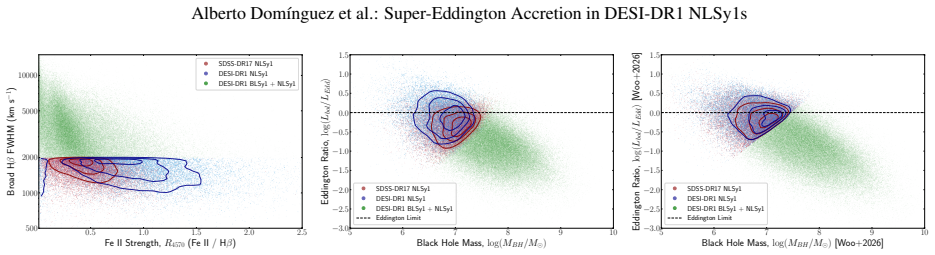
read the original abstract
The quasar main sequence, or Eigenvector 1 (EV1), describes the optical diversity of active galactic nuclei (AGN), with Narrow-Line Seyfert 1 (NLSy1) galaxies anchoring the high-accretion end. Recent discoveries of overly massive black holes in the early Universe highlight the need to study local, low-mass super-Eddington accretors as analogs of rapid black hole growth. We map a population of 18,749 NLSy1 galaxies identified in the Dark Energy Spectroscopic Instrument Data Release 1 (DESI DR1) onto the EV1 plane to determine whether they represent a distinct population of super-accretors. We compare the spectral properties of the DESI DR1 NLSy1 sample with the SDSS DR17 NLSy1 catalog. We extract key parameters, including the broad H-beta full width at half maximum (FWHM) and Fe II strength (R4570). To evaluate their accretion states, we derive single-epoch virial black hole masses using an Fe II strength-dependent scaling relation and an Eddington rate-dependent fundamental plane. The DESI DR1 NLSy1 population shows a shift toward the extreme end of the EV1 parameter space, with stronger Fe II emission (median log R4570 = -0.03) than the SDSS sample (-0.31). Furthermore, the DESI sources host less massive black holes (median log black hole mass ~6.73) than the SDSS objects (6.77-6.91). Given comparable continuum luminosities, a larger fraction of the DESI sample (43.8%-47.7%) exceeds the Eddington limit (log Eddington ratio > 0) than the SDSS sample (20.6%-37.4%). The sensitivity of DESI has unveiled a large population of low-mass, super-Eddington accreting AGN largely missing from previous surveys. These extreme EV1 objects naturally produce the observed intense Fe II emission. This unique sample provides a statistical dataset of local super-Eddington accretors for understanding early-Universe black hole growth.
Editorial analysis
A structured set of objections, weighed in public.
Referee Report
Summary. The manuscript analyzes 18,749 NLSy1 galaxies from DESI DR1 and maps them onto the Eigenvector 1 (EV1) plane using broad Hβ FWHM and Fe II strength (R4570). It compares these to the SDSS DR17 NLSy1 catalog, derives single-epoch virial black hole masses via an Fe II strength-dependent scaling relation and an Eddington rate-dependent fundamental plane, and reports that the DESI sample occupies the extreme EV1 end with stronger Fe II (median log R4570 = -0.03 vs. -0.31), lower median black hole masses (log M_BH ~6.73), and a substantially higher fraction (43.8-47.7%) of super-Eddington accretors (log λ_Edd > 0) than SDSS (20.6-37.4%). The authors conclude that DESI sensitivity has revealed a previously missing population of low-mass, super-Eddington AGN that naturally produce intense Fe II emission and serve as local analogs for early-Universe black hole growth.
Significance. If the single-epoch mass and Eddington ratio estimates are shown to be robust in the low-mass, high-accretion regime, the work would supply the largest statistical sample to date of local super-Eddington accretors, directly addressing the need for analogs to the overly massive high-redshift black holes and quantifying how survey depth affects the observed distribution along the quasar main sequence.
major comments (2)
- [Abstract and mass-derivation paragraph] Abstract and mass-derivation paragraph: The central claim that 43.8-47.7% of DESI NLSy1s exceed log λ_Edd = 0 (versus 20.6-37.4% in SDSS) rests entirely on black-hole masses obtained from an Fe II strength-dependent virial scaling relation combined with an Eddington-rate-dependent fundamental plane. These relations were calibrated on samples that under-represent the extreme-EV1, low-mass (median log M_BH ~6.73), high-accretion end now claimed for DESI; no validation, sensitivity test, or uncertainty budget is provided for possible systematic changes in BLR geometry or virial factor at log λ_Edd > 0, so the reported super-Eddington fraction may be biased.
- [Comparison with SDSS section] Comparison with SDSS section: The reported shift toward stronger Fe II and lower black-hole masses is presented as evidence of a distinct super-Eddington population, yet the same scaling relations are used for both samples; without an independent check (e.g., reverberation mapping or multi-epoch data) that the relations remain unbiased across the full EV1 range sampled by DESI, the difference in super-Eddington fractions cannot be unambiguously attributed to survey sensitivity rather than to the mass estimator itself.
minor comments (1)
- [Abstract] The range 43.8-47.7% is quoted without stating which assumptions (e.g., choice of bolometric correction or exact form of the fundamental plane) produce the bounds; a brief table or footnote clarifying the variants would improve reproducibility.
Simulated Author's Rebuttal
We thank the referee for the detailed and constructive report. The two major comments both concern the robustness of the single-epoch mass and Eddington-ratio estimates in the extreme-EV1 regime. We address each point below and agree that additional discussion of limitations and sensitivity is required.
read point-by-point responses
-
Referee: [Abstract and mass-derivation paragraph] The central claim that 43.8-47.7% of DESI NLSy1s exceed log λ_Edd = 0 (versus 20.6-37.4% in SDSS) rests entirely on black-hole masses obtained from an Fe II strength-dependent virial scaling relation combined with an Eddington rate-dependent fundamental plane. These relations were calibrated on samples that under-represent the extreme-EV1, low-mass (median log M_BH ~6.73), high-accretion end now claimed for DESI; no validation, sensitivity test, or uncertainty budget is provided for possible systematic changes in BLR geometry or virial factor at log λ_Edd > 0, so the reported super-Eddington fraction may be biased.
Authors: We acknowledge that the adopted scaling relations (Fe II-dependent virial estimator and Eddington-dependent fundamental plane) were calibrated on samples that do not fully populate the extreme-EV1, low-mass, super-Eddington domain. The relations were chosen precisely because they incorporate R4570 and λ_Edd dependence to reduce known biases, and the same relations are applied uniformly to both DESI and SDSS samples. Nevertheless, we agree that no explicit sensitivity tests or expanded uncertainty budget for this regime appear in the current manuscript. In revision we will add a new subsection that (i) quantifies the effect of varying the virial factor by ±0.3 dex, (ii) propagates the calibration scatter into the super-Eddington fraction, and (iii) explicitly states the absence of reverberation-mapping validation at log λ_Edd > 0. The absolute fractions will be presented with these caveats; the relative difference between surveys remains the primary result. revision: yes
-
Referee: [Comparison with SDSS section] The reported shift toward stronger Fe II and lower black-hole masses is presented as evidence of a distinct super-Eddington population, yet the same scaling relations are used for both samples; without an independent check (e.g., reverberation mapping or multi-epoch data) that the relations remain unbiased across the full EV1 range sampled by DESI, the difference in super-Eddington fractions cannot be unambiguously attributed to survey sensitivity rather than to the mass estimator itself.
Authors: The primary observables driving the EV1 shift—broad Hβ FWHM and R4570—are measured directly from the spectra and do not rely on the mass estimator. The mass and Eddington-ratio calculations are applied identically to both catalogs, so any systematic offset in the estimator affects the absolute fractions but does not create a spurious difference between the two samples. The observed median shifts in R4570 and M_BH are therefore independent of the estimator. We will revise the comparison section to separate the direct spectral measurements from the derived quantities and to state clearly that the larger super-Eddington fraction in DESI is a consequence of the different EV1 distributions rather than an artifact of the estimator. We cannot supply reverberation-mapping or multi-epoch validation for the low-mass super-Eddington regime, as such data do not exist for this sample. revision: partial
- Independent reverberation-mapping or multi-epoch spectroscopic validation of the single-epoch estimators in the log λ_Edd > 0, log M_BH ~ 6.7 regime is unavailable and cannot be provided.
Circularity Check
No significant circularity; external scaling relations applied to new spectra
full rationale
The paper computes single-epoch virial masses and Eddington ratios by applying literature Fe II-dependent scaling relations and Eddington-rate-dependent fundamental planes to the DESI DR1 spectra, then compares the resulting distributions against the SDSS sample. No new constants are fitted to the present data, no self-definitional loop equates the output population to the input relations, and the central claim (higher super-Eddington fraction in DESI) is a direct statistical comparison rather than a tautology. The derivation chain therefore remains independent of its own fitted values.
Axiom & Free-Parameter Ledger
axioms (2)
- domain assumption Virial theorem applies to the broad-line region kinematics for single-epoch black hole mass estimation
- domain assumption The Fe II strength-dependent scaling relation and Eddington rate-dependent fundamental plane remain unbiased for low-mass, super-Eddington NLSy1 objects
Reference graph
Works this paper leans on
-
[1]
A., Czerny, B., Lasota, J
Abramowicz, M. A., Czerny, B., Lasota, J. P., & Szuszkiewicz, E. 1988, ApJ, 332, 646 Bogdán, Á., Goulding, A. D., Natarajan, P., et al. 2024, Nat. Astron., 8, 126
1988
-
[2]
N., & Fink, H
Boller, T., Brandt, W. N., & Fink, H. 1996, A&A, 305, 53
1996
-
[3]
A., & Green, R
Boroson, T. A., & Green, R. F. 1992, ApJS, 80, 109
1992
-
[4]
2000, NewAR, 44, 531
Collin, S., & Joly, M. 2000, NewAR, 44, 531
2000
-
[5]
Data Release 1 of the Dark Energy Spectroscopic Instrument
Decarli, R., Dotti, M., Fontana, M., & Haardt, F. 2008, MNRAS, 386, L15 DESI Collaboration, Abdul-Karim, M., Adame, A. G., et al. 2025, arXiv:2503.14745
work page internal anchor Pith review Pith/arXiv arXiv 2008
-
[6]
2019, ApJ, 886, 42
Du, P., & Wang, J.-M. 2019, ApJ, 886, 42
2019
-
[7]
J., Hu, C., Wang, J.-M., et al
Ferland, G. J., Hu, C., Wang, J.-M., et al. 2009, ApJ, 707, L82
2009
-
[8]
Goodrich, R. W. 1989, ApJ, 342, 224
1989
-
[9]
2004, ApJ, 606, L41
Grupe, D., & Mathur, S. 2004, ApJ, 606, L41
2004
-
[10]
2023, MNRAS, 518, 6065
Jin, C., Done, C., Ward, M., et al. 2023, MNRAS, 518, 6065
2023
-
[11]
Leighly, K. M. 1999, ApJS, 125, 297
1999
-
[12]
2024, Nature, 627, 59
Maiolino, R., Scholtz, J., Witstok, J., et al. 2024, Nature, 627, 59
2024
-
[13]
W., Zwitter, T., et al
Marziani, P., Sulentic, J. W., Zwitter, T., et al. 2001, ApJ, 558, 553
2001
-
[14]
2000, MNRAS, 314, L17
Mathur, S. 2000, MNRAS, 314, L17
2000
-
[15]
J., & Dunlop, J
McLure, R. J., & Dunlop, J. S. 2004, MNRAS, 352, 1390
2004
- [16]
-
[17]
E., & Pogge, R
Osterbrock, D. E., & Pogge, R. W. 1985, ApJ, 297, 166
1985
-
[18]
K., & Loeb, A
Pacucci, F., Dayal, P., Harikane, Y ., Inoue, A. K., & Loeb, A. 2022, MNRAS, 514, L6
2022
-
[19]
S., Stalin, C
Paliya, V . S., Stalin, C. S., Domínguez, A., et al. 2024, MNRAS, 527, 7055
2024
-
[20]
S., Rakshit, S., Domínguez, A., et al
Paliya, V . S., Rakshit, S., Domínguez, A., et al. 2026, ApJ, submitted
2026
-
[21]
S., Chand, H., et al
Rakshit, S., Stalin, C. S., Chand, H., et al. 2017, ApJS, 229, 39
2017
-
[22]
T., Lacy, M., Storrie-Lombardi, L
Richards, G. T., Lacy, M., Storrie-Lombardi, L. J., et al. 2006, ApJS, 166, 470 Salomé, Q., Krongold, Y ., Longinotti, A. L., et al. 2023, MNRAS, 524, 3130
2006
-
[23]
T., Strauss, M
Shen, Y ., Richards, G. T., Strauss, M. A., et al. 2011, ApJS, 194, 45
2011
-
[24]
Shen, Y ., & Ho, L. C. 2014, Nature, 513, 210
2014
-
[25]
S., Saikia, D
Umayal, S., Paliya, V . S., Saikia, D. J., et al. 2025, ApJ, 995, 125
2025
-
[26]
Vestergaard, M., & Peterson, B. M. 2006, ApJ, 641, 689 V olonteri, M., Habouzit, M., & Colpi, M. 2021, Nat. Rev. Phys., 3, 732
2006
-
[27]
Woo, J.-H., Kim, J., Cho, H., & Wang, S. 2026, arXiv:2603.07047 Article number, page 4
work page internal anchor Pith review Pith/arXiv arXiv 2026
discussion (0)
Sign in with ORCID, Apple, or X to comment. Anyone can read and Pith papers without signing in.