AnisoLift: Anisotropic Latent Representations for Coarse Particle Liquid Enhancement
Pith reviewed 2026-06-27 11:15 UTC · model grok-4.3
The pith
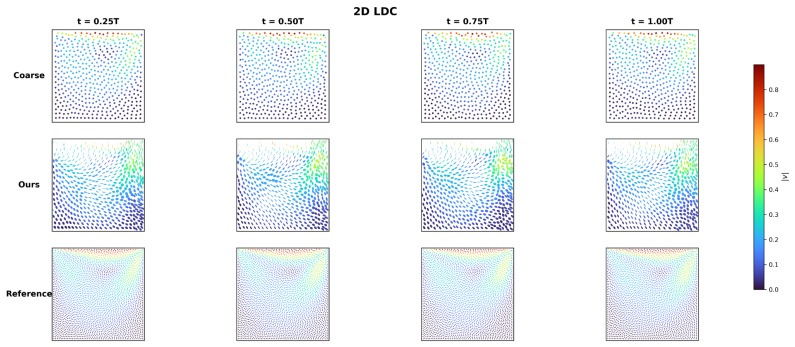
Augmenting each coarse particle with a learnable anisotropic ellipsoid recovers fine-scale liquid dynamics without generating extra particles.
A machine-rendered reading of the paper's core claim, the machinery that carries it, and where it could break.
Core claim
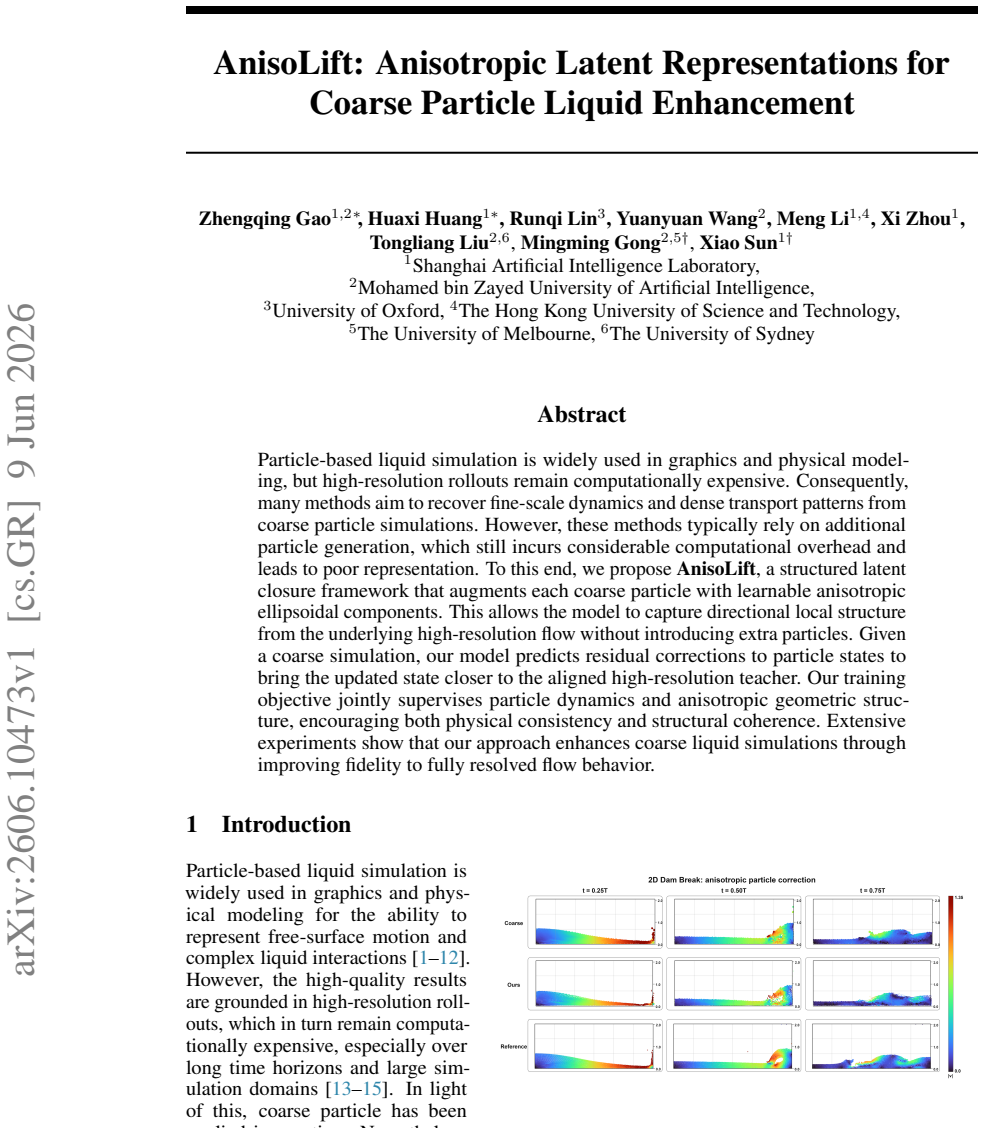
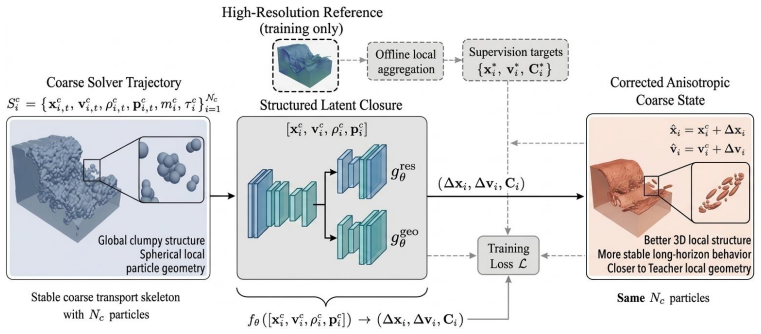
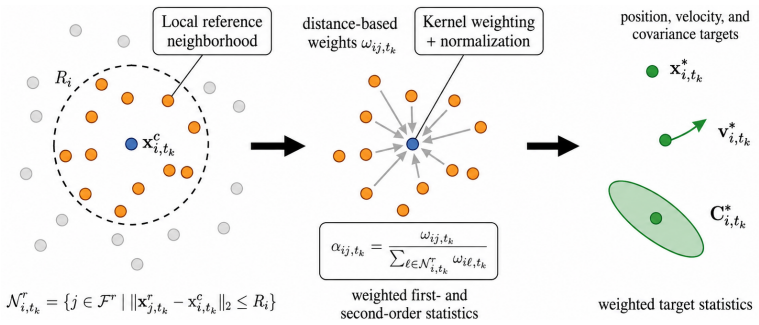
AnisoLift is a structured latent closure framework that augments each coarse particle with learnable anisotropic ellipsoidal components. This allows the model to capture directional local structure from the underlying high-resolution flow without introducing extra particles. Given a coarse simulation, the model predicts residual corrections to particle states to bring the updated state closer to the aligned high-resolution teacher. Training jointly supervises particle dynamics and anisotropic geometric structure, encouraging both physical consistency and structural coherence.
What carries the argument
Learnable anisotropic ellipsoidal components attached to each coarse particle that encode directional local flow structure.
If this is right
- Residual corrections align coarse particle states more closely with high-resolution references.
- Computational overhead stays lower because no new particles are generated.
- Joint supervision on dynamics and geometry produces both physically consistent motion and coherent local structure.
- Fidelity to fully resolved flow behavior improves across tested liquid scenarios.
Where Pith is reading between the lines
- The same anisotropic attachment could be tested on other particle systems such as gases or granular materials to check whether directional structure generalizes.
- The learned ellipsoids might be inspected after training to extract interpretable flow features without running a separate analysis pass.
- If the components remain stable across timesteps, they could support adaptive simulation where resolution varies locally based on ellipsoid size and orientation.
Load-bearing premise
Augmenting coarse particles with learnable anisotropic ellipsoidal components can capture directional local structure from high-resolution flow without needing to add extra particles.
What would settle it
An experiment in which adding the anisotropic components produces no measurable reduction in error to high-resolution reference trajectories compared with standard coarse simulation or isotropic latent baselines.
Figures
read the original abstract
Particle-based liquid simulation is widely used in graphics and physical modeling, but high-resolution rollouts remain computationally expensive. Consequently, many methods aim to recover fine-scale dynamics and dense transport patterns from coarse particle simulations. However, these methods typically rely on additional particle generation, which still incurs considerable computational overhead and leads to poor representation. To this end, we propose AnisoLift, a structured latent closure framework that augments each coarse particle with learnable anisotropic ellipsoidal components. This allows the model to capture directional local structure from the underlying high-resolution flow without introducing extra particles. Given a coarse simulation, our model predicts residual corrections to particle states to bring the updated state closer to the aligned high-resolution teacher. Our training objective jointly supervises particle dynamics and anisotropic geometric structure, encouraging both physical consistency and structural coherence. Extensive experiments show that our approach enhances coarse liquid simulations through improving fidelity to fully resolved flow behavior.
Editorial analysis
A structured set of objections, weighed in public.
Referee Report
Summary. The paper proposes AnisoLift, a structured latent closure framework for coarse particle liquid simulation enhancement. Each coarse particle is augmented with learnable anisotropic ellipsoidal components to capture directional local structure from high-resolution flows without generating extra particles. The model predicts residual corrections to particle states to align with a high-resolution teacher simulation. Training jointly supervises particle dynamics and anisotropic geometric structure for physical consistency and structural coherence. The central claim is that extensive experiments demonstrate improved fidelity to fully resolved flow behavior.
Significance. If the experimental claims hold with appropriate quantitative validation, the method could offer a computationally lighter alternative to particle-splitting approaches in graphics fluid simulation, addressing the overhead of dense particle sets while preserving directional flow features.
major comments (1)
- Abstract: the central claim that 'extensive experiments show that our approach enhances coarse liquid simulations through improving fidelity to fully resolved flow behavior' is unsupported, as the text supplies no metrics, baselines, error analysis, ablation studies, or experimental setup details, leaving the primary result unverifiable.
Simulated Author's Rebuttal
We thank the referee for the detailed review and the recommendation for major revision. We address the single major comment below and will incorporate changes to ensure the abstract is self-contained and verifiable.
read point-by-point responses
-
Referee: Abstract: the central claim that 'extensive experiments show that our approach enhances coarse liquid simulations through improving fidelity to fully resolved flow behavior' is unsupported, as the text supplies no metrics, baselines, error analysis, ablation studies, or experimental setup details, leaving the primary result unverifiable.
Authors: We agree that the abstract as written does not include specific quantitative details, which limits verifiability from the abstract alone. The full manuscript (Sections 4 and 5) contains the requested elements: quantitative metrics comparing to baselines, error analysis, ablation studies, and experimental setup. To resolve this, we will revise the abstract to concisely summarize the key results (e.g., error reductions and fidelity improvements) while keeping it within length constraints. revision: yes
Circularity Check
No derivation chain or equations present; no circularity identifiable
full rationale
The abstract and available text contain only a high-level method description with no equations, derivations, training objectives formalized, or self-citations. Without any claimed first-principles steps, predictions, or load-bearing reductions that can be quoted and shown equivalent to inputs by construction, no circularity exists per the evaluation rules. The paper's claims remain unevaluated for circularity due to lack of mathematical content, which is the default honest outcome when no reduction can be exhibited.
Axiom & Free-Parameter Ledger
invented entities (1)
-
Anisotropic ellipsoidal components
no independent evidence
Reference graph
Works this paper leans on
-
[1]
The well: a large-scale collection of diverse physics simulations for machine learning.Advances in Neural Information Processing Systems, 37:44989–45037, 2024
Ruben Ohana, Michael McCabe, Lucas Meyer, Rudy Morel, Fruzsina Agocs, Miguel Beneitez, Marsha Berger, Blakesly Burkhart, Stuart Dalziel, Drummond Fielding, et al. The well: a large-scale collection of diverse physics simulations for machine learning.Advances in Neural Information Processing Systems, 37:44989–45037, 2024
2024
-
[2]
Fluidgaussian: Propagating simulation-based uncertainty toward functionally-intelligent 3d reconstruction.CVPR, 2026
Yuqiu Liu, Jialin Song, Marissa Ramirez de Chanlatte, Rochishnu Chowdhury, Rushil Paresh Desai, Wuyang Chen, Daniel Martin, and Michael Mahoney. Fluidgaussian: Propagating simulation-based uncertainty toward functionally-intelligent 3d reconstruction.CVPR, 2026
2026
-
[3]
Jingxuan Xu, Hong Huang, Chuhang Zou, Manolis Savva, Yunchao Wei, and Wuyang Chen. Hy- brid neural-mpm for interactive fluid simulations in real-time.arXiv preprint arXiv:2505.18926, 2025
arXiv 2025
-
[4]
Keigo Enomoto, Takato Ishida, Yuya Doi, Takashi Uneyama, and Yuichi Masubuchi. Extension of moving particle simulation by introducing rotational degrees of freedom for dilute fiber suspensions.International Journal for Numerical Methods in Fluids, 96(2):125–137, 2024. doi: https://doi.org/10.1002/fld.5235. URL https://onlinelibrary.wiley.com/doi/abs/10. 1...
-
[5]
R. A. Gingold and J. J. Monaghan. Smoothed particle hydrodynamics: theory and application to non-spherical stars.Monthly Notices of the Royal Astronomical Society, 181(3):375–389, 12
-
[6]
ISSN 0035-8711. doi: 10.1093/mnras/181.3.375. URL https://doi.org/10.1093/ mnras/181.3.375
-
[7]
S. Koshizuka and Y . Oka. Moving-particle semi-implicit method for fragmentation of incompressible fluid.Nuclear Science and Engineering, 123(3):421–434, 1996. doi: 10.13182/NSE96-A24205. URLhttps://doi.org/10.13182/NSE96-A24205
-
[8]
Particle-based fluid simulation for interactive applications
Matthias Müller, David Charypar, and Markus Gross. Particle-based fluid simulation for interactive applications. InProceedings of the 2003 ACM SIGGRAPH/Eurographics Symposium on Computer Animation, SCA ’03, page 154–159, Goslar, DEU, 2003. Eurographics Association. ISBN 1581136595
2003
-
[9]
A Survey on SPH Methods in Computer Graphics.Computer Graphics Forum, 41(2), 2022
Dan Koschier, Jan Bender, Barbara Solenthaler, and Matthias Teschner. A Survey on SPH Methods in Computer Graphics.Computer Graphics Forum, 41(2), 2022. ISSN 1467-8659. doi: 10.1111/cgf.14508
-
[10]
The affine particle-in-cell method.ACM Trans
Chenfanfu Jiang, Craig Schroeder, Andrew Selle, Joseph Teran, and Alexey Stomakhin. The affine particle-in-cell method.ACM Trans. Graph., 34(4), July 2015. ISSN 0730-0301. doi: 10.1145/2766996. URLhttps://doi.org/10.1145/2766996
-
[11]
Yuanming Hu, Yu Fang, Ziheng Ge, Ziyin Qu, Yixin Zhu, Andre Pradhana, and Chenfanfu Jiang. A moving least squares material point method with displacement discontinuity and two-way rigid body coupling.ACM Trans. Graph., 37(4), July 2018. ISSN 0730-0301. doi: 10.1145/3197517.3201293. URLhttps://doi.org/10.1145/3197517.3201293
-
[12]
Deborah Sulsky, Shi-Jian Zhou, and Howard L. Schreyer. Application of a particle-in- cell method to solid mechanics.Computer Physics Communications, 87(1):236–252, 1995. ISSN 0010-4655. doi: https://doi.org/10.1016/0010-4655(94)00170-7. URL https://www. sciencedirect.com/science/article/pii/0010465594001707. Particle Simulation Methods
-
[13]
Robert D. Groot and Patrick B. Warren. Dissipative particle dynamics: Bridging the gap between atomistic and mesoscopic simulation.The Journal of Chemical Physics, 107(11): 4423–4435, 09 1997. ISSN 0021-9606. doi: 10.1063/1.474784. URL https://doi.org/10. 1063/1.474784
-
[14]
Michael B. Nielsen and Robert Bridson. Guide shapes for high resolution naturalistic liquid simulation.ACM Trans. Graph., 30(4), July 2011. ISSN 0730-0301. doi: 10.1145/2010324. 1964978. URLhttps://doi.org/10.1145/2010324.1964978. 14
-
[15]
Fluid implicit particles on coadjoint orbits.ACM Trans
Mohammad Sina Nabizadeh, Ritoban Roy-Chowdhury, Hang Yin, Ravi Ramamoorthi, and Albert Chern. Fluid implicit particles on coadjoint orbits.ACM Trans. Graph., 43(6), November
-
[16]
ISSN 0730-0301. doi: 10.1145/3687970. URL https://doi.org/10.1145/3687970
-
[17]
Neural fluid simulation on geometric surfaces
Haoxiang Wang, Tao Yu, Hui Qiao, and Qionghai Dai. Neural fluid simulation on geometric surfaces. In Y . Yue, A. Garg, N. Peng, F. Sha, and R. Yu, edi- tors,International Conference on Learning Representations, volume 2025, pages 99091– 99118, 2025. URL https://proceedings.iclr.cc/paper_files/paper/2025/file/ f58c24798220ba724fe05c0fa786227d-Paper-Conference.pdf
2025
-
[18]
Liquid splash modeling with neural networks
Kiwon Um, Xiangyu Hu, and Nils Thuerey. Liquid splash modeling with neural networks. Computer Graphics Forum, 37(8):171–182, 2018. doi: 10.1111/cgf.13522. URL https: //doi.org/10.1111/cgf.13522
-
[19]
Bruno Roy, Pierre Poulin, and Eric Paquette. Neural upflow: A scene flow learning approach to increase the apparent resolution of particle-based liquids.Proc. ACM Comput. Graph. Interact. Tech., 4(3), September 2021. doi: 10.1145/3480147. URL https://doi.org/10.1145/ 3480147
-
[20]
Learning to simulate complex physics with graph networks
Alvaro Sanchez-Gonzalez, Jonathan Godwin, Tobias Pfaff, Rex Ying, Jure Leskovec, and Peter Battaglia. Learning to simulate complex physics with graph networks. In Hal Daumé III and Aarti Singh, editors,Proceedings of the 37th International Conference on Machine Learning, volume 119 ofProceedings of Machine Learning Research, pages 8459–8468. PMLR, 13–18 J...
2020
-
[21]
Lagrangian fluid sim- ulation with continuous convolutions
Benjamin Ummenhofer, Lukas Prantl, Nils Thuerey, and Vladlen Koltun. Lagrangian fluid sim- ulation with continuous convolutions. InInternational Conference on Learning Representations (ICLR), 2020. URLhttps://openreview.net/forum?id=B1lDoJSYDH
2020
-
[22]
Guaranteed con- servation of momentum for learning particle-based fluid dynamics
Lukas Prantl, Benjamin Ummenhofer, Vladlen Koltun, and Nils Thuerey. Guaranteed con- servation of momentum for learning particle-based fluid dynamics. InAdvances in Neural Information Processing Systems, volume 35. Neural Information Processing Systems Founda- tion, 2022. URL https://proceedings.neurips.cc/paper_files/paper/2022/hash/ 2dd7f33ffbb59b4ff987...
2022
-
[23]
Erbesdobler, Nikolaus A
Artur Toshev, Jonas A. Erbesdobler, Nikolaus A. Adams, and Johannes Brandstetter. Neural SPH: Improved neural modeling of lagrangian fluid dynamics. In Ruslan Salakhutdinov, Zico Kolter, Katherine Heller, Adrian Weller, Nuria Oliver, Jonathan Scarlett, and Felix Berkenkamp, editors,Proceedings of the 41st International Conference on Machine Learning, volu...
2024
-
[24]
J. J. Monaghan. Smoothed particle hydrodynamics.Annual Review of Astronomy and Astro- physics, 30:543–574, 1992. doi: 10.1146/annurev.aa.30.090192.002551
-
[25]
J. J. Monaghan. Smoothed particle hydrodynamics.Reports on Progress in Physics, 68(8): 1703–1759, 2005. doi: 10.1088/0034-4885/68/8/R01
-
[26]
Artur P Toshev, Harish Ramachandran, Jonas A Erbesdobler, Gianluca Galletti, Johannes Brand- stetter, and Nikolaus A Adams. Jax-sph: A differentiable smoothed particle hydrodynamics framework.arXiv preprint arXiv:2403.04750, 2024
arXiv 2024
-
[27]
Weakly compressible SPH for free surface flows
Markus Becker and Matthias Teschner. Weakly compressible SPH for free surface flows. In Proceedings of the 2007 ACM SIGGRAPH/Eurographics Symposium on Computer Animation,
2007
-
[28]
URL https://dl.acm.org/doi/10.5555/1272690
doi: 10.1145/1272690.1272719. URL https://dl.acm.org/doi/10.5555/1272690. 1272719
-
[29]
B. Solenthaler and R. Pajarola. Predictive-corrective incompressible sph. InACM SIG- GRAPH 2009 Papers, SIGGRAPH ’09, New York, NY , USA, 2009. Association for Com- puting Machinery. ISBN 9781605587264. doi: 10.1145/1576246.1531346. URL https: //doi.org/10.1145/1576246.1531346. 15
-
[30]
Data-driven fluid simulations using regression forests.ACM Transactions on Graphics, 34(6),
L’ubor Ladický, SoHyeon Jeong, Barbara Solenthaler, Marc Pollefeys, and Markus Gross. Data-driven fluid simulations using regression forests.ACM Transactions on Graphics, 34(6),
-
[31]
doi: 10.1145/2816795.2818129
-
[32]
J. Michael Owen, Jens V . Villumsen, Paul R. Shapiro, and Hugo Martel. Adaptive smoothed particle hydrodynamics: Methodology. II.The Astrophysical Journal Supplement Series, 116 (2):155–209, 1998. doi: 10.1086/313100
-
[33]
Shapiro, Hugo Martel, and Jens V
Paul R. Shapiro, Hugo Martel, and Jens V . Villumsen. Adaptive smoothed particle hydrody- namics, with application to cosmology: Methodology.The Astrophysical Journal Supplement Series, 103:269–330, 1996. doi: 10.1086/192279
-
[34]
Jihun Yu and Greg Turk. Reconstructing surfaces of particle-based fluids using anisotropic kernels.ACM Transactions on Graphics, 32(1), 2013. doi: 10.1145/2421636.2421641. URL https://dl.acm.org/doi/10.1145/2421636.2421641
-
[35]
3D Gaussian Splatting for Real -Time Radiance Field Rendering,
Bernhard Kerbl, Georgios Kopanas, Thomas Leimkühler, and George Drettakis. 3d gaussian splatting for real-time radiance field rendering.ACM Transactions on Graphics, 42(4), 2023. doi: 10.1145/3592433. URLhttps://dl.acm.org/doi/10.1145/3592433
-
[36]
Jingrui Xing, Bin Wang, Mengyu Chu, and Baoquan Chen. Gaussian fluids: A grid-free fluid solver based on gaussian spatial representation. InACM SIGGRAPH 2025 Conference Papers, SIGGRAPH ’25, New York, NY , USA, 2025. Association for Computing Machinery. ISBN 9798400715402. doi: 10.1145/3721238.3730620. URL https://doi.org/10.1145/ 3721238.3730620. 16
discussion (0)
Sign in with ORCID, Apple, or X to comment. Anyone can read and Pith papers without signing in.