Phase-drifting with emitting plasma temperature in the quasi-periodic pulsations of an X-class solar flare
Pith reviewed 2026-06-27 12:02 UTC · model grok-4.3
The pith
Quasi-periodic pulsations in an X-class solar flare exhibit phase drifting that increases from hottest to cooler emitting plasma channels.
A machine-rendered reading of the paper's core claim, the machinery that carries it, and where it could break.
Core claim
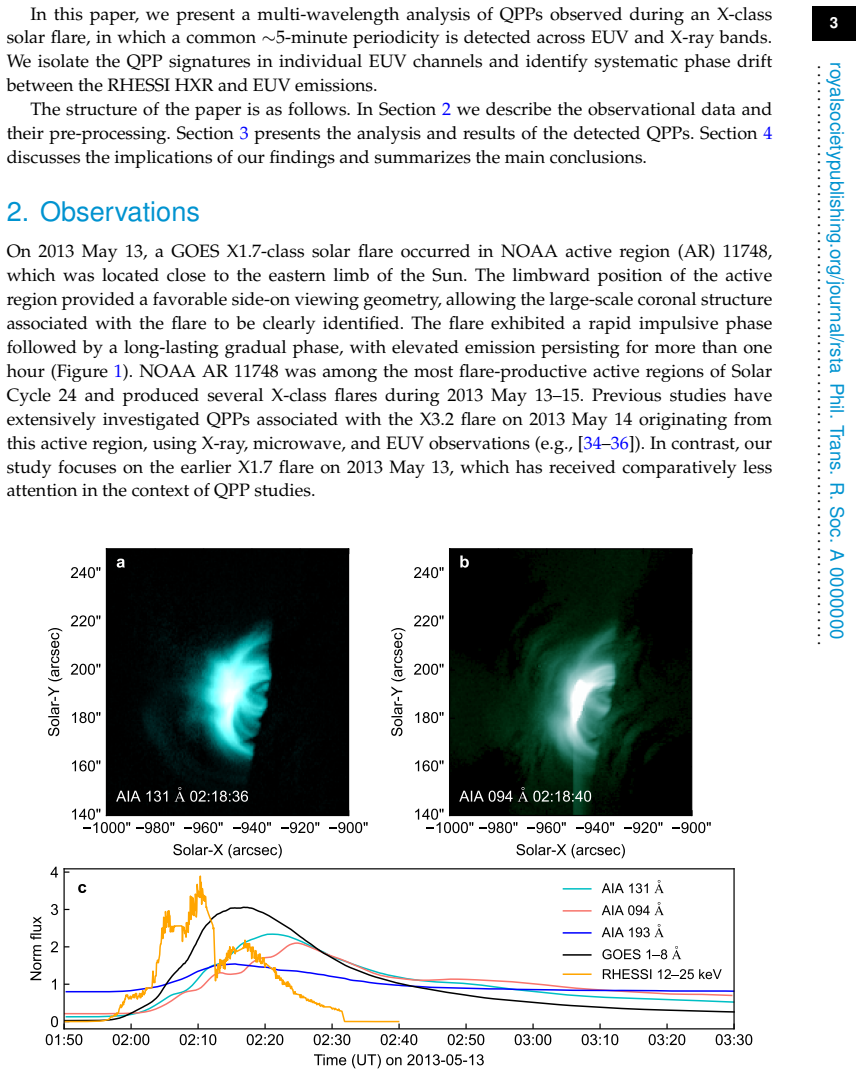
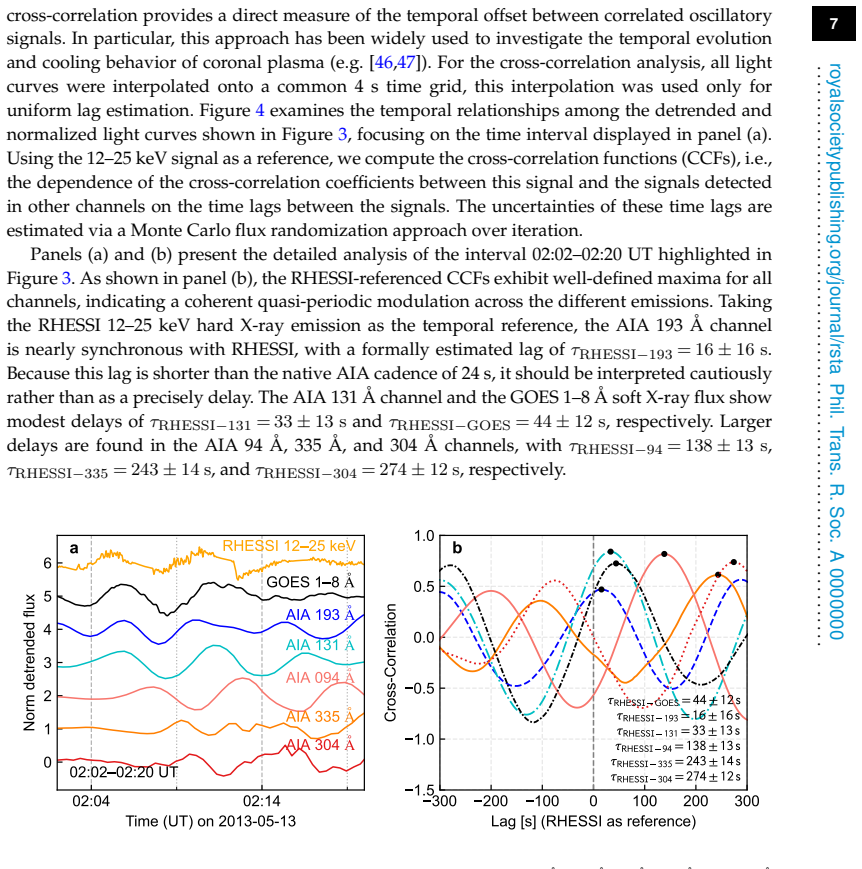
In an X-class solar flare, a ~5-minute QPP appears across hard X-ray, EUV, and soft X-ray bands with identical periods but a clear temperature-dependent phase drift, the delay relative to hard X-rays increasing from the hottest to cooler channels. The QPP lasts only a few cycles in the impulsive phase. These properties are taken to indicate that periodic reconnection modulates non-thermal electrons for the leading hard X-ray signal, after which plasma heating and cooling manifest sequentially in passbands of differing temperature response.
What carries the argument
Temperature-dependent phase drifting revealed by phase-resolved timing analysis across multi-wavelength, multi-temperature diagnostics.
If this is right
- QPPs share nearly identical oscillation periods in all diagnostics.
- Phase delay relative to hard X-ray emission increases systematically from hottest to cooler EUV channels.
- The QPP persists for only a few cycles during the impulsive phase.
- Multi-temperature, multi-wavelength phase relationships can constrain the temporal evolution of flare energy release.
Where Pith is reading between the lines
- The 5-minute period points to possible leakage of photospheric oscillations as a trigger for the reconnection.
- Similar temperature-ordered phase drifting may appear in other flares and could be used to test whether heating follows reconnection in a repeatable sequence.
- The method offers a way to separate the timing of particle acceleration from the subsequent thermal evolution without assuming a specific wave mode.
Load-bearing premise
The phase delays arise from sequential heating and cooling across temperature-sensitive passbands rather than wave propagation, instrumental offsets, or differing emission mechanisms.
What would settle it
An observation in which phase delays fail to correlate with the temperature response of the passbands, or in which the drifting persists well beyond the impulsive phase, would falsify the heating-cooling sequence interpretation.
Figures
read the original abstract
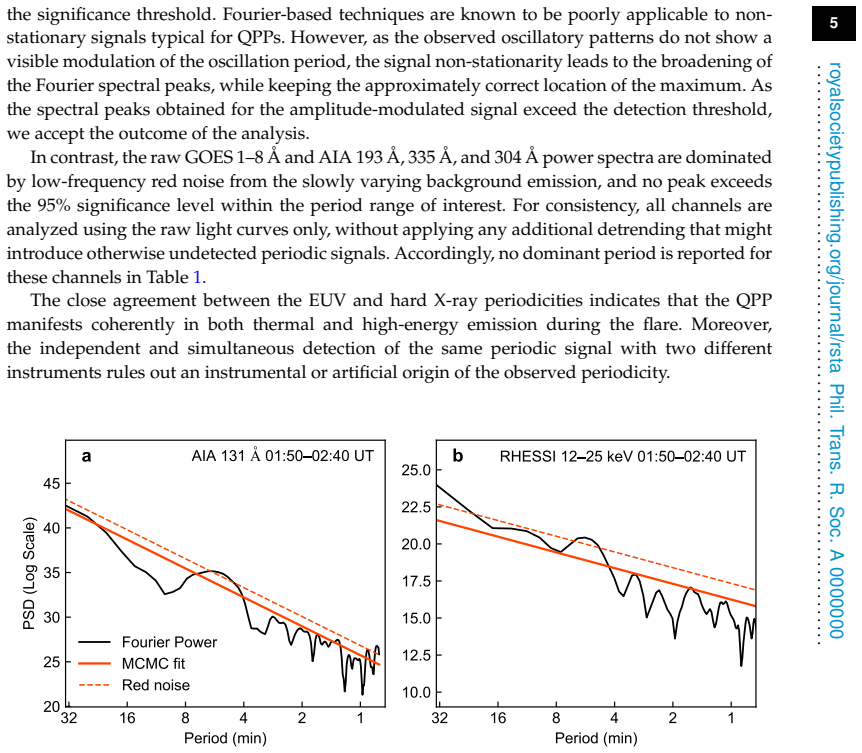
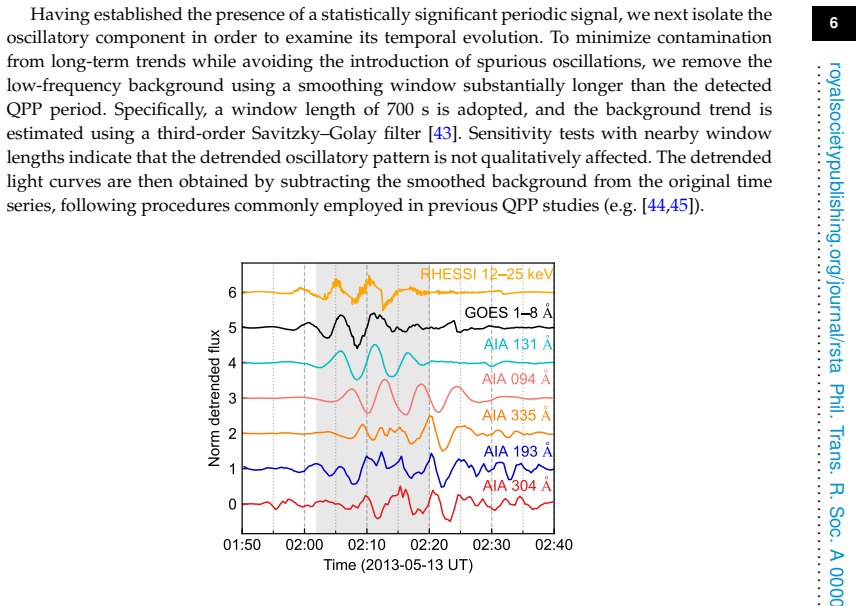
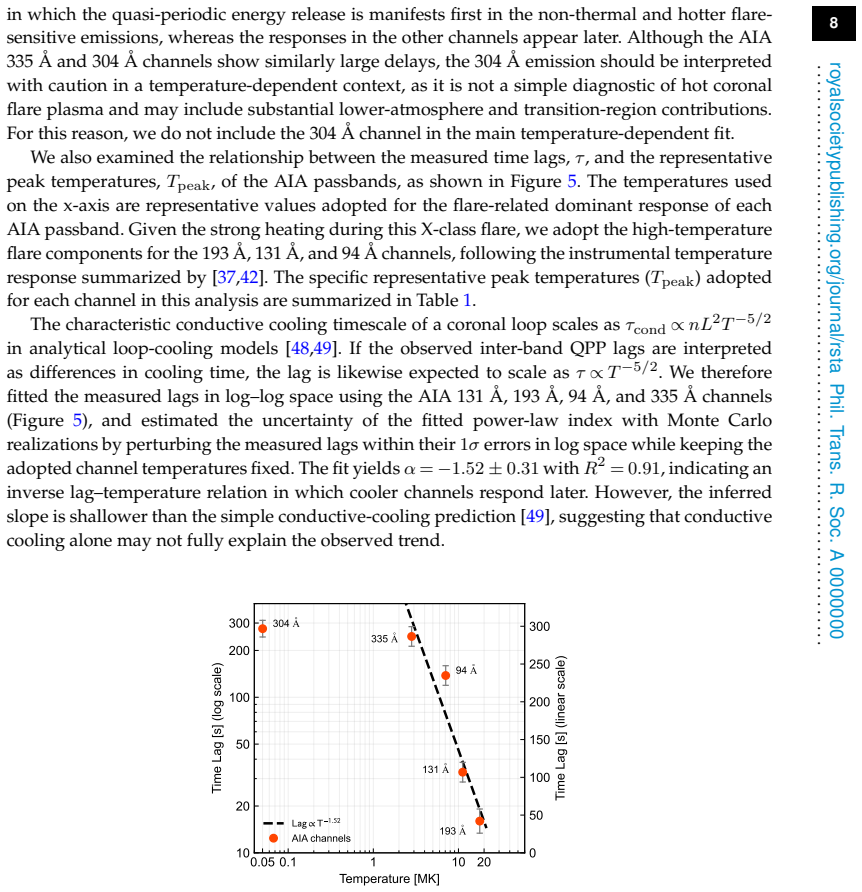
Recent multi-wavelength observations of solar flares have provided new constraints on the physical origin of quasi-periodic pulsations (QPPs). In an X-class flare, we detect a short-lived $\sim$5-minute QPP simultaneously in hard X-rays, extreme-ultraviolet (EUV), and soft X-ray emissions, exhibiting a clear phase-drifting behavior with emitting plasma temperature. Based on phase-resolved timing analysis, it is found that (i) the QPPs in all diagnostics share nearly identical oscillation periods, (ii) a systematic temperature-dependent phase drifting is present, with the phase delay relative to the hard X-ray emission increases systematically from the hottest to cooler EUV channels, and (iii) the QPP persists for only a few cycles during the impulsive phase. These properties imply that periodic magnetic reconnection, possibly triggered by the leakage of 5-minute oscillations from the lower atmosphere, modulates the non-thermal electrons responsible for the leading Hard X-ray QPPs. Subsequently, plasma heating and cooling processes manifest sequentially across passbands with different temperature responses, resulting in the observed temperature-dependent phase drifting. These results provide novel observational evidence supporting the use of multi-temperature, multi-wavelength phase relationships to constrain the temporal evolution of flare energy release and the origins of QPPs.
Editorial analysis
A structured set of objections, weighed in public.
Referee Report
Summary. The paper reports the detection of a short-lived ~5-minute QPP in an X-class solar flare, observed simultaneously in hard X-ray, EUV, and soft X-ray emissions. Phase-resolved timing analysis is claimed to reveal three properties: (i) nearly identical oscillation periods across all diagnostics, (ii) systematic temperature-dependent phase drifting with increasing delay from HXR to cooler EUV channels, and (iii) persistence for only a few cycles during the impulsive phase. These are interpreted as evidence that periodic magnetic reconnection (possibly triggered by leakage of 5-minute oscillations from the lower atmosphere) modulates non-thermal electrons, followed by sequential plasma heating and cooling across temperature-sensitive passbands.
Significance. If the phase-drifting interpretation holds after quantitative validation, the result would supply useful observational constraints on QPP origins in flares by linking multi-temperature phase relationships to the sequence of energy release and thermal evolution. It strengthens the case for using cross-passband timing to distinguish reconnection-driven modulation from other mechanisms. The single-event nature and lack of reported statistical anchors currently limit the strength of this contribution.
major comments (2)
- Abstract (phase-resolved timing analysis paragraph): the claim that the analysis supports the three listed properties is load-bearing for the central interpretation, yet the abstract supplies no error bars on measured periods or phase delays, no statistical significance tests, no data exclusion criteria, and no reference to raw light-curve figures or fitting procedures. This absence prevents assessment of whether the reported temperature-dependent drift is robust.
- Abstract (final interpretive sentence): the inference that observed phase delays arise specifically from sequential heating and cooling (rather than wave propagation at coronal sound/Alfvén speeds, instrumental timing offsets, or emission-mechanism differences) is not accompanied by any quantitative comparison of measured delays to expected cooling timescales from hydrodynamic models or to propagation delays. This assumption directly underpins the proposed periodic-reconnection scenario and requires explicit exclusion of alternatives to remain viable.
minor comments (1)
- Abstract: a brief statement of the specific instruments, passbands, and time resolution used for the multi-wavelength data would improve reproducibility without altering the central claim.
Simulated Author's Rebuttal
We thank the referee for their thoughtful comments, which help clarify the presentation of our phase-resolved timing results. We address each major comment below and indicate where revisions will be made.
read point-by-point responses
-
Referee: [—] Abstract (phase-resolved timing analysis paragraph): the claim that the analysis supports the three listed properties is load-bearing for the central interpretation, yet the abstract supplies no error bars on measured periods or phase delays, no statistical significance tests, no data exclusion criteria, and no reference to raw light-curve figures or fitting procedures. This absence prevents assessment of whether the reported temperature-dependent drift is robust.
Authors: The abstract is intentionally concise, but the supporting quantitative details (period uncertainties from wavelet analysis, phase-delay measurements with standard errors, data selection criteria, and references to the raw light curves in Figures 1–3 and the fitting procedures in Section 3) are fully reported in the main text. We agree that a brief pointer in the abstract would aid readers and will revise the abstract to include a short clause referencing the methods and key figures while preserving length constraints. revision: partial
-
Referee: [—] Abstract (final interpretive sentence): the inference that observed phase delays arise specifically from sequential heating and cooling (rather than wave propagation at coronal sound/Alfvén speeds, instrumental timing offsets, or emission-mechanism differences) is not accompanied by any quantitative comparison of measured delays to expected cooling timescales from hydrodynamic models or to propagation delays. This assumption directly underpins the proposed periodic-reconnection scenario and requires explicit exclusion of alternatives to remain viable.
Authors: We accept that the abstract’s interpretive sentence would be strengthened by explicit comparison. In the revised manuscript we will expand the discussion (Section 4) to include order-of-magnitude estimates of cooling timescales from hydrodynamic flare models and propagation delays at typical coronal sound and Alfvén speeds, showing that the observed delays are inconsistent with propagation but consistent with sequential heating/cooling. This will be cross-referenced from the abstract. revision: yes
Circularity Check
No circularity: purely observational detection and interpretation
full rationale
The paper reports multi-wavelength timing measurements of QPPs (identical periods, temperature-dependent phase drift, short-lived impulsive-phase signal) and offers a physical interpretation linking them to periodic reconnection plus sequential heating/cooling. No equations, fitted parameters, or self-citations are shown that reduce any claimed result to its own inputs by construction. The derivation chain consists of direct data properties followed by inference; the inference step is falsifiable against external models but does not contain self-referential reduction.
Axiom & Free-Parameter Ledger
axioms (2)
- domain assumption Standard assumptions about the temperature response functions of EUV and X-ray passbands in solar flare observations
- ad hoc to paper Phase delays arise from sequential plasma heating and cooling rather than propagation or instrumental effects
Reference graph
Works this paper leans on
-
[1]
Space Science Reviews , keywords =
Nakariakov VM, Melnikov VF. 2009 Quasi-Periodic Pulsations in Solar Flares.Space Sci. Rev. 149, 119–151. (10.1007/s11214-009-9536-3)
-
[2]
doi:10.1007/s11207-016-0977-z , eprint =
Van Doorsselaere T, Kupriyanova EG, Yuan D. 2016 Quasi-periodic Pulsations in Solar and Stellar Flares: An Overview of Recent Results (Invited Review).Sol. Phys.291, 3143–3164. (10.1007/s11207-016-0977-z)
-
[3]
Nakariakov VM, Kolotkov DY, Kupriyanova EG, Mehta T, Pugh CE, Lee DH, Broomhall AM. 2019 Non-stationary quasi-periodic pulsations in solar and stellar flares.Plasma Physics and Controlled Fusion61, 014024. (10.1088/1361-6587/aad97c)
-
[4]
2020 Quasi-Periodic Pulsations in Solar and Stellar Flares
Kupriyanova E, Kolotkov D, Nakariakov V , Kaufman A. 2020 Quasi-Periodic Pulsations in Solar and Stellar Flares. Review.Solar-T errestrial Physics6, 3–23. (10.12737/stp-61202001)
-
[5]
Space Science Reviews , keywords =
Zimovets IV , McLaughlin JA, Srivastava AK, Kolotkov DY, Kuznetsov AA, Kupriyanova EG, Cho IH, Inglis AR, Reale F, Pascoe DJ, Tian H, Yuan D, Li D, Zhang QM. 2021 Quasi-Periodic Pulsations in Solar and Stellar Flares: A Review of Underpinning Physical Mechanisms and Their Predicted Observational Signatures.Space Sci. Rev.217, 66. (10.1007/s11214-021-00840-9)
-
[6]
2010 Types of Microwave Quasi-Periodic Pulsations in Single Flaring Loops.Sol
Kupriyanova EG, Melnikov VF, Nakariakov VM, Shibasaki K. 2010 Types of Microwave Quasi-Periodic Pulsations in Single Flaring Loops.Sol. Phys.267, 329–342. (10.1007/s11207- 010-9642-0)
-
[7]
Tan B, Tan C. 2012 Microwave Quasi-periodic Pulsation with Millisecond Bursts in a Solar Flare on 2011 August 9.Astrophys. J.749, 28. (10.1088/0004-637X/749/1/28)
-
[8]
2021 Multiwavelength Quasi-periodic Pulsations in a Stellar Superflare.Astrophys
Kolotkov DY, Nakariakov VM, Holt R, Kuznetsov AA. 2021 Multiwavelength Quasi-periodic Pulsations in a Stellar Superflare.Astrophys. J. Lett.923, L33. (10.3847/2041-8213/ac432e)
-
[9]
2025 Detecting fast-variation pulsations in solar hard X-ray and radio emissions.Mon
Li D. 2025 Detecting fast-variation pulsations in solar hard X-ray and radio emissions.Mon. Not. R. Astron. Soc.542, L48–L52. (10.1093/mnrasl/slaf066)
-
[10]
2024 Long-period energy releases during a C2.8 flare
Li D, Li J, Shen J, Song Q, Ji H, Ning Z. 2024 Long-period energy releases during a C2.8 flare. Astron. Astrophys.690, A39. (10.1051/0004-6361/202450622)
-
[11]
The Astrophysical Journal , keywords =
Nakariakov VM, Anfinogentov S, Storozhenko AA, Kurochkin EA, Bogod VM, Sharykin IN, Kaltman TI. 2018 Quasi-periodic Pulsations in a Solar Microflare.Astrophys. J.859, 154. (10.3847/1538-4357/aabfb9)
-
[12]
2020 Quasi-periodic Pulsation Detected in Lyα Emission During Solar Flares.Astrophys
Li D, Lu L, Ning Z, Feng L, Gan W, Li H. 2020 Quasi-periodic Pulsation Detected in Lyα Emission During Solar Flares.Astrophys. J.893, 7. (10.3847/1538-4357/ab7cd1)
-
[15]
Lim D, Van Doorsselaere T, Berghmans D, Hayes LA, Verbeeck C, Narang N, Dominique M, Inglis AR. 2025 Quasi-Periodic Pulsations in Extreme-Ultraviolet Brightenings.Astronomy and Astrophysics698, A65. (10.1051/0004-6361/202554587)
-
[16]
Fletcher L, Dennis BR, Hudson HS, Krucker S, Phillips K, Veronig A, Battaglia M, Bone L, Caspi A, Chen Q, et al.. 2011 An Observational Overview of Solar Flares.Space Sci. Rev.159, 19–106. (10.1007/s11214-010-9701-8) 11royalsocietypublishing.org/journal/rsta Phil. Trans. R. Soc. A 0000000
-
[17]
2017 Flare Observations.Living Reviews in Solar Physics14, 2
Benz AO. 2017 Flare Observations.Living Reviews in Solar Physics14, 2. (10.1007/s41116-016- 0004-3)
-
[18]
Pugh CE, Armstrong DJ, Nakariakov VM, Broomhall AM. 2016 Statistical properties of quasi- periodic pulsations in white-light flares observed with Kepler.Mon. Not. R. Astron. Soc.459, 3659–3676. (10.1093/mnras/stw850)
-
[19]
doi:10.1007/s11207-015-0691-2 , eprint =
Simões PJA, Hudson HS, Fletcher L. 2015 Soft X-Ray Pulsations in Solar Flares.Solar Physics 290, 3625–3639. (10.1007/s11207-015-0691-2)
-
[20]
2018 Detection of Quasi-Periodic Pulsations in Solar EUV Time Series.Sol
Dominique M, Zhukov AN, Dolla L, Inglis A, Lapenta G. 2018 Detection of Quasi-Periodic Pulsations in Solar EUV Time Series.Sol. Phys.293, 61. (10.1007/s11207-018-1281-x)
-
[22]
The Astrophysical Journal , keywords =
Hayes LA, Inglis AR, Christe S, Dennis B, Gallagher PT. 2020 Statistical Study of GOES X-Ray Quasi-periodic Pulsations in Solar Flares.Astrophys. J.895, 50. (10.3847/1538-4357/ab8d40)
-
[24]
Monthly Notices of the Royal Astronomical Society , keywords =
Mehta T, Broomhall AM, Hayes LA. 2023 Prevalence of non-stationarity in quasi-periodic pulsations (QPPs) associated with M- and X-class solar flares.Mon. Not. R. Astron. Soc.523, 3689–3698. (10.1093/mnras/stad1619)
-
[25]
2018 Modelling Quasi- Periodic Pulsations in Solar and Stellar Flares.Space Sci
McLaughlin JA, Nakariakov VM, Dominique M, Jelínek P , Takasao S. 2018 Modelling Quasi- Periodic Pulsations in Solar and Stellar Flares.Space Sci. Rev.214, 45. (10.1007/s11214-018- 0478-5)
-
[26]
2022 Statistical Properties of X-ray Flares in Gamma-Ray Bursts.Universe8, 358
Shi YR, Ding XK, Zhu SY, Sun WP , Zhang FW. 2022 Statistical Properties of X-ray Flares in Gamma-Ray Bursts.Universe8, 358. (10.3390/universe8070358)
-
[27]
2024 Localising pulsations in the hard X-ray and microwave emission of an X-class flare.Astron
Collier H, Hayes LA, Yu S, Battaglia AF, Ashfield W, Polito V , Harra LK, Krucker S. 2024 Localising pulsations in the hard X-ray and microwave emission of an X-class flare.Astron. Astrophys.684, A215. (10.1051/0004-6361/202348652)
-
[29]
Mossessian G, Fleishman GD. 2012 Modeling of Gyrosynchrotron Radio Emission Pulsations Produced by Magnetohydrodynamic Loop Oscillations in Solar Flares.Astrophys. J.748, 140. (10.1088/0004-637X/748/2/140)
-
[30]
2022 Modulation of the solar microwave emission by sausage oscillations.Mon
Kupriyanova EG, Kaltman TI, Kuznetsov AA. 2022 Modulation of the solar microwave emission by sausage oscillations.Mon. Not. R. Astron. Soc.516, 2292–2299. (10.1093/mnras/stac2386)
-
[31]
Dolla L, Marqué C, Seaton DB, Van Doorsselaere T, Dominique M, Berghmans D, Cabanas C, De Groof A, Schmutz W, Verdini A, West MJ, Zender J, Zhukov AN. 2012 Time Delays in Quasi-periodic Pulsations Observed during the X2.2 Solar Flare on 2011 February 15. Astrophys. J. Lett.749, L16. (10.1088/2041-8205/749/1/L16)
-
[32]
Kupriyanova EG, Kashapova LK, Van Doorsselaere T, Chowdhury P , Srivastava AK, Moon YJ. 2019 Quasi-periodic pulsations in a solar flare with an unusual phase shift.Mon. Not. R. Astron. Soc.483, 5499–5507. (10.1093/mnras/sty3480)
-
[33]
2023 Quasi-Periodic Pulsations in an M-Class Solar Flare.Universe9,
Xu J, Ning Z, Li D, Shi F. 2023 Quasi-Periodic Pulsations in an M-Class Solar Flare.Universe9,
2023
-
[34]
(10.3390/universe9050215)
-
[35]
2015 Multi- mode quasi-periodic pulsations in a solar flare.Astron
Kolotkov DY, Nakariakov VM, Kupriyanova EG, Ratcliffe H, Shibasaki K. 2015 Multi- mode quasi-periodic pulsations in a solar flare.Astron. Astrophys.574, A53. (10.1051/0004- 6361/201424988)
-
[36]
Chowdhury P , Srivastava AK, Dwivedi BN, Sych R, Moon YJ. 2015 Study of multi-periodic coronal pulsations during an X-class solar flare.Advances in Space Research56, 2769–2778. (10.1016/j.asr.2015.08.003)
-
[37]
Dennis BR, Tolbert AK, Inglis A, Ireland J, Wang T, Holman GD, Hayes LA, Gallagher PT. 2017 Detection and Interpretation of Long-lived X-Ray Quasi-periodic Pulsations in the X-class Solar Flare on 2013 May 14.Astrophys. J.836, 84. (10.3847/1538-4357/836/1/84)
-
[38]
Lemen JR, Title AM, Akin DJ, Boerner PF, Chou C, Drake JF, Duncan DW, Edwards CG, Friedlaender FM, Heyman GF, Hurlburt NE, Katz NL, Kushner GD, Levay M, Lindgren RW, Mathur DP , McFeaters EL, Mitchell S, Rehse RA, Schrijver CJ, Springer LA, Stern RA, Tarbell 12royalsocietypublishing.org/journal/rsta Phil. Trans. R. Soc. A 0000000. . . . . . . . . . . . . ...
-
[39]
Pesnell WD, Thompson BJ, Chamberlin PC. 2012 The Solar Dynamics Observatory (SDO).Sol. Phys.275, 3–15. (10.1007/s11207-011-9841-3)
-
[40]
1998 Data Analysis with the SolarSoft System.Sol
Freeland SL, Handy BN. 1998 Data Analysis with the SolarSoft System.Sol. Phys.182, 497–500. (10.1023/A:1005038224881)
-
[41]
2002 The Reuven Ramaty High-Energy Solar Spectroscopic Imager (RHESSI).Sol
Lin RP , Dennis BR, Hurford GJ, Smith DM, Zehnder A, Harvey PR, Curtis DW, Pankow D, Turin P , Bester M, et al.. 2002 The Reuven Ramaty High-Energy Solar Spectroscopic Imager (RHESSI).Sol. Phys.210, 3–32. (10.1023/A:1022428818870)
-
[42]
2017 Direct Observation of Two-step Magnetic Reconnection in a Solar Flare.Astrophys
Gou T, Veronig AM, Dickson EC, Hernandez-Perez A, Liu R. 2017 Direct Observation of Two-step Magnetic Reconnection in a Solar Flare.Astrophys. J. Lett.845, L1. (10.3847/2041- 8213/aa813d)
-
[43]
2010 SDO/AIA response to coronal hole, quiet Sun, active region, and flare plasma.Astron
O’Dwyer B, Del Zanna G, Mason HE, Weber MA, Tripathi D. 2010 SDO/AIA response to coronal hole, quiet Sun, active region, and flare plasma.Astron. Astrophys.521, A21. (10.1051/0004-6361/201014872)
-
[44]
Savitzky A, Golay MJE. 1964 Smoothing and differentiation of data by simplified least squares procedures.Analytical Chemistry36, 1627–1639. (10.1021/ac60214a047)
-
[45]
2013 Evolution of the Source of Quasi- Periodic Microwave Pulsations in a Single Flaring Loop.Publ
Kupriyanova EG, Melnikov VF, Shibasaki K. 2013 Evolution of the Source of Quasi- Periodic Microwave Pulsations in a Single Flaring Loop.Publ. Astron. Soc. Jpn65, S3. (10.1093/pasj/65.sp1.S3)
-
[46]
arXiv , author =:1911.05217 , journal =
Yuan D, Feng S, Li D, Ning Z, Tan B. 2019 A Compact Source for Quasi-periodic Pulsation in an M-class Solar Flare.Astrophys. J. Lett.886, L25. (10.3847/2041-8213/ab5648)
-
[47]
Viall NM, Klimchuk JA. 2012 Evidence for Widespread Cooling in an Active Region Observed with the SDO Atmospheric Imaging Assembly.Astrophys. J.753, 35. (10.1088/0004- 637X/753/1/35)
-
[48]
2019 Understanding Heating in Active Region Cores through Machine Learning
Barnes WT, Bradshaw SJ, Viall NM. 2019 Understanding Heating in Active Region Cores through Machine Learning. I. Numerical Modeling and Predicted Observables.Astrophys. J. 880, 56. (10.3847/1538-4357/ab290c)
-
[49]
1994 Some Implications of the Nanoflare Concept.Astrophys
Cargill PJ. 1994 Some Implications of the Nanoflare Concept.Astrophys. J.422, 381. (10.1086/173733)
-
[50]
2005Physics of the Solar Corona
Aschwanden MJ. 2005Physics of the Solar Corona. An Introduction with Problems and Solutions (2nd edition). (10.1007/3-540-30766-4)
-
[51]
2011 SDO AIA and Hinode EIS observations of “warm” loops.Astron
Del Zanna G, O’Dwyer B, Mason HE. 2011 SDO AIA and Hinode EIS observations of “warm” loops.Astron. Astrophys.535, A46. (10.1051/0004-6361/201117470)
-
[52]
Sych R, Nakariakov VM, Karlicky M, Anfinogentov S. 2009 Relationship between wave processes in sunspots and quasi-periodic pulsations in active region flares.Astron. Astrophys. 505, 791–799. (10.1051/0004-6361/200912132)
-
[53]
2014 Oscillations in a Sunspot with Light Bridges.Astrophys
Yuan D, Nakariakov VM, Huang Z, Li B, Su J, Yan Y, Tan B. 2014 Oscillations in a Sunspot with Light Bridges.Astrophys. J.792, 41. (10.1088/0004-637X/792/1/41)
-
[54]
Frontiers in Astronomy and Space Sciences , keywords =
Li D, Shi F, Zhao H, Xiong S, Song L, Peng W, Li X, Chen W, Ning Z. 2022 Flare quasi-periodic pulsation associated with recurrent jets.Frontiers in Astronomy and Space Sciences9, 1032099. (10.3389/fspas.2022.1032099)
-
[55]
Vallisneriet al.(NANOGrav), (2020), 10.3847/1538- 4357/ab7b67, arXiv:2001.00595 [astro-ph.HE]
Mishra SK, Sangal K, Kayshap P , Jelínek P , Srivastava AK, Rajaguru SP . 2023 Origin of Quasi- periodic Pulsation at the Base of a Kink-unstable Jet.Astrophys. J.945, 113. (10.3847/1538- 4357/acb058)
-
[56]
Kerr GS, Krucker S, Allred JC, Rodríguez-Gómez JM, Inglis AR, Ryan DF, Hayes LA, Milligan RO, Kowalski AF, Plowman JE, Young PR, Kucera TA, Brosius JW. 2026 Spatial variation of energy transport mechanisms within solar flare ribbons.Nature Astronomy10, 202–213. (10.1038/s41550-025-02747-9)
-
[57]
2016 Forward modelling of optically thin coronal plasma with the FoMo tool.Frontiers in Astronomy and Space Sciences3,
Van Doorsselaere T, Antolin P , Yuan D, Reznikova V , Magyar N. 2016 Forward modelling of optically thin coronal plasma with the FoMo tool.Frontiers in Astronomy and Space Sciences3,
2016
-
[58]
(10.3389/fspas.2016.00004)
-
[59]
arXiv , author =:2110.14257 , journal =
Fyfe LE, Howson TA, De Moortel I. 2021 Forward modelling of heating within a coronal arcade.Astron. Astrophys.656, A120. (10.1051/0004-6361/202142028)
-
[60]
2019 Desaturating SDO/AIA Observations of Solar Flaring Storms.Astrophys
Guastavino S, Piana M, Massone AM, Schwartz R, Benvenuto F. 2019 Desaturating SDO/AIA Observations of Solar Flaring Storms.Astrophys. J.882, 109. (10.3847/1538-4357/ab35d8) 13royalsocietypublishing.org/journal/rsta Phil. Trans. R. Soc. A 0000000
-
[61]
2021 Image Desaturation for SDO/AIA Using Deep Learning.Sol
Yu X, Xu L, Yan Y. 2021 Image Desaturation for SDO/AIA Using Deep Learning.Sol. Phys. 296, 56. (10.1007/s11207-021-01808-2)
discussion (0)
Sign in with ORCID, Apple, or X to comment. Anyone can read and Pith papers without signing in.