Ytterbium lattice clock with uncertainty of 1.1times 10⁻¹⁸ and instability of low 10⁻¹⁹
Pith reviewed 2026-06-27 11:12 UTC · model grok-4.3
The pith
An ytterbium optical lattice clock reaches total systematic uncertainty of 1.1×10^{-18}.
A machine-rendered reading of the paper's core claim, the machinery that carries it, and where it could break.
Core claim
The authors establish an ytterbium lattice clock with total systematic uncertainty of 1.1×10^{-18} through differential measurements between two identical systems, in-vacuum lattice enhancement, and a shielded BBR environment that limits the blackbody contribution to 8.7×10^{-19}.
What carries the argument
Differential frequency measurement between two identical clocks, which isolates and quantifies systematic shifts by direct subtraction.
If this is right
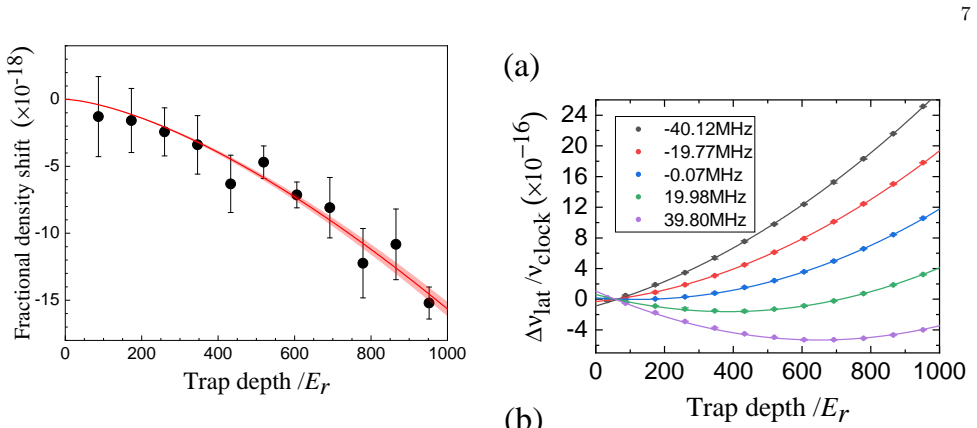
- Lattice light shift uncertainty is held to 3×10^{-19} under typical conditions.
- BBR Stark shift uncertainty is limited to 8.7×10^{-19} by the vacuum shield.
- The two clocks support direct remote frequency comparisons between Shanghai and Wuhan.
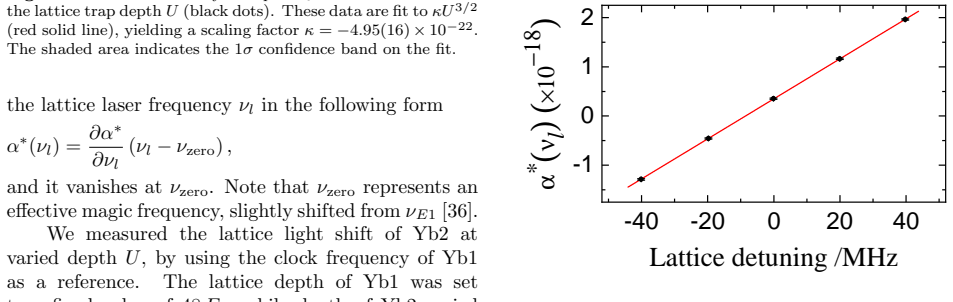
- Magic frequency is determined to 394798258.3(1) MHz with 0.1 MHz uncertainty.
Where Pith is reading between the lines
- The differential method could be extended to test whether common-mode environmental drifts remain below the 10^{-19} level over longer baselines.
- Achieved stability suggests the clock could resolve small secular drifts in fundamental constants if operated continuously for months.
- Scaling the twin-clock approach to additional sites would enable a network with sub-10^{-18} consistency for geodetic or relativistic tests.
Load-bearing premise
That frequency differences measured between the two clocks capture every systematic effect without residual common-mode errors from shared environment or unmodeled couplings.
What would settle it
An observed frequency offset between the two clocks that exceeds the stated 1.1×10^{-18} total uncertainty after all listed corrections are applied.
Figures
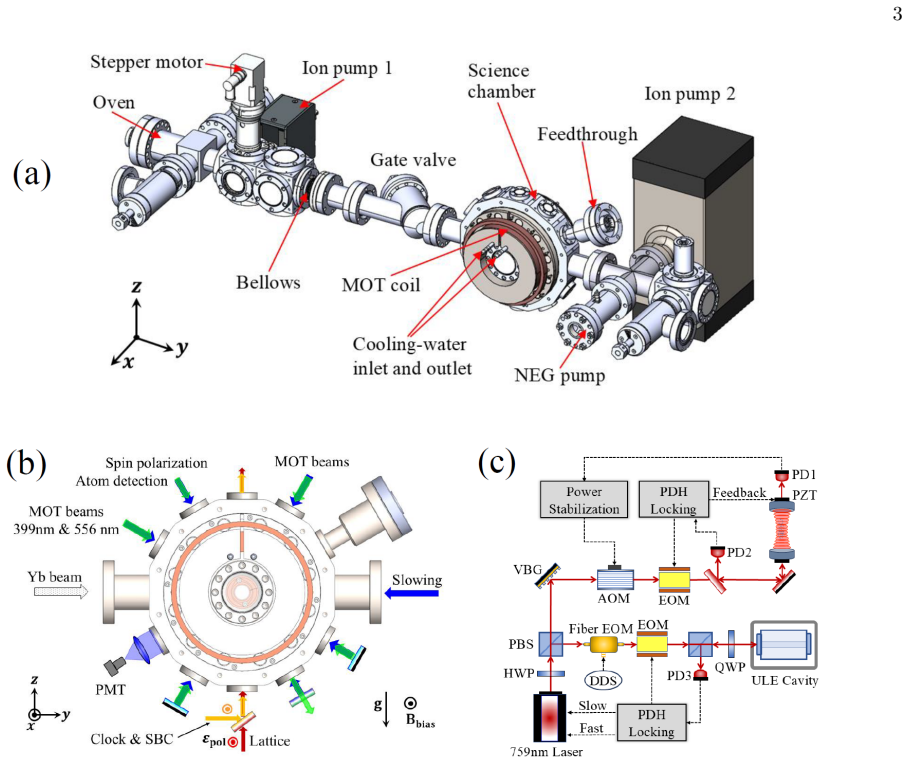
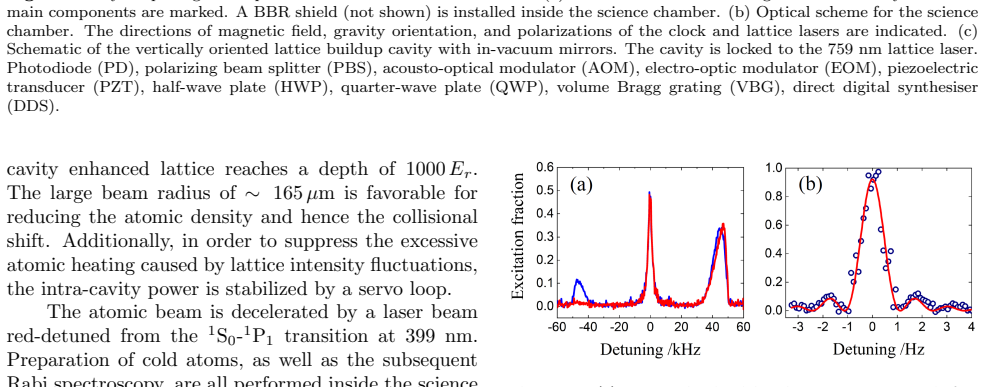
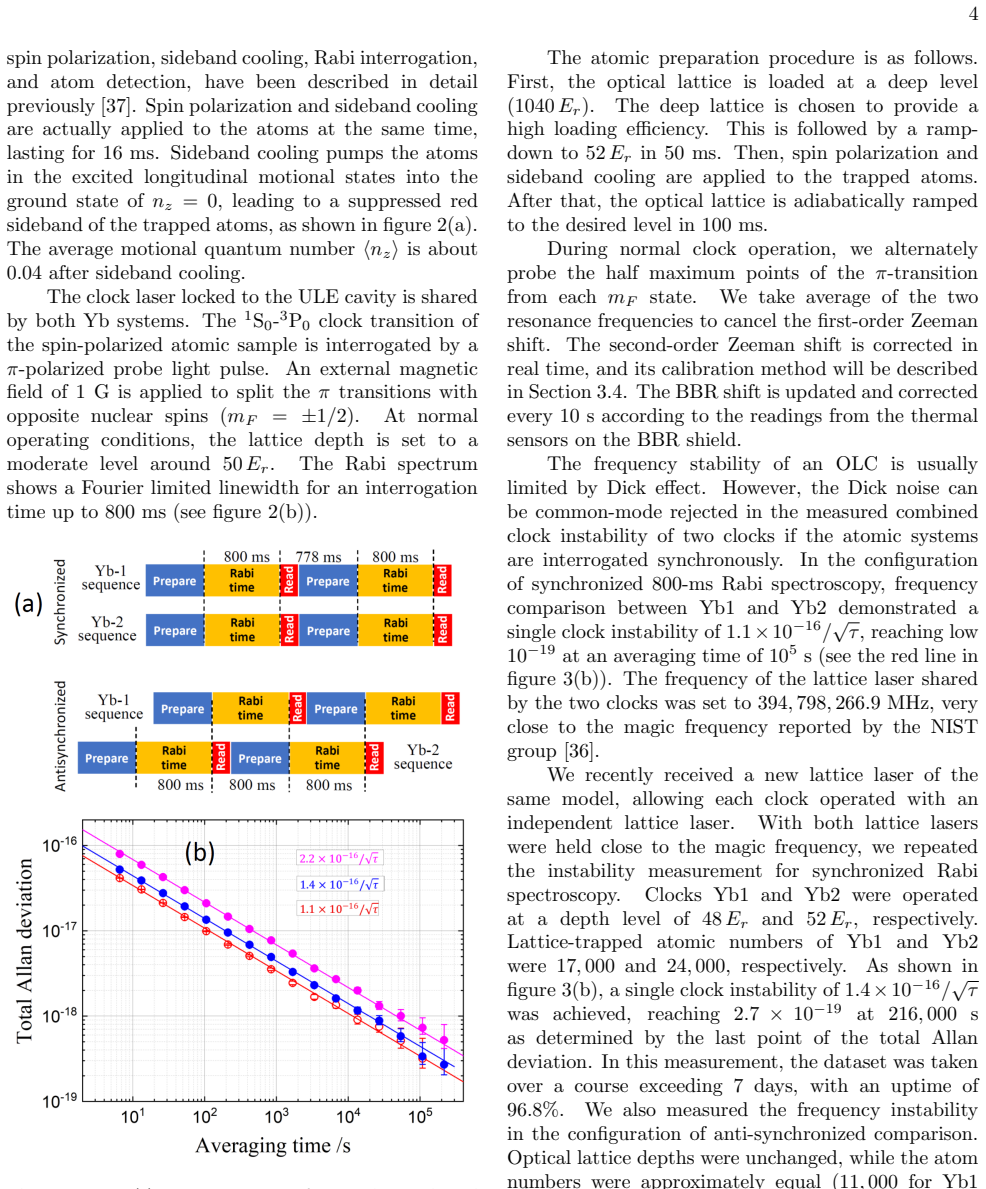
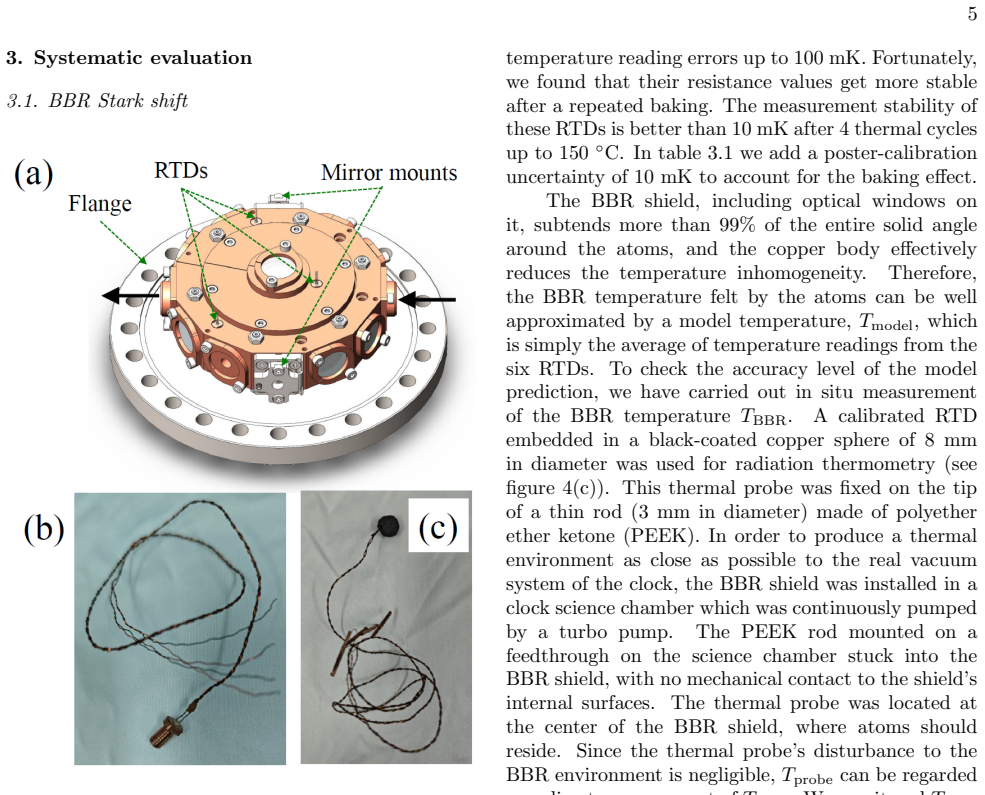
read the original abstract
We report an optical lattice clock based on $^{171}$Yb atoms with a total systematic uncertainty of $1.1\times 10^{-18}$. In-vacuum buildup cavity was employed to enhance the lattice light power. Differential frequency measurement between two identical clocks facilitate the evaluation of systematic shifts. Synchronous comparison of the two clocks reached a stability level of $2.7\times 10^{-19}$ in an averaging time of 216,000 s. The magic frequency $\nu_{\mathrm{zero}}$ was determined to be 394 798 258.3(1) MHz. Under typical operating conditions, the lattice light shift is controlled at an uncertainty level of $3\times 10^{-19}$. The blackbody radiation (BBR) shield which is placed in vacuum provides a well-characterized BBR environment, enabling an uncertainty contribution of $8.7\times 10^{-19}$ from the BBR Stark shift. Other systematic shifts have also been evaluated. The two clocks will be used for remote frequency comparisons between Shanghai and Wuhan.
Editorial analysis
A structured set of objections, weighed in public.
Referee Report
Summary. The paper reports an optical lattice clock based on 171Yb atoms achieving a total systematic uncertainty of 1.1×10^{-18}. It employs an in-vacuum buildup cavity to enhance lattice light power and uses differential frequency measurements between two identical clocks to evaluate systematic shifts. The magic frequency is determined as 394798258.3(1) MHz, with lattice light shift uncertainty controlled at 3×10^{-19} and BBR Stark shift uncertainty at 8.7×10^{-19} via a vacuum BBR shield. Synchronous comparison yields a stability of 2.7×10^{-19} at 216000 s averaging time. The clocks are intended for remote frequency comparisons between Shanghai and Wuhan.
Significance. If the uncertainty evaluations hold, this represents a competitive precision level for Yb lattice clocks, advancing optical frequency standards and enabling applications in fundamental constant tests and long-baseline comparisons. The differential measurement protocol and hardware elements (buildup cavity, BBR shield) are standard strengths that support the quoted low contributions from lattice and BBR shifts.
major comments (2)
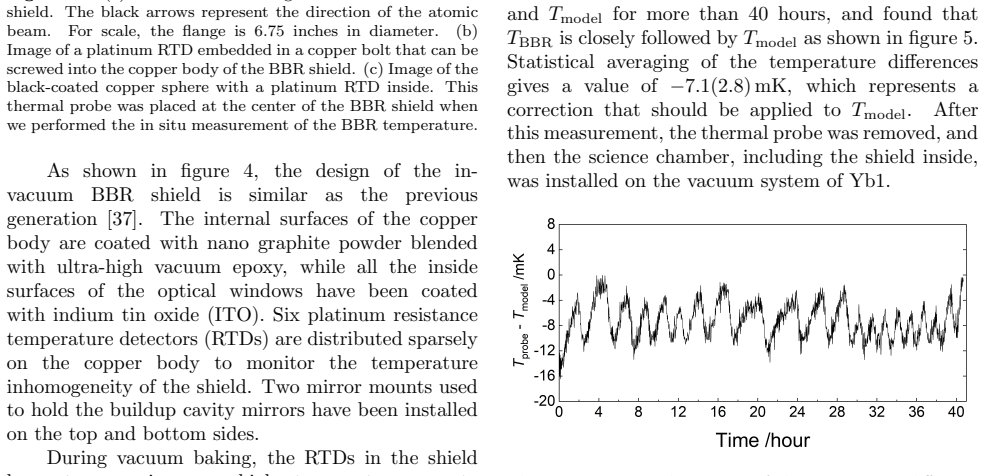
- [Abstract] Abstract: The total systematic uncertainty of 1.1×10^{-18} is stated alongside BBR (8.7×10^{-19}) and lattice (3×10^{-19}) contributions, but without an explicit uncertainty budget table or section detailing all individual terms, their evaluation methods, and the combination rule (e.g., root-sum-square), the total cannot be independently verified from the provided information.
- [Abstract] Abstract: The central claim relies on differential frequency measurements between two nominally identical clocks to isolate and quantify all systematic shifts; however, the assumption that this protocol fully eliminates residual common-mode errors or unaccounted environmental couplings lacks quantitative bounds or tests in the evaluation description, which is load-bearing for the 1.1×10^{-18} total.
minor comments (2)
- [Abstract] The magic frequency is reported as 394 798 258.3(1) MHz; clarify the exact meaning of the parenthetical uncertainty and ensure consistent notation throughout.
- Consider including a summary table of all evaluated systematic shifts with references to the relevant measurement sections for improved clarity.
Simulated Author's Rebuttal
We thank the referee for the careful review and constructive comments. We address the two major comments point by point below.
read point-by-point responses
-
Referee: [Abstract] Abstract: The total systematic uncertainty of 1.1×10^{-18} is stated alongside BBR (8.7×10^{-19}) and lattice (3×10^{-19}) contributions, but without an explicit uncertainty budget table or section detailing all individual terms, their evaluation methods, and the combination rule (e.g., root-sum-square), the total cannot be independently verified from the provided information.
Authors: The abstract is necessarily concise. The complete uncertainty budget table, listing every individual term with its evaluated value, method of determination, and the root-sum-square combination yielding the total 1.1×10^{-18}, appears in the main text (Systematic Uncertainty Evaluation section). We will revise the abstract to include an explicit cross-reference to this table so that readers can locate the full details immediately. revision: yes
-
Referee: [Abstract] Abstract: The central claim relies on differential frequency measurements between two nominally identical clocks to isolate and quantify all systematic shifts; however, the assumption that this protocol fully eliminates residual common-mode errors or unaccounted environmental couplings lacks quantitative bounds or tests in the evaluation description, which is load-bearing for the 1.1×10^{-18} total.
Authors: Quantitative bounds on residual common-mode rejection and environmental couplings are derived from the synchronous comparison data and auxiliary monitoring channels; these bounds and the associated tests are presented in the Differential Measurement and Systematic Shift Evaluation sections of the manuscript. The quoted total uncertainty incorporates these bounds. revision: no
Circularity Check
No significant circularity
full rationale
The paper's central result is an experimental uncertainty budget for a Yb lattice clock obtained via differential frequency comparisons between two nominally identical systems. The magic frequency, lattice shift, and BBR contributions are reported as direct measurements or characterizations (e.g., ν_zero = 394798258.3(1) MHz, lattice uncertainty 3×10^{-19}, BBR 8.7×10^{-19}), not as outputs of a model fitted to the final uncertainty figure. No self-citation chain, ansatz smuggling, or uniqueness theorem is invoked to close the derivation; the evaluation protocol is standard and externally falsifiable through the quoted stability and parameter-variation data. The derivation chain therefore remains self-contained against external benchmarks.
Axiom & Free-Parameter Ledger
free parameters (1)
- magic frequency =
394798258.3(1) MHz
axioms (1)
- domain assumption The two clocks are sufficiently identical that differential measurements isolate all relevant systematic shifts.
Reference graph
Works this paper leans on
-
[1]
Ushijima I, Takamoto M, Das M, Ohkubo T and Katori H 2015Nature Photonics9185–189
-
[2]
Huntemann N, Sanner C, Lipphardt B, Tamm C and Peik E 2016Phys. Rev. Lett.116(6) 063001
-
[3]
McGrew W F, Zhang X, Fasano R J, Sch¨ affer S A, Beloy K, Nicolodi D, Brown R C, Hinkley N, Milani G, Schioppo M, Yoon T H and Ludlow A D 2018Nature56487–90
-
[4]
Ohmae N, Takamoto M, Takahashi Y, Kokubun M, Araki K, Hinton A, Ushijima I, Muramatsu T, Furumiya T, Sakai Y, Moriya N, Kamiya N, Fujii K, Muramatsu R, Shiimado T and Katori H 2021Advanced Quantum Technologies42100015
-
[5]
Huang Y, Zhang B, Zeng M, Hao Y, Ma Z, Zhang H, Guan H, Chen Z, Wang M and Gao K 2022Phys. Rev. Applied 17034041
-
[6]
Cui K, Chao S, Sun C, Wang S, Zhang P, Wei Y, Yuan J, Cao J, Shu H and Huang X 2022Eur. Phys. J. D76140
-
[7]
Tofful A, Baynham C F A, Curtis E A, Parsons A O, Robertson B I, Schioppo M, Tunesi J, Margolis H S, Hendricks R J, Whale J, Thompson R C and Godun R M 2024Metrologia61045001
-
[8]
Ma Z Y, Deng K, Wang Z Y, Wei W Z, Hao P, Zhang H X, Pang L R, Wang B, Wu F F, Liu H L, Yuan W H, Chang J L, Zhang J X, Wu Q Y, Zhang J and Lu Z H 2024Phys. Rev. Appl.21(4) 044017
-
[9]
Liao T Y, Liu H, Meng F, Wang Q, Yang T, Tian H C, Lu B K, Zhu L, Li Y, Lin B K, Fang Z J and Lin Y G 2025 Chinese Physics Letters42034201
2025
-
[10]
Lu X T, Guo F, Liu Y Y, Cao J, Li J A, Xia J J, Xu Q F, Lu B Q, Wang Y B and Chang H 2025Metrologia62 035007
-
[11]
Zhang T, Jin T, Qi Q, Lei S, Xia Y, Zhang J, Chang H, Feng S, Liu X, Wang J, Zhang R, Xu Z, Tang Z and Xu X 2026Metrologia63025004
-
[12]
Brewer S M, Chen J S, Hankin A M, Clements E R, Chou C W, Wineland D J, Hume D B and Leibrandt D R 2019 Phys. Rev. Lett.123(3) 033201
2019
-
[13]
Zhiqiang Z, Arnold K J, Kaewuam R and Barrett M D 2023 Science Advances9eadg1971
2023
-
[14]
Aeppli A, Kim K, Warfield W, Safronova M S and Ye J 2024Phys. Rev. Lett.133(2) 023401
-
[15]
Marshall M C, Castillo D A R, Arthur-Dworschack W J, Aeppli A, Kim K, Lee D, Warfield W, Hinrichs J, Nardelli N V, Fortier T M, Ye J, Leibrandt D R and Hume D B 2025Phys. Rev. Lett.135(3) 033201
-
[16]
Lindvall T, Fordell T, Hanhij¨ arvi K, Doleˇ zal M, Rahm J, Weyers S and Wallin A 2025Phys. Rev. Appl.24(4) 044082
-
[17]
Zhang B l, Ma Z x, Huang Y, Han H l, Hu R m, Wang Y z, Zhang H q, Tang L y, Shi T y, Guan H and Gao K l 2026 Phys. Rev. Lett.136(5) 053202
2026
-
[18]
Jia Z P, Li J, Kong D Q, Zhang X, Yu H W, Liu X Y, Zhang Y C, Wang Y B, Zhu X Q, Zhang J H, Zhu M Y, Feng P J, Cui X Y, Xu P, Jiang X, Liu X P, Liu P, Dai H N, Chen Y A and Pan J W 2026Metrologia63025002
-
[19]
Dimarcq N, Gertsvolf M, Mileti G, Bize S, Oates C W, Peik E, Calonico D, Ido T, Tavella P, Meynadier F, Petit G, Panfilo G, Bartholomew J, Defraigne P, Donley E A, Hedekvist P O, Sesia I, Wouters M, Dub´ e P, Fang F, Levi F, Lodewyck J, Margolis H S, Newell D, Slyusarev S, Weyers S, Uzan J P, Yasuda M, Yu D H, Rieck C, Schnatz H, Hanado Y, Fujieda M, Pott...
-
[20]
Ido T, Hachisu H, Nakagawa F and Hanado Y 2016Journal of Physics: Conference Series723012041
-
[21]
Grebing C, Al-Masoudi A, D¨ orscher S, H¨ afner S, Gerginov V, Weyers S, Lipphardt B, Riehle F, Sterr U and Lisdat C 2016Optica3563–569
-
[22]
Hachisu H, Nakagawa F, Hanado Y and Ido T 2018 Scientific Reports84243
2018
-
[23]
Yao J, Sherman J, Fortier T, Leopardi H, Parker T, Levine J, Savory J, Romisch S, McGrew W, Zhang X, Nicolodi 10 D, Fasano R, Sch¨ affer S, Beloy K and Ludlow A 2018 NAVIGATION65601–608
2018
-
[24]
Kobayashi T, Akamatsu D, Hosaka K, Hisai Y, Wada M, Inaba H, Suzuyama T, Hong F L and Yasuda M 2020 Metrologia57065021
2020
-
[25]
Zhu L, Wang Q, Wang Y, Lin Y, Yang D, Li Y, Yang T, Meng F, Lin B, Tian H, Lu B and Fang Z 2024 Measurement Science and Technology35125014
2024
-
[26]
Yuan Y, Cao J, Yuan J, Wang D, Fang P, Chen Q, Cao S, Wang X, Chao S, Shu H, Li G, Xu J, Fu G, Yang Y, Zhao R, Shi F and Huang X 2026Metrologia63025003
-
[27]
Nosske I, Vishwakarma C, L¨ ucke T, Rahm J, Poudel N, Weyers S, Benkler E, D¨ orscher S and Lisdat C 2025 Quantum Science and Technology10045076
2025
-
[28]
Oelker E, Hutson R B, Kennedy C J, Sonderhouse L, Bothwell T, Goban A, Kedar D, Sanner C, Robinson J M, Marti G E, Matei D G, Legero T, Giunta M, Holzwarth R, Riehle F, Sterr U and Ye J 2019Nature Photonics13 714–719
-
[29]
Liu X Y, Liu P, Li J, Zhang Y C, Wang Y B, Jia Z P, Zhang X, Zhu X Q, Kong D Q, Song W L, Niu G Z, Yang Y M, Feng P J, Liu X P, Cui X Y, Xu P, Jiang X, Yin J, Liao S K, Peng C Z, Dai H N, Chen Y A and Pan J W 2025 Phys. Rev. Lett.135(26) 263402
2025
-
[30]
Beloy K, Hinkley N, Phillips N B, Sherman J A, Schioppo M, Lehman J, Feldman A, Hanssen L M, Oates C W and Ludlow A D 2014Phys. Rev. Lett.113(26) 260801
-
[31]
Xu Y L and Xu X Y 2016Chinese Physics B25103202
-
[32]
Xiong D, Zhu Q, Wang J, Zhang A, Tian C, Wang B, He L, Xiong Z and Lyu B 2021Metrologia58035005
-
[33]
Heo M S, Kim H, Yu D H, Lee W K and Park C Y 2022 Metrologia59055002
2022
-
[34]
Yu H, Liu P, Li Y, Jia Z, Zhang X, Yan J, Li J, Dai H and Chen Y 2026Measurement257118527 ISSN 0263-2241
-
[35]
Hassan Y S, Beloy K, Siegel J L, Kobayashi T, Swiler E, Grogan T, Brown R C, Rojo T, Bothwell T, Hunt B D, Halaoui A and Ludlow A D 2025Phys. Rev. Lett.135(6) 063402
-
[36]
Brown R C, Phillips N B, Beloy K, McGrew W F, Schioppo M, Fasano R J, Milani G, Zhang X, Hinkley N, Leopardi H, Yoon T H, Nicolodi D, Fortier T M and Ludlow A D 2017Phys. Rev. Lett.119(25) 253001
-
[37]
Zhang A, Xiong Z, Chen X, Jiang Y, Wang J, Tian C, Zhu Q, Wang B, Xiong D, He L, Ma L and Lyu B 2022 Metrologia59065009
2022
-
[38]
Sherman J A, Lemke N D, Hinkley N, Pizzocaro M, Fox R W, Ludlow A D and Oates C W 2012Phys. Rev. Lett. 108(15) 153002
-
[39]
Dzuba V A and Derevianko A 2010Journal of Physics B: Atomic, Molecular and Optical Physics43074011
-
[40]
Bothwell T, Hunt B D, Siegel J L, Hassan Y S, Grogan T, Kobayashi T, Gibble K, Porsev S G, Safronova M S, Brown R C, Beloy K and Ludlow A D 2025Phys. Rev. Lett.134(3) 033201
-
[41]
Zhang A, Tian C, Zhu Q, Wang B, Xiong D, Xiong Z, He L and Lyu B 2023Chinese Physics B32020601
-
[42]
Beloy K, Zhang X, McGrew W F, Hinkley N, Yoon T H, Nicolodi D, Fasano R J, Sch¨ affer S A, Brown R C and Ludlow A D 2018Phys. Rev. Lett.120(18) 183201
-
[43]
Fasano R, Chen Y, McGrew W, Brand W, Fox R and Ludlow A 2021Phys. Rev. Appl.15(4) 044016
-
[44]
Jia Z P, Cui X Y, Xie Y J, Zhang X, Niu G Z, Liu X Y, Zhu Q Q, Li J and Dai H N 2025Phys. Rev. Appl.23(1) 014014
discussion (0)
Sign in with ORCID, Apple, or X to comment. Anyone can read and Pith papers without signing in.