Long-time Asymptotics of a Full Camassa-Holm Soliton Gas
Pith reviewed 2026-06-27 10:59 UTC · model grok-4.3
The pith
As the number of solitons tends to infinity, the discrete Riemann-Hilbert problem for the Camassa-Holm equation converges to a limiting problem whose jump matrix contains two nonzero reflection coefficients.
A machine-rendered reading of the paper's core claim, the machinery that carries it, and where it could break.
Core claim
As N to infinity the discrete RH problem with 2N poles and two types of residue conditions converges to a soliton gas RH problem whose jump matrix contains two nonzero reflection coefficients. This limiting problem is analyzed by the Deift-Zhou nonlinear steepest descent method. The presence of two nonzero reflection coefficients requires two different types of triangular factorizations of the jump matrix and leads to a more delicate g-function mechanism. In Case I, depending on the location of the spectral endpoints eta1 and eta2, the long-time asymptotics consist of finite-gap elliptic functions in three elliptic-wave regions, with an O(t to the minus 1/2) correction involving parabolic cy
What carries the argument
The g-function construction adapted to the Camassa-Holm phase with precise control near k equals i over 2, which permits the required triangular factorizations of the jump matrix that contains two reflection coefficients.
If this is right
- The long-time leading term is a finite-gap elliptic function in each of the three elliptic-wave regions.
- In the central region the first correction term is of order t to the minus one-half and involves parabolic cylinder functions.
- Different g-function mechanisms arise according to the location of the spectral endpoints eta1 and eta2.
- The resulting model supplies a full soliton gas description for the Camassa-Holm equation rather than the half-soliton gas models studied previously.
Where Pith is reading between the lines
- The same limiting procedure could be applied to other integrable equations whose phase structure admits two distinct reflection coefficients.
- Large-N numerical simulations of Camassa-Holm soliton gases could be compared against the elliptic leading asymptotics to check the convergence rate.
- The richer jump matrix may produce additional interaction phenomena between the two families of solitons that are absent from half-gas models.
- Analysis of the remaining cases beyond Case I would likely reveal further asymptotic regimes controlled by different g-function choices.
Load-bearing premise
Suitable g-functions adapted to the Camassa-Holm phase can be constructed with precise control of their behavior near the distinguished point k equals i over 2 and at infinity.
What would settle it
Numerical solution of the limiting RH problem for large t in one of the three elliptic-wave regions compared directly against the predicted finite-gap elliptic function plus the parabolic-cylinder correction in the central region.
Figures


read the original abstract
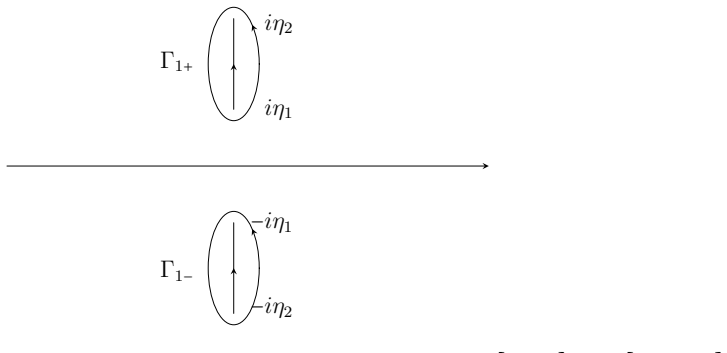
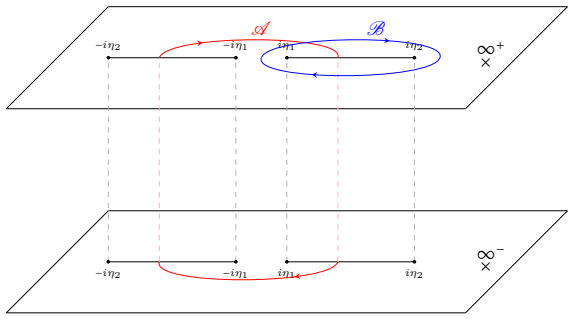
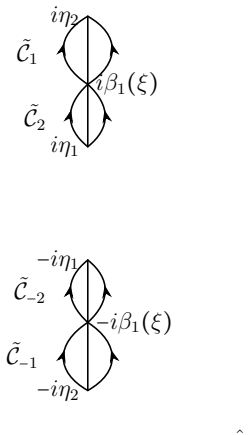
We investigate the long-time asymptotics of a full soliton gas for the Camassa--Holm equation. The analysis starts from a pure-soliton Riemann--Hilbert (RH) problem with \(2N\) poles and two distinct types of residue conditions. We prove that, as \(N\to\infty\), this discrete RH problem converges to a limiting soliton gas RH problem whose jump matrix contains two nonzero reflection coefficients. In this sense, the limiting problem gives a full soliton gas model for the Camassa--Holm equation, in contrast to the previously studied half soliton gas models, whose jump matrices involve only one nonzero reflection coefficient. The limiting RH problem is analyzed by the Deift--Zhou nonlinear steepest descent method. The presence of two nonzero reflection coefficients requires two different types of triangular factorizations of the jump matrix and leads to a more delicate \(g\)-function mechanism. The main difficulty lies in the construction of suitable \(g\)-functions adapted to the Camassa--Holm phase, together with the precise control of their behavior near the distinguished point \(k=i/2\) and at infinity. Depending on the location of the spectral endpoints \(\eta_1\) and \(\eta_2\), different \(g\)-function mechanisms arise. In this paper, we focus on Case I and derive the long-time asymptotic formulas in three elliptic-wave regions of the self-similar plane. In each region, the leading term is given by a finite-gap elliptic function, while in the central region the first correction is of order \(\mathcal O(t^{-1/2})\) and involves parabolic cylinder functions.
Editorial analysis
A structured set of objections, weighed in public.
Referee Report
Summary. The paper claims that a discrete pure-soliton RH problem with 2N poles and two types of residue conditions converges as N→∞ to a limiting soliton-gas RH problem whose jump matrix has two nonzero reflection coefficients. This limiting problem is then analyzed via the Deift-Zhou steepest descent method; the presence of two reflection coefficients requires two triangular factorizations and a delicate g-function construction adapted to the Camassa-Holm phase, with control near k=i/2 and at infinity. The manuscript focuses on Case I (determined by the positions of spectral endpoints η1, η2) and derives long-time asymptotics in three elliptic-wave regions of the self-similar plane, with leading finite-gap elliptic functions and, in the central region, an O(t^{-1/2}) correction involving parabolic cylinder functions.
Significance. If the central convergence and g-function constructions hold, the work supplies the first full soliton-gas model for the Camassa-Holm equation (contrasting with prior half-soliton-gas models that have only one nonzero reflection coefficient). The derivation begins from an explicit discrete RH problem and takes a continuum limit without fitted parameters; this is a methodological strength. The resulting explicit asymptotic formulas in the self-similar plane would be a concrete advance for long-time behavior of integrable soliton gases.
major comments (1)
- The abstract states that the main difficulty is the construction of g-functions adapted to the Camassa-Holm phase together with precise control of their behavior near the distinguished point k=i/2 and at infinity, with different mechanisms arising according to the locations of η1 and η2 (Case I). No explicit g-function formulas, residue conditions, or error estimates are supplied in the abstract, and the convergence statement plus the claimed leading elliptic-wave asymptotics (plus O(t^{-1/2}) parabolic-cylinder corrections) cannot be checked for internal consistency without these details. This construction is load-bearing for the central claim of convergence to the two-reflection-coefficient limiting RH problem.
Simulated Author's Rebuttal
We thank the referee for the careful reading and for recognizing the methodological contribution of deriving the full soliton-gas RH problem from an explicit discrete pure-soliton problem. We address the single major comment below.
read point-by-point responses
-
Referee: The abstract states that the main difficulty is the construction of g-functions adapted to the Camassa-Holm phase together with precise control of their behavior near the distinguished point k=i/2 and at infinity, with different mechanisms arising according to the locations of η1 and η2 (Case I). No explicit g-function formulas, residue conditions, or error estimates are supplied in the abstract, and the convergence statement plus the claimed leading elliptic-wave asymptotics (plus O(t^{-1/2}) parabolic-cylinder corrections) cannot be checked for internal consistency without these details. This construction is load-bearing for the central claim of convergence to the two-reflection-coefficient limiting RH problem.
Authors: We agree that the abstract contains only a high-level description and does not list explicit formulas. This is by design: abstracts in this field are limited to a few hundred words and serve as an overview. The explicit g-function formulas (including the two triangular factorizations and the control near k=i/2 and at infinity), the residue conditions for the limiting RH problem, and the error estimates that justify both the N→∞ convergence and the O(t^{-1/2}) parabolic-cylinder corrections are all supplied in the body of the manuscript. In particular, the g-function constructions for Case I appear in Section 4 with the required analytic properties proved in Lemmas 4.3–4.5; the residue conditions are stated in Definition 3.2 and Proposition 3.4; the steepest-descent analysis and error bounds, including the elliptic-wave leading terms and the central-region correction, are carried out in Sections 5 and 6. Internal consistency of the claims can therefore be verified directly from the detailed proofs. We do not believe it is necessary or conventional to embed these technical expressions in the abstract itself. revision: no
Circularity Check
No load-bearing circularity; derivation proceeds from explicit discrete RH problem via continuum limit and Deift-Zhou analysis
full rationale
The paper begins from a stated pure-soliton RH problem with 2N poles and two residue conditions, proves convergence as N→∞ to a limiting RH problem with two nonzero reflection coefficients, then applies the Deift-Zhou steepest descent method with g-function construction adapted to the Camassa-Holm phase. No step reduces a claimed prediction or asymptotic formula to a fitted parameter, self-defined quantity, or unverified self-citation chain; the contrast with prior half-soliton-gas models is not load-bearing for the central convergence or elliptic-wave asymptotics. The g-function construction is presented as the technical core but is not shown to be circular by the provided text.
Axiom & Free-Parameter Ledger
axioms (2)
- domain assumption The pure-soliton RH problem with 2N poles and two types of residue conditions converges to a limiting continuous RH problem as N→∞
- standard math The Deift-Zhou nonlinear steepest descent method applies directly once the limiting jump matrix with two nonzero reflection coefficients is obtained
Forward citations
Cited by 1 Pith paper
-
Long-time asymptotics of a full arbitrary-genus dark soliton gas for the defocusing nonlinear Schrodinger equation
Derives long-time asymptotics of a full arbitrary-genus dark soliton gas for defocusing NLS, yielding an N-dimensional Riemann-theta finite-gap solution with O(t^{-1}) or O(t^{-1/2}) errors in different sectors.
Reference graph
Works this paper leans on
-
[1]
Biondini, S
G. Biondini, S. T. Li and D. Mantzavinos, ‘Long-time asymptotics for the focusing nonlin- ear Schr¨ odinger equation with nonzero boundary conditions in the presence of a discrete spectrum’,Comm. Math. Phys.382 (2021), 1495–1577
2021
-
[2]
Arbitrary-genus dark soliton gases in the defocusing nonlinear Schr\"{o}dinger hydrodynamics
M. Bertola, D. S. Wang, P. Yan and D. H. Zhu, ‘Arbitrary-genus dark soliton gases in the defocusing nonlinear Schr¨ odinger hydrodynamics’, arXiv:2605.18651 [math-ph]
work page internal anchor Pith review Pith/arXiv arXiv
-
[3]
Grava and A
T. Grava and A. Minakov, ‘On the long-time asymptotic behavior of the modified Korteweg–de Vries equation with step-like initial data’,SIAM J. Math. Anal.52 (2020), 5892–5993
2020
-
[4]
Deift, A
P. Deift, A. Its and X. Zhou, ‘A Riemann-Hilbert approach to asymptotic problems arising in the theory of random matrix models, and also in the theory of integrable statistical mechanics’,Ann. of Math.146 (1997), 149–235
1997
-
[5]
X. E. Zhang and L. M. Ling, ‘A modified Korteweg–de Vries equation soliton gas on a nonzero background’,Phys. D482 (2025), 134890
2025
-
[6]
X. F. Han, X. E. Zhang and H. H. Dong, ‘Largexasymptotics of the soliton gas for the nonlinear Schr¨ odinger equation’,Stud. Appl. Math.154(2) (2025), Paper No. e70027. 49
2025
-
[7]
D. S. Wang, D. H. Zhu and X. D. Zhu, ‘Genus two KdV soliton gases and their long-time asymptotics’,Forum Math. Sigma14 (2026), e57
2026
-
[8]
P. V. Nabelek, ‘Algebro-geometric finite gap solutions to the Korteweg-de Vries equation as primitive solutions’,Phys. D414 (2020), 132709
2020
-
[9]
Boutet de Monvel, J
A. Boutet de Monvel, J. Lenells and D. Shepelsky, ‘The focusing NLS equation with step- like oscillating background: the genus 3 sector’,Comm. Math. Phys.390 (2022), 1081–1148
2022
-
[10]
Boutet de Monvel, A
A. Boutet de Monvel, A. Kostenko, D. Shepelsky and G. Teschl, ‘Long-time asymptotics for the Camassa-Holm equation’,SIAM J. Math. Anal.41 (2009), 1559–1588
2009
-
[11]
Boutet de Monvel and D
A. Boutet de Monvel and D. Shepelsky, ‘Riemann-Hilbert approach for the Camassa-Holm equation on the line’,C. R. Math. Acad. Sci. Paris343 (2006), 627–632
2006
-
[12]
Boutet de Monvel, A
A. Boutet de Monvel, A. Its and V. Kotlyarov, ‘Long-time asymptotics for the focusing NLS equation with time-periodic boundary condition on the half-line’,Comm. Math. Phys. 290 (2009), 479–522
2009
-
[13]
Boutet de Monvel, J
A. Boutet de Monvel, J. Lenells and D. Shepelsky, ‘The focusing NLS equation with step- like oscillating background: scenarios of long-time asymptotics’,Comm. Math. Phys.383 (2021), 893–952
2021
-
[14]
Camassa and D
R. Camassa and D. Holm, ‘An integrable shallow water equation with peaked solitons’, Phys. Rev. Lett.71 (1993), 1661–1664
1993
-
[15]
Constantin, ‘The Hamiltonian structure of the Camassa-Holm equation’,Expo
A. Constantin, ‘The Hamiltonian structure of the Camassa-Holm equation’,Expo. Math. 15 (1997), 53–85
1997
-
[16]
Constantin, ‘On the scattering problem for the Camassa-Holm equation’,Proc
A. Constantin, ‘On the scattering problem for the Camassa-Holm equation’,Proc. Royal Soc. A457 (2001), 953–970
2001
-
[17]
Constantin, V
A. Constantin, V. Gerdjikov and R. Ivanov, ‘Inverse scattering transform for the Camassa- Holm equation’,Inverse Problems22 (2006), 2197–2207
2006
-
[18]
H. H. Dai, ‘Model equations for nonlinear dispersive waves in a compressible Mooney-Rivlin rod’,Acta Mech.127 (1998), 193–207
1998
-
[19]
Deift and X
P. Deift and X. Zhou, ‘A steepest descent method for oscillatory Riemann-Hilbert prob- lems. Asymptotics for the mKdV equation’,Ann. of Math.137 (1993), 295–368
1993
-
[20]
Dyachenko, D
S. Dyachenko, D. Zakharov and V. Zakharov, ‘Primitive potentials and bounded solutions of the KdV equation’,Phys. D333 (2016), 148–156. 50
2016
- [21]
-
[22]
T. Grava, R. Jenkins, X. F. Zhang and Z. C. Zhang, Inverse scattering for the focusing non- linear Schr¨ odinger equation with elliptic background and full soliton gas, arXiv:2606.08321 [math.AP]
work page internal anchor Pith review Pith/arXiv arXiv
-
[23]
X. G. Geng and H. Liu, ‘The nonlinear steepest descent method to long-time asymptotics of the coupled nonlinear Schr¨ odinger equation’,J. Nonlinear Sci.28 (2018), 739–763
2018
-
[24]
H. Liu, X. G. Geng and B. Xue, ‘The Deift-Zhou steepest descent method to long-time asymptotics for the Sasa-Satsuma equation’,J. Differ. Equ.265 (2018), 5984–6008
2018
-
[25]
X. G. Geng, D. D. Yan and M. X. Jia, ‘Large-space and large-time asymptotics of the Camassa-Holm soliton gas’,J. Differ. Equ.444 (2025), 113581
2025
-
[26]
X. G. Geng, K. D. Wang and M. M. Chen, ‘Long-time asymptotics for the spin-1 Gross- Pitaevskii equation’,Comm. Math. Phys.382 (2021), 585–611
2021
-
[27]
Girotti, T
M. Girotti, T. Grava, R. Jenkins and K. D. T.-R. McLaughlin, ‘Rigorous asymptotics of a KdV soliton gas’,Comm. Math. Phys.384 (2021), 733–784
2021
-
[28]
Girotti, T
M. Girotti, T. Grava, R. Jenkins, K. D. T.-R. McLaughlin and A. Minakov, ‘Soliton versus the gas: Fredholm determinants, analysis, and the rapid oscillations behind the kinetic equation’,Comm. Pure Appl. Math.76 (2023), 3233–3299
2023
-
[29]
Grunert and G
K. Grunert and G. Teschl, ‘Long-time asymptotics for the Korteweg-de Vries equation via nonlinear steepest descent’,Math. Phys. Anal. Geom.12 (2009), 287–324
2009
-
[30]
Kotlyarov and A
V. Kotlyarov and A. Minakov, ‘Step-initial function to the mKdV equation: hyper-elliptic long-time asymptotics of the solution’,J. Math. Phys. Anal. Geom.8 (2012), 38–62
2012
-
[31]
Minakov, ‘Asymptotics of step-like solutions for the Camassa-Holm equation’,J
A. Minakov, ‘Asymptotics of step-like solutions for the Camassa-Holm equation’,J. Differ. Equ.261 (2016), 6055–6098
2016
-
[32]
K. Xu, E. G. Fan and Y. L. Yang, ‘The Cauchy problem of the Camassa-Holm equation in a weighted Sobolev space: long-time and Painlev´ e asymptotics’,J. Differ. Equ.380 (2024), 24–91
2024
-
[33]
D. D. Yan, X. G. Geng and K. D. Wang, ‘Large-space and large-time asymptotics for the mKdV soliton gas with any odd genus’, arXiv:2605.19934 [nlin.SI]
work page internal anchor Pith review Pith/arXiv arXiv
-
[34]
D. D. Yan, X. G. Geng and J. Wei, ‘Large-space and Large-time Asymptotics for the Focusing Nonlinear Schr¨ odinger Soliton Gas’, arXiv:2605.21091 [nlin.SI]. 51
work page internal anchor Pith review Pith/arXiv arXiv
-
[35]
D. D. Yan, X. G. Geng and J. Wei, ‘Large-time asymptotics of a new KdV soliton gas’, submitted
-
[36]
Zakharov, ‘Kinetic equation for solitons’,Sov
V. Zakharov, ‘Kinetic equation for solitons’,Sov. Phys. JETP33(3) (1971), 538–541
1971
- [37]
discussion (0)
Sign in with ORCID, Apple, or X to comment. Anyone can read and Pith papers without signing in.