REVIEW 3 major objections 2 minor 44 references
Fr\'echet Means of Periodic Orbits in Dynamical Systems: Geometry, Dynamics, and Diagnostics
T0 review · 3 major / 2 minor · reviewed 2026-06-27 · grok-4.3
Pith's one-line read Fréchet means of periodic orbits depend strongly on parametrization and require a decoupled geometric-dynamic reconstruction.
desk verdict The paper offers a quotient-space Fréchet mean for periodic orbits that separates geometric shape from dynamical speed, with practical diagnostics, though the infinite-dimensional existence result is the least detailed part. read the letter →
The pith
A machine-rendered reading of the paper's core claim, the machinery that carries it, and where it could break.
The reading
What carries the argument
Quotient-space metric on closed curves that quotients out circular phase shifts, together with the decoupled procedure of arc-length geometric Fréchet mean followed by harmonic averaging of speed profiles.
What would settle it
A concrete finite collection of periodic orbits for which the Fréchet functional on the quotient space has no minimizer would disprove the existence claim.
Extended reading notes
Core claim
Within the metric structure on the quotient space of closed curves that accounts for circular phase shifts, empirical Fréchet means exist. The resulting mean depends strongly on the chosen parametrization: time parametrization preserves dynamical information, whereas arc length parametrization emphasizes geometric structure. To reconcile these viewpoints, a geometric Fréchet mean is computed using arc length parametrization and representative dynamics are reconstructed through harmonic averaging of aligned speed profiles. Curvature- and medoid-based diagnostic measures quantify the representativeness of the resulting mean and identify situations in which averaging produces geometric artifact
Load-bearing premise
Empirical Fréchet means exist in the infinite-dimensional quotient space that accounts for circular phase shifts via the introduced metric structure.
Editorial extensions
If this is right
- The decoupled procedure yields both a geometric summary curve and a consistent averaged speed profile for any family of periodic orbits.
- Curvature- and medoid-based diagnostics can detect when the mean introduces artifacts or fails on heterogeneous ensembles.
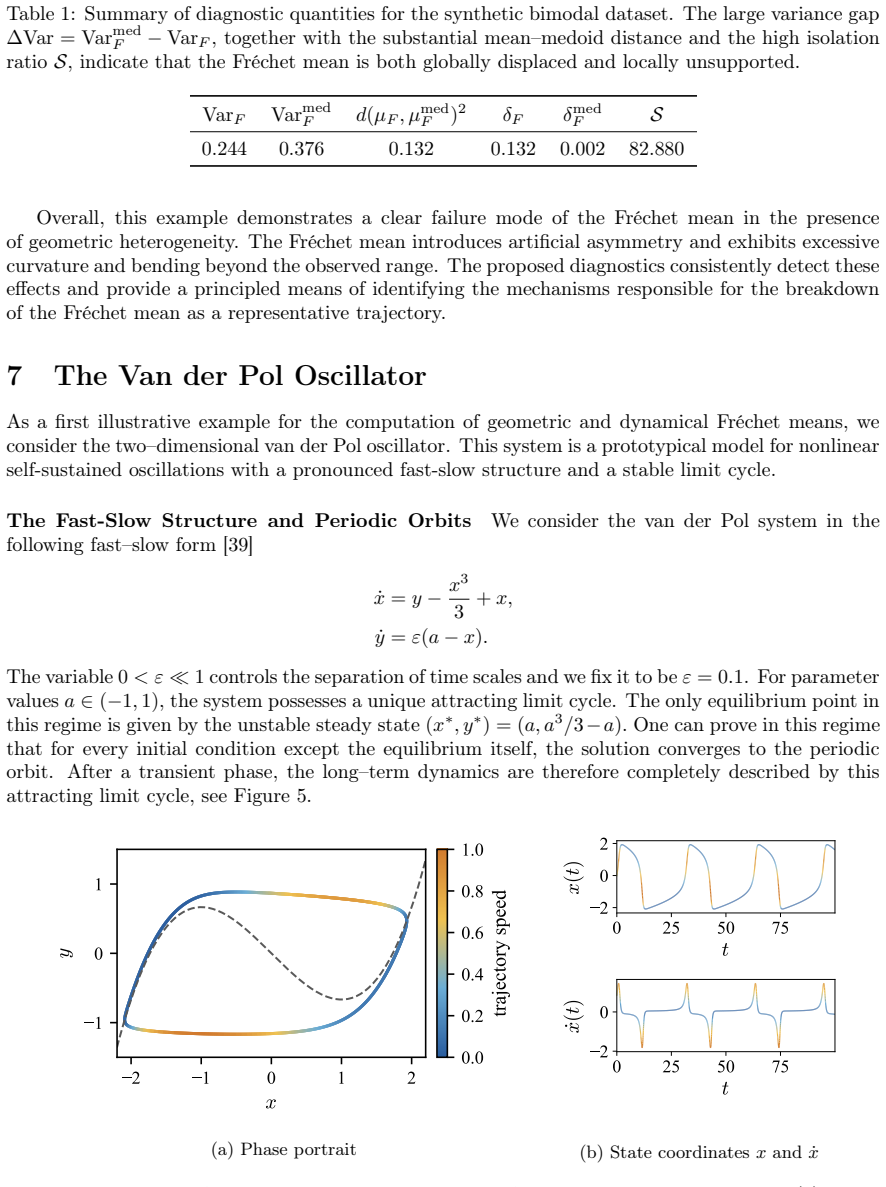
- The framework applies directly to parameter-dependent families in the Van der Pol oscillator, Rosenzweig-MacArthur model, and Morris-Lecar model.
- Numerical experiments confirm that the method produces robust geometric summaries together with consistent averaged dynamics.
Reading between the lines
- The separation of geometry and dynamics may improve uncertainty quantification when model parameters vary continuously.
- The same diagnostics could be applied to limit-cycle data extracted from experiments to decide whether a single representative orbit is justified.
- Testing whether the harmonic speed averaging step remains stable under small perturbations of the original speed profiles would be a direct next check.
Editorial analysis
A structured set of objections, weighed in public.
Referee Report
Summary. The paper develops a framework for Fréchet means of periodic orbits by representing trajectories as closed curves in a quotient space that identifies phase shifts via a suitable metric. It claims to establish existence of empirical Fréchet means in the resulting infinite-dimensional space, shows that the mean depends on parametrization (time vs. arc-length), proposes a decoupled procedure (arc-length geometric mean followed by harmonic averaging of aligned speed profiles), introduces curvature- and medoid-based diagnostics for representativeness, and demonstrates the method on the Van der Pol oscillator, Rosenzweig-MacArthur model, and Morris-Lecar model.
Significance. If the existence result and the decoupled reconstruction are placed on firm footing, the work supplies a principled geometric-dynamical averaging tool useful for uncertainty quantification in families of periodic orbits. The explicit separation of geometry and dynamics, together with the diagnostic measures, addresses a practical need in dynamical systems that standard shape-analysis techniques do not directly resolve.
major comments (3)
- [framework / existence statement] The central existence claim for empirical Fréchet means in the infinite-dimensional quotient space (abstract and the framework section) is asserted but not secured in detail. The manuscript must state the precise theorem invoked (e.g., a reference to a result on lower semi-continuity and coercivity in a complete metric space) and verify that the quotient metric remains a length metric and that the circle action does not destroy completeness or coercivity; without this verification the claim that existence “is established within the framework” is load-bearing and unsupported.
- [decoupled approach] § on the decoupled approach: the reconstruction of dynamics via harmonic averaging of aligned speed profiles after computing the arc-length geometric mean lacks a justification that the resulting time-parametrized orbit remains a critical point of the original Fréchet functional or at least a consistent approximation; a counter-example or error bound relating the two parametrizations would be needed to support the claim that the procedure reconciles the geometric and dynamical viewpoints.
- [numerical experiments] Numerical experiments section: the reported results on the three models provide no quantitative error analysis, convergence diagnostics, or comparison against ground-truth means when they exist; without these the assertion that the methodology “yields robust geometric summaries together with consistent averaged dynamics” cannot be assessed for the central claim of practical utility.
minor comments (2)
- [framework] Notation for the quotient metric and the circle action should be introduced once with a clear diagram or equation reference rather than repeated inline.
- [numerical experiments] Figure captions for the model trajectories should include the precise parameter values and integration tolerances used.
Simulated Author's Rebuttal
We thank the referee for the careful reading and constructive comments, which will help improve the clarity and rigor of the manuscript. We address each major comment below and indicate the revisions we will undertake.
read point-by-point responses
-
Referee: [framework / existence statement] The central existence claim for empirical Fréchet means in the infinite-dimensional quotient space (abstract and the framework section) is asserted but not secured in detail. The manuscript must state the precise theorem invoked (e.g., a reference to a result on lower semi-continuity and coercivity in a complete metric space) and verify that the quotient metric remains a length metric and that the circle action does not destroy completeness or coercivity; without this verification the claim that existence “is established within the framework” is load-bearing and unsupported.
Authors: We agree that the existence statement requires explicit justification. In the revised manuscript we will cite the standard theorem guaranteeing existence of Fréchet means via lower semi-continuity and coercivity on complete metric spaces, and we will add a short verification that the quotient metric is a length metric whose completeness and coercivity are preserved under the circle action. These additions will be placed in the framework section immediately after the definition of the quotient space. revision: yes
-
Referee: [decoupled approach] § on the decoupled approach: the reconstruction of dynamics via harmonic averaging of aligned speed profiles after computing the arc-length geometric mean lacks a justification that the resulting time-parametrized orbit remains a critical point of the original Fréchet functional or at least a consistent approximation; a counter-example or error bound relating the two parametrizations would be needed to support the claim that the procedure reconciles the geometric and dynamical viewpoints.
Authors: The decoupled procedure is presented as a practical heuristic that separates geometric shape from speed profiles rather than as an exact critical point of the joint Fréchet functional. We will revise the section to state this distinction explicitly, supply a brief error-bound discussion under the assumption of small phase misalignment, and include a simple analytic counter-example (two orbits with differing speed profiles) illustrating the approximation gap. This will clarify the scope of the method without overstating its optimality properties. revision: partial
-
Referee: [numerical experiments] Numerical experiments section: the reported results on the three models provide no quantitative error analysis, convergence diagnostics, or comparison against ground-truth means when they exist; without these the assertion that the methodology “yields robust geometric summaries together with consistent averaged dynamics” cannot be assessed for the central claim of practical utility.
Authors: We accept that quantitative diagnostics are needed to substantiate the practical-utility claim. The revised numerical section will include (i) Fréchet-distance error tables for each model, (ii) convergence plots of the optimization routines, and (iii) comparisons against analytically known means for the symmetric Van der Pol case. These additions will allow readers to evaluate robustness directly. revision: yes
Circularity Check
No significant circularity; framework adapts standard Fréchet means without self-referential reduction.
full rationale
The paper constructs a quotient metric space for closed curves modulo phase shifts and claims to establish existence of empirical Fréchet means inside that space. This is a standard existence argument in metric geometry (completeness + lower semi-continuity + coercivity) applied to a new but explicitly defined object; it does not reduce to a fitted parameter renamed as prediction, a self-definition, or a load-bearing self-citation. The central result (dependence on parametrization and the decoupled geometric+dynamics procedure) follows from the explicit metric definitions rather than from any input that already encodes the output. No equations or claims in the provided abstract or skeptic notes exhibit the forbidden patterns.
Assumptions & free parameters
assumptions (1)
- domain assumption Existence of empirical Fréchet means holds in the infinite-dimensional quotient space equipped with the phase-shift metric.
Cite this review
Pith. "Pith review of Fr\'echet Means of Periodic Orbits in Dynamical Systems: Geometry, Dynamics, and Diagnostics." pith.science (2026). https://pith.science/paper/KAWTXFXL
@misc{pith2026260610748,
  author       = {Pith},
  title        = {Pith review of: Fr\'echet Means of Periodic Orbits in Dynamical Systems: Geometry, Dynamics, and Diagnostics},
  year         = {2026},
  howpublished = {\url{https://pith.science/paper/KAWTXFXL}},
  note         = {Machine review of arXiv:2606.10748}
}
read the original abstract
In many dynamical systems applications, one seeks representative trajectories summarizing families of periodic orbits arising from parameter variation or uncertainty. While the Fr\'echet mean provides a natural notion of averaging in nonlinear metric spaces, its application to periodic trajectories is complicated by the interplay between geometric shape and temporal dynamics. Inspired by ideas from shape analysis, we develop a framework for computing Fr\'echet means of periodic orbits by representing trajectories as closed curves and introducing a metric structure on a quotient space that accounts for circular phase shifts. Within this framework, we establish the existence of empirical Fr\'echet means in the resulting infinite-dimensional quotient space. A central finding is that the resulting Fr\'echet mean depends strongly on the chosen parametrization: time parametrization preserves dynamical information, whereas arc length parametrization emphasizes geometric structure. To reconcile these viewpoints, we propose a decoupled approach that computes a geometric Fr\'echet mean using arc length parametrization and subsequently reconstructs representative dynamics through harmonic averaging of aligned speed profiles. We further introduce curvature- and medoid-based diagnostic measures that quantify the representativeness of the resulting mean and identify situations in which averaging produces geometric artifacts or fails to capture heterogeneous ensembles. Numerical experiments for the Van der Pol oscillator, the Rosenzweig-MacArthur predator-prey model, and the Morris-Lecar neuronal model demonstrate that the proposed methodology yields robust geometric summaries together with consistent averaged dynamics. The framework provides a principled approach for constructing representative periodic trajectories and assessing their validity in uncertainty quantification and dynamical systems.
Figures


Figures from the paper (11 more)





Reference graph
Works this paper leans on
-
[1]
Chapman and Hall/CRC, 2024
Steven H Strogatz.Nonlinear dynamics and chaos: with applications to physics, biology, chem- istry, and engineering. Chapman and Hall/CRC, 2024
2024
-
[2]
Springer Science & Business Media, 2013
John Guckenheimer and Philip Holmes.Nonlinear oscillations, dynamical systems, and bifur- cations of vector fields. Springer Science & Business Media, 2013
2013
-
[3]
Springer, 1998
Yuri A Kuznetsov.Elements of applied bifurcation theory. Springer, 1998
1998
-
[4]
Timothy John Sullivan.Introduction to uncertainty quantification. Vol. 63. Springer, 2015
2015
-
[5]
SIAM, 2024
Ralph C Smith.Uncertainty quantification: theory, implementation, and applications. SIAM, 2024
2024
-
[6]
Springer Science & Business Media, 2010
Olivier Le Maître and Omar M Knio.Spectral methods for uncertainty quantification: with applications to computational fluid dynamics. Springer Science & Business Media, 2010
2010
-
[7]
A Survey on Uncertainty Quantification in Dynamical Systems
Arash Latifi and Caterina M. Scoglio. “A Survey on Uncertainty Quantification in Dynamical Systems”. In:IEEE Transactions on Systems, Man, and Cybernetics: Systems55.8 (2025), pp. 5137–5151.doi:10.1109/TSMC.2025.3564984
-
[8]
Computing invariant sets of random differential equa- tions using polynomial chaos
Maxime Breden and Christian Kuehn. “Computing invariant sets of random differential equa- tions using polynomial chaos”. In:SIAM Journal on Applied Dynamical Systems19.1 (2020), pp. 577–618
2020
Show all 44 references
-
[9]
A posteriori validation of generalized polynomial chaos expansions
M. Breden. “A posteriori validation of generalized polynomial chaos expansions”. In:SIAM J. Appl. Dyn. Syst.22.2 (2023), pp. 765–801
2023
-
[10]
Uncertaintyquantificationofbifurcationsinrandomordinarydifferential equations
C.KuehnandK.Lux.“Uncertaintyquantificationofbifurcationsinrandomordinarydifferential equations”. In:SIAM J. Appl. Dyn. Syst.20.4 (2021), pp. 2295–2334
2021
-
[11]
Assessing the impact of parametric uncertainty on tipping points of the Atlantic meridional overturning circulation
K. Lux et al. “Assessing the impact of parametric uncertainty on tipping points of the Atlantic meridional overturning circulation”. In:Environmental Research Letters17 (2022), p. 075002
2022
-
[12]
Uncertainty quantification analysis of bifurcations of the Allen-Cahn equation with random coefficients
C. Kuehn, C. Piazzola, and E. Ullmann. “Uncertainty quantification analysis of bifurcations of the Allen-Cahn equation with random coefficients”. In:Physica D470 (2024), p. 134390
2024
-
[13]
An equatorial ocean recharge paradigm for ENSO. Part I: Conceptual model
Fei-Fei Jin. “An equatorial ocean recharge paradigm for ENSO. Part I: Conceptual model”. In: Journal of the atmospheric sciences54.7 (1997), pp. 811–829
1997
-
[14]
Graphical representation and stability con- ditions of predator-prey interactions
Michael L Rosenzweig and Robert H MacArthur. “Graphical representation and stability con- ditions of predator-prey interactions”. In:The American Naturalist97.895 (1963), pp. 209–223
1963
-
[15]
Voltage oscillations in the barnacle giant muscle fiber
Catherine Morris and Harold Lecar. “Voltage oscillations in the barnacle giant muscle fiber”. In:Biophysical journal35.1 (1981), pp. 193–213
1981
-
[16]
Springer, 1997
James O Ramsay and Bernard W Silverman.Functional data analysis. Springer, 1997
1997
-
[17]
Anuj Srivastava and Eric P Klassen.Functional and shape data analysis. Vol. 1. Springer, 2016
2016
-
[18]
Les éléments aléatoires de nature quelconque dans un espace distancié
Maurice Fréchet. “Les éléments aléatoires de nature quelconque dans un espace distancié”. In: Annales de l’Institut Henri Poincaré10 (1948), pp. 215–310
1948
-
[19]
Riemannian center of mass and mollifier smoothing
Hermann Karcher. “Riemannian center of mass and mollifier smoothing”. In:Communications on pure and applied mathematics30.5 (1977), pp. 509–541
1977
-
[20]
Intrinsic statistics on Riemannian manifolds: Basic tools for geometric mea- surements
Xavier Pennec. “Intrinsic statistics on Riemannian manifolds: Basic tools for geometric mea- surements”. In:Journal of Mathematical Imaging and Vision25.1 (2006), pp. 127–154
2006
-
[21]
Largesampletheoryofintrinsicandextrinsicsample means on manifolds
RabiBhattacharyaandVicPatrangenaru.“Largesampletheoryofintrinsicandextrinsicsample means on manifolds”. In:The Annals of Statistics31.1 (2003), pp. 1–29. 32
2003
-
[22]
RiemannianL p center of mass: existence, uniqueness, and convexity
Bijan Afsari. “RiemannianL p center of mass: existence, uniqueness, and convexity”. In:Pro- ceedings of the American Mathematical Society139.2 (2011), pp. 655–673
2011
-
[23]
Springer, 2005
Ilya Molchanov.Theory of random sets. Springer, 2005
2005
-
[24]
Springer Science & Business Media, 2012
Eugene L Allgower and Kurt Georg.Numerical continuation methods: an introduction. Springer Science & Business Media, 2012
2012
-
[25]
Springer, 2008
Bernard Dacorogna.Direct methods in the calculus of variations. Springer, 2008
2008
-
[26]
Haim Brezis.Functional analysis, Sobolev spaces and partial differential equations. Vol. 2. 3. Springer, 2011
2011
-
[27]
Probability, convexity, and harmonic maps with small image I: uniqueness and fine existence
Wilfrid S Kendall. “Probability, convexity, and harmonic maps with small image I: uniqueness and fine existence”. In:Proceedings of the London Mathematical Society3.2 (1990), pp. 371–406
1990
-
[28]
Locating Fréchet means with application to shape spaces
Huiling Le. “Locating Fréchet means with application to shape spaces”. In:Advances in Applied Probability33.2 (2001), pp. 324–338
2001
-
[29]
On expected figures and a strong law of large numbers for random elements in quasi-metric spaces
Herbert Ziezold. “On expected figures and a strong law of large numbers for random elements in quasi-metric spaces”. In:Transactions of the Seventh Prague Conference on Information Theory, Statistical Decision Functions, Random Processes and of the 1974 European Meeting of Sta...
1974
-
[30]
Springer Science & Business Media, 2010
Andrew N Pressley.Elementary differential geometry. Springer Science & Business Media, 2010
2010
-
[31]
Average speed bumps: Four perspectives on averaging speeds
Ruma Falk, Avital Lann, and Shmuel Zamir. “Average speed bumps: Four perspectives on averaging speeds”. In:Chance18.1 (2005), pp. 25–32
2005
-
[32]
John Wiley & Sons Hoboken, NJ, USA, 2009
Elvezio M Ronchetti and Peter J Huber.Robust statistics. John Wiley & Sons Hoboken, NJ, USA, 2009
2009
-
[33]
Trevor Hastie, Robert Tibshirani, Jerome Friedman, et al.The elements of statistical learning. 2009
2009
-
[34]
Kristopher Tapp.Differential geometry of curves and surfaces. Vol. 3. Springer, 2016
2016
-
[35]
Über Krümmung und Windung geschlossener Raumkurven
W. Fenchel. “Über Krümmung und Windung geschlossener Raumkurven”. In:Mathematische Annalen101 (1929), pp. 238–252.url:http://eudml.org/doc/159330
1929
-
[36]
Tatsuya Miura.Elastic curves and self-intersections. 2025. arXiv:2408.03020 [math.AP].url: https://arxiv.org/abs/2408.03020
2025
-
[37]
John Wiley & Sons, 2009
Leonard Kaufman and Peter J Rousseeuw.Finding groups in data: an introduction to cluster analysis. John Wiley & Sons, 2009
2009
-
[38]
Matthieu Bulté and Helle Sørensen.Medoid splits for efficient random forests in metric spaces
-
[39]
arXiv:2306.17031 [stat.ME].url:https://arxiv.org/abs/2306.17031
-
[40]
Christian Kuehn et al.Multiple time scale dynamics. Vol. 191. Springer, 2015
2015
-
[41]
Cambridge University Press, 2001
Mark Kot.Elements of mathematical ecology. Cambridge University Press, 2001
2001
-
[42]
Largesampletheoryofintrinsicandextrinsicsample means on manifolds—II
RabiBhattacharyaandVicPatrangenaru.“Largesampletheoryofintrinsicandextrinsicsample means on manifolds—II”. In: (2005)
2005
-
[43]
Sur la moyenne d’un élément aléatoire dans un espace distancié
Shafik Doss. “Sur la moyenne d’un élément aléatoire dans un espace distancié”. In:Bull. Sci. Math73.2 (1949), pp. 48–72
1949
-
[44]
SFB 611, 2003
Karl-Theodor Sturm.Probability measures on metric spaces of nonpositive curvature. SFB 611, 2003. 33
2003
Reviewed June 27, 2026 · model on record in the stance chip above.
Discussion (0). Continue with ORCID to comment.