Nonequilibrium Green Functions Simulations for Large Correlated Systems
Pith reviewed 2026-06-27 11:41 UTC · model grok-4.3
The pith
A fluctuation-based reformulation of nonequilibrium Green functions enables stable correlated simulations up to basis sizes of order 10,000 while retaining linear time scaling.
A machine-rendered reading of the paper's core claim, the machinery that carries it, and where it could break.
Core claim
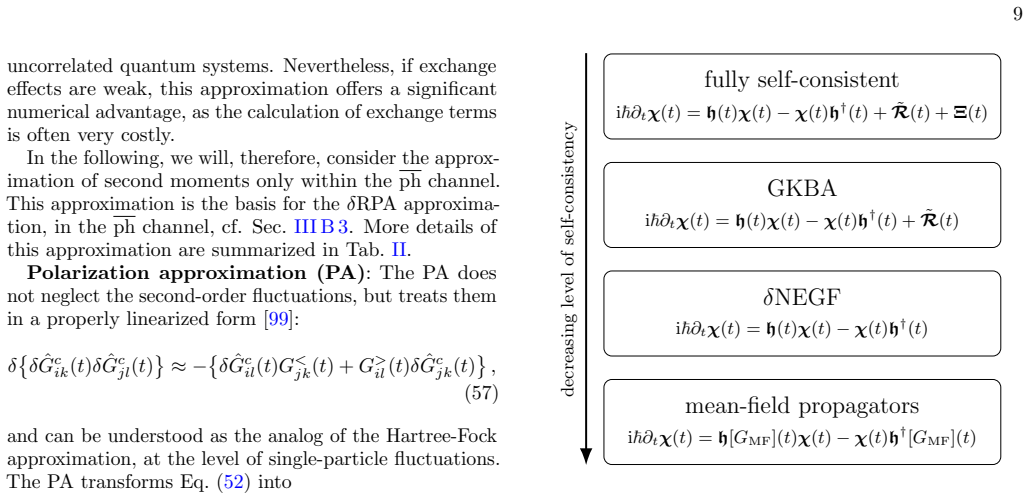
δNEGF represents dynamical two-particle correlations through fluctuations of field-operator products δĜ, which guarantees stable dynamics by preserving positivity of the reduced density matrices, avoids explicit storage of the two-particle Green function, and reduces propagation to a finite ensemble of Hartree-Fock-like trajectories; combined with stochastic low-rank decomposition this retains time-linear scaling and extends GW and T-matrix simulations to Nb∼10^4.
What carries the argument
The quantum-fluctuation formulation that encodes two-particle correlations as fluctuations δĜ of field-operator products, together with stochastic low-rank decomposition.
If this is right
- Dynamical GW and particle-particle or particle-hole T-matrix simulations become feasible for basis sizes up to order 10,000.
- Time propagation remains linear in the number of time steps.
- Stable correlated dynamics are obtained even at strong coupling.
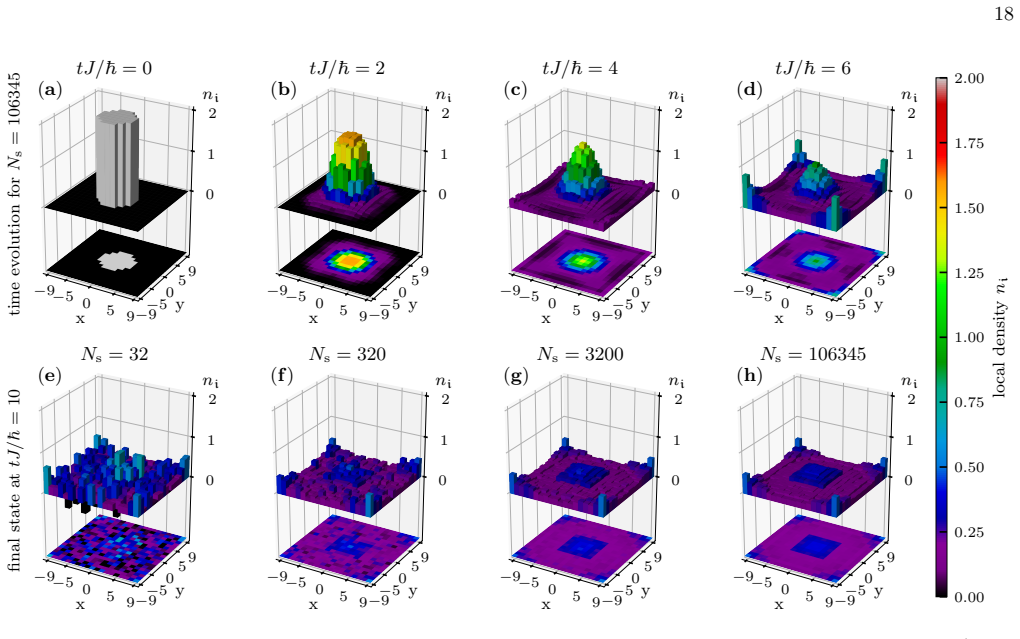
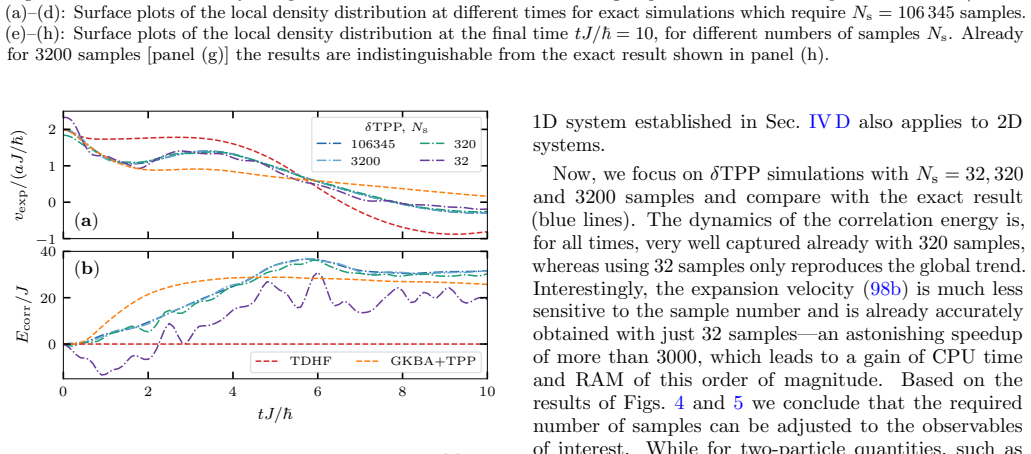
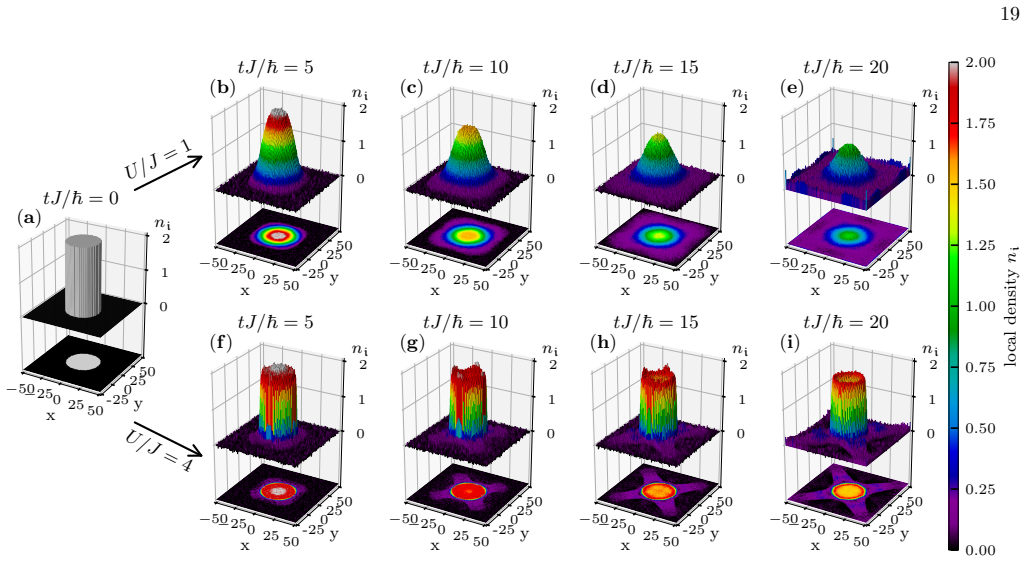
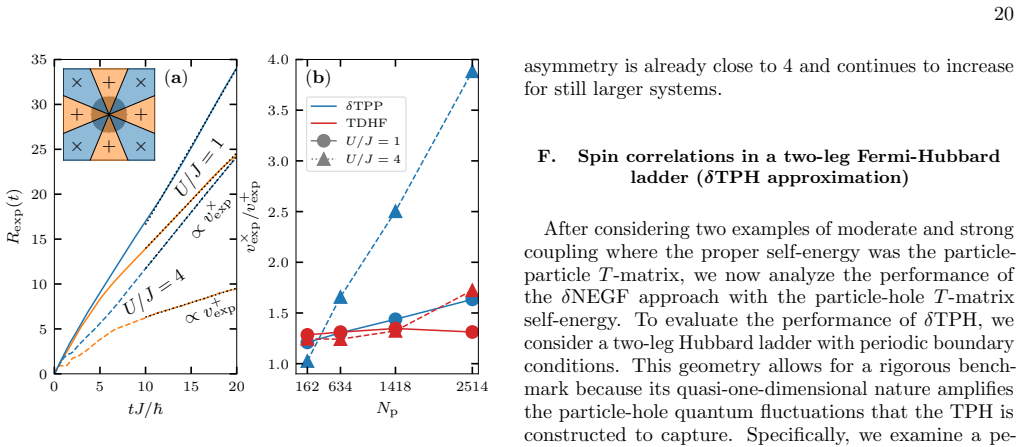
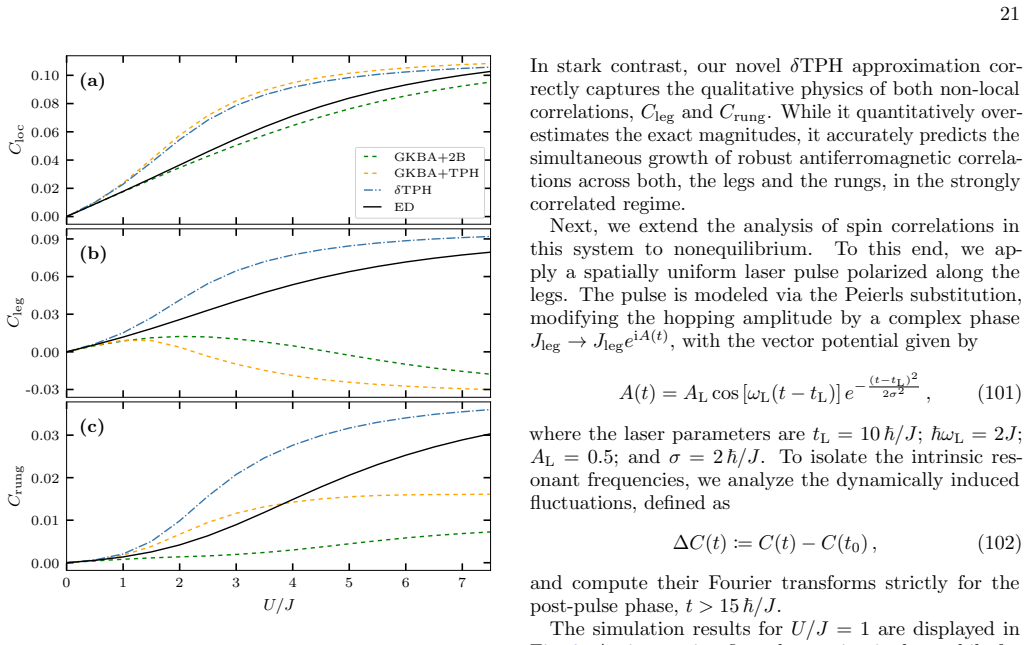
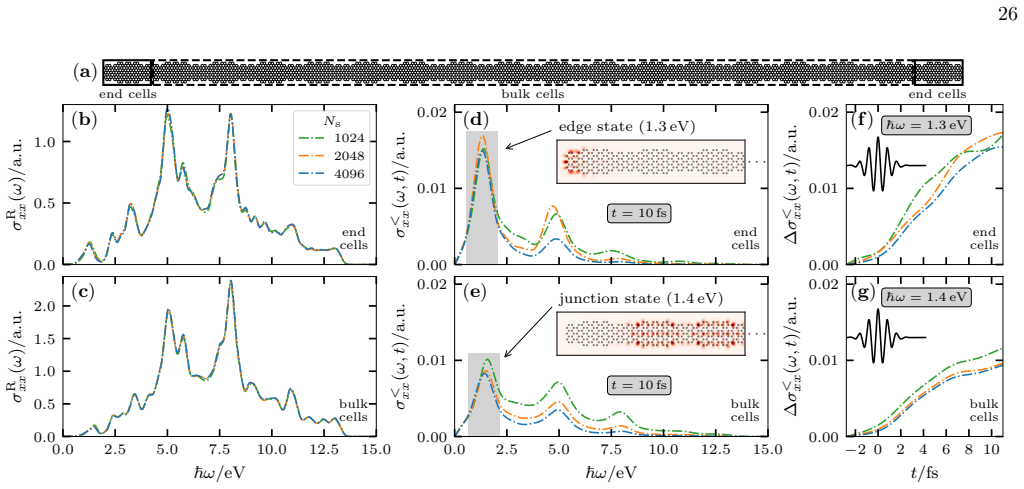
- Large-scale simulations of diffusion in two-dimensional Hubbard lattices and ultrafast relaxation in graphene nanoribbon heterostructures are demonstrated.
Where Pith is reading between the lines
- The positivity-preserving property may allow δNEGF to serve as a stable platform for embedding other self-energy approximations beyond GW and T-matrix.
- The reduction to an ensemble of single-particle trajectories suggests possible hybrid schemes that combine δNEGF with classical or semiclassical sampling methods for even larger systems.
- Extension to three-dimensional or disordered geometries could be tested by applying the same stochastic decomposition to systems with broken translational symmetry.
Load-bearing premise
The representation of two-particle correlations through fluctuations of field-operator products together with the stochastic low-rank decomposition accurately captures the essential dynamical correlations and preserves positivity without significant uncontrolled errors.
What would settle it
A calculation on a lattice system with roughly 1000 basis states at strong coupling where δNEGF results diverge from exact or HF-GKBA benchmarks by more than a few percent in observables such as double occupancy or current.
Figures
read the original abstract
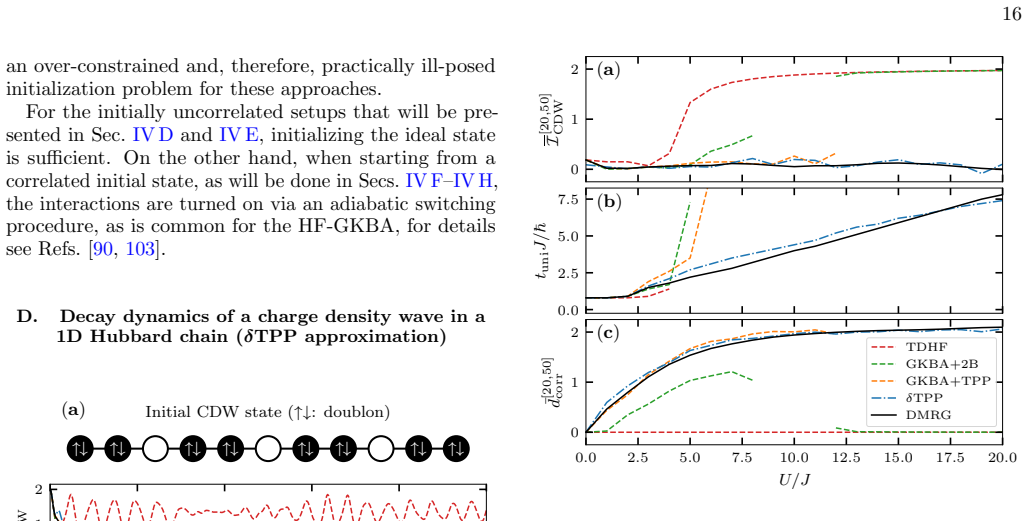
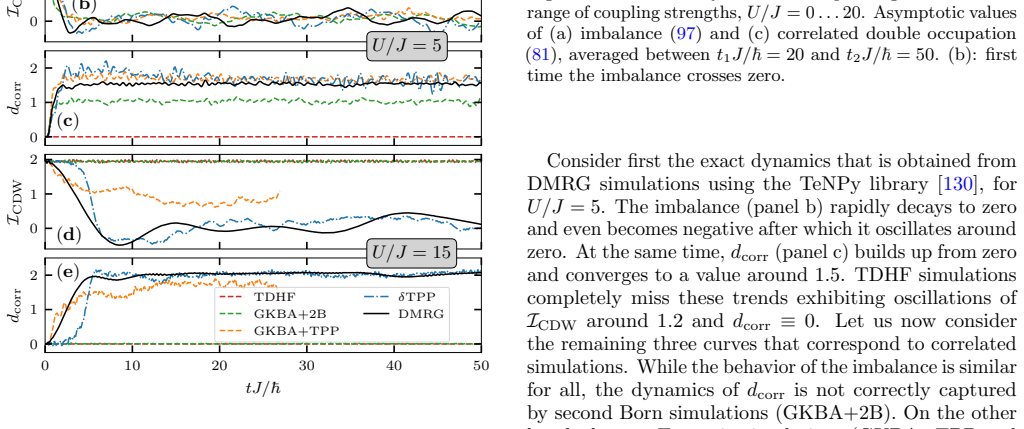
Correlated real-time dynamics in large, spatially inhomogeneous quantum systems remain difficult to access with nonequilibrium many-body methods. Two-time nonequilibrium Green functions (NEGF) retain dynamical correlations but their computational runtime grows cubically with the number of time steps $N_\mathrm{t}$. This scaling bottleneck could recently be overcome by introducing the G1--G2 scheme that is linear in $N_\mathrm{t}$, but requires propagation of a two-particle correlation function and may suffer from numerical instabilities. This has restricted simulations to small systems with $N_\mathrm{b} \sim 10^2$ basis states. Here we introduce a quantum-fluctuation formulation of nonequilibrium Green functions, denoted $\delta$NEGF, that represents dynamical two-particle correlations through fluctuations of field-operator products, $\delta \hat G$. This guarantees stable dynamics by preserving the positivity of the reduced density matrices, avoids the explicit storage of the two-particle Green function, and reduces the propagation to a finite ensemble of Hartree-Fock-like trajectories. Combined with a stochastic low-rank decomposition of the correlation functions, the method retains time-linear scaling while extending dynamical $GW$ and particle-particle and particle-hole $T$-matrix simulations to basis sizes of order $N_\mathrm{b}\sim 10^4$. We benchmark $\delta$NEGF against exact and HF-GKBA results for lattice systems, finding stable correlated dynamics also at strong coupling. We further demonstrate large-scale simulations of diffusion in two-dimensional Hubbard lattices and ultrafast relaxation in graphene nanoribbon heterostructures with long-range Coulomb interactions. These results establish $\delta$NEGF as a scalable route to dynamical self-energy simulations of large, spatially inhomogeneous correlated quantum systems beyond the reach of existing NEGF implementations.
Editorial analysis
A structured set of objections, weighed in public.
Referee Report
Summary. The manuscript introduces δNEGF, a quantum-fluctuation formulation of nonequilibrium Green functions that represents two-particle correlations via fluctuations δĜ of field-operator products. This is claimed to guarantee stable dynamics through positivity preservation of reduced density matrices, avoid explicit two-particle Green function storage, and reduce propagation to an ensemble of Hartree-Fock-like trajectories. Combined with stochastic low-rank decomposition of the correlation functions, the approach retains time-linear scaling and extends dynamical GW and particle-particle/particle-hole T-matrix simulations to Nb∼10^4. Benchmarks against exact and HF-GKBA results on lattice systems are reported to show stable correlated dynamics at strong coupling, with demonstrations on diffusion in 2D Hubbard lattices and ultrafast relaxation in graphene nanoribbon heterostructures.
Significance. If the stochastic low-rank approximation to δĜ preserves positivity and essential dynamical correlations without uncontrolled errors, the method would represent a substantial advance by overcoming the Nb∼10^2 limit of the G1-G2 scheme and enabling scalable NEGF simulations for large inhomogeneous systems. The time-linear scaling and extension to strong coupling are notable strengths.
major comments (2)
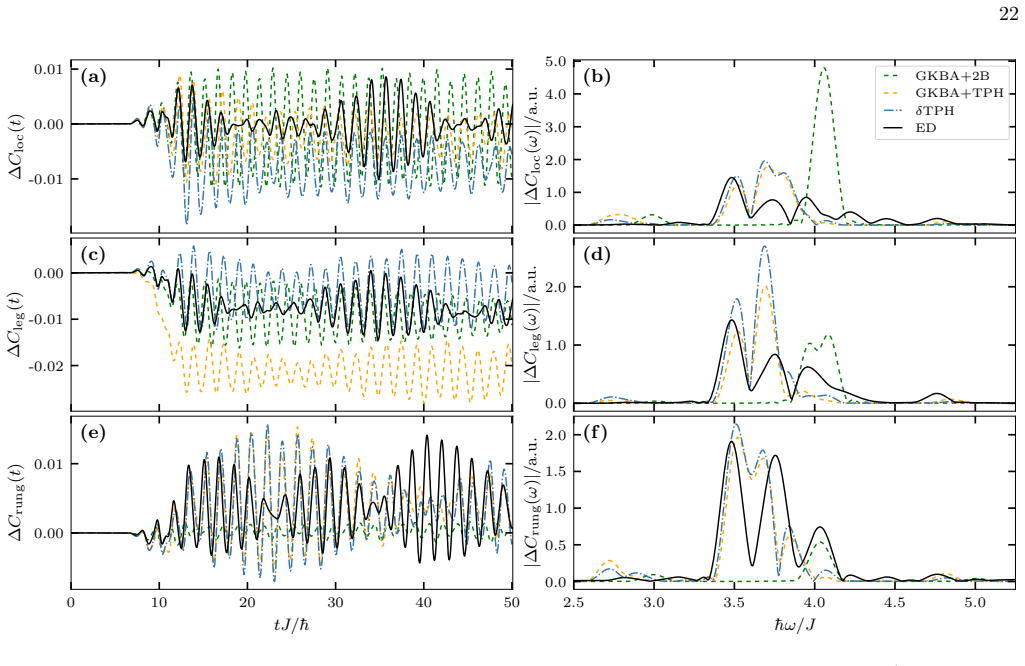
- [Method and benchmarks] The central stability claim rests on the δĜ representation guaranteeing positivity of reduced density matrices even after stochastic low-rank truncation; however, the manuscript provides no explicit derivation or numerical test quantifying positivity violations or truncation errors as a function of rank and Nb in the benchmark comparisons to exact results.
- [Results on lattice systems and applications] The extension to Nb∼10^4 for inhomogeneous systems with long-range interactions is load-bearing for the main result, yet the abstract and reported demonstrations lack quantitative error analysis (e.g., deviation from exact or HF-GKBA data at strong coupling) that would confirm the low-rank decomposition captures the essential two-particle correlations without significant uncontrolled approximations.
minor comments (1)
- [Introduction] Notation for δĜ and the stochastic ensemble should be defined more explicitly at first use to improve readability for readers unfamiliar with fluctuation-based formulations.
Simulated Author's Rebuttal
We thank the referee for their careful reading, positive assessment of the work's significance, and constructive major comments. We address each point below and will implement revisions to strengthen the presentation of the method and results.
read point-by-point responses
-
Referee: [Method and benchmarks] The central stability claim rests on the δĜ representation guaranteeing positivity of reduced density matrices even after stochastic low-rank truncation; however, the manuscript provides no explicit derivation or numerical test quantifying positivity violations or truncation errors as a function of rank and Nb in the benchmark comparisons to exact results.
Authors: We agree that an explicit treatment of positivity under truncation is needed. The exact δĜ dynamics preserve positivity of the reduced density matrices by construction, as the fluctuation operators are defined directly from the full many-body state (see Sec. II). For the stochastic low-rank case we will add a short derivation in the methods section showing the conditions for approximate preservation, together with numerical tests in the benchmarks (new panel or appendix) that report the lowest eigenvalue of the one-particle density matrix versus rank for the lattice systems, directly compared to exact results. This will quantify any violations as a function of rank and Nb. revision: yes
-
Referee: [Results on lattice systems and applications] The extension to Nb∼10^4 for inhomogeneous systems with long-range interactions is load-bearing for the main result, yet the abstract and reported demonstrations lack quantitative error analysis (e.g., deviation from exact or HF-GKBA data at strong coupling) that would confirm the low-rank decomposition captures the essential two-particle correlations without significant uncontrolled approximations.
Authors: The referee correctly notes the value of quantitative error metrics. While the manuscript already shows qualitative stability and agreement with exact/HF-GKBA data for small systems, we will revise the abstract to include a brief statement on observed error magnitudes and add a table or figure panel in the results section reporting relative deviations in observables (density, energy, or correlation functions) versus rank and interaction strength for the benchmark lattices. For the Nb∼10^4 demonstrations we will include rank-convergence checks where feasible. revision: yes
Circularity Check
No significant circularity; new formulation with external benchmarks
full rationale
The paper introduces δNEGF as a distinct quantum-fluctuation representation of two-particle correlations via δĜ fluctuations, explicitly designed to preserve positivity and avoid explicit two-particle Green function storage. It is benchmarked against exact results and HF-GKBA for lattice systems, providing independent validation. The reference to the prior G1-G2 scheme serves only as historical context for the scaling limitation being addressed and is not used to justify the new method's correctness. No self-definitional reductions, fitted inputs renamed as predictions, or load-bearing self-citation chains appear in the derivation chain. The stochastic low-rank decomposition is presented as an additional technical step, not a redefinition of the core claim.
Axiom & Free-Parameter Ledger
invented entities (1)
-
δĜ (fluctuations of field-operator products)
no independent evidence
Reference graph
Works this paper leans on
-
[1]
Symmetries of the generalized susceptibilities Conservation laws are directly linked to symmetries (Noether’s theorems). In NEGF theory conserving approx- imations are linked to symmetries of the two-particle two- time Green function G(2) or of the self-energy [51, 52, 110]: G(2) ijkl(z1, z2, z+ 1 , z+ 2 ) =G (2) jilk(z2, z1, z+ 2 , z+ 1 ).(B1) While most...
-
[2]
Energy conservation in the particle-particle channel We start by considering the particle-particle channel. Here, we do not consider the symmetrized expression given by χc,K for the investigation of energy conservation, as the greater and lesser components χpp,≷ already satisfy the necessary exchange symmetry (B2a). In the particle- particle channel, this...
-
[3]
Energy conservation in the particle-hole channels Next, we consider the particle-hole channels. For com- pleteness, we will, at this point, give the expression for the equations of motion for the generalized susceptibilities in their lowest-order approximations that we have discussed, the approximation of second moments (55): iℏ∂tχc,≷(t) = h0,c(t) +h cor,...
-
[4]
Keimer and J
B. Keimer and J. E. Moore, The physics of quantum materials, Nature Physics13, 1045 (2017)
2017
-
[5]
Dzsaber, D
S. Dzsaber, D. A. Zocco, A. McCollam, F. Weick- ert, R. McDonald, M. Taupin, G. Eguchi, X. Yan, A. Prokofiev, L. M. K. Tang, B. Vlaar, L. E. Winter, M. Jaime, Q. Si, and S. Paschen, Control of electronic topology in a strongly correlated electron system, Nature Communications13, 5729 (2022)
2022
-
[6]
R. A. Hart, P. M. Duarte, T.-L. Yang, X. Liu, T. Paiva, E. Khatami, R. T. Scalettar, N. Trivedi, D. A. Huse, and R. G. Hulet, Observation of antiferromagnetic cor- relations in the hubbard model with ultracold atoms, Nature519, 211 (2015)
2015
-
[7]
Onofrio and L
R. Onofrio and L. Salasnich, Ultracold atoms as strongly correlated systems, inPhysics and Technology of Ultra- cold Atomic Gases(Springer Nature Switzerland, Cham,
-
[8]
Vorberger, F
J. Vorberger, F. Graziani, D. Riley, A. D. Baczewski, I. Baraffe, M. Bethkenhagen, S. Blouin, M. P. B¨ ohme, M. Bonitz, M. Bussmann, A. Casner, W. Cayzac, P. Cel- liers, G. Chabrier, N. Chamel, D. Chapman, M. Chen, J. Clerouin, G. Collins, F. Coppari, T. D¨ oppner, T. Dorn- heim, L. B. Fletcher, D. O. Gericke, S. Glenzer, A. F. Goncharov, G. Gregori, S. H...
2026
-
[9]
Dornheim, S
T. Dornheim, S. Groth, and M. Bonitz, The uniform electron gas at warm dense matter conditions, Phys. Rep. 744, 1 (2018)
2018
-
[10]
Gross, E
F. Gross, E. Klempt, S. J. Brodsky, A. J. Buras, V. D. Burkert, G. Heinrich, K. Jakobs, C. A. Meyer, K. Orginos, M. Strickland,et al., 50 years of quantum chromodynamics, The European Physical Journal C83, 1125 (2023)
2023
-
[11]
Niggas, J
A. Niggas, J. Schwestka, K. Balzer, D. Weichselbaum, N. Schl¨ unzen, R. Heller, S. Creutzburg, H. Inani, M. Tri- pathi, C. Speckmann, N. McEvoy, T. Susi, J. Kotakoski, Z. Gan, A. George, A. Turchanin, M. Bonitz, F. Au- mayr, and R. A. Wilhelm, Ion-Induced Surface Charge Dynamics in Freestanding Monolayers of Graphene and MoS2 Probed by the Emission of Ele...
2022
-
[12]
Schneider, L
U. Schneider, L. Hackerm¨ uller, J. P. Ronzheimer, S. Will, S. Braun, T. Best, I. Bloch, E. Demler, S. Mandt, D. Rasch, and A. Rosch, Fermionic transport and out-of- equilibrium dynamics in a homogeneous Hubbard model with ultracold atoms, Nat. Phys.8, 213 (2012)
2012
-
[13]
Schl¨ unzen, S
N. Schl¨ unzen, S. Hermanns, M. Bonitz, and C. Verdozzi, Dynamics of strongly correlated fermions:Ab initiore- sults for two and three dimensions, Phys. Rev. B93, 035107 (2016)
2016
-
[14]
Schl¨ unzen and M
N. Schl¨ unzen and M. Bonitz, Nonequilibrium Green Functions Approach to Strongly Correlated Fermions in Lattice Systems, Contrib. Plasma Phys.56, 5 (2016)
2016
-
[15]
Lisowski, P
M. Lisowski, P. A. Loukakos, A. Melnikov, I. Radu, L. Ungureanu, M. Wolf, and U. Bovensiepen, Femtosec- ond electron and spin dynamics in gd(0001) studied by time-resolved photoemission and magneto-optics, Phys. Rev. Lett.95, 137402 (2005)
2005
-
[16]
A. L. Cavalieri, N. M¨ uller, T. Uphues, V. S. Yakovlev, A. Baltuˇ ska, B. Horvath, B. Schmidt, L. Bl¨ umel, R. Holzwarth, S. Hendel, M. Drescher, U. Kleineberg, P. M. Echenique, R. Kienberger, F. Krausz, and U. Heinz- mann, Attosecond spectroscopy in condensed matter, Nature449, 1029 (2007)
2007
-
[17]
Sch¨ utte, S
B. Sch¨ utte, S. Bauch, U. Fr¨ uhling, M. Wieland, M. Gen- sch, E. Pl¨ onjes, T. Gaumnitz, A. Azima, M. Bonitz, and M. Drescher, Evidence for chirped Auger-electron emission, Phys. Rev. Lett.108, 253003 (2012)
2012
-
[18]
de la Torre, D
A. de la Torre, D. M. Kennes, M. Claassen, S. Gerber, J. W. McIver, and M. A. Sentef, Colloquium: Nonther- mal pathways to ultrafast control in quantum materials, Rev. Mod. Phys.93, 041002 (2021)
2021
-
[19]
Joost and M
J.-P. Joost and M. Bonitz, Ultrafast charge separation induced by a uniform field in graphene nanoribbons, Phys. Rev. Res.7, L032068 (2025)
2025
-
[20]
Y. Li, E. Rojas-Gatjens, Y. Guo, B. Yang, D. Sun, L. Holtzman, J. Oh, K. Barmak, C. R. Dean, J. C. Hone, N. Gabor, E. A. Arsenault, and X. Zhu, Pho- toinduced Metal-to-Insulator Transitions in 2D Moir´ e Devices, Phys. Rev. Lett.136, 206502 (2026)
2026
-
[21]
D. Fausti, R. I. Tobey, N. Dean, S. Kaiser, A. Dienst, M. C. Hoffmann, S. Pyon, T. Takayama, H. Takagi, and A. Cavalleri, Light-induced superconductivity in a stripe-ordered cuprate, Science331, 189 (2011), https://www.science.org/doi/pdf/10.1126/science.1197294
-
[22]
Buzzi, D
M. Buzzi, D. Nicoletti, M. Fechner, N. Tancogne-Dejean, M. A. Sentef, A. Georges, T. Biesner, E. Uykur, M. Dres- sel, A. Henderson, T. Siegrist, J. A. Schlueter, K. Miya- gawa, K. Kanoda, M.-S. Nam, A. Ardavan, J. Coulthard, J. Tindall, F. Schlawin, D. Jaksch, and A. Cavalleri, Pho- tomolecular high-temperature superconductivity, Phys. Rev. X10, 031028 (2020)
2020
-
[23]
J. W. McIver, B. Schulte, F.-U. Stein, T. Matsuyama, G. Jotzu, G. Meier, and A. Cavalleri, Light-induced anomalous Hall effect in graphene, Nat. Phys.16, 38 (2020)
2020
-
[24]
A. S. Disa, J. Curtis, M. Fechner, A. Liu, A. von Hoegen, M. F¨ orst, T. F. Nova, P. Narang, A. Maljuk, A. V. Boris, B. Keimer, and A. Cavalleri, Photo-induced high- temperature ferromagnetism in ytio3, Nature617, 73 (2023)
2023
-
[25]
Caruso, M
F. Caruso, M. A. Sentef, C. Attaccalite, M. Bonitz, C. Draxl, U. De Giovannini, M. Eckstein, R. Ernstor- fer, M. Fechner, M. Gr¨ uning, H. H¨ ubener, J.-P. Joost, D. M. Juraschek, C. Karrasch, D. M. Kennes, S. Latini, I.-T. Lu, O. Neufeld, E. Perfetto, L. Rettig, R. R. Pela, A. Rubio, J. F. Rudzinski, M. Ruggenthaler, D. San- galli, M. Sch¨ uler, S. Shall...
2025
-
[26]
J.-P. Joost, A.-P. Jauho, and M. Bonitz, Correlated topological states in graphene nanoribbon heterostruc- tures, Nano Letters19, 9045 (2019), pMID: 31735027, https://doi.org/10.1021/acs.nanolett.9b04075
-
[27]
Liu and M
X. Liu and M. C. Hersam, 2d materials for quantum information science, Nature Reviews Materials4, 669 (2019)
2019
-
[28]
Wolfowicz, F
G. Wolfowicz, F. J. Heremans, C. P. Anderson, S. Kanai, H. Seo, A. Gali, G. Galli, and D. D. Awschalom, Quan- tum guidelines for solid-state spin defects, Nature Re- views Materials6, 906 (2021)
2021
-
[29]
F. Calegari, D. Ayuso, A. Trabattoni, L. Belshaw, S. D. Camillis, S. Anumula, F. Frassetto, L. Poletto, A. Palacios, P. Decleva, J. B. Greenwood, F. Mart´ ın, and M. Nisoli, Ultrafast electron dynamics in phenylalanine initiated by attosecond pulses, Science346, 336 (2014), https://www.science.org/doi/pdf/10.1126/science.1254061
-
[30]
H. J. W¨ orner, C. A. Arrell, N. Banerji, A. Cannizzo, M. Chergui, A. K. Das, P. Hamm, U. Keller, P. M. Kraus, E. Liberatore, P. Lopez-Tarifa, M. Lucchini, M. Meuwly, C. Milne, J.-E. Moser, U. Rothlisberger, G. Smolent- sev, J. Teuscher, J. A. van Bokhoven, and O. Wenger, Charge migration and charge transfer in molecular sys- tems, Structural Dynamics4, 0...
2017
-
[31]
Nisoli, P
M. Nisoli, P. Decleva, F. Calegari, A. Palacios, and F. Mart´ ın, Attosecond electron dynamics in molecules, Chemical Reviews117, 10760 (2017)
2017
-
[32]
A. Palacios and F. Mart´ ın, The quantum chemistry of attosecond molecular science, WIREs Com- putational Molecular Science10, e1430 (2020), https://wires.onlinelibrary.wiley.com/doi/pdf/10.1002/wcms.1430
-
[33]
Calegari and F
F. Calegari and F. Mart´ ın, Open questions in attochem- istry, Communications Chemistry6, 184 (2023)
2023
-
[34]
F¨ ohlisch, P
A. F¨ ohlisch, P. Feulner, F. Hennies, A. Fink, D. Menzel, D. Sanchez-Portal, P. M. Echenique, and W. Wurth, Direct observation of electron dynamics in the attosecond domain, Nature436, 373 (2005)
2005
-
[35]
C. D. Lindstrom and X.-Y. Zhu, Photoinduced electron transfer at molecule–metal interfaces, Chemical Reviews 106, 4281 (2006)
2006
-
[36]
R. D. Mui˜ no, D. S´ anchez-Portal, V. M. Silkin, E. V. Chulkov, and P. M. Echenique, Time-dependent electron phenomena at surfaces, Proceedings of the National Academy of Sciences108, 971 (2011), https://www.pnas.org/doi/pdf/10.1073/pnas.1008517107
-
[37]
Aguilar-Galindo, A
F. Aguilar-Galindo, A. G. Borisov, and S. D´ ıaz-Tendero, Ultrafast dynamics of electronic resonances in molecules adsorbed on metal surfaces: A wave packet propagation approach, Journal of Chemical Theory and Computation 17, 639 (2021)
2021
-
[38]
Inzani and M
G. Inzani and M. Lucchini, Attosecond electron dynamics in solid-state systems, Journal of Physics: Photonics7, 022001 (2025)
2025
-
[39]
X. Hong, J. Kim, S.-F. Shi, Y. Zhang, C. Jin, Y. Sun, S. Tongay, J. Wu, Y. Zhang, and F. Wang, Ultrafast charge transfer in atomically thin mos2/ws2 heterostruc- tures, Nature Nanotechnology9, 682 (2014)
2014
-
[40]
C. Jin, E. Y. Ma, O. Karni, E. C. Regan, F. Wang, and T. F. Heinz, Ultrafast dynamics in van der waals heterostructures, Nature Nanotechnology13, 994 (2018)
2018
-
[41]
Rivera, H
P. Rivera, H. Yu, K. L. Seyler, N. P. Wilson, W. Yao, and X. Xu, Interlayer valley excitons in heterobilayers of transition metal dichalcogenides, Nature Nanotechnology 13, 1004 (2018)
2018
-
[42]
Cederbaum and J
L. Cederbaum and J. Zobeley, Ultrafast charge migration by electron correlation, Chemical Physics Letters307, 205 (1999)
1999
-
[43]
Calegari, A
F. Calegari, A. Trabattoni, A. Palacios, D. Ayuso, M. C. Castrovilli, J. B. Greenwood, P. Decleva, F. Mart´ ın, and M. Nisoli, Charge migration induced by attosec- ond pulses in bio-relevant molecules, Journal of Physics B: Atomic, Molecular and Optical Physics49, 142001 (2016)
2016
-
[44]
Ovesen, S
S. Ovesen, S. Brem, C. Linder¨ alv, M. Kuisma, T. Korn, P. Erhart, M. Selig, and E. Malic, Interlayer exciton dynamics in van der waals heterostructures, Communi- cations Physics2, 23 (2019)
2019
-
[45]
Balzer and M
K. Balzer and M. Bonitz,Nonequilibrium Green’s Func- tions Approach to Inhomogeneous Systems(Springer, Berlin Heidelberg, 2013)
2013
-
[46]
X. Li, N. Govind, C. Isborn, A. E. DePrince III, and K. Lopata, Real-time time-dependent electronic struc- ture theory, Chemical Reviews120, 9951 (2020)
2020
-
[47]
Tancogne-Dejean, M
N. Tancogne-Dejean, M. J. T. Oliveira, X. Andrade, H. Appel, C. H. Borca, G. Le Breton, F. Buchholz, A. Castro, S. Corni, A. A. Correa, U. De Giovannini, A. Delgado, F. G. Eich, J. Flick, G. Gil, A. Gomez, N. Helbig, H. H¨ ubener, R. Jest¨ adt, J. Jornet-Somoza, A. H. Larsen, I. V. Lebedeva, M. L¨ uders, M. A. L. Mar- ques, S. T. Ohlmann, S. Pipolo, M. Ra...
2020
-
[48]
H. Wang, J. Bang, Y. Sun, L. Liang, D. West, V. Meu- nier, and S. Zhang, The role of collective motion in the ultrafast charge transfer in van der waals heterostruc- tures, Nature Communications7, 11504 (2016)
2016
-
[49]
S. Biswas, A. Trabattoni, P. Rupp, M. Magrakvelidze, M. E.-A. Madjet, U. D. Giovannini, M. C. Castrovilli, M. Galli, Q. Liu, E. P. M˚ ansson, J. Sch¨ otz, V. Wanie, P. Wnuk, L. Colaizzi, D. Mocci, M. Reduzzi, M. Lucchini, M. Nisoli, A. Rubio, H. S. Chakraborty, M. F. Kling, and F. Calegari, Correlation-driven attosecond photoemis- sion delay in the plasmo...
-
[50]
Guiot du Doignon, R
C. Guiot du Doignon, R. Sinha-Roy, F. Rabilloud, and V. Despr´ e, Correlation-driven charge migration triggered by infrared multi-photon ionization, Chemical Science 16, 16729 (2025)
2025
-
[51]
N. T. Maitra, Double and charge-transfer excitations in time-dependent density functional theory, Annual Review of Physical Chemistry73, 117 (2022)
2022
-
[52]
Lacombe and N
L. Lacombe and N. T. Maitra, Non-adiabatic approx- imations in time-dependent density functional theory: progress and prospects, npj Computational Materials9, 124 (2023)
2023
-
[53]
L. V. Keldysh, Diagram technique for nonequilibrium processes, Zh. Eksp. Teor. Fiz.47, 1515 (1964)
1964
-
[54]
L. P. Kadanoff and G. Baym,Quantum Statistical Mechanics: Green’s Function Methods in Equilibrium and Nonequilibrium Problems(CRC Press, Boca Raton, 1962)
1962
-
[55]
Stefanucci and R
G. Stefanucci and R. v. Leeuwen,Nonequilibrium Many- Body Theory of Quantum Systems: A Modern Introduc- 34 tion(Cambridge University Press, 2013)
2013
-
[56]
Bonitz, R
M. Bonitz, R. Nareyka, and D. S. (eds.),Progress in Nonequilibrium Green’s Functions: Proceedings of the Conference ”Kadanoff-Baym Equations: Progress and Perspectives for Many-body Physics”, Rostock, Germany, 20-24 September 1999(World Scientific Publ., Singapore, 2000)
1999
-
[57]
Bonitz and D
M. Bonitz and D. S. (eds.),Progress in Nonequilibrium Green’s Functions II(World Scientific, Singapore, 2003)
2003
-
[58]
Stefanucci, A
G. Stefanucci, A. Marini, and S. Bellucci, Non- equilibrium green’s functions, physica status solidi (b) 256, 1900335 (2019)
2019
-
[59]
H. U. Strand, C. Verdozzi, and M. Bonitz, Progress in Non-equilibrium Green’s Functions VIII (PNGF VIII), phys. stat. sol. (b)261, 2400341 (2024)
2024
-
[60]
K¨ ohler, N
H. K¨ ohler, N. Kwong, and H. A. Yousif, A fortran code for solving the kadanoff–baym equations for a homoge- neous fermion system, Computer Physics Communica- tions123, 123 (1999)
1999
-
[61]
Sch¨ uler, D
M. Sch¨ uler, D. Goleˇ z, Y. Murakami, N. Bittner, A. Her- rmann, H. U. Strand, P. Werner, and M. Eckstein, Nessi: The non-equilibrium systems simulation package, Com- puter Physics Communications257, 107484 (2020)
2020
-
[62]
Marini, C
A. Marini, C. Hogan, M. Gr¨ uning, and D. Varsano, yambo: An ab initio tool for excited state calculations, Comput. Phys. Commun.180, 1392 (2009)
2009
-
[63]
N. E. Dahlen and R. van Leeuwen, Solving the Kadanoff- Baym Equations for Inhomogeneous Systems: Appli- cation to Atoms and Molecules, Phys. Rev. Lett.98, 153004 (2007)
2007
-
[64]
A. Stan, N. E. Dahlen, and R. van Leeuwen, Time prop- agation of the kadanoff–baym equations for inhomoge- neous systems, The Journal of Chemical Physics130, 224101 (2009)
2009
-
[65]
M. P. von Friesen, C. Verdozzi, and C.-O. Almbladh, Successes and Failures of Kadanoff-Baym Dynamics in Hubbard Nanoclusters, Phys. Rev. Lett.103, 176404 (2009)
2009
-
[66]
Balzer, M
K. Balzer, M. R. Rasmussen, N. Schl¨ unzen, J.-P. Joost, and M. Bonitz, Doublon Formation by Ions Impacting a Strongly Correlated Finite Lattice System, Phys. Rev. Lett.121, 267602 (2018)
2018
-
[67]
Joost, N
J.-P. Joost, N. Schl¨ unzen, and M. Bonitz, Femtosec- ond Electron Dynamics in Graphene Nanoribbons – A Nonequilibrium Green Functions Approach Within an Extended Hubbard Model, Phys. Status Solidi B256, 1800498 (2019)
2019
-
[68]
Joost, N
J.-P. Joost, N. Schl¨ unzen, S. Hese, M. Bonitz, C. Ver- dozzi, P. Schmitteckert, and M. Hopjan, L¨ owdin’s symmetry dilemma within Green functions theory for the one-dimensional Hubbard model, Contributions to Plasma Physics61, e202000220 (2021), e202000220 ctpp.202000220
2021
-
[69]
Schl¨ unzen, J.-P
N. Schl¨ unzen, J.-P. Joost, and M. Bonitz, Achieving the Scaling Limit for Nonequilibrium Green Functions Simulations, Phys. Rev. Lett.124, 076601 (2020)
2020
-
[70]
Lipavsk´ y, V.ˇSpiˇ cka, and B
P. Lipavsk´ y, V.ˇSpiˇ cka, and B. Velick´ y, Generalized Kadanoff-Baym ansatz for deriving quantum transport equations, Phys. Rev. B34, 6933 (1986)
1986
-
[71]
Joost, N
J.-P. Joost, N. Schl¨ unzen, and M. Bonitz, G1-G2 scheme: Dramatic acceleration of nonequilibrium Green func- tions simulations within the Hartree-Fock generalized Kadanoff-Baym ansatz, Phys. Rev. B101, 245101 (2020)
2020
-
[72]
Joost, N
J.-P. Joost, N. Schl¨ unzen, H. Ohldag, M. Bonitz, F. Lack- ner, and I. Brezinova, The dynamically screened ladder approximation: Simultaneous treatment of strong elec- tronic correlations and dynamical screening out of equi- librium, Phys. Rev. B105, 165155 (2022)
2022
-
[73]
Donsa, F
S. Donsa, F. Lackner, J. Burgd¨ orfer, M. Bonitz, B. Kloss, A. Rubio, and I. Brezinova, Non-Equilibrium correlation dynamics in the one-dimensional Fermi-Hubbard model: A testbed for the two-particle reduced density matrix theory, Phys. Rev. Research5, 033022 (2023)
2023
-
[74]
Pavlyukh, R
Y. Pavlyukh, R. Tuovinen, E. Perfetto, and G. Stefanucci, Cheers: A Linear-Scaling KBE+GKBA Code, physica status solidi (b)261, 2300504 (2024)
2024
-
[75]
Borkowski, N
L. Borkowski, N. Schl¨ unzen, J.-P. Joost, F. Reiser, and M. Bonitz, Doublon production in correlated materials by multiple ion impacts, physica status solidi (b)259, 2100511 (2022)
2022
-
[76]
Lovato, M
G. Lovato, M. Bonitz, K. Balzer, F. Caruso, and J.-P. Joost, Electronic correlation effects in the response of graphene and MoS 2 monolayers to the impact of highly- charged ions, phys. stat. sol. (b) , e202500458 (2025)
2025
-
[77]
Tuovinen, Y
R. Tuovinen, Y. Pavlyukh, E. Perfetto, and G. Stefanucci, Time-linear quantum transport simulations with corre- lated nonequilibrium green’s functions, Phys. Rev. Lett. 130, 246301 (2023)
2023
-
[78]
Balzer, N
K. Balzer, N. Schl¨ unzen, H. Ohldag, J.-P. Joost, and M. Bonitz, Accelerating nonequilibrium Green function simulations with embedding self-energies, Phys. Rev. B 107, 155141 (2023)
2023
-
[79]
Cosco, R
F. Cosco, R. Tuovinen, and N. Lo Gullo, Interacting Electrons in a Flat-Band System within the Generalized Kadanoff–Baym Ansatz, physica status solidi (b)261, 2300561 (2024)
2024
-
[80]
Pavlyukh and R
Y. Pavlyukh and R. Tuovinen, Open system dynamics in linear time beyond the wide-band limit, Phys. Rev. B 111, L241101 (2025)
2025
discussion (0)
Sign in with ORCID, Apple, or X to comment. Anyone can read and Pith papers without signing in.