Enhanced nondipole momentum offsets in triple ionization of atoms driven by mid-infrared laser fields
Pith reviewed 2026-06-27 10:56 UTC · model grok-4.3
The pith
In triple ionization of neon by mid-infrared lasers, a positive momentum offset along the propagation direction increases with wavelength due to magnetic field effects on bound electrons.
A machine-rendered reading of the paper's core claim, the machinery that carries it, and where it could break.
Core claim
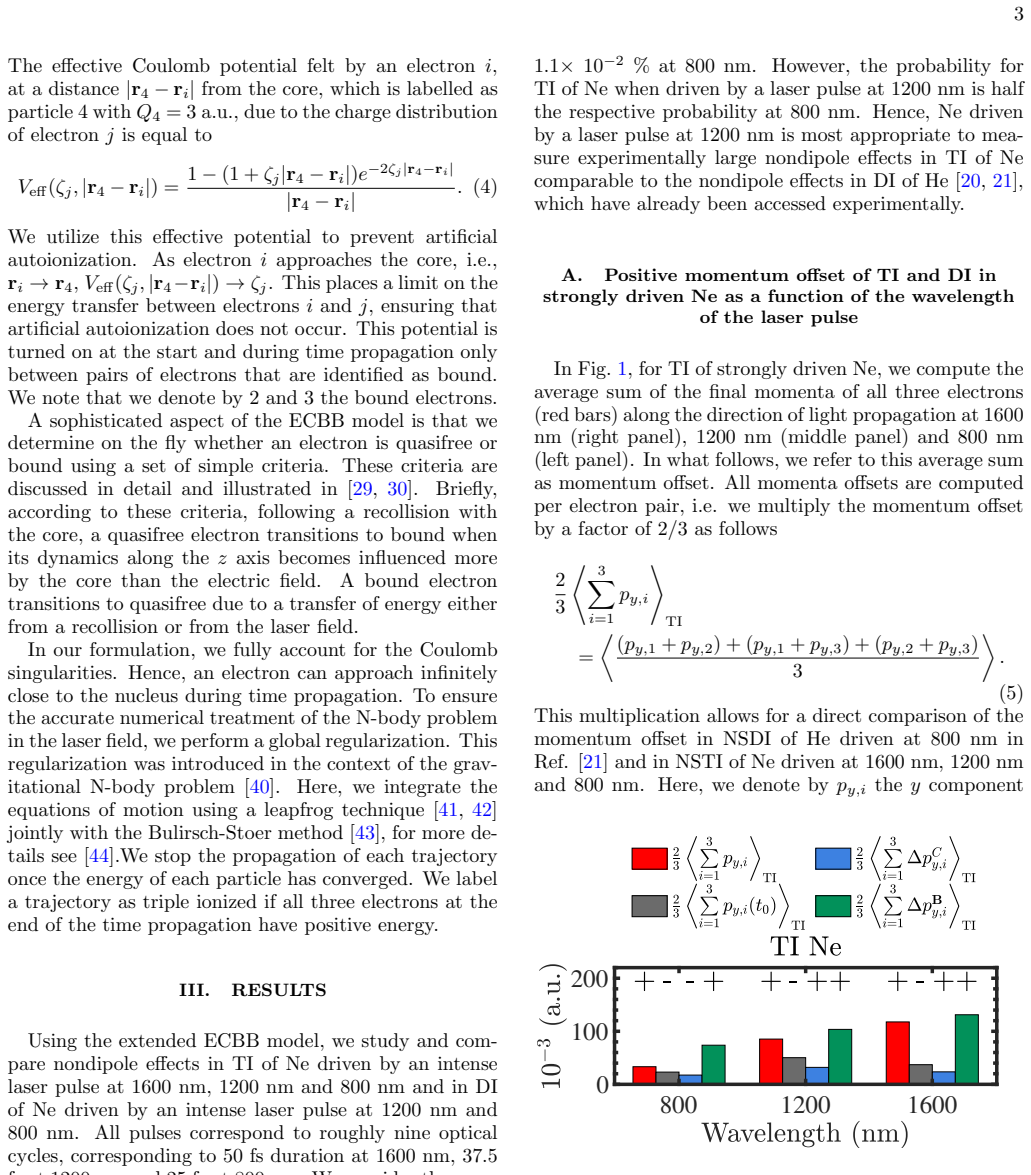
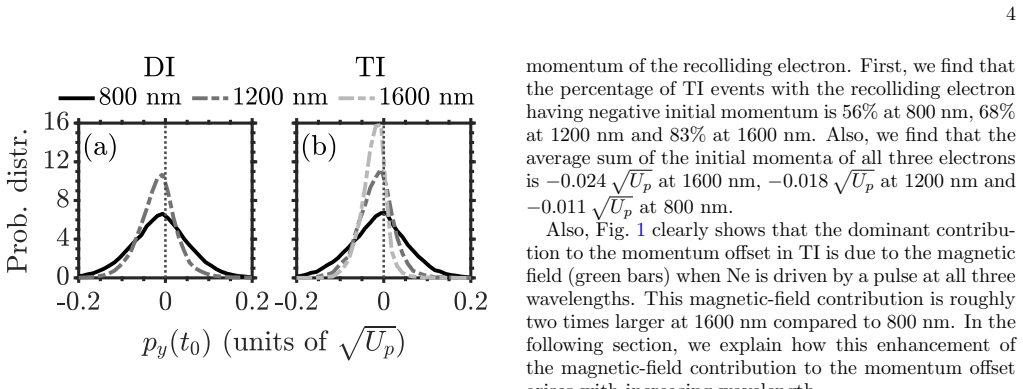
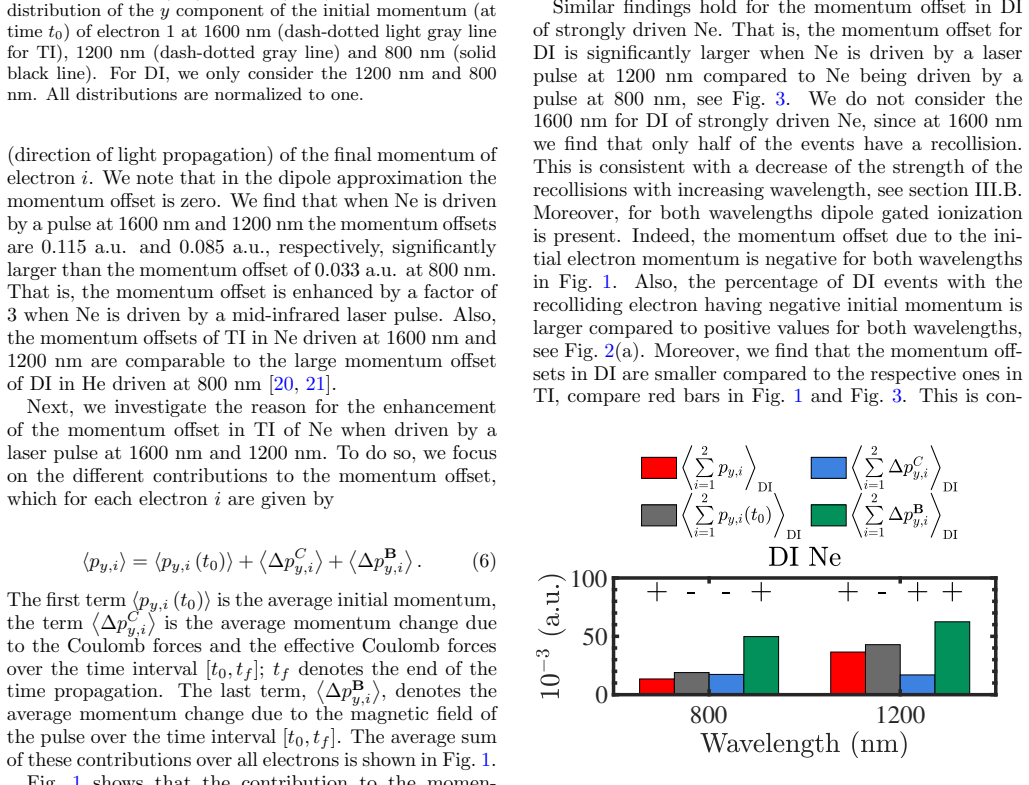
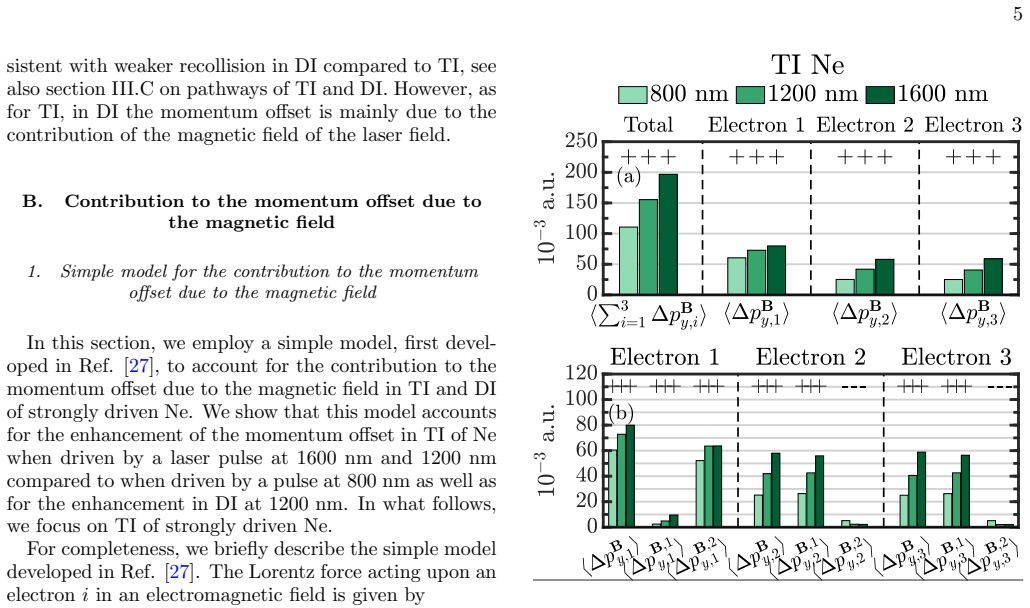
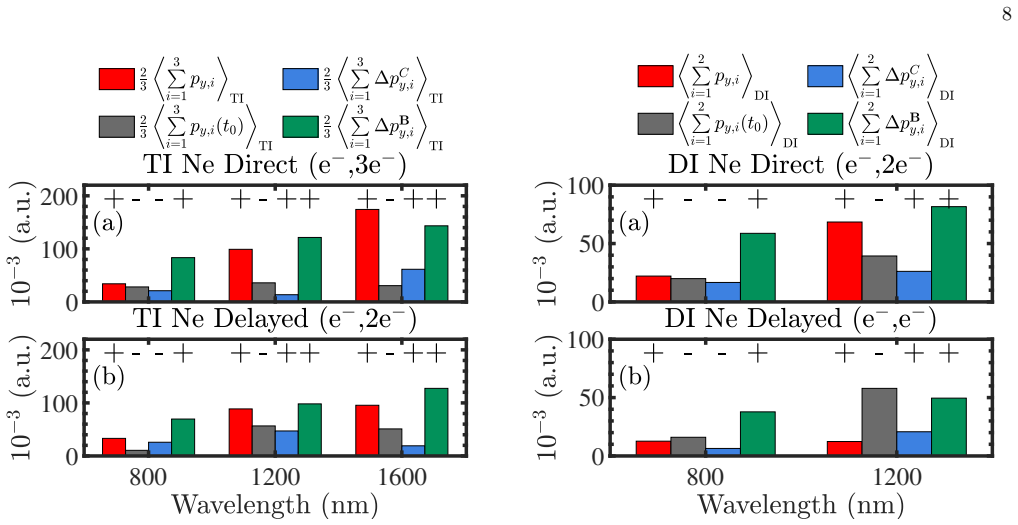
We find in triple ionization of strongly driven Ne a large positive average momentum offset along the direction of laser propagation, which vanishes in the dipole approximation. This positive momentum offset significantly increases with increasing wavelength of the laser pulse. This increase is present for all triple ionization events as well as for the main direct and delayed pathways of triple ionization. We attribute the increase of the momentum offset to the contribution of the effect of the magnetic field of the laser pulse on the bound electrons. This contribution counterbalances the decrease in the strength of the recollisions with increasing wavelength.
What carries the argument
Three-dimensional semiclassical model that fully accounts for nondipole effects together with the Coulomb singularity in the electron-core interaction, revealing the magnetic field contribution on bound electrons.
If this is right
- The momentum offset is observed in all triple ionization events and in both direct and delayed pathways.
- The offset grows with wavelength for every pathway considered.
- 1200 nm offers an ideal wavelength for experimentally measuring the momentum offset associated with correlated three-electron escape.
Where Pith is reading between the lines
- Similar wavelength-dependent nondipole effects may appear in other multi-electron ionization processes in strong fields.
- Extending the model to other atomic species could test whether the magnetic field mechanism is general.
- Experimental data at 1200 nm could provide a benchmark for semiclassical treatments of nondipole strong-field dynamics.
Load-bearing premise
The three-dimensional semiclassical model fully and accurately accounts for nondipole effects and the increase in offset with wavelength is caused by the magnetic-field contribution on bound electrons rather than by other unmodeled mechanisms.
What would settle it
An experimental measurement of the average momentum offset in triple ionization of Ne at wavelengths from 800 nm to 2000 nm that fails to show a significant increase would contradict the claim.
Figures

read the original abstract
We investigate the dependence on wavelength of nondipole effects in triple ionization of Ne driven by intense infrared and mid-infrared laser pulses using a three-dimensional semiclassical model that fully accounts for nondipole effects and the Coulomb singularity in the electron-core interaction. We find in triple ionization of strongly driven Ne a large positive average momentum offset along the direction of laser propagation, which vanishes in the dipole approximation. This positive momentum offset significantly increases with increasing wavelength of the laser pulse. This increase is present for all triple ionization events as well as for the main direct and delayed pathways of triple ionization. We attribute the increase of the momentum offset to the contribution of the effect of the magnetic field of the laser pulse on the bound electrons. This contribution counterbalances the decrease in the strength of the recollisions with increasing wavelength. We find that 1200 nm is an ideal wavelength for experimentally measuring the momentum offset related to correlated three-electron escape.
Editorial analysis
A structured set of objections, weighed in public.
Referee Report
Summary. The manuscript investigates nondipole effects in triple ionization of neon using a three-dimensional semiclassical model that incorporates the full nondipole vector potential and the Coulomb singularity. It reports a large positive average momentum offset along the laser propagation direction that vanishes under the dipole approximation, increases significantly with laser wavelength (present in all pathways and the main direct/delayed channels), and attributes this wavelength dependence to the magnetic-field component acting on initially bound electrons, which counterbalances weaker recollisions at longer wavelengths. The work identifies 1200 nm as optimal for experimental measurement of the offset.
Significance. If the central attribution is substantiated, the result would provide concrete evidence that nondipole magnetic effects on bound electrons become measurable in multi-electron strong-field ionization at mid-IR wavelengths, offering a falsifiable prediction for experiments and extending understanding of propagation-direction momentum shifts beyond single-electron or dipole treatments.
major comments (2)
- [Abstract, §4 (pathway analysis)] Abstract and the discussion of pathway decomposition: the claim that the wavelength-dependent rise in offset is caused by the magnetic field acting on bound electrons (counterbalancing recollision weakening) is not isolated by any controlled comparison. The model evolves trajectories with the full nondipole vector potential, yet no runs are reported with the B-field term disabled selectively on bound electrons (or only after ionization) to demonstrate that this specific contribution, rather than other nondipole corrections or classical recollision modeling, drives the observed increase.
- [§2 (model description)] Model validation section: the three-dimensional semiclassical treatment is asserted to fully account for nondipole effects together with the Coulomb singularity, but no quantitative benchmarks against exact quantum or TDSE results for the momentum offset (or its wavelength scaling) are provided; without such validation the attribution remains dependent on untested aspects of the classical propagation and initial-condition sampling.
minor comments (2)
- [Figures 3-5] Figure captions and axis labels should explicitly state whether the reported offsets are averaged over all events or conditioned on specific pathways.
- [Conclusion] The statement that 1200 nm is 'ideal' for measurement would benefit from a brief quantitative estimate of the expected offset magnitude relative to typical experimental momentum resolution.
Simulated Author's Rebuttal
We thank the referee for the careful reading and constructive comments on our manuscript. We address each major comment below.
read point-by-point responses
-
Referee: [Abstract, §4 (pathway analysis)] Abstract and the discussion of pathway decomposition: the claim that the wavelength-dependent rise in offset is caused by the magnetic field acting on bound electrons (counterbalancing recollision weakening) is not isolated by any controlled comparison. The model evolves trajectories with the full nondipole vector potential, yet no runs are reported with the B-field term disabled selectively on bound electrons (or only after ionization) to demonstrate that this specific contribution, rather than other nondipole corrections or classical recollision modeling, drives the observed increase.
Authors: We agree that a controlled numerical experiment disabling the magnetic-field term selectively on bound electrons would strengthen the attribution of the wavelength dependence. In the revised manuscript we will report additional trajectory ensembles with this term switched off for initially bound electrons (while retaining all other nondipole corrections) and show that the positive offset and its wavelength scaling disappear, thereby isolating the claimed mechanism. revision: yes
-
Referee: [§2 (model description)] Model validation section: the three-dimensional semiclassical treatment is asserted to fully account for nondipole effects together with the Coulomb singularity, but no quantitative benchmarks against exact quantum or TDSE results for the momentum offset (or its wavelength scaling) are provided; without such validation the attribution remains dependent on untested aspects of the classical propagation and initial-condition sampling.
Authors: We acknowledge that direct, quantitative TDSE benchmarks for the propagation-direction momentum offset in triple ionization at mid-IR wavelengths are absent. Full three-electron TDSE calculations at these wavelengths remain computationally prohibitive. The semiclassical model employed here has been validated against available quantum results for single- and double-ionization momentum distributions in earlier works; we will expand §2 to cite these validations explicitly and to discuss the limitations of the classical treatment for the present observable. revision: partial
Circularity Check
No circularity: results emerge from semiclassical trajectory integration
full rationale
The reported positive momentum offset and its wavelength dependence are outputs of numerical integration in a 3D semiclassical model that evolves electrons under the full nondipole vector potential plus Coulomb interaction. No equation defines the offset in terms of itself, no parameter is fitted to the offset and then re-predicted, and no load-bearing claim rests on a self-citation chain. The attribution to magnetic-field action on bound electrons is an interpretive post-processing step rather than a definitional reduction, leaving the central numerical finding self-contained against external benchmarks.
Axiom & Free-Parameter Ledger
Reference graph
Works this paper leans on
-
[1]
[27], to account for the contribution to the momentum offset due to the magnetic field in TI and DI of strongly driven Ne
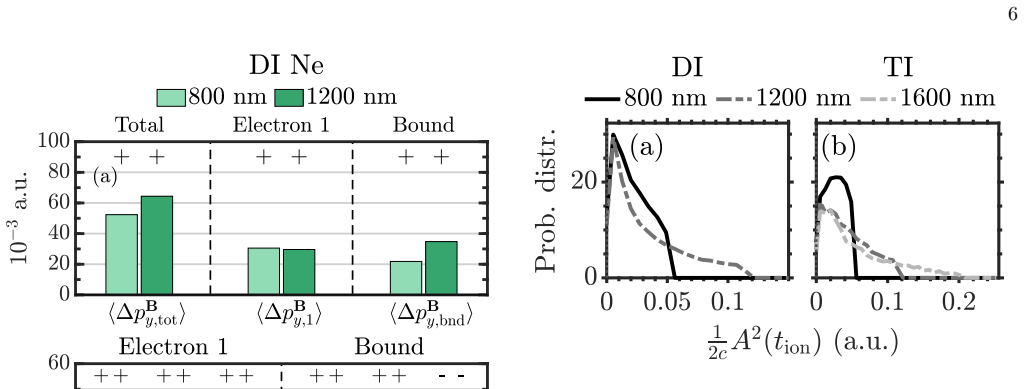
Simple model for the contribution to the momentum offset due to the magnetic field In this section, we employ a simple model, first devel- oped in Ref. [27], to account for the contribution to the momentum offset due to the magnetic field in TI and DI of strongly driven Ne. We show that this model accounts for the enhancement of the momentum offset in TI ...
-
[2]
[27] that ∆pB,1 y,i (trec →t f) = 1 2c A2(trec).(13) Here, the ionization time is more relevant for the bound electrons, as previously mentioned
Contribution to the momentum offset due to the magnetic field for the bound electrons Assuming that the momentum of each bound electron just before recollision is zero, i.ep i(tα)≈0, we have shown in Ref. [27] that ∆pB,1 y,i (trec →t f) = 1 2c A2(trec).(13) Here, the ionization time is more relevant for the bound electrons, as previously mentioned. Hence,...
-
[3]
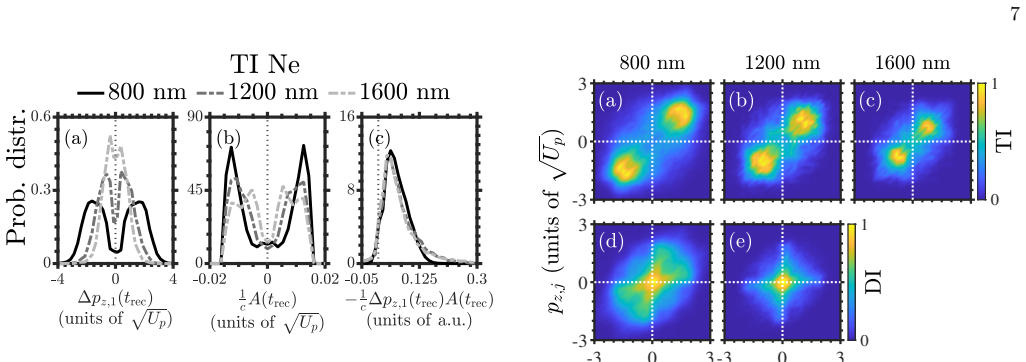
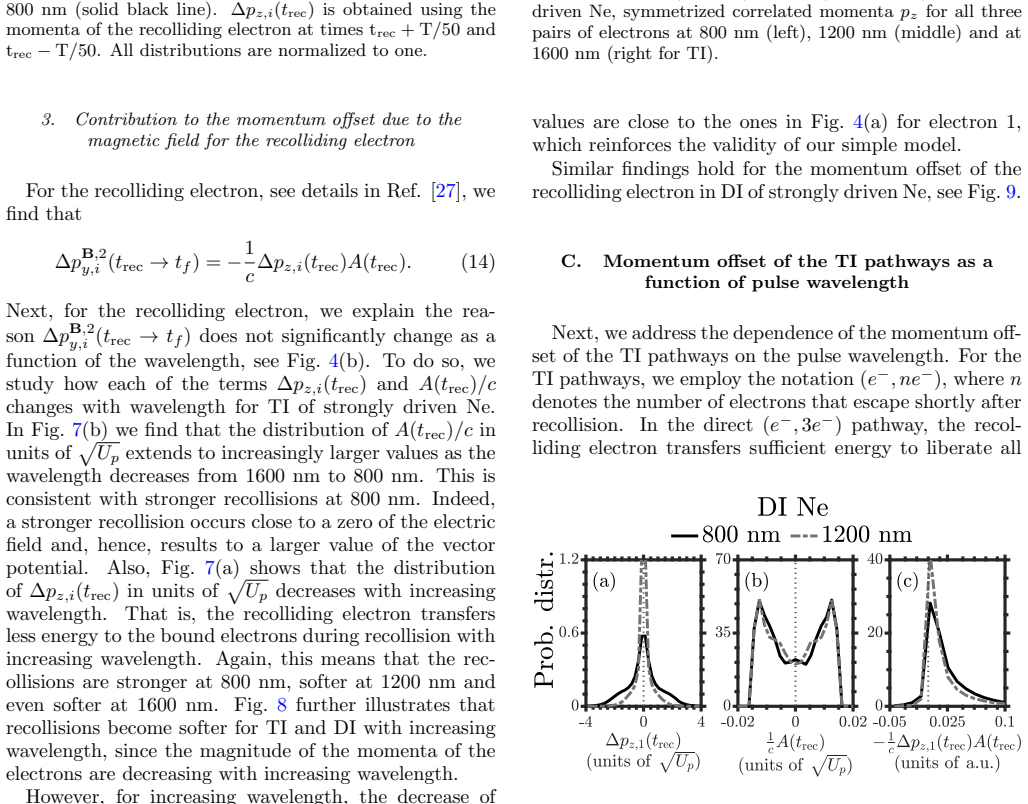
Contribution to the momentum offset due to the magnetic field for the recolliding electron For the recolliding electron, see details in Ref. [27], we find that ∆pB,2 y,i (trec →t f) =− 1 c ∆pz,i(trec)A(trec).(14) Next, for the recolliding electron, we explain the rea- son ∆p B,2 y,i (trec →t f) does not significantly change as a function of the wavelength...
-
[4]
P. B. Corkum, Plasma perspective on strong field multi- photon ionization, Phys. Rev. Lett.71, 1994 (1993)
1994
-
[5]
P. J. Ho and J. H. Eberly, In-Plane Theory of Nonse- quential Triple Ionization, Phys. Rev. Lett.97, 083001 (2006)
2006
-
[6]
Y. Zhou, Q. Liao, and P. Lu, Complex sub-laser-cycle electron dynamics in strong-field nonsequential triple ion- izaion, Opt. Express18, 16025 (2010)
2010
-
[7]
Q. Tang, C. Huang, Y. Zhou, and P. Lu, Correlated mul- tielectron dynamics in mid-infrared laser pulse interac- tions with neon atoms, Opt. Express21, 21433 (2013)
2013
-
[8]
J. H. Thiede, B. Eckhardt, D. K. Efimov, J. S. Prauzner- Bechcicki, and J. Zakrzewski, Ab initio study of time- dependent dynamics in strong-field triple ionization, Phys. Rev. A98, 031401(R) (2018)
2018
-
[9]
J. S. Prauzner-Bechcicki, D. K. Efimov, M. Mandrysz, and J. Zakrzewski, Strong-field triple ionisation of atoms withp 3 valence shell, J. Phys. B: At. Mol. Opt. Phys.54, 114001 (2021)
2021
-
[10]
D. K. Efimov, A. Maksymov, M. Ciappina, J. S. Prauzner-Bechcicki, M. Lewenstein, and J. Zakrzewski, Three-electron correlations in strong laser field ioniza- tion, Opt. Express29, 26526 (2021)
2021
-
[11]
Jiang, D
H. Jiang, D. Efimov, F. He, and J. S. Prauzner-Bechcicki, Dalitz plots as a tool to resolve nonsequential paths in strong-field triple ionization, Phys. Rev. A105, 053119 (2022)
2022
-
[12]
H. R. Reiss, Limits on Tunneling Theories of Strong- Field Ionization, Phys. Rev. Lett.101, 043002 (2008)
2008
-
[13]
H. R. Reiss, The tunnelling model of laser-induced ion- ization and its failure at low frequencies, J. Phys. B47, 204006 (2014)
2014
-
[14]
M. Y. Emelin and M. Y. Ryabikin, Atomic photoioniza- tion and dynamical stabilization with subrelativistically intense high-frequency light: Magnetic-field effects revis- ited, Phys. Rev. A89, 013418 (2014)
2014
-
[15]
C. C. Chiril˘ a, N. J. Kylstra, R. M. Potvliege, and C. J. Joachain, Nondipole effects in photon emission by laser- driven ions, Phys. Rev. A66, 063411 (2002)
2002
-
[16]
M. W. Walser, C. H. Keitel, A. Scrinzi, and T. Brabec, High harmonic generation beyond the electric dipole ap- proximation, Phys. Rev. Lett.85, 5082 (2000)
2000
-
[17]
C. H. Keitel and P. L. Knight, Monte carlo classical sim- ulations of ionization and harmonic generation in the rel- ativistic domain, Phys. Rev. A51, 1420 (1995)
1995
-
[18]
Palaniyappan, A
S. Palaniyappan, A. DiChiara, E. Chowdhury, A. Falkowski, G. Ongadi, E. L. Huskins, and B. C. Walker, Ultrastrong field ionization of ne n+ (n≤8): Rescattering and the role of the magnetic field, Phys. Rev. Lett.94, 243003 (2005)
2005
-
[19]
C. T. L. Smeenk, L. Arissian, B. Zhou, A. Mysyrowicz, D. M. Villeneuve, A. Staudte, and P. B. Corkum, Parti- tioning of the linear photon momentum in multiphoton ionization, Phys. Rev. Lett.106, 193002 (2011)
2011
-
[20]
Ludwig, J
A. Ludwig, J. Maurer, B. W. Mayer, C. R. Phillips, L. Gallmann, and U. Keller, Breakdown of the Dipole Ap- proximation in Strong-Field Ionization, Phys. Rev. Lett. 113, 243001 (2014)
2014
-
[21]
Chelkowski, A
S. Chelkowski, A. D. Bandrauk, and P. B. Corkum, Pho- ton Momentum Sharing between an Electron and an Ion in Photoionization: From One-Photon (Photoelectric Ef- fect) to Multiphoton Absorption, Phys. Rev. Lett.113, 263005 (2014)
2014
-
[22]
Wolter, M
B. Wolter, M. G. Pullen, M. Baudisch, M. Sclafani, M. Hemmer, A. Senftleben, C. D. Schr¨ oter, J. Ullrich, R. Moshammer, and J. Biegert, Strong-Field Physics with Mid-IR Fields, Phys. Rev. X5, 021034 (2015)
2015
-
[23]
Emmanouilidou and T
A. Emmanouilidou and T. Meltzer, Recollision as a probe of magnetic-field effects in nonsequential double ioniza- tion, Phys. Rev. A95, 033405 (2017)
2017
-
[24]
Emmanouilidou, T
A. Emmanouilidou, T. Meltzer, and P. B. Corkum, Non- dipole recollision-gated double ionization and observable effects, J. Phys. B50, 225602 (2017)
2017
-
[25]
Willenberg, J
B. Willenberg, J. Maurer, B. W. Mayer, and U. Keller, Sub-cycle time resolution of multi-photon momentum transfer in strong-field ionization, Nat. Commun.10, 5548 (2019)
2019
-
[26]
F. Sun, X. Chen, W. Zhang, J. Qiang, H. Li, P. Lu, X. Gong, Q. Ji, K. Lin, H. Li, J. Tong, F. Chen, C. Ruiz, J. Wu, and F. He, Longitudinal photon-momentum trans- fer in strong-field double ionization of argon atoms, Phys. Rev. A101, 021402(R) (2020)
2020
-
[27]
K. Lin, X. Chen, S. Eckart, H. Jiang, A. Hartung, D. Tra- bert, K. Fehre, J. Rist, L. P. H. Schmidt, M. S. Sch¨ offler, T. Jahnke, M. Kunitski, F. He, and R. D¨ orner, Magnetic- Field Effect as a Tool to Investigate Electron Correlation in Strong-Field Ionization, Phys. Rev. Lett.128, 113201 (2022)
2022
-
[28]
Y. Dou, P. Li, X. Long, P. Ge, Y. Deng, C. Wu, Q. Gong, and Y. Liu, Nondipole Effects on Electron Correlation Dynamics of Xe Atoms in Circularly Polarized Laser Fields, Physical Review Letters136, 073201 (2026)
2026
-
[29]
K. Lin, S. Brennecke, H. Ni, X. Chen, A. Hartung, D. Trabert, K. Fehre, J. Rist, X.-M. Tong, J. Burgd¨ orfer, L. P. H. Schmidt, M. S. Sch¨ offler, T. Jahnke, M. Kunitski, F. He, M. Lein, S. Eckart, and R. D¨ orner, Magnetic-Field 10 Effect in High-Order Above-Threshold Ionization, Phys. Rev. Lett.128, 023201 (2022)
2022
-
[30]
G. P. Katsoulis, M. B. Peters, and A. Emmanouilidou, Nondipole electron momentum offset as a probe of corre- lated three-electron ionization in strongly driven atoms, Physical Review A108, 043111 (2023)
2023
-
[31]
M. B. Peters, G. P. Katsoulis, and A. Emmanouilidou, General model and toolkit for the ionization of three or more electrons in strongly driven atoms using an effec- tive coulomb potential for the interaction between bound electrons, Phys. Rev. A105, 043102 (2022)
2022
-
[32]
A. Emmanouilidou, M. B. Peters, and G. P. Katsoulis, Singularity in electron-core potential as a gateway to accurate multi-electron ionization spectra in strongly driven atoms (2023), arXiv:2302.03777 [physics.atom- ph]
arXiv 2023
-
[33]
S. J. Praill, G. P. Katsoulis, and A. Emmanouilidou, Three-electron escape in strongly driven Ne at high in- tensities, Journal of Physics B: Atomic, Molecular and Optical Physics59, 025601 (2026)
2026
-
[34]
C. L. Kirschbaum and L. Wilets, Classical many-body model for atomic collisions incorporating the Heisenberg and Pauli principles, Phys. Rev. A21, 834 (1980)
1980
-
[35]
R. R. Pandit, Y. Sentoku, V. R. Becker, K. Barrington, J. Thurston, J. Cheatham, L. Ramunno, and E. Ackad, Effect of soft-core potentials on inverse bremsstrahlung heating during laser matter interactions, Phys. Plasmas 24, 073303 (2017)
2017
-
[36]
R. R. Pandit, V. R. Becker, K. Barrington, J. Thurston, L. Ramunno, and E. Ackad, Comparison of the ef- fect of soft-core potentials and coulombic potentials on bremsstrahlung during laser matter interaction, Phys. s 25, 043302 (2018)
2018
-
[37]
N. B. Delone and V. P. Krainov, Energy and angular electron spectra for the tunnel ionization of atoms by strong low-frequency radiation, J. Opt. Soc. Am. B8, 1207 (1991)
1991
-
[38]
L. D. Landau and E. M. Lifshitz,Quantum Mechan- ics: Non-Relativistic Theory, 2nd ed. (Pergamon, Ox- ford, 1965)
1965
-
[39]
X. M. Tong and C. D. Lin, Empirical formula for static field ionization rates of atoms and molecules by lasers in the barrier-suppression regime, J. Phys. B: At. Mol. Opt. Phys38, 2593 (2005)
2005
-
[40]
R. Y. Rubinstein and D. P. Froese,Simulation and the Monte Carlo Method, 3rd ed. (Wiley, New Jersey, 2016)
2016
-
[41]
N. B. Delone and V. P. Krainov, Tunneling and barrier- suppression ionization of atoms and ions in a laser radi- ation field, Phys.-Uspekhi41, 469 (1998)
1998
-
[42]
Fechner, N
L. Fechner, N. Camus, J. Ullrich, T. Pfeifer, and R. Moshammer, Strong-Field Tunneling from a Coher- ent Superposition of Electronic States, Phys. Rev. Lett. 112, 213001 (2014)
2014
-
[43]
D. C. Heggie, A global regularisation of the gravitational N-body problem, Celest. Mech.10, 217 (1974)
1974
-
[44]
Pihajoki, Explicit methods in extended phase space for inseparable Hamiltonian problems, Celest
P. Pihajoki, Explicit methods in extended phase space for inseparable Hamiltonian problems, Celest. Mech. Dyn. Astron.121, 211 (2015)
2015
-
[45]
L. Liu, X. Wu, G. Huang, and F. Liu, Higher order ex- plicit symmetric integrators for inseparable forms of co- ordinates and momenta, Mon. Not. R. Astron. Soc.459, 1968 (2016)
1968
-
[46]
W. H. Press, S. A. Teukolsky, W. T. Vetterling, and B. P. Flannery,Numerical recipes: The Art of Scientific Com- puting, 3rd ed. (Cambridge University Press, Cambridge, 2007)
2007
-
[47]
G. P. Katsoulis, M. B. Peters, A. Staudte, R. Bhardwaj, and A. Emmanouilidou, Signatures of magnetic-field ef- fects in nonsequential double ionization manifesting as backscattering for molecules versus forward scattering for atoms, Phys. Rev. A103, 033115 (2021)
2021
-
[48]
Abramowitz and I
M. Abramowitz and I. Stegun,Handbook of Mathematical Functions: With Formulas, Graphs, and Mathematical Tables, Applied mathematics series (Dover Publications, 1965)
1965
discussion (0)
Sign in with ORCID, Apple, or X to comment. Anyone can read and Pith papers without signing in.