Local density of states distribution and multifractal eigenvectors of weighted random networks via the cavity approach
Pith reviewed 2026-06-27 10:54 UTC · model grok-4.3
The pith
The local density of states on weighted random networks has power-law tails of exponent 3, implying weakly multifractal eigenvectors with logarithmic inverse participation ratio scaling.
A machine-rendered reading of the paper's core claim, the machinery that carries it, and where it could break.
Core claim
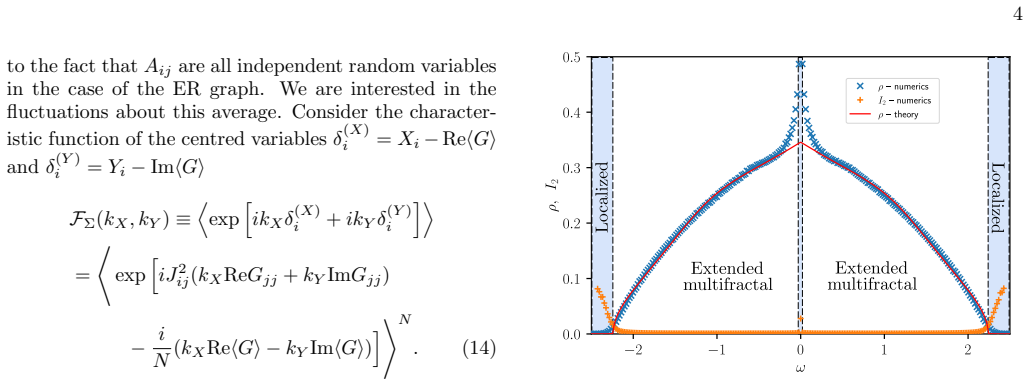
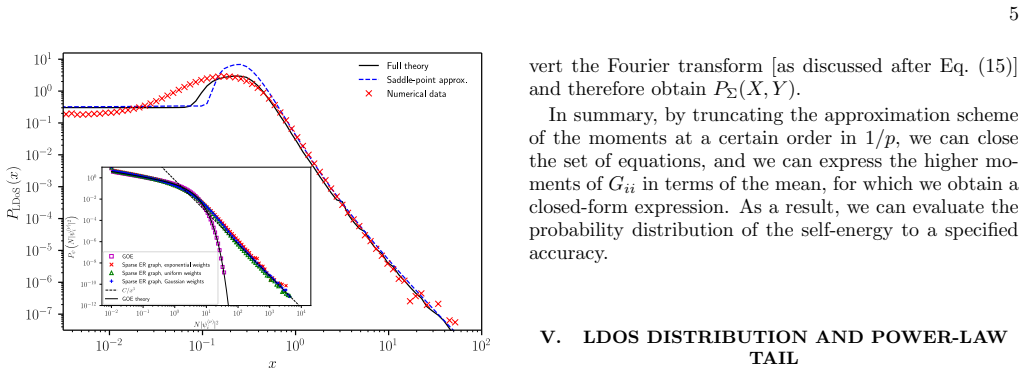
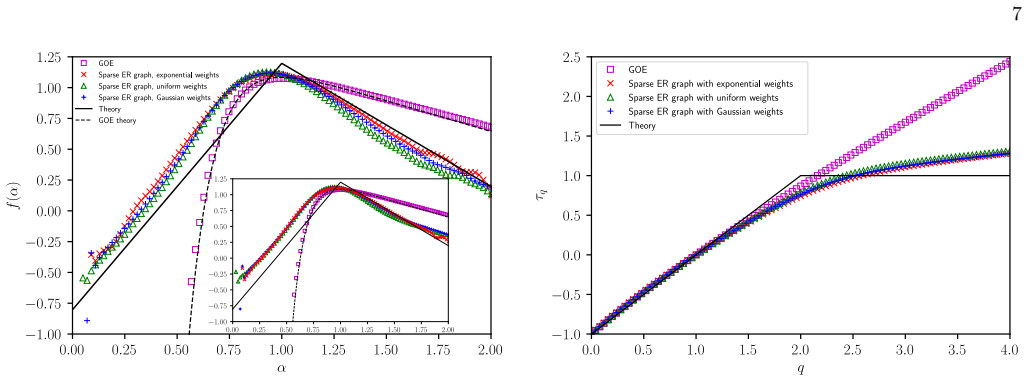
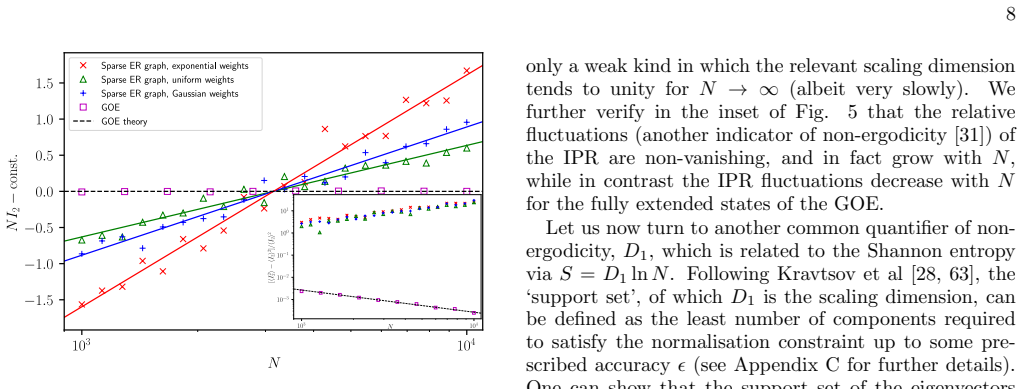
Using the cavity approach on a general class of weighted Erdős-Rényi graphs, we obtain a good approximation to the full local density of states distribution together with compact expressions for its power-law tails, which have exponent 3 in the extended phase. We deduce that the eigenvectors in the continuous part of the spectrum are extended but weakly multifractal, extract the associated fractal dimensions and singularity spectrum, and demonstrate that the inverse participation ratio exhibits an unusual logarithmic scaling with system size. Finally we verify that symmetry properties derived from the non-linear sigma model hold for both the local density of states distribution and the singu
What carries the argument
The cavity method applied to the local density of states on weighted Erdős-Rényi graphs, which produces the full distribution and its power-law tails.
If this is right
- Eigenvectors in the continuous spectrum are extended but weakly multifractal.
- The inverse participation ratio scales logarithmically with system size rather than remaining constant or decaying as a power law.
- The fractal dimensions and singularity spectrum follow from the power-law tails of the local density of states.
- Symmetry properties from the non-linear sigma model hold for the local density of states distribution and the singularity spectrum.
Where Pith is reading between the lines
- The same cavity-method route to the local density of states distribution could be applied to other sparse weighted graph ensembles to test whether exponent-3 tails are generic.
- Finite-size scaling studies on graphs of increasing size could directly check whether the logarithmic inverse participation ratio persists before the thermodynamic limit is reached.
- The observed multifractality may provide a concrete example for testing general predictions about critical states at the localization transition on networks.
Load-bearing premise
The cavity method supplies a quantitatively accurate approximation to the full local density of states distribution and its tails throughout the extended phase in the thermodynamic limit.
What would settle it
Numerical diagonalization of finite but large weighted Erdős-Rényi graphs that yields a local density of states tail exponent measurably different from 3, or an inverse participation ratio that fails to scale logarithmically with system size, would falsify the central claim.
Figures
read the original abstract
We study the local density of states (LDoS) distribution of a general class of weighted Erd\H{o}s-R\'enyi graphs. Using the cavity method, we obtain a good approximation to the full LDoS distribution and compact expressions for its power-law tails, which we show to have exponent $3$ in the extended phase. We deduce that the eigenvectors in the continuous part of the spectrum are extended but (weakly) multifractal, and we extract expressions for the associated fractal dimensions and the singularity spectrum. We also demonstrate that the inverse participation ratio in this multifractal phase exhibits an unusual logarithmic scaling with system size, which is neither fully-extended nor localised by the usual definitions. Finally, we verify that some symmetry properties (derived from the non-linear sigma model), which have been shown to hold for many systems exhibiting multifractality, also hold in our case, both for the LDoS distribution and the singularity spectrum.
Editorial analysis
A structured set of objections, weighed in public.
Referee Report
Summary. The manuscript applies the cavity method to a class of weighted Erdős-Rényi graphs to obtain an approximation to the full local density of states (LDoS) distribution. It derives compact expressions for the power-law tails of this distribution (exponent 3 in the extended phase), deduces that eigenvectors in the continuous spectrum are extended but weakly multifractal, extracts the associated fractal dimensions and singularity spectrum, demonstrates logarithmic scaling of the inverse participation ratio with system size, and verifies that non-linear sigma model symmetry properties hold for both the LDoS distribution and the singularity spectrum.
Significance. If the derivations hold, the work supplies an analytically tractable route to the full LDoS distribution and its multifractal consequences on locally tree-like graphs, where the cavity method is exact in the thermodynamic limit. The explicit large-argument asymptotics yielding the exponent-3 tails, the resulting weak multifractality with logarithmic IPR scaling, and the independent consistency check against NLSM symmetries constitute clear strengths. These results are relevant to localization and spectral statistics in disordered networks.
minor comments (3)
- [cavity equations section] § on cavity equations: the transition from the distributional fixed-point equations to the explicit tail asymptotics should include one intermediate step showing how the exponent 3 emerges from the large-argument behavior without additional assumptions.
- [figures] Figure captions for the numerical checks of the LDoS tails and IPR scaling should state the system sizes and number of realizations used, to allow direct assessment of finite-size effects.
- [model definition] Notation for the weighted adjacency matrix and the cavity fields should be introduced once with a single consistent symbol set to avoid minor ambiguity in later sections.
Simulated Author's Rebuttal
We thank the referee for their positive summary, significance assessment, and recommendation to accept the manuscript. No major comments were raised in the report.
Circularity Check
No significant circularity detected
full rationale
The derivation applies the cavity method (standard for locally tree-like ER graphs) to obtain self-consistent distributional equations for the LDoS. Asymptotics of these equations directly yield the power-law tails of exponent 3, from which the weak multifractality, fractal dimensions, and logarithmic IPR scaling follow via moment relations. No parameters are fitted to the target observables, no self-citations bear the central claims, and no ansatz or uniqueness theorem is smuggled in; the NLSM symmetry checks supply independent consistency support. The result is self-contained against the cavity equations.
Axiom & Free-Parameter Ledger
axioms (2)
- domain assumption The cavity method yields a quantitatively accurate approximation to the LDoS distribution in the thermodynamic limit.
- domain assumption Symmetry properties derived from the non-linear sigma model hold for the LDoS distribution and singularity spectrum.
Reference graph
Works this paper leans on
-
[1]
For extended eigenvectors, all of the eigenvector com- ponents have roughly the same magnitude of|ψ (ν) i |2 ∼ 1/N
We can then define the global density of states and the eigenvector distribution (at a fixed locationωin the spectrum) ρ(ω) = 1 N *X ν δ(ω−λ ν) + , Pψ(y) = 1 N2ρ(ω) *X i;ν δ(ω−λ ν)δ(y−N|ψ (ν) i |2) + ,(2) where we suppress the dependence ofP ψ(y) onωfor no- tational convenience. For extended eigenvectors, all of the eigenvector com- ponents have roughly t...
-
[2]
Using a similar approach, we can also evaluate the higher moments, which enter into the expression for FΣ(kX , KY ) in Eq. (15). We have ⟨(ReGii)2⟩ ≈ ⟨ReG ii⟩2 + β4 p Re ⟨Gii⟩3 2 , ⟨(ImGii)2⟩ ≈ ⟨ImG ii⟩2 + β4 p Im ⟨Gii⟩3 2 , ⟨ReGii ImGii⟩ ≈ ⟨ReG ii⟩⟨ImGii⟩ + β4 p Re ⟨Gii⟩3 Im ⟨Gii⟩3 .(17) Again, these expressions can also be derived using the diagrammatic...
-
[3]
Absence of diffusion in certain ran- dom lattices.Physical review, 109(5):1492, 1958
Philip W Anderson. Absence of diffusion in certain ran- dom lattices.Physical review, 109(5):1492, 1958
1958
-
[4]
Anderson tran- sitions.Reviews of Modern Physics, 80(4):1355–1417, 2008
Ferdinand Evers and Alexander D Mirlin. Anderson tran- sitions.Reviews of Modern Physics, 80(4):1355–1417, 2008
2008
-
[5]
Multifractality and crit- ical fluctuations at the anderson transition.Physical Re- view B, 62(12):7920, 2000
AD Mirlin and Ferdinand Evers. Multifractality and crit- ical fluctuations at the anderson transition.Physical Re- view B, 62(12):7920, 2000
2000
-
[6]
Distribution of local densities of states, order parameter function, and critical behavior near the anderson transition.Physical review letters, 72(4):526, 1994
Alexander D Mirlin and Yan V Fyodorov. Distribution of local densities of states, order parameter function, and critical behavior near the anderson transition.Physical review letters, 72(4):526, 1994
1994
-
[7]
Exact relations between multifrac- tal exponents at the anderson transition.Physical review letters, 97(4):046803, 2006
Alexander D Mirlin, Yu V Fyodorov, A Mildenberger, and Ferdinand Evers. Exact relations between multifrac- tal exponents at the anderson transition.Physical review letters, 97(4):046803, 2006
2006
-
[8]
Multifractality and freezing phenom- ena in random energy landscapes: An introduction
Yan V Fyodorov. Multifractality and freezing phenom- ena in random energy landscapes: An introduction. Physica A: Statistical Mechanics and its Applications, 389(20):4229–4254, 2010
2010
-
[9]
C´ ecile Monthus and Thomas Garel. Anderson localiza- tion on the cayley tree: multifractal statistics of the transmission at criticality and off criticality.Journal of Physics A: Mathematical and Theoretical, 44(14):145001, 2011
2011
-
[10]
C´ ecile Monthus. Statistical properties of the green func- tion in finite size for anderson localization models with multifractal eigenvectors.Journal of Physics A: Mathe- matical and Theoretical, 50(11):115002, 2017
2017
-
[11]
Many-body local- ization: An introduction and selected topics.Comptes Rendus Physique, 19(6):498–525, 2018
Fabien Alet and Nicolas Laflorencie. Many-body local- ization: An introduction and selected topics.Comptes Rendus Physique, 19(6):498–525, 2018
2018
-
[12]
The ergodic side of the many-body localization transition.Annalen der Physik, 529(7):1600350, 2017
David J Luitz and Yevgeny Bar Lev. The ergodic side of the many-body localization transition.Annalen der Physik, 529(7):1600350, 2017
2017
-
[13]
Many-body localization transition in hilbert space.Physical Review B, 102(1):014208, 2020
Marco Tarzia. Many-body localization transition in hilbert space.Physical Review B, 102(1):014208, 2020
2020
-
[14]
Fock-space correla- tions and the origins of many-body localization.Physical Review B, 101(13):134202, 2020
Sthitadhi Roy and David E Logan. Fock-space correla- tions and the origins of many-body localization.Physical Review B, 101(13):134202, 2020
2020
-
[15]
Diagonalization and many-body localiza- tion for a disordered quantum spin chain.Physical review letters, 117(2):027201, 2016
John Z Imbrie. Diagonalization and many-body localiza- tion for a disordered quantum spin chain.Physical review letters, 117(2):027201, 2016
2016
-
[16]
On many-body localization for quantum spin chains.Journal of Statistical Physics, 163(5):998– 1048, 2016
John Z Imbrie. On many-body localization for quantum spin chains.Journal of Statistical Physics, 163(5):998– 1048, 2016
2016
-
[17]
Obser- vation of many-body localization of interacting fermions in a quasirandom optical lattice.Science, 349(6250):842– 845, 2015
Michael Schreiber, Sean S Hodgman, Pranjal Bordia, Henrik P L¨ uschen, Mark H Fischer, Ronen Vosk, Ehud Altman, Ulrich Schneider, and Immanuel Bloch. Obser- vation of many-body localization of interacting fermions in a quasirandom optical lattice.Science, 349(6250):842– 845, 2015
2015
-
[18]
Coupling identical one-dimensional many-body lo- calized systems.Physical review letters, 116(14):140401, 2016
Pranjal Bordia, Henrik P L¨ uschen, Sean S Hodgman, Michael Schreiber, Immanuel Bloch, and Ulrich Schnei- der. Coupling identical one-dimensional many-body lo- calized systems.Physical review letters, 116(14):140401, 2016
2016
-
[19]
Many-body localization in a quantum simulator with programmable random dis- order.Nature Physics, 12(10):907–911, 2016
Jacob Smith, Aaron Lee, Philip Richerme, Brian Neyen- huis, Paul W Hess, Philipp Hauke, Markus Heyl, David A Huse, and Christopher Monroe. Many-body localization in a quantum simulator with programmable random dis- order.Nature Physics, 12(10):907–911, 2016
2016
-
[20]
Exploring the many-body localization transition in two dimensions.Science, 352(6293):1547–1552, 2016
Jae-yoon Choi, Sebastian Hild, Johannes Zeiher, Peter Schauß, Antonio Rubio-Abadal, Tarik Yefsah, Vedika Khemani, David A Huse, Immanuel Bloch, and Christian Gross. Exploring the many-body localization transition in two dimensions.Science, 352(6293):1547–1552, 2016
2016
-
[21]
Quasiparticle lifetime in a finite sys- tem: A nonperturbative approach.Physical review let- ters, 78(14):2803, 1997
Boris L Altshuler, Yuval Gefen, Alex Kamenev, and Leonid S Levitov. Quasiparticle lifetime in a finite sys- tem: A nonperturbative approach.Physical review let- ters, 78(14):2803, 1997
1997
-
[22]
Rare-region effects and dynamics near the many- body localization transition.Annalen der Physik, 529(7):1600326, 2017
Kartiek Agarwal, Ehud Altman, Eugene Demler, Sarang Gopalakrishnan, David A Huse, and Michael Knap. Rare-region effects and dynamics near the many- body localization transition.Annalen der Physik, 529(7):1600326, 2017
2017
-
[23]
Delocalized glassy dy- namics and many-body localization.Physical Review B, 96(20):201114, 2017
Giulio Biroli and Marco Tarzia. Delocalized glassy dy- namics and many-body localization.Physical Review B, 96(20):201114, 2017
2017
-
[24]
Ran- dom matrices.Oberwolfach Reports, 16(4):3459–3527, 2020
L´ aszl´ o Erd˝ os, Friedrich G¨ otze, and Alice Guionnet. Ran- dom matrices.Oberwolfach Reports, 16(4):3459–3527, 2020
2020
-
[25]
J. W. Baron. Classes of non-gaussian random matrices: Long-range eigenvalue correlations and non-ergodic ex- tended eigenvectors.Europhysics Letters, 151(2):21002, aug 2025
2025
-
[26]
Universal k-matrix distribution inβ= 2 ensembles of ran- dom matrices.Journal of Physics A: Mathematical and Theoretical, 46(26):262001, 2013
Yan V Fyodorov, Boris A Khoruzhenko, and Andr´ e Nock. Universal k-matrix distribution inβ= 2 ensembles of ran- dom matrices.Journal of Physics A: Mathematical and Theoretical, 46(26):262001, 2013
2013
-
[27]
Random matrices: universal properties of eigenvectors.Random Matrices: Theory and Applications, 1(01):1150001, 2012
Terence Tao and Van Vu. Random matrices: universal properties of eigenvectors.Random Matrices: Theory and Applications, 1(01):1150001, 2012
2012
-
[28]
Supersymmetry and theory of disordered metals.advances in Physics, 32(1):53–127, 1983
KB Efetov. Supersymmetry and theory of disordered metals.advances in Physics, 32(1):53–127, 1983
1983
-
[29]
Giulio Biroli and Marco Tarzia. Delocalization and er- godicity of the anderson model on bethe lattices.arXiv preprint arXiv:1810.07545, 2018
Pith/arXiv arXiv 2018
-
[30]
Kravtsov, B.L
V.E. Kravtsov, B.L. Altshuler, and L.B. Ioffe. Non- ergodic delocalized phase in anderson model on bethe lattice and regular graph.Annals of Physics, 389:148– 191, 2018
2018
-
[31]
Fractal- ity of wave functions on a cayley tree: Difference between tree and locally treelike graph without boundary.Physi- cal Review B, 94(18):184203, 2016
Konstantin S Tikhonov and Alexander D Mirlin. Fractal- ity of wave functions on a cayley tree: Difference between tree and locally treelike graph without boundary.Physi- cal Review B, 94(18):184203, 2016
2016
-
[32]
Multifractality of wave functions on a cayley tree: From root to leaves
M Sonner, KS Tikhonov, and AD Mirlin. Multifractality of wave functions on a cayley tree: From root to leaves. Physical Review B, 96(21):214204, 2017
2017
-
[33]
Anderson localization on the bethe lat- tice: Nonergodicity of extended states.Physical review letters, 113(4):046806, 2014
Andrea De Luca, BL Altshuler, VE Kravtsov, and A Scardicchio. Anderson localization on the bethe lat- tice: Nonergodicity of extended states.Physical review letters, 113(4):046806, 2014
2014
-
[34]
Tran- sition from localized to extended eigenstates in the en- semble of power-law random banded matrices.Physical Review E, 54(4):3221, 1996
Alexander D Mirlin, Yan V Fyodorov, Frank-Michael Dittes, Javier Quezada, and Thomas H Seligman. Tran- sition from localized to extended eigenstates in the en- semble of power-law random banded matrices.Physical Review E, 54(4):3221, 1996
1996
-
[35]
Robust nonergodicity of the ground states in theβensemble.Physical Review B, 109(6):064206, 2024
Adway Kumar Das, Anandamohan Ghosh, and Ivan M Khaymovich. Robust nonergodicity of the ground states in theβensemble.Physical Review B, 109(6):064206, 2024. 14
2024
-
[36]
Spectral properties, localization transition and multifractal eigenvectors of the laplacian on hetero- geneous networks.SciPost Physics, 18(2):047, 2025
Jeferson D da Silva, Diego Tapias, Peter Sollich, and Fer- nando Metz. Spectral properties, localization transition and multifractal eigenvectors of the laplacian on hetero- geneous networks.SciPost Physics, 18(2):047, 2025
2025
-
[37]
Multifractality and sta- tistical localization in highly heterogeneous random net- works.Europhysics Letters, 144(4):41001, 2023
Diego Tapias and Peter Sollich. Multifractality and sta- tistical localization in highly heterogeneous random net- works.Europhysics Letters, 144(4):41001, 2023
2023
-
[38]
Analytic solu- tion of the resolvent equations for heterogeneous random graphs: spectral and localization properties.Journal of Physics: Complexity, 3(4):045012, 2022
Jeferson D Silva and Fernando L Metz. Analytic solu- tion of the resolvent equations for heterogeneous random graphs: spectral and localization properties.Journal of Physics: Complexity, 3(4):045012, 2022
2022
-
[39]
L´ evy-rosenzweig- porter random matrix ensemble.Physical Review B, 103(10):104205, 2021
Giulio Biroli and Marco Tarzia. L´ evy-rosenzweig- porter random matrix ensemble.Physical Review B, 103(10):104205, 2021
2021
-
[40]
Replica approach to the generalized rosenzweig-porter model.SciPost Physics, 14(5):110, 2023
Davide Venturelli, Leticia F Cugliandolo, Gr´ egory Schehr, and Marco Tarzia. Replica approach to the generalized rosenzweig-porter model.SciPost Physics, 14(5):110, 2023
2023
-
[41]
Spectral properties of levy rosenzweig-porter model via supersymmetric approach.SciPost Physics, 18(1):010, 2025
Elizaveta Safonova, Mikhail V Feigel’man, and Vladimir Kravtsov. Spectral properties of levy rosenzweig-porter model via supersymmetric approach.SciPost Physics, 18(1):010, 2025
2025
-
[42]
Fragile extended phases in the log-normal rosenzweig-porter model.Physical Review Research, 2(4):043346, 2020
Ivan M Khaymovich, VE Kravtsov, BL Altshuler, and LB Ioffe. Fragile extended phases in the log-normal rosenzweig-porter model.Physical Review Research, 2(4):043346, 2020
2020
-
[43]
multifractal
Ivan M. Khaymovich and Vladimir E. Kravtsov. Dynam- ical phases in a “multifractal” Rosenzweig-Porter model. SciPost Phys., 11:045, 2021
2021
-
[44]
Multifractal phase in the weighted adjacency matrices of random erd¨ os-r´ enyi graphs.Phys- ical Review B, 110(17):174202, 2024
Leticia F Cugliandolo, Gr´ egory Schehr, Marco Tarzia, and Davide Venturelli. Multifractal phase in the weighted adjacency matrices of random erd¨ os-r´ enyi graphs.Phys- ical Review B, 110(17):174202, 2024
2024
-
[45]
Cavity approach to the spectral den- sity of sparse symmetric random matrices.Physical Re- view E—Statistical, Nonlinear, and Soft Matter Physics, 78(3):031116, 2008
Tim Rogers, Isaac P´ erez Castillo, Reimer K¨ uhn, and Koujin Takeda. Cavity approach to the spectral den- sity of sparse symmetric random matrices.Physical Re- view E—Statistical, Nonlinear, and Soft Matter Physics, 78(3):031116, 2008
2008
-
[46]
Cav- ity and replica methods for the spectral density of sparse symmetric random matrices.SciPost Physics Lecture Notes, page 033, 2021
Vito AR Susca, Pierpaolo Vivo, and Reimer K¨ uhn. Cav- ity and replica methods for the spectral density of sparse symmetric random matrices.SciPost Physics Lecture Notes, page 033, 2021
2021
-
[47]
Cizeau and J
P. Cizeau and J. P. Bouchaud. Theory of l´ evy matrices. Phys. Rev. E, 50:1810–1822, Sep 1994
1994
-
[48]
From non-ergodic eigenvectors to local resolvent statistics and back: A random matrix perspective.Europhysics Letters, 115(4):47003, sep 2016
Davide Facoetti, Pierpaolo Vivo, and Giulio Biroli. From non-ergodic eigenvectors to local resolvent statistics and back: A random matrix perspective.Europhysics Letters, 115(4):47003, sep 2016
2016
-
[49]
The spectrum of heavy tailed random matrices.Communications in Mathematical Physics, 278(3):715–751, 2008
G´ erard Ben Arous and Alice Guionnet. The spectrum of heavy tailed random matrices.Communications in Mathematical Physics, 278(3):715–751, 2008
2008
-
[50]
Resolvent of large random graphs.Random Structures & Algorithms, 37(3):332–352, 2010
Charles Bordenave and Marc Lelarge. Resolvent of large random graphs.Random Structures & Algorithms, 37(3):332–352, 2010
2010
-
[51]
A selfconsistent theory of localization.Journal of Physics C: Solid State Physics, 6(10):1734, may 1973
R Abou-Chacra, D J Thouless, and P W Anderson. A selfconsistent theory of localization.Journal of Physics C: Solid State Physics, 6(10):1734, may 1973
1973
-
[52]
The wishart–rosenzweig–porter random matrix ensemble
Victor Delapalme, Leticia F Cugliandolo, Gr´ egory Schehr, Marco Tarzia, and Davide Venturelli. The wishart–rosenzweig–porter random matrix ensemble. arXiv preprint arXiv:2510.15764, 2025
arXiv 2025
-
[53]
Asymptotic approximations to dis- tributions.The Annals of Mathematical Statistics, 29(3):635–654, 1958
David L Wallace. Asymptotic approximations to dis- tributions.The Annals of Mathematical Statistics, 29(3):635–654, 1958
1958
-
[54]
Path-integral approach to sparse non-hermitian random matrices.Physical Review E, 111(3):034217, 2025
Joseph W Baron. Path-integral approach to sparse non-hermitian random matrices.Physical Review E, 111(3):034217, 2025
2025
-
[55]
Eigenvalue spectra and stability of directed complex networks.Physical Review E, 106(6):064302, 2022
Joseph W Baron. Eigenvalue spectra and stability of directed complex networks.Physical Review E, 106(6):064302, 2022
2022
-
[56]
Yan V Fyodorov and Dmitry V Savin. Statistics of impedance, local density of states, and reflection in quan- tum chaotic systems with absorption.Journal of Exper- imental and Theoretical Physics Letters, 80(12):725–729, 2004
2004
-
[57]
Statistics of eigen- states near the localization transition on random regular graphs.Physical Review B, 99(2):024202, 2019
KS Tikhonov and AD Mirlin. Statistics of eigen- states near the localization transition on random regular graphs.Physical Review B, 99(2):024202, 2019
2019
-
[58]
Statistical properties of one-point green functions in disordered sys- tems and critical behavior near the anderson transition
Alexander D Mirlin and Yan V Fyodorov. Statistical properties of one-point green functions in disordered sys- tems and critical behavior near the anderson transition. Journal de Physique I, 4(5):655–673, 1994
1994
-
[59]
Hartmann, and Marco Tarzia
Giulio Biroli, Alexander K. Hartmann, and Marco Tarzia. Critical behavior of the anderson model on the bethe lattice via a large-deviation approach.Phys. Rev. B, 105:094202, Mar 2022
2022
-
[60]
Khaymovich
Adway Kumar Das, Anandamohan Ghosh, and Ivan M. Khaymovich. Absence of mobility edge in short-range uncorrelated disordered model: Coexistence of localized and extended states.Phys. Rev. Lett., 131:166401, Oct 2023
2023
-
[61]
Arijeet Pal and David A. Huse. Many-body localization phase transition.Phys. Rev. B, 82:174411, Nov 2010
2010
-
[62]
David J. Luitz. Long tail distributions near the many- body localization transition.Phys. Rev. B, 93:134201, Apr 2016
2016
-
[63]
Extended nonergodic states in disordered many-body quantum sys- tems.Annalen der Physik, 529(7):1600284, 2017
E Jonathan Torres-Herrera and Lea F Santos. Extended nonergodic states in disordered many-body quantum sys- tems.Annalen der Physik, 529(7):1600284, 2017
2017
-
[64]
B. L. Altshuler, E. Cuevas, L. B. Ioffe, and V. E. Kravtsov. Nonergodic phases in strongly disordered ran- dom regular graphs.Phys. Rev. Lett., 117:156601, Oct 2016
2016
-
[65]
Support set of ran- dom wave-functions on the bethe lattice.arXiv preprint arXiv:1401.0019, 2013
Andrea De Luca, Antonello Scardicchio, Vladimir E Kravtsov, and Boris L Altshuler. Support set of ran- dom wave-functions on the bethe lattice.arXiv preprint arXiv:1401.0019, 2013
Pith/arXiv arXiv 2013
-
[66]
A single defect approx- imation for localized states on random lattices.Journal of Physics A: Mathematical and General, 32(24):L255, 1999
Giulio Biroli and R´ emi Monasson. A single defect approx- imation for localized states on random lattices.Journal of Physics A: Mathematical and General, 32(24):L255, 1999
1999
-
[67]
Sparse random matrices: the eigenvalue spectrum revisited
Guilhem Semerjian and Leticia F Cugliandolo. Sparse random matrices: the eigenvalue spectrum revisited. Journal of Physics A: Mathematical and General, 35(23):4837, 2002
2002
-
[68]
Eigenvalue spectral tails and lo- calisation properties of asymmetric networks.Journal of Physics A: Mathematical and Theoretical, 58(45):455002, 2025
Pietro Valigi, Joseph W Baron, Izaak Neri, Giulio Biroli, and Chiara Cammarota. Eigenvalue spectral tails and lo- calisation properties of asymmetric networks.Journal of Physics A: Mathematical and Theoretical, 58(45):455002, 2025
2025
-
[69]
An- derson model on bethe lattices: density of states, local- ization properties and isolated eigenvalue.Progress of Theoretical Physics Supplement, 184:187–199, 2010
Giulio Biroli, Guilhem Semerjian, and Marco Tarzia. An- derson model on bethe lattices: density of states, local- ization properties and isolated eigenvalue.Progress of Theoretical Physics Supplement, 184:187–199, 2010
2010
-
[70]
Density of states of a sparse random matrix.Physical Review B, 37(7):3557, 1988
Geoff J Rodgers and Alan J Bray. Density of states of a sparse random matrix.Physical Review B, 37(7):3557, 1988
1988
discussion (0)
Sign in with ORCID, Apple, or X to comment. Anyone can read and Pith papers without signing in.