A Functional Data Framework For Analyzing Shapes and Textures in Images
Pith reviewed 2026-06-27 12:19 UTC · model grok-4.3
The pith
Images of objects with star-shaped interiors admit a continuous functional representation instead of pixel grids.
A machine-rendered reading of the paper's core claim, the machinery that carries it, and where it could break.
Core claim
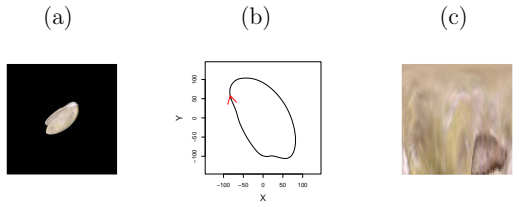
Under the condition that objects possess star-shaped domain interiors, images can be expressed through a functional data analysis lens by mapping them to continuous functions that capture both shape contours and texture information, yielding a more frugal representation than pixel-based discretizations.
What carries the argument
The star-shaped domain interior assumption that permits direct mapping of each image to a set of continuous functions for shapes and textures.
If this is right
- Image analysis tasks can shift from high-dimensional pixel arrays to lower-dimensional functional observations.
- Standard functional data analysis tools become directly applicable to shape and texture features.
- Supervised classification of images can proceed using the functional representation on real datasets.
- Computational costs decrease relative to methods that retain full pixel grids.
Where Pith is reading between the lines
- The same mapping idea might be adapted to other boundary conditions if the star-shaped restriction is replaced by a different geometric rule.
- This functional view could be compared directly against existing contour or radial representations in shape statistics to quantify the dimension reduction achieved.
- Datasets containing mixed star-shaped and non-star-shaped objects would require preprocessing or hybrid handling to test the framework's robustness.
Load-bearing premise
Every object appearing in the images must possess a star-shaped domain interior.
What would settle it
Take an image whose central object has a non-star-shaped boundary such as a concavity or hole, attempt the functional mapping, and check whether the resulting representation can still be defined and used for downstream tasks like classification without additional adjustments.
Figures
read the original abstract
Images represent objects characterized by contours and textures. From a statistical perspective these features can be defined as observations of continuous random functions. However, most existing approaches rely on pixel-based discretizations which lead to high-dimensional representations and heavy computational costs. In this note, we introduce an alternative more frugal representation. This representation assumes that the object has a star-shaped domain interior. Under this condition, we explore the analysis of images from a functional data analysis perspective. The proposed framework is illustrated on a real data supervised image classification problem.
Editorial analysis
A structured set of objections, weighed in public.
Referee Report
Summary. The manuscript introduces a functional data analysis framework for representing shapes and textures in images of objects assumed to have star-shaped domain interiors as continuous random functions, claiming this yields a more frugal representation than pixel-based discretizations, and illustrates the approach via a supervised classification task on real data.
Significance. If the mapping can be rigorously derived and shown to deliver measurable efficiency or accuracy gains while respecting the geometric precondition, the framework could reduce dimensionality in image-based FDA applications. The real-data illustration is a positive element, but the absence of supporting derivations and comparisons limits evaluation of its practical value.
major comments (3)
- [Abstract] Abstract: the central claim that the representation is 'more frugal' than pixel discretizations is load-bearing yet unsupported by any explicit functional mapping, derivation, or error analysis showing how the star-shaped assumption produces lower-dimensional continuous functions.
- [Illustration] Illustration on classification: no quantitative results, baseline comparisons to pixel methods, or assessment of classification performance metrics are supplied, preventing verification of whether the functional representation improves upon standard approaches.
- [Method] The star-shaped domain assumption is stated as required for the mapping but receives no discussion of its prevalence in the real dataset, sensitivity analysis, or fallback procedures when the condition fails for any object.
minor comments (2)
- [Abstract] The abstract could be expanded to preview the explicit form of the functional representation and any assumptions beyond star-shaped domains.
- Notation for the continuous functions derived from contours and textures should be introduced with a clear definition early in the text.
Simulated Author's Rebuttal
We thank the referee for the constructive comments. We address each major point below and will revise the manuscript to incorporate clarifications and additional material where appropriate.
read point-by-point responses
-
Referee: [Abstract] Abstract: the central claim that the representation is 'more frugal' than pixel discretizations is load-bearing yet unsupported by any explicit functional mapping, derivation, or error analysis showing how the star-shaped assumption produces lower-dimensional continuous functions.
Authors: We agree that the abstract would benefit from supporting detail on the mapping. The star-shaped assumption permits representing the contour via a single radial function r(θ) defined on [0,2π] and the texture via a function on the same angular coordinate, both of which are one-dimensional continuous objects rather than a two-dimensional pixel array. In the revision we will add an explicit derivation of this mapping together with a brief comparison of the resulting functional dimension to a typical pixel grid (e.g., 100 imes100 pixels). revision: yes
-
Referee: [Illustration] Illustration on classification: no quantitative results, baseline comparisons to pixel methods, or assessment of classification performance metrics are supplied, preventing verification of whether the functional representation improves upon standard approaches.
Authors: The classification task is presented as an illustration of the framework rather than a full benchmark study. To address the concern we will augment the section with standard performance metrics (accuracy, F1) and a direct comparison against a pixel-based baseline (flattened images fed to the same classifier) on the same data split. revision: yes
-
Referee: [Method] The star-shaped domain assumption is stated as required for the mapping but receives no discussion of its prevalence in the real dataset, sensitivity analysis, or fallback procedures when the condition fails for any object.
Authors: We acknowledge the omission. The revision will report the fraction of images in the dataset that satisfy the star-shaped condition after preprocessing, include a brief sensitivity check by relaxing the assumption on a subset of objects, and describe a simple fallback (radial approximation or exclusion) for the remaining cases. revision: yes
Circularity Check
No circularity detected; framework rests on explicit geometric assumption with no self-referential derivations
full rationale
The manuscript introduces a representation that explicitly requires the star-shaped domain interior assumption as a precondition and then proceeds to functional data analysis under that modeling choice. No equations, fitted parameters, self-citations, or uniqueness theorems are described that would reduce any claimed result to its own inputs by construction. The approach is presented as an alternative to pixel-based methods via a stated geometric restriction rather than a derived claim that loops back on itself, making the derivation self-contained against external benchmarks.
Axiom & Free-Parameter Ledger
Reference graph
Works this paper leans on
-
[1]
Journal of Computational and Graphical Statistics , volume=
Probabilistic k-means with local alignment for clustering and motif discovery in functional data , author=. Journal of Computational and Graphical Statistics , volume=. 2023 , publisher=
2023
-
[2]
arXiv preprint arXiv:2503.05632 , year=
A functional approach for curve alignment and shape analysis , author=. arXiv preprint arXiv:2503.05632 , year=
-
[3]
LeCun, Y. and Boser, B. and Denker, J. S. and Henderson, D. and Howard, R. E. and Hubbard, W. and Jackel, L. D. , title =. Neural Computation , volume =. 1989 , month =. doi:10.1162/neco.1989.1.4.541 , url =
-
[4]
arXiv preprint arXiv:2401.16386 , year=
Continual learning with pre-trained models: A survey , author=. arXiv preprint arXiv:2401.16386 , year=
-
[5]
2005 , publisher=
Functional data analysis , author=. 2005 , publisher=
2005
-
[6]
2016 , publisher=
Statistical shape analysis: with applications in R , author=. 2016 , publisher=
2016
-
[7]
Medical Imaging 2001: Image Processing , volume=
Statistical models of appearance for medical image analysis and computer vision , author=. Medical Imaging 2001: Image Processing , volume=. 2001 , organization=
2001
-
[8]
arXiv preprint arXiv:2508.11780 , year=
Statistical analysis of multivariate planar curves and applications to X-ray classification , author=. arXiv preprint arXiv:2508.11780 , year=
-
[9]
Automatica , volume=
A threshold selection method from gray-level histograms , author=. Automatica , volume=
-
[10]
2003 international conference on geometric modeling and graphics, 2003
Geometric design and space planning using the marching squares and marching cube algorithms , author=. 2003 international conference on geometric modeling and graphics, 2003. Proceedings , pages=. 2003 , organization=
2003
-
[11]
Transactions of the American Mathematical society , volume=
Convex and starlike univalent functions , author=. Transactions of the American Mathematical society , volume=. 1969 , publisher=
1969
-
[12]
Journal of the American Statistical Association , volume=
Multivariate functional principal component analysis for data observed on different (dimensional) domains , author=. Journal of the American Statistical Association , volume=. 2018 , publisher=
2018
-
[13]
Statistics and Computing , volume=
Classification of multivariate functional data on different domains with partial least squares approaches , author=. Statistics and Computing , volume=. 2024 , publisher=
2024
-
[14]
Proceedings of the IEEE conference on computer vision and pattern recognition , pages=
Interpretable convolutional neural networks , author=. Proceedings of the IEEE conference on computer vision and pattern recognition , pages=
-
[15]
Electronics , volume=
Classification and analysis of pistachio species with pre-trained deep learning models , author=. Electronics , volume=. 2022 , publisher=
2022
-
[16]
Choice of technique, image interpretation, diagnostic accuracy, and transfer to clinical practice , author=
The current status of breast MR imaging part I. Choice of technique, image interpretation, diagnostic accuracy, and transfer to clinical practice , author=. Radiology , volume=. 2007 , publisher=
2007
-
[17]
Computers in biology and medicine , volume=
Artificial intelligence-based image classification methods for diagnosis of skin cancer: Challenges and opportunities , author=. Computers in biology and medicine , volume=. 2020 , publisher=
2020
-
[18]
Artificial Intelligence in Agriculture , volume=
Fruit ripeness classification: A survey , author=. Artificial Intelligence in Agriculture , volume=. 2023 , publisher=
2023
-
[19]
Computational intelligence and neuroscience , volume=
Deep learning for computer vision: A brief review , author=. Computational intelligence and neuroscience , volume=. 2018 , publisher=
2018
-
[20]
arXiv preprint arXiv:2007.05558 , volume=
The computational limits of deep learning , author=. arXiv preprint arXiv:2007.05558 , volume=
arXiv 2007
-
[21]
International conference on medical image computing and computer-assisted intervention , pages=
Cell detection with star-convex polygons , author=. International conference on medical image computing and computer-assisted intervention , pages=. 2018 , organization=
2018
-
[22]
Pattern recognition , volume=
A survey on image segmentation , author=. Pattern recognition , volume=. 1981 , publisher=
1981
-
[23]
Procedia Computer Science , volume=
Survey on image segmentation techniques , author=. Procedia Computer Science , volume=. 2015 , publisher=
2015
-
[24]
Statistical Science , volume=
A survey of the statistical theory of shape , author=. Statistical Science , volume=. 1989 , publisher=
1989
-
[25]
2016 , publisher=
Functional and shape data analysis , author=. 2016 , publisher=
2016
-
[26]
Computational Statistics , volume=
PLS classification of functional data , author=. Computational Statistics , volume=. 2007 , publisher=
2007
-
[27]
Statistics in medicine , volume=
The impact of model assumptions in scalar-on-image regression , author=. Statistics in medicine , volume=. 2018 , publisher=
2018
-
[28]
Journal of Computational and Graphical Statistics , volume=
Smooth scalar-on-image regression via spatial Bayesian variable selection , author=. Journal of Computational and Graphical Statistics , volume=. 2014 , publisher=
2014
-
[29]
Hills, A
J. Hills, A. Bagnall , year=. MPEG-7 Shape Dataset , howpublished =
-
[30]
Statistics and Computing , volume=
Functional autoencoder for smoothing and representation learning , author=. Statistics and Computing , volume=. 2024 , publisher=
2024
-
[31]
Wiley Interdisciplinary Reviews: Computational Statistics , volume=
Functional data analysis using deep neural networks , author=. Wiley Interdisciplinary Reviews: Computational Statistics , volume=. 2024 , publisher=
2024
discussion (0)
Sign in with ORCID, Apple, or X to comment. Anyone can read and Pith papers without signing in.