Thick points under Gaussian free field dynamics
Pith reviewed 2026-06-27 11:52 UTC · model grok-4.3
The pith
Thickness of points in the 2D Gaussian free field evolves continuously under the Ornstein-Uhlenbeck dynamic for all points at once, while the additive stochastic heat equation produces discontinuous thickness, super-thick points, and phase
A machine-rendered reading of the paper's core claim, the machinery that carries it, and where it could break.
Core claim
Under the Ornstein-Uhlenbeck dynamics for the 2D GFF, the thickness of every point evolves continuously in time, and the possible thickness functions are all deterministic functions f from reals to reals. Under the stationary solution of the additive stochastic heat equation, thickness is discontinuous and points with thickness exceeding 2 exist; moreover, for each N there are phase transitions in gamma >2 at specific values gamma squared equals 8, 6, 16/3 and so on where the existence of times with at least N gamma-thick points changes, and these values are the Beraha numbers via the map q equals 4 cos squared of 4 pi over gamma squared.
What carries the argument
The thickness of a point, extracted from the local covariance structure of the GFF, tracked simultaneously under the Ornstein-Uhlenbeck process and under the stationary additive stochastic heat equation.
If this is right
- Every deterministic real-valued function on the time line arises as the thickness trajectory of some point under the Ornstein-Uhlenbeck dynamic.
- The additive stochastic heat equation produces points whose thickness exceeds 2.
- For each fixed N there exist infinitely many critical gamma greater than 2 at which the existence of times with at least N gamma-thick points changes.
- These critical gamma squared values are 8, 6, 16/3 and so on, converge to 4, and map exactly to the Beraha numbers under the FK-model relation q equals 4 cos squared of 4 pi over gamma squared.
- At these Beraha values the associated conformal field theory for critical FK percolation is minimal.
Where Pith is reading between the lines
- The phase transitions supply a dynamical mechanism that could realize the Beraha-number spectrum inside a single random field rather than across a family of static models.
- The convergence of the critical values to 4 as N grows suggests a limiting regime in which the number of exceptionally thick points becomes dense at the boundary gamma squared equals 4.
- The same continuity-versus-discontinuity distinction may appear when thickness is replaced by other local functionals such as the Liouville measure or the occupation measure of the field.
- Because the mapping to FK percolation is explicit, the exceptional times identified here correspond to dynamical versions of the points where the FK model changes its conformal properties.
Load-bearing premise
The thickness measure is well-defined from the GFF covariance and the two dynamics preserve the properties needed for the continuity and phase-transition statements to hold.
What would settle it
Observation of a single point whose thickness function jumps under the Ornstein-Uhlenbeck dynamics, or failure to detect a change in the number of gamma-thick points when gamma squared crosses one of the listed values such as 8 or 6.
Figures
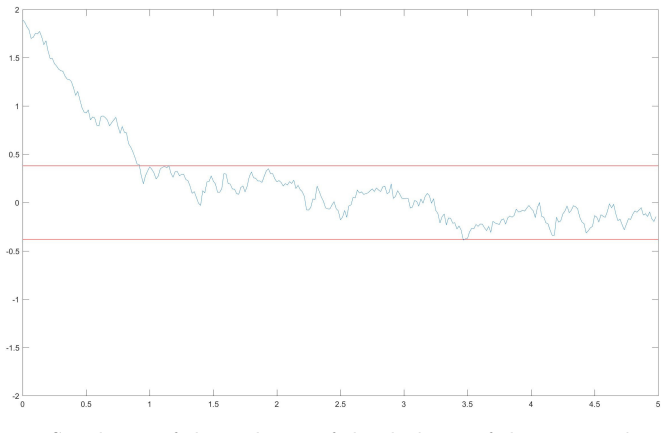
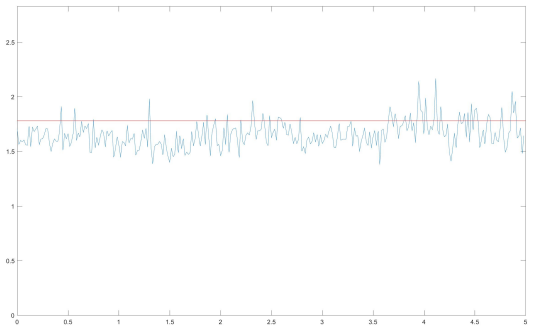
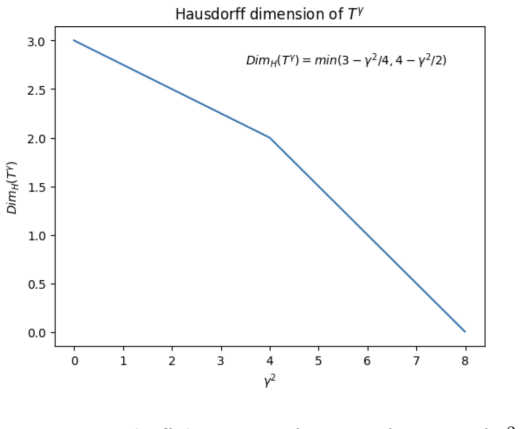
read the original abstract
We investigate the evolution of thick points under two natural dynamics for the Gaussian free field (GFF) in dimension 2. The first dynamic we analyze is the Ornstein-Uhlenbeck GFF. We prove that, simultaneously for all points, the evolution of their thickness is continuous. Additionally, we characterize all deterministic functions $f: \mathbb{R}\rightarrow \mathbb{R}$ such that there are points whose thickness function is $f$. The second dynamic we study is the stationary solution of the additive stochastic heat equation. In this case, the thickness of points is not continuous. Moreover, this rougher dynamic generates super-thick points, namely points with thickness greater than $2$. As a function of $\gamma > 2$, we identify infinitely many phase transitions corresponding to the existence of exceptional times where at least $N$ points are $\gamma$-thick. These phase transitions, occurring at $\gamma^2 = 8, 6, 16/3, \dots$, converge to $4$ as $N \to \infty$. Mapping to the critical FK-model parameter via $q=4\cos^2(4\pi/\gamma^2)$, these critical values correspond to the Beraha numbers, which are precisely the points at which the CFT for critical FK percolation should be minimal
Editorial analysis
A structured set of objections, weighed in public.
Referee Report
Summary. The manuscript investigates the evolution of thick points of the 2D Gaussian free field under two dynamics: the Ornstein-Uhlenbeck GFF and the stationary additive stochastic heat equation. For the OU dynamics it claims simultaneous continuity of thickness for all points and a complete characterization of admissible deterministic thickness functions f. For the SHE dynamics it claims discontinuity of thickness, the existence of super-thick points (thickness >2), and the location of infinitely many phase transitions in gamma>2 for the existence of at least N gamma-thick points at the values gamma^2=8,6,16/3,..., converging to 4; these are mapped to Beraha numbers via q=4 cos^2(4 pi / gamma^2) and linked to minimal CFT for critical FK percolation.
Significance. If the stated continuity, characterization, and phase-transition results hold with the indicated rigor, the work supplies a precise dynamical analysis of exceptional sets for log-correlated fields, connecting the geometry of thick points to stochastic PDEs and to the Beraha numbers of FK percolation. The explicit sequence of critical gamma values and the observation that they accumulate at the Liouville quantum gravity threshold constitute a concrete, falsifiable contribution to the interface between Gaussian multiplicative chaos and conformal field theory.
minor comments (3)
- The definition of thickness (via cutoffs or limits on the circle-average or other regularization of the GFF) should be stated explicitly in §1 or §2 before the statements of the main theorems, even if it follows standard references; this would make the continuity claim in the OU case immediately verifiable from the text.
- In the phase-transition statement, the precise meaning of 'exceptional times' (Lebesgue measure zero but positive Hausdorff dimension, or existence in the support of the measure) should be clarified in the paragraph following the list of gamma^2 values.
- The mapping q=4 cos^2(4 pi / gamma^2) is presented as an observation; a short remark confirming that the critical values indeed land exactly on the Beraha sequence (rather than approximately) would strengthen the CFT link without altering the probabilistic content.
Simulated Author's Rebuttal
We thank the referee for their positive assessment of the manuscript, the recognition of its significance at the interface of Gaussian multiplicative chaos, stochastic PDEs, and conformal field theory, and the recommendation of minor revision. No specific major comments or concerns were raised in the report.
Circularity Check
No significant circularity identified
full rationale
The paper derives its main results on continuity of thickness under OU dynamics, characterization of admissible thickness functions, non-continuity and super-thick points under additive SHE, and the explicit locations of gamma-phase transitions directly from the standard log-correlated covariance structure of the 2D GFF together with explicit constructions and analysis of the two dynamics. The Beraha-number mapping is presented strictly as a post-hoc observation after the transition values are obtained, not as an input or justification. No self-definitional reductions, fitted quantities renamed as predictions, or load-bearing self-citations appear in the derivation chain.
Axiom & Free-Parameter Ledger
axioms (1)
- domain assumption The two-dimensional Gaussian free field exists with its standard logarithmic covariance kernel.
Reference graph
Works this paper leans on
-
[1]
Agresti, Antonio , journal=
-
[2]
arXiv preprint arXiv:2602.05886 , year=
The Ising magnetisation field and the Gaussian free field , author=. arXiv preprint arXiv:2602.05886 , year=
- [3]
-
[4]
Electronic Journal of Probability , number =
Juhan Aru and Avelio Sep. Electronic Journal of Probability , number =. 2018 , doi =
2018
-
[5]
Journal of the Institute of Mathematics of Jussieu , volume=
Aru, Juhan and Sep. Journal of the Institute of Mathematics of Jussieu , volume=. 2019 , publisher=
2019
-
[6]
Probability Theory and Related Fields , volume=
Aru, Juhan and Lupu, Titus and Sep. Probability Theory and Related Fields , volume=. 2020 , publisher=
2020
-
[7]
Communications in Mathematical Physics , volume=
Aru, Juhan and Lupu, Titus and Sep. Communications in Mathematical Physics , volume=. 2020 , publisher=
2020
-
[8]
Aru, Juhan and Lupu, Titus and Sepúlveda, Avelio , journal=
-
[9]
Electronic Communications in Probability , number =
Nathana. Electronic Communications in Probability , number =. 2017 , doi =
2017
-
[10]
Journal of Combinatorial Theory, Series B , volume=
Limits of chromatic zeros of some families of maps , author=. Journal of Combinatorial Theory, Series B , volume=. 1980 , publisher=
1980
-
[11]
The Annals of Probability , volume=
Bauerschmidt, Roland and Park, Jiwoon and Rodríguez, Pierre-Fran. The Annals of Probability , volume=. 2024 , publisher=
2024
-
[12]
Norms in motivic homotopy theory
Duplantier, Bertrand and Miller, Jason and Sheffield, Scott , TITLE =. Ast\'erisque , FJOURNAL =. 2021 , PAGES =. doi:10.24033/ast , URL =
-
[13]
The Annals of Probability , number =
Ewain Gwynne and Jason Miller and Scott Sheffield , title =. The Annals of Probability , number =. 2021 , doi =
2021
-
[14]
The Annals of Probability , number =
Xiaoyu Hu and Jason Miller and Yuval Peres , title =. The Annals of Probability , number =. 2010 , doi =
2010
-
[15]
Markov Processes And Related Fields , publisher=
Aru, Juhan , title=. Markov Processes And Related Fields , publisher=. 2020 , number=
2020
-
[16]
2020 , publisher=
Garban, Christophe , journal=. 2020 , publisher=
2020
-
[17]
2016 , publisher=
Hairer, Martin and Shen, Hao , journal=. 2016 , publisher=
2016
-
[18]
2010 , publisher=
M. 2010 , publisher=
2010
-
[19]
arXiv e-prints, page , author=
Critical Gaussian multiplicative chaos: a review. arXiv e-prints, page , author=. arXiv preprint arXiv:2006.13767 , year=
arXiv 2006
-
[20]
Annales de l'Institut Henri Poincaré, Probabilités et Statistiques , number =
Ellen Powell and Hao Wu , title =. Annales de l'Institut Henri Poincaré, Probabilités et Statistiques , number =. 2017 , doi =
2017
-
[21]
Electronic Journal of Probability , number =
Ellen Powell , title =. Electronic Journal of Probability , number =. 2018 , doi =
2018
-
[22]
2011 , publisher=
Br. 2011 , publisher=
2011
-
[23]
Modern Physics Letters B , volume=
The antiferromagnetic Potts model , author=. Modern Physics Letters B , volume=. 2011 , publisher=
2011
-
[24]
Acta Mathematica , volume=
Convergence of uniform triangulations under the Cardy embedding , author=. Acta Mathematica , volume=. 2023 , publisher=
2023
-
[25]
Stein, Elias M and Shakarchi, Rami , year=
-
[26]
2022 , publisher=
Evans, Lawrence C , volume=. 2022 , publisher=
2022
-
[27]
2024 , publisher=
Leoni, Giovanni , volume=. 2024 , publisher=
2024
-
[28]
Peyriere, Jacques , journal=
-
[29]
Departamiento de Ingenieria Matematica , volume=
San Mart. Departamiento de Ingenieria Matematica , volume=
-
[30]
Hairer, Martin , journal=
-
[31]
Falconer, Kenneth , year=
-
[32]
2007 , publisher=
Sheffield, Scott , journal=. 2007 , publisher=
2007
-
[33]
1967 , organization=
Gross, Leonard , booktitle=. 1967 , organization=
1967
-
[34]
2016 , publisher=
Le Gall, Jean-Fran. 2016 , publisher=
2016
-
[35]
Hida, Takeyuki and Hida, T , year=
-
[36]
Annales de l'Institut Henri Poincaré, Probabilités et Statistiques , number =
Marek Biskup and Oren Louidor , title =. Annales de l'Institut Henri Poincaré, Probabilités et Statistiques , number =. 2019 , doi =
2019
-
[37]
International Mathematics Research Notices , volume =
Rider, Brian and Virág, Bálint , title =. International Mathematics Research Notices , volume =. 2007 , month =. doi:10.1093/imrn/rnm006 , url =
-
[38]
2016 , publisher=
Miller, Jason and Sheffield, Scott , journal=. 2016 , publisher=
2016
-
[39]
2017 , publisher=
Miller, Jason and Sheffield, Scott , journal=. 2017 , publisher=
2017
-
[40]
Journal de l’
An axiomatic characterization of the Brownian map , author=. Journal de l’
-
[41]
2015 , publisher=
Aru, Juhan , journal=. 2015 , publisher=
2015
-
[42]
2017 , publisher=
Wang, Menglu and Wu, Hao , journal=. 2017 , publisher=
2017
-
[43]
2014 , publisher=
Geisinger, Leander , journal=. 2014 , publisher=
2014
-
[44]
2020 , organization=
Biskup, Marek , booktitle=. 2020 , organization=
2020
-
[45]
Kahane, Jean-Pierre , journal=
-
[46]
2011 , publisher=
Duplantier, Bertrand and Sheffield, Scott , journal=. 2011 , publisher=
2011
-
[47]
The Annals of Probability , number =
Bertrand Duplantier and R. The Annals of Probability , number =. 2014 , doi =
2014
-
[48]
Communications in Mathematical Physics , volume=
Duplantier, Bertrand and Rhodes, R. Communications in Mathematical Physics , volume=. 2014 , publisher=
2014
-
[49]
Duplantier, Bertrand and Miller, Jason and Sheffield, Scott , journal=
-
[50]
Communications in Mathematical Physics , volume=
David, Fran. Communications in Mathematical Physics , volume=. 2016 , publisher=
2016
-
[51]
Journal of Mathematical physics , volume=
Liouville quantum gravity on complex tori , author=. Journal of Mathematical physics , volume=. 2016 , publisher=
2016
-
[52]
2024 , publisher=
Bazaes, Rodrigo and Lammers, Isabel and Mukherjee, Chiranjib , journal=. 2024 , publisher=
2024
-
[53]
arXiv preprint arXiv:1410.5407 , year=
Berestycki, Nathana. arXiv preprint arXiv:1410.5407 , year=
-
[54]
Gaussian free field convergence of the six-vertex model with
Duminil-Copin, Hugo and Kozlowski, Karol Kajetan and Lammers, Piet and Manolescu, Ioan , journal=. Gaussian free field convergence of the six-vertex model with
-
[55]
Duminil-Copin, Hugo and Lis, Marcin and Qian, Wei , journal=
-
[56]
Communications in Partial Differential Equations , volume=
Uniform bounds for eigenfunctions of the Laplacian on manifolds with boundary , author=. Communications in Partial Differential Equations , volume=. 2002 , publisher=
2002
-
[57]
1996 , publisher=
Partial differential equations III , author=. 1996 , publisher=
1996
-
[58]
Gaussian Free Field and Liouville Quantum Gravity , publisher=
Berestycki, Nathanaël and Powell, Ellen , year=. Gaussian Free Field and Liouville Quantum Gravity , publisher=
-
[59]
2025 , publisher=
Gaussian free field and Liouville quantum gravity , author=. 2025 , publisher=
2025
-
[60]
2021 , publisher=
Lecture notes on the Gaussian free field , author=. 2021 , publisher=
2021
-
[61]
Nuclear Physics B , volume=
The antiferromagnetic transition for the square-lattice Potts model , author=. Nuclear Physics B , volume=. 2006 , publisher=
2006
-
[62]
1997 , publisher=
Foundations of modern probability , author=. 1997 , publisher=
1997
-
[63]
Annals of probability , pages=
Dominos and the Gaussian free field , author=. Annals of probability , pages=. 2001 , publisher=
2001
-
[64]
2009 , publisher=
Lectures on fractal geometry and dynamical systems , author=. 2009 , publisher=
2009
-
[65]
An elementary approach to quantum length of
Powell, Ellen and Sep. An elementary approach to quantum length of. Probability and Mathematical Physics , volume=. 2025 , publisher=
2025
-
[66]
Springer Monographs in Mathematics , year=
Discrete energy on rectifiable sets , author=. Springer Monographs in Mathematics , year=
-
[67]
Selected Works of Oded Schramm , pages=
Quantitative noise sensitivity and exceptional times for percolation , author=. Selected Works of Oded Schramm , pages=. 2011 , publisher=
2011
-
[68]
Annales de l'Institut Henri Poincare (B) Probability and Statistics , volume=
Dynamical percolation , author=. Annales de l'Institut Henri Poincare (B) Probability and Statistics , volume=. 1997 , organization=
1997
-
[69]
Annales Scientifiques de l'
Exceptional times for percolation under exclusion dynamics , author=. Annales Scientifiques de l'
-
[70]
International Mathematics Research Notices , volume=
The noise in the circular law and the Gaussian free field , author=. International Mathematics Research Notices , volume=. 2007 , publisher=
2007
-
[71]
Probability Theory and Related Fields , volume=
Non-simple conformal loop ensembles on Liouville quantum gravity and the law of CLE percolation interfaces , author=. Probability Theory and Related Fields , volume=. 2021 , publisher=
2021
-
[72]
The Annals of Probability , number =
Scott Sheffield , title =. The Annals of Probability , number =. 2016 , doi =
2016
-
[73]
arXiv preprint arXiv:2602.21981 , year=
Fractal dimension of singular times for SPDEs: Energy bounds, criticality, and weak-strong uniqueness , author=. arXiv preprint arXiv:2602.21981 , year=
-
[74]
Transfer matrices and partition-function zeros for antiferromagnetic Potts models. I. General theory and square-lattice chromatic polynomial , author=. Journal of Statistical Physics , volume=. 2001 , publisher=
2001
-
[75]
Nuclear Physics B , volume=
The antiferromagnetic Potts model in two dimensions: Berker-Kadanoff phase, antiferromagnetic transition, and the role of Beraha numbers , author=. Nuclear Physics B , volume=. 1991 , publisher=
1991
-
[76]
Communications in Mathematical Physics , number =
Raphael H. Communications in Mathematical Physics , number =
-
[77]
Acta Mathematica , number =
Oded Schramm and Scott Sheffield , title =. Acta Mathematica , number =. 2009 , doi =
2009
-
[78]
Journal of Combinatorial Theory , volume=
On chromatic polynomials and the golden ratio , author=. Journal of Combinatorial Theory , volume=. 1970 , publisher=
1970
-
[79]
Communications in Mathematical Physics , volume=
On the parabolic and hyperbolic Liouville equations , author=. Communications in Mathematical Physics , volume=. 2021 , publisher=
2021
-
[80]
1991 , publisher=
Potts models and related problems in statistical mechanics , author=. 1991 , publisher=
1991
discussion (0)
Sign in with ORCID, Apple, or X to comment. Anyone can read and Pith papers without signing in.