Hybrid Hamiltonian-diagrammatic quantum impurity solver
Pith reviewed 2026-06-27 11:20 UTC · model grok-4.3
The pith
Adding a small auxiliary bath to diagrammatic solvers reduces the residual problem to one where low-order perturbation theory converges rapidly and accurately.
A machine-rendered reading of the paper's core claim, the machinery that carries it, and where it could break.
Core claim
Augmenting a diagrammatic expansion with a small auxiliary bath discretization reduces the residual quantum impurity problem to a regime in which low-order perturbation theory becomes highly accurate and rapidly convergent. In a simple benchmark this hybrid yields precision several orders of magnitude above bold-line calculations; for a strongly interacting two-orbital model with a severe sign problem, convergence occurs at three orders of magnitude lower computational cost; and convergence to the unknown exact result accelerates markedly in a difficult realistic problem.
What carries the argument
The auxiliary bath that is added to the diagrammatic expansion so that the remaining interaction is weak enough for low-order perturbation theory to suffice.
If this is right
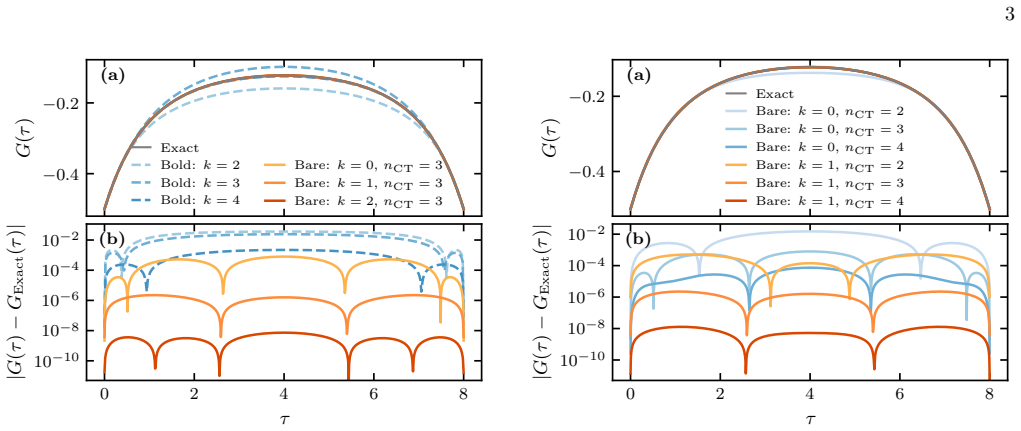
- Precision several orders of magnitude above bold-line diagrammatic results is obtained on simple benchmarks.
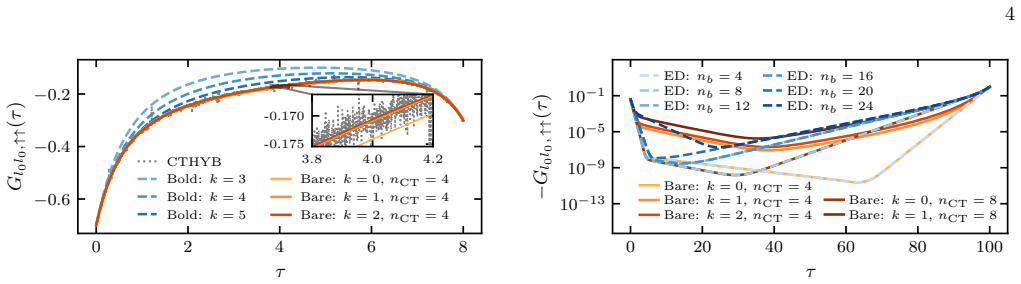
- A two-orbital model with severe sign problem converges at three orders of magnitude lower cost than existing methods.
- Convergence to the exact result accelerates rapidly in difficult realistic impurity problems.
- The approach supplies a practical route to high-precision solutions for quantum impurity models in correlated systems.
Where Pith is reading between the lines
- The same bath-augmentation idea could be tested on other diagrammatic expansions that currently suffer from slow convergence or sign problems.
- Optimizing the auxiliary bath choice might further reduce the number of sites needed while preserving accuracy.
- The hybrid construction suggests a general strategy for turning intractable diagrammatic series into controllable perturbative ones by controlled discretization of part of the environment.
Load-bearing premise
A small auxiliary bath can be chosen so that the leftover diagrammatic problem enters a regime of rapid, accurate low-order convergence without the bath itself introducing uncontrolled systematic errors into the final impurity solution.
What would settle it
A controlled test on a model with a known exact solution in which the hybrid result, after systematic enlargement of the auxiliary bath, deviates from the exact value by more than the claimed improvement over pure diagrammatic methods.
Figures
read the original abstract
Quantum impurity models, which describe the coupling between interacting orbitals and a non-interacting bath, play a central role in the physics of strongly correlated electron systems. Solving a quantum impurity model in general requires the use of non-perturbative numerical methods. Hamiltonian-based approaches, which rely on an explicit bath discretization, are typically limited to a small number of bath sites or small entanglement, and diagrammatic methods suffer from sign problems, slow convergence, or diagram truncation approximations. Here we show that these two classes of methods can be combined: augmenting diagrammatic methods with a small auxiliary bath can reduce the residual problem to a regime where low-order perturbation theory is highly accurate and rapidly converging. In a simple benchmark, the precision of the hybrid approach surpasses bold-line calculations by several orders of magnitude; for a strongly interacting two-orbital model with a severe sign problem, convergence is achieved at three orders of magnitude lower computational cost than competing methods; and convergence to the unknown exact result is rapidly accelerated in a difficult realistic problem. Our results establish a practical route to high-precision quantum impurity solutions in correlated quantum systems.
Editorial analysis
A structured set of objections, weighed in public.
Referee Report
Summary. The manuscript proposes a hybrid quantum impurity solver that augments diagrammatic perturbation theory with a small auxiliary bath obtained from Hamiltonian discretization. This is claimed to reduce the residual problem to a regime where low-order perturbation theory becomes highly accurate and rapidly convergent, yielding several orders of magnitude better precision than bold-line diagrammatic calculations in a simple benchmark, three orders of magnitude lower computational cost for a strongly interacting two-orbital model with a severe sign problem, and accelerated convergence in a realistic problem.
Significance. If the central claim holds, the hybrid method would provide a practical route to high-precision solutions for quantum impurity models that are difficult for either pure Hamiltonian or pure diagrammatic approaches, with potential applications in DMFT calculations for correlated materials. The reported numerical gains on sign-problematic cases would be a notable advance if they can be shown to arise from controlled suppression of the residual diagrammatic series rather than uncontrolled cancellations.
major comments (1)
- [Abstract and method description] The central claim rests on the existence of a small auxiliary bath such that the residual diagrammatic series after hybridization is both rapidly convergent and free of truncation bias. No systematic criterion, a-posteriori error estimator, or convergence bound with respect to bath size or diagram order is supplied that would certify this for arbitrary models; the benchmarks demonstrate numerical improvement but do not isolate whether the observed precision gain is due to genuine suppression of the residual or to partial cancellation between bath-induced bias and PT truncation error.
Simulated Author's Rebuttal
We thank the referee for the careful reading and constructive feedback. We address the single major comment below.
read point-by-point responses
-
Referee: [Abstract and method description] The central claim rests on the existence of a small auxiliary bath such that the residual diagrammatic series after hybridization is both rapidly convergent and free of truncation bias. No systematic criterion, a-posteriori error estimator, or convergence bound with respect to bath size or diagram order is supplied that would certify this for arbitrary models; the benchmarks demonstrate numerical improvement but do not isolate whether the observed precision gain is due to genuine suppression of the residual or to partial cancellation between bath-induced bias and PT truncation error.
Authors: We agree that no general systematic criterion, a-posteriori estimator, or model-independent convergence bound is supplied; deriving such a bound lies outside the scope of the present work and would be highly model-dependent. The benchmarks nevertheless allow isolation of the effect in at least one case: the simple benchmark compares directly against the known exact solution and shows that the hybrid solver achieves several orders of magnitude higher precision than bold-line diagrammatic calculations at the same diagram order, consistent with genuine suppression of the residual series rather than cancellation. The two-orbital and realistic-model benchmarks further show accelerated convergence to results obtained by independent methods. We will revise the manuscript to add an explicit discussion of these points and of the absence of a general bound. revision: yes
Circularity Check
No significant circularity; derivation self-contained via external benchmarks
full rationale
The paper proposes combining Hamiltonian discretization with diagrammatic perturbation theory via an auxiliary bath, claiming improved convergence on external benchmarks (simple model, two-orbital sign-problem case, realistic problem). No quoted equations or steps reduce a claimed prediction to a fitted parameter by construction, invoke self-citations as uniqueness theorems, or rename known results. The auxiliary-bath choice and low-order truncation are presented as empirical improvements validated against independent reference calculations, with no load-bearing self-referential definitions or ansatzes smuggled via prior author work. The derivation chain therefore remains independent of its own outputs.
Axiom & Free-Parameter Ledger
axioms (1)
- domain assumption A small auxiliary bath can be chosen so that the residual problem lies in a regime where low-order perturbation theory is highly accurate.
Reference graph
Works this paper leans on
-
[1]
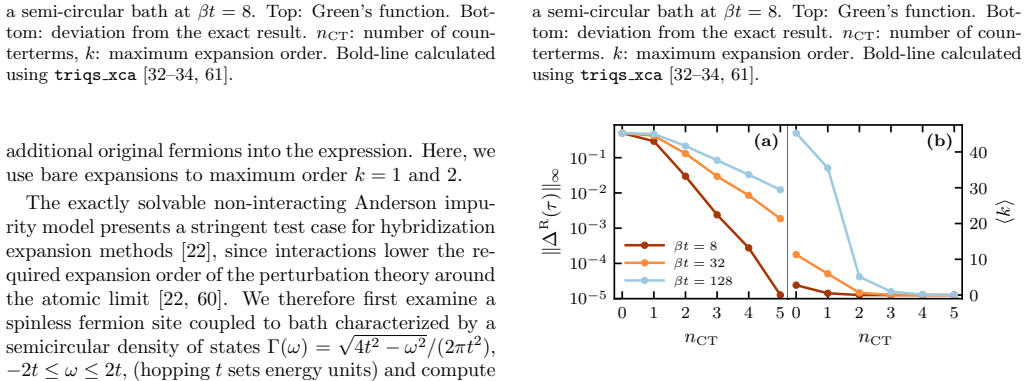
While the impurity Green’s functionGis problem-specific (and exactly known in the current example), the hybridization strength ∆R depends on the number of counterterms
of the bare hybridization expansion, which is given by⟨k⟩=− P 12 ∆R 12G21 [63]. While the impurity Green’s functionGis problem-specific (and exactly known in the current example), the hybridization strength ∆R depends on the number of counterterms. The left panel of Fig. 3 shows the magnitude of this residual hybridization ∆ R for the example of Fig. 1, t...
-
[2]
P. W. Anderson, Localized Magnetic States in Metals, Physical Review124, 41 (1961)
1961
-
[3]
Hanson, Spins in few-electron quantum dots, Reviews of Modern Physics79, 1217 (2007)
R. Hanson, Spins in few-electron quantum dots, Reviews of Modern Physics79, 1217 (2007)
2007
-
[4]
D. C. Langreth, Derivation of a master equation for charge-transfer processes in atom-surface collisions, Physical Review B43, 2541 (1991)
1991
-
[5]
Georges, G
A. Georges, G. Kotliar, W. Krauth, and M. J. Rozen- berg, Dynamical mean-field theory of strongly correlated fermion systems and the limit of infinite dimensions, Re- views of Modern Physics68, 13 (1996)
1996
-
[6]
Kotliar, S
G. Kotliar, S. Y. Savrasov, K. Haule, V. S. Oudovenko, O. Parcollet, and C. A. Marianetti, Electronic structure calculations with dynamical mean-field theory, Reviews of Modern Physics78, 865 (2006)
2006
-
[7]
Zgid and E
D. Zgid and E. Gull, Finite temperature quantum em- bedding theories for correlated systems, New Journal of Physics19, 023047 (2017)
2017
-
[8]
A. A. Rusakov, S. Iskakov, L. N. Tran, and D. Zgid, Self- Energy Embedding Theory (SEET) for Periodic Systems, Journal of Chemical Theory and Computation15, 229 (2019)
2019
-
[9]
L. N. Tran, N. L. Nguyen, S. Iskakov, and D. Zgid, Gen- eralized self-energy embedding theory, The Journal of Physical Chemistry Letters8, 1859 (2017)
2017
-
[10]
Caffarel and W
M. Caffarel and W. Krauth, Exact diagonalization ap- proach to correlated fermions in infinite dimensions: Mott transition and superconductivity, Physical Review Letters72, 1545 (1994)
1994
-
[11]
Zgid and G
D. Zgid and G. K.-L. Chan, Dynamical mean-field theory from a quantum chemical perspective, The Journal of Chemical Physics134, 094115 (2011)
2011
-
[12]
D. Zgid, E. Gull, and G. K.-L. Chan, Truncated config- uration interaction expansions as solvers for correlated quantum impurity models and dynamical mean-field the- ory, Physical Review B86, 165128 (2012)
2012
-
[13]
Shee and D
A. Shee and D. Zgid, Coupled Cluster as an Impu- rity Solver for Green’s Function Embedding Methods, Journal of Chemical Theory and Computation15, 6010 (2019)
2019
-
[14]
T. Zhu, Coupled-cluster impurity solvers for dynamical mean-field theory, Physical Review B100, 10.1103/Phys- RevB.100.115154 (2019)
-
[15]
Nishimoto and E
S. Nishimoto and E. Jeckelmann, Density-matrix renor- malization group approach to quantum impurity prob- lems, Journal of Physics: Condensed Matter16, 613 (2004)
2004
-
[16]
D. J. Garc´ ıa, K. Hallberg, and M. J. Rozenberg, Dynam- ical Mean Field Theory with the Density Matrix Renor- malization Group, Physical Review Letters93, 246403 (2004)
2004
-
[17]
X. Cao, Y. Lu, E. M. Stoudenmire, and O. Parcollet, Dynamical correlation functions from complex time evo- lution, Physical Review B109, 235110 (2024)
2024
-
[18]
Grundner, P
M. Grundner, P. Westhoff, F. B. Kugler, O. Parcollet, and U. Schollw¨ ock, Complex time evolution in tensor networks and time-dependent Green’s functions, Phys- ical Review B109, 155124 (2024)
2024
-
[19]
Y. Yu, L. Zhang, E. Gull, X. Cao, and X. Dong, Multi- orbital dynamical mean-field theory with a complex-time solver, Physical Review Research8, 023142 (2026)
2026
-
[20]
Y. Lu, M. H¨ oppner, O. Gunnarsson, and M. W. Haverkort, Efficient real-frequency solver for dynamical mean-field theory, Phys. Rev. B90, 085102 (2014)
2014
-
[21]
Lu and M
Y. Lu and M. W. Haverkort, Exact diagonalization as an impurity solver in dynamical mean field theory, The Eu- ropean Physical Journal Special Topics226, 2549 (2017)
2017
-
[22]
A. N. Rubtsov, V. V. Savkin, and A. I. Lichten- stein, Continuous-time quantum Monte Carlo method for fermions, Physical Review B72, 035122 (2005)
2005
-
[23]
Werner, A
P. Werner, A. Comanac, L. de’ Medici, M. Troyer, and A. J. Millis, Continuous-time solver for quantum impu- rity models, Physical Review Letters97, 076405 (2006)
2006
-
[24]
E. Gull, P. Werner, O. Parcollet, and M. Troyer, Continuous-time auxiliary-field Monte Carlo for quantum 6 impurity models, EPL (Europhysics Letters)82, 57003 (2008)
2008
-
[25]
E. Gull, D. R. Reichman, and A. J. Millis, Bold-line di- agrammatic Monte Carlo method: General formulation and application to expansion around the noncrossing ap- proximation, Physical Review B82, 075109 (2010)
2010
-
[26]
E. Gull, A. J. Millis, A. I. Lichtenstein, A. N. Rubtsov, M. Troyer, and P. Werner, Continuous-time Monte Carlo methods for quantum impurity models, Reviews of Mod- ern Physics83, 349 (2011)
2011
-
[27]
Eidelstein, E
E. Eidelstein, E. Gull, and G. Cohen, Multiorbital Quantum Impurity Solver for General Interactions and Hybridizations, Physical Review Letters124, 206405 (2020)
2020
-
[28]
Keiter and J
H. Keiter and J. C. Kimball, Perturbation Technique for the Anderson Hamiltonian, Physical Review Letters25, 672 (1970)
1970
-
[29]
Pruschke and N
Th. Pruschke and N. Grewe, The Anderson model with finite Coulomb repulsion, Zeitschrift f¨ ur Physik B Con- densed Matter74, 439 (1989)
1989
-
[30]
N´ u˜ nez Fern´ andez, M
Y. N´ u˜ nez Fern´ andez, M. Jeannin, P. T. Dumitrescu, T. Kloss, J. Kaye, O. Parcollet, and X. Waintal, Learning Feynman Diagrams with Tensor Trains, Physical Review X12, 041018 (2022)
2022
-
[31]
Y. Yu, A. Erpenbeck, D. Zgid, G. Cohen, O. Parcollet, and E. Gull, Inchworm tensor train hybridization expan- sion quantum impurity solver, Physical Review B112, 085120 (2025)
2025
-
[32]
Erpenbeck, W.-T
A. Erpenbeck, W.-T. Lin, T. Blommel, L. Zhang, S. Iskakov, L. Bernheimer, Y. N´ u˜ nez-Fern´ andez, G. Co- hen, O. Parcollet, X. Waintal, and E. Gull, Tensor train continuous time solver for quantum impurity models, Physical Review B107, 245135 (2023)
2023
-
[33]
J. Kaye, Z. Huang, H. U. R. Strand, and D. Goleˇ z, Decomposing Imaginary-Time Feynman Diagrams Using Separable Basis Functions: Anderson Impurity Model Strong-Coupling Expansion, Physical Review X14, 031034 (2024)
2024
-
[34]
J. Kaye, H. U. r Strand, and N. Wentzell, Cppdlr: Imag- inary time calculations using the discrete Lehmann rep- resentation, Journal of Open Source Software9, 6297 (2024)
2024
-
[35]
Huang, D
Z. Huang, D. Golez, H. U. R. Strand, and J. Kaye, Auto- mated evaluation of imaginary time strong coupling dia- grams by sum-of-exponentials hybridization fitting, Sci- Post Physics19, 121 (2025)
2025
-
[36]
Pollet, N
L. Pollet, N. V. Prokof’ev, and B. V. Svistunov, Regu- larization of Diagrammatic Series with Zero Convergence Radius, Physical Review Letters105, 210601 (2010)
2010
-
[37]
Rossi, F
R. Rossi, F. Werner, N. Prokof’ev, and B. Svistunov, Shifted-action expansion and applicability of dressed di- agrammatic schemes, Physical Review B93, 161102 (2016)
2016
-
[38]
Rossi, Determinant Diagrammatic Monte Carlo Al- gorithm in the Thermodynamic Limit, Physical Review Letters119, 045701 (2017)
R. Rossi, Determinant Diagrammatic Monte Carlo Al- gorithm in the Thermodynamic Limit, Physical Review Letters119, 045701 (2017)
2017
-
[39]
A. J. Kim, N. V. Prokof’ev, B. V. Svistunov, and E. Kozik, Homotopic Action: A Pathway to Convergent Diagrammatic Theories, Physical Review Letters126, 257001 (2021)
2021
-
[40]
Wang and K
Y. Wang and K. Haule, Variational Diagrammatic Monte Carlo Built on Dynamical Mean-Field Theory, Physical Review Letters135, 176501 (2025)
2025
-
[41]
J. Li, M. Wallerberger, and E. Gull, Diagrammatic Monte Carlo method for impurity models with general interac- tions and hybridizations, Physical Review Research2, 033211 (2020)
2020
-
[42]
J. Li, Y. Yu, E. Gull, and G. Cohen, Interaction- expansion inchworm Monte Carlo solver for lattice and impurity models, Physical Review B105, 165133 (2022)
2022
-
[43]
A. N. Rubtsov, M. I. Katsnelson, and A. I. Lichtenstein, Dual fermion approach to nonlocal correlations in the Hubbard model, Physical Review B77, 033101 (2008)
2008
-
[44]
Rohringer, H
G. Rohringer, H. Hafermann, A. Toschi, A. A. Katanin, A. E. Antipov, M. I. Katsnelson, A. I. Lichtenstein, A. N. Rubtsov, and K. Held, Diagrammatic routes to nonlo- cal correlations beyond dynamical mean field theory, Re- views of Modern Physics90, 025003 (2018)
2018
-
[45]
See the Supplemental Material at XXX for the deriva- tion of the formulas presented in the main text, along with supplemental numerical results, which included Refs. [45–51]. (n.d.)
-
[46]
C. G. BROYDEN, The Convergence of a Class of Double- rank Minimization Algorithms 1. General Considera- tions, IMA Journal of Applied Mathematics6, 76 (1970)
1970
-
[47]
M. J. D. Powell,The BOBYQA Algorithm for Bound Constrained Optimization without Derivatives, Technical Report NA2009/06 (Department of Applied Mathemat- ics and Theoretical Physics, Cambridge University, Cam- bridge, England, 2009)
2009
-
[48]
Roy and T
R. Roy and T. Kailath, ESPRIT-estimation of signal parameters via rotational invariance techniques, IEEE Transactions on Acoustics, Speech, and Signal Process- ing37, 984 (1989)
1989
-
[49]
Hua and T
Y. Hua and T. Sarkar, Matrix pencil method for estimat- ing parameters of exponentially damped/undamped sinu- soids in noise, IEEE Transactions on Acoustics, Speech, and Signal Processing38, 814 (1990)
1990
-
[50]
Sarkar and O
T. Sarkar and O. Pereira, Using the matrix pencil method to estimate the parameters of a sum of complex exponen- tials, IEEE Antennas and Propagation Magazine37, 48 (1995)
1995
-
[51]
Fei, C.-N
J. Fei, C.-N. Yeh, D. Zgid, and E. Gull, Analytical con- tinuation of matrix-valued functions: Carath´ eodory for- malism, Physical Review B104, 165111 (2021)
2021
-
[52]
Nakatsukasa, O
Y. Nakatsukasa, O. S` ete, and L. N. Trefethen, The AAA Algorithm for Rational Approximation, SIAM Journal on Scientific Computing40, A1494 (2018)
2018
-
[53]
Mejuto-Zaera, L
C. Mejuto-Zaera, L. Zepeda-N´ u˜ nez, M. Lindsey, N. Tub- man, B. Whaley, and L. Lin, Efficient hybridization fit- ting for dynamical mean-field theory via semi-definite re- laxation, Physical Review B101, 035143 (2020)
2020
-
[54]
Huang, E
Z. Huang, E. Gull, and L. Lin, Robust analytic contin- uation of Green’s functions via projection, pole estima- tion, and semidefinite relaxation, Physical Review B107, 075151 (2023)
2023
-
[55]
Zhang and E
L. Zhang and E. Gull, Minimal pole representation and controlled analytic continuation of Matsubara response functions, Physical Review B110, 035154 (2024)
2024
-
[56]
Zhang, Y
L. Zhang, Y. Yu, and E. Gull, Minimal pole representa- tion and analytic continuation of matrix-valued correla- tion functions, Physical Review B110, 235131 (2024)
2024
-
[57]
Zhang, A
L. Zhang, A. Erpenbeck, Y. Yu, and E. Gull, Minimal pole representation for spectral functions, The Journal of Chemical Physics162, 214111 (2025)
2025
-
[58]
Ying, Pole Recovery From Noisy Data on Imaginary Axis, Journal of Scientific Computing92, 107 (2022)
L. Ying, Pole Recovery From Noisy Data on Imaginary Axis, Journal of Scientific Computing92, 107 (2022)
2022
-
[59]
Ying, Analytic continuation from limited noisy Mat- 7 subara data, Journal of Computational Physics469, 111549 (2022)
L. Ying, Analytic continuation from limited noisy Mat- 7 subara data, Journal of Computational Physics469, 111549 (2022)
2022
-
[60]
J. Ostmeyer and C. Urbach, The Truncated Hankel Cor- relator Method (2025), arXiv:2510.15500 [hep-lat]
arXiv 2025
-
[61]
E. Gull, P. Werner, A. Millis, and M. Troyer, Perfor- mance analysis of continuous-time solvers for quantum impurity models, Physical Review B76, 235123 (2007)
2007
-
[62]
J. Kaye, K. Chen, and O. Parcollet, Discrete Lehmann representation of imaginary time Green’s functions, Physical Review B105, 235115 (2022)
2022
-
[63]
J. Kaye, K. Chen, and H. U. R. Strand, Libdlr: Efficient imaginary time calculations using the discrete Lehmann representation, Computer Physics Communications280, 108458 (2022)
2022
-
[64]
K. Haule, Quantum Monte Carlo impurity solver for clus- ter dynamical mean-field theory and electronic structure calculations with adjustable cluster base, Physical Re- view B75, 155113 (2007)
2007
-
[65]
Kanamori, Electron correlation and ferromagnetism of transition metals, Progress of Theoretical Physics30, 275 (1963)
J. Kanamori, Electron correlation and ferromagnetism of transition metals, Progress of Theoretical Physics30, 275 (1963)
1963
-
[66]
Werner, E
P. Werner, E. Gull, M. Troyer, and A. J. Millis, Spin Freezing Transition and Non-Fermi-Liquid Self-Energy in a Three-Orbital Model, Physical Review Letters101, 166405 (2008)
2008
-
[67]
Georges, L
A. Georges, L. de’ Medici, and J. Mravlje, Strong Cor- relations from Hund’s Coupling, Annual Review of Con- densed Matter Physics4, 137 (2013)
2013
-
[68]
Iskakov, C.-N
S. Iskakov, C.-N. Yeh, E. Gull, and D. Zgid, Ab initio self-energy embedding for the photoemission spectra of NiO and MnO, Physical Review B102, 085105 (2020)
2020
-
[69]
A. A. Kananenka, E. Gull, and D. Zgid, Systematically improvable multiscale solver for correlated electron sys- tems, Physical Review B91, 121111 (2015)
2015
-
[70]
C.-N. Yeh, S. Iskakov, D. Zgid, and E. Gull, Fully self- consistent finite-temperature$GW$in Gaussian Bloch orbitals for solids, Physical Review B106, 235104 (2022)
2022
-
[71]
Iskakov, C.-N
S. Iskakov, C.-N. Yeh, P. Pokhilko, Y. Yu, L. Zhang, G. Harsha, V. Abraham, M. Wen, M. Wang, J. Adamski, T. Chen, E. Gull, and D. Zgid, Green/WeakCoupling: Implementation of fully self-consistent finite-temperature many-body perturbation theory for molecules and solids, Computer Physics Communications306, 109380 (2025)
2025
-
[72]
Iskakov and M
S. Iskakov and M. Danilov, Exact diagonalization library for quantum electron models, Computer Physics Com- munications225, 128 (2018)
2018
-
[73]
Gaenko, A
A. Gaenko, A. E. Antipov, G. Carcassi, T. Chen, X. Chen, Q. Dong, L. Gamper, J. Gukelberger, R. Igarashi, S. Iskakov, M. K¨ onz, J. P. F. LeBlanc, R. Levy, P. N. Ma, J. E. Paki, H. Shinaoka, S. Todo, M. Troyer, and E. Gull, Updated core libraries of the ALPS project, Computer Physics Communications213, 235 (2017)
2017
-
[74]
Cohen, E
G. Cohen, E. Gull, D. R. Reichman, and A. J. Millis, Taming the dynamical sign problem in real-time evolu- tion of quantum many-body problems, Physical Review Letters115, 266802 (2015)
2015
-
[75]
Hybrid Hamiltonian- diagrammatic quantum impurity solver
Y. Yu, G. Harsha, L. Zhang, A. Ja˙ zd˙ zewska, D. Zgid, X. Dong, and E. Gull, Dataset for publication “Hybrid Hamiltonian- diagrammatic quantum impurity solver”, https://doi.org/10.5281/zenodo.20150672(2026)
discussion (0)
Sign in with ORCID, Apple, or X to comment. Anyone can read and Pith papers without signing in.