A systematic survey for hypervelocity runaways from thermonuclear supernovae
Pith reviewed 2026-06-27 11:29 UTC · model grok-4.3
The pith
A systematic Gaia survey of hypervelocity stars finds intermediate-heating models best match the observed D6 population and imply low birth rates.
A machine-rendered reading of the paper's core claim, the machinery that carries it, and where it could break.
Core claim
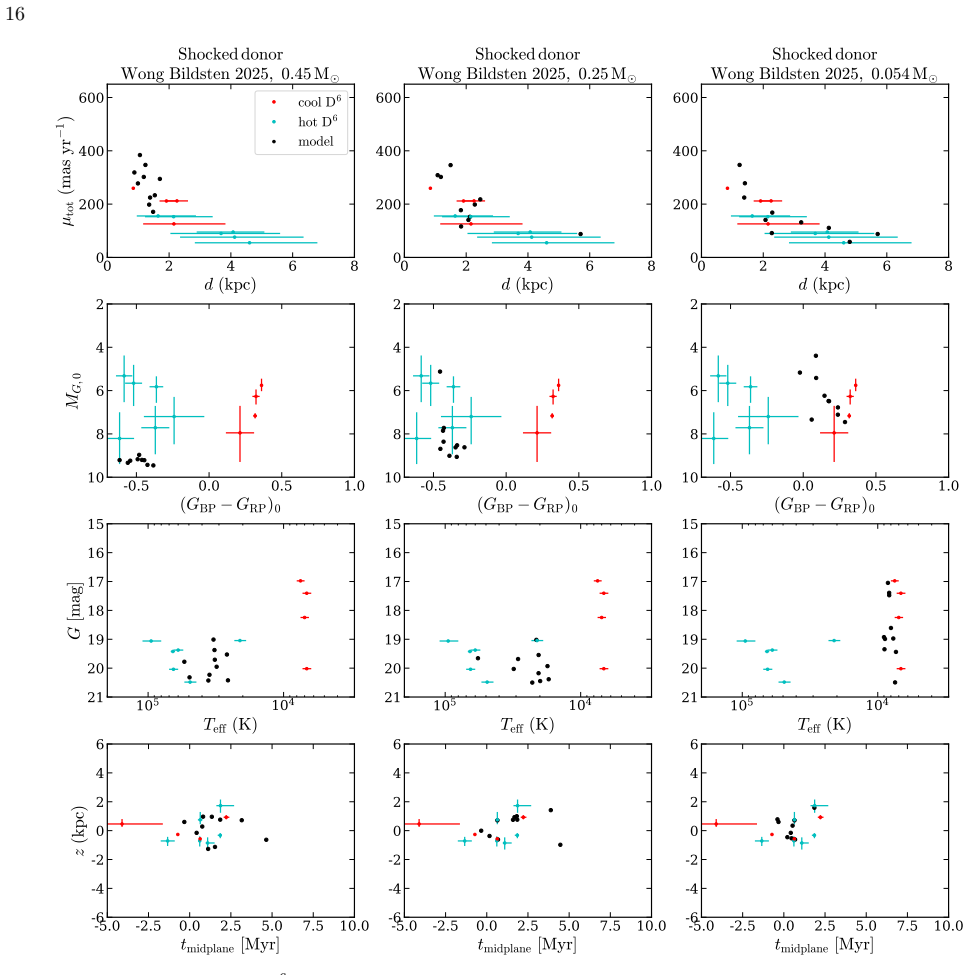
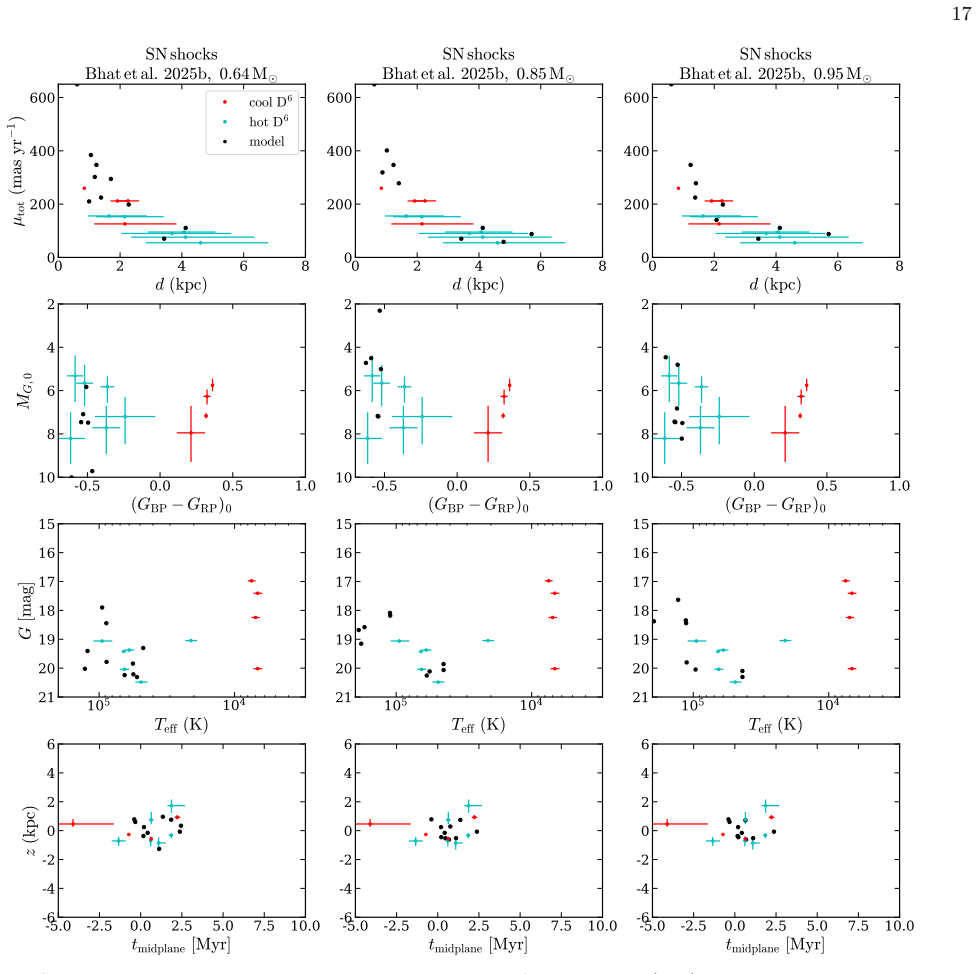
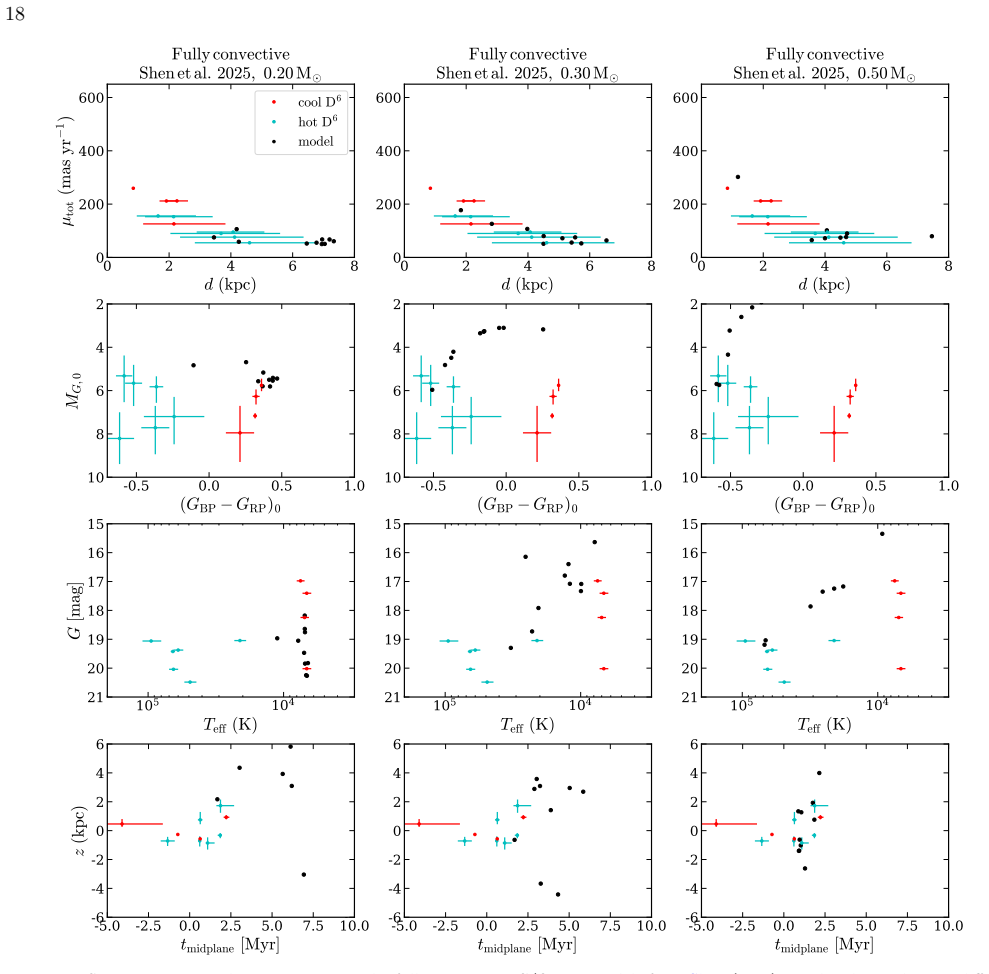
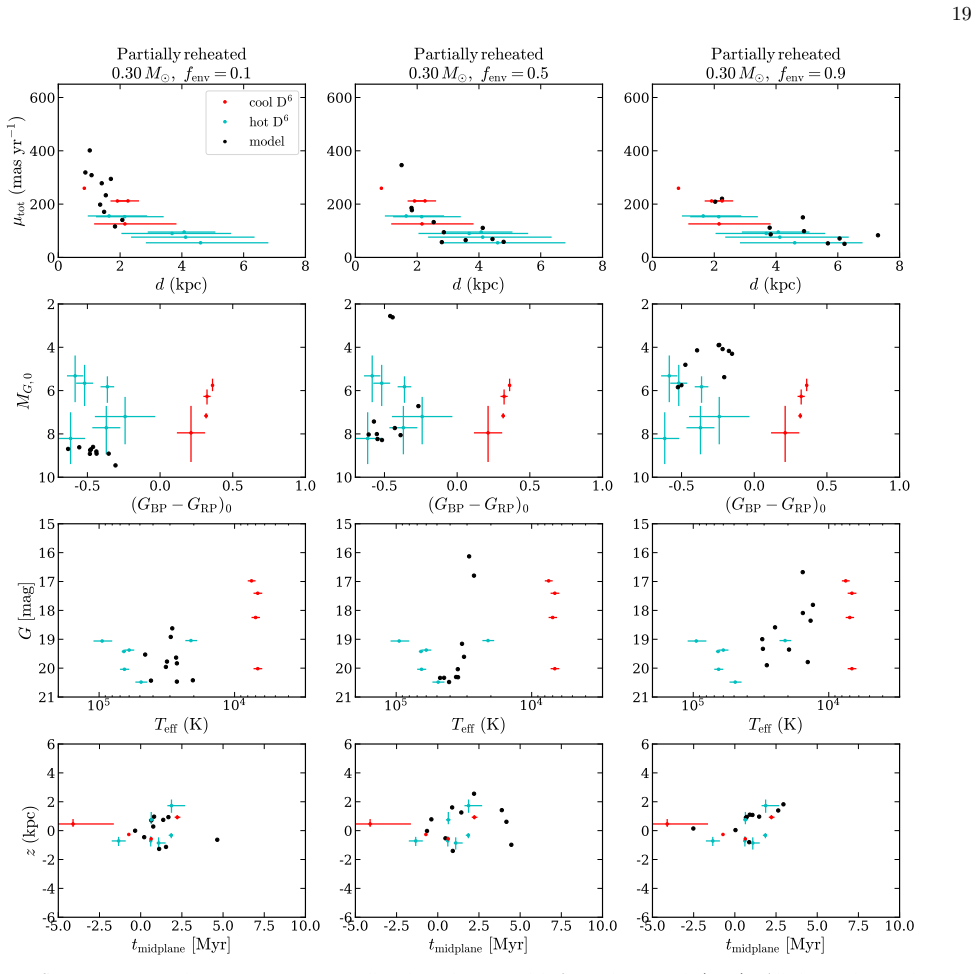
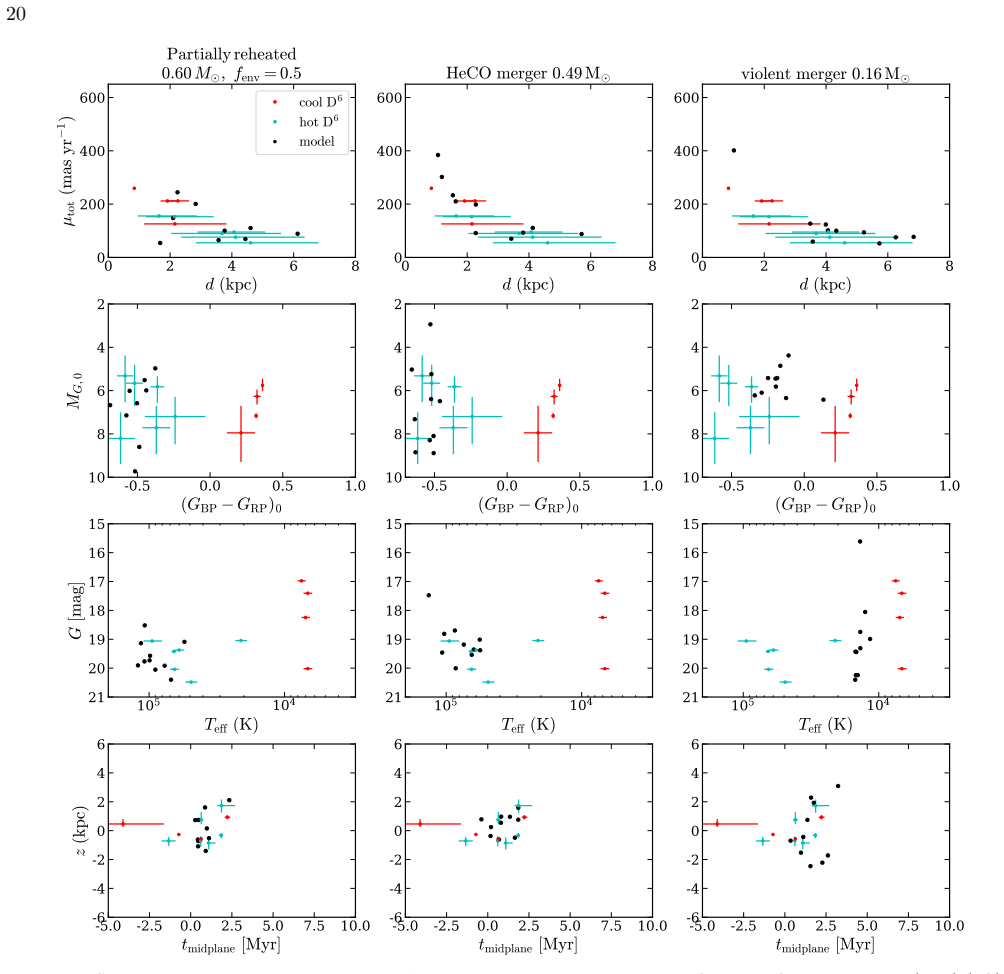
No single D6 evolutionary model reproduces the observed diversity; shock-heating-only models underpredict the sample while fully reheated models overpredict it, but intermediate-heating models that occur in some violent-merger and partial-disruption simulations match the magnitude, distance, and kinematic-age distributions. The inferred D6 birth rate under these best-matching models is only a few percent of the Galactic SN Ia rate, suggesting that most type Ia events arise from white-dwarf binaries in which both components explode.
What carries the argument
Forward-modeling that couples proposed D6 evolutionary tracks (shock heating only, full reheating, intermediate cases) to a Galactic density-velocity model and the survey's explicit selection function.
If this is right
- Shock-heating-only models are too faint and short-lived to account for most of the observed D6 stars.
- Fully reheated models are too luminous and long-lived to match the sample.
- Intermediate-heating models reproduce the magnitude, distance, and kinematic-age distributions.
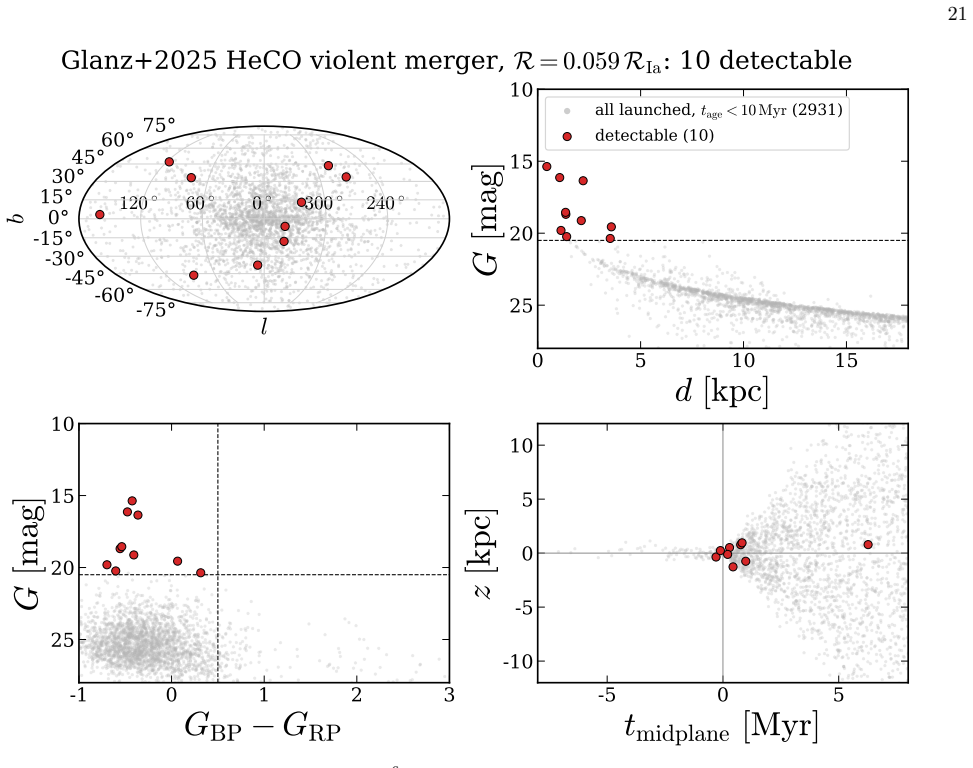
- The D6 birth rate required by the best-matching models is only a few percent of the Galactic SN Ia rate.
Where Pith is reading between the lines
- The low inferred rate would require that the majority of SN Ia events leave no surviving companion.
- The observed temperature spread among D6 stars suggests that real events sample a range of remnant masses and heating efficiencies.
- Larger spectroscopic surveys could test whether the velocity and spatial distributions continue to favor the intermediate-heating channel.
Load-bearing premise
The adopted D6 evolutionary models correctly predict the post-explosion thermal evolution, cooling tracks, and detectable lifetimes of the runaways.
What would settle it
A measured D6 birth rate substantially higher than a few percent of the SN Ia rate, or the discovery of a large additional population whose luminosities and ages match only the shock-only or fully-reheated tracks.
Figures
read the original abstract
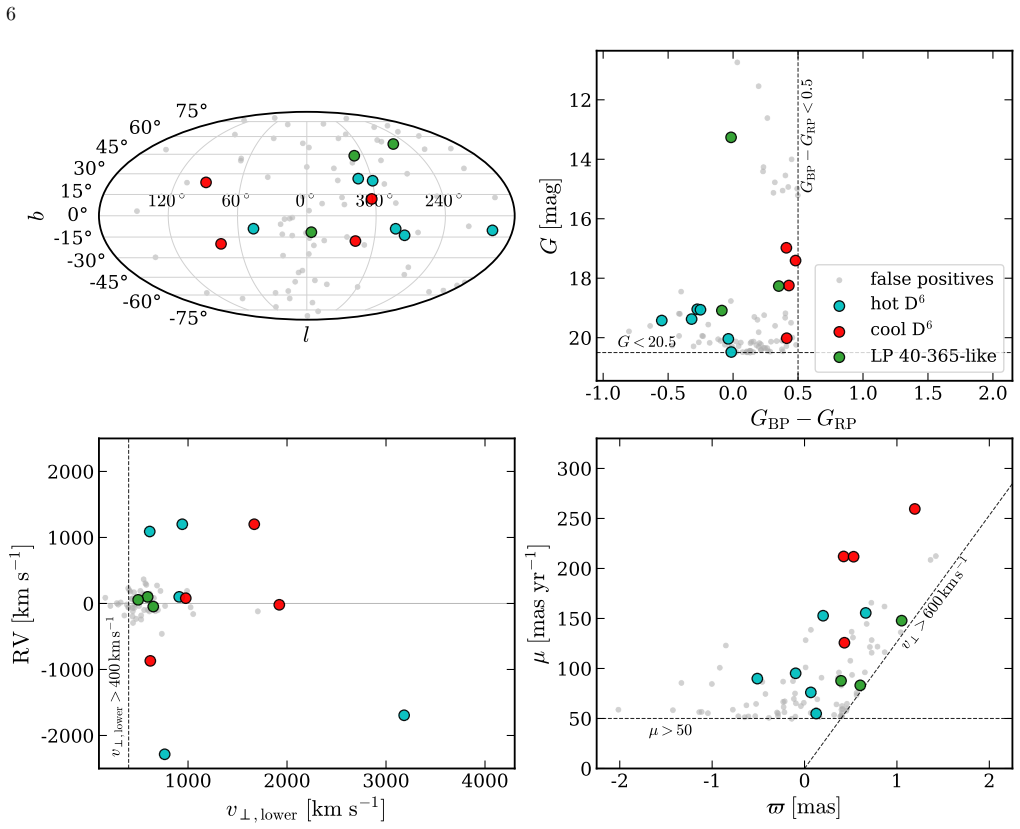
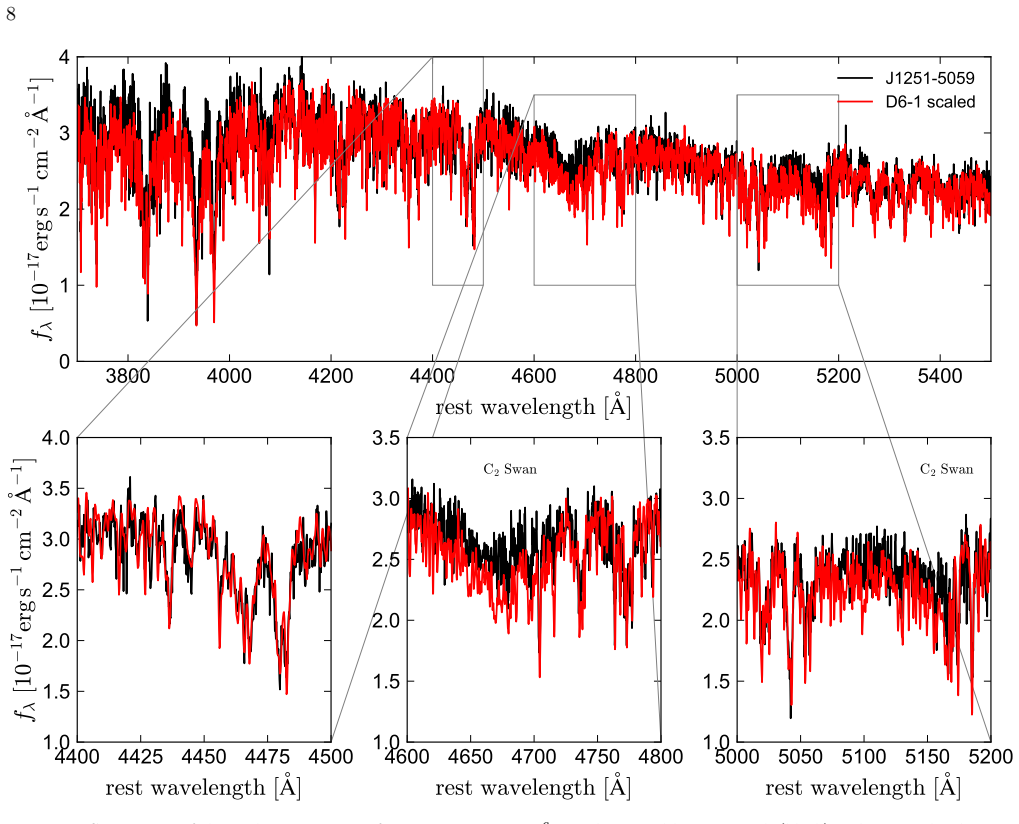
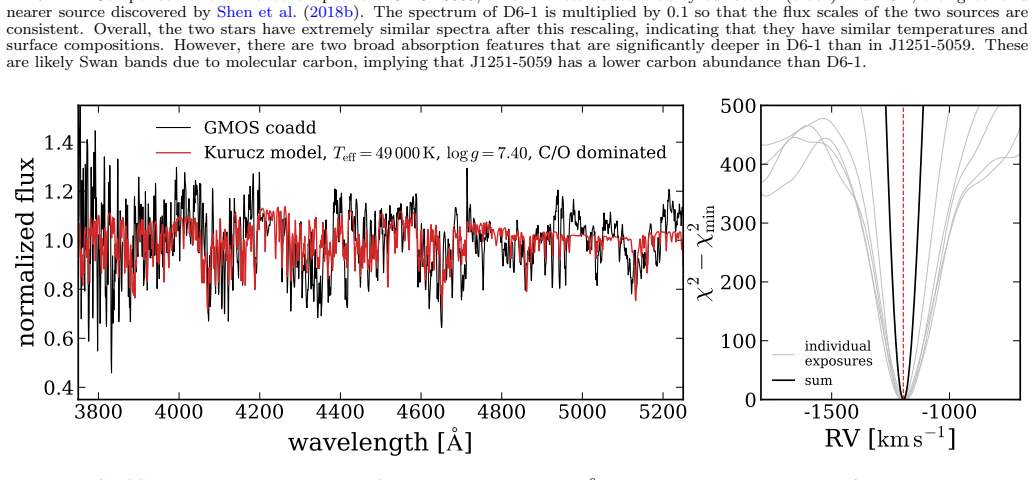
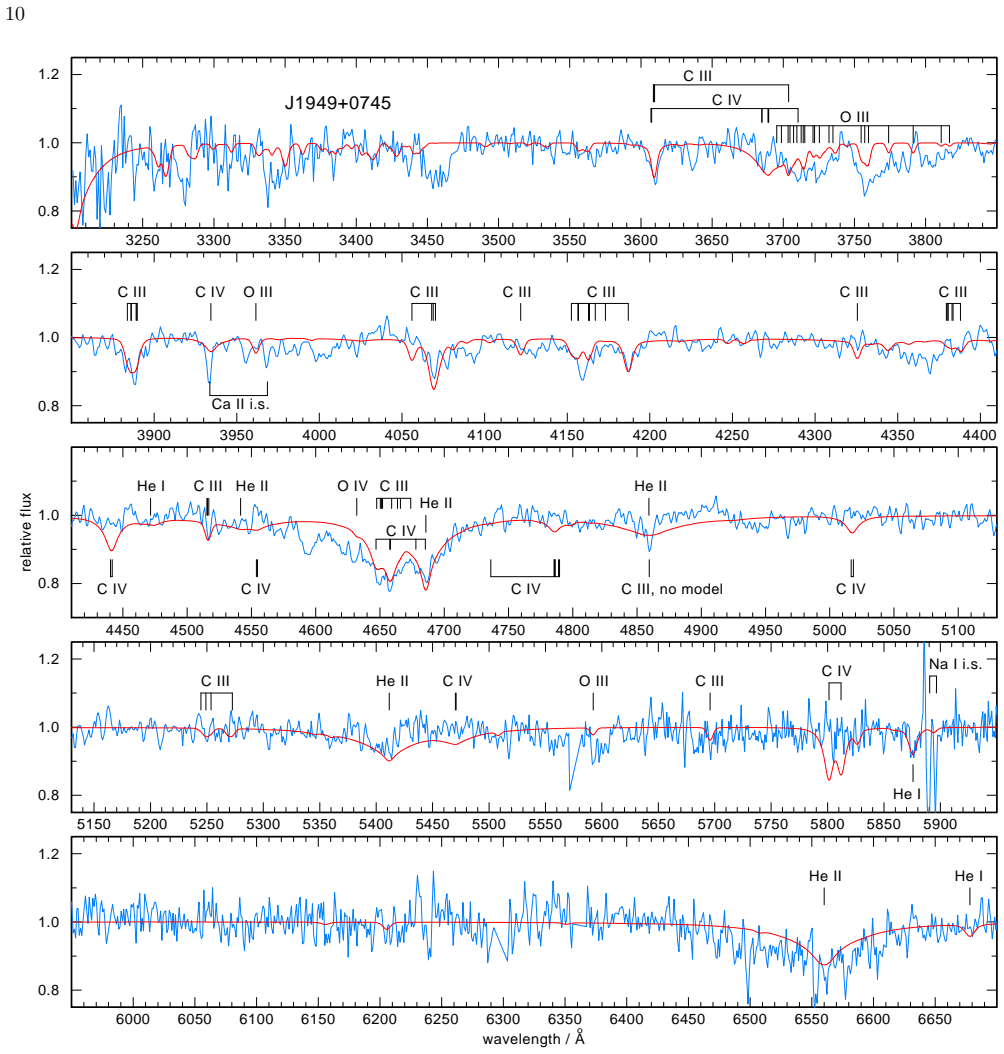
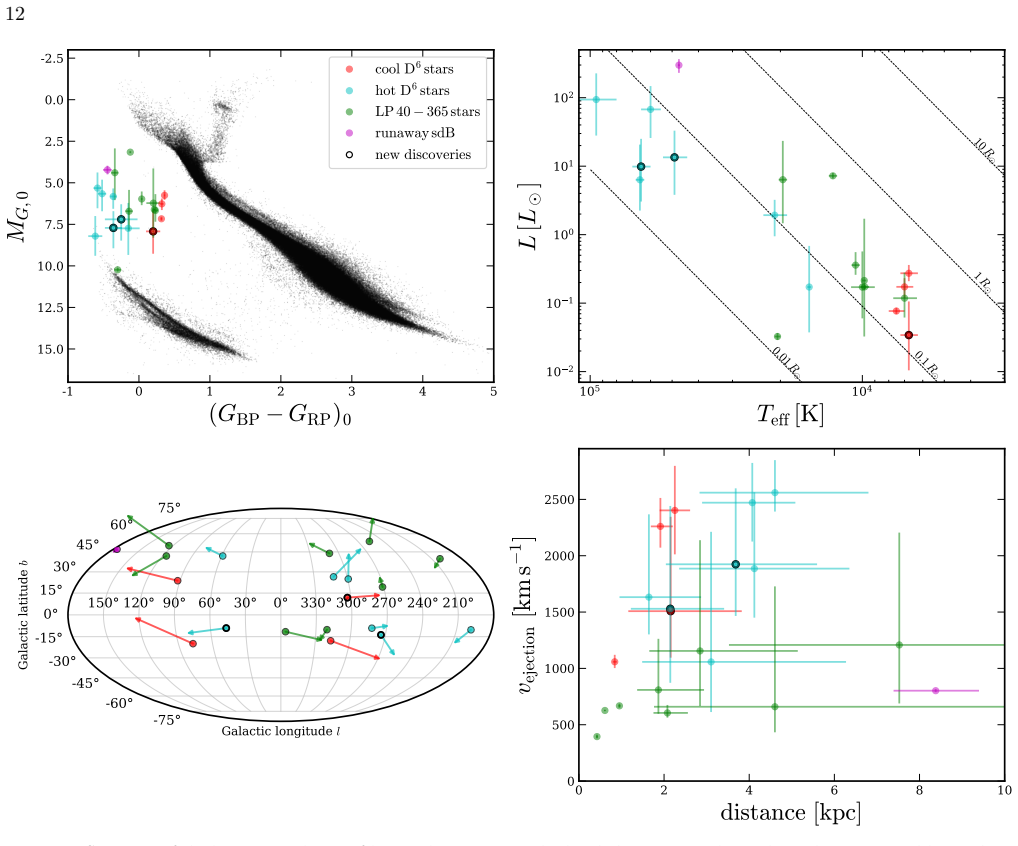
The explosion of a white dwarf (WD) in a close binary can launch a surviving runaway star at velocities of $\gtrsim 1000\, \rm km\,s^{-1}$. Such runaways provide a direct probe of thermonuclear supernovae (SNe) in double-degenerate binaries. Several candidate runaways are known, but their evolutionary states and the demographics of the broader population are uncertain. To enable robust population inference, we carry out a systematic survey for hypervelocity runaways with a simple selection function, selecting candidates based on large Gaia-inferred tangential velocities and blue colors. We classify 100% of the resulting 92 candidates using a combination of spectroscopic follow-up and archival data. The search yields ten suspected D$^6$ stars and three LP 40-365 stars. Three D$^6$ stars are new discoveries, including two hot ($T_{\rm eff} > 50,000$ K) objects and one cool ($T_{\rm eff}\approx 7,000$ K) object. We forward-model our survey under several proposed D$^6$ star evolutionary models, coupling each to a Galactic model and the survey selection function. No single model reproduces the observed diversity of D$^6$ stars, which likely reflects a range of remnant masses, ages, and heating mechanisms. Models in which runaway companions are heated by SN shocks alone are too faint and short-lived to explain most of the observed sample, while fully reheated models are too luminous and long-lived. Models with intermediate heating, as occurs in some simulations of violent mergers and partially disrupted remnants, best match the observed magnitude, distance, and kinematic-age distributions. The inferred D$^6$ star birth rate is model dependent, but the models that best match the observed population require rates of only a few percent of the Galactic SN Ia rate, perhaps implying that most SNe Ia result from WD binaries in which both components explode.
Editorial analysis
A structured set of objections, weighed in public.
Referee Report
Summary. The paper conducts a systematic Gaia-based survey for hypervelocity runaway stars from thermonuclear supernovae using a simple selection on large tangential velocities and blue colors. It classifies all 92 candidates via spectroscopy and archival data, identifying 10 suspected D6 stars (including three new) and three LP 40-365 stars. Forward modeling of the survey under different D6 evolutionary models (shock heating only, full reheating, intermediate) coupled to a Galactic model and selection function shows that intermediate-heating models best match the observed magnitude, distance, and kinematic-age distributions, while implying a D6 birth rate of only a few percent of the Galactic SN Ia rate.
Significance. If the forward-modeling results hold, the work supplies direct demographic constraints on the double-degenerate SN Ia channel by showing that surviving runaways are rare, consistent with most events involving both white dwarfs exploding. The complete classification of a well-defined sample and the identification of new hot and cool D6 candidates strengthen the observational foundation for testing evolutionary scenarios.
major comments (2)
- [forward-modeling analysis] The forward-modeling comparison (detailed after the candidate classification) assumes that the adopted D6 cooling tracks and heating prescriptions for the three model families correctly predict luminosities, effective temperatures, and lifetimes as functions of remnant mass and age. No independent validation of the intermediate-heating case against detailed stellar-evolution calculations is described, yet this family is identified as best-matching; any systematic offset in cooling timescales would alter both the model preference and the inferred birth-rate ratio.
- [results and discussion of birth rates] The birth-rate inference that best-matching models require rates of only a few percent of the SN Ia rate is presented as model-dependent, but the text does not quantify the sensitivity of the predicted detectable counts to the specific choices of Galactic density/velocity distributions or the exact form of the survey selection function; these enter the comparison directly and could shift the rate ratio if biased.
minor comments (2)
- [abstract] The abstract states that 'no single model reproduces the observed diversity' but does not list the specific goodness-of-fit metric or number of free parameters used to rank the three heating families.
- [candidate table] Table or figure presenting the 10 D6 candidates should include the adopted kinematic ages and distances for direct comparison to the model predictions.
Simulated Author's Rebuttal
We thank the referee for their thorough review and constructive comments. We address each major comment below.
read point-by-point responses
-
Referee: [forward-modeling analysis] The forward-modeling comparison (detailed after the candidate classification) assumes that the adopted D6 cooling tracks and heating prescriptions for the three model families correctly predict luminosities, effective temperatures, and lifetimes as functions of remnant mass and age. No independent validation of the intermediate-heating case against detailed stellar-evolution calculations is described, yet this family is identified as best-matching; any systematic offset in cooling timescales would alter both the model preference and the inferred birth-rate ratio.
Authors: The three model families are taken directly from published hydrodynamical simulations and stellar-evolution calculations in the literature; our analysis compares the observed sample against these existing prescriptions rather than deriving new tracks. We agree that the lack of an independent validation of the intermediate-heating case within this work is a limitation, and any systematic offset in cooling timescales would affect both the model ranking and the birth-rate ratio. We will revise the discussion to explicitly note this reliance on literature models and to discuss how plausible offsets in cooling timescales could alter the conclusions. revision: partial
-
Referee: [results and discussion of birth rates] The birth-rate inference that best-matching models require rates of only a few percent of the SN Ia rate is presented as model-dependent, but the text does not quantify the sensitivity of the predicted detectable counts to the specific choices of Galactic density/velocity distributions or the exact form of the survey selection function; these enter the comparison directly and could shift the rate ratio if biased.
Authors: The Galactic model and selection function are fully specified in the methods section using standard parameters from the literature. While the manuscript states that the birth-rate result is model-dependent, we have not performed a quantitative sensitivity study varying the Galactic density/velocity distributions or the precise selection cuts. We will add a short discussion (or appendix) that explores the effect of reasonable variations in these inputs on the predicted detectable counts, thereby quantifying the robustness of the inferred rate ratio. revision: yes
Circularity Check
No circularity: observational survey and external model comparison are independent
full rationale
The paper conducts a Gaia-based candidate selection and spectroscopic classification that is independent of the D6 evolutionary models. It then forward-models the survey using several proposed external models (shock-heating only, full reheating, intermediate) coupled to a Galactic density/velocity model and selection function. Model preference is determined by match to observed magnitude, distance, and kinematic-age distributions; the birth rate is scaled to match counts but remains explicitly model-dependent without reducing to a tautology or self-fit by the paper's equations. No self-definitional, fitted-input-called-prediction, or load-bearing self-citation steps are present. The derivation chain is self-contained against external benchmarks.
Axiom & Free-Parameter Ledger
free parameters (1)
- reheating efficiency
axioms (1)
- domain assumption The selected high-velocity blue stars are genuine thermonuclear-supernova runaways whose properties are governed by the tested evolutionary models.
Reference graph
Works this paper leans on
-
[1]
Bauer E. B., White C. J., Bildsten L., 2019, @doi [ ] 10.3847/1538-4357/ab4ea4 , https://ui.adsabs.harvard.edu/abs/2019ApJ...887...68B 887, 68
-
[2]
Bauer E. B., Chandra V., Shen K. J., Hermes J. J., 2021, @doi [ ] 10.3847/2041-8213/ac432d , https://ui.adsabs.harvard.edu/abs/2021ApJ...923L..34B 923, L34
-
[3]
B \'e dard A., Bergeron P., Brassard P., 2022, @doi [ ] 10.3847/1538-4357/ac609d , https://ui.adsabs.harvard.edu/abs/2022ApJ...930....8B 930, 8
-
[4]
Belokurov V., et al., 2020, @doi [ ] 10.1093/mnras/staa1522 , https://ui.adsabs.harvard.edu/abs/2020MNRAS.496.1922B 496, 1922
-
[5]
Bhat A., Bauer E. B., Pakmor R., Shen K. J., Caiazzo I., Rajamuthukumar A. S., El-Badry K., Kerzendorf W. E., 2025, @doi [ ] 10.1051/0004-6361/202451371 , https://ui.adsabs.harvard.edu/abs/2025A&A...693A.114B 693, A114
-
[6]
Bhat A., Hollands M., Dorsch M., Geier S., Heber U., Koester D., Pakmor R., Shen K. J., 2026a, @doi [arXiv e-prints] 10.48550/arXiv.2602.23900 , https://ui.adsabs.harvard.edu/abs/2026arXiv260223900B p. arXiv:2602.23900
-
[7]
Bhat A., Pakmor R., Shen K. J., Bauer E. B., Rajamuthukumar A. S., 2026b, @doi [ ] 10.1051/0004-6361/202557683 , https://ui.adsabs.harvard.edu/abs/2026A&A...706A.375B 706, A375
-
[8]
Blaauw A., 1961, , https://ui.adsabs.harvard.edu/abs/1961BAN....15..265B 15, 265
1961
-
[9]
Bland-Hawthorn J., Gerhard O., 2016, @doi [ ] 10.1146/annurev-astro-081915-023441 , https://ui.adsabs.harvard.edu/abs/2016ARA&A..54..529B 54, 529
-
[10]
C., M \'e sz \'a ros S., Fleming S
Bohlin R. C., M \'e sz \'a ros S., Fleming S. W., Gordon K. D., Koekemoer A. M., Kov \'a cs J., 2017, @doi [ ] 10.3847/1538-3881/aa6ba9 , https://ui.adsabs.harvard.edu/abs/2017AJ....153..234B 153, 234
-
[11]
Boos S. J., Townsley D. M., Shen K. J., 2024, @doi [ ] 10.3847/1538-4357/ad5da2 , https://ui.adsabs.harvard.edu/abs/2024ApJ...972..200B 972, 200
-
[12]
Bovy J., 2015, @doi [ ] 10.1088/0067-0049/216/2/29 , https://ui.adsabs.harvard.edu/abs/2015ApJS..216...29B 216, 29
-
[13]
Braudo J., Soker N., 2024, @doi [The Open Journal of Astrophysics] 10.21105/astro.2310.16554 , https://ui.adsabs.harvard.edu/abs/2024OJAp....7E...7B 7, 7
-
[14]
Brown W. R., 2015, @doi [ ] 10.1146/annurev-astro-082214-122230 , https://ui.adsabs.harvard.edu/abs/2015ARA&A..53...15B 53, 15
-
[15]
Brown W. R., Beers T. C., Wilhelm R., Allende Prieto C., Geller M. J., Kenyon S. J., Kurtz M. J., 2008, @doi [ ] 10.1088/0004-6256/135/2/564 , https://ui.adsabs.harvard.edu/abs/2008AJ....135..564B 135, 564
-
[16]
Brown W. R., Anderson J., Gnedin O. Y., Bond H. E., Geller M. J., Kenyon S. J., 2015, @doi [ ] 10.1088/0004-637X/804/1/49 , https://ui.adsabs.harvard.edu/abs/2015ApJ...804...49B 804, 49
-
[17]
Cardelli J. A., Clayton G. C., Mathis J. S., 1989, @doi [ ] 10.1086/167900 , https://ui.adsabs.harvard.edu/abs/1989ApJ...345..245C 345, 245
doi:10.1086/167900 1989
-
[18]
Chandra V., et al., 2022, @doi [ ] 10.1093/mnras/stac883 , https://ui.adsabs.harvard.edu/abs/2022MNRAS.512.6122C 512, 6122
-
[19]
Clemens J. C., Crain J. A., Anderson R., 2004, in Moorwood A. F. M., Iye M., eds, Society of Photo-Optical Instrumentation Engineers (SPIE) Conference Series Vol. 5492, Ground-based Instrumentation for Astronomy. pp 331--340, @doi 10.1117/12.550069
-
[20]
Cui X.-Q., et al., 2012, @doi [Research in Astronomy and Astrophysics] 10.1088/1674-4527/12/9/003 , https://ui.adsabs.harvard.edu/abs/2012RAA....12.1197C 12, 1197
-
[21]
Cukanovaite E., Tremblay P.-E., Bergeron P., Freytag B., Ludwig H.-G., Steffen M., 2021, @doi [ ] 10.1093/mnras/staa3684 , https://ui.adsabs.harvard.edu/abs/2021MNRAS.501.5274C 501, 5274
-
[22]
De Angeli F., et al., 2023, @doi [ ] 10.1051/0004-6361/202243680 , https://ui.adsabs.harvard.edu/abs/2023A&A...674A...2D 674, A2
-
[23]
El-Badry K., 2025, @doi [The Open Journal of Astrophysics] 10.33232/001c.138448 , https://ui.adsabs.harvard.edu/abs/2025OJAp....8E..62E 8, 62
-
[24]
El-Badry K., Rix H.-W., Heintz T. M., 2021, @doi [ ] 10.1093/mnras/stab323 , https://ui.adsabs.harvard.edu/abs/2021MNRAS.506.2269E 506, 2269
-
[25]
El-Badry K., et al., 2023, @doi [The Open Journal of Astrophysics] 10.21105/astro.2306.03914 , https://ui.adsabs.harvard.edu/abs/2023OJAp....6E..28E 6, 28
-
[26]
Eyer L., et al., 2023, @doi [ ] 10.1051/0004-6361/202244242 , https://ui.adsabs.harvard.edu/abs/2023A&A...674A..13E 674, A13
-
[27]
Foley R. J., et al., 2013, @doi [ ] 10.1088/0004-637X/767/1/57 , https://ui.adsabs.harvard.edu/abs/2013ApJ...767...57F 767, 57
-
[28]
M., Ballester P., Forchi V., Garc \' a-Dabl \'o C
Freudling W., Romaniello M., Bramich D. M., Ballester P., Forchi V., Garc \' a-Dabl \'o C. E., Moehler S., Neeser M. J., 2013, @doi [ ] 10.1051/0004-6361/201322494 , https://ui.adsabs.harvard.edu/abs/2013A&A...559A..96F 559, A96
-
[29]
T., Koester D., Raddi R., Toloza O., Kepler S
G \"a nsicke B. T., Koester D., Raddi R., Toloza O., Kepler S. O., 2020, @doi [ ] 10.1093/mnras/staa1761 , https://ui.adsabs.harvard.edu/abs/2020MNRAS.496.4079G 496, 4079
-
[30]
Geier S., et al., 2015, @doi [Science] 10.1126/science.1259063 , https://ui.adsabs.harvard.edu/abs/2015Sci...347.1126G 347, 1126
-
[31]
Geier S., et al., 2024, @doi [ ] 10.1051/0004-6361/202450778 , https://ui.adsabs.harvard.edu/abs/2024A&A...690A.368G 690, A368
-
[32]
Glanz H., Perets H. B., Bhat A., Pakmor R., 2025, @doi [Nature Astronomy] 10.1038/s41550-025-02633-4 , https://ui.adsabs.harvard.edu/abs/2025NatAs...9.1523G 9, 1523
-
[33]
Griffin R., 1973, @doi [ ] 10.1093/mnras/162.3.243 , https://ui.adsabs.harvard.edu/abs/1973MNRAS.162..243G 162, 243
-
[34]
Hayashi C., 1961, @doi [ ] 10.1093/pasj/13.4.450 , https://ui.adsabs.harvard.edu/abs/1961PASJ...13..450H 13, 450
-
[35]
G., 1988, @doi [ ] 10.1038/331687a0 , https://ui.adsabs.harvard.edu/abs/1988Natur.331..687H 331, 687
Hills J. G., 1988, @doi [ ] 10.1038/331687a0 , https://ui.adsabs.harvard.edu/abs/1988Natur.331..687H 331, 687
doi:10.1038/331687a0 1988
-
[36]
Hirsch H. A., Heber U., O'Toole S. J., Bresolin F., 2005, @doi [ ] 10.1051/0004-6361:200500212 , https://ui.adsabs.harvard.edu/abs/2005A&A...444L..61H 444, L61
-
[37]
Hollands M. A., Shen K. J., Raddi R., G \"a nsicke B. T., Bauer E. B., Rebassa-Mansergas A., 2025, @doi [ ] 10.1093/mnras/staf950 , https://ui.adsabs.harvard.edu/abs/2025MNRAS.541.2231H 541, 2231
-
[38]
M., J rgensen I., Allington-Smith J
Hook I. M., J rgensen I., Allington-Smith J. R., Davies R. L., Metcalfe N., Murowinski R. G., Crampton D., 2004, @doi [ ] 10.1086/383624 , https://ui.adsabs.harvard.edu/abs/2004PASP..116..425H 116, 425
doi:10.1086/383624 2004
-
[39]
Iben Jr. I., Tutukov A. V., 1984, @doi [ ] 10.1086/190932 , https://ui.adsabs.harvard.edu/abs/1984ApJS...54..335I 54, 335
doi:10.1086/190932 1984
-
[40]
Jermyn A. S., et al., 2023, @doi [ ] 10.3847/1538-4365/acae8d , https://ui.adsabs.harvard.edu/abs/2023ApJS..265...15J 265, 15
-
[41]
Justham S., Wolf C., Podsiadlowski P., Han Z., 2009, @doi [ ] 10.1051/0004-6361:200810106 , https://ui.adsabs.harvard.edu/abs/2009A&A...493.1081J 493, 1081
-
[42]
O., et al., 2016, @doi [Science] 10.1126/science.aad6705 , 352, 67
Kepler S. O., et al., 2016, @doi [Science] 10.1126/science.aad6705 , 352, 67
-
[43]
Kerzendorf W. E., Schmidt B. P., Laird J. B., Podsiadlowski P., Bessell M. S., 2012, @doi [ ] 10.1088/0004-637X/759/1/7 , https://ui.adsabs.harvard.edu/abs/2012ApJ...759....7K 759, 7
-
[44]
Kerzendorf W. E., et al., 2013, @doi [ ] 10.1088/0004-637X/774/2/99 , https://ui.adsabs.harvard.edu/abs/2013ApJ...774...99K 774, 99
-
[45]
E., Childress M., Scharw \"a chter J., Do T., Schmidt B
Kerzendorf W. E., Childress M., Scharw \"a chter J., Do T., Schmidt B. P., 2014, @doi [ ] 10.1088/0004-637X/782/1/27 , https://ui.adsabs.harvard.edu/abs/2014ApJ...782...27K 782, 27
-
[46]
Kerzendorf W. E., Strampelli G., Shen K. J., Schwab J., Pakmor R., Do T., Buchner J., Rest A., 2018, @doi [ ] 10.1093/mnras/sty1357 , https://ui.adsabs.harvard.edu/abs/2018MNRAS.479..192K 479, 192
-
[47]
Kleinman S. J., et al., 2013, @doi [ ] 10.1088/0067-0049/204/1/5 , https://ui.adsabs.harvard.edu/abs/2013ApJS..204....5K 204, 5
-
[48]
Koester D., 2010, Memorie della Societa Astronomica Italiana, https://ui.adsabs.harvard.edu/abs/2010MmSAI..81..921K 81, 921
2010
-
[49]
Koposov S. E., et al., 2020, @doi [ ] 10.1093/mnras/stz3081 , https://ui.adsabs.harvard.edu/abs/2020MNRAS.491.2465K 491, 2465
-
[50]
L., 1993, ATLAS9 Stellar Atmosphere Programs and 2 km/s grid , Kurucz CD-ROM No
Kurucz R. L., 1993, ATLAS9 Stellar Atmosphere Programs and 2 km/s grid , Kurucz CD-ROM No. 13
1993
-
[51]
Leonard P. J. T., 1991, @doi [ ] 10.1086/115704 , https://ui.adsabs.harvard.edu/abs/1991AJ....101..562L 101, 562
doi:10.1086/115704 1991
-
[52]
Li W., Chornock R., Leaman J., Filippenko A. V., Poznanski D., Wang X., Ganeshalingam M., Mannucci F., 2011, @doi [ ] 10.1111/j.1365-2966.2011.18162.x , https://ui.adsabs.harvard.edu/abs/2011MNRAS.412.1473L 412, 1473
-
[53]
Lindegren L., 2018, R e-normalising the astrometric chi-square in G aia D R 2, GAIA-C3-TN-LU-LL-124, https://dms.cosmos.esa.int/COSMOS/doc_fetch.php?id=3757412
2018
-
[54]
Lindegren L., et al., 2021, @doi [ ] 10.1051/0004-6361/202039709 , https://ui.adsabs.harvard.edu/abs/2021A&A...649A...2L 649, A2
-
[55]
Mackensen N., Reindl N., Werner K., Dorsch M., Tan S., 2025, @doi [ ] 10.1051/0004-6361/202554639 , https://ui.adsabs.harvard.edu/abs/2025A&A...700A..24M 700, A24
-
[56]
Mandigo-Stoba M. S., Fremling C., Kasliwal M. M., 2022, @doi [Journal of Open Source Software] 10.21105/joss.03612 , 7, 3612
-
[57]
Maoz D., Mannucci F., Brandt T. D., 2012, @doi [ ] 10.1111/j.1365-2966.2012.21871.x , https://ui.adsabs.harvard.edu/abs/2012MNRAS.426.3282M 426, 3282
-
[58]
Maoz D., Mannucci F., Nelemans G., 2014, @doi [ ] 10.1146/annurev-astro-082812-141031 , https://ui.adsabs.harvard.edu/abs/2014ARA&A..52..107M 52, 107
-
[59]
Marietta E., Burrows A., Fryxell B., 2000, @doi [ ] 10.1086/313392 , https://ui.adsabs.harvard.edu/abs/2000ApJS..128..615M 128, 615
doi:10.1086/313392 2000
-
[60]
Marshall J. L., et al., 2008, in McLean I. S., Casali M. M., eds, Society of Photo-Optical Instrumentation Engineers (SPIE) Conference Series Vol. 7014, Ground-based and Airborne Instrumentation for Astronomy II. p. 701454 ( @eprint arXiv 0807.3774 ), @doi 10.1117/12.789972
-
[61]
Mehta V., Tiwari V., Pakmor R., Singh D., Fisher R., 2026, arXiv e-prints, https://ui.adsabs.harvard.edu/abs/2026arXiv260223414M p. arXiv:2602.23414
arXiv 2026
-
[62]
Nagarajan P., El-Badry K., Rodriguez A. C., van Roestel J., Roulston B., 2023, @doi [arXiv e-prints] 10.48550/arXiv.2304.07324 , https://ui.adsabs.harvard.edu/abs/2023arXiv230407324N p. arXiv:2304.07324
-
[63]
Neunteufel P., 2020, @doi [ ] 10.1051/0004-6361/202037792 , https://ui.adsabs.harvard.edu/abs/2020A&A...641A..52N 641, A52
-
[64]
Neunteufel P., Preece H., Kruckow M., Geier S., Hamers A. S., Justham S., Podsiadlowski P., 2022, @doi [ ] 10.1051/0004-6361/202142864 , https://ui.adsabs.harvard.edu/abs/2022A&A...663A..91N 663, A91
-
[65]
Oke J. B., Gunn J. E., 1982, @doi [ ] 10.1086/131027 , https://ui.adsabs.harvard.edu/abs/1982PASP...94..586O 94, 586
doi:10.1086/131027 1982
-
[66]
Oke J. B., et al., 1995, @doi [ ] 10.1086/133562 , https://ui.adsabs.harvard.edu/abs/1995PASP..107..375O 107, 375
doi:10.1086/133562 1995
-
[67]
Pakmor R., et al., 2022, @doi [ ] 10.1093/mnras/stac3107 , https://ui.adsabs.harvard.edu/abs/2022MNRAS.517.5260P 517, 5260
-
[68]
Pakmor R., et al., 2025, @doi [arXiv e-prints] 10.48550/arXiv.2510.11781 , https://ui.adsabs.harvard.edu/abs/2025arXiv251011781P p. arXiv:2510.11781
-
[69]
Pan K.-C., Ricker P. M., Taam R. E., 2012, @doi [ ] 10.1088/0004-637X/760/1/21 , https://ui.adsabs.harvard.edu/abs/2012ApJ...760...21P 760, 21
-
[70]
Paxton B., Bildsten L., Dotter A., Herwig F., Lesaffre P., Timmes F., 2011, @doi [ ] 10.1088/0067-0049/192/1/3 , https://ui.adsabs.harvard.edu/abs/2011ApJS..192....3P 192, 3
-
[71]
Paxton B., et al., 2013, @doi [ ] 10.1088/0067-0049/208/1/4 , https://ui.adsabs.harvard.edu/abs/2013ApJS..208....4P 208, 4
-
[72]
Paxton B., et al., 2015, @doi [ ] 10.1088/0067-0049/220/1/15 , https://ui.adsabs.harvard.edu/abs/2015ApJS..220...15P 220, 15
-
[73]
Paxton B., et al., 2018, @doi [ ] 10.3847/1538-4365/aaa5a8 , https://ui.adsabs.harvard.edu/abs/2018ApJS..234...34P 234, 34
-
[74]
Paxton B., et al., 2019, @doi [ ] 10.3847/1538-4365/ab2241 , https://ui.adsabs.harvard.edu/abs/2019ApJS..243...10P 243, 10
-
[75]
Perley D. A., 2019, @doi [ ] 10.1088/1538-3873/ab215d , https://ui.adsabs.harvard.edu/abs/2019PASP..131h4503P 131, 084503
-
[76]
Pollin J. M., Sim S. A., Pakmor R., Callan F. P., Collins C. E., Shingles L. J., R \"o pke F. K., Srivastav S., 2024, @doi [ ] 10.1093/mnras/stae1909 , https://ui.adsabs.harvard.edu/abs/2024MNRAS.533.3036P 533, 3036
-
[77]
Prochaska J. X., Hennawi J. F., Westfall K. B., Cooke R. J., Wang F., Hsyu T., Davies F. B., Farina E. P., 2020, arXiv e-prints, https://ui.adsabs.harvard.edu/abs/2020arXiv200506505P p. arXiv:2005.06505
arXiv 2020
-
[78]
Prust L. J., Bildsten L., Boos S. J., 2026, @doi [ ] 10.3847/1538-4357/ae22db , https://ui.adsabs.harvard.edu/abs/2026ApJ...997...17P 997, 17
-
[79]
Raddi R., et al., 2019, @doi [ ] 10.1093/mnras/stz1618 , https://ui.adsabs.harvard.edu/abs/2019MNRAS.489.1489R 489, 1489
-
[80]
Rajamuthukumar A. S., Bauer E. B., Justham S., Pakmor R., de Mink S. E., Neunteufel P., 2025, @doi [ ] 10.1051/0004-6361/202554452 , https://ui.adsabs.harvard.edu/abs/2025A&A...704A..82R 704, A82
discussion (0)
Sign in with ORCID, Apple, or X to comment. Anyone can read and Pith papers without signing in.