Phase-dependent magnetic coherence in the turbulent interstellar medium
Pith reviewed 2026-06-27 12:24 UTC · model grok-4.3
The pith
CNM clouds align with the local magnetic field and show lower disorder per column density than the warm neutral medium.
A machine-rendered reading of the paper's core claim, the machinery that carries it, and where it could break.
Core claim
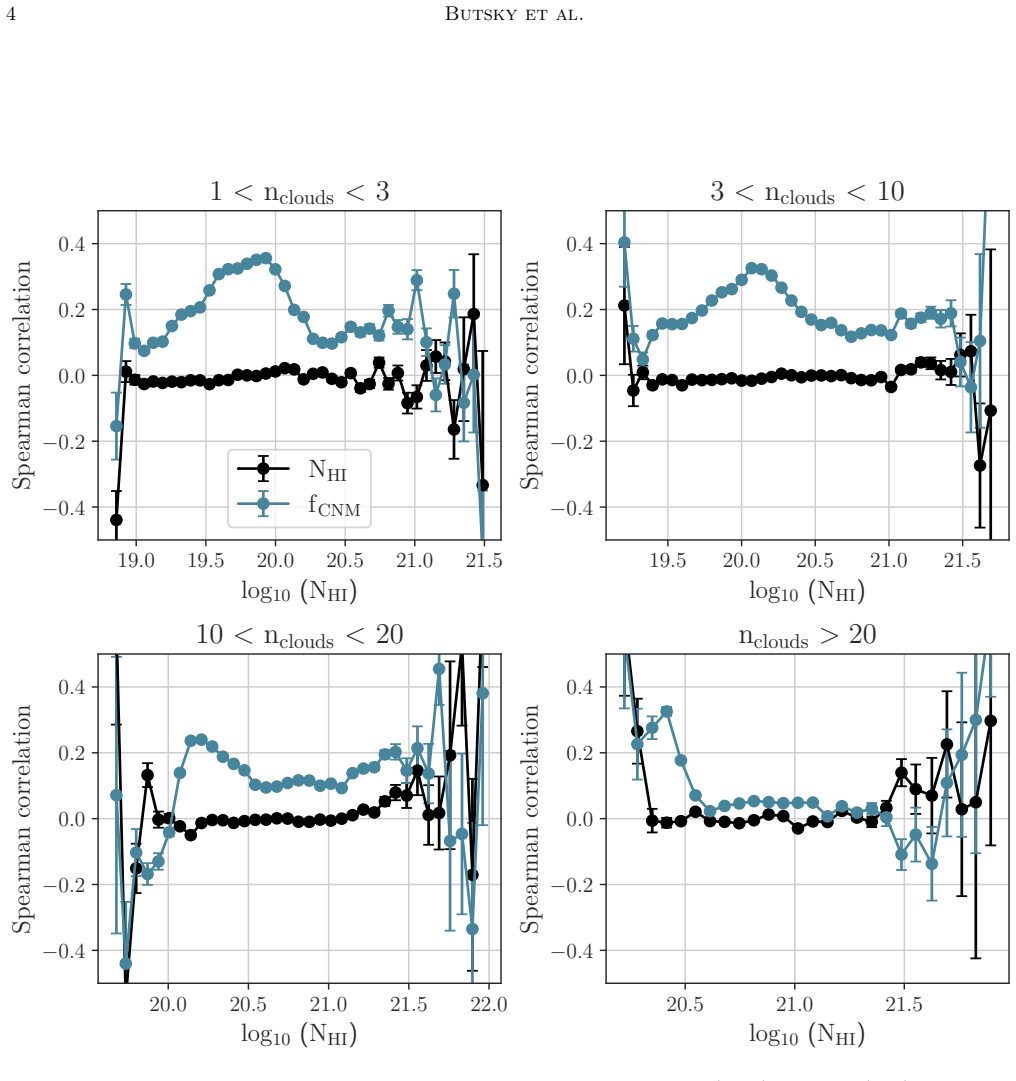
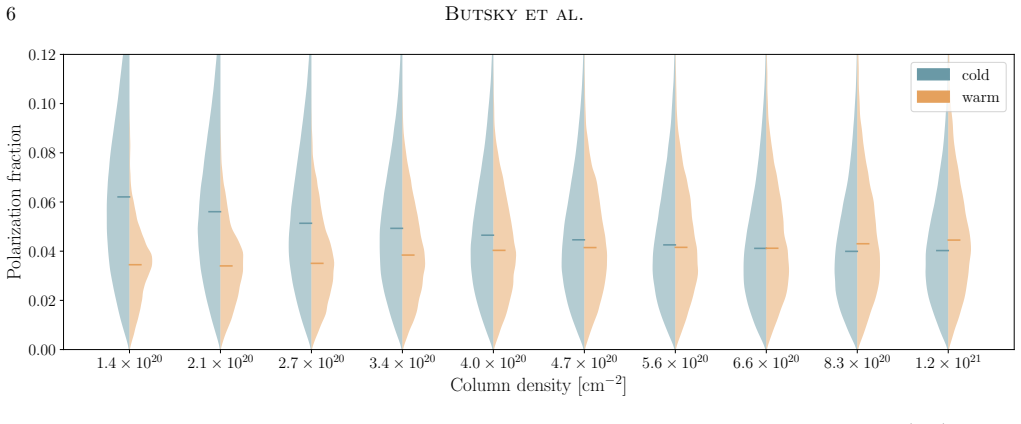
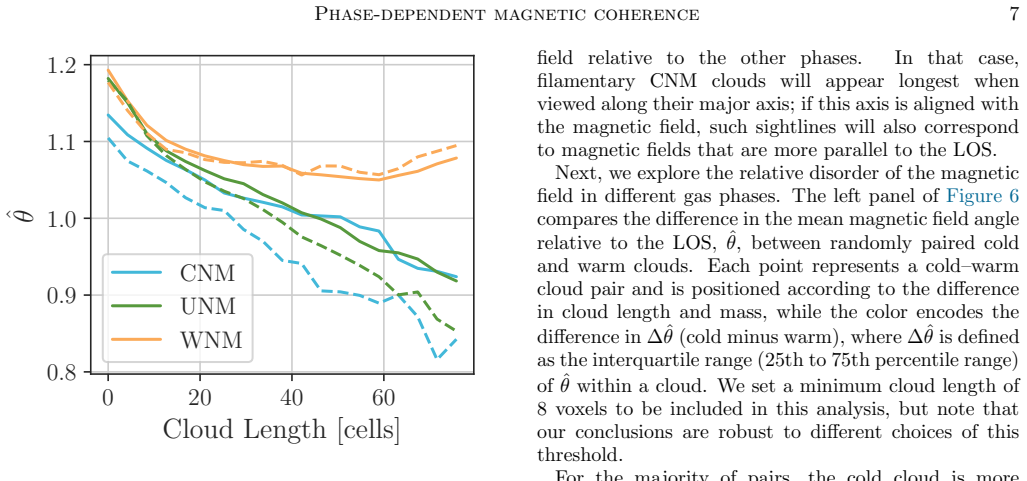
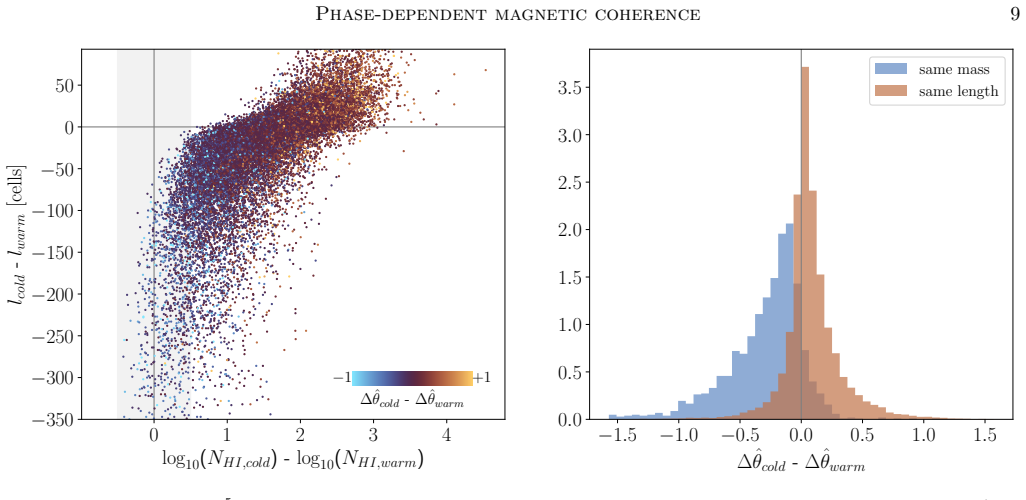
Simulations recover the positive f_CNM-polarization correlation most clearly for sightlines intersecting fewer than ~20 discrete CNM clouds. CNM clouds tend to be elongated along the local magnetic field and, when normalized by column density, exhibit lower magnetic disorder than the WNM. The results support a picture in which CNM structures host relatively ordered magnetic fields, producing higher polarization fractions along CNM-dominated sightlines in the diffuse ISM.
What carries the argument
Phase-dependent magnetic coherence, in which CNM clouds align with and carry reduced disorder relative to the local magnetic field.
If this is right
- The correlation weakens or becomes intermittent for sightlines intersecting more than ~20 CNM clouds.
- Magnetic disorder appears different when measured per unit path length versus per unit mass.
- CNM-dominated sightlines produce higher polarization fractions in the diffuse ISM.
Where Pith is reading between the lines
- If CNM condensation occurs through field-aligned compression, the observed alignment would be a direct consequence of how the phase transition proceeds.
- Polarization maps could be inverted to estimate the typical number of independent CNM structures along a line of sight.
- The same normalization distinction (per length versus per mass) may reconcile other apparent contradictions between simulated and observed magnetic disorder in multiphase media.
Load-bearing premise
The procedure for identifying and counting discrete CNM clouds isolates independent structures whose number controls the polarization trend.
What would settle it
A data set in which the f_CNM-polarization correlation persists unchanged for sightlines crossing many more than 20 CNM clouds, or vanishes even for sightlines with very few clouds.
Figures
read the original abstract
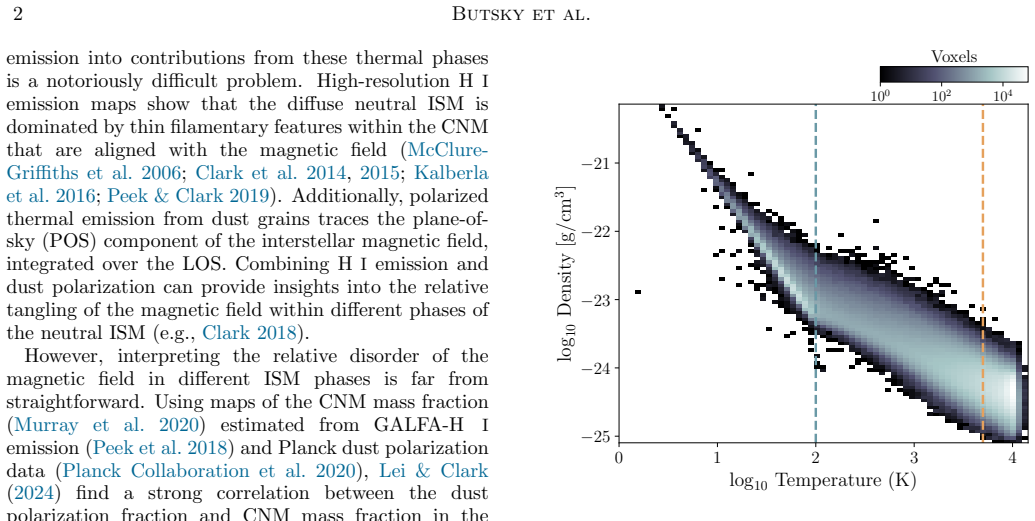
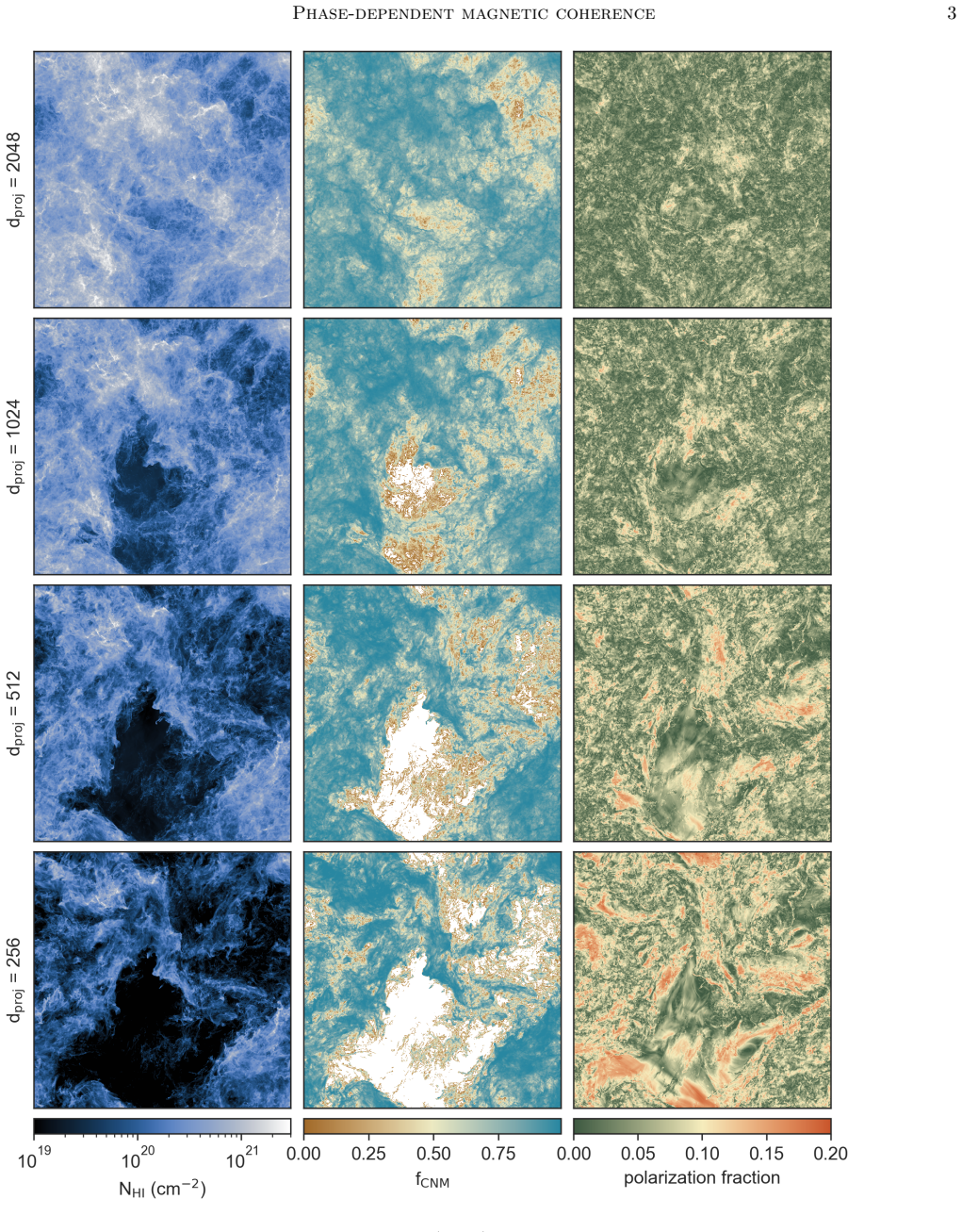
Magnetic fields permeate the multiphase interstellar medium (ISM), yet their phase-dependent structure remains poorly constrained by observations. Dust polarization and \ion{H}{1} emission together offer complementary probes of the plane-of-sky magnetic field and cold neutral medium (CNM) gas structure, respectively. Recent observational work has shown that in the diffuse ISM, the dust polarization fraction correlates positively with the CNM mass fraction ($f_{\rm CNM}$) but not with total \ion{H}{1} column density, suggesting a phase-dependent magnetic field geometry. Here, we use extremely high-resolution ($2048^3$) simulations of the turbulent, magnetized, multiphase ISM to investigate the physical origin of this trend. By constructing synthetic \ion{H}{1} and dust polarization maps, we directly compare our simulations to the observational results of \citet{Lei:2024}. We recover a positive $f_{\rm CNM}$-polarization correlation most clearly for sightlines intersecting fewer than $\sim$20 discrete CNM clouds, while the trend becomes weak or intermittent for larger cloud counts, consistent with the expectation that high-Galactic-latitude sightlines contain relatively few independent cold structures. We show that this correlation reflects genuine phase-dependent magnetic structure: CNM clouds tend to be elongated along the local magnetic field and, when normalized by column density, exhibit lower magnetic disorder than the warm neutral medium (WNM). We further demonstrate that apparent discrepancies between simulation- and observation-based measures of magnetic disorder arise from whether disorder is quantified per unit path length or per unit mass. Our results support a picture in which CNM structures host relatively ordered magnetic fields, producing higher polarization fractions along CNM-dominated sightlines in the diffuse ISM.
Editorial analysis
A structured set of objections, weighed in public.
Referee Report
Summary. The paper uses 2048^3 MHD simulations of the turbulent, magnetized, multiphase ISM to construct synthetic H I and dust polarization maps. It recovers the observed positive correlation between CNM mass fraction f_CNM and polarization fraction reported by Lei:2024, most clearly for sightlines intersecting fewer than ~20 discrete CNM clouds. The trend is attributed to genuine phase-dependent magnetic structure: CNM clouds are elongated along the local B-field and exhibit lower magnetic disorder (when normalized by column density) than the WNM, with apparent discrepancies in disorder metrics arising from path-length versus mass normalization.
Significance. If the central methodological steps are robust, the work supplies a physically grounded explanation for the phase dependence of magnetic ordering in the diffuse ISM and clarifies how CNM structures contribute to higher polarization fractions, directly linking simulation physics to an external observational result without parameter fitting to the polarization data.
major comments (2)
- [Abstract] Abstract: the recovery of the f_CNM–polarization correlation specifically in the regime of fewer than ~20 discrete CNM clouds is presented as a key result, yet no quantitative details are supplied on the cloud identification algorithm (density/velocity thresholds, spatial connectivity, Friends-of-Friends parameters) or on its application to both the 2048^3 simulation cubes and the Lei:2024 observations. This choice directly controls the reported threshold and the interpretation that the trend reflects phase-dependent geometry rather than an artifact of structure counting.
- [Abstract] Abstract: the construction of synthetic H I and dust polarization maps is invoked to enable the direct comparison, but the manuscript provides no description of the radiative transfer assumptions, line-of-sight integration method, or error estimation used to generate the maps from the simulation data. These steps are load-bearing for the claim that the simulations reproduce the observational trend.
Simulated Author's Rebuttal
We thank the referee for their constructive report and for recognizing the significance of the work in providing a physical explanation for the observed f_CNM–polarization correlation. We address each major comment below and will revise the manuscript to incorporate the requested methodological details.
read point-by-point responses
-
Referee: [Abstract] Abstract: the recovery of the f_CNM–polarization correlation specifically in the regime of fewer than ~20 discrete CNM clouds is presented as a key result, yet no quantitative details are supplied on the cloud identification algorithm (density/velocity thresholds, spatial connectivity, Friends-of-Friends parameters) or on its application to both the 2048^3 simulation cubes and the Lei:2024 observations. This choice directly controls the reported threshold and the interpretation that the trend reflects phase-dependent geometry rather than an artifact of structure counting.
Authors: We agree that the manuscript does not supply quantitative details on the cloud identification algorithm. The current text refers only to 'discrete CNM clouds' without specifying the density/velocity thresholds, connectivity criteria, or FoF parameters, nor does it describe application to the observational data. In the revised manuscript we will add a dedicated methods subsection (or expand Section 3) that states the exact thresholds, linking length, and velocity coherence requirements used for both the 2048^3 cubes and the Lei:2024 sightlines. We will also report a brief robustness test showing that the ~20-cloud threshold is stable under modest variations of these parameters. This addition directly addresses the concern that the reported trend could be an artifact of structure counting. revision: yes
-
Referee: [Abstract] Abstract: the construction of synthetic H I and dust polarization maps is invoked to enable the direct comparison, but the manuscript provides no description of the radiative transfer assumptions, line-of-sight integration method, or error estimation used to generate the maps from the simulation data. These steps are load-bearing for the claim that the simulations reproduce the observational trend.
Authors: We acknowledge that the manuscript does not describe the radiative transfer assumptions, line-of-sight integration procedure, or error estimation for the synthetic maps. The revised version will include a new paragraph in the methods section that specifies (i) the optically thin approximation adopted for H I, (ii) the Stokes-parameter integration for dust polarization with the assumed grain-alignment efficiency, (iii) the numerical line-of-sight integration scheme (including grid interpolation), and (iv) the error estimation approach (multiple random sightlines plus added observational noise). These details will make the comparison with Lei:2024 fully reproducible. revision: yes
Circularity Check
No significant circularity
full rationale
The paper uses 2048^3 MHD simulations to generate synthetic H I and dust polarization maps, then compares them to the observational trend reported in Lei:2024. It recovers the f_CNM-polarization correlation for sightlines with fewer than ~20 discrete CNM clouds and attributes the trend to CNM clouds being elongated along the local B-field with lower disorder per unit column density. These geometric and disorder properties are measured directly from the simulation volume; no parameters are fitted to the polarization data, and no equation or result reduces by construction to an input. The citation to Lei:2024 supplies an external benchmark rather than a load-bearing self-referential premise. The central claim therefore remains independent of its inputs.
Axiom & Free-Parameter Ledger
axioms (2)
- standard math Ideal MHD equations govern the evolution of the turbulent, magnetized, multiphase ISM.
- domain assumption Dust polarization fraction traces the plane-of-sky magnetic field geometry.
Reference graph
Works this paper leans on
-
[1]
2020, A&A, 640, A100, doi: 10.1051/0004-6361/201936124
Adak, D., Ghosh, T., Boulanger, F., et al. 2020, A&A, 640, A100, doi: 10.1051/0004-6361/201936124
-
[2]
Angarita, Y., Versteeg, M. J. F., Haverkorn, M., et al. 2024, AJ, 168, 47, doi: 10.3847/1538-3881/ad4b14
-
[3]
2014, ApJL, 784, L20, doi: 10.1088/2041-8205/784/2/L20
Beresnyak, A. 2014, ApJL, 784, L20, doi: 10.1088/2041-8205/784/2/L20
-
[4]
Clark, S. E. 2018, ApJL, 857, L10, doi: 10.3847/2041-8213/aabb54
-
[5]
Babler, B. L. 2015, PhRvL, 115, 241302, doi: 10.1103/PhysRevLett.115.241302
-
[6]
Clark, S. E., Peek, J. E. G., & Miville-Deschˆ enes, M. A. 2019, ApJ, 874, 171, doi: 10.3847/1538-4357/ab0b3b
-
[7]
Clark, S. E., Peek, J. E. G., & Putman, M. E. 2014, ApJ, 789, 82, doi: 10.1088/0004-637X/789/1/82
-
[8]
Crutcher, R. M. 2012, ARA&A, 50, 29, doi: 10.1146/annurev-astro-081811-125514 Ferri` ere, K. M. 2001, Reviews of Modern Physics, 73, 1031, doi: 10.1103/RevModPhys.73.1031
-
[9]
Fiege, J. D., & Pudritz, R. E. 2000, The Astrophysical Journal, 544, 830, doi: 10.1086/317228
-
[10]
B., Ripperda, B., & Philippov, A
Fielding, D. B., Ripperda, B., & Philippov, A. A. 2023, ApJL, 949, L5, doi: 10.3847/2041-8213/accf1f
-
[11]
Ghosh, T., Boulanger, F., Martin, P. G., et al. 2017, A&A, 601, A71, doi: 10.1051/0004-6361/201629829 Granda-Mu˜ noz, G., V´ azquez-Semadeni, E., & G´ omez, G. C. 2025, A&A, 694, A296, doi: 10.1051/0004-6361/202450720
-
[12]
E., Cukierman, A., Beck, D., & Kuo, C.-L
Halal, G., Clark, S. E., Cukierman, A., Beck, D., & Kuo, C.-L. 2024, ApJ, 961, 29, doi: 10.3847/1538-4357/ad06aa
-
[13]
Ho, K. W., Yuen, K. H., & Lazarian, A. 2023, MNRAS, 521, 230, doi: 10.1093/mnras/stad481
-
[14]
Kalberla, P. M. W. 2025, A&A, 694, L11, doi: 10.1051/0004-6361/202452771
-
[15]
Kalberla, P. M. W., Kerp, J., Haud, U., et al. 2016, ApJ, 821, 117, doi: 10.3847/0004-637X/821/2/117
-
[16]
1997, PhRvL, 78, 2058, doi: 10.1103/PhysRevLett.78.2058
Kamionkowski, M., Kosowsky, A., & Stebbins, A. 1997, PhRvL, 78, 2058, doi: 10.1103/PhysRevLett.78.2058
-
[17]
Kim, C.-G., & Ostriker, E. C. 2017, ApJ, 846, 133, doi: 10.3847/1538-4357/aa8599
-
[18]
Vishniac, E. T. 2017, ApJ, 838, 91, doi: 10.3847/1538-4357/aa6001
-
[19]
Kritsuk, A. G., Ustyugov, S. D., & Norman, M. L. 2017, New Journal of Physics, 19, 065003, doi: 10.1088/1367-2630/aa7156
-
[20]
Lei, M., & Clark, S. E. 2024, ApJ, 972, 66, doi: 10.3847/1538-4357/ad5ade
-
[21]
Green, A. J., & Haverkorn, M. 2006, ApJ, 652, 1339, doi: 10.1086/508706
-
[22]
M., Stanimirovi´ c, S., & Rybarczyk, D
McClure-Griffiths, N. M., Stanimirovi´ c, S., & Rybarczyk, D. R. 2023, ARA&A, 61, 19, doi: 10.1146/annurev-astro-052920-104851
-
[23]
Murray, C. E., Peek, J. E. G., & Kim, C.-G. 2020, ApJ, 899, 15, doi: 10.3847/1538-4357/aba19b
-
[24]
Nowotka, M., Clark, S. E., Burkhart, B., et al. 2025, ApJ, 992, 129, doi: 10.3847/1538-4357/adff52
-
[25]
2016b, ApJ, 822, 11, doi: 10.3847/0004-637X/822/1/11
Padoan, P., Pan, L., Haugbølle, T., & Nordlund, ˚A. 2016, ApJ, 822, 11, doi: 10.3847/0004-637X/822/1/11
-
[26]
Panopoulou, G. V., & Lenz, D. 2020, ApJ, 902, 120, doi: 10.3847/1538-4357/abb6f5
-
[27]
Peek, J. E. G., & Clark, S. E. 2019, ApJL, 886, L13, doi: 10.3847/2041-8213/ab53de
-
[28]
Peek, J. E. G., Babler, B. L., Zheng, Y., et al. 2018, ApJS, 234, 2, doi: 10.3847/1538-4365/aa91d3
-
[29]
Pelkonen, V.-M., Juvela, M., & Padoan, P. 2007, A&A, 461, 551, doi: 10.1051/0004-6361:20065838 Planck Collaboration, Aghanim, N., Akrami, Y., et al. 2020, A&A, 641, A1, doi: 10.1051/0004-6361/201833880
-
[30]
Ponnada, S. B., Panopoulou, G. V., Butsky, I. S., et al. 2022, MNRAS, 516, 4417, doi: 10.1093/mnras/stac2448
-
[31]
Putman, M. E., Kim, D. A., Clark, S. E., et al. 2026, AJ, 171, 76, doi: 10.3847/1538-3881/ae27c3
-
[32]
2021, MNRAS, 504, 1039, doi: 10.1093/mnras/stab900
Rathjen, T.-E., Naab, T., Girichidis, P., et al. 2021, MNRAS, 504, 1039, doi: 10.1093/mnras/stab900
-
[33]
1997, ApJ, 482, 6, doi: 10.1086/304123
Seljak, U. 1997, ApJ, 482, 6, doi: 10.1086/304123
-
[34]
1997, PhRvL, 78, 2054, doi: 10.1103/PhysRevLett.78.2054
Seljak, U., & Zaldarriaga, M. 1997, PhRvL, 78, 2054, doi: 10.1103/PhysRevLett.78.2054
-
[35]
Stone, J. M., Tomida, K., White, C. J., & Felker, K. G. 2020, ApJS, 249, 4, doi: 10.3847/1538-4365/ab929b
-
[36]
Zweibel, E. G. 2017, Physics of Plasmas, 24, 055402, doi: 10.1063/1.4984017
discussion (0)
Sign in with ORCID, Apple, or X to comment. Anyone can read and Pith papers without signing in.