Translation dynamics of evaporating sessile binary-mixture droplet populations
Pith reviewed 2026-06-27 11:24 UTC · model grok-4.3
The pith
Vapor shielding creates uneven evaporation that generates Marangoni and capillary stresses controlling attraction, repulsion, and chasing between binary-mixture droplets.
A machine-rendered reading of the paper's core claim, the machinery that carries it, and where it could break.
Core claim
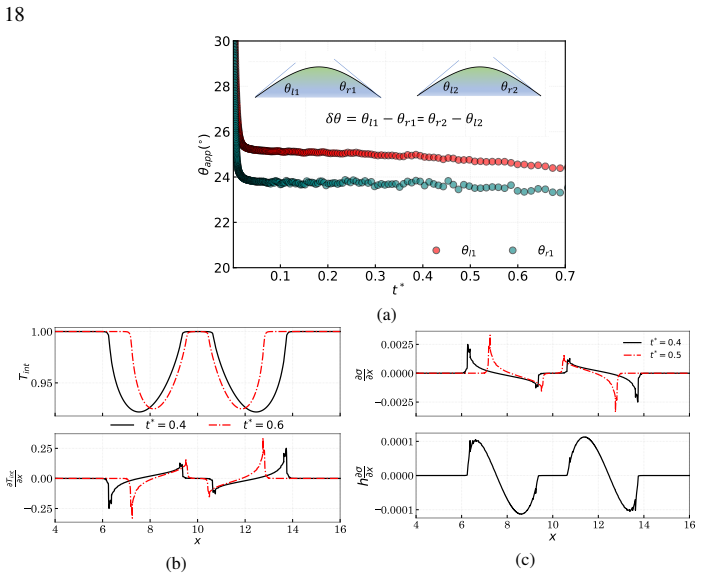
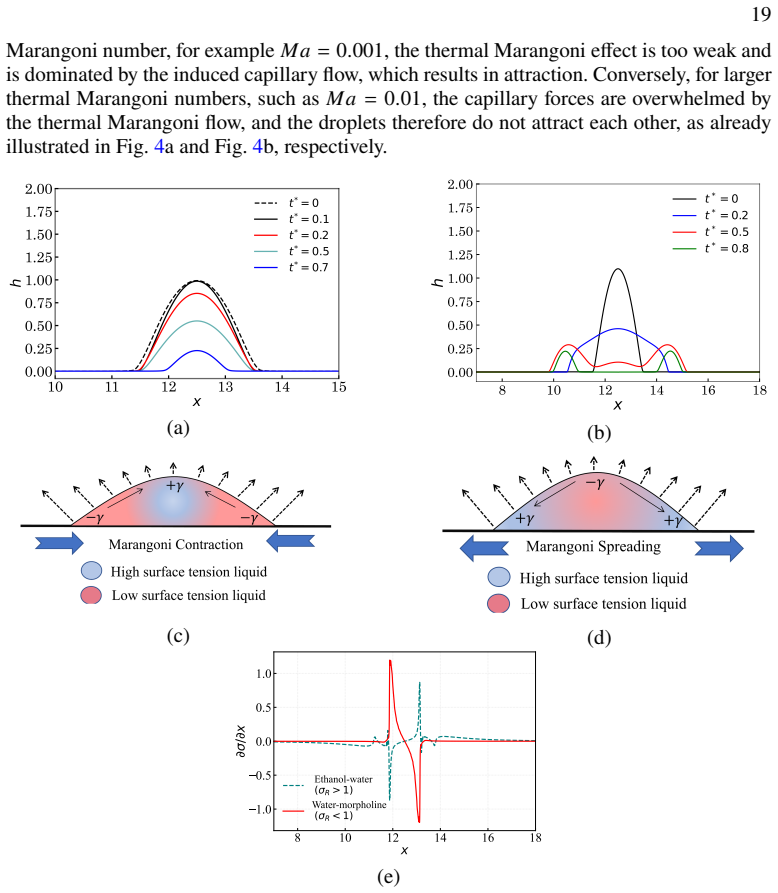
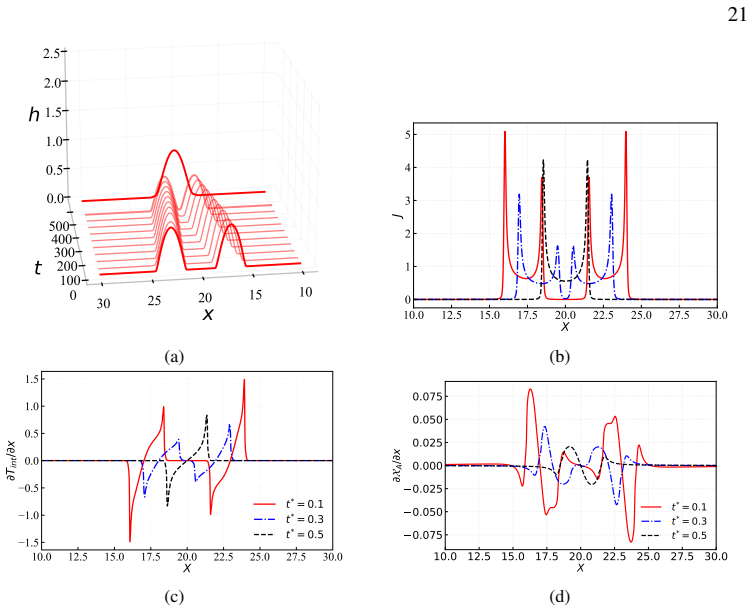
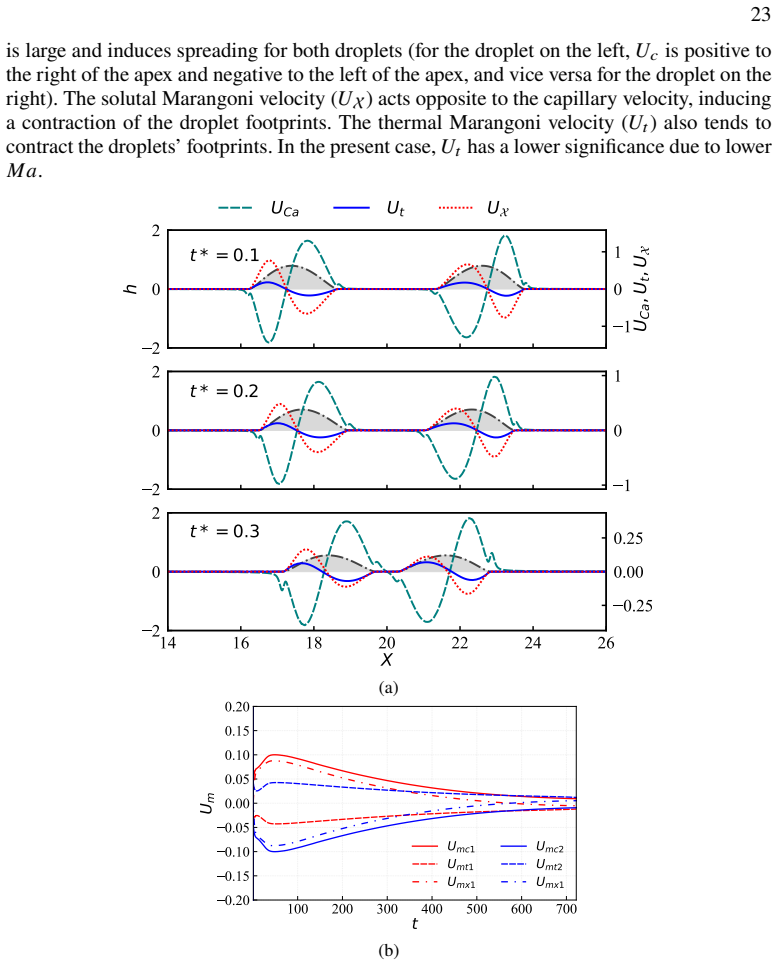
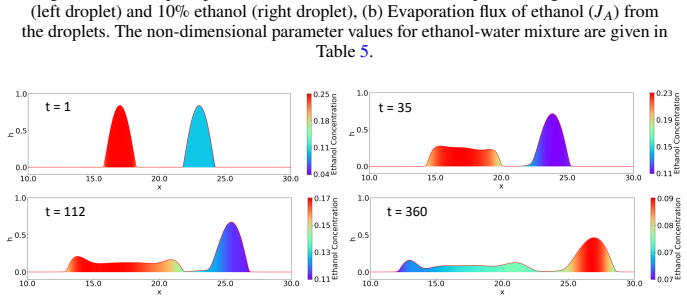
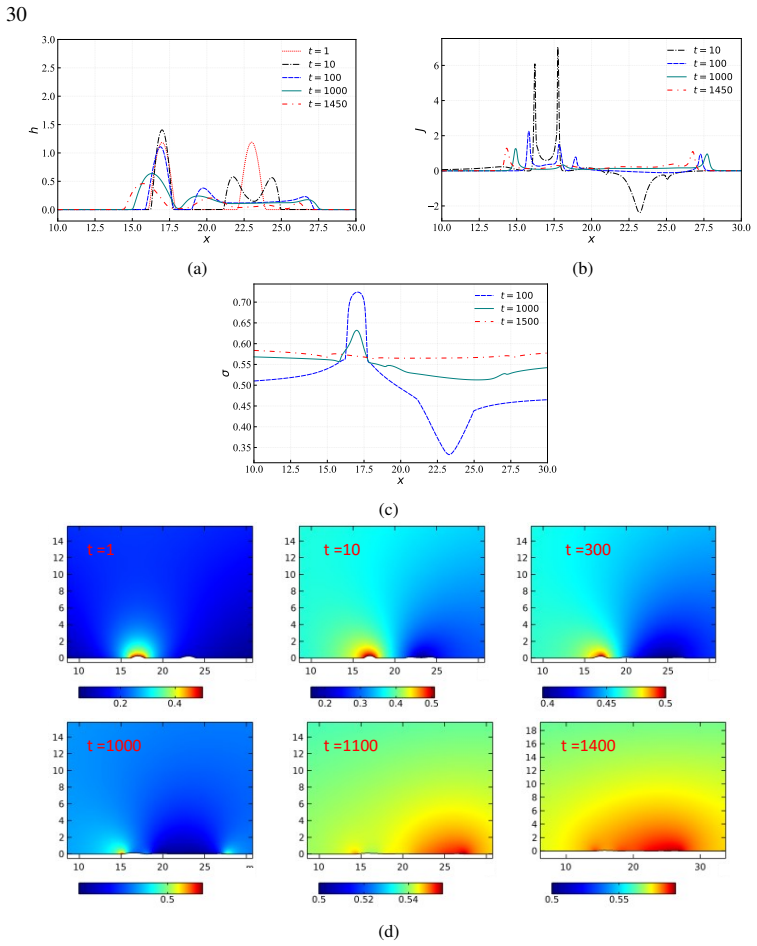
The translation dynamics of two binary mixture droplets are governed by the combined effect of solutal Marangoni, capillary, and thermal Marangoni stresses that arise from non-uniform evaporation generated by vapour shielding. For droplets sharing the same initial composition, solutal Marangoni and capillary forces induce attraction while thermal Marangoni drives repulsion. For droplets with different initial compositions, the drop containing a higher concentration of the more volatile component pushes or chases the other drop, an effect driven entirely by solutal Marangoni. The model accounts for Marangoni stresses from evaporative cooling and concentration gradients together with vapour di
What carries the argument
Lubrication-theory evolution equations for the droplet height and composition profiles that incorporate solutal Marangoni stresses from concentration gradients, thermal Marangoni stresses from evaporative cooling, capillary pressure, and vapor diffusion for both species.
If this is right
- Droplets of identical initial composition will exhibit net attraction or repulsion according to which Marangoni mechanism dominates at each stage of evaporation.
- Composition mismatch produces directed chasing motion independent of thermal effects.
- The same vapor-shielding mechanism can be expected to produce collective translation patterns in larger arrays of binary droplets.
- The relative strengths of the three stress contributions can be tuned by changing the initial mixture ratio or the volatility difference between components.
Where Pith is reading between the lines
- The chasing mechanism could be exploited to sort or transport droplets by composition without external forcing.
- Similar interactions may appear in other multicomponent volatile systems such as inkjet printing or respiratory droplets.
- Extending the model to three or more droplets would test whether pairwise chasing produces stable clusters or chaotic motion.
- The assumption that droplets stay thin may break down at late times, suggesting a need for a full Navier-Stokes treatment near the end of evaporation.
Load-bearing premise
The droplets remain thin enough throughout their lifetime that the lubrication approximation continues to hold and the derived evolution equations stay valid.
What would settle it
A controlled experiment in which two droplets of different initial compositions exhibit no chasing motion despite clear vapor shielding and measurable concentration gradients would falsify the claim that solutal Marangoni alone drives the chasing.
Figures
read the original abstract
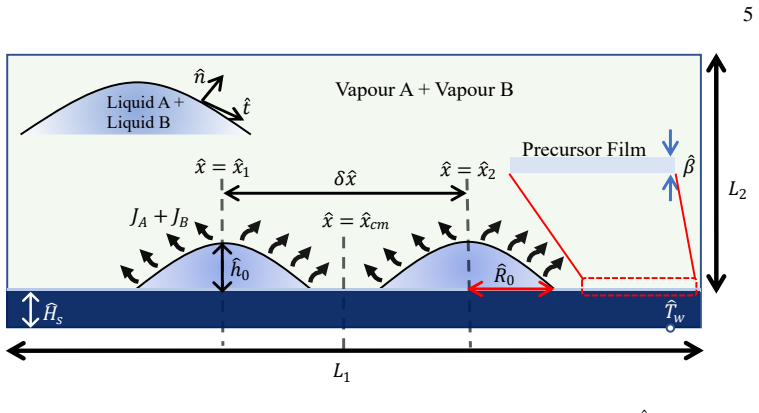
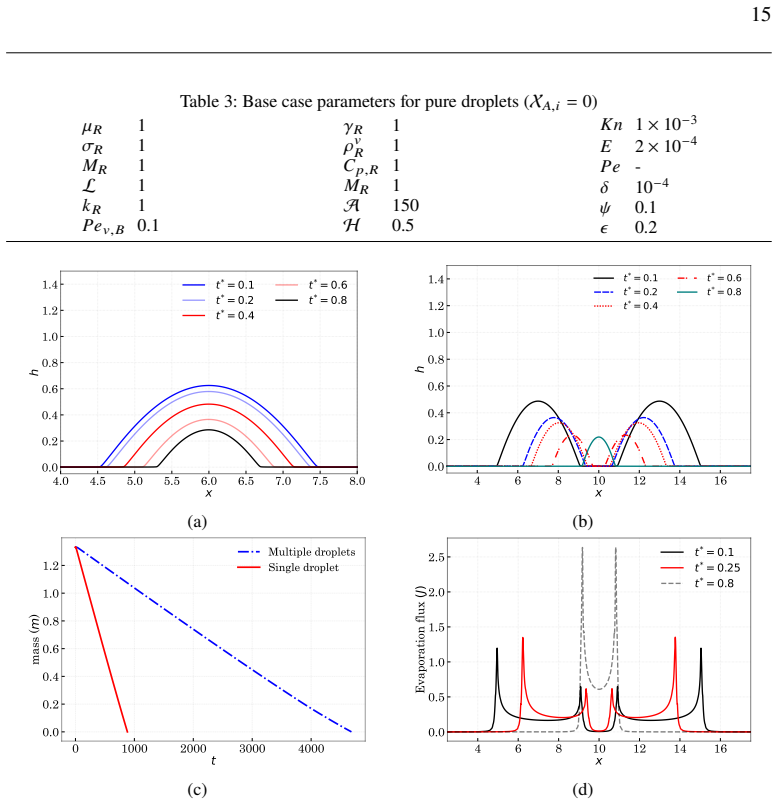
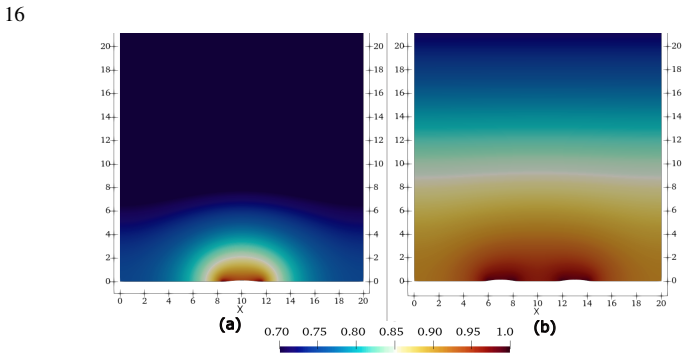
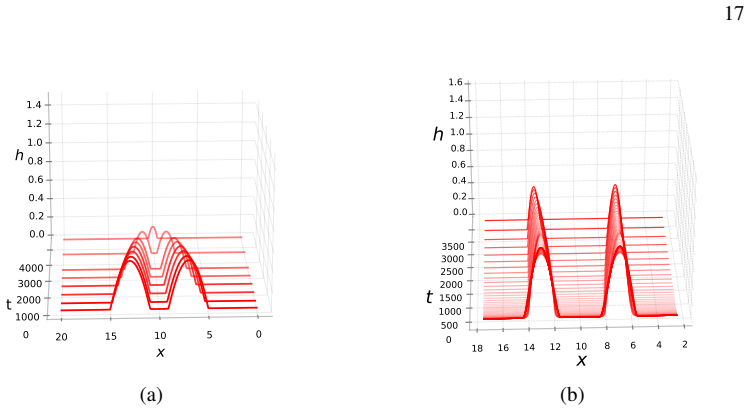
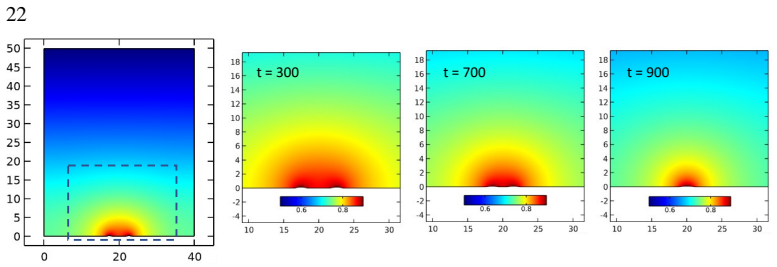
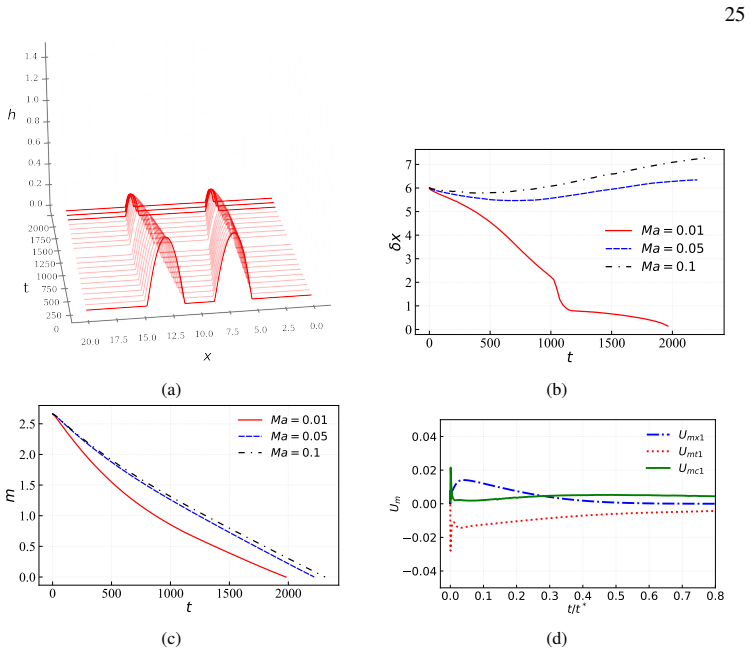
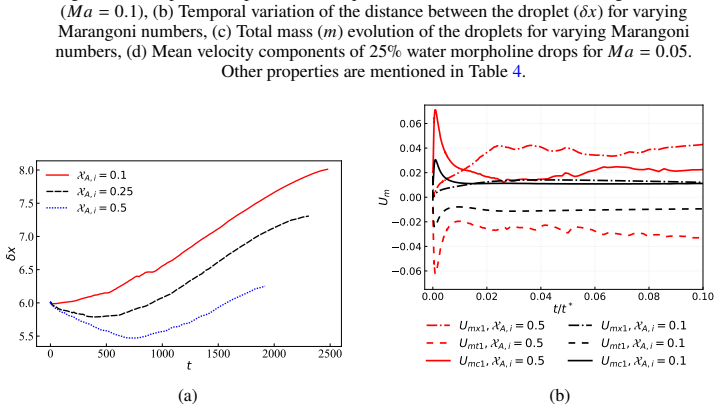
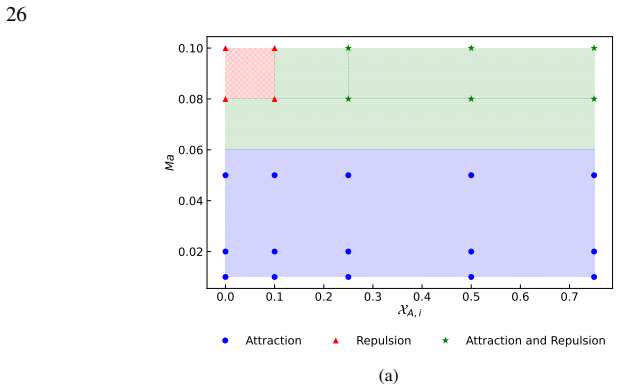
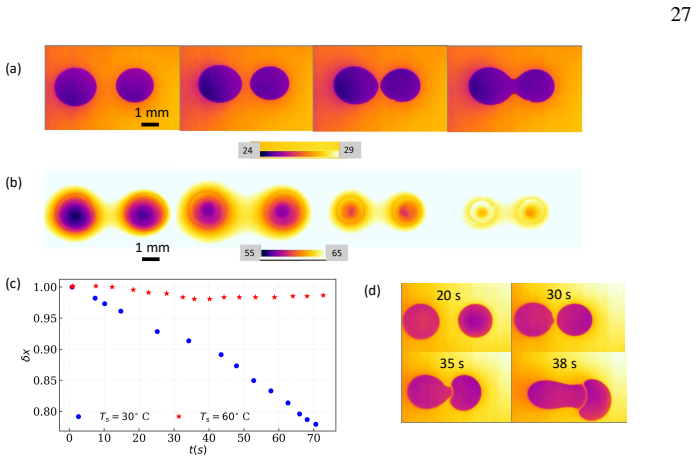
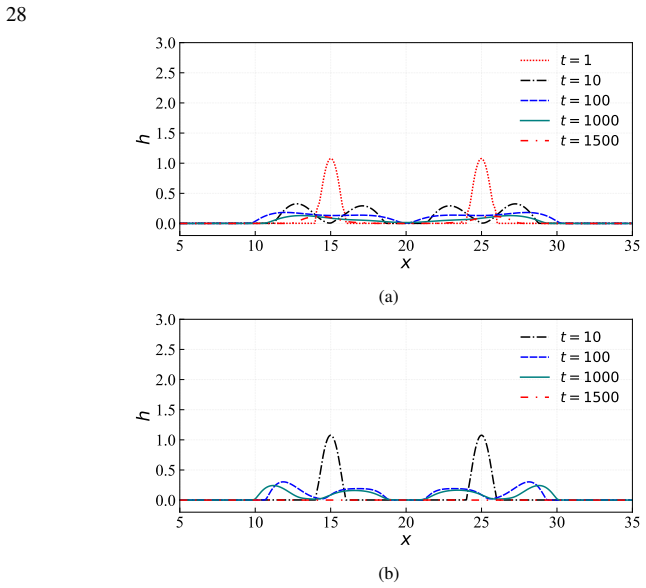
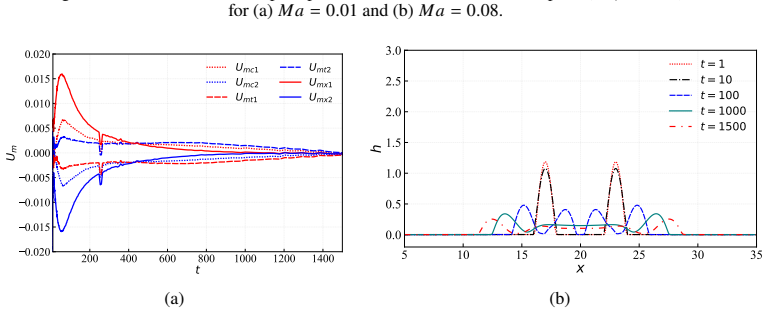
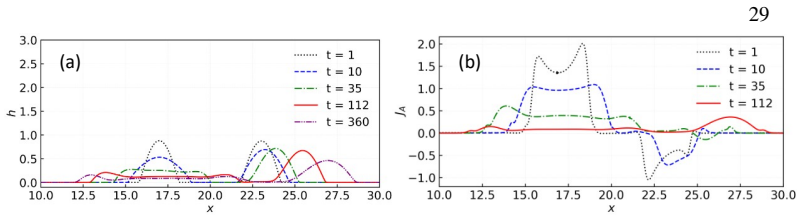
The translation dynamics of two binary mixture droplets is investigated theoretically and is corroborated with experiments. The proposed model accounts for the effects of Marangoni stresses generated by evaporative cooling and concentration gradients, as well as vapour diffusion, for both components of the binary mixture. We consider thin droplets, allowing us to use the lubrication theory to derive the evolution equation for the droplet profiles. We numerically solve the evolution equations using the finite element method and examine various cases of pure and binary droplet pairs exhibiting translational behaviours like attraction, repulsion, and 'chasing'. The results show that the combined effect of solutal Marangoni, capillary effect, and thermal Marangoni determines the movement of the droplets. The non-uniform evaporation generated from 'vapour shielding' creates such effects. We observe that for droplets with the same initial composition, solutal Marangoni and capillary forces induce droplet attraction, while thermal Marangoni effects drive their repulsion. For droplets with different initial compositions, the drop with a higher concentration of the more volatile component pushes, or `chases', the drop with a lower initial concentration of this component, completely driven by the solutal Marangoni. We carried out experiments involving water-morpholine binary mixture droplets to validate the results predicted by our model.
Editorial analysis
A structured set of objections, weighed in public.
Referee Report
Summary. The manuscript develops a lubrication-theory model for the translational dynamics of pairs of evaporating sessile binary-mixture droplets. The evolution equations incorporate solutal and thermal Marangoni stresses arising from concentration gradients and evaporative cooling, together with vapor diffusion for both components. Numerical solutions via finite elements are used to reproduce attraction, repulsion, and chasing behaviors, which are attributed to non-uniform evaporation caused by vapor shielding. Experiments with water-morpholine droplets are presented as corroboration. The central claim is that the observed motions are determined by the combined action of solutal Marangoni, capillary, and thermal Marangoni effects, with specific composition-dependent roles for each.
Significance. If the reduced model remains valid, the work supplies a mechanistic explanation for composition-dependent droplet interactions that are relevant to coating, printing, and microfluidic applications. The explicit inclusion of both solutal and thermal Marangoni stresses together with vapor shielding, plus the experimental comparison, constitutes a concrete advance over single-component treatments.
major comments (2)
- [Model derivation] Model derivation (paragraph beginning 'We consider thin droplets'): The central claim that the reported attraction/repulsion/chasing motions follow from the derived velocity fields rests on the lubrication approximation remaining accurate throughout the droplet lifetime. No quantitative check is supplied on the instantaneous aspect ratio h/R under the non-uniform evaporation profiles that drive the interactions; if h/R reaches O(0.1), the neglected higher-order terms would alter the height and velocity fields used to predict the translational dynamics.
- [Numerical results] Numerical results and experimental comparison (section describing the cases of same and different initial compositions): The manuscript states that chasing is 'completely driven by the solutal Marangoni' for dissimilar droplets, yet the relative magnitudes of the three stress contributions are not quantified (e.g., via separate runs with individual terms suppressed) to demonstrate that thermal Marangoni and capillary contributions are negligible in that regime.
minor comments (1)
- [Abstract] The abstract and main text refer to 'vapour shielding' without a concise definition or reference to the underlying diffusion problem at first use.
Simulated Author's Rebuttal
We thank the referee for the constructive report and the recommendation for major revision. We address each major comment below and will revise the manuscript accordingly to strengthen the justification of the model and the attribution of mechanisms.
read point-by-point responses
-
Referee: [Model derivation] Model derivation (paragraph beginning 'We consider thin droplets'): The central claim that the reported attraction/repulsion/chasing motions follow from the derived velocity fields rests on the lubrication approximation remaining accurate throughout the droplet lifetime. No quantitative check is supplied on the instantaneous aspect ratio h/R under the non-uniform evaporation profiles that drive the interactions; if h/R reaches O(0.1), the neglected higher-order terms would alter the height and velocity fields used to predict the translational dynamics.
Authors: We agree that an explicit check on the instantaneous aspect ratio is needed to confirm the validity of the lubrication approximation under the non-uniform evaporation that drives the interactions. In the revised manuscript we will add a supplementary figure or table reporting the time evolution of max(h/R) for all simulated cases (same-composition and dissimilar-composition pairs). Preliminary post-processing of our existing solutions shows max(h/R) remains below 0.05 throughout the lifetime, well inside the regime where higher-order corrections are negligible; the new figure will document this quantitatively. revision: yes
-
Referee: [Numerical results] Numerical results and experimental comparison (section describing the cases of same and different initial compositions): The manuscript states that chasing is 'completely driven by the solutal Marangoni' for dissimilar droplets, yet the relative magnitudes of the three stress contributions are not quantified (e.g., via separate runs with individual terms suppressed) to demonstrate that thermal Marangoni and capillary contributions are negligible in that regime.
Authors: We acknowledge that the claim would be stronger with a direct quantification of the relative stress contributions. In the revised manuscript we will add a new subsection (or supplementary material) presenting three additional numerical experiments for the dissimilar-composition case in which (i) thermal Marangoni stress, (ii) capillary pressure gradient, and (iii) both are individually suppressed while keeping all other terms active. The resulting droplet trajectories will be compared with the full model to demonstrate that only the solutal Marangoni term produces the observed chasing motion. revision: yes
Circularity Check
No circularity: standard lubrication derivation with external validation
full rationale
The paper applies the standard lubrication approximation to thin droplets to obtain evolution equations for height and concentration profiles, then numerically integrates those equations to obtain interaction dynamics (attraction/repulsion/chasing). These outputs are compared against independent experiments on water-morpholine droplets. No parameter is fitted to the target behaviors and then relabeled as a prediction; no load-bearing premise reduces to a self-citation; the thin-droplet premise is an explicit modeling choice whose validity is an external question of correctness rather than a definitional loop. The derivation chain is therefore self-contained against external benchmarks.
Axiom & Free-Parameter Ledger
axioms (2)
- domain assumption Droplets remain thin enough for lubrication theory to apply throughout evaporation
- standard math Vapor diffusion and evaporative cooling produce the stated Marangoni stresses
Reference graph
Works this paper leans on
-
[1]
and Kempers, R
Azzam, A. and Kempers, R. and Amirfazli, A. , title =. International Communications in Heat and Mass Transfer , year =
-
[2]
Saxton, M. A. and Vella, D. and Whiteley, J. P. and Oliver, J. M. , title =. Journal of Engineering Mathematics , volume =. 2017 , doi =
2017
-
[3]
and Rednikov, A
Colinet, P. and Rednikov, A. , title =. European Physical Journal Special Topics , volume =. 2011 , doi =
2011
-
[4]
Journal of colloid and interface science , volume=
Surface-tension-driven instabilities of a pure liquid layer evaporating into an inert gas , author=. Journal of colloid and interface science , volume=. 2005 , publisher=
2005
-
[5]
Journal of Fluid Mechanics , author =
Evaporation of a thin film: diffusion of the vapour and. Journal of Fluid Mechanics , author =. 2005 , note =. doi:10.1017/S0022112005006348 , abstract =
-
[6]
Reviews of modern physics , volume=
Long-scale evolution of thin liquid films , author=. Reviews of modern physics , volume=. 1997 , publisher=
1997
-
[7]
Zhao, H. and Orejon, D. and Sefiane, K. and Shanahan, M. E. R. , title =. Langmuir , year =. doi:10.1021/acs.langmuir.4c04255 , note =
-
[8]
and Karapetsas, G
Malachtari, A. and Karapetsas, G. , title =. Journal of Fluid Mechanics , year =
-
[9]
Langmuir , volume=
Drying of droplets of colloidal suspensions on rough substrates , author=. Langmuir , volume=. 2017 , publisher=
2017
-
[10]
de Gennes, P. G. , title =. Reviews of Modern Physics , volume =. 1985 , doi =
1985
-
[11]
Journal of Fluid Mechanics , volume=
On the motion of a fluid-fluid interface along a solid surface , author=. Journal of Fluid Mechanics , volume=. 1974 , publisher=
1974
-
[12]
Journal of colloid and interface science , volume=
Hydrodynamic model of steady movement of a solid/liquid/fluid contact line , author=. Journal of colloid and interface science , volume=. 1971 , publisher=
1971
-
[13]
2011 , publisher=
Intermolecular and surface forces (3rd ed) , author=. 2011 , publisher=
2011
-
[14]
and Tsakelidis, I
Malachtari, A. and Tsakelidis, I. and Karapetsas, G. , title =. Phys. Rev. Fluids , year =
-
[15]
Multiple srop evaporation thesis , author =
-
[16]
and Kita, Y
Askounis, A. and Kita, Y. and Kohno, M. and Takata, Y. and Koutsos, V. and Sefiane, K. , title =. Langmuir , year =
-
[17]
Applied Physics Letters , author =
Induction of. Applied Physics Letters , author =. 2016 , pages =. doi:10.1063/1.4966542 , abstract =
-
[18]
Physical Review Fluids , author =
Flow stability in shallow droplets subject to localized heating of the bottom plate , volume =. Physical Review Fluids , author =. 2024 , note =. doi:10.1103/PhysRevFluids.9.014003 , abstract =
-
[19]
Journal of Computational Physics 115(1), 200–212 (1994) https://doi.org/10.1006/jcph.1994.1187
Weighted. Journal of Computational Physics , author =. 1994 , pages =. doi:10.1006/jcph.1994.1187 , abstract =
-
[20]
Kavuri, S. and Karapetsas, G. and Sharma, C. S. and Sahu, K. C. , month = nov, year =. Evaporation-driven coalescence of two droplets undergoing freezing , url =. doi:10.48550/arXiv.2408.09827 , abstract =
-
[21]
Journal of Computational Physics , author =
Computation of multiphase systems with phase field models , volume =. Journal of Computational Physics , author =. 2003 , keywords =. doi:10.1016/S0021-9991(03)00280-8 , abstract =
-
[22]
Wetting condition in diffuse interface simulations of contact line motion , volume =. Physical Review E , author =. 2007 , note =. doi:10.1103/PhysRevE.75.046708 , abstract =
-
[23]
Evaporation of. Langmuir , author =. 2016 , note =. doi:10.1021/acs.langmuir.6b01042 , abstract =
-
[24]
Convective. Langmuir , author =. 2012 , note =. doi:10.1021/la3019088 , abstract =
-
[25]
Analysis of the effects of marangoni stresses on the microflow in an evaporating sessile droplet , volume =. Langmuir , author =. 2005 , note =. doi:10.1021/LA0475270/ASSET/IMAGES/MEDIUM/LA0475270E00037.GIF , abstract =
work page doi:10.1021/la0475270/asset/images/medium/la0475270e00037.gif 2005
-
[26]
A phase field model of capillarity , volume =. Physics of Fluids , author =. 1995 , pages =. doi:10.1063/1.868598 , abstract =
-
[27]
Journal of Computational Physics , author =
Diffuse interface model for incompressible two-phase flows with large density ratios , volume =. Journal of Computational Physics , author =. 2007 , keywords =. doi:10.1016/j.jcp.2007.06.028 , abstract =
-
[29]
Applied Thermal Engineering , author =
An equation for the estimation of alcohol-air diffusion coefficients for modelling evaporation losses in fuel systems , volume =. Applied Thermal Engineering , author =. 2014 , keywords =. doi:10.1016/j.applthermaleng.2014.08.009 , abstract =
-
[30]
Physical Review Fluids , author =
Colloidal deposits from evaporating sessile droplets:. Physical Review Fluids , author =. 2024 , note =. doi:10.1103/PhysRevFluids.9.064304 , abstract =
-
[31]
Spreading of volatile droplets in a humidity-controlled environment , issn =. Soft Matter , author =. 2024 , note =. doi:10.1039/D4SM00583J , abstract =
-
[33]
Journal of Fluid Mechanics , author =
Role of volatility and thermal properties in droplet spreading: a generalisation to. Journal of Fluid Mechanics , author =. 2024 , keywords =. doi:10.1017/jfm.2024.385 , abstract =
-
[34]
Oil on troubled waters:. Physics Today , author =. 2006 , pages =. doi:10.1063/1.2180175 , abstract =
-
[35]
Does the van der. Physics of Fluids , author =. 2024 , note =. doi:10.1063/5.0192771/3268285 , abstract =
-
[36]
Journal of Fluid Mechanics , author =
Does. Journal of Fluid Mechanics , author =. 2023 , note =. doi:10.1017/JFM.2023.667 , abstract =
-
[37]
Journal of Fluid Mechanics , author =
Dynamics of hygroscopic aqueous solution droplets undergoing evaporation or vapour absorption , volume =. Journal of Fluid Mechanics , author =. 2021 , note =. doi:10.1017/jfm.2020.1073 , abstract =
-
[38]
Wetting and evaporation of multicomponent droplets , volume =. Physics Reports , author =. 2022 , note =. doi:10.1016/J.PHYSREP.2022.02.005 , abstract =
-
[40]
Proceedings of the National Academy of Sciences of the United States of America , author =
Marangoni spreading and contracting three-component droplets on completely wetting surfaces , volume =. Proceedings of the National Academy of Sciences of the United States of America , author =. 2022 , pmid =. doi:10.1073/PNAS.2120432119/SUPPL_FILE/PNAS.2120432119.SM05.MP4 , abstract =
work page doi:10.1073/pnas.2120432119/suppl_file/pnas.2120432119.sm05.mp4 2022
-
[41]
Journal of Fluid Mechanics , author =
Spreading and retraction dynamics of sessile evaporating droplets comprising volatile binary mixtures , volume =. Journal of Fluid Mechanics , author =. 2021 , note =. doi:10.1017/jfm.2020.840 , abstract =
-
[42]
Colloids and Surfaces A: Physicochemical and Engineering Aspects , author =
Influence of an adjacent droplet on fluid convection inside an evaporating droplet of binary mixture , volume =. Colloids and Surfaces A: Physicochemical and Engineering Aspects , author =. 2016 , note =. doi:10.1016/J.COLSURFA.2016.03.073 , abstract =
-
[43]
Journal of Fluid Mechanics , author =
Competing. Journal of Fluid Mechanics , author =. 2021 , note =. doi:10.1017/JFM.2020.734 , abstract =
-
[44]
Physical Review Letters , author =
Vapor-. Physical Review Letters , author =. 2017 , note =. doi:10.1103/PhysRevLett.119.044502 , number =
-
[45]
Cira, N. J. and Benusiglio, A. and Prakash, M. , year =. Vapour-mediated sensing and motility in two-component droplets , doi =
-
[46]
Journal of Fluid Mechanics , author =
Water–propylene glycol sessile droplet shapes and migration:. Journal of Fluid Mechanics , author =. 2022 , note =. doi:10.1017/JFM.2021.1030 , abstract =
-
[47]
Annual Review of Fluid Mechanics , author =
Numerical simulations of flows with moving contact lines , volume =. Annual Review of Fluid Mechanics , author =. 2014 , note =. doi:10.1146/ANNUREV-FLUID-010313-141338/CITE/REFWORKS , abstract =
work page doi:10.1146/annurev-fluid-010313-141338/cite/refworks 2014
-
[48]
Physical Review Letters , author =
Thermal. Physical Review Letters , author =. 2021 , pmid =. doi:10.1103/PHYSREVLETT.127.024502/FIGURES/4/MEDIUM , abstract =
work page doi:10.1103/physrevlett.127.024502/figures/4/medium 2021
-
[49]
Vapor-. Langmuir , author =. 2019 , pmid =. doi:10.1021/ACS.LANGMUIR.9B00522/ASSET/IMAGES/MEDIUM/LA-2019-005222_M011.GIF , abstract =
work page doi:10.1021/acs.langmuir.9b00522/asset/images/medium/la-2019-005222_m011.gif 2019
-
[50]
Vapor-induced motion of two pure liquid droplets , volume =. Soft Matter , author =. 2019 , pmid =. doi:10.1039/C8SM02584C , abstract =
-
[51]
Journal of Fluid Mechanics , author =
Evaporating droplets , volume =. Journal of Fluid Mechanics , author =. 2006 , note =. doi:10.1017/S0022112005008190 , abstract =
-
[52]
Journal of Bionic Engineering , author =
On the. Journal of Bionic Engineering , author =. 2010 , note =. doi:10.1016/S1672-6529(09)60221-3 , abstract =
-
[53]
Marangoni. Langmuir , author =. 2017 , pmid =. doi:10.1021/ACS.LANGMUIR.7B00740/ASSET/IMAGES/LA-2017-007407_M013.GIF , abstract =
work page doi:10.1021/acs.langmuir.7b00740/asset/images/la-2017-007407_m013.gif 2017
-
[54]
Journal of Fluid Mechanics , author =
Onset of motion of a three-dimensional droplet on a wall in shear flow at moderate. Journal of Fluid Mechanics , author =. 2008 , note =. doi:10.1017/S0022112008000190 , abstract =
-
[55]
Journal of Fluid Mechanics , author =
Spreading of thin volatile liquid droplets on uniformly heated surfaces , volume =. Journal of Fluid Mechanics , author =. 2005 , note =. doi:10.1017/S0022112005003320 , abstract =
-
[56]
Journal of Fluid Mechanics , author =
Predicting evaporation rates of droplet arrays , volume =. Journal of Fluid Mechanics , author =. 2022 , note =. doi:10.1017/JFM.2021.1084 , abstract =
-
[57]
Physical Review Fluids , author =
Drying dynamics of sessile-droplet arrays , volume =. Physical Review Fluids , author =. 2023 , note =. doi:10.1103/PHYSREVFLUIDS.8.013602/FIGURES/7/MEDIUM , abstract =
work page doi:10.1103/physrevfluids.8.013602/figures/7/medium 2023
-
[58]
Journal of Colloid and Interface Science , author =
Numerical simulation of the drying of inkjet-printed droplets , volume =. Journal of Colloid and Interface Science , author =. 2013 , note =. doi:10.1016/J.JCIS.2012.09.063 , abstract =
-
[59]
Physical Review Letters , author =
Density-. Physical Review Letters , author =. 2018 , pmid =. doi:10.1103/PHYSREVLETT.121.184501/FIGURES/3/MEDIUM , abstract =
work page doi:10.1103/physrevlett.121.184501/figures/3/medium 2018
-
[60]
Contact line deposits in an evaporating drop , volume =. Physical Review E , author =. 2000 , pmid =. doi:10.1103/PhysRevE.62.756 , abstract =
-
[61]
Journal of Fluid Mechanics , author =
Dynamics of the interaction of a pair of thin evaporating droplets on compliant substrates , volume =. Journal of Fluid Mechanics , author =. 2024 , note =. doi:10.1017/JFM.2023.855 , abstract =
-
[62]
Effect of ambient temperature and relative humidity on interfacial temperature during early stages of drop evaporation , volume =. Physical Review E , author =. 2016 , note =. doi:10.1103/PHYSREVE.93.043103/FIGURES/17/MEDIUM , abstract =
work page doi:10.1103/physreve.93.043103/figures/17/medium 2016
-
[63]
Effects of surface roughness on wettability , volume =. Acta Materialia , author =. 1998 , note =. doi:10.1016/S1359-6454(98)80012-8 , abstract =
-
[64]
Journal of Rheology , author =. 2003 , note =. doi:10.1122/1.1595097 , abstract =
-
[65]
Journal of Fluid Mechanics , author =
Rayleigh–. Journal of Fluid Mechanics , author =. 2020 , note =. doi:10.1017/JFM.2020.449 , abstract =
-
[66]
Predicting the lifetimes of evaporating droplets in ordered arrays , volume =. Physics of Fluids , author =. 2022 , note =. doi:10.1063/5.0105243/2846778 , abstract =
-
[67]
International Journal of Heat and Mass Transfer , author =
Heat flux distribution beneath evaporating hydrophilic and superhydrophobic droplets , volume =. International Journal of Heat and Mass Transfer , author =. 2020 , note =. doi:10.1016/J.IJHEATMASSTRANSFER.2019.119093 , abstract =
-
[68]
Colloids and Surfaces A: Physicochemical and Engineering Aspects , author =
On evaporation rate and interfacial temperature of volatile sessile drops , volume =. Colloids and Surfaces A: Physicochemical and Engineering Aspects , author =. 2009 , note =. doi:10.1016/J.COLSURFA.2008.09.047 , abstract =
-
[69]
and Souzy, M
Kant, P. and Souzy, M. and Kim, N. and van der Meer, D. and Lohse, D. , month = jun, year =. Autothermotaxis of volatile drops , url =
-
[70]
Journal of Engineering Mathematics , author =
The shielding effect extends the lifetimes of two-dimensional sessile droplets , volume =. Journal of Engineering Mathematics , author =. 2020 , note =. doi:10.1007/S10665-019-10033-7/FIGURES/10 , abstract =
-
[71]
Applied Physics Letters , author =
Self-excited hydrothermal waves in evaporating sessile drops , volume =. Applied Physics Letters , author =. 2008 , note =. doi:10.1063/1.2969072/336088 , abstract =
-
[72]
Vortices, dissipation and flow transition in volatile binary drops , volume =. J. Fluid Mech , author =. 2014 , note =. doi:10.1017/jfm.2014.220 , abstract =
-
[73]
and Williams, L
Graham, A. and Williams, L. , year =. Evaporation of
-
[74]
Droplet evaporation study applied to. Langmuir , author =. 2005 , pmid =. doi:10.1021/LA050764Y/ASSET/IMAGES/LARGE/LA050764YF00006.JPEG , abstract =
work page doi:10.1021/la050764y/asset/images/large/la050764yf00006.jpeg 2005
-
[75]
Proceedings of the National Academy of Sciences of the United States of America , author =
Automated high resolution optical mapping using arrayed, fluid-fixed. Proceedings of the National Academy of Sciences of the United States of America , author =. 1998 , pmid =. doi:10.1073/PNAS.95.14.8046/ASSET/D89FF7C0-77B1-4E72-BD13-B52DBE615DA7/ASSETS/GRAPHIC/PQ1381472004.JPEG , abstract =
work page doi:10.1073/pnas.95.14.8046/asset/d89ff7c0-77b1-4e72-bd13-b52dbe615da7/assets/graphic/pq1381472004.jpeg 1998
-
[76]
Journal of Fluid Mechanics , author =
Pattern formation in drying drops of blood , volume =. Journal of Fluid Mechanics , author =. 2011 , note =. doi:10.1017/S0022112010005070 , abstract =
-
[77]
International Journal of Heat and Fluid Flow , author =
Spray cooling heat transfer:. International Journal of Heat and Fluid Flow , author =. 2007 , note =. doi:10.1016/J.IJHEATFLUIDFLOW.2006.09.003 , abstract =
-
[78]
Proceedings of the IEEE , author =
Direct liquid cooling of high flux micro and nano electronic components , volume =. Proceedings of the IEEE , author =. 2006 , note =. doi:10.1109/JPROC.2006.879791 , abstract =
-
[79]
Inkjet. Advanced Materials , author =. 2010 , pmid =. doi:10.1002/ADMA.200901141 , abstract =
-
[80]
Matar, O. K. , year =. A simple derivation of the time-dependent convective-diffusion equation for surfactant transport along a deforming interface , volume =. doi:10.1063/1.1516597 , journal =
-
[81]
and Karapetsas, G
Wang, Z. and Karapetsas, G. and Valluri, P. and Inoue, C. , month = apr, year =. Intricate
-
[82]
Insight into the. Langmuir , author =. 2016 , note =. doi:10.1021/ACS.LANGMUIR.5B04570/ASSET/IMAGES/LARGE/LA-2015-045703_0009.JPEG , abstract =
work page doi:10.1021/acs.langmuir.5b04570/asset/images/large/la-2015-045703_0009.jpeg 2016
-
[84]
Droplet evaporation on soft solid substrates , volume =. Soft Matter , author =. 2021 , pmid =. doi:10.1039/D1SM00828E , abstract =
discussion (0)
Sign in with ORCID, Apple, or X to comment. Anyone can read and Pith papers without signing in.