Bayesian Causal Machine Learning for Cure Models
Pith reviewed 2026-06-27 12:14 UTC · model grok-4.3
The pith
Causal effects on survival with cured patients can be split into effects on cure probability and on time to failure among the uncured.
A machine-rendered reading of the paper's core claim, the machinery that carries it, and where it could break.
Core claim
The authors define meaningful causal effects in the presence of a cured subpopulation that decompose the causal effect on restricted mean survival time into a stochastic cure and stochastic latency component, relate these effects to both stochastic intervention effects and causal effects in principal strata, and introduce BartCure as a Bayesian causal machine learning method using BART to estimate them while handling treatment effect heterogeneity.
What carries the argument
the decomposition of the causal effect on restricted mean survival time into a stochastic cure component and a stochastic latency component, estimated with BartCure
If this is right
- Clinicians obtain separate estimates of how much a treatment raises cure probability versus how much it delays failure among uncured patients.
- Subgroup analysis reveals whether the dominant mechanism differs across patient populations.
- The Bayesian tree regularization supports conservative detection of treatment-effect heterogeneity without large finite-sample bias.
- The new effects connect directly to principal-strata and stochastic-intervention interpretations.
Where Pith is reading between the lines
- The same decomposition could be applied to other survival models that do not explicitly include a cure fraction.
- If the components can be targeted separately, trial design might shift toward interventions that optimize one mechanism over the other.
- Extensions to time-varying treatments or competing risks would test whether the decomposition remains useful in more complex longitudinal settings.
Load-bearing premise
The assumed cure fraction and latency structure correctly describe the data-generating process.
What would settle it
Simulations in which data are generated from a model that violates the cure-fraction and latency assumptions and the method recovers biased estimates of the decomposed effects or incorrect directions of heterogeneity.
Figures
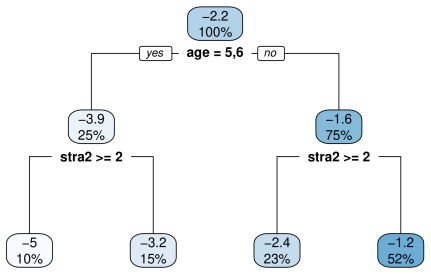
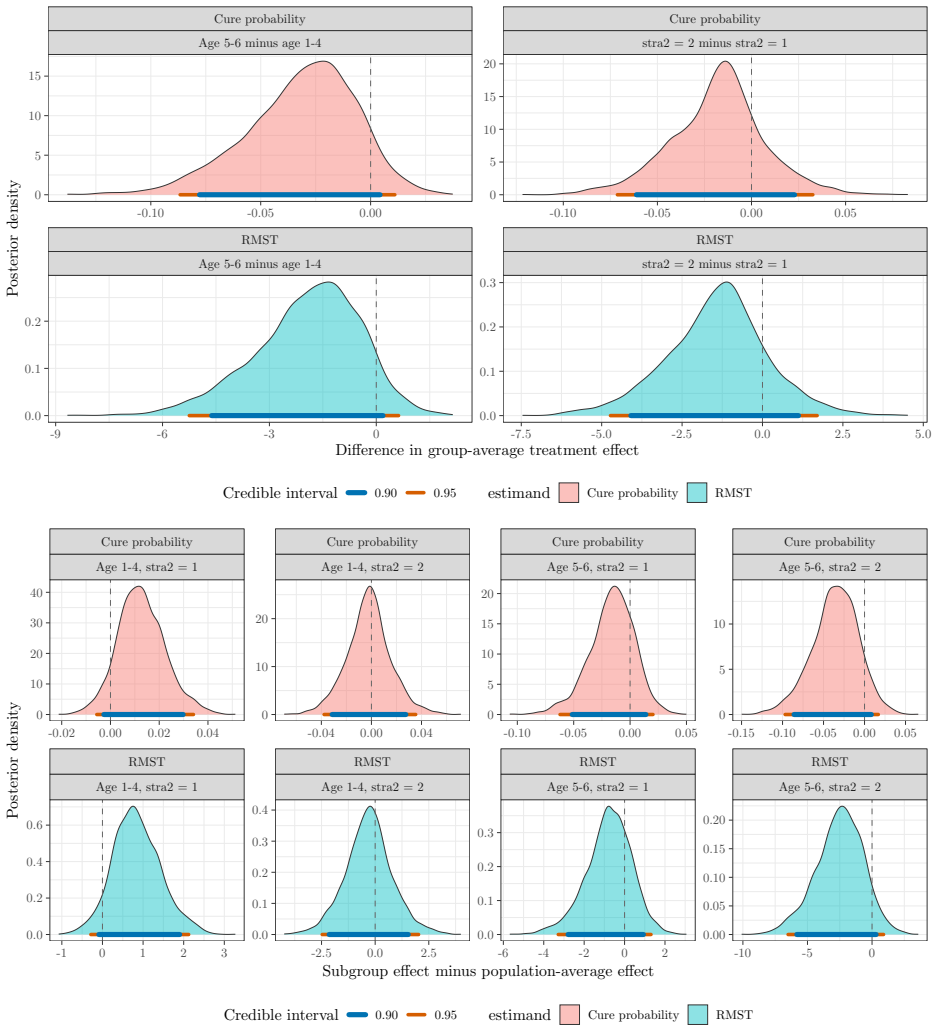
read the original abstract
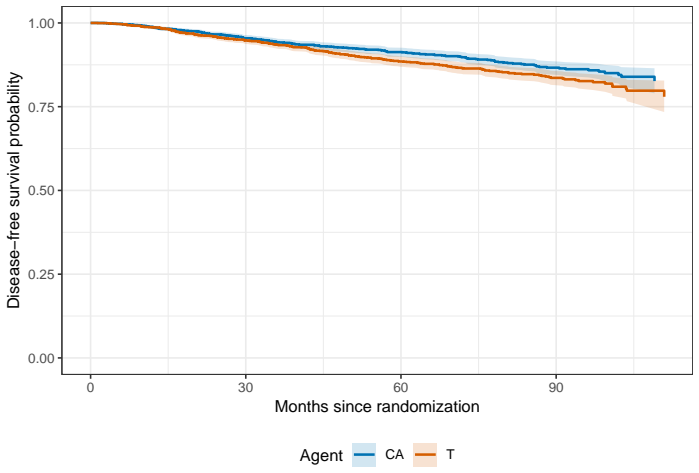
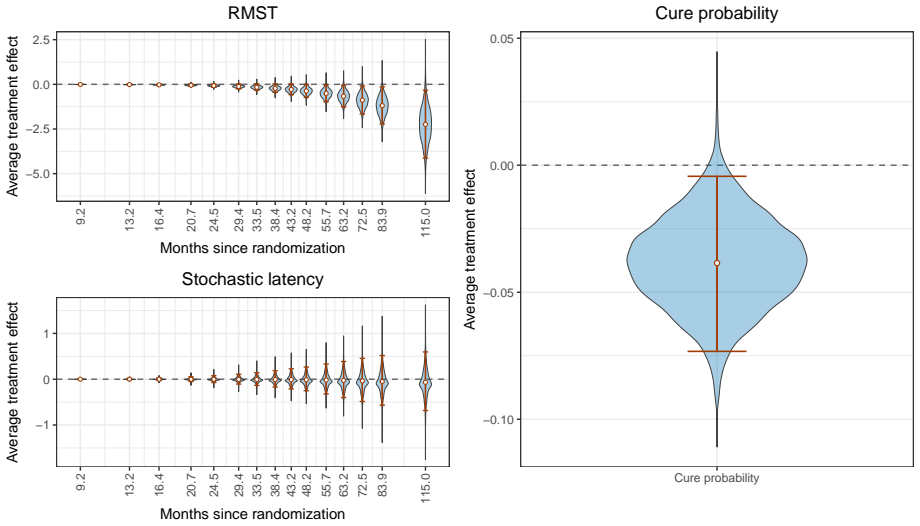
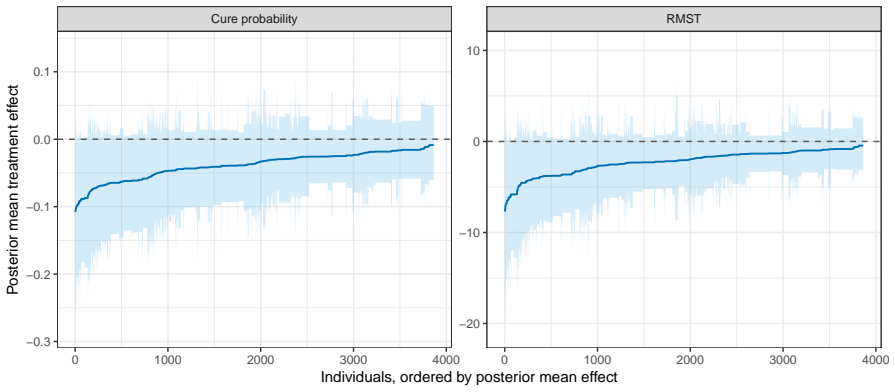
In survival studies, treatments can benefit patients through different mechanisms: a treatment may increase the probability of being cured or delay failure among patients who are not cured. Quantifying which mechanism is dominant, and whether it varies across subpopulations, is clinically important, yet there is limited work in the causal machine learning literature addressing this problem. Standard causal survival learners target finite-horizon survival or restricted mean survival time, while many cure models capture cure structures without estimating causal effects. In this work, we define meaningful causal effects in the presence of a cured subpopulation and introduce BartCure, a Bayesian causal machine learning approach for estimating them. The causal effects we recommend decompose the causal effect on restricted mean survival time into a stochastic cure and stochastic latency component, and we relate these new effects to both stochastic intervention effects and causal effects in principal strata. In simulations, BartCure is competitive for estimating average effects and is especially effective at conservatively detecting the direction of treatment-effect heterogeneity. We apply BartCure to estimate average and subgroup causal effects and to identify treatment effect heterogeneity in the CALGB 40101 breast cancer trial.
Editorial analysis
A structured set of objections, weighed in public.
Referee Report
Summary. The paper defines causal effects for survival data with a cured subpopulation by decomposing the treatment effect on restricted mean survival time (RMST) into a stochastic cure component and a stochastic latency component under a mixture cure model. It introduces BartCure, a Bayesian nonparametric approach using BART priors on both the cure probability and latency functions to estimate these effects (and their heterogeneity), relates the decomposition to stochastic interventions and principal-strata effects, reports competitive performance on average effects and conservative heterogeneity detection in simulations, and applies the method to the CALGB 40101 breast cancer trial.
Significance. If the mixture cure factorization is correctly specified, the decomposition supplies a clinically useful separation of treatment mechanisms (cure vs. delay) that is currently missing from causal survival learners, while the BART regularization offers a principled way to detect heterogeneity without over-fitting. The explicit links to stochastic intervention and principal-strata estimands are a clear strength, as is the emphasis on conservative detection of effect variation.
major comments (2)
- [§3.2] §3.2 (decomposition of RMST): the stochastic cure and stochastic latency effects are defined only under the exact mixture factorization (point mass at infinity for the cured fraction plus a proper latency distribution for the uncured). No simulation scenario or sensitivity analysis examines data-generating processes that violate this factorization (e.g., heavy-tailed latency without a point mass at infinity or cure status dependent on unobservables), so the interpretability of the decomposed components as separate mechanisms is not established.
- [§4.1–4.2] §4.1–4.2 (simulation design): all reported scenarios generate data exactly from the assumed mixture cure model with the same BART priors used by BartCure; this circularity means the reported superiority in heterogeneity detection and the competitive RMST performance cannot speak to robustness when the cure/latency structure is misspecified, which is load-bearing for the central causal claim.
minor comments (2)
- [§3.3] Notation for the stochastic intervention and principal-strata relations in §3.3 could be clarified with an explicit mapping table between the new effects and the existing estimands.
- [§5] The CALGB 40101 analysis reports subgroup effects but does not include a diagnostic (e.g., posterior predictive check) for the cure-fraction assumption in the observed data.
Simulated Author's Rebuttal
We thank the referee for their constructive comments on the decomposition and simulation design. We respond to each major comment below.
read point-by-point responses
-
Referee: [§3.2] §3.2 (decomposition of RMST): the stochastic cure and stochastic latency effects are defined only under the exact mixture factorization (point mass at infinity for the cured fraction plus a proper latency distribution for the uncured). No simulation scenario or sensitivity analysis examines data-generating processes that violate this factorization (e.g., heavy-tailed latency without a point mass at infinity or cure status dependent on unobservables), so the interpretability of the decomposed components as separate mechanisms is not established.
Authors: The decomposition is explicitly defined under the mixture cure model, which is the standard framework for separating cure and latency mechanisms in this literature. The effects therefore inherit the model's assumptions, and their interpretation as distinct mechanisms holds conditionally on correct specification. We agree that violations (such as heavy tails or unobservable cure dependence) would affect interpretability, but the manuscript does not claim the decomposition is robust to such violations. We will add a clarifying paragraph in the discussion section on the role of the mixture assumption. revision: partial
-
Referee: [§4.1–4.2] §4.1–4.2 (simulation design): all reported scenarios generate data exactly from the assumed mixture cure model with the same BART priors used by BartCure; this circularity means the reported superiority in heterogeneity detection and the competitive RMST performance cannot speak to robustness when the cure/latency structure is misspecified, which is load-bearing for the central causal claim.
Authors: The simulations evaluate estimator performance when the data-generating process matches the assumed mixture cure model, which is required to confirm that BartCure recovers the defined effects and detects heterogeneity conservatively under correct specification. The central claim concerns definition and estimation of the decomposed effects under this model; the simulations support that claim. We do not assert robustness to misspecification. We will revise the simulation section and discussion to state this scope explicitly. revision: partial
Circularity Check
No significant circularity in derivation of causal effects
full rationale
The paper defines new causal effects by decomposing RMST into stochastic cure and latency components under a mixture cure model, relating them to stochastic interventions and principal strata. These definitions are presented as novel quantities derived from standard cure model assumptions rather than reducing by construction to fitted parameters or prior self-citations. No load-bearing step equates a claimed prediction or uniqueness result to an input by definition; the central claims remain independent of the paper's own equations or citations.
Axiom & Free-Parameter Ledger
axioms (2)
- domain assumption A cure fraction exists and the mixture cure model structure is appropriate for the data.
- domain assumption Standard causal assumptions (consistency, positivity, no unmeasured confounding) hold for the observed treatment assignment.
Reference graph
Works this paper leans on
-
[1]
Comparison of doxorubicin and cyclophosphamide versus single-agent paclitaxel as adjuvant therapy for breast cancer in women with 0 to 3 positive axillary nodes:
Shulman, Lawrence N and Berry, Donald A and Cirrincione, Constance T and Becker, Heather P and Perez, Edith A and O'Regan, Ruth and Martino, Silvana and Shapiro, Charles L and Schneider, Charles J and Kimmick, Gretchen and others , journal=. Comparison of doxorubicin and cyclophosphamide versus single-agent paclitaxel as adjuvant therapy for breast cancer...
2014
-
[2]
and Vansteelandt, Stijn and Robins, James M
VanderWeele, Tyler J. and Vansteelandt, Stijn and Robins, James M. , title =. Epidemiology , year =
-
[3]
and Young, Jessica G
Stensrud, Mats J. and Young, Jessica G. and Didelez, Vanessa and Robins, James M. and Hern. Separable Effects for Causal Inference in the Presence of Competing Events , journal =. 2022 , volume =
2022
-
[4]
Decision Theoretic Subgroup Detection With
Alam, Entejar and Kundu, Poorbita and Linero, Antonio R , journal=. Decision Theoretic Subgroup Detection With
-
[5]
Handbook of Survival Analysis , volume=
Cure Models , author=. Handbook of Survival Analysis , volume=. 2014 , publisher=
2014
-
[6]
Statistics & Probability Letters , volume=
Identifiability of cure models , author=. Statistics & Probability Letters , volume=. 2001 , publisher=
2001
-
[7]
Diseases , volume=
Prognostic factors associated with breast cancer-specific survival from 1995 to 2022: a systematic review and meta-analysis of 1,386,663 cases from 30 countries , author=. Diseases , volume=. 2024 , publisher=
1995
-
[8]
2024 , note =
grf: Generalized Random Forests , author =. 2024 , note =
2024
-
[9]
and Tsiatis, A
Chen, P.-Y. and Tsiatis, A. A. , title =. Biometrics , year =
-
[10]
Computer Methods and Programs in Biomedicine , volume=
Adjusted survival curves with inverse probability weights , author=. Computer Methods and Programs in Biomedicine , volume=
-
[11]
Journal of the American Statistical Association , volume=
Causal inference using potential outcomes: Design, modeling, decisions , author=. Journal of the American Statistical Association , volume=. 2005 , publisher=
2005
-
[12]
Beyond power calculations: Assessing type
Gelman, Andrew and Carlin, John , journal=. Beyond power calculations: Assessing type. 2014 , publisher=
2014
-
[13]
Journal of Biomedical Informatics , volume =
Zhu, Jie and Gallego, Blanca , title =. Journal of Biomedical Informatics , volume =. 2020 , doi =
2020
-
[14]
Advances in Neural Information Processing Systems , volume =
Curth, Alicia and Lee, Changhee and van der Schaar, Mihaela , title =. Advances in Neural Information Processing Systems , volume =
-
[15]
and Tsodikov, Alex D
Yakovlev, Andrei Y. and Tsodikov, Alex D. and Asselain, Bernard , title =. 1996 , doi =
1996
-
[16]
and Sinha, Debajyoti , title =
Chen, Ming-Hui and Ibrahim, Joseph G. and Sinha, Debajyoti , title =. Journal of the American Statistical Association , volume =. 1999 , doi =
1999
-
[17]
BMC Medical Research Methodology , volume=
Restricted mean survival time: an alternative to the hazard ratio for the design and analysis of randomized trials with a time-to-event outcome , author=. BMC Medical Research Methodology , volume=. 2013 , publisher=
2013
-
[18]
Biometrics , volume=
Principal stratification in causal inference , author=. Biometrics , volume=. 2002 , publisher=
2002
-
[19]
Biometrics , volume=
Causal inference for time-to-event data with a cured subpopulation , author=. Biometrics , volume=. 2024 , publisher=
2024
-
[20]
2021 , publisher=
Cure models: methods, applications, and implementation , author=. 2021 , publisher=
2021
-
[21]
Clinical Cancer Research , volume=
Cure models as a useful statistical tool for analyzing survival , author=. Clinical Cancer Research , volume=. 2012 , publisher=
2012
-
[22]
Bioinformatics , volume =
Bayesian Ensemble Methods for Survival Prediction in Gene Expression Data , author =. Bioinformatics , volume =. 2011 , doi =
2011
-
[23]
Nonparametric survival analysis using
Sparapani, Rodney A and Logan, Brent R and McCulloch, Robert E and Laud, Purushottam W , journal=. Nonparametric survival analysis using. 2016 , publisher=
2016
-
[24]
and Logan, Brent R
Sparapani, Rodney A. and Logan, Brent R. and McCulloch, Robert E. and Laud, Purushottam W. , journal =. Nonparametric Competing Risks Analysis Using. 2020 , doi =
2020
-
[25]
and Rein, Lisa E
Sparapani, Rodney A. and Rein, Lisa E. and Tarima, Sergey S. and Jackson, Tourette A. and Meurer, John R. , journal =. Non-parametric Recurrent Events Analysis with. 2020 , doi =
2020
-
[26]
and Sinha, Debajyoti and Lipsitz, Stuart R
Basak, Piyali and Linero, Antonio R. and Sinha, Debajyoti and Lipsitz, Stuart R. , journal =. Semiparametric Analysis of Clustered Interval-Censored Survival Data Using Soft. 2022 , doi =
2022
-
[27]
and Logan, Brent R
Sparapani, Rodney A. and Logan, Brent R. and Maiers, Martin J. and Laud, Purushottam W. and McCulloch, Robert E. , journal =. Nonparametric Failure Time: Time-to-Event Machine Learning with Heteroskedastic. 2023 , doi =
2023
-
[28]
and Hossain, S
Li, Xiao and Logan, Brent R. and Hossain, S. M. Ferdous and Moodie, Erica E. M. , journal =. Dynamic Treatment Regimes Using. 2024 , doi =
2024
-
[29]
Analysis of spatially clustered survival data with unobserved covariates using
Ghosh, Durbadal and Sinha, Debajyoti and Linero, Antonio R and Rust, George , journal=. Analysis of spatially clustered survival data with unobserved covariates using
-
[30]
Ashouri, Mahsa and Henderson, Nicholas C. , journal =. Generalized. 2025 , note =. doi:10.1214/25-BA1579 , eprint =
-
[31]
, journal =
Linero, Antonio R. , journal =. Generalized. 2025 , note =
2025
-
[32]
Quantifying uncertainty of individualized treatment effects in right-censored survival data: a comparison of
Kabata, Daijiro and Henderson, Nicholas C and Varadhan, Ravi , journal=. Quantifying uncertainty of individualized treatment effects in right-censored survival data: a comparison of. 2026 , volume=
2026
-
[33]
Journal of the American Statistical Association , volume=
Bayesian density estimation and inference using mixtures , author=. Journal of the American Statistical Association , volume=. 1995 , publisher=
1995
-
[34]
Statistics in Medicine , volume=
Estimating heterogeneous survival treatment effect in observational data using machine learning , author=. Statistics in Medicine , volume=. 2021 , publisher=
2021
-
[35]
Journal of the Royal Statistical Society Series B: Statistical Methodology , volume=
Estimating heterogeneous treatment effects with right-censored data via causal survival forests , author=. Journal of the Royal Statistical Society Series B: Statistical Methodology , volume=. 2023 , publisher=
2023
-
[36]
Individualized treatment effects with censored data via fully nonparametric
Henderson, Nicholas C and Louis, Thomas A and Rosner, Gary L and Varadhan, Ravi , journal=. Individualized treatment effects with censored data via fully nonparametric. 2020 , publisher=
2020
-
[37]
A tree-based
Sun, Rongqian and Song, Xinyuan , journal=. A tree-based. 2025 , publisher=
2025
-
[38]
Journal of the American Statistical Association , volume=
Estimating cure rates from survival data: an alternative to two-component mixture models , author=. Journal of the American Statistical Association , volume=. 2003 , publisher=
2003
-
[39]
Rubin, Donald B. , journal=. Randomization Analysis of Experimental Data: The. 1980 , month=. doi:10.2307/2287653 , publisher=
-
[40]
Understanding inequalities in cancer survival using
Basak, Piyali and Maringe, Camille and Rubio, F Javier and Linero, Antonio R , journal=. Understanding inequalities in cancer survival using. 2026 , volume=
2026
-
[41]
Bayesian Analysis , volume=
Bayesian survival tree ensembles with submodel shrinkage , author=. Bayesian Analysis , volume=. 2022 , publisher=
2022
-
[42]
A unified
Alam, Entejar and Linero, Antonio R , journal=. A unified
-
[43]
Automated versus Do-It-Yourself Methods for Causal Inference: Lessons Learned from a Data Analysis Competition , author=. Statistical Science , volume=. 2019 , month=. doi:10.1214/18-STS667 , url=
-
[44]
False-Positive Psychology: Undisclosed Flexibility in Data Collection and Analysis Allows Presenting Anything as Significant , author=. Psychological Science , volume=. 2011 , month=. doi:10.1177/0956797611417632 , publisher=
-
[45]
Causal methods madness: Lessons learned from the 2022
Thal, Dan RC and Finucane, Mariel M , journal=. Causal methods madness: Lessons learned from the 2022. 2023 , publisher=
2022
-
[46]
Journal of Computational and Graphical Statistics , volume=
Bayesian nonparametric modeling for causal inference , author=. Journal of Computational and Graphical Statistics , volume=. 2011 , publisher=
2011
-
[47]
Bayesian Analysis , volume=
Bayesian regression tree models for causal inference: Regularization, confounding, and heterogeneous effects (with discussion) , author=. Bayesian Analysis , volume=. 2020 , publisher=
2020
-
[48]
Bayesian
Chipman, Hugh A and George, Edward I and McCulloch, Robert E , journal=. Bayesian. 1998 , publisher=
1998
-
[49]
2010 , publisher=
Chipman, Hugh A and George, Edward I and McCulloch, Robert E , journal=. 2010 , publisher=
2010
-
[50]
Log-linear
Murray, Jared S , journal=. Log-linear. 2021 , publisher=
2021
-
[51]
Annual Review of Statistics and its Application , volume=
Bayesian additive regression trees: A review and look forward , author=. Annual Review of Statistics and its Application , volume=. 2020 , publisher=
2020
-
[52]
Biometrics , volume=
Semiparametric mixed-scale models using shared Bayesian forests , author=. Biometrics , volume=. 2020 , publisher=
2020
-
[53]
The Annals of Statistics , volume=
A general approach for cure models in survival analysis , author=. The Annals of Statistics , volume=
-
[54]
Journal of the American Statistical Association , volume=
Estimating cure rates from survival data: an alternative to two-component mixture models , author=. Journal of the American Statistical Association , volume=
-
[55]
2023 , institution=
Exogenous time-varying covariates in double additive cure survival model with application to fertility , author=. 2023 , institution=
2023
-
[56]
Journal of the Royal Statistical Society Series A: Statistics in Society , volume=
Inclusion of time-varying covariates in cure survival models with an application in fertility studies , author=. Journal of the Royal Statistical Society Series A: Statistics in Society , volume=
-
[57]
Biometrical Journal , volume=
Estimation and identification issues in the promotion time cure model when the same covariates influence long-and short-term survival , author=. Biometrical Journal , volume=
-
[58]
Biometrical Journal , volume=
On near-redundancy and identifiability of parametric hazard regression models under censoring , author=. Biometrical Journal , volume=
-
[59]
Statistical Methods in Medical Research , volume=
On a general structure for hazard-based regression models: an application to population-based cancer research , author=. Statistical Methods in Medical Research , volume=
-
[60]
, journal=
Tsodikov, A. , journal=. Semi-parametric models of long-and short-term survival: an application to the analysis of breast cancer survival in
-
[61]
Computational Statistics & Data Analysis , volume=
Flexible estimation in cure survival models using Bayesian P-splines , author=. Computational Statistics & Data Analysis , volume=
-
[62]
Biometrics , volume=
A proportional hazards model taking account of long-term survivors , author=. Biometrics , volume=
-
[63]
Canadian Journal of Statistics , volume=
Cure rate models: a unified approach , author=. Canadian Journal of Statistics , volume=
-
[64]
1996 , publisher=
Stochastic Models of Tumor Latency and their Biostatistical Applications , author=. 1996 , publisher=
1996
-
[65]
The Annals of Statistics , volume=
On an extension of the promotion time cure model , author=. The Annals of Statistics , volume=
-
[66]
Statistical Methods in Medical Research , volume=
Variable selection for mixture and promotion time cure rate models , author=. Statistical Methods in Medical Research , volume=
-
[67]
Journal of Multivariate Analysis , volume=
Identifiability of cure models revisited , author=. Journal of Multivariate Analysis , volume=
-
[68]
Biometrics , volume=
Modeling excess hazard with time-to-cure as a parameter , author=. Biometrics , volume=
-
[69]
Statistics in Medicine , volume=
Semiparametric estimation of the cure fraction in population-based cancer survival analysis , author=. Statistics in Medicine , volume=
-
[70]
2020 , school =
Flexible Regression Models for Survival Data , author=. 2020 , school =
2020
-
[71]
Statistics in Medicine , volume=
Cure fraction estimation from the mixture cure models for grouped survival data , author=. Statistics in Medicine , volume=
-
[72]
and Ibrahim, J.G
Chen, M.H. and Ibrahim, J.G. and Sinha, D. , journal=. A new
-
[73]
2016 , publisher =
Handbook of Survival Analysis , author =. 2016 , publisher =
2016
-
[74]
2021 , publisher=
Cure Models: Methods, Applications, and Implementation , author=. 2021 , publisher=
2021
-
[75]
Annual Review of Statistics and Its Application , volume=
Cure models in survival analysis , author=. Annual Review of Statistics and Its Application , volume=
-
[76]
Biostatistics , volume=
Estimating and modeling the cure fraction in population-based cancer survival analysis , author=. Biostatistics , volume=
-
[77]
BMC Medical Research Methodology , volume=
Estimating and modelling cure in population-based cancer studies within the framework of flexible parametric survival models , author=. BMC Medical Research Methodology , volume=
-
[78]
Biometrical Journal , volume=
Generalized parametric cure models for relative survival , author=. Biometrical Journal , volume=
-
[79]
Abdul Rahman, H., Zaim, S. N. N., Suhaimei, U. S., and Jamain, A. A. (2024). Prognostic factors associated with breast cancer-specific survival from 1995 to 2022: a systematic review and meta-analysis of 1,386,663 cases from 30 countries. Diseases , 12(6):111
2024
-
[80]
Alam, E., Kundu, P., and Linero, A. R. (2025). Decision theoretic subgroup detection with B ayesian machine learning. arXiv preprint arXiv:2509.05832
arXiv 2025
discussion (0)
Sign in with ORCID, Apple, or X to comment. Anyone can read and Pith papers without signing in.