Tensor Product K-theory is Rational Algebraic K-theory
Pith reviewed 2026-06-27 10:27 UTC · model grok-4.3
The pith
For a commutative ring R, group-completing free modules under tensor product yields the rationalization of its algebraic K-theory space, up to π0.
A machine-rendered reading of the paper's core claim, the machinery that carries it, and where it could break.
Core claim
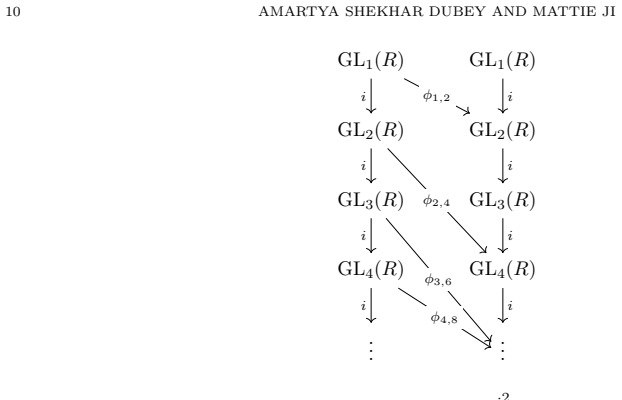
For a commutative ring R with unity, the group-completion of the symmetric monoidal category of finitely generated free R-modules under tensor product is the rationalization of K(R), up to π0. The authors give a plus-construction proof of this folklore theorem without using the full machinery of multiplicative infinite loop space theory.
What carries the argument
The group-completion functor applied to the tensor product symmetric monoidal structure on the category of finitely generated free R-modules.
If this is right
- The homotopy groups of the tensor product group completion agree with the rationalized K-groups of R in positive degrees.
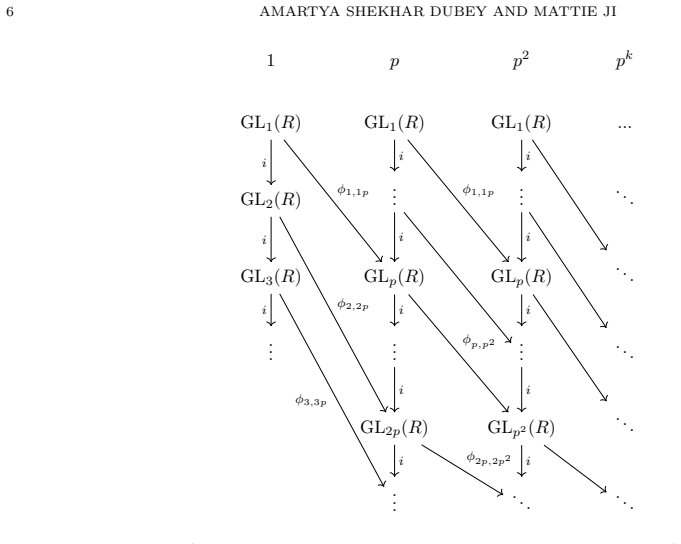
- A similar group-completion with respect to tensor product gives the p-perfection of K(R) for a prime p.
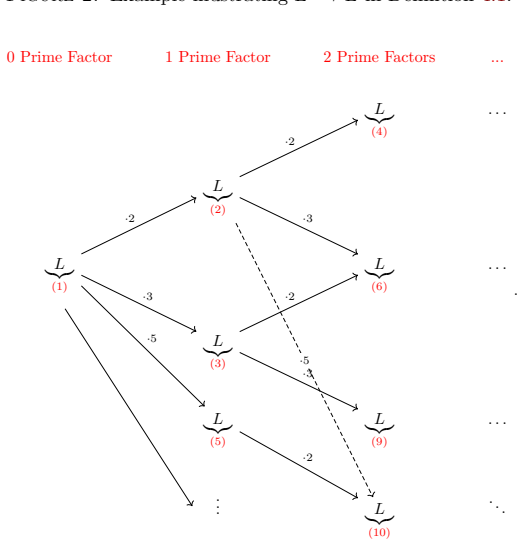
- The localization of K(R) at any non-trivial multiplicatively closed subset S of positive integers can be obtained this way.
- The result follows from a localization theorem of May but is proved directly here using plus-construction.
Where Pith is reading between the lines
- This identification suggests that rational algebraic K-theory can be constructed directly from the multiplicative structure on modules rather than the additive one.
- Similar ideas might apply to other symmetric monoidal categories where tensor product interacts with direct sum in controlled ways.
- Testing this for specific rings like integers or fields could confirm the rational homotopy groups explicitly.
Load-bearing premise
That applying group completion to the tensor product structure produces a space with the same higher homotopy groups as the rationalization of the direct-sum K-theory space.
What would settle it
Compute both spaces for a specific ring like the integers and find a degree where their homotopy groups differ after rationalization.
Figures
read the original abstract
For a commutative ring $R$ with unity, its algebraic $K$-theory space $K(R)$ may be obtained by group-completing the symmetric monoidal category of finitely generated free $R$-modules under direct sum. A natural question is what happens when one group-completes with respect to the tensor product structure instead. In this note, we give a direct proof of the folklore theorem that the resulting group-completion is the rationalization of $K(R)$, up to $\pi_0$. We also discuss how a similar group-completion would give the $p$-perfection and, more generally, the localization of $K(R)$ at any non-trivial multiplicatively closed subset $S \subseteq \mathbb{Z}_{> 0}$. The localization statement can be recovered from a localization theorem of May. We give a plus-construction proof without using the full machinery of multiplicative infinite loop space theory.
Editorial analysis
A structured set of objections, weighed in public.
Referee Report
Summary. The paper proves that for a commutative ring R with unity, the group-completion of the symmetric monoidal category of finitely generated free R-modules under tensor product is the rationalization of the algebraic K-theory space K(R), up to π0. It supplies both a direct proof from the definitions of group-completion and rationalization, and an independent plus-construction argument. The note further treats p-perfection and localization of K(R) at any non-trivial multiplicatively closed subset S of positive integers, recovering May's localization theorem via the plus-construction route while avoiding the full machinery of multiplicative infinite loop space theory.
Significance. If the identification holds, the manuscript supplies an elementary and self-contained proof of a folklore result, together with a plus-construction route that is independent of heavy multiplicative infinite-loop-space machinery. The explicit treatment of the π0 discrepancy and the recovery of the localization statement from May's theorem are concrete strengths that may be useful to workers in algebraic K-theory who wish to avoid the full apparatus of multiplicative E_∞ structures.
minor comments (2)
- [Introduction] The abstract and introduction flag the 'up to π0' caveat; a single sentence in §1 or §2 making explicit which homotopy groups are unaffected and which are altered by the adjustment would improve readability.
- [plus-construction section] The plus-construction argument is presented as avoiding the full multiplicative theory; a brief parenthetical comparison (one or two sentences) to the hypotheses of May's theorem would help readers see precisely where the new argument diverges.
Simulated Author's Rebuttal
We thank the referee for their positive assessment of the manuscript, the clear summary of its contributions, and the recommendation for minor revision. No specific major comments appear in the report.
Circularity Check
No significant circularity; derivation self-contained from definitions
full rationale
The paper states a direct proof of the folklore identification between tensor-product group completion and rationalization of K(R) (up to π0), using plus-construction and an external citation to May's localization theorem. No load-bearing step reduces by definition, by fitted parameter, or by self-citation chain to the target claim itself. The central equivalence is presented as following from the standard definitions of group completion on the multiplicative monoid of ranks and rationalization, with the π0 adjustment explicitly noted; higher homotopy groups are recovered via independent plus-construction arguments without invoking the authors' prior results as uniqueness theorems.
Axiom & Free-Parameter Ledger
Reference graph
Works this paper leans on
-
[1]
Weibel , journal =
C.A. Weibel , journal =
-
[2]
1968 , publisher=
Algebraic K-theory , author=. 1968 , publisher=
1968
-
[3]
May, J.P. , title =. 1977 , isbn =. doi:10.1007/BFb0097608 , url =
-
[4]
M. Ramzi and M. Yakerson , year=. p -perfection and group completion of. 2505.06979 , archivePrefix=
-
[5]
2013 , publisher=
The K -book: An Introduction to Algebraic K -theory , author=. 2013 , publisher=
2013
-
[6]
G. Segal , title =. Topology , volume =. 1974 , pages =. doi:10.1016/0040-9383(74)90022-6 , mrnumber =
-
[7]
, title =
May, J.P. , title =. 1972 , isbn =
1972
-
[8]
The uniqueness of infinite loop space machines , journal =. 1978 , issn =. doi:https://doi.org/10.1016/0040-9383(78)90026-5 , url =
-
[9]
J. P. May , title=. Geometry & Topology Monographs , year =
-
[10]
Multiplicative infinite loop space theory , journal =. 1982 , issn =. doi:https://doi.org/10.1016/0022-4049(82)90029-9 , url =
-
[11]
Gepner, D. and Groth, M. and Nikolaus, T. , year=. Universality of multiplicative infinite loop space machines , volume=. Algebraic & Geometric Topology , publisher=. doi:10.2140/agt.2015.15.3107 , number=
- [12]
-
[13]
Higher algebraic K-theory: II
Grayson, D. Higher algebraic K-theory: II. Algebraic K-Theory. 1976
1976
-
[14]
Quantum , volume=
A review of quantum cellular automata , author=. Quantum , volume=. 2020 , publisher=
2020
-
[15]
Yang, B. , year=. Communications in Mathematical Physics , publisher=. doi:10.1007/s00220-026-05596-3 , number=
-
[16]
Delooping classifying spaces in algebraic K-theory , journal =. 1972 , issn =. doi:https://doi.org/10.1016/0040-9383(72)90031-6 , url =
-
[17]
C. A. Weibel , journal =
-
[18]
and Randal-Williams, O
Galatius, S. and Randal-Williams, O. , title =. Annals of Mathematics , series =. 2017 , pages =
2017
-
[19]
Mikkola, K. and Sasane, A. , title=. Complex Analysis and Operator Theory , year=. doi:10.1007/s11785-009-0009-1 , url=
-
[20]
van der , journal =
Kallen, W. van der , journal =. Homology Stability for Linear Groups. , url =
-
[21]
Vasershtein, L. N. , title=. Functional Analysis and Its Applications , year=. doi:10.1007/BF01076414 , url=
-
[22]
, title =
Hofstadter, Douglas R. , title =. 1976 , howpublished =
1976
-
[23]
Homology of classical Lie groups made discrete, I
Sah, Chih-Han , journal =. Homology of classical Lie groups made discrete, I. Stability theorems and Schur mulipliers. , url =
discussion (0)
Sign in with ORCID, Apple, or X to comment. Anyone can read and Pith papers without signing in.