Synthetic Altermagnetism Beyond the Crystal Limit
Pith reviewed 2026-06-27 10:15 UTC · model grok-4.3
The pith
A stack of antiferromagnetically coupled films with alternating anisotropies produces altermagnetic magnon splitting without crystal symmetry.
A machine-rendered reading of the paper's core claim, the machinery that carries it, and where it could break.
Core claim
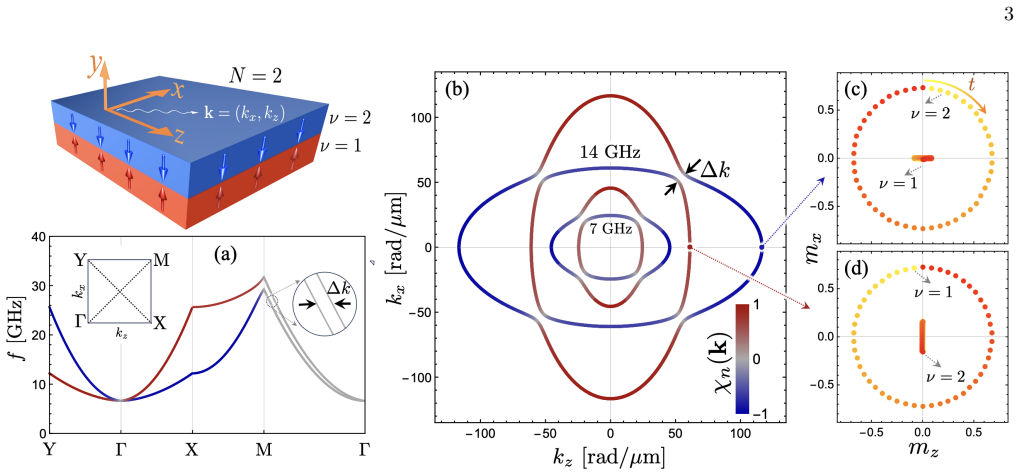
In a continuum platform of antiferromagnetically coupled ferromagnetic films with alternating in-plane exchange anisotropies, the dipole-exchange magnon spectrum reproduces the characteristic momentum-dependent splitting, nodal directions, and anisotropic isofrequency contours of A-type altermagnets; long-range dipolar interactions lift the nominal nodal degeneracy, hybridize opposite-chirality modes, and generate finite wave-vector splitting along directions that are nodal in the exchange-only limit, while finite multilayers undergo a parity-dependent reconstruction that separates surface and bulk altermagnetic excitations.
What carries the argument
The multilayer geometry of antiferromagnetically coupled ferromagnetic films with alternating in-plane exchange anisotropies, analyzed by solving the linearized Landau-Lifshitz equation in the dipole-exchange continuum model.
If this is right
- Dipolar interactions introduce finite wave-vector splitting along directions that remain nodal when only exchange is considered.
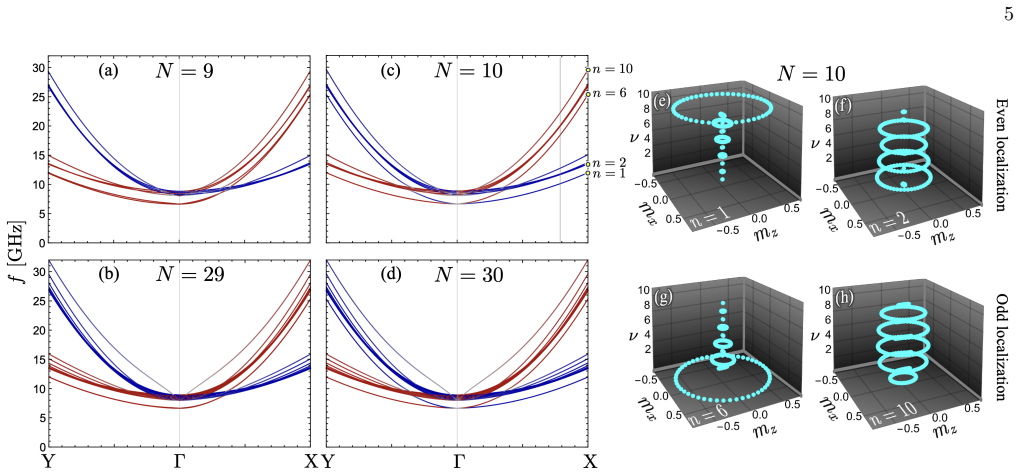
- The spectrum undergoes a parity-dependent reconstruction in finite multilayers that separates surface and bulk altermagnetic modes.
- Altermagnetic magnon features become tunable through layer thickness and total number of layers.
- The same signatures can be obtained in any dipole-exchange multilayer engineered with alternating anisotropies.
Where Pith is reading between the lines
- Standard thin-film deposition methods could produce functional altermagnetic magnonic devices without requiring specific crystal symmetries.
- Control of layer parity offers a route to select surface-dominated versus bulk-dominated magnon transport.
- The mechanism may generalize to other long-range interactions or to hybrid magnon-phonon systems in similar geometries.
Load-bearing premise
The linearized Landau-Lifshitz equation solved in the dipole-exchange continuum model for the multilayer geometry is sufficient to capture the altermagnetic magnon phenomenology without any crystalline point-group symmetry.
What would settle it
Fabrication of the described multilayer stack followed by measurement of its magnon dispersion to check for the predicted momentum-dependent splitting along nominal nodal directions and the thickness-dependent lifting of degeneracy.
Figures
read the original abstract
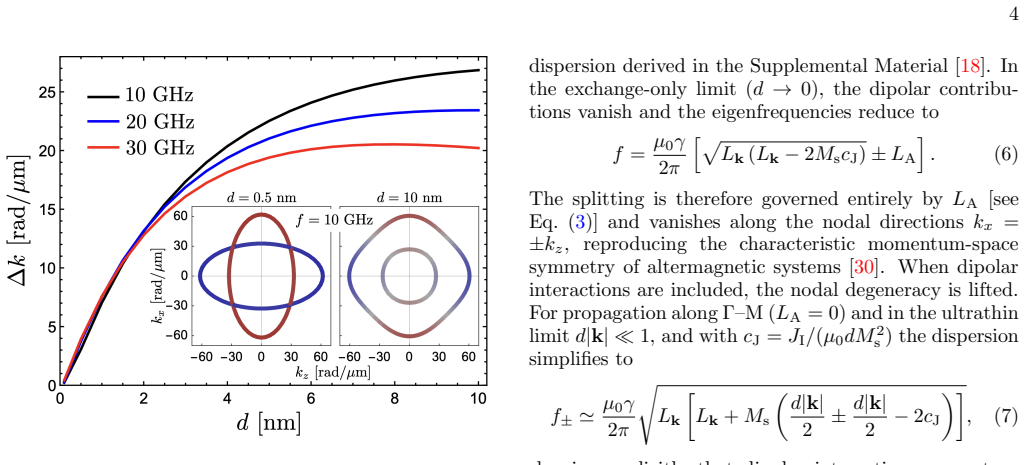
Altermagnetic magnons in crystalline materials exhibit momentum-dependent splitting whose nodal structure and chiral character are governed by the point-group symmetry of the magnetic sublattice rotation. Here, we demonstrate the first synthetic realization of altermagnetic magnonics in a continuum platform composed of antiferromagnetically coupled ferromagnetic films with alternating in-plane exchange anisotropies, showing that the key signatures of altermagnetic magnonics emerge beyond the crystalline setting. Solving the linearized Landau-Lifshitz equation within a dipole-exchange framework, we show that this architecture reproduces the characteristic momentum-dependent splitting, nodal directions, and anisotropic isofrequency contours of A-type altermagnets. Long-range dipolar interactions qualitatively reconstruct this exchange-driven spectrum by lifting the nominal nodal degeneracy, hybridizing opposite-chirality modes, and producing a finite, thickness-dependent wave-vector splitting along directions that are nodal in the exchange-only limit. Extending the bilayer to finite multilayers reveals that synthetic altermagnetism undergoes a parity-dependent reconstruction that separates surface and bulk altermagnetic excitations. These results establish altermagnetic magnon phenomenology as an engineerable collective response of dipole-exchange multilayers beyond microscopic crystal symmetries.
Editorial analysis
A structured set of objections, weighed in public.
Referee Report
Summary. The manuscript proposes a synthetic realization of altermagnetic magnonics in a continuum platform of antiferromagnetically coupled ferromagnetic films with alternating in-plane exchange anisotropies. Solving the linearized Landau-Lifshitz equation in a dipole-exchange framework, the work claims that this geometry reproduces the momentum-dependent splitting, nodal directions, and anisotropic isofrequency contours of A-type altermagnets, with long-range dipolar interactions lifting nominal nodal degeneracy to produce thickness-dependent wave-vector splitting; extension to finite multilayers shows parity-dependent reconstruction separating surface and bulk modes.
Significance. If the central derivation holds, the result would establish altermagnetic magnon phenomenology as an engineerable collective response in artificial dipole-exchange multilayers without requiring crystalline point-group symmetry, opening routes to synthetic magnonic platforms. The strength lies in applying the standard dipole-exchange continuum model to derive these features from geometry and alternating anisotropies, yielding falsifiable predictions such as thickness-dependent splitting along former nodal lines.
major comments (2)
- [Abstract] Abstract (solution method paragraph): the claim that the multilayer geometry with alternating in-plane exchange anisotropies plus dipolar coupling reproduces the characteristic altermagnetic spectrum rests on solving the linearized Landau-Lifshitz equation, yet no explicit derivation steps, boundary conditions for the multilayer stack, or parameter values are supplied to confirm that the nodal structure and chirality match those enforced by magnetic point-group operations in crystalline A-type altermagnets rather than arising coincidentally.
- [Abstract] Abstract (exchange-only limit and dipolar reconstruction): the statement that long-range dipolar interactions lift the nominal nodal degeneracy and hybridize opposite-chirality modes requires demonstration that this lifting produces the same momentum-dependent splitting and anisotropic contours as in the crystalline case; without validation against known limits of the dipole-exchange model or comparison to lattice-based altermagnet calculations, it remains unclear whether the continuum treatment captures the essential symmetry or a distinct mechanism.
minor comments (1)
- [Abstract] The abstract refers to 'A-type altermagnets' without a brief definition or reference to the standard classification of altermagnetic types, which would aid readers unfamiliar with the crystalline literature.
Simulated Author's Rebuttal
We thank the referee for their careful reading and constructive comments on our manuscript. We address the major comments point by point below, clarifying the content of the derivations and the symmetry considerations already present in the work.
read point-by-point responses
-
Referee: [Abstract] Abstract (solution method paragraph): the claim that the multilayer geometry with alternating in-plane exchange anisotropies plus dipolar coupling reproduces the characteristic altermagnetic spectrum rests on solving the linearized Landau-Lifshitz equation, yet no explicit derivation steps, boundary conditions for the multilayer stack, or parameter values are supplied to confirm that the nodal structure and chirality match those enforced by magnetic point-group operations in crystalline A-type altermagnets rather than arising coincidentally.
Authors: The abstract is a concise summary; the explicit derivation steps for the linearized Landau-Lifshitz equation, the boundary conditions (continuity of the magnetostatic potential and its normal derivative together with exchange boundary conditions at film interfaces), and the numerical parameter values are all supplied in the main text (Sections II and III) and associated figures. The nodal structure and mode chirality follow directly from the imposed alternating in-plane exchange anisotropies, which are constructed to enforce the same symmetry breaking as the magnetic point-group operations of A-type altermagnets (180° rotation combined with time reversal). This equivalence is verified by the resulting eigenvectors and dispersion, which are not coincidental but arise by design from the geometry. We are prepared to add a single sentence in the abstract directing readers to the relevant sections. revision: partial
-
Referee: [Abstract] Abstract (exchange-only limit and dipolar reconstruction): the statement that long-range dipolar interactions lift the nominal nodal degeneracy and hybridize opposite-chirality modes requires demonstration that this lifting produces the same momentum-dependent splitting and anisotropic contours as in the crystalline case; without validation against known limits of the dipole-exchange model or comparison to lattice-based altermagnet calculations, it remains unclear whether the continuum treatment captures the essential symmetry or a distinct mechanism.
Authors: The manuscript explicitly solves the dipole-exchange model first in the exchange-only limit (recovering the nodal degeneracy and anisotropic contours dictated by the alternating anisotropies) and then with full long-range dipolar interactions (showing the thickness-dependent lifting of degeneracy and hybridization of opposite-chirality modes). The resulting momentum-dependent splitting and isofrequency contours match the functional form reported for crystalline A-type altermagnets. The continuum dipole-exchange framework is the established model for thin-film magnonics; our numerics are validated against its known analytic limits (pure exchange and pure dipolar regimes). A direct lattice-based comparison lies outside the scope of this continuum study, whose purpose is to demonstrate that the altermagnetic phenomenology emerges from the engineered geometry and anisotropies independent of microscopic crystalline symmetry. revision: no
Circularity Check
No significant circularity; spectrum emerges from dipole-exchange LL solution
full rationale
The paper solves the linearized Landau-Lifshitz equation in the standard dipole-exchange continuum model for a multilayer geometry with antiferromagnetic interlayer coupling and alternating in-plane exchange anisotropies. The reported momentum-dependent splitting, nodal directions, and anisotropic contours are stated to arise directly from this calculation (including the lifting of nodal degeneracy by dipolar terms), without parameter fitting to altermagnetic data or self-definitional mapping. No load-bearing self-citations, uniqueness theorems, or ansatzes imported from prior author work are invoked to force the result; the derivation remains independent of the target phenomenology.
Axiom & Free-Parameter Ledger
Reference graph
Works this paper leans on
-
[1]
ˇSmejkal, A
L. ˇSmejkal, A. Marmodoro, K.-H. Ahn, R. Gonz´ alez- Hern´ andez, I. Turek, S. Mankovsky, H. Ebert, S. W. D’Souza, O. c. v. ˇSipr, J. Sinova, and T. c. v. Jungwirth, 6 Chiral magnons in altermagnetic ruo 2, Phys. Rev. Lett. 131, 256703 (2023)
2023
-
[2]
Z. Liu, M. Ozeki, S. Asai, S. Itoh, and T. Masuda, Chiral split magnon in altermagnetic MnTe, Phys. Rev. Lett. 133, 156702 (2024)
2024
-
[3]
Hoyer, P
R. Hoyer, P. P. Stavropoulos, A. Razpopov, R. Valent´ ı, L. ˇSmejkal, and A. Mook, Altermagnetic splitting of magnons in hematiteα-Fe 2O3, Phys. Rev. B112, 064425 (2025)
2025
-
[4]
Weißenhofer and A
M. Weißenhofer and A. Marmodoro, Atomistic spin dy- namics simulations of magnonic spin seebeck and spin nernst effects in altermagnets, Phys. Rev. B110, 094427 (2024)
2024
-
[5]
K. Wu, J. Dong, M. Zhu, F. Zheng, and J. Zhang, Magnon splitting and magnon spin transport in alter- magnets, Chin. Phys. Lett.42, 070702 (2025)
2025
-
[6]
Q. Cui, X. Bai, Y. Ge, A. Edstr¨ om, C. Li, Y. Sassa, C. Song, K. Wang, and A. Delin, Altermagnetic Magnons in Twisted van der Waals Antiferromagnets, Nano Lett. 26, 5078 (2026)
2026
-
[7]
Q. Faure, D. Bounoua, V. Bal´ edent, A. Gukasov, V. O. Garlea, A. Ribeiro, J. G. Rau, S. Petit, and P. McClarty, Altermagnetism revealed by polarized neutrons in MnF 2, arXiv preprint arXiv:2509.07087 10.48550/arXiv.2509.07087 (2025)
-
[8]
Sears, V
J. Sears, V. O. Garlea, D. Lederman, J. M. Tranquada, and I. A. Zaliznyak, Altermagnetic and Dipolar Splitting of Magnons in FeF2, Phys. Rev. Lett.136, 226701 (2026)
2026
-
[9]
V. C. Morano, Z. Maesen, S. E. Nikitin, J. Lass, D. G. Mazzone, and O. Zaharko, Absence of Altermagnetic Magnon Band Splitting in MnF 2, Phys. Rev. Lett.134, 226702 (2025)
2025
-
[10]
Asgharpour, B
A. Asgharpour, B. Koopmans, and R. A. Duine, Syn- thetic altermagnets, Phys. Rev. B111, 094412 (2025)
2025
-
[11]
Xiang, Y
Y. Xiang, Y. Wang, X. Li, Z. Zhao, and W. Xie, Interface- induced two-dimensional altermagnetism in RuO 2/TiO2 superlattices, J. Phys. Condens. Matter. (2026)
2026
-
[12]
Jiang, X
Y. Jiang, X. Chen, C. Xuan, Z. Wang, and H. Yu, Al- termagnet skyrmions: Macroscopic realization of d-wave symmetry, Phys. Rev. B112, 014423 (2025)
2025
-
[13]
Camley, Magnetization dynamics in thin films and multilayers, J
R. Camley, Magnetization dynamics in thin films and multilayers, J. Magn. Magn. Mater.200, 583 (1999)
1999
-
[14]
Camley, Nonreciprocal surface waves, Surf
R. Camley, Nonreciprocal surface waves, Surf. Sci. Rep. 7, 103 (1987)
1987
-
[15]
Hillebrands, Spin-wave calculations for multilayered structures, Phys
B. Hillebrands, Spin-wave calculations for multilayered structures, Phys. Rev. B41, 530 (1990)
1990
-
[16]
Z. Jin, T. Gong, J. Liu, H. Yang, Z. Zeng, Y. Cao, and P. Yan, Strong coupling of chiral magnons in altermag- nets, Phys. Rev. Lett.135, 126702 (2025)
2025
-
[17]
Z. Sun, Y. Chen, T. Yu, H.-Z. Lu, and X. C. Xie, Anisotropic surface spin waves as signature of A-type altermagnets (2026), arXiv:2605.14735 [cond-mat.mes- hall]
Pith/arXiv arXiv 2026
-
[18]
Supplemental material,URL_will_be_inserted_by_ publisher, includes additional theoretical details, analytical derivations, and candidate experimental platforms
-
[19]
Barsukov, Y
I. Barsukov, Y. Fu, C. Safranski, Y.-J. Chen, B. Young- blood, A. M. Gon¸ calves, M. Spasova, M. Farle, J. A. Katine, C. C. Kuo, and I. N. Krivorotov, Magnetic phase transitions in Ta/CoFeB/MgO multilayers, Appl. Phys. Lett.106, 192407 (2015)
2015
-
[20]
Akyol, Origin of interfacial magnetic anisotropy in Ta/CoFeB/MgO and Pt/CoFeB/MgO multilayer thin film stacks, J
M. Akyol, Origin of interfacial magnetic anisotropy in Ta/CoFeB/MgO and Pt/CoFeB/MgO multilayer thin film stacks, J. Supercond. Nov. Magn.32, 457 (2019)
2019
-
[21]
Ikeda, K
S. Ikeda, K. Miura, H. Yamamoto, K. Mizunuma, H. D. Gan, M. Endo, S. Kanai, J. Hayakawa, F. Matsukura, and H. Ohno, A perpendicular-anisotropy CoFeB–MgO magnetic tunnel junction, Nat. Mater.9, 721 (2010)
2010
-
[22]
Oh, K.-D
Y.-W. Oh, K.-D. Lee, J.-R. Jeong, and B.-G. Park, Inter- facial perpendicular magnetic anisotropy in CoFeB/MgO structure with various underlayers, J. Appl. Phys.115, 17C724 (2014)
2014
-
[23]
Fallarino, B
L. Fallarino, B. J. Kirby, M. Pancaldi, P. Riego, A. L. Balk, C. W. Miller, P. Vavassori, and A. Berger, Magnetic properties of epitaxial cocr films with depth-dependent exchange-coupling profiles, Phys. Rev. B95, 134445 (2017)
2017
-
[24]
R. A. Duine, K.-J. Lee, S. S. P. Parkin, and M. D. Stiles, Synthetic antiferromagnetic spintronics, Nat. Phys.14, 217 (2018)
2018
-
[25]
S. K. Jena, R. Islam, E. Mili´ nska, M. M. Jakubowski, R. Minikayev, S. Lewi´ nska, A. Lynnyk, A. Pietruczik, P. Aleszkiewicz, C. Autieri,et al., Interfacial Dzyaloshinskii-Moriya interaction in the epitaxial W/Co/Pt multilayers, Nanoscale13, 7685 (2021)
2021
-
[26]
Y. Liu, J. Yu, and H. Zhong, Strong antiferromagnetic interlayer exchange coupling in [Co/Pt] 6/Ru/[Co/Pt]4 structures with perpendicular magnetic anisotropy, J. Magn. Magn. Mater.474, 536 (2019)
2019
-
[27]
Ishibashi, Y
M. Ishibashi, Y. Shiota, S. Funada, T. Moriyama, and T. Ono, Spin wave resonance in perpendicularly magne- tized synthetic antiferromagnets, J. Magn. Soc. Jpn.45, 25 (2021)
2021
-
[28]
Dieterle, J
G. Dieterle, J. F¨ orster, H. Stoll, A. S. Semisalova, S. Finizio, A. Gangwar, M. Weigand, M. Noske, M. F¨ ahnle, I. Bykova, J. Gr¨ afe, D. A. Bozhko, H. Y. Musiienko-Shmarova, V. Tiberkevich, A. N. Slavin, C. H. Back, J. Raabe, G. Sch¨ utz, and S. Wintz, Coherent ex- citation of heterosymmetric spin waves with ultrashort wavelengths, Phys. Rev. Lett.122,...
2019
-
[29]
S. Mayr, J. F¨ orster, S. Finizio, K. Schultheiss, R. A. Gal- lardo, R. Narkovicz, G. Dieterle, A. Semisalova, J. Bai- ley, E. Kirk, A. Suszka, J. Lindner, J. Gr¨ afe, J. Raabe, G. Sch¨ utz, M. Weigand, H. Stoll, and S. Wintz, Time- resolved X-ray imaging of nanoscale spin-wave dynam- ics at multi-GHz frequencies using low-alpha synchrotron operation, App...
2024
-
[30]
ˇSmejkal, J
L. ˇSmejkal, J. Sinova, and T. Jungwirth, Emerging re- search landscape of altermagnetism, Phys. Rev. X12, 040501 (2022)
2022
-
[31]
Krˇ cma, O
J. Krˇ cma, O. Wojewoda, M. Hrtoˇ n, J. Holobr´ adek, J. A. Arregi, J. Panda, E. Pribytova, and M. Urb´ anek, Mie- enhanced microfocused brillouin light scattering for full wave vector resolution of nanoscale spin waves, Sci. Adv. 11, eady8833 (2025)
2025
-
[32]
Contreras-Gallardo, J
P. Contreras-Gallardo, J. Jim´ enez-Bustamante, N. Vidal- Silva, F. Brevis, J. W. Gonz´ alez, O. Hellwig, J. Lindner, and R. A. Gallardo, Spin-wave softening and the emer- gence of stripe domains in synthetic antiferromagnetic multilayers, Phys. Rev. B112, 224435 (2025)
2025
-
[33]
M. S. Gabor, T. Petrisor, R. B. Mos, M. Nasui, C. Tiu- san, and T. Petrisor, Interlayer exchange coupling in perpendicularly magnetized Pt/Co/Ir/Co/Pt structures, Phys. D: Appl. Phys.50, 465004 (2017)
2017
-
[34]
Mouhoub, F
A. Mouhoub, F. Millo, C. Chappert, J.-V. Kim, J. L´ etang, A. Solignac, and T. Devolder, Exchange en- ergies in CoFeB/Ru/CoFeB synthetic antiferromagnets, 7 Phys. Rev. Mater.7, 044404 (2023)
2023
-
[35]
Grassi, M
M. Grassi, M. Geilen, D. Louis, M. Mohseni, T. Br¨ acher, M. Hehn, D. Stoeffler, M. Bailleul, P. Pirro, and Y. Henry, Slow-wave-based nanomagnonic diode, Physi- cal Review Applied14, 024047 (2020)
2020
-
[36]
Tovar Costa, J
M. Tovar Costa, J. d’Albuquerque e Castro, and R. Mu- niz, Exchange stiffness constant of two-dimensional Ni (100), (110) and (111) orientations, J. Magn. Magn. Mater.121, 170 (1993), proceedings of the International Symposium on Magnetic Ultrathin Films, Multilayers and Surfaces
1993
-
[37]
B. J. Kirby, J. E. Davies, K. Liu, S. M. Watson, G. T. Zimanyi, R. D. Shull, P. A. Kienzle, and J. A. Borchers, Vertically graded anisotropy in co/pd multilayers, Phys. Rev. B81, 100405 (2010)
2010
-
[38]
R. A. Gallardo, A. Banholzer, K. Wagner, M. K¨ orner, K. Lenz, M. Farle, J. Lindner, J. Fassbender, and P. Lan- deros, Splitting of spin-wave modes in thin films with ar- rays of periodic perturbations: theory and experiment, New J. Phys.16, 023015 (2014)
2014
-
[39]
B. Obry, P. Pirro, T. Br¨ acher, A. V. Chumak, J. Osten, F. Ciubotaru, A. A. Serga, J. Fassbender, and B. Hille- brands, A micro-structured ion-implanted magnonic crystal, Appl. Phys. Lett.102, 202403 (2013). 8 Supplemental Material Synthetic Altermagnetism Beyond the Crystal Limit S1. THEORETICAL MODEL AND DYNAMICAL MA TRIX We consider a synthetic alterm...
2013
discussion (0)
Sign in with ORCID, Apple, or X to comment. Anyone can read and Pith papers without signing in.