Percolation on hierarchical lattices
Pith reviewed 2026-06-27 11:30 UTC · model grok-4.3
The pith
Under sharp conditions on a seed graph, hierarchical lattices exhibit a unique percolation phase transition with defined critical exponents.
A machine-rendered reading of the paper's core claim, the machinery that carries it, and where it could break.
Core claim
Under sharp hypotheses on the seed graph G1 with distinguished vertices a1 and b1, percolation on the hierarchical sequence (Gk) has a unique phase transition; the critical exponents ν, μ, and α1 exist; on the infinite limit G∞ the infinite cluster is unique, θ(p) is continuous at pc, the exponent β exists, and scaling relations hold among α1, ν, and β; crossing functions on Gk are sharply noise sensitive; and a necessary and sufficient condition is given for the map p ↦ Ep[g] to possess a unique fixed point in (0,1) when g is a nontrivial monotone Boolean function.
What carries the argument
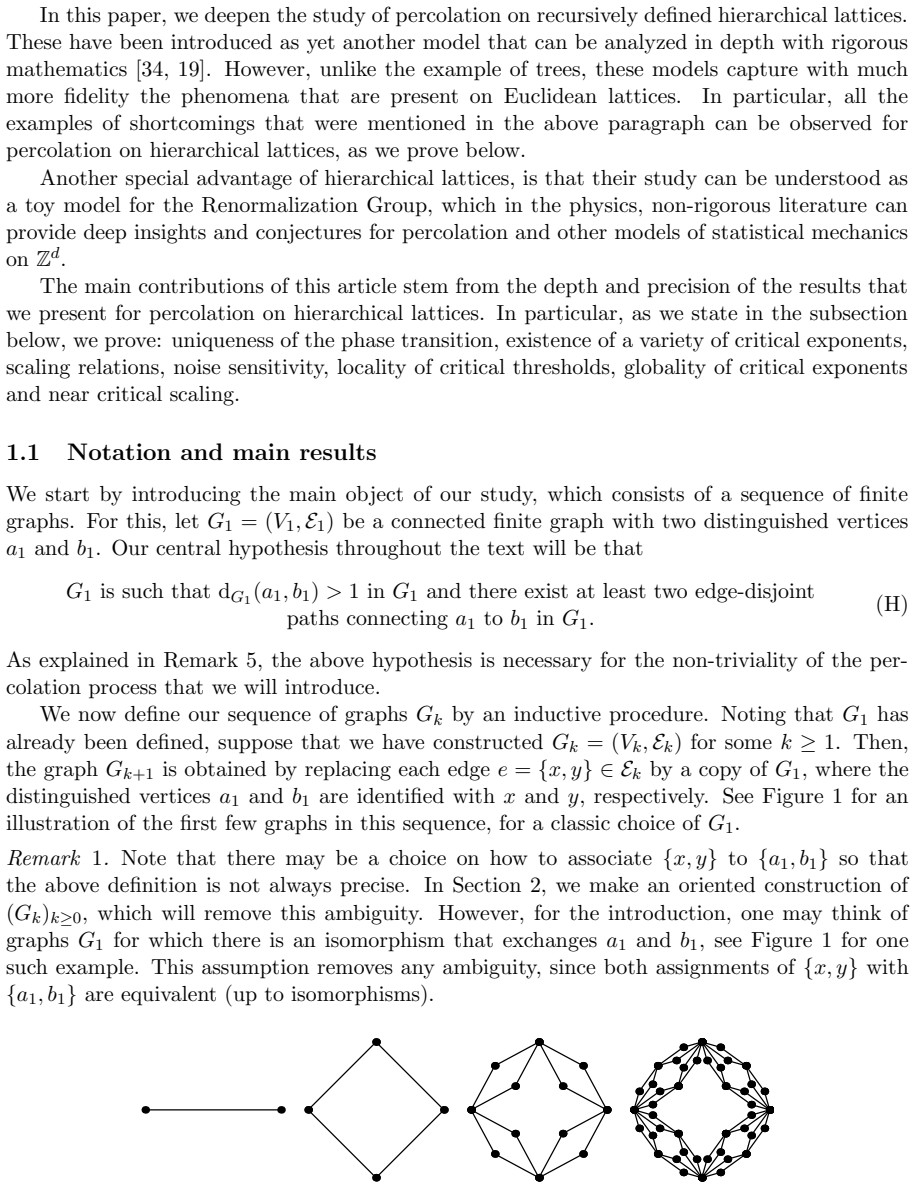
The recursive edge-replacement construction that produces the sequence of hierarchical graphs Gk from the seed G1 by substituting a copy of G1 for each edge, attached at the distinguished vertices a1 and b1; this construction enables renormalization arguments that control the phase transition and exponents.
If this is right
- There is a single critical probability pc separating the regime with no infinite cluster from the regime with a unique infinite cluster.
- The correlation length, surface tension, and one-arm exponents ν, μ, and α1 are well-defined and finite.
- On the infinite graph the percolation probability θ(p) is continuous and the exponent β exists with scaling relations to the other exponents.
- Crossing events in finite hierarchical graphs are sharply noise sensitive.
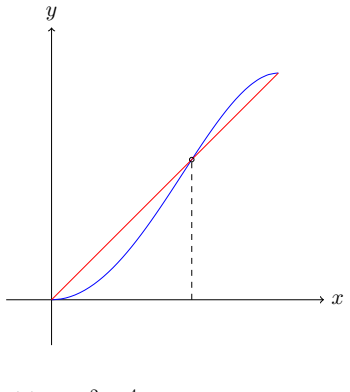
- The expectation map for any nontrivial monotone Boolean function has at most one fixed point in (0,1) precisely when a stated algebraic condition on its Fourier spectrum holds.
Where Pith is reading between the lines
- The separation between a locally determined threshold and globally determined exponents may extend to other self-similar graphs or fractals where renormalization can be carried out explicitly.
- The necessary and sufficient condition on monotone Boolean functions could be checked algorithmically for small n to classify which functions admit unique fixed points under expectation maps.
- Noise-sensitivity results on finite levels suggest that sampling algorithms for crossing events become unstable under small random perturbations of the parameter p.
- Finite-level simulations on Gk for moderate k could numerically verify the scaling relations before taking the infinite-graph limit.
Load-bearing premise
The seed graph G1 with its distinguished vertices satisfies the sharp hypotheses that make the renormalization maps contractive or otherwise controllable.
What would settle it
Construction of a seed graph meeting the basic connectivity requirements but violating one of the sharp hypotheses, followed by explicit computation or simulation on the first few Gk levels that reveals either multiple distinct percolation thresholds or the non-existence of one of the claimed exponents.
Figures

read the original abstract
We consider independent Bernoulli percolation on top of sequences of hierarchical graphs. Given a graph $G_{1}$ with two distinguished vertices $a_{1}$ and $b_{1}$, the hierarchical graph with seed $G_{1}$ is the sequence $\big( G_{k} \big)_{k \geq 1}$ resulting from the inductive procedure, where the graph $G_{k+1}$ is obtained from $G_{k}$ by replacing each of its edges with a copy of $G_{1}$, attached by the vertices $a_{1}$ and $b_{1}$. We prove that, under sharp hypotheses, percolation on these graphs presents a unique phase transition. Second, we establish the existence of several critical exponents in this context, such as the critical exponents for the correlation length $\nu$, the surface tension $\mu$, the one-arm exponent $\alpha_{1}$. Several results are also obtained for their infinite counterpart $G_\infty$, which is the Benjamini-Schramm limit of $G_k$: uniqueness of the infinite cluster, continuity of $\theta(p)$, existence of the percolation-probability exponent $\beta$ and scaling relations for the critical exponents $\alpha_1$, $\nu$ and $\beta$. Furthermore, we analyze noise sensitivity for crossing functions in $G_{k}$ and establish sharp noise sensitivity in this setting. Finally, we propose a setup where it is possible to verify the locality hypothesis, stating that the critical threshold for percolation is a local property, while critical exponents are determined by the global geometry of the graph. As a consequence of the techniques developed here, we also provide a necessary and sufficient condition for the existence of a unique fixed point for the map $p \mapsto \mathbb{E}_p[g]$ in $(0,1)$, where $g:\{0,1\}^n \to \{0,1\}$ is a nontrivial monotone Boolean function.
Editorial analysis
A structured set of objections, weighed in public.
Referee Report
Summary. The paper studies independent Bernoulli percolation on a sequence of hierarchical graphs (G_k) constructed inductively from a seed graph G_1 with distinguished vertices a_1, b_1 by replacing each edge of G_k with a copy of G_1. Under unspecified 'sharp hypotheses' on G_1, it claims a unique phase transition, existence of critical exponents ν (correlation length), μ (surface tension), α_1 (one-arm), and for the Benjamini-Schramm limit G_∞: uniqueness of the infinite cluster, continuity of θ(p), existence of β (percolation probability), and scaling relations among α_1, ν, β. It further claims sharp noise sensitivity for crossing events in G_k and a necessary-and-sufficient condition for a unique fixed point of the map p ↦ E_p[g] for nontrivial monotone Boolean functions g.
Significance. If the claims hold under the stated hypotheses, the work supplies an explicit recursive framework in which percolation exponents and noise sensitivity can be derived from the seed graph, together with a general criterion for uniqueness of fixed points of expectation maps on monotone Boolean functions. The hierarchical construction and renormalization approach are strengths that could make the results reproducible and falsifiable once the hypotheses are pinned down.
major comments (2)
- [Abstract and §1 (setup)] The abstract and introduction repeatedly invoke 'sharp hypotheses' on G_1 (connectivity and a_1-b_1 crossing properties) as the load-bearing assumption for the unique phase transition, all listed exponents, uniqueness of the infinite cluster, continuity of θ(p), scaling relations, and the fixed-point criterion, yet no explicit list or minimal set of these hypotheses appears in the setup. Without an enumerated statement (e.g., in the section defining G_k), it is impossible to verify minimality or that the renormalization map and recursive relations do not tacitly rely on stronger conditions.
- [Section on G_∞ results] The derivation of the scaling relations for α_1, ν and β on G_∞ (and the continuity of θ(p)) is stated to follow from the recursive structure induced by the seed G_1, but the manuscript does not exhibit the precise recursive identities or the induction step that converts the hypotheses on G_1 into the claimed relations; this is load-bearing for the exponent claims.
minor comments (2)
- [§2] Notation for the hierarchical graphs and the distinguished vertices should be introduced with a single diagram or explicit inductive definition to avoid ambiguity when referring to copies of G_1 inside G_k.
- [Final section] The statement of the necessary-and-sufficient condition for the unique fixed point of p ↦ E_p[g] would benefit from an explicit reference to the monotonicity and nontriviality assumptions on g.
Simulated Author's Rebuttal
Thank you for the referee's thorough review and insightful comments on our manuscript. We appreciate the opportunity to clarify and strengthen the presentation of our results on percolation on hierarchical lattices. Below, we provide point-by-point responses to the major comments.
read point-by-point responses
-
Referee: [Abstract and §1 (setup)] The abstract and introduction repeatedly invoke 'sharp hypotheses' on G_1 (connectivity and a_1-b_1 crossing properties) as the load-bearing assumption for the unique phase transition, all listed exponents, uniqueness of the infinite cluster, continuity of θ(p), scaling relations, and the fixed-point criterion, yet no explicit list or minimal set of these hypotheses appears in the setup. Without an enumerated statement (e.g., in the section defining G_k), it is impossible to verify minimality or that the renormalization map and recursive relations do not tacitly rely on stronger conditions.
Authors: We agree with the referee that an explicit enumeration of the 'sharp hypotheses' is necessary for clarity and verifiability. In the revised version, we will introduce a new subsection in Section 1 that provides a minimal enumerated list of the assumptions on the seed graph G_1. This list will include the required connectivity properties and a_1-b_1 crossing conditions, ensuring that the renormalization map and all subsequent results are clearly grounded in these hypotheses without tacit stronger assumptions. revision: yes
-
Referee: [Section on G_∞ results] The derivation of the scaling relations for α_1, ν and β on G_∞ (and the continuity of θ(p)) is stated to follow from the recursive structure induced by the seed G_1, but the manuscript does not exhibit the precise recursive identities or the induction step that converts the hypotheses on G_1 into the claimed relations; this is load-bearing for the exponent claims.
Authors: The referee is correct that the precise recursive identities and the induction steps for deriving the scaling relations and continuity of θ(p) on G_∞ need to be exhibited explicitly. Although the recursive structure is outlined in the renormalization sections, we will add a detailed subsection in the G_∞ results section that presents the exact recursive identities for the exponents α_1, ν, and β, together with the complete induction argument showing how these follow from the hypotheses on G_1. This will make the load-bearing steps fully transparent. revision: yes
Circularity Check
Derivation self-contained from hierarchical construction and standard percolation arguments
full rationale
The paper derives unique phase transition, critical exponents (ν, μ, α1, β), uniqueness of infinite cluster, continuity of θ(p), scaling relations, and noise sensitivity results directly from the inductive edge-replacement construction of G_k from seed G1 (with distinguished a1,b1) under external sharp hypotheses on G1. These hypotheses function as base-case inputs that control the renormalization map p ↦ E_p[g] and recursive relations, but are not obtained from the target conclusions. No quoted step equates a prediction to a fitted parameter by construction, invokes a self-citation chain as load-bearing uniqueness theorem, or renames a known empirical pattern; the central claims retain independent content from the graph geometry and monotone Boolean function analysis. This is the normal non-circular outcome.
Axiom & Free-Parameter Ledger
axioms (2)
- standard math Axioms of probability measure and independence for Bernoulli percolation
- domain assumption Properties of hierarchical graph construction via edge replacement
Reference graph
Works this paper leans on
-
[1]
Daniel Ahlberg and Jeffrey E Steif. Scaling limits for the threshold window: When does a monotone boolean function flip its outcome? Annales de L’Institut Henri Poincare Section (B) Probability and Statistics , 53(4):2135–2161, 2017
2017
-
[2]
Anisimova, A.V
G.D. Anisimova, A.V. Myshlyavtsev, and S.S. Akimenko. The two-layer ising model on a sequence of diamond-like hierarchical lattices. Physica A: Statistical Mechanics and its Applications, 583:126341, 2021
2021
-
[3]
Application of a generalization of Russo’s formula to learning from multiple random oracles
Jan Arpe and Elchanan Mossel. Application of a generalization of Russo’s formula to learning from multiple random oracles. Combinatorics, Probability and Computing , 19(2):183–199, 2010
2010
-
[4]
On the convergence of infinite products of matrices
Marc Artzrouni. On the convergence of infinite products of matrices. Linear Algebra and its Applications, 74:11–21, 1986
1986
-
[5]
Large deviations for marked sparse random graphs with applications to interacting diffusions
Rangel Baldasso, Roberto Oliveira, Alan Pereira, and Guilherme Reis. Large deviations for marked sparse random graphs with applications to interacting diffusions. Journal of Statistical Physics, 193(2):25, 2026
2026
-
[6]
Introduction to a renormali- sation group method
Roland Bauerschmidt, David C Brydges, and Gordon Slade. Introduction to a renormali- sation group method. Springer Nature, 2019
2019
-
[7]
A discontinuous percolation phase transition on the hierarchical lattice
Johannes B¨ aumler and Tom Hutchcroft. A discontinuous percolation phase transition on the hierarchical lattice. arXiv e-prints, page arXiv:2512.12124, December 2025
-
[8]
Noise sensitivity of Boolean functions and applications to percolation
Itai Benjamini, Gil Kalai, and Oded Schramm. Noise sensitivity of Boolean functions and applications to percolation. Publications Math´ ematiques de l’Institut des Hautes ´Etudes Scientifiques, 90(1):5–43, 1999
1999
-
[9]
Recurrence of distributional limits of finite planar graphs
Itai Benjamini and Oded Schramm. Recurrence of distributional limits of finite planar graphs. Selected Works of Oded Schramm , pages 533–545, 2011
2011
-
[10]
Limit gibbs distributions for the ising model on hierarchical lattices
P Bleher and E Zalys. Limit gibbs distributions for the ising model on hierarchical lattices. Lithuanian Mathematical Journal , 28(2):127–139, 1988
1988
-
[11]
Pavel Bleher and E. ˇZalys. Asymptotics of the susceptibility for the ising model on the hierarchical lattices. Communications in Mathematical Physics , 120, 09 1989
1989
-
[12]
Self-avoiding walk on a hierarchical lattice in four dimensions
David Brydges, Steven N Evans, and John Z Imbrie. Self-avoiding walk on a hierarchical lattice in four dimensions. The Annals of Probability , pages 82–124, 1992
1992
-
[13]
Random graphs: the local convergence point of view, 2017
Nicolas Curien. Random graphs: the local convergence point of view, 2017. Unpublished lecture notes
2017
-
[14]
Potts models on hierarchical lattices and renormalization group dynamics
J De Simoi and S Marmi. Potts models on hierarchical lattices and renormalization group dynamics. Journal of Physics A: Mathematical and Theoretical , 42(9):095001, feb 2009
2009
-
[15]
Freeman J. Dyson. Existence of a phase-transition in a one-dimensional Ising ferromagnet. Communications in Mathematical Physics , 12(2):91–107, June 1969
1969
-
[16]
The scaling limits of near-critical and dynamical percolation
Christophe Garban, G´ abor Pete, and Oded Schramm. The scaling limits of near-critical and dynamical percolation. Journal of the European Mathematical Society , 20(5):1195–1268, 2018. 41
2018
-
[17]
Spin systems on hierarchical lattices
Robert Griffiths and Miron Kaufman. Spin systems on hierarchical lattices. introduction and thermodynamic limit. Physical Review B, 26, 11 1982
1982
-
[18]
Percolation, volume 321 of Grundlehren der Mathematischen Wis- senschaften [Fundamental Principles of Mathematical Sciences]
Geoffrey Grimmett. Percolation, volume 321 of Grundlehren der Mathematischen Wis- senschaften [Fundamental Principles of Mathematical Sciences] . Springer-Verlag, Berlin, second edition, 1999
1999
-
[19]
Diffusion on the scaling limit of the critical percola- tion cluster in the diamond hierarchical lattice
Ben M Hambly and Takashi Kumagai. Diffusion on the scaling limit of the critical percola- tion cluster in the diamond hierarchical lattice. Communications in Mathematical Physics, 295(1):29–69, 2010
2010
-
[20]
Exit time tails from pairwise decor- relation in hidden Markov chains, with applications to dynamical percolation
Alan Hammond, Elchanan Mossel, and G´ abor Pete. Exit time tails from pairwise decor- relation in hidden Markov chains, with applications to dynamical percolation. Electronic Journal of Probability, 17(none):1 – 16, 2012
2012
-
[21]
Mean-field critical behaviour for percolation in high dimensions
Takashi Hara and Gordon Slade. Mean-field critical behaviour for percolation in high dimensions. Communications in Mathematical Physics , 128(2):333–391, 1990
1990
-
[22]
The critical two-point function for long-range percolation on the hierar- chical lattice
Tom Hutchcroft. The critical two-point function for long-range percolation on the hierar- chical lattice. arXiv e-prints, page arXiv:2103.17013, March 2021
-
[23]
Hutchcroft, Critical long-range percolation i: High ef- fective dimension (2025), arXiv:2508.18807
Tom Hutchcroft. Critical long-range percolation I: High effective dimension. arXiv preprint arXiv:2508.18807, 2025
-
[24]
Hutchcroft, Critical long-range percolation ii: Low effective dimension (2025), arXiv:2508.18808
Tom Hutchcroft. Critical long-range percolation II: Low effective dimension. arXiv preprint arXiv:2508.18808, 2025
-
[25]
Tom Hutchcroft. Critical long-range percolation III: The upper critical dimension. arXiv preprint arXiv:2508.18809, 2025
-
[26]
Exactly soluble ising models on hierarchical lattices
Miron Kaufman and Robert Griffiths. Exactly soluble ising models on hierarchical lattices. Physical Review B, 24:1–1981, 07 1981
1981
-
[27]
Spin systems on hierarchical lattices
Miron Kaufman and Robert B Griffiths. Spin systems on hierarchical lattices. ii. some examples of soluble models. Physical Review B, 30(1):244, 1984
1984
-
[28]
A scaling relation at criticality for 2D-percolation
Harry Kesten. A scaling relation at criticality for 2D-percolation. In Percolation theory and ergodic theory of infinite particle systems , pages 203–212. Springer, 1987
1987
-
[29]
Scaling relations for 2D-percolation
Harry Kesten. Scaling relations for 2D-percolation. Communications in Mathematical Physics, 109(1):109–156, 1987
1987
-
[30]
Harry Kesten and Bernt P. Stigum. A limit theorem for multidimensional Galton-Watson processes. The Annals of Mathematical Statistics , 37(5):1211–1223, 1966
1966
-
[31]
A closer look at the frustrated ising model on a hierachical lattice and possible phase diagram modifications
Jun Yong Khoo. A closer look at the frustrated ising model on a hierachical lattice and possible phase diagram modifications. 2014
2014
-
[32]
Directed polymers on hierarchical lattices with site disorder
Hubert Lacoin and Gregorio Moreno. Directed polymers on hierarchical lattices with site disorder. Stochastic Processes and their Applications , 120(4):467–493, 2010
2010
-
[33]
Lawler, Oded Schramm, and Wendelin Werner
Gregory F. Lawler, Oded Schramm, and Wendelin Werner. One-arm exponent for critical 2D percolation. Electronic Journal of Probability, 7:Paper–No, 2002
2002
-
[34]
Renormalization group approach to percolation in hierarchical lattices, 2022
Abraham Levitan. Renormalization group approach to percolation in hierarchical lattices, 2022. 42
2022
-
[35]
Random walks and percolation on trees
Russell Lyons. Random walks and percolation on trees. The annals of Probability , 18(3):931–958, 1990
1990
-
[36]
Continuum percolation, volume 119
Ronald Meester and Rahul Roy. Continuum percolation, volume 119. Cambridge University Press, 1996
1996
-
[37]
Near-critical percolation in two dimensions
Pierre Nolin. Near-critical percolation in two dimensions. Electronic Journal of Probability, 13(none):1562 – 1623, 2008
2008
-
[38]
Analysis of Boolean functions
Ryan O’Donnell. Analysis of Boolean functions . Cambridge University Press, 2014
2014
-
[39]
Servedio
Ryan O’Donnell, Michael Saks, Oded Schramm, and Rocco A. Servedio. Every decision tree has an influential variable. In 46th Annual IEEE Symposium on Foundations of Computer Science (FOCS’05), pages 31–39, 2005
2005
-
[40]
Phase transition and level-set percola- tion for the gaussian free field
Pierre-Fran¸ cois Rodriguez and Alain-Sol Sznitman. Phase transition and level-set percola- tion for the gaussian free field. Communications in Mathematical Physics , 320(2):571–601, 2013
2013
-
[41]
Critical percolation in the plane: conformal invariance, Cardy’s for- mula, scaling limits
Stanislav Smirnov. Critical percolation in the plane: conformal invariance, Cardy’s for- mula, scaling limits. Comptes Rendus de l’Acad´ emie des Sciences-Series I-Mathematics, 333(3):239–244, 2001
2001
-
[42]
Vacant set of random interlacements and percolation
Alain-Sol Sznitman. Vacant set of random interlacements and percolation. Annals of Mathematics, 171(3):2039–2087, 2010
2039
-
[43]
Noise sensitivity of percolation via differential inequalities
Vincent Tassion and Hugo Vanneuville. Noise sensitivity of percolation via differential inequalities. Proceedings of the London Mathematical Society, 126(4):1063–1091, 2023
2023
-
[44]
Differential equations: a dynamical systems approach to theory and practice , volume 212
Marcelo Viana and Jos´ e M Espinar. Differential equations: a dynamical systems approach to theory and practice , volume 212. American Mathematical Society, 2021
2021
-
[45]
Lectures on two-dimensional critical percolation
Wendelin Werner. Lectures on two-dimensional critical percolation. arXiv preprint arXiv:0710.0856, 2007. Unpublished lecture notes. 43
work page internal anchor Pith review Pith/arXiv arXiv 2007
discussion (0)
Sign in with ORCID, Apple, or X to comment. Anyone can read and Pith papers without signing in.