Long thermonuclear burst driven thermal-viscous instability of accretion disk: triggering an outburst-like X-ray flare
Pith reviewed 2026-06-27 09:13 UTC · model grok-4.3
The pith
A long thermonuclear burst can irradiate its accretion disk and launch a heating front that temporarily raises the mass accretion rate.
A machine-rendered reading of the paper's core claim, the machinery that carries it, and where it could break.
Core claim
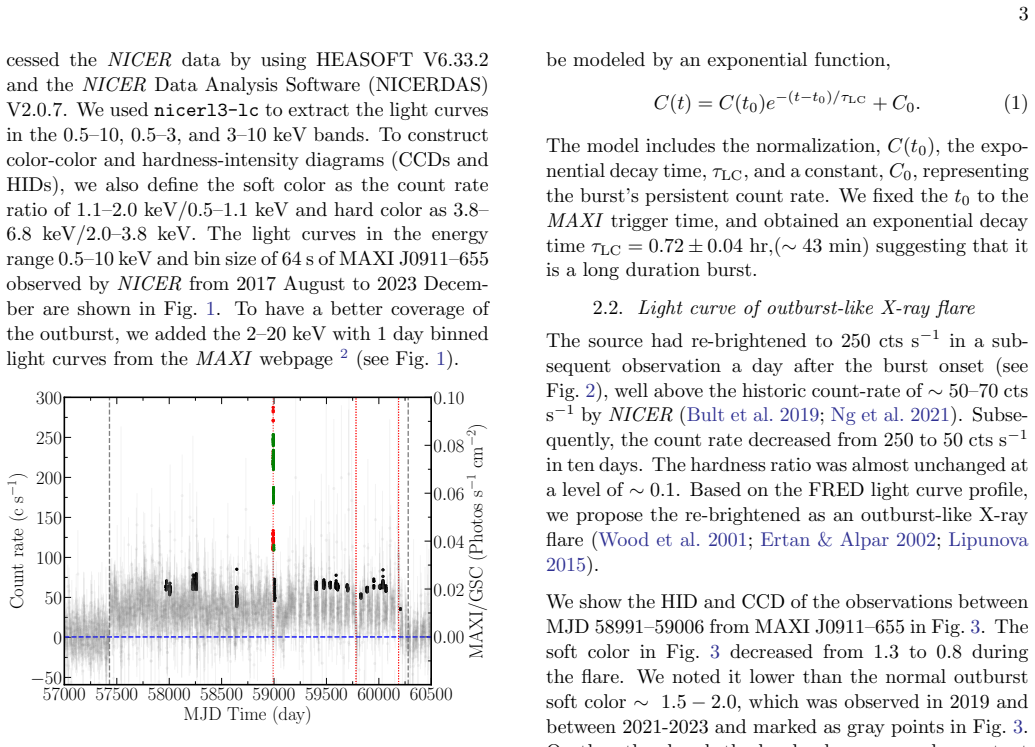
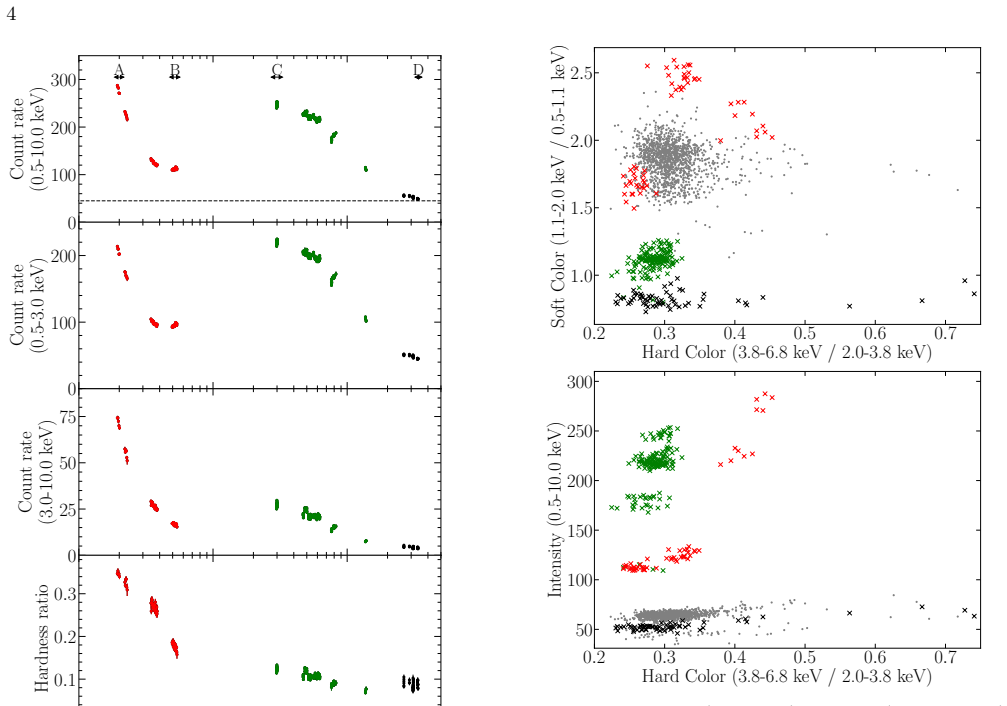
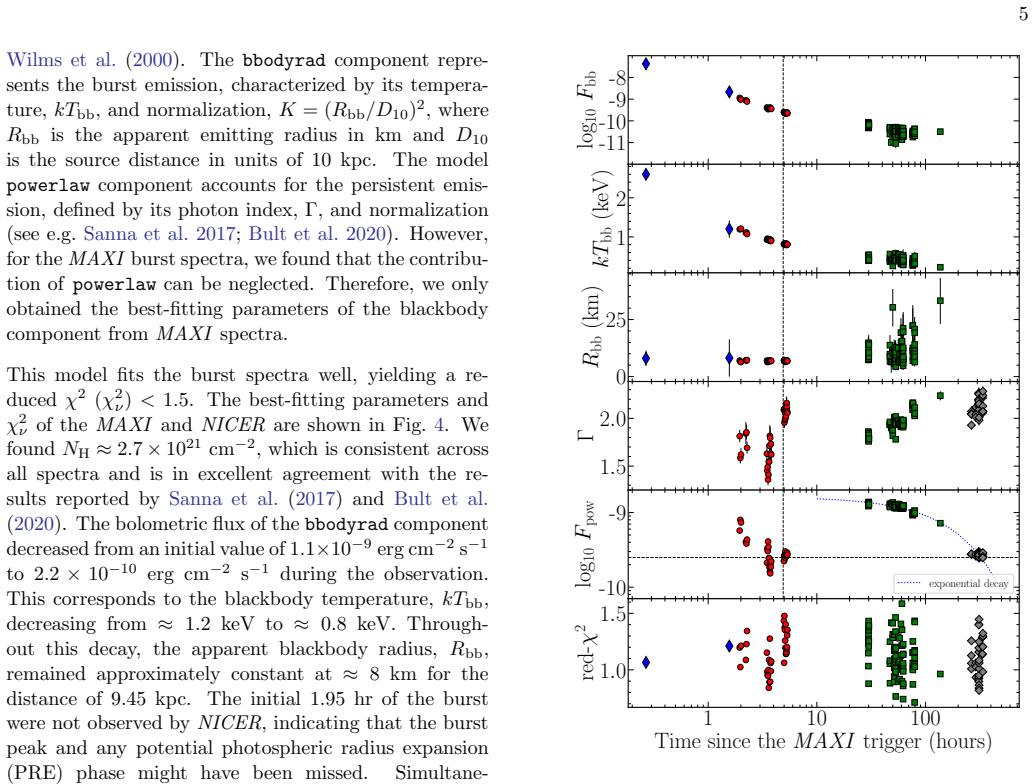
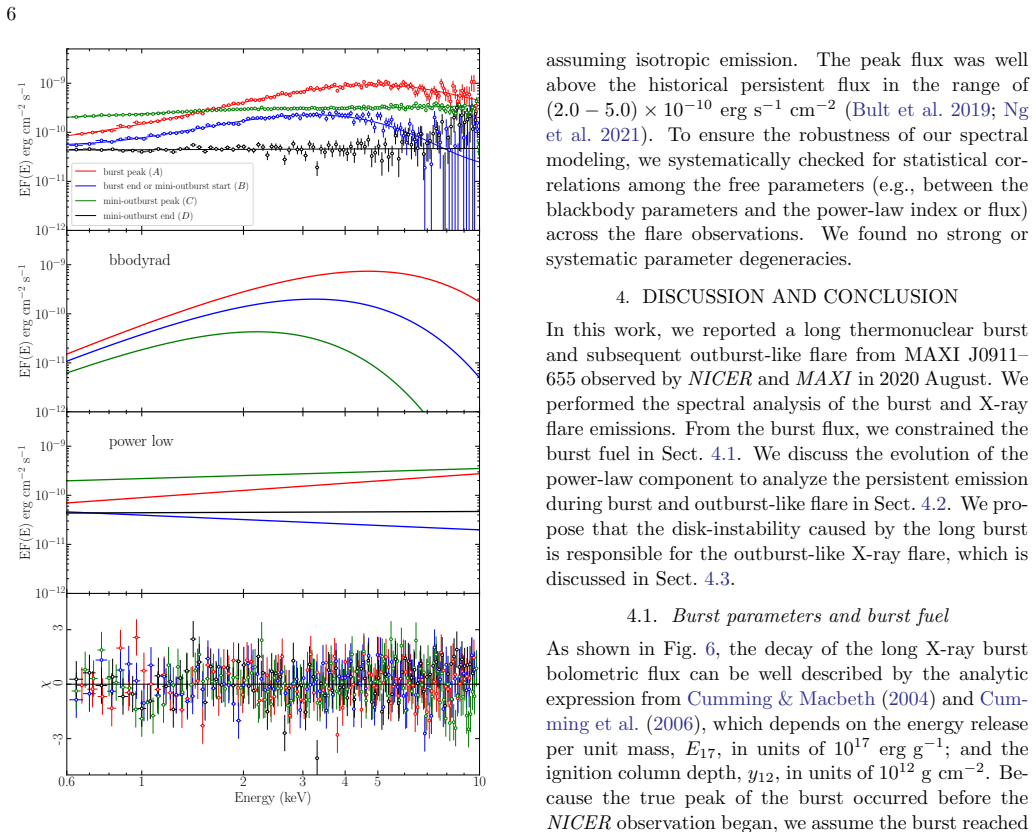
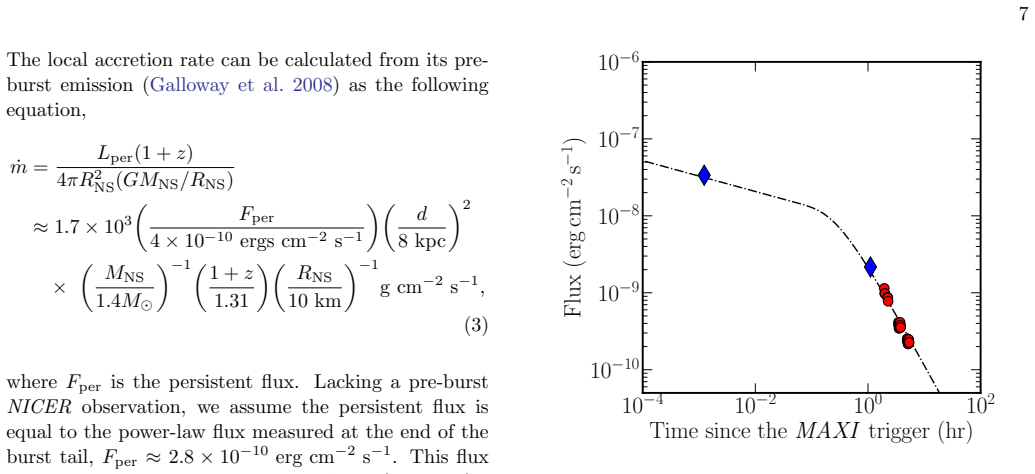
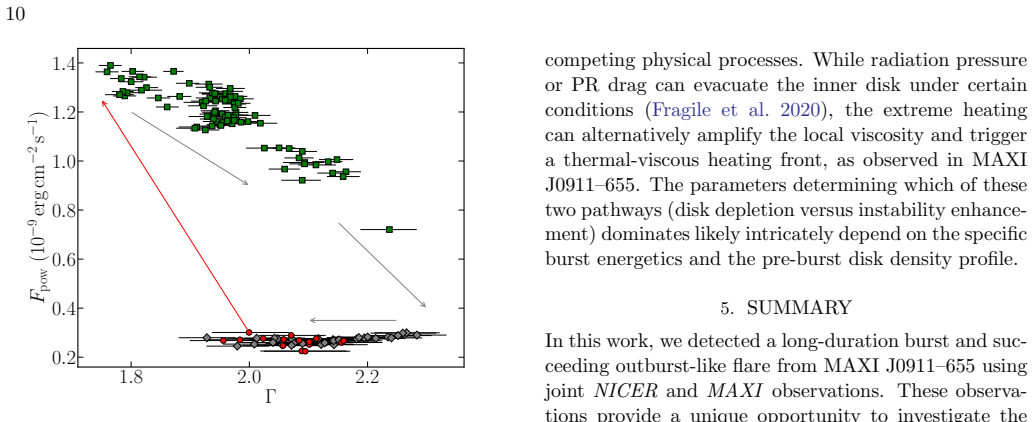
The long burst, with fluence 1.1e-4 erg cm^-2 and decay time ~43 min, delivered enough irradiation to amplify the ongoing thermal-viscous accretion process in a disk accreting at ~1% Eddington. The added heat drove an inside-out heating front that raised the persistent 0.5-10 keV flux from 0.27e-9 to 1.4e-9 erg cm^-2 s^-1 and changed the photon index from ~1.7 to ~2.2, after which the source returned to its baseline low/hard state.
What carries the argument
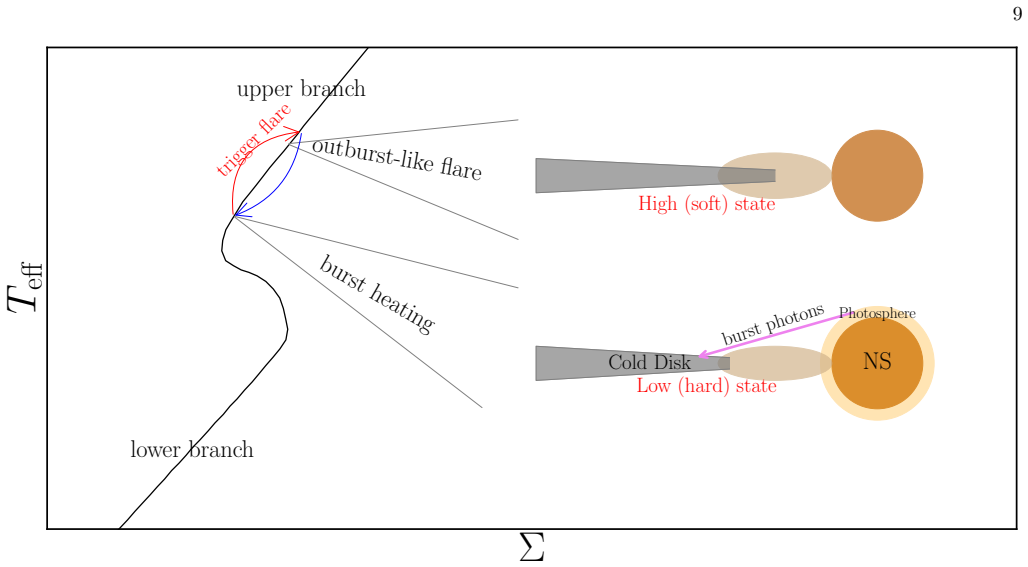
The inside-out heating front triggered when burst irradiation pushes a marginally stable disk across the thermal-viscous instability threshold.
If this is right
- The burst can modulate accretion on a one-day timescale even when the disk is accreting at only one percent of Eddington.
- The flare's spectral softening follows the expected change when a heating front moves outward through the disk.
- Similar long bursts in other low-accretion-rate systems should produce observable post-burst flares if the disk is near the instability threshold.
- The total energy released in the burst (~1.2e42 erg) is sufficient to supply the extra heat needed to launch the front.
Where Pith is reading between the lines
- If confirmed in additional sources, burst-triggered flares could be used to map the radial structure of disks at low accretion rates.
- Models of disk stability may need to include the transient heat input from bursts as a standard perturbation term.
Load-bearing premise
The flare is caused by the burst's irradiation rather than an unrelated change in the accretion flow.
What would settle it
A detailed disk-instability model calculation that uses the measured burst fluence and pre-burst accretion rate but predicts no flare with the observed delay, amplitude, and spectral evolution would falsify the causal link.
Figures
read the original abstract
We report on NICER and MAXI observations of a long-duration thermonuclear X-ray burst and a subsequent outburst-like X-ray flare from the neutron star low-mass X-ray binary MAXI J0911--655. Prior to the burst, the source was in a persistent low/hard state with a power-law-dominated spectrum ($\Gamma \sim 1.7$) and a mass accretion rate of $\sim 1\%$ of the Eddington limit. The long burst, detected by MAXI on 2020 May 22 (MJD 58991.7101), was rapidly followed up by NICER. From time-resolved spectroscopy of the cooling tail, we estimate an exponential decay time of $\approx43$ minutes, the ignition column depth of $\approx0.1\times 10^{12}~{\rm g ~cm^{-2}}$, the burst fluence of $\approx 1.1\times 10^{-4}~{\rm erg~cm^{-2}}$, and the total energy release of $\approx1.2\times10^{42}$ erg. Approximately one day after the burst onset, the 0.5-10 keV light curve unexpectedly re-brightened, initiating an outburst-like flare. During the peak of this flare, the persistent power-law flux increased from its pre-burst level of $\sim0.27\times10^{-9}~{\rm erg~cm^{-2}~s^{-1}}$ to $1.4\times10^{-9}~{\rm erg~cm^{-2}~s^{-1}}$. This flux enhancement was accompanied by significant spectral softening, with the photon index increasing to $\Gamma \sim 2.2$. Subsequently, the flux decayed and the source returned to its baseline low/hard state. The observed timescales and energetics suggest that intense irradiation from the long burst amplified the ongoing thermal-viscous accretion process. This heating drove an inside-out heating front that temporarily enhanced the mass accretion rate, providing compelling observational evidence of a thermonuclear burst directly modulating the accretion dynamics of its surrounding disk.
Editorial analysis
A structured set of objections, weighed in public.
Referee Report
Summary. The paper reports NICER and MAXI observations of a long thermonuclear X-ray burst from MAXI J0911-655 in the low/hard state at ~1% Eddington, with measured decay time ~43 min, ignition depth ~0.1e12 g cm^-2, fluence ~1.1e-4 erg cm^-2, and total energy ~1.2e42 erg. Approximately one day later, the 0.5-10 keV flux rose from ~0.27e-9 to 1.4e-9 erg cm^-2 s^-1 with spectral softening (Gamma from 1.7 to 2.2), followed by decay back to baseline. The authors interpret the flare as burst irradiation triggering an inside-out heating front that enhances accretion via thermal-viscous instability.
Significance. If the causal mechanism is substantiated, the result would supply rare direct observational evidence that a thermonuclear burst can modulate accretion-disk dynamics through irradiation-driven thermal-viscous instability, with implications for disk stability thresholds in NS LMXBs at low accretion rates.
major comments (2)
- [Abstract] Abstract: the central causal claim that the ~1-day flare results from burst irradiation launching a heating front rests on qualitative timescale and energetics matching without quantitative support; no estimate is given of the irradiation temperature profile, the radial trigger location, or the expected viscous/thermal timescale at that radius for a 1% Eddington disk.
- [Abstract] Abstract (final paragraph): alternative explanations such as unrelated accretion-rate fluctuations are not addressed or excluded, leaving the attribution to burst-driven instability as an untested assumption rather than a demonstrated conclusion.
Simulated Author's Rebuttal
We thank the referee for their constructive comments on our manuscript. We address each major comment below and indicate where revisions will be made.
read point-by-point responses
-
Referee: [Abstract] Abstract: the central causal claim that the ~1-day flare results from burst irradiation launching a heating front rests on qualitative timescale and energetics matching without quantitative support; no estimate is given of the irradiation temperature profile, the radial trigger location, or the expected viscous/thermal timescale at that radius for a 1% Eddington disk.
Authors: We agree that the manuscript provides only qualitative support via timescale and energetics matching and does not include quantitative estimates of the irradiation temperature profile, trigger radius, or local viscous/thermal timescales. The work is observational in focus, and such modeling would require additional assumptions about disk viscosity, opacity, and structure that are not constrained by the NICER/MAXI data. We will revise the abstract to describe the interpretation as suggestive rather than definitive and add a note in the discussion section acknowledging this limitation and the value of future theoretical work. revision: partial
-
Referee: [Abstract] Abstract (final paragraph): alternative explanations such as unrelated accretion-rate fluctuations are not addressed or excluded, leaving the attribution to burst-driven instability as an untested assumption rather than a demonstrated conclusion.
Authors: We accept that alternative explanations were not explicitly discussed. In the revised manuscript we will add a short paragraph in the discussion addressing the possibility of unrelated accretion-rate fluctuations, while noting that the precise one-day delay after the burst and the accompanying spectral softening (Gamma increasing from 1.7 to 2.2) make a causal link more plausible than a random coincidence. We will also moderate the abstract language to present the burst-driven instability as an interpretation supported by the observations rather than a conclusively demonstrated mechanism. revision: yes
- Provision of quantitative estimates for the irradiation temperature profile, radial trigger location, and expected viscous/thermal timescales, as these require new theoretical disk modeling outside the scope of the current observational paper.
Circularity Check
No circularity: observational interpretation of measured fluxes and timescales
full rationale
The paper reports direct NICER/MAXI observations of a long thermonuclear burst (decay time ~43 min, fluence ~1.1e-4 erg cm^-2, energy ~1.2e42 erg) followed ~1 day later by a re-brightening flare with increased power-law flux and spectral softening. The central claim is an interpretive suggestion that burst irradiation amplified thermal-viscous instability, based on the observed temporal sequence and energetics. No equations, fitted parameters renamed as predictions, or self-citation chains appear in the provided text; the result does not reduce to its inputs by construction. The analysis is self-contained against external benchmarks of measured quantities.
Axiom & Free-Parameter Ledger
axioms (1)
- domain assumption Thermal-viscous instability in accretion disks can be triggered by external irradiation from a thermonuclear burst when the disk is near the stability threshold
Reference graph
Works this paper leans on
-
[1]
2023, , 521, 3608, 10.1093/mnras/stad374
Alizai , K., Chenevez , J., Cumming , A., et al. 2023, , 521, 3608, 10.1093/mnras/stad374
-
[2]
Arnaud , K. A. 1996, in Astronomical Society of the Pacific Conference Series, Vol. 101, Astronomical Data Analysis Software and Systems V, ed. G. H. Jacoby & J. Barnes , 17
1996
-
[3]
Ballantyne , D. R., & Everett , J. E. 2005, , 626, 364, 10.1086/429860
-
[4]
arXiv , author =:1812.10684 , journal =
Bilous , A. V., & Watts , A. L. 2019, , 245, 19, 10.3847/1538-4365/ab2fe1
-
[5]
F., et al
Buccheri , R., Bennett , K., Bignami , G. F., et al. 1983, , 128, 245
1983
-
[6]
2021, , 920, 59, 10.3847/1538-4357/ac18c4
Bult , P., Altamirano , D., Arzoumanian , Z., et al. 2021, , 920, 59, 10.3847/1538-4357/ac18c4
-
[7]
M., Arzoumanian , Z., & Gendreau , K
Bult , P. M., Arzoumanian , Z., & Gendreau , K. C. 2020, The Astronomer's Telegram, 13760, 1
2020
-
[8]
M., Gendreau , K
Bult , P. M., Gendreau , K. C., Strohmayer , T. E., et al. 2019, The Astronomer's Telegram, 12869, 1
2019
-
[9]
C oban , \"O . F., & Ertan , \"U . 2024, , 961, 252, 10.3847/1538-4357/ad1515
-
[10]
Chen , Y. P., Zhang , S., Qu , J. L., et al. 2018, , 864, L30, 10.3847/2041-8213/aadc0e
-
[11]
2001, , 559, L127, 10.1086/323937
Cumming , A., & Bildsten , L. 2001, , 559, L127, 10.1086/323937
-
[12]
2004, , 603, L37, 10.1086/382873
Cumming , A., & Macbeth , J. 2004, , 603, L37, 10.1086/382873
-
[13]
Cumming , A., Macbeth , J., in 't Zand , J. J. M., & Page , D. 2006, , 646, 429, 10.1086/504698
-
[14]
Degenaar , N., Ballantyne , D. R., Belloni , T., et al. 2018, , 214, 15, 10.1007/s11214-017-0448-3
-
[15]
2001, A&A, 373, 251, doi: 10.1051/0004-6361:20010632
Dubus , G., Hameury , J. M., & Lasota , J. P. 2001, , 373, 251, 10.1051/0004-6361:20010632
-
[16]
Optical spectra of the central cluster galaxies
Dubus , G., Lasota , J.-P., Hameury , J.-M., & Charles , P. 1999, , 303, 139, 10.1046/j.1365-8711.1999.02212.x
-
[17]
Ertan , \"U ., & Alpar , M. A. 2002, , 393, 205, 10.1051/0004-6361:20020998
-
[18]
2008, , 484, 43, 10.1051/0004-6361:20078982
Falanga , M., Chenevez , J., Cumming , A., et al. 2008, , 484, 43, 10.1051/0004-6361:20078982
-
[19]
Fragile , P. C., Ballantyne , D. R., & Blankenship , A. 2020, Nature Astronomy, 4, 541, 10.1038/s41550-019-0987-5
-
[20]
2025, The Astrophysical Journal, 980, 161, 10.3847/1538-4357/adadee
Fu, T., Li, Z., Pan, Y., et al. 2025, The Astrophysical Journal, 980, 161, 10.3847/1538-4357/adadee
-
[21]
Galloway , D. K., & Keek , L. 2021, Astrophysics and Space Science Library, 461, 209, 10.1007/978-3-662-62110-3\_5
-
[22]
K., Muno, M
Galloway, D. K., Muno, M. P., Hartman, J. M., Psaltis, D., & Chakrabarty, D. 2008, The Astrophysical Journal Supplement Series, 179, 360
2008
-
[23]
Galloway , D. K., Muno , M. P., Hartman , J. M., Psaltis , D., & Chakrabarty , D. 2008, , 179, 360, 10.1086/592044
-
[24]
Hameury, J. 2020, Advances in Space Research, 66, 1004, https://doi.org/10.1016/j.asr.2019.10.022
-
[25]
O., & Degenaar , N
Heinke , C. O., & Degenaar , N. 2023, The Astronomer's Telegram, 16358, 1
2023
-
[26]
Huppenkothen , D., Bachetti , M., Stevens , A. L., et al. 2019, , 881, 39, 10.3847/1538-4357/ab258d
-
[27]
2017, in 7 years of MAXI: monitoring X-ray Transients, ed
in't Zand , J. 2017, in 7 years of MAXI: monitoring X-ray Transients, ed. M. Serino , M. Shidatsu , W. Iwakiri , & T. Mihara , 121. 1702.04899
Pith/arXiv arXiv 2017
-
[28]
in't Zand , J. J. M., Galloway , D. K., & Ballantyne , D. R. 2011, , 525, A111, 10.1051/0004-6361/201015556
-
[30]
2019 b , , 621, A53, 10.1051/0004-6361/201834270
---. 2019 b , , 621, A53, 10.1051/0004-6361/201834270
-
[31]
Keek , L., Galloway , D. K., in't Zand , J. J. M., & Heger , A. 2010, , 718, 292, 10.1088/0004-637X/718/1/292
-
[32]
Keek , L., Heger , A., & in't Zand , J. J. M. 2012, , 752, 150, 10.1088/0004-637X/752/2/150
-
[33]
Kuulkers , E., in't Zand , J. J. M., & Lasota , J. P. 2009, , 503, 889, 10.1051/0004-6361/200810981
-
[34]
Kuulkers , E., in't Zand , J. J. M., Atteia , J. L., et al. 2010, , 514, A65, 10.1051/0004-6361/200913210
-
[35]
2001, , 45, 449, 10.1016/S1387-6473(01)00112-9
Lasota , J.-P. 2001, , 45, 449, 10.1016/S1387-6473(01)00112-9
-
[36]
Lasota , J. P., Dubus , G., & Kruk , K. 2008, , 486, 523, 10.1051/0004-6361:200809658
-
[37]
H., Van Paradijs, J., & Taam, R
Lewin, W. H., Van Paradijs, J., & Taam, R. E. 1993, Space Science Reviews, 62, 223
1993
-
[38]
Lewin , W. H. G., van Paradijs , J., & Taam , R. E. 1993, , 62, 223, 10.1007/BF00196124
-
[39]
2021, , 920, 35, 10.3847/1538-4357/ac1f15
Li , Z., Pan , Y., & Falanga , M. 2021, , 920, 35, 10.3847/1538-4357/ac1f15
-
[40]
Li , Z., Suleimanov , V. F., Poutanen , J., et al. 2018, , 866, 53, 10.3847/1538-4357/aade8e
-
[41]
Lipunova, G. V. 2015, The Astrophysical Journal, 804, 87, 10.1088/0004-637X/804/2/87
-
[42]
2024, , 969, 15, 10.3847/1538-4357/ad4d86
Lu , Y., Li , Z., Yu , W., Pan , Y., & Falanga , M. 2024, , 969, 15, 10.3847/1538-4357/ad4d86
-
[43]
2023, , 670, A87, 10.1051/0004-6361/202244984
Lu , Y., Li , Z., Pan , Y., et al. 2023, , 670, A87, 10.1051/0004-6361/202244984
-
[44]
Maccarone , T. J., & Coppi , P. S. 2003, , 399, 1151, 10.1051/0004-6361:20021881
-
[45]
2020, The Astronomer's Telegram, 13754, 1
Nakajima , M., Sugita , S., Serino , M., et al. 2020, The Astronomer's Telegram, 13754, 1
2020
-
[46]
M., Strohmayer , T
Ng , M., Bult , P. M., Strohmayer , T. E., et al. 2021, The Astronomer's Telegram, 14767, 1
2021
-
[47]
R., Paresce , F., & De Marchi , G
Paltrinieri , B., Ferraro , F. R., Paresce , F., & De Marchi , G. 2001, , 121, 3114, 10.1086/321069
-
[48]
2025, The Astrophysical Journal, 982, 18, 10.3847/1538-4357/adb726
Peng, Z., Li, Z., Pan, Y., et al. 2025, The Astrophysical Journal, 982, 18, 10.3847/1538-4357/adb726
-
[49]
2006, in Compact stellar X-ray sources, ed
Psaltis , D. 2006, in Compact stellar X-ray sources, ed. W. H. G. Lewin & M. van der Klis , Vol. 39, 1--38
2006
-
[50]
A., Loewenstein , M., Steiner , J
Remillard , R. A., Loewenstein , M., Steiner , J. F., et al. 2021, arXiv e-prints, arXiv:2105.09901. 2105.09901
arXiv 2021
-
[51]
D., Degenaar , N., van den Eijnden , J., et al
Russell , T. D., Degenaar , N., van den Eijnden , J., et al. 2024, , 627, 763, 10.1038/s41586-024-07133-5
-
[52]
2017, , 598, A34, 10.1051/0004-6361/201629406
Sanna , A., Papitto , A., Burderi , L., et al. 2017, , 598, A34, 10.1051/0004-6361/201629406
-
[53]
2012, , 64, 91, 10.1093/pasj/64.5.91
Serino , M., Mihara , T., Matsuoka , M., et al. 2012, , 64, 91, 10.1093/pasj/64.5.91
-
[54]
2016, The Astronomer's Telegram, 8872, 1
Serino , M., Tanaka , K., Negoro , H., et al. 2016, The Astronomer's Telegram, 8872, 1
2016
-
[55]
Speicher , J., Ballantyne , D. R., & Fragile , P. C. 2024, , 976, 44, 10.3847/1538-4357/ad863d
-
[56]
Speicher , J., Ballantyne , D. R., & Malzac , J. 2020, , 499, 4479, 10.1093/mnras/staa3137
-
[57]
2006, in Compact stellar X-ray sources, Cambridge Astrophysics Series, No
Strohmayer , T., & Bildsten , L. 2006, in Compact stellar X-ray sources, Cambridge Astrophysics Series, No. 39, ed. W. Lewin & M. van der Klis (Cambridge: Cambridge University Press), 113--156
2006
-
[58]
Strohmayer , T. E., & Brown , E. F. 2002, , 566, 1045, 10.1086/338337
-
[59]
Suleimanov , V. F., Poutanen , J., N \"a ttil \"a , J., et al. 2017, , 466, 906, 10.1093/mnras/stw3132
-
[60]
Watkins , L. L., van der Marel , R. P., Bellini , A., & Anderson , J. 2015, , 812, 149, 10.1088/0004-637X/812/2/149
-
[61]
On the Absorption of X-rays in the Interstellar Medium
Wilms, J., Allen, A., & McCray, R. 2000, The Astrophysical Journal, 542, 914, 10.1086/317016
work page internal anchor Pith review doi:10.1086/317016 2000
-
[62]
Wood, K. S., Titarchuk, L., Ray, P. S., et al. 2001, The Astrophysical Journal, 563, 246, 10.1086/323768
-
[63]
2024, , 683, A93, 10.1051/0004-6361/202348195
Yu , W., Li , Z., Lu , Y., et al. 2024, , 683, A93, 10.1051/0004-6361/202348195
-
[64]
2025, , 696, A139, 10.1051/0004-6361/202453142
Yu , W., Li , Z., Pan , Y., et al. 2025, , 696, A139, 10.1051/0004-6361/202453142
-
[65]
2022, , 660, A31, 10.1051/0004-6361/202142801
Zhao , G., Li , Z., Pan , Y., et al. 2022, , 660, A31, 10.1051/0004-6361/202142801
discussion (0)
Sign in with ORCID, Apple, or X to comment. Anyone can read and Pith papers without signing in.