Hierarchical excitatory processes for modelling event-time data in the presence of exogenous stimuli
Pith reviewed 2026-06-27 08:56 UTC · model grok-4.3
The pith
A hierarchical excitatory process models event-time data under repeated stimuli by superposing kernels with dynamically evolving parameters.
A machine-rendered reading of the paper's core claim, the machinery that carries it, and where it could break.
Core claim
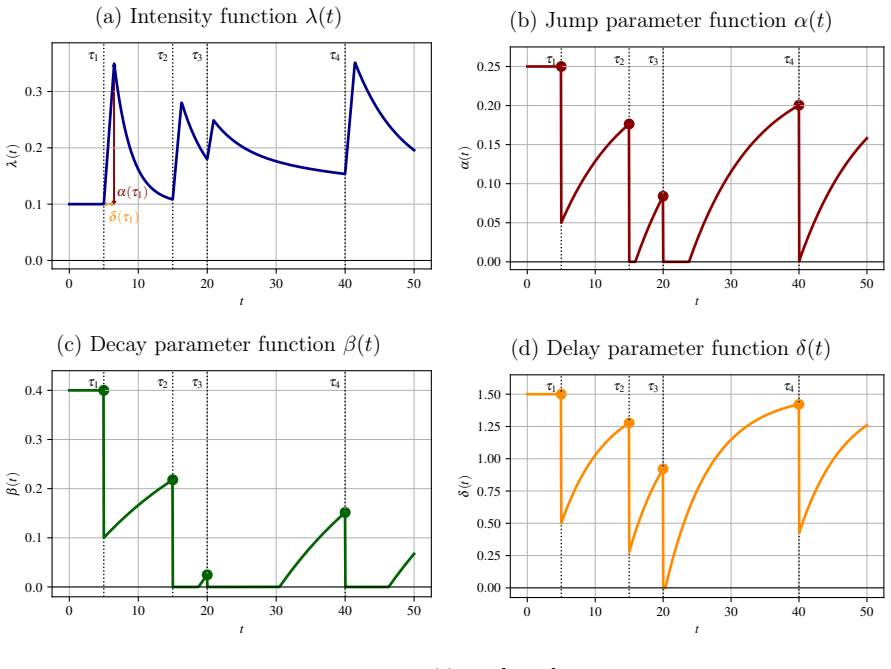
The Hierarchical Excitatory Process expresses the conditional intensity of a point process as a superposition of excitation effects induced by external stimuli, with the kernels' parameters evolving dynamically over repeated presentations in a hierarchical construction that modulates excitation strength and supports both likelihood inference and model-based clustering of latent groups with similar response dynamics.
What carries the argument
The Hierarchical Excitatory Process (HEP), a point process model whose conditional intensity is a superposition of stimulus-induced excitation kernels whose parameters evolve hierarchically over repeated presentations.
If this is right
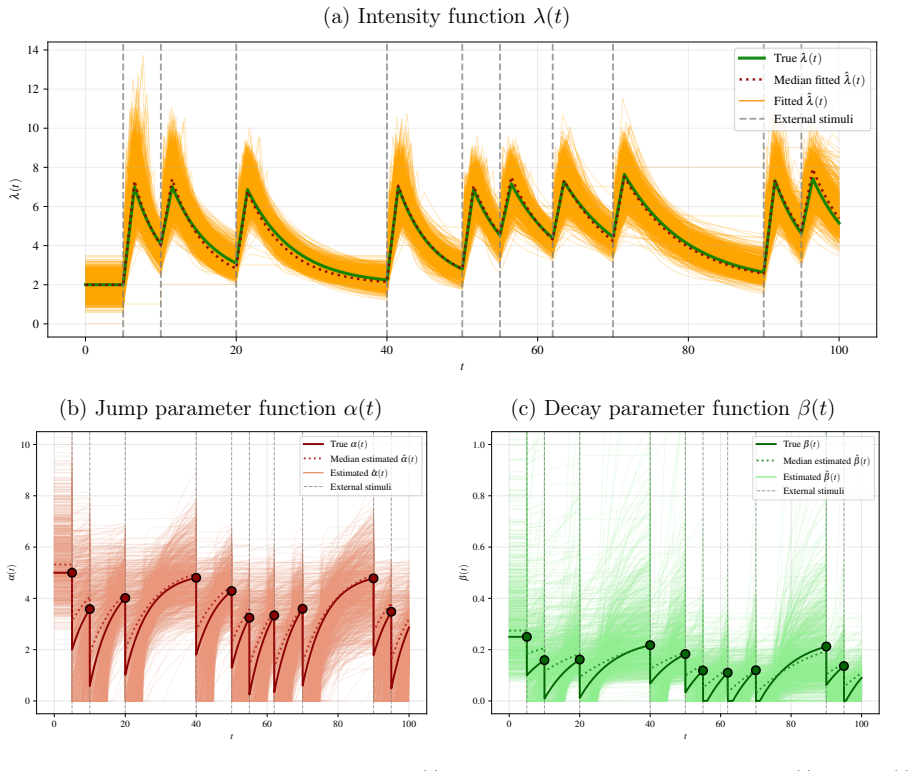
- The model enables recovery of evolving latent patterns in simulated event-time data.
- Likelihood-based parameter estimation is feasible for the hierarchical structure.
- Embedding in clustering identifies groups sharing similar response dynamics to stimuli.
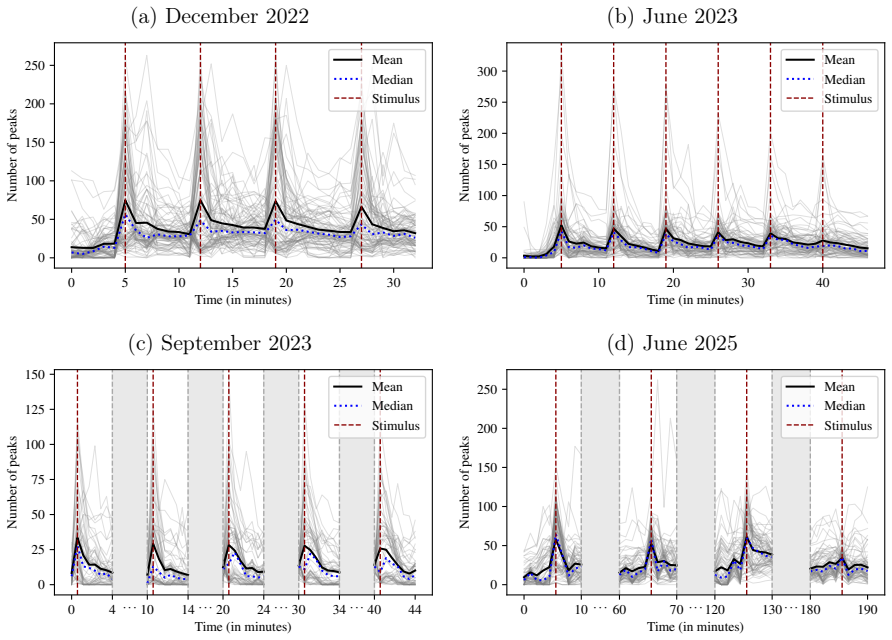
- Application to Aplysia spike trains characterizes stimulus-driven neuronal excitability under varying conditions.
Where Pith is reading between the lines
- If the model holds, it could extend to predicting responses in new stimulus sequences by extrapolating the hierarchical parameter evolution.
- The approach might apply to other repeated-stimulus point processes such as user interactions or seismic events.
- Clustering within the model could reveal subtypes of responses that inform experimental design in neuroscience.
Load-bearing premise
The conditional intensity can be written as a superposition of excitation kernels from external stimuli whose parameters change dynamically over repeated presentations in a hierarchical way.
What would settle it
If simulations with known non-hierarchical parameter evolution show the model failing to recover the true patterns, or if clustering on Aplysia data under different conditions produces groups that do not align with the experimental conditions.
Figures
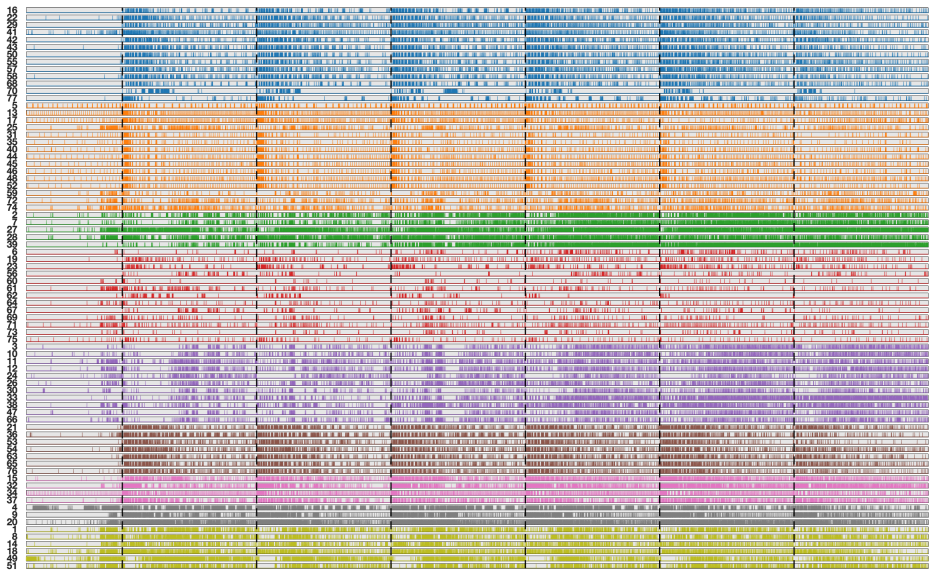
read the original abstract
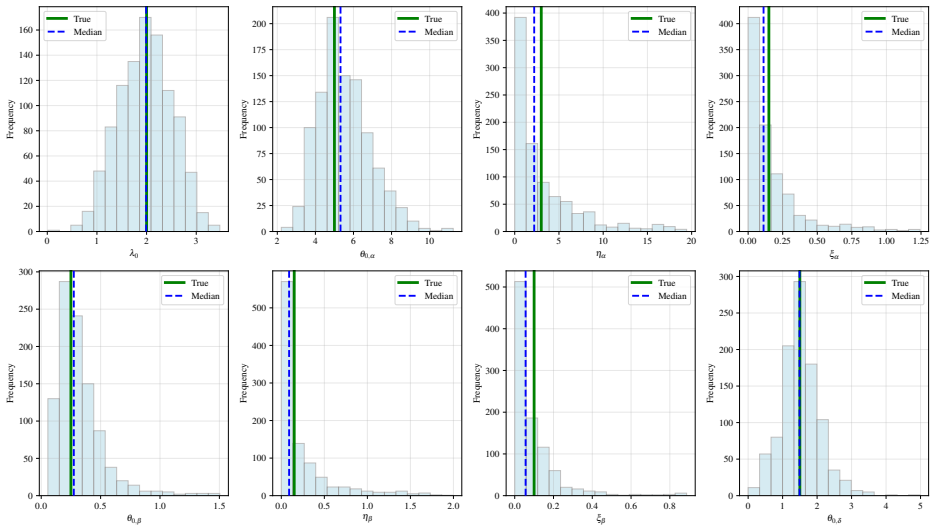
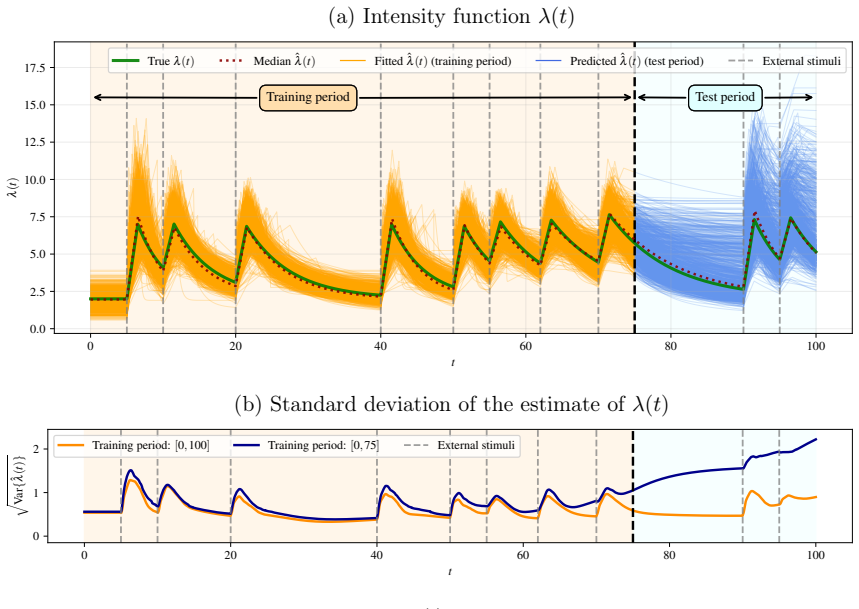
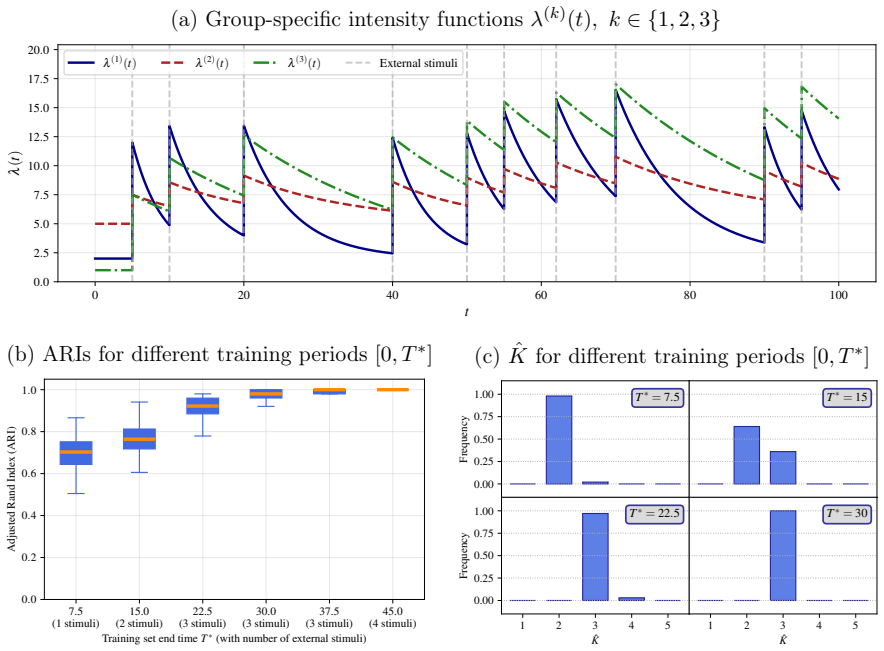
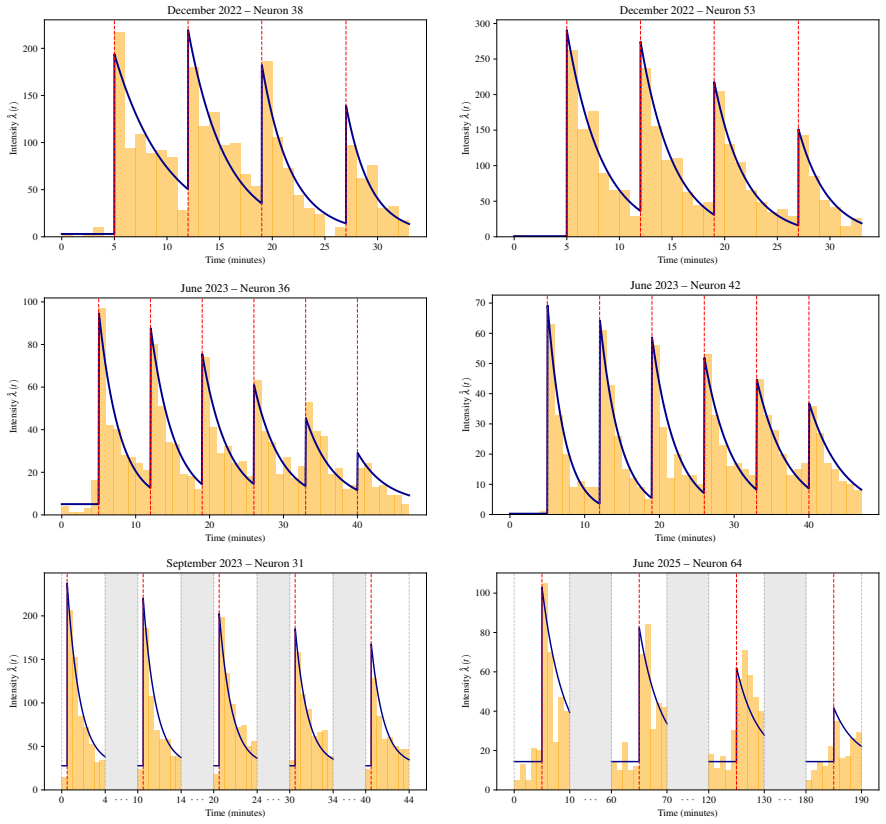
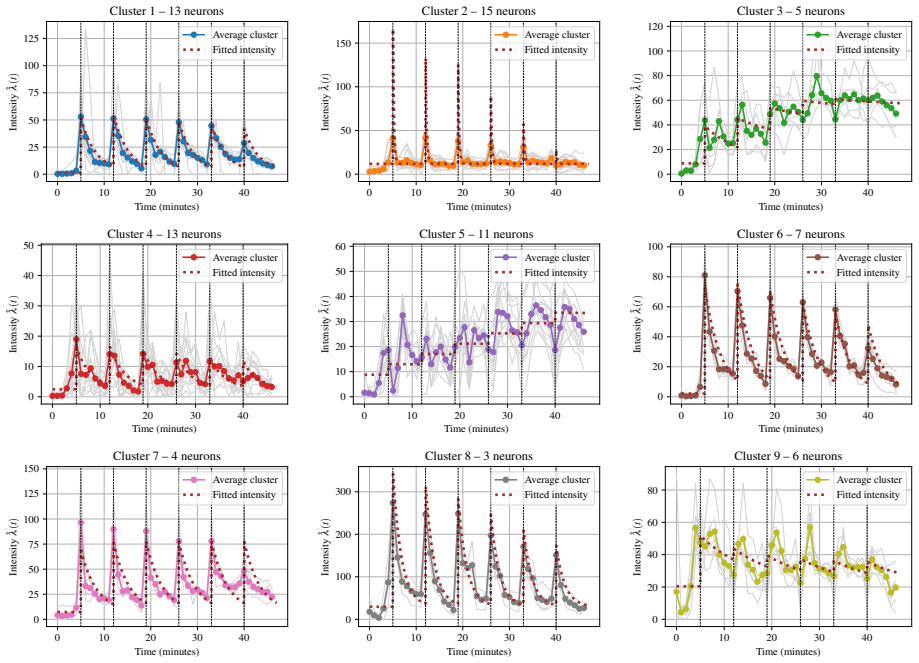
We introduce the Hierarchical Excitatory Process (HEP), a flexible point process model for event-time data observed under repeated external stimuli. The proposed framework models the conditional intensity of a point process as a superposition of excitation effects induced by external stimuli, characterised by kernels with parameters dynamically evolving over time. This hierarchical construction enables modulation of excitation strength across repeated stimuli, providing an interpretable structure. We establish likelihood-based inference for the proposed model and embed HEP within a model-based clustering framework to identify latent groups sharing similar response dynamics. Simulation studies demonstrate the model's ability to recover evolving latent patterns, and an application to spike train recordings from the sea slug Aplysia pedal ganglion illustrates how HEPs are able to characterise stimulus-driven excitability of neurons across repeated stimulation under different experimental conditions.
Editorial analysis
A structured set of objections, weighed in public.
Referee Report
Summary. The manuscript introduces the Hierarchical Excitatory Process (HEP), a point process model for event-time data observed under repeated external stimuli. The conditional intensity is modeled as a superposition of excitation effects induced by external stimuli, with kernels whose parameters evolve dynamically over repeated presentations in a hierarchical manner. Likelihood-based inference is established for the model, which is further embedded in a model-based clustering framework to identify latent groups sharing similar response dynamics. Simulation studies are claimed to recover evolving latent patterns, and an application to spike train recordings from the sea slug Aplysia pedal ganglion is presented to illustrate characterization of stimulus-driven excitability under different experimental conditions.
Significance. If the central modeling and inference claims hold, HEP supplies an interpretable hierarchical structure for modulating excitation strength across repeated stimuli in point-process settings. This is relevant for neuroscience applications involving evolving responses. The combination of likelihood inference with model-based clustering adds a practical tool for discovering subgroups with shared dynamics. The simulation recovery and real-data illustration are the natural empirical checks for the stability of the proposed inference procedure.
major comments (2)
- [Simulation studies] Simulation studies section: the claim that simulations recover evolving latent patterns is asserted without any description of the data-generation process, true parameter values, estimation procedure, quantitative recovery metrics (bias, variance, or coverage), or comparison baselines; this leaves the performance of the likelihood inference unverified and load-bearing for the central claim of stable inference.
- [Aplysia application] Aplysia application section: the claim that HEPs characterise stimulus-driven excitability is not supported by any fitting details, parameter estimates, uncertainty quantification (error bars), or data-exclusion rules; without these the data-to-claim link cannot be assessed and the empirical illustration remains unverifiable.
minor comments (1)
- [Abstract] Abstract: the description of the hierarchical kernel evolution is purely verbal; a single compact equation would improve precision without lengthening the abstract.
Simulated Author's Rebuttal
Thank you for the referee's thoughtful comments on our manuscript. We address the major comments below and will revise the manuscript accordingly to strengthen the empirical sections.
read point-by-point responses
-
Referee: [Simulation studies] Simulation studies section: the claim that simulations recover evolving latent patterns is asserted without any description of the data-generation process, true parameter values, estimation procedure, quantitative recovery metrics (bias, variance, or coverage), or comparison baselines; this leaves the performance of the likelihood inference unverified and load-bearing for the central claim of stable inference.
Authors: We agree with the referee that the simulation studies require more detailed reporting to substantiate the claims. In the revised manuscript, we will expand the Simulation studies section to include a complete description of the data-generation process, the true parameter values used, the estimation procedure, quantitative recovery metrics such as bias, variance, and coverage probabilities, as well as comparisons to baseline methods. This will provide a thorough verification of the likelihood inference procedure. revision: yes
-
Referee: [Aplysia application] Aplysia application section: the claim that HEPs characterise stimulus-driven excitability is not supported by any fitting details, parameter estimates, uncertainty quantification (error bars), or data-exclusion rules; without these the data-to-claim link cannot be assessed and the empirical illustration remains unverifiable.
Authors: We acknowledge that the Aplysia application section currently lacks the necessary details to fully support the claims. In the revision, we will include detailed fitting information, the obtained parameter estimates, uncertainty quantification such as standard errors or confidence intervals, and any data-exclusion rules applied. This will make the empirical illustration verifiable and strengthen the link between the data and the conclusions about stimulus-driven excitability. revision: yes
Circularity Check
No significant circularity detected
full rationale
The paper defines the Hierarchical Excitatory Process (HEP) as a superposition of stimulus-induced kernels with hierarchically evolving parameters, then states that likelihood-based inference is established for this model and that it is embedded in a clustering framework. No equations are presented that reduce any claimed prediction or result to a quantity already fitted inside the same model by construction, nor is any load-bearing premise justified solely via self-citation. The central claims rest on the explicit model construction and standard likelihood methods applied to it, making the derivation self-contained against external benchmarks such as simulation recovery and the Aplysia data application.
Axiom & Free-Parameter Ledger
free parameters (1)
- evolving kernel parameters
axioms (1)
- domain assumption The conditional intensity is a superposition of stimulus-induced excitation effects.
Reference graph
Works this paper leans on
-
[1]
Kandel , title =
Eric R. Kandel , title =. Science , volume =. 2001 , doi =
2001
-
[2]
Thompson, Richard F. and Spencer, William A. , title =. Psychological Review , year =. doi:10.1037/h0022681 , publisher =
-
[3]
and Adams, Ryan P
Linderman, Scott W. and Adams, Ryan P. , title =. Proceedings of the 31st International Conference on International Conference on Machine Learning - Volume 32 , pages =. 2014 , publisher =
2014
-
[4]
Mutually Exciting Point Process Graphs for Modeling Dynamic Networks , volume =
Francesco. Mutually Exciting Point Process Graphs for Modeling Dynamic Networks , volume =. Journal of Computational and Graphical Statistics , number =
-
[5]
Scrucca, Luca and Fop, Michael and Murphy, T. Brendan and Raftery, Adrian E. , title =. The R Journal , year =. doi:10.32614/RJ-2016-021 , volume =
-
[6]
Hubert, Lawrence and Arabie, Phipps , date =. Comparing partitions , url =. Journal of Classification , number =. 1985 , bdsk-url-1 =. doi:10.1007/BF01908075 , id =
-
[7]
and Celeux, G
Biernacki, C. and Celeux, G. and Govaert, G. , journal=. Assessing a mixture model for clustering with the integrated completed likelihood , year=
-
[8]
Lewis, P. A. W and Shedler, G. S. , title =. Naval Research Logistics Quarterly , volume =. doi:https://doi.org/10.1002/nav.3800260304 , url =. https://onlinelibrary.wiley.com/doi/pdf/10.1002/nav.3800260304 , year =
-
[9]
Nonlinear Modeling of Neural Interaction for Spike Prediction Using the Staged Point-Process Model , year=
Qian, Cunle and Sun, Xuyun and Zhang, Shaomin and Xing, Dong and Li, Hongbao and Zheng, Xiaoxiang and Pan, Gang and Wang, Yiwen , journal=. Nonlinear Modeling of Neural Interaction for Spike Prediction Using the Staged Point-Process Model , year=
-
[10]
De, Abir and Bhattacharya, Sourangshu and Ganguly, Niloy , title =. 2018 , isbn =. doi:10.1145/3178876.3186121 , booktitle =
-
[11]
Learning to Select Exogenous Events for Marked Temporal Point Process , volume =
Zhang, Ping and Iyer, Rishabh and Tendulkar, Ashish and Aggarwal, Gaurav and De, Abir , booktitle =. Learning to Select Exogenous Events for Marked Temporal Point Process , volume =
-
[12]
Non-stationary spatio-temporal point process modeling for high-resolution COVID-19 data , volume =
Dong, Zheng and Zhu, Shixiang and Xie, Yao and Mateu, Jorge and Rodr. Non-stationary spatio-temporal point process modeling for high-resolution COVID-19 data , volume =. Journal of the Royal Statistical Society Series C: Applied Statistics , month =. doi:10.1093/jrsssc/qlad013 , eprint =
-
[13]
Spatio-Temporal Point Processes With Attention for Traffic Congestion Event Modeling , year=
Zhu, Shixiang and Ding, Ruyi and Zhang, Minghe and Hentenryck, Pascal Van and Xie, Yao , journal=. Spatio-Temporal Point Processes With Attention for Traffic Congestion Event Modeling , year=
-
[14]
Proceedings of the 34th International Conference on Machine Learning , pages =
Fake News Mitigation via Point Process Based Intervention , author =. Proceedings of the 34th International Conference on Machine Learning , pages =. 2017 , editor =
2017
-
[15]
Rizoiu, Marian-Andrei and Xie, Lexing and Sanner, Scott and Cebrian, Manuel and Yu, Honglin and Van Hentenryck, Pascal , title =. 2017 , isbn =. doi:10.1145/3038912.3052650 , booktitle =
-
[16]
Ruggeri, Fabrizio and Porter, Michael D. and White, Gentry , title =. Statistica Neerlandica , volume =. doi:https://doi.org/10.1111/stan.12347 , year =
-
[17]
and Lee, Kyung-Hoon and Gupta, Suneel , journal =
Li, Lang and Brown, Morton B. and Lee, Kyung-Hoon and Gupta, Suneel , journal =. Estimation and Inference for a Spline-Enhanced Population Pharmacokinetic Model , volume =
-
[18]
Gamma Generalized Linear Models for Pharmacokinetic Data , volume =
Salway, Ruth and Wakefield, Jon , journal =. Gamma Generalized Linear Models for Pharmacokinetic Data , volume =
-
[19]
and Tchetgen Tchetgen, Eric J
VanderWeele, Tyler J. and Tchetgen Tchetgen, Eric J. , journal =. Mediation Analysis with time Varying Exposures and Mediators , volume =
-
[20]
and Stensrud, Mats J
Aalen, Odd O. and Stensrud, Mats J. and Didelez, Vanessa and Daniel, Rhian and Røysland, Kjetil and Strohmaier, Susanne , title =. Biometrical Journal , volume =
-
[21]
Temporal causal mediation through a point process: direct and indirect effects of healthcare interventions , year =
H. Temporal causal mediation through a point process: direct and indirect effects of healthcare interventions , year =. Proceedings of the 37th International Conference on Neural Information Processing Systems , articleno =
-
[22]
Bomfim , journal =
Antulio N. Bomfim , journal =. Pre-announcement effects, news effects, and volatility: Monetary policy and the stock market , volume =
-
[23]
Accounting & Finance , volume =
Zheng, Liyi , title =. Accounting & Finance , volume =. doi:https://doi.org/10.1111/acfi.12356 , year =
-
[24]
Sanna Passino, Francesco and Che, Yining and Cardoso Correia Perello, Carlos , title =. Stat , volume =. doi:https://doi.org/10.1002/sta4.660 , year =
-
[25]
Oxford Research Encyclopedia of Neuroscience , title =
B. Oxford Research Encyclopedia of Neuroscience , title =. 2020 , publisher =
2020
-
[26]
Photodiode-Based Optical Imaging for Recording Network Dynamics with Single-Neuron Resolution in Non-Transgenic Invertebrates , year =
Hill, Evan S and Brown, Jeffrey W and Frost, William N , journal =. Photodiode-Based Optical Imaging for Recording Network Dynamics with Single-Neuron Resolution in Non-Transgenic Invertebrates , year =
-
[27]
and Kass, Robert E
Eden, Uri T. and Kass, Robert E. Statistical Models of Spike Train Data. Neuroscience in the 21st Century: From Basic to Clinical. 2022
2022
-
[28]
, journal =
Hawkes, Alan G. , journal =. Spectra of some self-exciting and mutually exciting point processes , volume =
-
[29]
John and Eames, Ken TD , journal =
Brooks-Pollock, Ellen and Tilston, Natasha and Edmunds, W. John and Eames, Ken TD , journal =. Using an online survey of healthcare-seeking behaviour to estimate the magnitude and severity of the 2009 H1N1v influenza epidemic in England , volume =
2009
-
[30]
Proceedings of the National Academy of Sciences , volume =
Yang Shen and Sanjoy Dasgupta and Saket Navlakha , title =. Proceedings of the National Academy of Sciences , volume =. 2020 , doi =
2020
-
[31]
A Space--Time Conditional Intensity Model for Invasive Meningococcal Disease Occurrence , volume =
Meyer, Sebastian and Elias, Johannes and H. A Space--Time Conditional Intensity Model for Invasive Meningococcal Disease Occurrence , volume =. Biometrics , month =
-
[32]
G. O. Mohler and M. B. Short and P. J. Brantingham and F. P. Schoenberg and G. E. Tita , journal =. Self-Exciting Point Process Modeling of Crime , volume =
-
[33]
Bowsher , doi =
Clive G. Bowsher , doi =. Modelling security market events in continuous time: Intensity based, multivariate point process models , volume =. Journal of Econometrics , keywords =
-
[34]
and Barbieri, Riccardo and Ventura, Val\'
Brown, Emery N. and Barbieri, Riccardo and Ventura, Val\'. The time-rescaling theorem and its application to neural spike train data analysis , year =. Neural Computation , month = feb, pages =
-
[35]
Nicholas A Heard and Christopher C Holmes and David A Stephens , journal =
-
[36]
Kandel and J
E.R. Kandel and J. Koester and S. Mack and S. Siegelbaum , publisher =. Principles of Neural Science (Sixth Edition) , year =
-
[37]
Hening and E.T
W.A. Hening and E.T. Walters and T.J. Carew and E.R. Kandel , journal =. Motorneuronal control of locomotion in Aplysia , volume =
-
[38]
Frost, W. N. and Kandel, E. R. , journal =. Structure of the network mediating siphon-elicited siphon withdrawal in Aplysia , volume =
-
[39]
Castellucci, V. F. and Frost, W.N. and Goelet, P. and Montarolo, P.G. and Schacher, S. and Morgan, J.A. and Blumenfeld, H. and Kandel, E.R. , journal =. Cell and molecular analysis of long-term sensitization in Aplysia. , volume =
-
[40]
, publisher =
Kandel, E.R. , publisher =. Behavioral Biology of Aplysia, a Contribution to the Comparative Study of Opisthobranch Molluscs , year =
-
[41]
2024 , journal =
Vuleti. 2024 , journal =
2024
-
[42]
Advances in Neural Information Processing Systems , volume=
Spectral embedding for dynamic networks with stability guarantees , author=. Advances in Neural Information Processing Systems , volume=
-
[43]
Statistical arbitrage in the US equities market , volume =
Marco Avellaneda and Jeong-Hyun Lee , journal =. Statistical arbitrage in the US equities market , volume =
-
[44]
, journal =
Rubin-Delanchy, Patrick and Cape, Joshua and Tang, Minh and Priebe, Carey E. , journal =. A Statistical Interpretation of Spectral Embedding: The Generalised Random Dot Product Graph , volume =
-
[45]
Karrer, Brian and Newman, M. E. J. , issue =. Physical Review E , title =
-
[46]
Journal of the Royal Statistical Society (Series B) , number =
Caron, Fran. Journal of the Royal Statistical Society (Series B) , number =
-
[47]
Journal of Multivariate Analysis , volume=
Autoregressive process modeling via the lasso procedure , author=. Journal of Multivariate Analysis , volume=. 2011 , publisher=
2011
-
[48]
Journal of economic surveys , volume=
Machine learning advances for time series forecasting , author=. Journal of economic surveys , volume=. 2023 , publisher=
2023
-
[49]
Proceedings of the American Mathematical Society , volume=
Spectral radius inequalities for Hilbert space operators , author=. Proceedings of the American Mathematical Society , volume=
-
[50]
2002 , publisher=
Introduction to time series and forecasting , author=. 2002 , publisher=
2002
-
[51]
Journal of Classification , volume=
Comparing partitions , author=. Journal of Classification , volume=. 1985 , publisher=
1985
-
[52]
Proceedings of the 26th annual international conference on machine learning , pages=
Information theoretic measures for clusterings comparison: is a correction for chance necessary? , author=. Proceedings of the 26th annual international conference on machine learning , pages=
-
[53]
Psychometrika , volume=
A generalized solution of the orthogonal procrustes problem , author=. Psychometrika , volume=. 1966 , publisher=
1966
-
[54]
arXiv preprint arXiv:2110.09596 , year=
A General Modeling Framework for Network Autoregressive Processes , author=. arXiv preprint arXiv:2110.09596 , year=
-
[55]
2020 , publisher=
Time series analysis , author=. 2020 , publisher=
2020
-
[56]
2005 , publisher=
New introduction to multiple time series analysis , author=. 2005 , publisher=
2005
-
[57]
2009 , publisher=
Time series: theory and methods , author=. 2009 , publisher=
2009
-
[58]
Journal of multivariate analysis , volume=
A well-conditioned estimator for large-dimensional covariance matrices , author=. Journal of multivariate analysis , volume=. 2004 , publisher=
2004
-
[59]
Journal of Financial Econometrics , volume=
The power of (non-) linear shrinking: A review and guide to covariance matrix estimation , author=. Journal of Financial Econometrics , volume=. 2022 , publisher=
2022
-
[60]
The Annals of Statistics , volume=
Analytical nonlinear shrinkage of large-dimensional covariance matrices , author=. The Annals of Statistics , volume=
-
[61]
Monograph Award , volume=
Introduction to random matrices theory and practice , author=. Monograph Award , volume=
-
[62]
Beyond universality in random matrix theory , author=
-
[63]
Statistics and Computing , volume=
Bayesian estimation of the latent dimension and communities in stochastic blockmodels , author=. Statistics and Computing , volume=. 2020 , publisher=
2020
-
[64]
Available at SSRN 3745692 , year=
Estimation of Large Financial Covariances: A Cross-Validation Approach , author=. Available at SSRN 3745692 , year=
-
[65]
Annals of Statistics , volume=
Nonparametric eigenvalue-regularized precision or covariance matrix estimator , author=. Annals of Statistics , volume=. 2016 , publisher=
2016
-
[66]
arXiv e-prints , pages=
Correlation networks, dynamic factor models and community detection , author=. arXiv e-prints , pages=
-
[67]
The Annals of Statistics , volume=
Rate-optimal robust estimation of high-dimensional vector autoregressive models , author=. The Annals of Statistics , volume=. 2023 , publisher=
2023
-
[68]
Journal of Econometrics , volume=
Detecting groups in large vector autoregressions , author=. Journal of Econometrics , volume=. 2021 , publisher=
2021
-
[69]
The Annals of Statistics , number =
Xuening Zhu and Rui Pan and Guodong Li and Yuewen Liu and Hansheng Wang , title =. The Annals of Statistics , number =. 2017 , doi =
2017
-
[70]
Generalized Network Autoregressive Processes and the
Knight, Marina and Leeming, Kathryn and Nason, Guy and Nunes, Matthew , journal=. Generalized Network Autoregressive Processes and the
-
[71]
The Annals of Statistics , volume=
High-dimensional latent panel quantile regression with an application to asset pricing , author=. The Annals of Statistics , volume=. 2023 , publisher=
2023
-
[72]
The Annals of Statistics , volume=
ScreeNOT: Exact MSE-optimal singular value thresholding in correlated noise , author=. The Annals of Statistics , volume=. 2023 , publisher=
2023
-
[73]
Computational Statistics & Data Analysis , volume=
Automatic dimensionality selection from the scree plot via the use of profile likelihood , author=. Computational Statistics & Data Analysis , volume=. 2006 , publisher=
2006
-
[74]
Journal of the American Statistical Association , volume=
Forecasting using principal components from a large number of predictors , author=. Journal of the American Statistical Association , volume=. 2002 , publisher=
2002
-
[75]
Inferential Theory for Factor Models of Large Dimensions , urldate =
Jushan Bai , journal =. Inferential Theory for Factor Models of Large Dimensions , urldate =
-
[76]
Large covariance estimation by thresholding principal orthogonal complements , urldate =
Jianqing Fan and Yuan Liao and Martina Mincheva , journal =. Large covariance estimation by thresholding principal orthogonal complements , urldate =
-
[77]
Regression Shrinkage and Selection via the Lasso , urldate =
Robert Tibshirani , journal =. Regression Shrinkage and Selection via the Lasso , urldate =
-
[78]
Jianqing Fan and Runze Li , title =. Journal of the American Statistical Association , volume =. 2001 , publisher =. doi:10.1198/016214501753382273 , URL =
-
[79]
Least Angle Regression , urldate =
Bradley Efron and Trevor Hastie and Iain Johnstone and Robert Tibshirani , journal =. Least Angle Regression , urldate =
-
[80]
Social Networks , volume=
Stochastic blockmodels: First steps , author=. Social Networks , volume=. 1983 , publisher=
1983
discussion (0)
Sign in with ORCID, Apple, or X to comment. Anyone can read and Pith papers without signing in.