On the Robustness of AFBM Sensing to Power Amplifier Nonlinearities
Pith reviewed 2026-06-27 08:56 UTC · model grok-4.3
The pith
The structure of the AFBM modulation matrix determines how power amplifier distortion propagates in the ambiguity function, keeping sensing performance stable.
A machine-rendered reading of the paper's core claim, the machinery that carries it, and where it could break.
Core claim
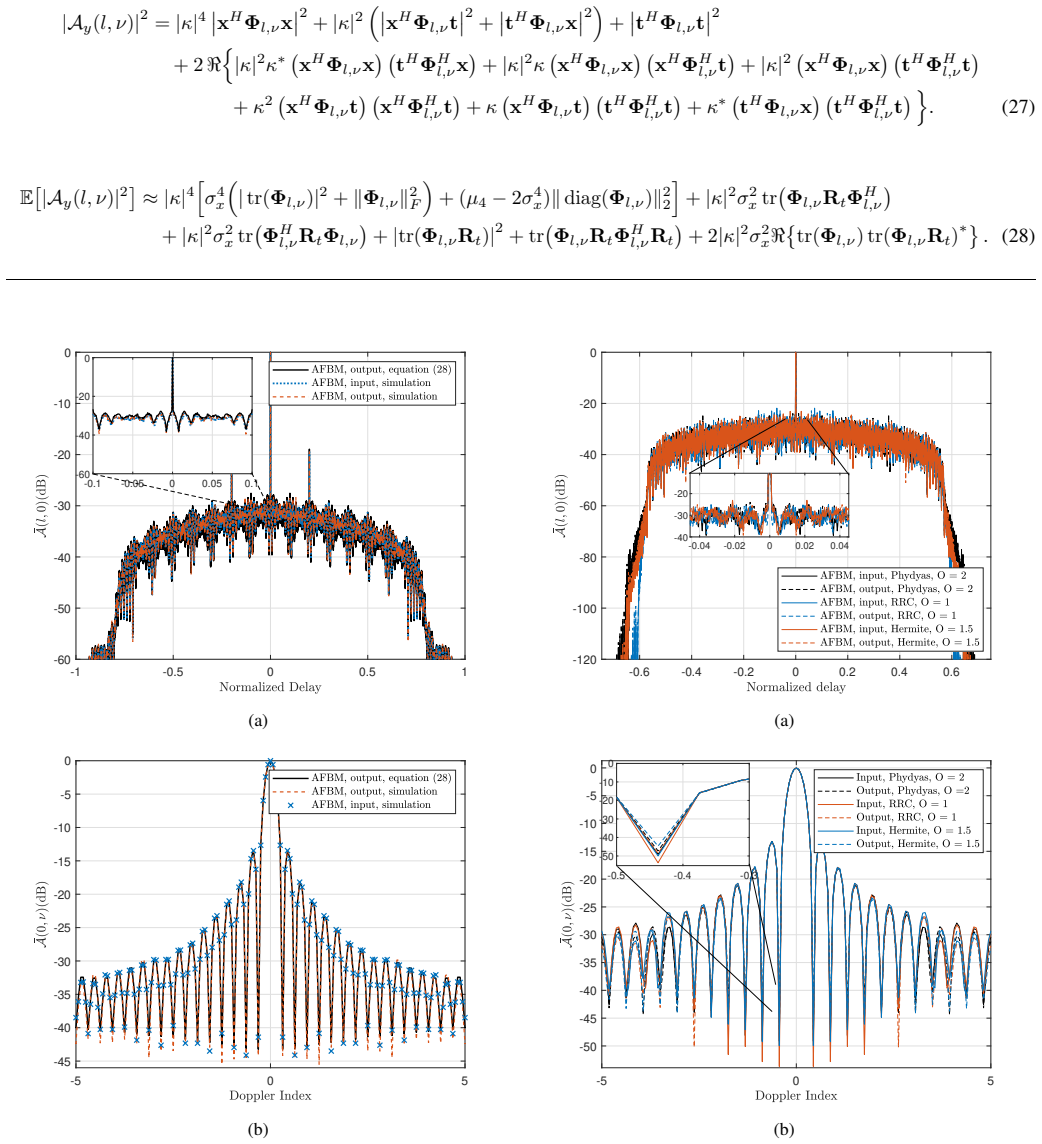
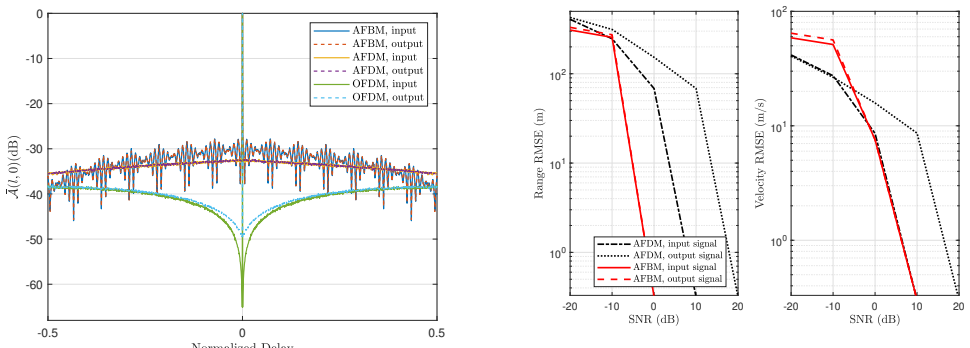
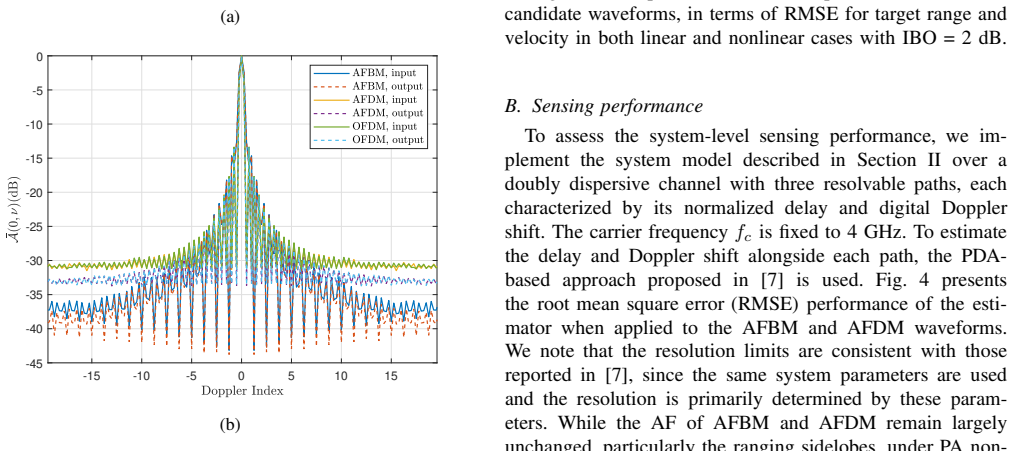
Analytical results reveal that the structure of the effective AFBM modulation matrix dictates how distortion propagates within the ambiguity function. Simulations demonstrate that both the AF and the overall sensing performance of AFBM remain insensitive to such nonlinearities.
What carries the argument
The effective AFBM modulation matrix, which dictates the propagation of distortion within the ambiguity function.
If this is right
- The ambiguity function of AFBM is largely unaffected by power amplifier nonlinearities.
- Sensing performance metrics for AFBM stay consistent despite hardware distortions.
- AFBM becomes viable for ISAC applications where high transmit power is needed but linear PAs are impractical.
- The robustness comes directly from the matrix structure rather than external mitigation.
Where Pith is reading between the lines
- Other modulation schemes with similar matrix structures might show comparable robustness to nonlinearities.
- Real-world hardware tests with actual power amplifiers could validate the simulation findings for AFBM.
- Waveform designers might prioritize matrix structures that limit distortion spread in future ISAC systems.
Load-bearing premise
The power amplifier nonlinearity model and the AFBM parameters selected accurately reflect conditions in practical integrated sensing and communications hardware.
What would settle it
Measuring a significant change in the ambiguity function or a drop in sensing accuracy when an AFBM waveform is transmitted through a nonlinear power amplifier.
Figures
read the original abstract
We investigate the impact of power amplifier (PA) nonlinearities on the sensing performance of affine filter bank modulation (AFBM). While AFBM offers several advantageous properties for integrated sensing and communications (ISAC) - including reduced out-of-band emission (OOBE), low peak-to-average power ratio (PAPR), and natural robustness to doubly-dispersive (DD) channel effects - mitigating waveform distortion typically requires highly linear PAs. This creates a fundamental contradiction with ISAC applications, which demand high transmit power for reliable sensing. Our analytical results reveal that the structure of the effective AFBM modulation matrix dictates how distortion propagates within the ambiguity function (AF). Furthermore, simulations demonstrate that both the AF and the overall sensing performance of AFBM remain remarkably insensitive to such nonlinearities. These findings highlight the robustness of AFBM, making it a highly viable candidate for practical ISAC deployments constrained by hardware impairments.
Editorial analysis
A structured set of objections, weighed in public.
Referee Report
Summary. The manuscript investigates the impact of power amplifier nonlinearities on affine filter bank modulation (AFBM) for integrated sensing and communications (ISAC). It claims that analytical results show the structure of the effective AFBM modulation matrix controls distortion propagation into the ambiguity function (AF), while simulations demonstrate that both the AF and overall sensing performance remain remarkably insensitive to such nonlinearities, positioning AFBM as robust for hardware-constrained ISAC deployments.
Significance. If the matrix-structure result and observed insensitivity hold, the work would be significant for ISAC waveform design: it directly addresses the tension between high transmit power needs for sensing and PA linearity constraints, potentially enabling practical operation without additional linearization. The explicit connection between modulation-matrix structure and AF distortion propagation, together with simulation validation of sensing metrics, provides a concrete, falsifiable contribution.
major comments (2)
- [analysis and simulation sections (abstract and § on PA model)] The specific PA nonlinearity model (e.g., memoryless polynomial order, coefficients, or inclusion of memory effects) is not stated with an equation or parameter values in the analysis or simulation sections; this is load-bearing because the propagation result and insensitivity claim depend on the exact form of the introduced distortion.
- [simulation results section] No sensitivity analysis or parameter sweep is reported for the AFBM filter-bank and modulation parameters (e.g., subcarrier spacing, prototype filter length) used in the derivations and Monte-Carlo runs; the central claim that the matrix structure dictates insensitivity therefore rests on a single, unvaried operating point whose representativeness for practical ISAC hardware is untested.
minor comments (2)
- [analysis section] Notation for the effective modulation matrix and the AF computation should be introduced with an explicit equation early in the analysis section to allow readers to follow the distortion-propagation argument without ambiguity.
- [figures] Figure captions for the AF plots and sensing-performance curves should include the exact PA model parameters and AFBM settings used, rather than referring only to 'the nonlinear case'.
Simulated Author's Rebuttal
We thank the referee for the constructive feedback. The comments highlight areas where additional detail will strengthen the manuscript. We address each major comment below and will revise accordingly.
read point-by-point responses
-
Referee: [analysis and simulation sections (abstract and § on PA model)] The specific PA nonlinearity model (e.g., memoryless polynomial order, coefficients, or inclusion of memory effects) is not stated with an equation or parameter values in the analysis or simulation sections; this is load-bearing because the propagation result and insensitivity claim depend on the exact form of the introduced distortion.
Authors: We agree that the PA model requires explicit specification. The current manuscript refers to power amplifier nonlinearities without providing the governing equation or parameter values. In the revised version, we will insert the exact memoryless polynomial model (including order and coefficients) used for both the analytical derivation of distortion propagation through the AFBM modulation matrix and the Monte-Carlo simulations. This addition will make the load-bearing assumptions transparent and reproducible. revision: yes
-
Referee: [simulation results section] No sensitivity analysis or parameter sweep is reported for the AFBM filter-bank and modulation parameters (e.g., subcarrier spacing, prototype filter length) used in the derivations and Monte-Carlo runs; the central claim that the matrix structure dictates insensitivity therefore rests on a single, unvaried operating point whose representativeness for practical ISAC hardware is untested.
Authors: The analytical result that the effective modulation matrix structure controls distortion propagation into the ambiguity function is derived without dependence on specific filter-bank parameters. However, the simulations are presented for one operating point, as noted. We will add a parameter sweep over subcarrier spacing and prototype filter length in the revised simulation section to confirm that the observed insensitivity holds across representative ISAC configurations. revision: partial
Circularity Check
No circularity: claims rest on independent analysis and simulations
full rationale
The paper derives its central claims from an analytical examination of how the effective AFBM modulation matrix structure governs distortion propagation into the ambiguity function, followed by Monte-Carlo simulations that quantify insensitivity under a stated PA nonlinearity model. No quoted step reduces by construction to a fitted parameter, self-referential definition, or load-bearing self-citation chain; the derivation chain remains self-contained against the chosen models and does not invoke uniqueness theorems or ansatzes imported from prior author work.
Axiom & Free-Parameter Ledger
axioms (1)
- domain assumption The structure of the effective AFBM modulation matrix dictates distortion propagation in the ambiguity function
Reference graph
Works this paper leans on
-
[1]
Joint radar and communication design: Applications, state-of-t he-art, and the road ahead,
F. Liu, C. Masouros, A. P . Petropulu, H. Griffiths, and L. H anzo, “Joint radar and communication design: Applications, state-of-t he-art, and the road ahead,” IEEE Transactions on Communications , vol. 68, no. 6, pp. 3834–3862, 2020
2020
-
[2]
Analysis of Non-li near Power Amplifier Effect and Digital Predistortion on OFDM Radar,
R. Feng, M. Bauduin, and A. Bourdoux, “Analysis of Non-li near Power Amplifier Effect and Digital Predistortion on OFDM Radar,” i n 2024 21st European Radar Conference (EuRAD) . IEEE, 2024, pp. 248–251
2024
-
[3]
Robustness of ISAC Waveforms to Power Amplifier Distor tion,
A. R. M. Ismail, M. Guenach, A. Sakhnini, A. Bourdouk, and H. Steen- dam, “Robustness of ISAC Waveforms to Power Amplifier Distor tion,” in 2024 IEEE 4th International Symposium on Joint Communicati ons & Sensing (JC&S) . IEEE, 2024, pp. 1–6
2024
-
[4]
In tegrated Sensing and Communication with Power Amplifier Impairment,
H. Akca, E. Memis ¸o˘ glu, H. A. C ¸ ırpan, and H. Arslan, “In tegrated Sensing and Communication with Power Amplifier Impairment, ” in 2024 6th International Conference on Communications, Signal Pr ocessing, and their Applications (ICCSPA) . IEEE, 2024, pp. 1–6
2024
-
[5]
On the ambiguity function of ofdm-based isac signals under non-id eal power amplifiers,
E. Gourar, Y . Medjahdi, L. Clavier, A. K. Gizzini, and P . S ondi, “On the ambiguity function of ofdm-based isac signals under non-id eal power amplifiers,” 2025. [Online]. Available: https://arxiv.or g/abs/2512.09803 1The validity of this approximation is supported by empirica l results, as shown in Section IV
-
[6]
H. S. Rou, G. T. F. De Abreu, J. Choi, D. Gonz´ alez, M. Kount ouris, Y . L. Guan, and O. Gonsa, “From orthogonal time–frequency sp ace to affine frequency-division multiplexing: A comparative stu dy of next- generation waveforms for integrated sensing and communica tions in doubly dispersive channels,” IEEE Signal Processing Magazine , vol. 41, no. 5, pp....
2024
-
[7]
Affine filter ban k modulation (afbm): A novel 6g isac waveform with low papr and oobe,
K. R. R. Ranasinghe, H. L. Senger, G. P . Gonc ¸alves, H. S. R ou, B. S. Chang, G. T. F. d. Abreu, and D. Le Ruyet, “Affine filter ban k modulation (afbm): A novel 6g isac waveform with low papr and oobe,” IEEE Transactions on Wireless Communications , vol. 25, pp. 12 754– 12 769, 2026
2026
-
[8]
Ambiguity function analysis of afdm signals for integrated sensing and communications,
H. Yin, Y . Tang, Y . Ni, Z. Wang, G. Chen, J. Xiong, K. Y ang, M. Kountouris, Y . L. Guan, and Y . Zeng, “Ambiguity function analysis of afdm signals for integrated sensing and communications,” IEEE Journal on Selected Areas in Communications , 2025
2025
-
[9]
On discrete ambiguity functions of random communication waveforms,
Y . Zhang, F. Liu, Y . Xiong, W. Y uan, S. Li, L. Zheng, T. X. Ha n, C. Masouros, and S. Jin, “On discrete ambiguity functions of random communication waveforms,” arXiv preprint arXiv:2512.08352 , 2025
-
[10]
Normalized ambiguity fun ction characteristics of ofdm, otfs, afdm, and cp-afdm for isac,
H. S. Rou and G. T. F. de Abreu, “Normalized ambiguity fun ction characteristics of ofdm, otfs, afdm, and cp-afdm for isac,” arXiv preprint arXiv:2510.11216, 2025
-
[11]
Ambiguity fun ction analysis of afdm under pulse-shaped random isac signaling,
Y . Ni, F. Liu, H. Yin, Y . Tang, and Z. Wang, “Ambiguity fun ction analysis of afdm under pulse-shaped random isac signaling, ” arXiv preprint arXiv:2511.04200, 2025
-
[12]
E. Bedeer, “Ambiguity function analysis of affine frequ ency division multiplexing for integrated sensing and communication,” arXiv preprint arXiv:2504.02582, 2025
-
[13]
MIMO-AFDM Outperforms MIMO-OFDM in the Face of Hardware Impairments
Z. Sui, Z. Liu, L. Musavian, Y . L. Guan, L.-L. Y ang, and L. Hanzo, “Mimo-afdm outperforms mimo-ofdm in the face of hardware im pair- ments,” arXiv preprint arXiv:2601.00502 , 2026
work page internal anchor Pith review Pith/arXiv arXiv 2026
-
[14]
Impact of pa nonlinearities on afdm sensing: A matched filtering per spective,
E. Gourar, Y . Medjahdi, L. Clavier, A. K. Gizzini, and P . Sondi, “Impact of pa nonlinearities on afdm sensing: A matched filtering per spective,” 2026
2026
-
[15]
AFDM: Evolving OFDM towards 6G+,
H. S. Rou, V . Savaux, Z. Sui, G. T. F. de Abreu, and Z. Liu, “ Afdm: Evolving ofdm towards 6g+,” arXiv preprint arXiv:2602.08163 , 2026
-
[16]
Affine frequency division multiple access based on daft spreading for next- generation wireless networks,
Y . Tao, M. Wen, Y . Ge, T. Mao, Y . Tang, and A. Doosti-Aref, “Affine frequency division multiple access based on daft spreading for next- generation wireless networks,” IEEE Transactions on Wireless Commu- nications, vol. 25, pp. 4626–4641, 2026
2026
-
[17]
Theoretical analysis of BER performance of nonlinearly amplified FBMC/OQAM and OFDM signals,
H. Bouhadda, H. Shaiek, D. Roviras, R. Zayani, Y . Medjah di, and R. Bouallegue, “Theoretical analysis of BER performance of nonlinearly amplified FBMC/OQAM and OFDM signals,” EURASIP Journal on Advances in Signal Processing , vol. 2014, no. 1, p. 60, 2014
2014
-
[18]
Circularly-symmetric gaussian rando m vectors,
R. G. Gallager, “Circularly-symmetric gaussian rando m vectors,” preprint, vol. 1, 2008
2008
-
[19]
Cp-ofdm achieves the lowest average ranging sidelobe unde r qam/psk constellations,
F. Liu, Y . Zhang, Y . Xiong, S. Li, W. Y uan, F. Gao, S. Jin, a nd G. Caire, “Cp-ofdm achieves the lowest average ranging sidelobe unde r qam/psk constellations,” IEEE Transactions on Information Theory , 2025
2025
-
[20]
Proper complex random pro cesses with applications to information theory,
F. D. Neeser and J. L. Massey, “Proper complex random pro cesses with applications to information theory,” IEEE transactions on information theory, vol. 39, no. 4, pp. 1293–1302, 1993
1993
discussion (0)
Sign in with ORCID, Apple, or X to comment. Anyone can read and Pith papers without signing in.