PAPEL: A Collaborative System for Parental Guidance during Preschool Play-Based English Learning
Pith reviewed 2026-06-27 08:30 UTC · model grok-4.3
The pith
PAPEL helps parents combine playful and instructional English during preschool play, leading to more integrated utterances and conversational turns than a basic chatbot.
A machine-rendered reading of the paper's core claim, the machinery that carries it, and where it could break.
Core claim
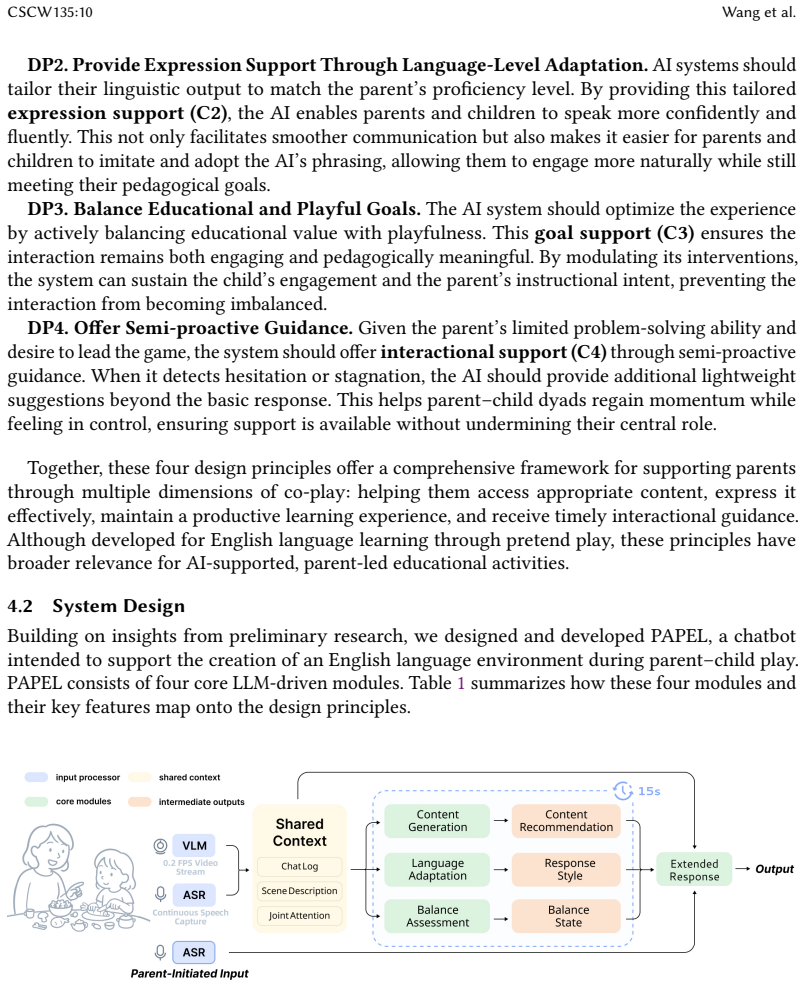
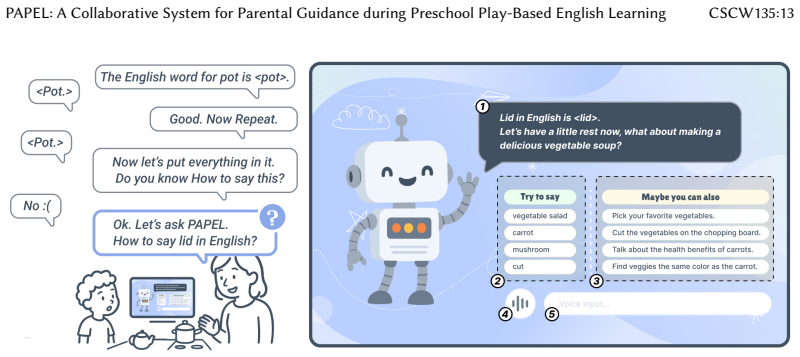
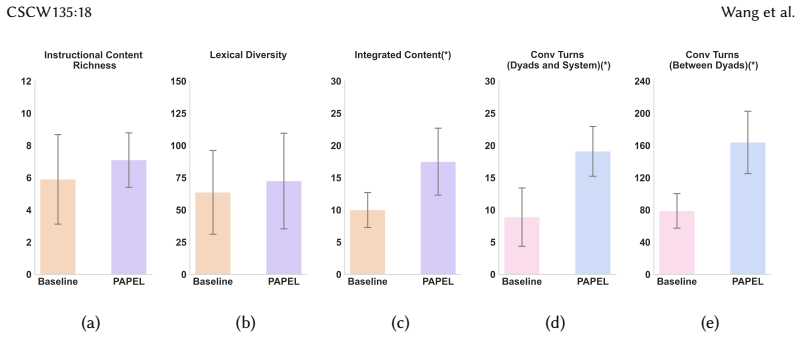
PAPEL, a parent-AI collaborative system that grounds suggestions in the ongoing play scene and organizes support into content generation, language adaptation, balance assessment, and extended response modules, was associated with more integrated parent utterances that combined playful and instructional content, as well as more parent-child conversational turns, than the lightweight chatbot baseline in a counterbalanced within-subjects study with 16 dyads.
What carries the argument
PAPEL's four core modules (content generation, language adaptation, balance assessment, and extended response) that ground AI suggestions in the current play scene to support parent guidance.
If this is right
- Parents receive real-time, scene-specific prompts that help blend play and language instruction.
- The system increases the number of parent-child exchanges during play sessions.
- Support is organized to address the four identified challenges of content selection, language expression, balance, and problem solving.
- The approach treats the parent as the primary guide while the AI supplies targeted assistance.
Where Pith is reading between the lines
- The same grounding technique could be tested with other home activities such as mealtime or bedtime routines.
- Similar module structures might support guidance in additional subjects like math or science during play.
- The design could be adapted for remote or asynchronous parent-child language practice.
Load-bearing premise
Observed differences in parent utterances and turns result from PAPEL's specific modules rather than the general presence of any AI assistance or effects of study participation.
What would settle it
A follow-up study in which parents use a generic AI chatbot without the four play-grounded modules and show no measurable rise in integrated utterances or conversational turns.
Figures
read the original abstract
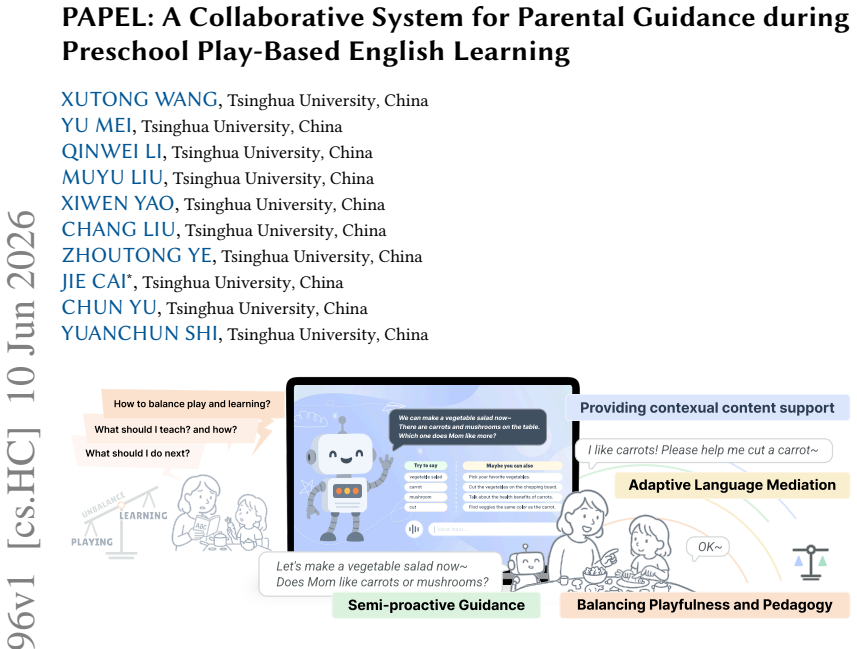
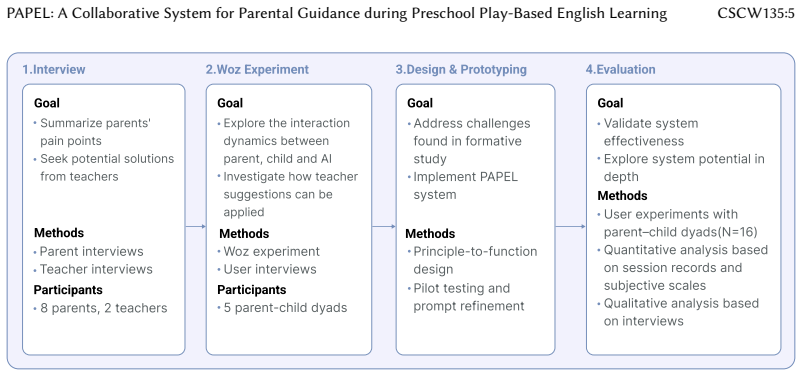
Play-based parent-child interaction offers preschoolers rich opportunities for everyday foreign language learning, yet many parents struggle to turn open-ended play into effective English-as-a-Foreign-Language (EFL) learning experiences at home. To explore how AI might support this process, we conducted formative studies through interviews and a Wizard-of-Oz study. We identified four key challenges: content selection, language expression, balancing instruction and play, and problem solving. To address these challenges, we present PAPEL, a parent-AI collaborative system that grounds suggestions in the ongoing play scene and organizes support into four core modules: content generation, language adaptation, balance assessment, and extended response. In a counterbalanced within-subjects study with 16 parent-child dyads, PAPEL was associated with more integrated parent utterances that combined playful and instructional content, as well as more parent-child conversational turns, than the lightweight chatbot baseline used in our study.
Editorial analysis
A structured set of objections, weighed in public.
Referee Report
Summary. The paper presents PAPEL, an AI-supported collaborative system for parents guiding preschoolers in play-based English-as-a-foreign-language learning. Formative interviews and a Wizard-of-Oz study identified four challenges (content selection, language expression, balancing instruction/play, problem solving), which are addressed via four modules (content generation, language adaptation, balance assessment, extended response) that ground suggestions in the ongoing play scene. A counterbalanced within-subjects study with 16 parent-child dyads reports that PAPEL produced more integrated parent utterances (combining playful and instructional content) and more conversational turns than a lightweight chatbot baseline.
Significance. If the reported associations hold after addressing design and reporting issues, the work contributes to HCI research on AI for family-based language learning by showing how scene-grounded, modular support can shift parent behavior toward more integrated interactions. The formative-to-evaluation pipeline and focus on parent-child conversational metrics are strengths that could inform future systems in educational technology.
major comments (2)
- [Abstract] Abstract: the counterbalanced within-subjects study (n=16 dyads) compares PAPEL only to a lightweight chatbot baseline; because both conditions supply AI assistance, the observed increases in integrated utterances and conversational turns cannot be attributed specifically to the four modules rather than to the general presence of structured AI suggestions.
- [Abstract] Abstract: the manuscript provides no details on the utterance-coding scheme, inter-rater reliability, statistical tests (including handling of order effects in the counterbalanced design), effect sizes, or power analysis, which are required to evaluate whether the data support the central claim given the small sample.
Simulated Author's Rebuttal
We thank the referee for their thoughtful comments on our work. We provide point-by-point responses to the major comments and indicate where revisions will be made.
read point-by-point responses
-
Referee: [Abstract] Abstract: the counterbalanced within-subjects study (n=16 dyads) compares PAPEL only to a lightweight chatbot baseline; because both conditions supply AI assistance, the observed increases in integrated utterances and conversational turns cannot be attributed specifically to the four modules rather than to the general presence of structured AI suggestions.
Authors: The baseline condition was a lightweight chatbot that provided general responses without the scene-grounded modules or the four specific features of PAPEL. Our intention was to compare the complete system against a minimal AI assistance baseline to highlight the benefits of the modular, play-scene grounded approach. We recognize that this does not allow attribution to individual modules, and we will clarify this in the revised manuscript by elaborating on the baseline design and discussing it as a limitation. This does not change our central claim about the PAPEL system as a whole. revision: partial
-
Referee: [Abstract] Abstract: the manuscript provides no details on the utterance-coding scheme, inter-rater reliability, statistical tests (including handling of order effects in the counterbalanced design), effect sizes, or power analysis, which are required to evaluate whether the data support the central claim given the small sample.
Authors: We will revise the abstract to include a concise description of the utterance coding scheme, inter-rater reliability, the statistical tests used (including counterbalancing for order effects), and effect sizes. A power analysis was not performed given the small sample and exploratory nature of the study; we will note this as a limitation in the discussion section. revision: yes
Circularity Check
Empirical user study with no derivation chain or fitted predictions
full rationale
The paper describes formative interviews and a Wizard-of-Oz study to identify challenges, then presents a system (PAPEL) with four modules, followed by a counterbalanced within-subjects evaluation (n=16 dyads) comparing outcomes to a baseline chatbot. No equations, first-principles derivations, parameter fitting, or predictions are present. Outcomes are observed metrics from the study design itself, not reductions of any claimed result to prior inputs by construction. Self-citations (if any) are not load-bearing for a central mathematical claim. This is a standard HCI system paper whose central claims rest on external empirical data collection rather than internal self-reference.
Axiom & Free-Parameter Ledger
Reference graph
Works this paper leans on
-
[1]
SuperCLUE Chinese Language Understanding Evaluation
2025. SuperCLUE Chinese Language Understanding Evaluation. https://www.superclueai.com. Accessed: 2025-09-15
2025
-
[2]
Basawapatna, Alexander Repenning, Kyu Han Koh, and Hilarie Nickerson
Ashok R. Basawapatna, Alexander Repenning, Kyu Han Koh, and Hilarie Nickerson. 2013. The zones of proximal flow: guiding students through a space of computational thinking skills and challenges. InProceedings of the Ninth Annual International ACM Conference on International Computing Education Research(San Diego, San California, USA) (ICER ’13). Associati...
-
[3]
B. J. Biddle. 1986. Recent Developments in Role Theory.Annual Review of Sociology12, Volume 12, 1986 (1986), 67–92. doi:10.1146/annurev.so.12.080186.000435
-
[4]
Virginia Braun and Victoria Clarke. 2006. Using thematic analysis in psychology.Qualitative Research in Psychology 3, 2 (2006), 77–101. arXiv:https://doi.org/10.1191/1478088706qp063oa doi:10.1191/1478088706qp063oa
-
[5]
Thomas Breideband, Jeffrey Bush, Chelsea Chandler, Michael Chang, Rachel Dickler, Peter Foltz, Ananya Ganesh, Rachel Lieber, William R. Penuel, Jason G. Reitman, John Weatherley, and Sidney D’Mello. 2023. The Com- munity Builder (CoBi): Helping Students to Develop Better Small Group Collaborative Learning Skills. InCom- panion Publication of the 2023 Conf...
-
[6]
Jarmila Bubikova-Moan, Hanne Næss Hjetland, and Sabine Wollscheid. 2019. ECE teachers’ views on play-based learning: A systematic review.European early childhood education research journal27, 6 (2019), 776–800
2019
-
[7]
Cucuk Wawan Budiyanto, Faaizah Shahbodin, Muhammad Ulin Khoirul Umam, Ratih Isnaini, Anayanti Rahmawati, and Indah Widiastuti. 2021. Developing Computational Thinking Ability in Early Childhood Education: The Influence of Programming Toy on Parent-Children Engagement.Online Submission5, 1 (2021), 19–25
2021
-
[8]
Yuko Goto Butler. 2015. English language education among young learners in East Asia: A review of current research (2004–2014).Language teaching48, 3 (2015), 303–342. Proc. ACM Hum.-Comput. Interact., Vol. 10, No. 6, Article CSCW135. Publication date: October 2026. CSCW135:28 Wang et al
2015
-
[9]
Krista Byers-Heinlein and Casey Lew-Williams. 2013. Bilingualism in the early years: What the science says.LEARNing landscapes7, 1 (2013), 95
2013
-
[10]
Bengisu Cagiltay and Bilge Mutlu. 2024. Toward family-robot interactions: A family-centered framework in hri. In Proceedings of the 2024 ACM/IEEE International Conference on Human-Robot Interaction. 76–85
2024
-
[11]
Su Cai and Man Xue. 2023. A Case Study Using Augmented Reality-based Scratch Games in English Learning for Preschool Children. InProceedings of the 2023 6th International Conference on Big Data and Education. 59–66
2023
-
[12]
Meng-Ying Chan, Yi-Hsuan Lin, Long-Fei Lin, Ting-Wei Lin, Wei-Che Hsu, Chia-yu Chang, Rui Liu, Ko-Yu Chang, Min-hua Lin, and Jane Yung-jen Hsu. 2017. WAKEY: assisting parent-child communication for better morning routines. InProceedings of the 2017 ACM Conference on Computer Supported Cooperative Work and Social Computing. 2287–2299
2017
-
[13]
Huili Chen, Yubin Kim, Kejia Patterson, Cynthia Breazeal, and Hae Won Park. 2025. Social robots as conversational catalysts: Enhancing long-term human-human interaction at home.Science Robotics10, 100 (2025), eadk3307. doi:10.1126/scirobotics.adk3307
-
[14]
Huili Chen, Anastasia K Ostrowski, Soo Jung Jang, Cynthia Breazeal, and Hae Won Park. 2022. Designing long-term parent-child-robot triadic interaction at home through lived technology experiences and interviews. In2022 31st IEEE International Conference on Robot and Human Interactive Communication (RO-MAN). IEEE, 401–408
2022
-
[15]
Jiaju Chen, Yuxuan Lu, Shao Zhang, Bingsheng Yao, Yuanzhe Dong, Ying Xu, Yunyao Li, Qianwen Wang, Dakuo Wang, and Yuling Sun. 2024. Storysparkqa: Expert-annotated qa pairs with real-world knowledge for children’s story-based learning. InProceedings of the 2024 Conference on Empirical Methods in Natural Language Processing. 17351–17370
2024
-
[16]
Jiaju Chen, Minglong Tang, Yuxuan Lu, Bingsheng Yao, Elissa Fan, Xiaojuan Ma, Ying Xu, Dakuo Wang, Yuling Sun, and Liang He. 2025. Characterizing LLM-Empowered Personalized Story Reading and Interaction for Children: Insights From Multi-Stakeholder Perspectives. InProceedings of the 2025 CHI Conference on Human Factors in Computing Systems (CHI ’25). ACM,...
-
[17]
Kun-Hung Cheng and Chin-Chung Tsai. 2014. Children and parents’ reading of an augmented reality picture book: Analyses of behavioral patterns and cognitive attainment.Computers & Education72 (2014), 302–312
2014
-
[18]
Dasom Choi, SoHyun Park, Kyungah Lee, Hwajung Hong, and Young-Ho Kim. 2024. AACessTalk: Fostering Communication between Minimally Verbal Autistic Children and Parents with Contextual Guidance and Card Recommendation.arXiv preprint arXiv:2409.09641(2024)
arXiv 2024
-
[19]
Eliška Cigánová and Simone Kriglstein. 2025. Engaging Users Through Play: Exploring Interactive Methods for Collecting Feedback in HCI. InProceedings of the Extended Abstracts of the CHI Conference on Human Factors in Computing Systems (CHI EA ’25). Association for Computing Machinery, New York, NY, USA, Article 220, 7 pages. doi:10.1145/3706599.3719765
-
[20]
Laura Elena Ciolan. 2013. Play to learn, Learn to play. Creating better opportunities for learning in early childhood. Procedia-Social and Behavioral Sciences76 (2013), 186–189
2013
-
[21]
Victoria Clarke and Virginia Braun. 2017. Thematic analysis.The journal of positive psychology12, 3 (2017), 297–298
2017
-
[22]
Sabrina L Connell, Alexis R Lauricella, and Ellen Wartella. 2015. Parental co-use of media technology with their young children in the USA.Journal of children and media9, 1 (2015), 5–21
2015
-
[23]
Stephanie J. Creary and Judith R. Gordon. 2016.Role Conflict, Role Overload, and Role Strain. John Wiley & Sons, Ltd, 1–6. arXiv:https://onlinelibrary.wiley.com/doi/pdf/10.1002/9781119085621.wbefs012 doi:10.1002/9781119085621.wbefs012
-
[24]
Kyle Diederich, Flannery Hope Currin, Kaitlyn Blasi, Allyson Dale Schmidt, Holly David, Kerry Peterman, and Juan Pablo Hourcade. 2024. Changing the dynamics of preschool children’s social play with technology: evaluation of technology-based supports for tools of the mind style play.Behaviour & Information Technology43, 8 (2024), 1554–1579
2024
-
[25]
Griffin Dietz Smith, Siddhartha Prasad, Matt J Davidson, Leah Findlater, and R Benjamin Shapiro. 2024. ContextQ: Generated Questions to Support Meaningful Parent-Child Dialogue While Co-Reading. InProceedings of the 23rd Annual ACM Interaction Design and Children Conference. 408–423
2024
-
[26]
A Anne Dorathy and SN Mahalakshmi. 2011. Second language acquisition through task-based approach–role-play in English language teaching.English for specific purposes world11, 33 (2011), 1–7
2011
-
[27]
John Driscoll, Yulin Chen, Viki Shi, Izak Vucharatavintara, Yaxing Yao, and Haojian Jin. 2026. Understanding Parents’ Desires in Moderating Children’s Interactions with GenAI Chatbots through LLM-Generated Probes. InProceedings of the 2026 CHI Conference on Human Factors in Computing Systems (CHI ’26). Association for Computing Machinery, New York, NY, US...
-
[28]
Stefania Druga, Thomas Ball, and Amy Ko. 2022. How families design and program games: a qualitative analysis of a 4-week online in-home study. InProceedings of the 21st Annual ACM Interaction Design and Children Conference. 237–252. Proc. ACM Hum.-Comput. Interact., Vol. 10, No. 6, Article CSCW135. Publication date: October 2026. PAPEL: A Collaborative Sy...
2022
-
[29]
WITHIN EARLY. 2009. Behavioural differences exhibited by children when practising a task under formal and playful conditions.Play and learning in educational settings26, 2 (2009), 31
2009
-
[30]
Susan Edwards. 2017. Play-based Learning and Intentional Teaching: Forever Different?Australasian Journal of Early Childhood42, 2 (2017), 4–11. arXiv:https://doi.org/10.23965/AJEC.42.2.01 doi:10.23965/AJEC.42.2.01
-
[31]
Susan Edwards and Amy Cutter-Mackenzie. 2013. Pedagogical Play Types: What Do They Suggest for Learning About Sustainability in Early Childhood Education?International Journal of Early Childhood45, 3 (Nov 2013), 327–346. doi:10.1007/s13158-013-0082-5
-
[32]
2009.Code-switching
Penelope Gardner-Chloros. 2009.Code-switching. Cambridge university press
2009
-
[33]
Kenneth R Ginsburg, Committee on Communications, Committee on Psychosocial Aspects of Child, and Family Health. 2007. The importance of play in promoting healthy child development and maintaining strong parent-child bonds.Pediatrics119, 1 (2007), 182–191
2007
-
[34]
Jean Berko Gleason. 1973. Code switching in children’s language.Cognitive development and acquisition of language (1973), 159–167
1973
-
[35]
Xinning Gui, Yao Li, and Yanlai Wu. 2021. Teacher-Guardian Collaboration for Emergency Remote Learning in the COVID-19 Crisis.Proc. ACM Hum.-Comput. Interact.5, CSCW2, Article 399 (Oct. 2021), 26 pages. doi:10.1145/3479543
-
[36]
Ewa Guz. 2016. Learning a foreign language through play.Roczniki Humanistyczne64, 11 (2016), 41–52
2016
-
[37]
Omer Gvirsman, Yaacov Koren, Tal Norman, and Goren Gordon. 2020. Patricc: A platform for triadic interaction with changeable characters. InProceedings of the 2020 ACM/IEEE International Conference on Human-robot Interaction. 399–407
2020
-
[38]
Sandra G. Hart and Lowell E. Staveland. 1988. Development of NASA-TLX (Task Load Index): Results of Empirical and Theoretical Research. InHuman Mental Workload, Peter A. Hancock and Najmedin Meshkati (Eds.). Advances in Psychology, Vol. 52. North-Holland, 139–183. doi:10.1016/S0166-4115(08)62386-9
-
[39]
Kunlei He, Julian Levine, Kelsyann Cervera, Santiago Ojeda-Ramirez, Ying Xu, and Mark Warschauer. 2024. A Home Study of Parent-Child Co-Reading with a Bilingual Conversational Agent. InExtended Abstracts of the CHI Conference on Human Factors in Computing Systems(Honolulu, HI, USA)(CHI EA ’24). Association for Computing Machinery, New York, NY, USA, Artic...
-
[40]
Alexis Hiniker, Bongshin Lee, Julie A Kientz, and Jenny S Radesky. 2018. Let’s play! Digital and analog play between preschoolers and parents. InProceedings of the 2018 CHI conference on human factors in computing systems. 1–13
2018
-
[41]
Alexis Hiniker, Sarita Y Schoenebeck, and Julie A Kientz. 2016. Not at the dinner table: Parents’ and children’s perspectives on family technology rules. InProceedings of the 19th ACM conference on computer-supported cooperative work & social computing. 1376–1389
2016
-
[42]
Kathy Hirsh-Pasek. 2009. A mandate for playful learning in preschool: Applying the scientific evidence. (2009)
2009
-
[43]
Kathy Hirsh-Pasek, Lauren B Adamson, Roger Bakeman, Margaret Tresch Owen, Roberta Michnick Golinkoff, Amy Pace, Paula KS Yust, and Katharine Suma. 2015. The contribution of early communication quality to low-income children’s language success.Psychological science26, 7 (2015), 1071–1083
2015
-
[44]
2004.Einstein never used flash cards: How our children really learn–and why they need to play more and memorize less
Kathy Hirsh-Pasek, Roberta Michnick Golinkoff, and Diane Eyer. 2004.Einstein never used flash cards: How our children really learn–and why they need to play more and memorize less. Rodale Books
2004
-
[45]
It’s Not a Replacement:
Hui-Ru Ho, Edward M Hubbard, and Bilge Mutlu. 2024. " It’s Not a Replacement:" Enabling Parent-Robot Collaboration to Support In-Home Learning Experiences of Young Children. InProceedings of the 2024 CHI Conference on Human Factors in Computing Systems. 1–18
2024
-
[46]
Hui-Ru Ho, Nitigya Kargeti, Ziqi Liu, and Bilge Mutlu. 2025. SET-PAiREd: Designing for Parental Involvement in Learning with an AI-Assisted Educational Robot. InProceedings of the 2025 CHI Conference on Human Factors in Computing Systems (CHI ’25). Association for Computing Machinery, New York, NY, USA, Article 1040, 20 pages. doi:10.1145/3706598.3713330
-
[47]
Hui-Ru Ho, Nathan Thomas White, Edward M Hubbard, and Bilge Mutlu. 2023. Designing Parent-child-robot Interactions to Facilitate In-Home Parental Math Talk with Young Children. InProceedings of the 22nd Annual ACM Interaction Design and Children Conference. 355–366
2023
-
[48]
2009.Children, play, and development
Fergus P Hughes. 2009.Children, play, and development. Sage
2009
-
[49]
Lixian Jin and Martin Cortazzi. 2018. Early English language learning in East Asia. InThe Routledge handbook of teaching English to young learners. Routledge, 477–492
2018
-
[50]
Grabell, and Deepak Ganesan
Manasa Kalanadhabhatta, Mohammad Mehdi Rastikerdar, Tauhidur Rahman, Adam S. Grabell, and Deepak Ganesan
-
[51]
Playlogue: Dataset and Benchmarks for Analyzing Adult-Child Conversations During Play.Proc. ACM Interact. Mob. Wearable Ubiquitous Technol.8, 4, Article 173 (Nov. 2024), 34 pages. doi:10.1145/3699775
-
[52]
Michail Kalogiannakis, Maria Ampartzaki, Stamatios Papadakis, and Evangelia Skaraki. 2018. Teaching natural science concepts to young children with mobile devices and hands-on activities. A case study.International Journal of Teaching and Case Studies9, 2 (2018), 171–183. Proc. ACM Hum.-Comput. Interact., Vol. 10, No. 6, Article CSCW135. Publication date:...
2018
-
[53]
Hideki Kozima. 2023. Communication as joint prediction: A case study of robot-mediated pretend play with children at a kindergarten. In2023 32nd IEEE International Conference on Robot and Human Interactive Communication (RO-MAN). IEEE, 1216–1221
2023
-
[54]
Taeahn Kwon, Minkyung Jeong, Eon-Suk Ko, and Youngki Lee. 2022. Captivate! contextual language guidance for parent–child interaction. InProceedings of the 2022 CHI Conference on Human Factors in Computing Systems. 1–17
2022
-
[55]
Yi Chen Dora Lan, Jane Torr, and Sheila Degotardi. 2011. Learning English as a foreign language at home: The practices of Taiwanese mothers and their preschoolers.Journal of modern education review1, 1 (2011), 10–21
2011
-
[56]
J Richard Landis and Gary G. Koch. 1977. The measurement of observer agreement for categorical data.Biometrics33 1 (1977), 159–74. https://api.semanticscholar.org/CorpusID:11077516
1977
-
[57]
Cheuk Yin Phipson Lee, Zhuohao Zhang, Jaylin Herskovitz, JooYoung Seo, and Anhong Guo. 2022. Collabally: Accessible collaboration awareness in document editing. InProceedings of the 2022 CHI Conference on Human Factors in Computing Systems. 1–17
2022
-
[58]
Jungeun Lee, Suwon Yoon, Kyoosik Lee, Eunae Jeong, Jae-Eun Cho, Wonjeong Park, Dongsun Yim, and Inseok Hwang
-
[59]
InProceedings of the 2024 CHI Conference on Human Factors in Computing Systems
Open sesame? Open salami! Personalizing vocabulary assessment-intervention for children via pervasive profiling and bespoke storybook generation. InProceedings of the 2024 CHI Conference on Human Factors in Computing Systems. 1–32
2024
-
[60]
Ming-Chaun Li, Chin-Chung Tsai, and Huei-Tse Hou. 2024. Parent-Child Interaction in Game-Based Learning. In 2024 16th IIAI International Congress on Advanced Applied Informatics (IIAI-AAI). IEEE, 172–177
2024
-
[61]
Miller, Erin Brady, and Karl F
Chaolan Lin, Selma Šabanović, Lynn Dombrowski, Andrew D. Miller, Erin Brady, and Karl F. MacDorman. 2021. Parental Acceptance of Children’s Storytelling Robots: A Projection of the Uncanny Valley of AI.Frontiers in Robotics and AI8 (May 2021), 579993. doi:10.3389/frobt.2021.579993 Copyright©2021 Lin, Šabanović, Dombrowski, Miller, Brady and MacDorman
-
[62]
Xunyi Lin and Hui Li. 2020. Parents’ play beliefs and engagement in young children’s play at home. InWorking with Parents and Families in Early Childhood Education. Routledge, 5–20
2020
-
[63]
Ya-Fang Lin, Na Li, Wan-Hsuan Huang, Karen Ecsedy, Mark E. Feinberg, Douglas Teti, and John M. Carroll. 2024. "Ultimately We’re Together": Understanding New Parents’ Experiences of Co-parenting.Proc. ACM Hum.-Comput. Interact.8, CSCW2, Article 479 (Nov. 2024), 25 pages. doi:10.1145/3687018
-
[64]
Ya-Fang Lin, Xiaotian Li, Wan-Hsuan Huang, Charan Pushpanathan Prabavathi, Jie Cai, and John M. Carroll. 2025. Parental Collaboration and Closeness: Envisioning with New Couple Parents. InProceedings of the 2025 ACM Designing Interactive Systems Conference (DIS ’25). Association for Computing Machinery, New York, NY, USA, 2637–2651. doi:10.1145/3715336.3735837
-
[65]
Di Liu, Zhenhao Zhang, Zhuoyi Zhang, Yufei Hu, Keming Jiao, Xueliang Li, and Pengcheng An. 2026. DOLLama: Fostering Family Anti-Bullying Learning through AI-Augmented, Toy-Mediated Educational Drama. InProceedings of the 2026 CHI Conference on Human Factors in Computing Systems (CHI ’26). Association for Computing Machinery, New York, NY, USA, Article 94,...
-
[66]
Yujia Liu, Siyu Zha, Yuewen Zhang, Yanjin Wang, Yangming Zhang, Qi Xin, Lun Yiu Nie, Chao Zhang, and Yingqing Xu. 2025. BrickSmart: Leveraging Generative AI to Support Children’s Spatial Language Learning in Family Block Play. InProceedings of the 2025 CHI Conference on Human Factors in Computing Systems. 1–19
2025
-
[67]
Marta Łockiewicz, Zuzanna Sarzała-Przybylska, and Małgorzata Lipowska. 2018. Early predictors of learning a foreign language in pre-school–Polish as a first language, English as a foreign language.Frontiers in Psychology9 (2018), 1813
2018
-
[68]
Duri Long, Anthony Teachey, and Brian Magerko. 2022. Family learning talk in AI literacy learning activities. In Proceedings of the 2022 CHI Conference on Human Factors in Computing Systems. 1–20
2022
-
[69]
Vivek Mannava, Alex Mitrevski, and Paul G Plöger. 2024. Exploring the Suitability of Conversational AI for Child- Robot Interaction. In2024 33rd IEEE International Conference on Robot and Human Interactive Communication (ROMAN). IEEE, 1821–1827
2024
-
[70]
2014.The excellence of play
Janet Moyles. 2014.The excellence of play. McGraw-Hill Education (UK)
2014
-
[71]
Tim Naglé, Scott Bateman, and Max V Birk. 2021. Pathfinder: The behavioural and motivational effects of collectibles in gamified software training.Proceedings of the ACM on Human-Computer Interaction5, CHI PLAY (2021), 1–23
2021
-
[72]
Sarah Nikkhah, Swaroop John, Krishna Supradeep Yalamarti, Emily L. Mueller, and Andrew D. Miller. 2021. Helping Their Child, Helping Each Other: Parents’ Mediated Social Support in the Children’s Hospital. InCompanion Publication of the 2021 Conference on Computer Supported Cooperative Work and Social Computing(Virtual Event, USA)(CSCW ’21 Companion). Ass...
-
[73]
Mueller, and Andrew D
Sarah Nikkhah, Akash Uday Rode, Neha Keshav Kulkarni, Priyanjali Mittal, Emily L. Mueller, and Andrew D. Miller
-
[74]
Family Resilience in Care Coordination Technologies: Designing for Families as Adaptive Systems.Proc. ACM Hum.-Comput. Interact.8, CSCW2, Article 459 (Nov. 2024), 28 pages. doi:10.1145/3686998 Proc. ACM Hum.-Comput. Interact., Vol. 10, No. 6, Article CSCW135. Publication date: October 2026. PAPEL: A Collaborative System for Parental Guidance during Presch...
-
[75]
Fatma Ceren Ön and Asim Ari. 2024. Examining Parents’ Views on Parental Involvement in Preschool English Teaching.Anatolian Journal of Education9, 2 (2024), 17–28
2024
-
[76]
Keunwoo Park, Subin Ahn, Mina Jung, You Jung Cho, Seulah Jeong, and Cheong-Ah Huh. 2024. Limitations of Online Play Content for Parents of Infants and Toddlers.arXiv preprint arXiv:2411.15783(2024)
arXiv 2024
-
[77]
Ruth A Piker. 2013. Understanding influences of play on second language learning: A microethnographic view in one Head Start preschool classroom.Journal of Early Childhood Research11, 2 (2013), 184–200
2013
-
[78]
Danijela Prošić-Santovac and Vera Savić. 2020. English as a foreign language in early language education.Handbook of early language education(2020), 1–26
2020
-
[79]
Shuang Quan, Yao Du, and Yi Ding. 2024. Young Children and ChatGPT: Parents’ Use of ChatGPT in Parenting. In Extended Abstracts of the CHI Conference on Human Factors in Computing Systems(Honolulu, HI, USA)(CHI EA ’24). Association for Computing Machinery, New York, NY, USA, Article 378, 7 pages. doi:10.1145/3613905.3650880
-
[80]
Richard M Ryan and Edward L Deci. 2000. Self-determination theory and the facilitation of intrinsic motivation, social development, and well-being.American psychologist55, 1 (2000), 68
2000
discussion (0)
Sign in with ORCID, Apple, or X to comment. Anyone can read and Pith papers without signing in.