Quantum tidal locking in orbiting Bose-Einstein condensates
Pith reviewed 2026-06-27 07:44 UTC · model grok-4.3
The pith
Orbiting Bose-Einstein condensates develop quantum tidal locking as geometric squeezing synchronizes their internal rotation with orbital motion.
A machine-rendered reading of the paper's core claim, the machinery that carries it, and where it could break.
Core claim
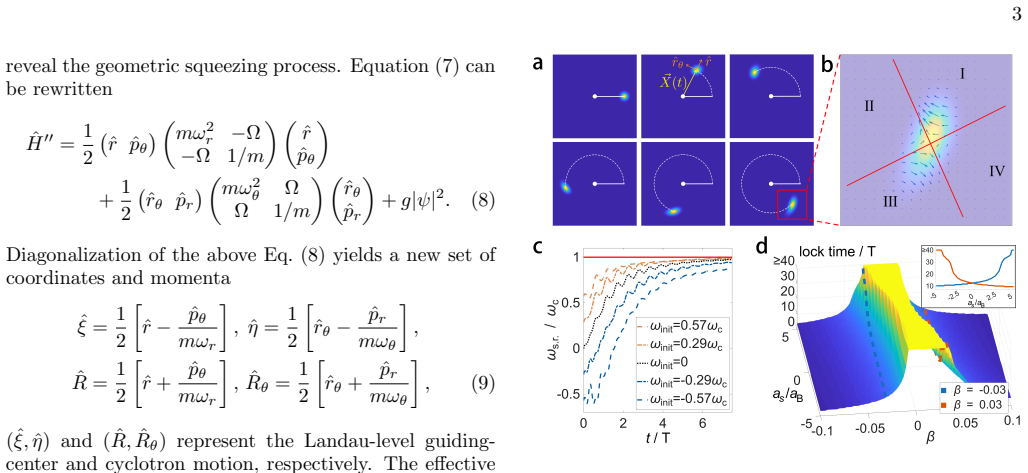
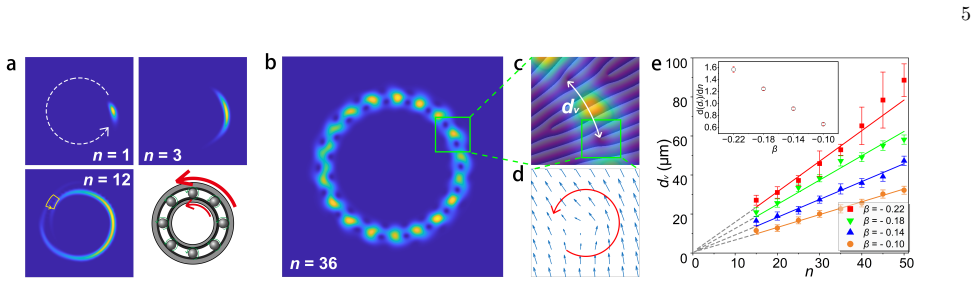
The central claim is that quantum tidal locking emerges in Bose-Einstein condensates undergoing central-force motion in an anharmonic potential. The condensate follows a well-defined orbital trajectory and experiences an effective rotating potential induced by the trap anharmonicity. Sustained geometric squeezing continuously deforms the condensate and drives a self-organized synchronization in which intrinsic rotation gradually locks to the orbital motion. Numerical simulations further show that the coherent evolution during locking produces a ring-shaped vortex array over longer timescales. The findings establish quantum tidal locking as a robust self-organized mechanism for generating and
What carries the argument
The effective rotating potential induced by trap anharmonicity, which generates sustained geometric squeezing that deforms the condensate and enforces synchronization between intrinsic rotation and orbital motion.
If this is right
- The locking process stabilizes circulating states in the condensate without external torques or dissipation.
- Over longer timescales the coherent rotating matter wave evolves into a ring-shaped vortex array.
- Quantum tidal locking provides a self-organized route to generating and maintaining angular momentum in mesoscopic quantum fluids.
- The synchronization occurs through geometric deformation alone and therefore persists in the absence of explicit damping mechanisms.
Where Pith is reading between the lines
- The same geometric mechanism could be tested in other trapped quantum gases by tuning trap anharmonicity and measuring rotation-orbit frequency matching.
- Vortex-array formation may feed back on the locking stability, suggesting a possible route to collective modes not explored in the present work.
- The absence of required dissipation raises the question whether similar locking appears in non-dissipative classical fluid analogs under anharmonic confinement.
Load-bearing premise
The trap anharmonicity produces a sustained effective rotating potential that induces continuous geometric squeezing sufficient to drive the locking dynamics without requiring explicit dissipation or external torques.
What would settle it
A simulation or experiment in which anharmonicity is removed (purely harmonic trap) shows that the condensate's rotation rate does not approach the orbital frequency over time.
Figures
read the original abstract
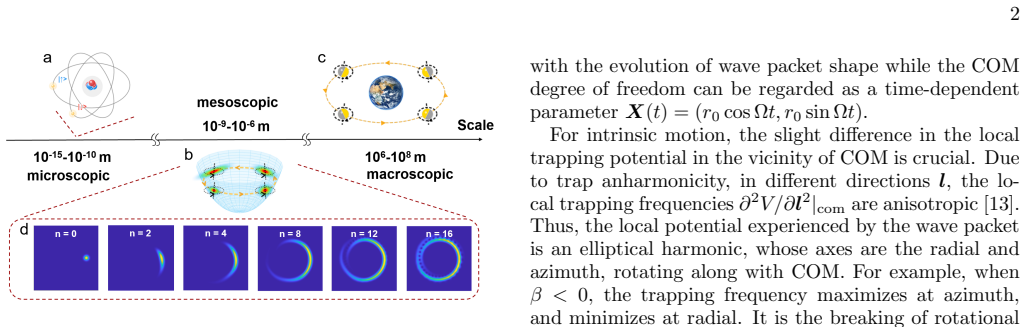
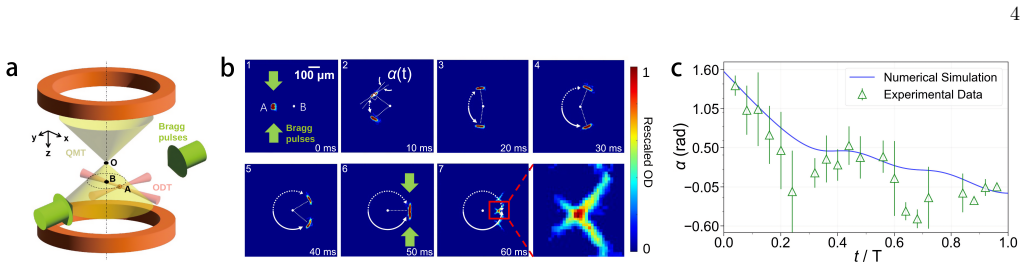
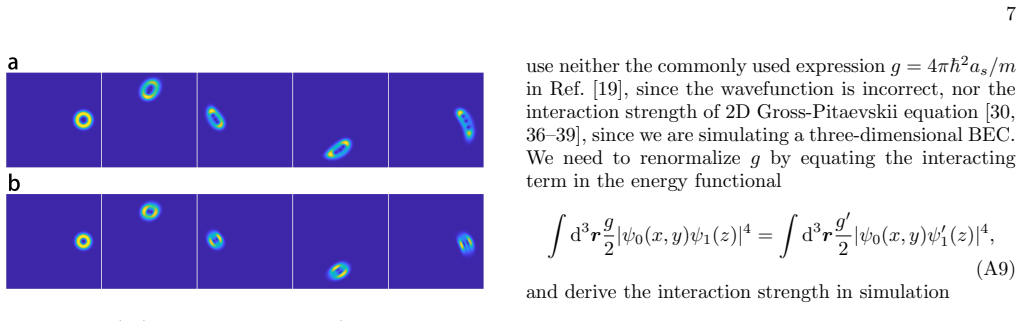
Angular momentum coupling manifests widely in diverse physical systems, underpinning the emergent properties and collective dynamics across different scales. The tidal locking, which originates from the synchronization of rotational and orbital motions, has far-reaching impacts in celestial mechanics, reflecting fundamental processes of angular momentum transfer, energy dissipation, and evolution toward dynamical equilibrium. However, its counterpart in mesoscopic quantum fluids has remained largely unexplored. Here we demonstrate the emergence of quantum tidal locking in Bose-Einstein condensates undergoing central force motion in an anharmonic potential. The condensate follows a well-defined orbital trajectory in a static trap and experiences an effective rotating potential induced by the trap anharmonicity. The sustained geometric squeezing continuously deforms the condensate and drives a self-organized synchronization process, in which the intrinsic rotation gradually locks to the orbital motion. Numerical simulations further reveal the formation of a ring-shaped vortex array over longer timescales, arising from the coherent evolution of the rotating matter wave during the locking dynamics. Our findings establish quantum tidal locking in mesoscopic systems as a robust self-organized mechanism for generating and stabilizing circulating states.
Editorial analysis
A structured set of objections, weighed in public.
Referee Report
Summary. The manuscript claims that Bose-Einstein condensates undergoing central-force orbital motion in a static anharmonic trap experience an effective rotating potential induced solely by the anharmonicity; this potential produces sustained geometric squeezing that drives a self-organized, dissipation-free synchronization in which the condensate's intrinsic rotation locks to the orbital frequency, with longer-time evolution producing a ring-shaped vortex array, all within unitary Gross-Pitaevskii dynamics.
Significance. If substantiated with explicit derivations and converged numerics, the result would identify a novel mesoscopic mechanism for angular-momentum synchronization that operates without external torques or explicit dissipation, furnishing a concrete, falsifiable route to the spontaneous generation of circulating states in quantum fluids. The reported vortex-array formation constitutes a testable prediction whose verification would strengthen the analogy to classical tidal locking.
major comments (3)
- [Abstract] Abstract: the central assertion that 'the condensate ... experiences an effective rotating potential induced by the trap anharmonicity' is load-bearing for the entire synchronization claim, yet no derivation, frame transformation, or explicit effective-potential expression is supplied; without it, it remains unclear how a time-independent anharmonic term can generate a persistent rotating drive capable of continuous geometric squeezing in a closed unitary evolution.
- [Abstract] Abstract (numerical simulations paragraph): the reported locking and vortex-array formation rest on forward simulations whose governing equation, spatial discretization, time-stepping method, grid resolution, and convergence diagnostics are not stated; this absence directly weakens the evidence that the observed synchronization persists over many orbital periods rather than arising from numerical artifacts.
- [Abstract] Abstract: in a unitary Gross-Pitaevskii evolution total angular momentum is strictly conserved, so any apparent locking of intrinsic rotation to orbital frequency must arise from an internal redistribution mechanism; the manuscript provides no derivation or diagnostic (e.g., decomposition of angular momentum into orbital and intrinsic components) showing that such redistribution occurs and remains stable under the claimed geometric squeezing.
minor comments (1)
- [Abstract] Abstract: the phrase 'well-defined orbital trajectory' is used without specifying the initial conditions or trap parameters that guarantee this trajectory, which would aid reproducibility.
Simulated Author's Rebuttal
We thank the referee for their careful reading and constructive comments, which help clarify the presentation of our results. We address each major comment point by point below and will revise the manuscript accordingly.
read point-by-point responses
-
Referee: [Abstract] Abstract: the central assertion that 'the condensate ... experiences an effective rotating potential induced by the trap anharmonicity' is load-bearing for the entire synchronization claim, yet no derivation, frame transformation, or explicit effective-potential expression is supplied; without it, it remains unclear how a time-independent anharmonic term can generate a persistent rotating drive capable of continuous geometric squeezing in a closed unitary evolution.
Authors: We agree that an explicit derivation strengthens the central claim. In the revised manuscript we will add a concise derivation (in a new subsection of the main text, with a forward reference from the abstract) showing the transformation to the co-moving frame attached to the orbital trajectory. The anharmonic terms then produce a static but azimuthally modulated effective potential whose time dependence in the lab frame appears as a persistent rotating drive; this drives the geometric squeezing while preserving unitarity. The explicit effective-potential expression will be stated. revision: yes
-
Referee: [Abstract] Abstract (numerical simulations paragraph): the reported locking and vortex-array formation rest on forward simulations whose governing equation, spatial discretization, time-stepping method, grid resolution, and convergence diagnostics are not stated; this absence directly weakens the evidence that the observed synchronization persists over many orbital periods rather than arising from numerical artifacts.
Authors: We acknowledge the omission. The revised manuscript will include a dedicated methods paragraph (or appendix) stating the Gross-Pitaevskii equation solved, the spatial discretization scheme, time integrator, grid parameters, and convergence diagnostics (energy and norm conservation, orbital-period stability over >50 periods). These additions will confirm that the synchronization and vortex-array formation are not numerical artifacts. revision: yes
-
Referee: [Abstract] Abstract: in a unitary Gross-Pitaevskii evolution total angular momentum is strictly conserved, so any apparent locking of intrinsic rotation to orbital frequency must arise from an internal redistribution mechanism; the manuscript provides no derivation or diagnostic (e.g., decomposition of angular momentum into orbital and intrinsic components) showing that such redistribution occurs and remains stable under the claimed geometric squeezing.
Authors: We agree that an explicit decomposition is needed. In the revision we will add both an analytic argument and a numerical diagnostic (new figure or panel) that partitions the total angular momentum into center-of-mass orbital and intrinsic (wave-function) contributions. The plots will demonstrate the transfer driven by geometric squeezing and its stability once locking is achieved, all within the conserved total. revision: yes
Circularity Check
No circularity: claim rests on forward simulation of unitary dynamics
full rationale
The paper presents quantum tidal locking as an emergent outcome of Gross-Pitaevskii evolution in a static anharmonic trap, with the effective rotating potential and geometric squeezing arising directly from the trap shape and orbital motion. No equations, fitted parameters, or self-citations are shown that would reduce the reported synchronization to a definition, a prior fit, or an imported ansatz. The derivation chain is therefore self-contained against external benchmarks and receives the default non-finding.
Axiom & Free-Parameter Ledger
axioms (1)
- domain assumption The dynamics of the condensate are governed by a mean-field wave equation (Gross-Pitaevskii type).
Reference graph
Works this paper leans on
-
[1]
M. Z. Hasan and C. L. Kane, Colloquium: Topological insulators, Rev. Mod. Phys.82, 3045 (2010)
2010
-
[2]
Galitski and I
V. Galitski and I. B. Spielman, Spin-orbit coupling in quantum gases, Nature494, 49 (2013)
2013
-
[3]
Zhai, Degenerate quantum gases with spin-orbit cou- pling: a review, Reports on Progress in Physics78, 026001 (2015)
H. Zhai, Degenerate quantum gases with spin-orbit cou- pling: a review, Reports on Progress in Physics78, 026001 (2015)
2015
-
[4]
Goldreich, History of the lunar orbit, Rev
P. Goldreich, History of the lunar orbit, Rev. Geophys. 4, 411 (1966)
1966
-
[5]
J. G. Williams and D. H. Boggs, Lunar rotational dis- sipation in solid body and molten core, Geophys. Res. Planets119, 1546 (2014)
2014
-
[6]
M. R. Matthews, B. P. Anderson, P. C. Haljan, D. S. Hall, C. E. Wieman, and E. A. Cornell, Vortices in a Bose- Einstein condensate, Phys. Rev. Lett.83, 2498 (1999)
1999
-
[7]
K. W. Madison, F. Chevy, W. Wohlleben, and J. Dal- ibard, Vortex formation in a stirred Bose-Einstein con- densate, Phys. Rev. Lett.84, 806 (2000)
2000
-
[8]
O. M. Marag` o, S. A. Hopkins, J. Arlt, E. Hodby, G. Hechenblaikner, and C. J. Foot, Observation of the scissors mode and evidence for superfluidity of a trapped Bose-Einstein condensed gas, Phys. Rev. Lett.84, 2056 (2000)
2056
-
[9]
J. R. Abo-Shaeer, C. Raman, J. M. Vogels, and W. Ket- terle, Observation of vortex lattices in Bose-Einstein con- densates, Science292, 476 (2001)
2001
-
[10]
Schweikhard, I
V. Schweikhard, I. Coddington, P. Engels, V. P. Mogen- dorff, and E. A. Cornell, Rapidly rotating Bose-Einstein condensates in and near the lowest Landau level, Phys. Rev. Lett.92, 040404 (2004)
2004
-
[11]
Bretin, S
V. Bretin, S. Stock, Y. Seurin, and J. Dalibard, Fast rotation of a Bose-Einstein condensate, Phys. Rev. Lett. 92, 050403 (2004)
2004
-
[12]
A. L. Fetter, Rotating trapped Bose-Einstein conden- sates, Rev. Mod. Phys.81, 647 (2009)
2009
-
[13]
S. Kang, J. Choi, S. W. Seo, W. J. Kwon, and Y. Shin, Rotating a Bose-Einstein condensate by shaking an an- harmonic axisymmetric magnetic potential, Phys. Rev. A91, 013603 (2015)
2015
-
[14]
Mukherjee, A
B. Mukherjee, A. Shaffer, P. B. Patel, Z. Yan, C. C. Wil- son, V. Cr´ epel, R. J. Fletcher, and M. Zwierlein, Crys- tallization of bosonic quantum Hall states in a rotating quantum gas, Nature601, 58 (2022)
2022
-
[15]
M. W. Zwierlein, J. R. Abo-Shaeer, A. Schirotzek, C. H. Schunck, and W. Ketterle, Vortices and superfluidity in a strongly interacting Fermi gas, Nature435, 1047 (2005)
2005
-
[16]
W. J. Kwon, G. Del Pace, K. Xhani, L. Galantucci, A. Muzi Falconi, M. Inguscio, F. Scazza, and G. Roati, Sound emission and annihilations in a programmable quantum vortex collider, Nature600, 64 (2021)
2021
-
[17]
P. Lunt, P. Hill, J. Reiter, P. M. Preiss, M. Ga lka, and S. Jochim, Realization of a Laughlin state of two rapidly rotating fermions, Phys. Rev. Lett.133, 253401 (2024)
2024
-
[18]
E. Poli, A. Litvinov, E. Casotti, C. Ulm, L. Klaus, M. J. Mark, G. Lamporesi, T. Bland, and F. Ferlaino, Synchronization in rotating supersolids, Nature Phys. 10.1038/s41567-025-03065-7 (2025). 8
-
[19]
Dalfovo, S
F. Dalfovo, S. Giorgini, L. P. Pitaevskii, and S. Stringari, Theory of Bose-Einstein condensation in trapped gases, Rev. Mod. Phys.71, 463 (1999)
1999
-
[20]
Cooper, Rapidly rotating atomic gases, Adv
N. Cooper, Rapidly rotating atomic gases, Adv. Phys. 57, 539 (2008)
2008
-
[21]
R. J. Fletcher, A. Shaffer, C. C. Wilson, P. B. Patel, Z. Yan, V. Cr´ epel, B. Mukherjee, and M. W. Zwierlein, Geometric squeezing into the lowest Landau level, Sci- ence372, 1318 (2021)
2021
-
[22]
Sharma and E
V. Sharma and E. J. Mueller, Rotating Bose gas dynami- cally entering the lowest Landau level, Phys. Rev. A105, 023310 (2022)
2022
-
[23]
Cr´ epel, R
V. Cr´ epel, R. Yao, B. Mukherjee, R. Fletcher, and M. Zwierlein, Geometric squeezing of rotating quantum gases into the lowest Landau level, C. R. Phys.24, 241 (2023)
2023
-
[24]
L. Chen, F. Zhu, Z. Tang, L. Zeng, J. J. Lee, and H. Pu, Dynamical generation of geometric squeezing in interact- ing Bose-Einstein condensates, Phys. Rev. A112, 043319 (2025)
2025
-
[25]
J. A. C. Weideman and B. M. Herbst, Split-step methods for the solution of the nonlinear Schr¨ odinger equation, SIAM J. Numer. Anal.23, 485 (1986)
1986
-
[26]
W. Bao, D. Jaksch, and P. A. Markowich, Numerical so- lution of the Gross-Pitaevskii equation for Bose-Einstein condensation, J. Comput. Phys.187, 318 (2003)
2003
-
[27]
Wang, Numerical studies on the split-step finite differ- ence method for nonlinear Schr¨ odinger equations, Appl
H. Wang, Numerical studies on the split-step finite differ- ence method for nonlinear Schr¨ odinger equations, Appl. Math. Comput.170, 17 (2005)
2005
-
[28]
Recati, F
A. Recati, F. Zambelli, and S. Stringari, Overcritical ro- tation of a trapped Bose-Einstein condensate, Phys. Rev. Lett.86, 377 (2001)
2001
-
[29]
Brito, A
L. Brito, A. Andriati, L. Tomio, and A. Gam- mal, Breakup of rotating asymmetric quartic-quadratic trapped condensates, Phys. Rev. A102, 063330 (2020)
2020
-
[30]
Nikolaou, G
S. Nikolaou, G. M. Kavoulakis, and M. ¨Ogren, Rotating quantum droplets confined in an anharmonic potential, Phys. Rev. A109, 043304 (2024)
2024
-
[31]
Y. Fan, S. Shi, L. Cao, Q. Zhang, D. Hu, Y. Wang, and X. Zhou, Spin polarization control via magnetic field in dissipative bosonic systems, Front. Phys.21, 012200 (2026)
2026
-
[32]
G. M. Kavoulakis and G. Baym, Rapidly rotating Bose- Einstein condensates in anharmonic potentials, New J. Phys.5, 51 (2003)
2003
-
[33]
A. L. Fetter, B. Jackson, and S. Stringari, Rapid rotation of a Bose-Einstein condensate in a harmonic plus quartic trap, Phys. Rev. A71, 013605 (2005)
2005
-
[34]
Quan- tum tidal locking in orbiting Bose-Einstein condensates
Y. Fan, S. Shi, L. Cao, Z. He, Q. Zhang, D. Hu, Y. Wang, Q. Wang, T. Zhou, and X. Zhou, Data for “Quan- tum tidal locking in orbiting Bose-Einstein condensates”, https://doi.org/10.5281/zenodo.19875235 (2026)
-
[35]
Code available fromhttps://github.com/ShiShuoyu/ BEC_Dynamics_2D/releases/tag/v1.2.3
-
[36]
S.-H. Kim, C. Won, S. D. Oh, and W. Jhe, Two- dimensional gross-pitaevskii equation: Theory of Bose- Einstein condensation and the vortex state (1999), arXiv:cond-mat/9904087 [cond-mat]
Pith/arXiv arXiv 1999
-
[37]
Winkler, Spin-orbit coupling effects in two- dimensional electron and hole systems, Springer Tracts in Modern Physics191(2003)
R. Winkler, Spin-orbit coupling effects in two- dimensional electron and hole systems, Springer Tracts in Modern Physics191(2003)
2003
-
[38]
E. H. Lieb, R. Seiringer, and J. Yngvason, A rigorous derivation of the Gross-Pitaevskii energy functional for a two-dimensional Bose gas, Commun. Math. Phys.224, 17 (2001)
2001
-
[39]
Dong and Y
L. Dong and Y. V. Kartashov, Rotating multidimensional quantum droplets, Phys. Rev. Lett.126, 244101 (2021)
2021
discussion (0)
Sign in with ORCID, Apple, or X to comment. Anyone can read and Pith papers without signing in.