Channels and Substrates: Distributed Cognition as an Interaction Model for Ubiquitous Analytics
Pith reviewed 2026-06-27 08:21 UTC · model grok-4.3
The pith
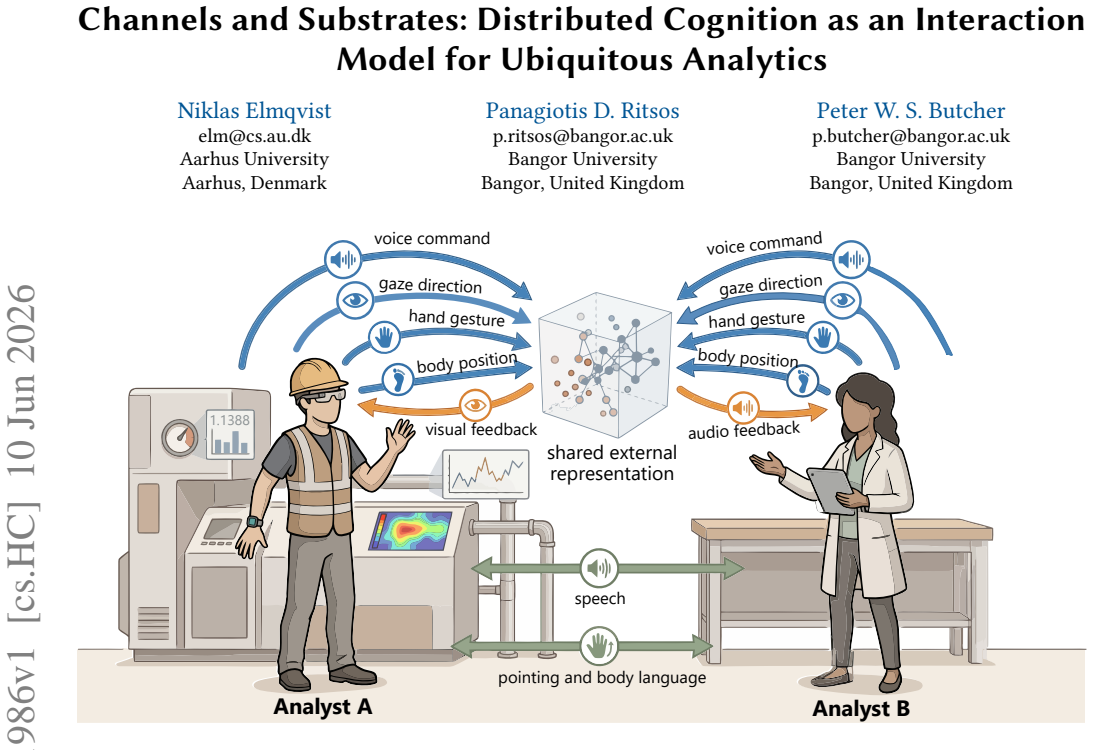
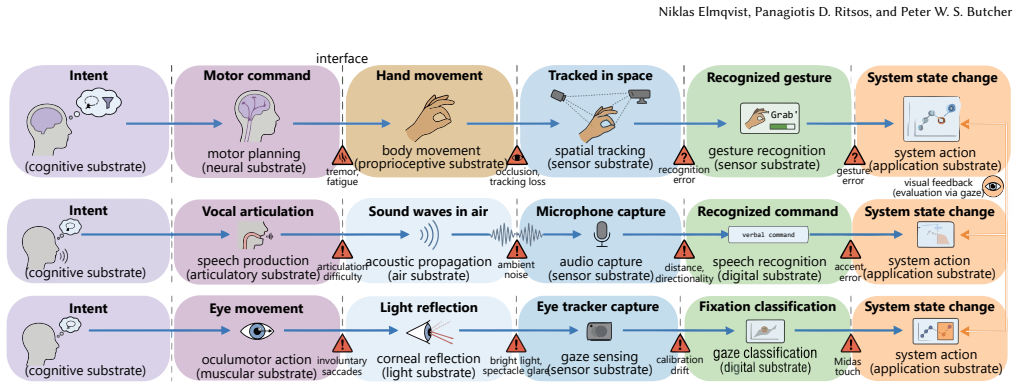
Ubiquitous analytics interaction is modeled as propagation of representational state across substrates using distributed cognition rather than traffic through a single interface.
A machine-rendered reading of the paper's core claim, the machinery that carries it, and where it could break.
Core claim
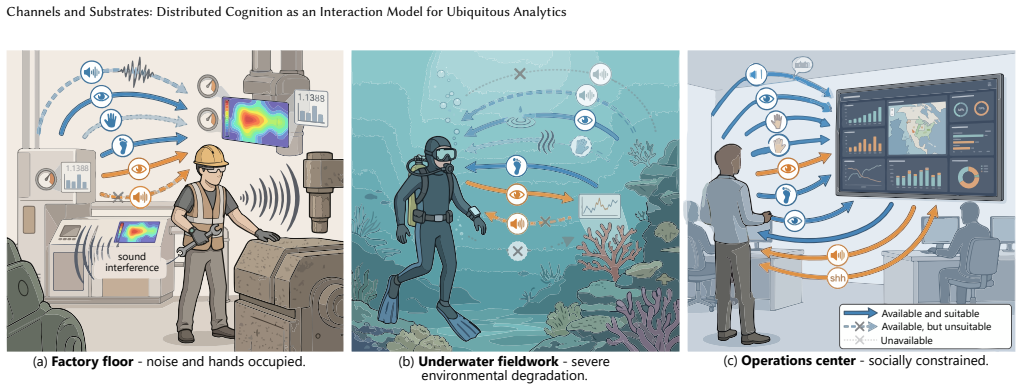
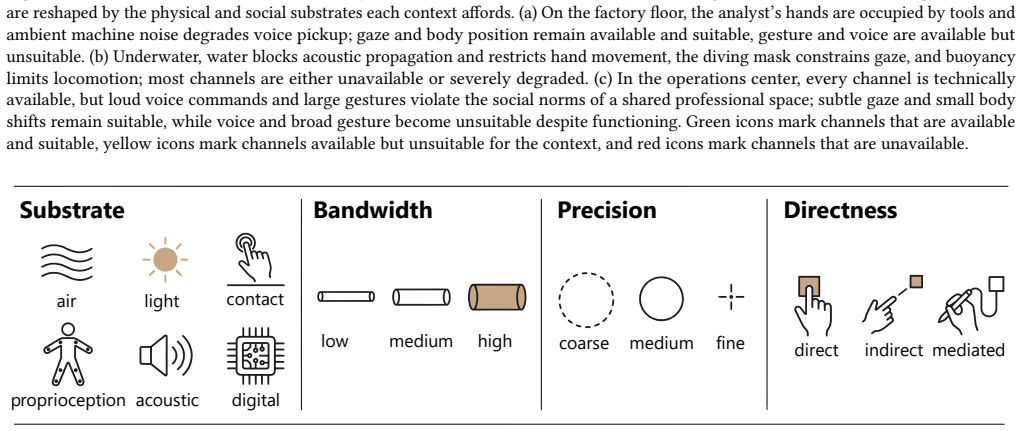
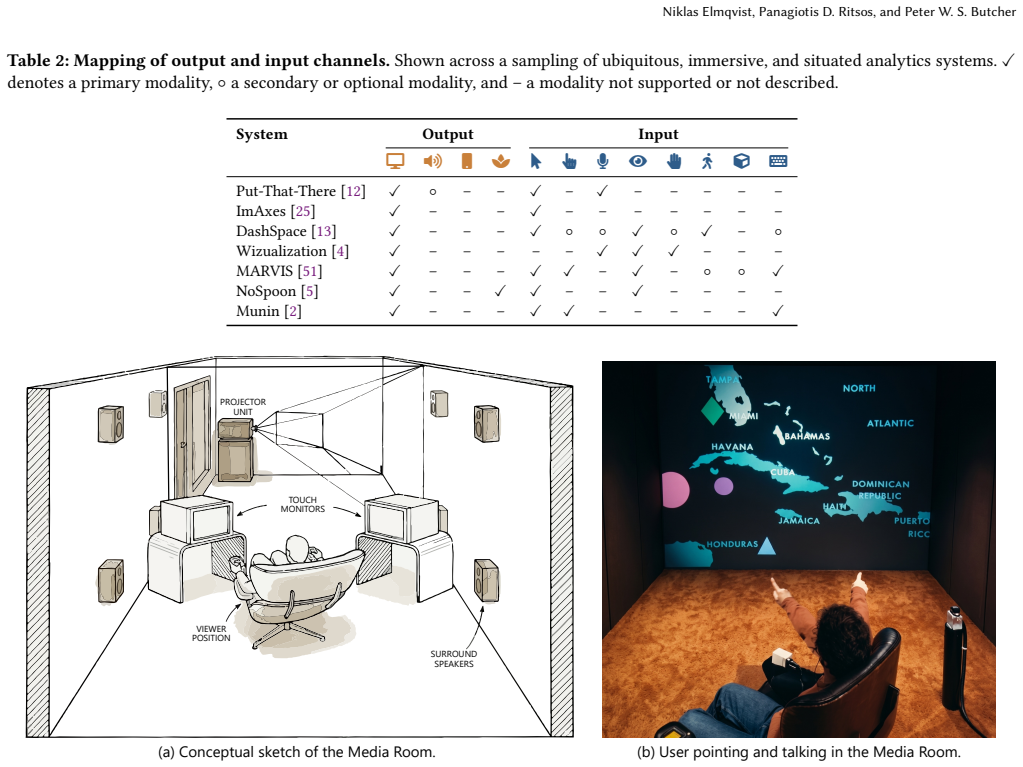
The paper claims that interaction in ubiquitous analytics can be modeled using distributed cognition as propagation of representational state across substrates—minds, speech, bodies, artifacts, and devices—rather than as traffic through a single interface. On this basis input and output channels are introduced as generalizations of the visual channels from data visualization, carrying representational state through substrates whose availability, suitability, and preferability depend on context. The channels and substrates framework is demonstrated by reanalyzing several ubiquitous, immersive, and situated analytics systems.
What carries the argument
input and output channels as generalizations of visual channels that carry representational state through substrates in a distributed cognition model
If this is right
- Design of ubiquitous analytics systems can be guided by evaluating channel availability, suitability, and preferability across different substrates in a given context.
- Existing systems can be reanalyzed to reveal how they already distribute representational state across multiple substrates rather than relying on one interface.
- Input and output channels provide a way to generalize visual channel concepts to non-visual substrates such as speech, touch, or physical artifacts.
- Cross-device setups become analyzable as coordinated propagation of state instead of separate interfaces competing for user attention.
Where Pith is reading between the lines
- The model could extend to collaborative sensemaking scenarios beyond analytics, where multiple people and artifacts coordinate state propagation.
- New evaluation methods might be developed that measure how effectively a system supports channel switching or state handoff across substrates.
- Toolkits could be built that explicitly expose channel properties to help designers select and combine substrates during development.
Load-bearing premise
Distributed cognition theory supplies a sufficiently precise and operationalizable foundation for defining input and output channels whose availability, suitability, and preferability can guide concrete system design in cross-device analytics.
What would settle it
Apply the channels and substrates framework to redesign an existing cross-device analytics system and observe whether the resulting design decisions differ meaningfully from those produced by traditional single-interface models, or identify an observed interaction sequence that cannot be expressed as propagation of representational state across substrates.
Figures
read the original abstract
Traditional HCI interaction models assume a single monolithic interface and a stable sensorimotor loop. These models fit poorly with cross-device (XVA) and ubiquitous analytics (UA), where interactive data sensemaking unfolds across multiple devices, artifacts, and people in disparate settings from the office to the factory floor. In this paper, we show how interaction in ubiquitous analytics can be modeled using distributed cognition as propagation of representational state across substrates -- minds, speech, bodies, artifacts, and devices -- rather than as traffic through a single interface. On this basis we introduce input and output channels as generalizations of the visual channels from data visualization: just as visual channels carry data through properties of the visual substrate, input and output channels carry representational state through substrates whose availability, suitability, and preferability depend on context. We demonstrate the channels and substrates framework by reanalyzing several ubiquitous, immersive, and situated analytics systems.
Editorial analysis
A structured set of objections, weighed in public.
Referee Report
Summary. The paper argues that traditional HCI models assuming a single monolithic interface and stable sensorimotor loop are inadequate for cross-device (XVA) and ubiquitous analytics (UA), where sensemaking spans multiple devices, artifacts, and people. It proposes modeling UA interaction via distributed cognition as the propagation of representational state across substrates (minds, speech, bodies, artifacts, devices) rather than traffic through one interface. Input and output channels are introduced as generalizations of visual channels from data visualization, with properties of availability, suitability, and preferability that depend on context. The framework is demonstrated through reanalysis of several existing ubiquitous, immersive, and situated analytics systems.
Significance. If the operationalizability claim holds, the work could supply a principled way to reason about multi-substrate interaction in UA that extends beyond standard interface-centric models, potentially informing design choices in settings like factories or collaborative environments. The reanalysis approach reuses established distributed-cognition theory without introducing new free parameters or ad-hoc axioms, which is a strength for conceptual clarity, but the absence of any derived design recommendation or falsifiable prediction that differs from conventional HCI analysis limits immediate applicability.
major comments (2)
- [Abstract, paragraph 3; reanalysis sections] Abstract, paragraph 3 and the reanalysis sections: the central claim asserts that channel availability/suitability/preferability can operationally guide concrete UA design decisions and generalize visual channels. However, the demonstration consists solely of retrofitting existing system features into the new terminology; no section derives even one concrete design recommendation or falsifiable prediction from the channel/substrate properties that would have altered a prior design choice or differs from standard HCI analysis. This leaves the asserted operationalizability unsupported.
- [Demonstration / reanalysis] The weakest assumption identified in the reader's note is load-bearing: without at least one worked example showing how the framework would change a design decision (e.g., preferring one substrate over another in a specific context), the generalization from visual channels remains terminological rather than prescriptive.
minor comments (2)
- [Introduction / framework definition] Clarify whether the substrates list (minds, speech, bodies, artifacts, devices) is intended to be exhaustive or extensible, and provide a brief example of how a new substrate would be incorporated.
- [Framework section] The paper would benefit from a short table contrasting the new channel/substrate properties with conventional visual-channel properties to make the generalization explicit.
Simulated Author's Rebuttal
We thank the referee for the constructive review. The comments correctly identify that our demonstration relies on reanalysis rather than forward-looking design guidance. We respond to each major comment below.
read point-by-point responses
-
Referee: [Abstract, paragraph 3; reanalysis sections] Abstract, paragraph 3 and the reanalysis sections: the central claim asserts that channel availability/suitability/preferability can operationally guide concrete UA design decisions and generalize visual channels. However, the demonstration consists solely of retrofitting existing system features into the new terminology; no section derives even one concrete design recommendation or falsifiable prediction from the channel/substrate properties that would have altered a prior design choice or differs from standard HCI analysis. This leaves the asserted operationalizability unsupported.
Authors: We agree the manuscript currently demonstrates the framework through reanalysis of existing systems to illustrate its descriptive utility across diverse UA settings. This approach reuses distributed cognition without new axioms, but does not include a forward design example. To strengthen the operationalizability claim, we will revise by adding a brief hypothetical design scenario in the demonstration section showing how channel properties (e.g., preferability in a hands-busy context) could alter a substrate choice. revision: yes
-
Referee: [Demonstration / reanalysis] The weakest assumption identified in the reader's note is load-bearing: without at least one worked example showing how the framework would change a design decision (e.g., preferring one substrate over another in a specific context), the generalization from visual channels remains terminological rather than prescriptive.
Authors: We acknowledge the point: the current reanalysis validates applicability but stops short of prescriptive guidance. The added scenario in revision will address this by walking through a concrete context (e.g., factory-floor analytics) where suitability and availability properties lead to preferring one channel/substrate combination over another, distinguishing it from standard single-interface analysis. revision: yes
Circularity Check
No significant circularity; applies external distributed cognition theory to UA via conceptual mapping and reanalysis
full rationale
The paper's derivation applies the pre-existing theory of distributed cognition (external to this work) to model interaction in ubiquitous analytics as propagation of representational state across substrates. Input/output channels are introduced as a generalization of visual channels from data visualization. This is demonstrated solely through reanalysis of existing systems, with no equations, fitted parameters, self-citations as load-bearing premises, or reductions where outputs equal inputs by construction. The framework remains self-contained against external benchmarks.
Axiom & Free-Parameter Ledger
axioms (1)
- domain assumption Distributed cognition theory provides an appropriate and operational basis for modeling interaction across multiple heterogeneous substrates in analytics settings.
invented entities (2)
-
input and output channels
no independent evidence
-
substrates
no independent evidence
Reference graph
Works this paper leans on
-
[1]
Sriram Karthik Badam, Fereshteh Amini, Niklas Elmqvist, and Pourang Irani
-
[2]
InProceedings of the IEEE Conference on Visual Analytics Sci- ence and Technology
Supporting Visual Exploration for Multiple Users in Large Display Environments. InProceedings of the IEEE Conference on Visual Analytics Sci- ence and Technology. IEEE Computer Society, Los Alamitos, CA, USA, 1–10. doi:10.1109/vast.2016.7883506
-
[3]
Sriram Karthik Badam, Eli Fisher, and Niklas Elmqvist. 2015. Munin: A Peer- to-Peer Middleware for Ubiquitous Analytics and Visualization Spaces.IEEE Transactions on Visualization and Computer Graphics21, 2 (2015), 215–228. doi:10. 1109/TVCG.2014.2337337
arXiv 2015
-
[4]
Robert Ball, Chris North, and Doug A. Bowman. 2007. Move to Improve: Pro- moting Physical Navigation to Increase User Performance with Large Displays. InProceedings of the ACM Conference on Human Factors in Computing Systems. ACM, New York, NY, USA, 191–200. doi:10.1145/1240624.1240656
-
[5]
Andrea Batch, Peter W. S. Butcher, Panagiotis D. Ritsos, and Niklas Elmqvist
-
[6]
Wizualization: A "Hard Magic" Visualization System for Immersive and Ubiquitous Analytics.IEEE Transactions on Visualization and Computer Graphics 30, 1 (2024), 507–517. doi:10.1109/TVCG.2023.3326580
-
[7]
Andrea Batch, Andrew Cunningham, Maxime Cordeil, Niklas Elmqvist, Tim Dwyer, Bruce H. Thomas, and Kim Marriott. 2020. There Is No Spoon: Evaluating Performance, Space Use, and Presence with Expert Domain Users in Immersive Analytics.IEEE Transactions on Visualization and Computer Graphics26, 1 (2020), 536–546. doi:10.1109/TVCG.2019.2934803
-
[8]
Andrea Batch, Biswaksen Patnaik, Moses Akazue, and Niklas Elmqvist. 2020. Scents and Sensibility: Evaluating Information Olfactation. InProceedings of the ACM Conference on Human Factors in Computing Systems. ACM, New York, NY, USA, 1–14. doi:10.1145/3313831.3376733
-
[9]
Michel Beaudouin-Lafon. 2000. Instrumental Interaction: an Interaction Model for Designing Post-WIMP User Interfaces. InProceedings of the ACM Conference on Human Factors in Computing Systems. ACM, New York, NY, USA, 446–453. doi:10.1145/332040.332473
-
[10]
Michel Beaudouin-Lafon. 2004. Designing Interaction, Not Interfaces. InPro- ceedings of the ACM Conference on Advanced Visual Interfaces. ACM, New York, NY, USA, 15–22. doi:10.1145/989863.989865
-
[11]
Joanna Bergström and Kasper Hornbæk. 2025. DIRA: A model of the user interface.International Journal of Human-Computer Studies193 (2025), 103381. doi:10.1016/J.IJHCS.2024.103381
-
[12]
1967.Sémiologie graphique : Les diagrammes - Les réseaux - Les cartes(les réimpressions ed.)
Jacques Bertin. 1967.Sémiologie graphique : Les diagrammes - Les réseaux - Les cartes(les réimpressions ed.). Editions de l’Ecole des Hautes Etudes en Sciences, Paris, France
1967
-
[13]
Susanne Bødker. 2006. When second wave HCI meets third wave challenges. In Proceedings of the Nordic Conference on Human-Computer Interaction. ACM, New York, NY, USA, 1–8. doi:10.1145/1182475.1182476
-
[14]
Richard A. Bolt. 1980. “Put-That-There”: Voice and gesture at the graphics interface.Computer Graphics14, 3 (1980), 262–270. doi:10.1145/965105.807503
-
[15]
Marcel Borowski, Peter W. S. Butcher, Janus Bager Kristensen, Jonas Oxenbøll Petersen, Panagiotis D. Ritsos, Clemens N. Klokmose, and Niklas Elmqvist. 2025. DashSpace: A Live Collaborative Platform for Immersive and Ubiquitous Ana- lytics.IEEE Transactions on Visualization and Computer Graphics31, 10 (2025), 7034–7047. doi:10.1109/TVCG.2025.3537679
-
[16]
Matthew Brehmer and Tamara Munzner. 2013. A multi-level typology of abstract visualization tasks.IEEE Transactions on Visualization and Computer Graphics 19, 12 (2013), 2376–2385. doi:10.1109/TVCG.2013.124
-
[17]
William Buxton. 1983. Lexical and pragmatic considerations of input structures. SIGGRAPH Computer Graphics17, 1 (Jan. 1983), 31–37. doi:10.1145/988584.988586
-
[18]
Stuart K. Card, Jock D. Mackinlay, and George G. Robertson. 1990. The design space of input devices. InProceedings of the ACM Conference on Human Factors in Computing Systems. New York, NY, USA, ACM, 117–124. doi:10.1145/97243.97263
-
[19]
Stuart K. Card, Jock D. Mackinlay, and George G. Robertson. 1991. A Morpho- logical Analysis of the Design Space of Input Devices.ACM Transactions on Information Systems9, 2 (1991), 99–122. doi:10.1145/123078.128726
-
[20]
Card, Jock D
Stuart K. Card, Jock D. Mackinlay, and Ben Shneiderman (Eds.). 1999.Readings in Information Visualization: Using Vision to Think. Morgan Kaufmann Publishers, San Francisco, CA, USA
1999
-
[21]
Tom Chandler, Maxime Cordeil, Tobias Czauderna, Tim Dwyer, Jaroslaw Glowacki, Cagatay Goncu, Matthias Klapperstueck, Karsten Klein, Falk Schreiber, and Elliot Wilson. 2015. Immersive Analytics. InProceedings of the Interna- tional Symposium on Big Data Visual Analytics. IEEE, Piscataway, NJ, USA, 1–8. doi:10.1109/BDVA.2015.7314296
-
[22]
Jinho Choi, Sanghun Jung, Deok Gun Park, Jaegul Choo, and Niklas Elmqvist
-
[23]
Visualizing for the Non-Visual: Enabling the Visually Impaired to Use Visualization.Computer Graphics Forum38, 3 (2019), 249–260. doi:10.1111/CGF. 13686
work page doi:10.1111/cgf 2019
-
[24]
Pramod Chundury, Biswaksen Patnaik, Yasmin Reyazuddin, Christine Tang, Jonathan Lazar, and Niklas Elmqvist. 2022. Towards Understanding Sensory Substitution for Accessible Visualization: An Interview Study.IEEE Transactions on Visualization and Computer Graphics28, 1 (2022), 1084–1094. doi:10.1109/ Channels and Substrates: Distributed Cognition as an Inte...
arXiv 2022
-
[25]
Andy Clark and David Chalmers. 1998. The Extended Mind.Analysis58, 1 (1998), 7–19. doi:10.1093/analys/58.1.7
-
[26]
William S. Cleveland and Robert McGill. 1984. Graphical Perception: Theory, Experimentation and Application to the Development of Graphical Methods.J. Amer. Statist. Assoc.79, 387 (Sept. 1984), 531–554. doi:10.2307/2288400
-
[27]
Cook and Janice Miller Polgar
Albert M. Cook and Janice Miller Polgar. 2014.Assistive Technologies: Principles and Practice(4th ed.). Elsevier Health Sciences, St. Louis, MO, USA
2014
-
[28]
Maxime Cordeil, Andrew Cunningham, Tim Dwyer, Bruce H. Thomas, and Kim Marriott. 2017. ImAxes: Immersive Axes as Embodied Affordances for Interactive Multivariate Data Visualisation. InProceedings of the ACM Symposium on User Interface Software and Technology. ACM, New York, NY, USA, 71–83. doi:10.1145/3126594.3126613
-
[29]
Evanthia Dimara and Charles Perin. 2020. What is Interaction for Data Visual- ization?IEEE Transactions on Visualization and Computer Graphics26, 1 (2020), 119–129. doi:10.1109/TVCG.2019.2934283
-
[30]
2001.Where the Action Is: The Foundations of Embodied Interaction
Paul Dourish. 2001.Where the Action Is: The Foundations of Embodied Interaction. MIT Press, Cambridge, MA, USA
2001
-
[31]
Niklas Elmqvist. 2011. Embodied Human-Data Interaction. InProceedings of the ACM CHI Workshop on Embodied Interaction: Theory and Practice in HCI. ACM, New York, NY, USA
2011
-
[32]
Niklas Elmqvist. 2023. Data Analytics Anywhere and Everywhere.Commun. ACM66, 12 (2023), 52–63. doi:10.1145/3584858
-
[33]
Niklas Elmqvist. 2023. Visualization for the Blind.Interactions30, 1 (2023), 52–56. doi:10.1145/3571737
-
[34]
Niklas Elmqvist and Pourang Irani. 2013. Ubiquitous Analytics: Interacting with Big Data Anywhere, Anytime.IEEE Computer46, 4 (2013), 86–89. doi:10.1109/ mc.2013.147
2013
-
[35]
Neven A. M. ElSayed, Bruce H. Thomas, Kim Marriott, Julia Piantadosi, and Ross T. Smith. 2016. Situated Analytics: Demonstrating immersive analytical tools with Augmented Reality.Journal of Visual Languages & Computing36 (2016), 13–23. doi:10.1016/j.jvlc.2016.07.006
-
[36]
2014.Learning by Expanding: An Activity-Theoretical Approach to Developmental Research(2nd ed.)
Yrjö Engeström. 2014.Learning by Expanding: An Activity-Theoretical Approach to Developmental Research(2nd ed.). Cambridge University Press, Cambridge, UK
2014
-
[37]
Saul Greenberg, Nicolai Marquardt, Till Ballendat, Rob Diaz-Marino, and Miaosen Wang. 2011. Proxemic interactions: the new ubicomp?Interactions18, 1 (2011), 42–50. doi:10.1145/1897239.1897250
-
[38]
Mark Hancock, Sheelagh Carpendale, and Andy Cockburn. 2007. Shallow- Depth 3D Interaction: Design and Evaluation of One-, Two- and Three-Touch Techniques. InProceedings of the ACM Conference on Human Factors in Computing Systems. ACM, New York, NY, USA, 1147–1156. doi:10.1145/1240624.1240798
-
[39]
Neuhoff (Eds.)
Thomas Hermann, Andy Hunt, and John G. Neuhoff (Eds.). 2011.The Sonification Handbook. Logos Verlag, Berlin, Germany
2011
-
[40]
Juan David Hincapié-Ramos, Xiang Guo, Paymahn Moghadasian, and Pourang Irani. 2014. Consumed Endurance: A Metric to Quantify Arm Fatigue of Mid- Air Interactions. InProceedings of the ACM Conference on Human Factors in Computing Systems. ACM, New York, NY, USA, 1063–1072. doi:10.1145/2556288. 2557130
-
[41]
James D. Hollan, Edwin L. Hutchins, and David Kirsh. 2000. Distributed cogni- tion: toward a new foundation for human-computer interaction research.ACM Transactions on Computer-Human Interaction7, 2 (2000), 174–196. doi:10.1145/ 353485.353487
arXiv 2000
-
[42]
Kasper Hornbæk and Antti Oulasvirta. 2017. What Is Interaction?. InProceedings of the ACM Conference on Human Factors in Computing Systems. ACM, New York, NY, USA, 5040–5052. doi:10.1145/3025453.3025765
-
[43]
1995.Cognition in the Wild
Edwin Hutchins. 1995.Cognition in the Wild. MIT Press, Cambridge, MA, USA
1995
-
[44]
Edwin Hutchins. 1995. How a Cockpit Remembers Its Speeds.Cognitive Science 19, 3 (1995), 265–288. doi:10.1207/s15516709cog1903_1
-
[45]
Hiroshi Ishii and Brygg Ullmer. 1997. Tangible Bits: Towards Seamless Interfaces between People, Bits and Atoms. InProceedings of the ACM Conference on Human Factors in Computing Systems. ACM, New York, NY, USA, 234–241. doi:10.1145/ 258549.258715
arXiv 1997
-
[46]
Robert J. K. Jacob. 1991. The use of eye movements in human-computer in- teraction techniques: what you look at is what you get.ACM Transactions on Information Systems9, 2 (April 1991), 152–169. doi:10.1145/123078.128728
-
[47]
Jakobsen, Yonas Sahlemariam Haile, Soren Knudsen, and Kasper Horn- bæk
Mikkel R. Jakobsen, Yonas Sahlemariam Haile, Soren Knudsen, and Kasper Horn- bæk. 2013. Information Visualization and Proxemics: Design Opportunities and Empirical Findings.IEEE Transactions on Visualization and Computer Graphics 19, 12 (2013), 2386–2395. doi:10.1109/tvcg.2013.166
-
[48]
Yvonne Jansen, Pierre Dragicevic, Petra Isenberg, Jason Alexander, Abhijit Karnik, Johan Kildal, Sriram Subramanian, and Kasper Hornbæk. 2015. Opportunities and Challenges for Data Physicalization. InProceedings of the ACM Conference on Human Factors in Computing Systems. ACM, New York, NY, USA, 3227–3236. doi:10.1145/2702123.2702180
-
[49]
KyungTae Kim and Niklas Elmqvist. 2012. Embodied lenses for collaborative visual queries on tabletop displays.Information Visualization11, 4 (2012), 319–338. doi:10.1177/1473871612441874
-
[50]
David Kirsh. 1995. The Intelligent Use of Space.Artificial Intelligence73, 1-2 (1995), 31–68. doi:10.1016/0004-3702(94)00017-U
-
[51]
Stefanie Klum, Petra Isenberg, Ricardo Langner, Jean-Daniel Fekete, and Raimund Dachselt. 2012. Stackables: combining tangibles for faceted browsing. InProceed- ings of the ACM Conference on Advanced Visual Interfaces. ACM, New York, NY, USA, 241–248. doi:10.1145/2254556.2254600
-
[53]
Heidi Lam. 2008. A Framework of Interaction Costs in Information Visualization. IEEE Transactions on Visualization and Computer Graphics14, 6 (2008), 1149–1156. doi:10.1109/TVCG.2008.109
-
[54]
Ricardo Langner, Marc Satkowski, Wolfgang Büschel, and Raimund Dachselt
-
[55]
MARVIS: Combining Mobile Devices and Augmented Reality for Visual Data Analysis. InProceedings of the ACM Conference on Human Factors in Com- puting Systems. ACM, New York, NY, USA, 468:1–468:17. doi:10.1145/3411764. 3445593
-
[56]
Kim, Ali Parsaei, Jean-Daniel Fekete, Pierre Drag- icevic, and Sean Follmer
Mathieu Le Goc, Lawrence H. Kim, Ali Parsaei, Jean-Daniel Fekete, Pierre Drag- icevic, and Sean Follmer. 2016. Zooids: Building Blocks for Swarm User Interfaces. InProceedings of the ACM Symposium on User Interface Software and Technology. ACM, New York, NY, USA, 97–109. doi:10.1145/2984511.2984547
-
[57]
SK Lee, William Buxton, and K. C. Smith. 1985. A Multi-Touch Three Dimensional Touch-Sensitive Tablet. InProceedings of the ACM Conference on Human Factors in Computing Systems. ACM, New York, NY, USA, 21–25. doi:10.1145/317456.317461
-
[58]
Zhicheng Liu, Nancy J. Nersessian, and John T. Stasko. 2008. Distributed Cognition as a Theoretical Framework for Information Visualization.IEEE Transactions on Visualization and Computer Graphics14, 6 (2008), 1173–1180. doi:10.1109/TVCG.2008.121
-
[59]
Wendy E. Mackay. 1999. Is Paper Safer? The Role of Paper Flight Strips in Air Traffic Control.ACM Transactions on Computer-Human Interaction6, 4 (1999), 311–340. doi:10.1145/331490.331491
-
[60]
Mackay and Michel Beaudouin-Lafon
Wendy E. Mackay and Michel Beaudouin-Lafon. 2025. Interaction Substrates: Combining Power and Simplicity in Interactive Systems. InProceedings of the ACM Conference on Human Factors in Computing Systems. ACM, New York, NY, USA, 6871:1–687:16. doi:10.1145/3706598.3714006
-
[61]
Jock Mackinlay. 1986. Automating the Design of Graphical Presentations of Relational Information.ACM Transactions on Graphics5, 2 (April 1986), 110–141. doi:10.1145/22949.22950
-
[62]
Karon E. MacLean. 2008. Haptic Interaction Design for Everyday Interfaces. Reviews of Human Factors and Ergonomics4, 1 (2008), 149–194. doi:10.1518/ 155723408X342826
2008
-
[63]
Kim Marriott, Falk Schreiber, Tim Dwyer, Karsten Klein, Nathalie Henry Riche, Takayuki Itoh, Wolfgang Stuerzlinger, and Bruce H. Thomas (Eds.). 2018.Im- mersive Analytics. Lecture Notes in Computer Science, Vol. 11190. Springer International Publishing, Berlin, Germany. doi:10.1007/978-3-030-01388-2
-
[64]
2014.Visualization Analysis and Design
Tamara Munzner. 2014.Visualization Analysis and Design. A K Peters (CRC Press), Boca Raton, FL, USA
2014
-
[65]
Sundar Murugappan, Vinayak, Niklas Elmqvist, and Karthik Ramani. 2012. Ex- tended multitouch: recovering touch posture and differentiating users using a depth camera. InProceedings of the ACM Symposium on User Interface Software and Technology. ACM, New York, NY, USA, 487–496. doi:10.1145/2380116.2380177
-
[66]
Nardi (Ed.)
Bonnie A. Nardi (Ed.). 1995.Context and Consciousness: Activity Theory and Human-Computer Interaction. MIT Press, Cambridge, MA, USA
1995
-
[67]
Donald A. Norman. 1986. Cognitive Engineering. InUser Centered System Design: New Perspectives on Human-Computer Interaction, Donald A. Norman and Stephen W. Draper (Eds.). Lawrence Erlbaum Associates, Hillsdale, NJ, USA, 31–61
1986
-
[68]
Donald A. Norman. 1988.The Design of Everyday Things. Basic Books, New York, NY, USA
1988
-
[69]
Panëels and Jonathan C
Sabrina A. Panëels and Jonathan C. Roberts. 2010. Review of Designs for Haptic Data Visualization.IEEE Transactions on Haptics3, 2 (2010), 119–137. doi:10. 1109/TOH.2009.44
2010
-
[70]
Biswaksen Patnaik, Andrea Batch, and Niklas Elmqvist. 2019. Information Olfactation: Harnessing Scent to Convey Data.IEEE Transactions on Visualization and Computer Graphics25, 1 (2019), 726–736. doi:10.1109/TVCG.2018.2865237
-
[71]
Ken Pfeuffer, Jason Alexander, Ming Ki Chong, and Hans Gellersen. 2014. Gaze- touch: combining gaze with multi-touch for interaction on the same surface. In Proceedings of the ACM Symposium on User Interface Software and Technology. ACM, New York, NY, USA, 509–518. doi:10.1145/2642918.2647397
-
[72]
Pike, John Stasko, Remco Chang, and Theresa A
William A. Pike, John Stasko, Remco Chang, and Theresa A. O’Connell. 2009. The Science of Interaction.Information Visualization8, 4 (Dec. 2009), 263–274. doi:10.1057/ivs.2009.22
-
[73]
Richard L. Potter, Linda J. Weldon, and Ben Shneiderman. 1988. Improving the Accuracy of Touch Screens: An Experimental Evaluation of Three Strategies. InProceedings of the ACM Conference on Human Factors in Computing Systems. ACM, New York, NY, USA, 27–32. doi:10.1145/57167.57171
-
[74]
Michael Scaife and Yvonne Rogers. 1996. External cognition: how do graphical representations work?International Journal of Human-Computer Studies45, 2 Niklas Elmqvist, Panagiotis D. Ritsos, and Peter W. S. Butcher (1996), 185–213. doi:10.1006/ijhc.1996.0048
-
[75]
Orit Shaer and Eva Hornecker. 2010. Tangible User Interfaces: Past, Present, and Future Directions.Foundations and Trends in Human-Computer Interaction3, 1–2 (2010), 1–137. doi:10.1561/1100000026
-
[76]
Lawrence A. Shapiro. 2011.Embodied Cognition. Routledge, New York, NY, USA
2011
-
[77]
Sungbok Shin, Andrea Batch, Peter William Scott Butcher, Panagiotis D. Ritsos, and Niklas Elmqvist. 2024. The Reality of the Situation: A Survey of Situated Analytics.IEEE Transactions on Visualization and Computer Graphics30, 8 (2024), 5147–5164. doi:10.1109/TVCG.2023.3285546
-
[78]
Ben Shneiderman. 1983. Direct Manipulation: A Step Beyond Programming Languages.Computer16, 8 (1983), 57–69. doi:10.1109/MC.1983.1654471
-
[79]
Cohen, Steven Jacobs, and Niklas Elmqvist
Ben Shneiderman, Catherine Plaisant, Maxine S. Cohen, Steven Jacobs, and Niklas Elmqvist. 2016.Designing the User Interface - Strategies for Effective Human-Computer Interaction(6th edition ed.). Pearson, Hoboken, NJ, USA
2016
-
[80]
David Simkin and Reid Hastie. 1987. An Information-Processing Analysis of Graph Perception.J. Amer. Statist. Assoc.82, 398 (1987), 454–465. doi:10.1080/ 01621459.1987.10478448
arXiv 1987
-
[81]
Martin Spindler, Christian Tominski, Heidrun Schumann, and Raimund Dachselt
discussion (0)
Sign in with ORCID, Apple, or X to comment. Anyone can read and Pith papers without signing in.