Phonons and magnetism of kagome FeGe probed by nuclear resonant scattering
Pith reviewed 2026-06-27 08:19 UTC · model grok-4.3
The pith
Nuclear resonant scattering shows the CDW in kagome FeGe hardens acoustic and optical phonons while linking to magnetism.
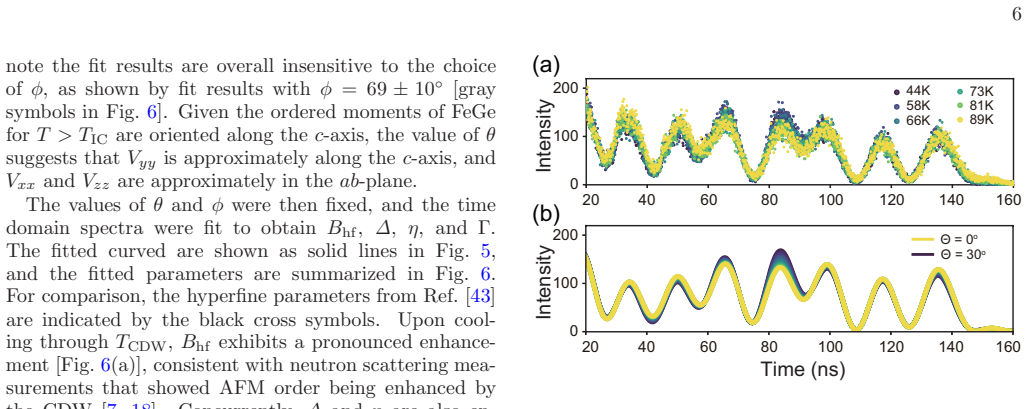
A machine-rendered reading of the paper's core claim, the machinery that carries it, and where it could break.
Core claim
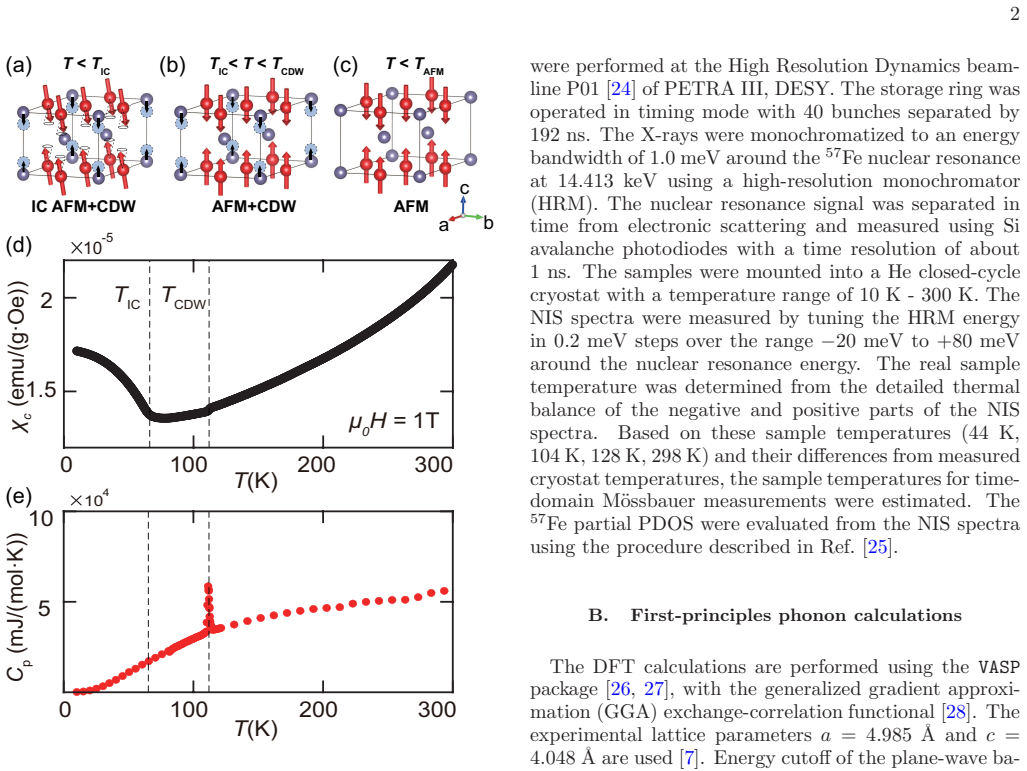
Upon entering the CDW state, hardening of acoustic phonons and optical phonons around 22 meV, 27 meV, and 31 meV occurs in the Fe partial phonon density of states, which first-principle calculations capture qualitatively. Upon entering the incommensurate magnetic phase, neither the phonon density of states nor the hyperfine interaction parameters change significantly, although a subtle feature associated with the incommensurate magnetic order or slow fluctuations appears in the time-domain Mossbauer spectra. The CDW therefore modifies lattice dynamics and magnetism, evidencing an intertwined nature of the spin, charge, and lattice degrees of freedom.
What carries the argument
57Fe nuclear resonant scattering, which extracts the iron partial phonon density of states and hyperfine parameters across the temperature-driven CDW and magnetic transitions.
If this is right
- The CDW state produces measurable hardening of acoustic phonons and optical modes at 22 meV, 27 meV, and 31 meV.
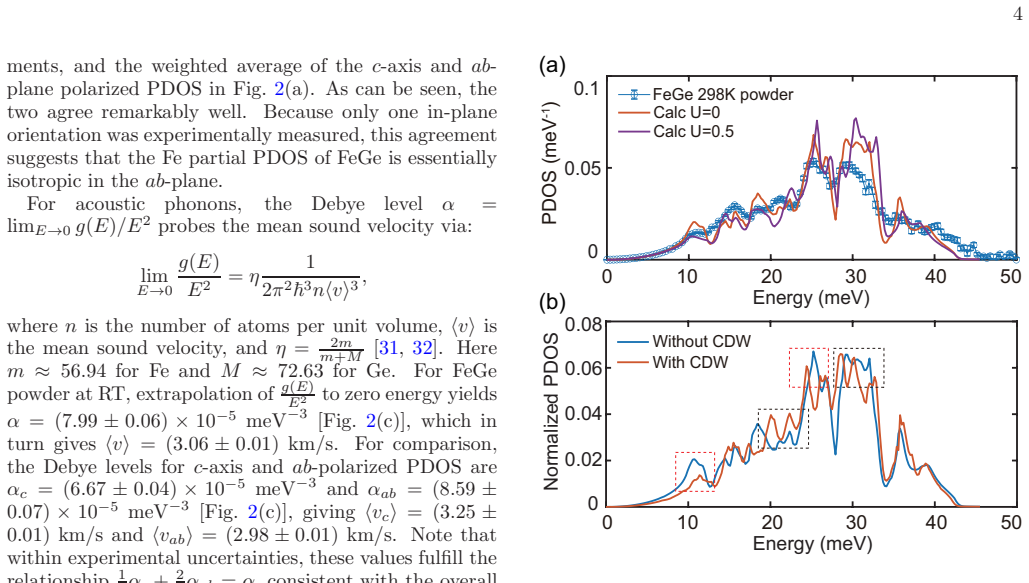
- First-principles calculations based on the CDW structure account for the observed phonon hardening.
- Crossing the incommensurate magnetic transition leaves the phonon density of states and hyperfine parameters essentially unaltered.
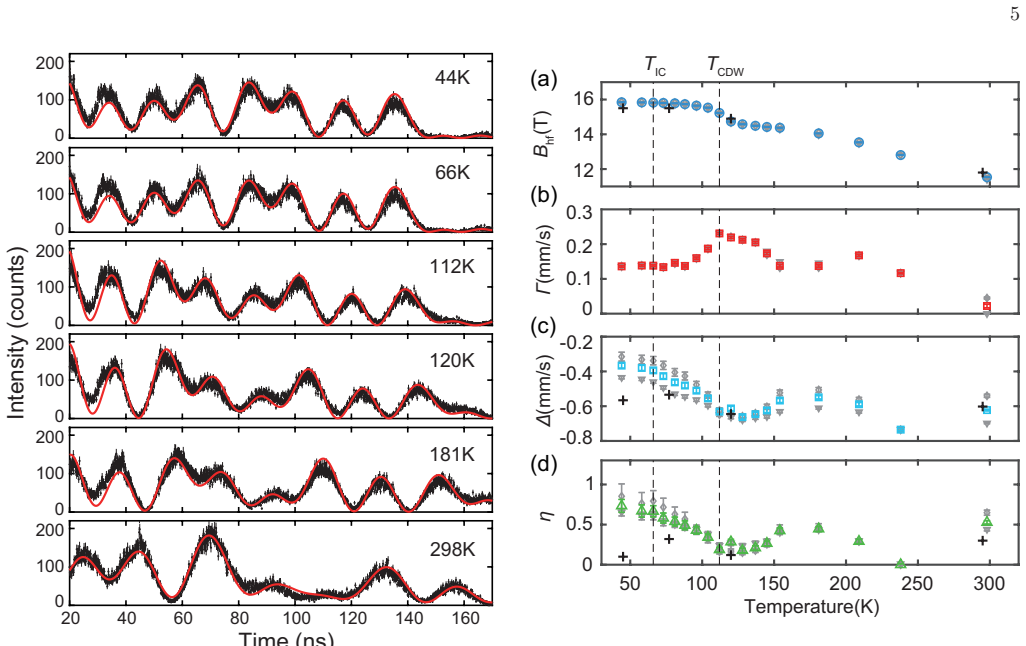
- A weak additional signal appears in time-domain Mossbauer spectra only in the incommensurate magnetic phase.
- The CDW presence therefore alters both vibrational spectrum and magnetic response.
Where Pith is reading between the lines
- If the CDW drives the phonon shifts, suppressing the CDW by pressure or doping should restore the softer phonon energies.
- The absence of major magnetic-phase effects on phonons suggests the lattice response is tied more directly to charge order than to the magnetic modulation.
- The subtle time-domain feature may reflect slow spin fluctuations whose timescale could be tested with complementary spectroscopies.
- Similar nuclear resonant measurements on isostructural kagome compounds could test whether CDW-induced phonon hardening is a general feature of intertwined orders.
Load-bearing premise
The measured changes in phonon spectra and time-domain signals arise specifically from the CDW and magnetic transitions rather than from unrelated temperature dependence or resolution limits.
What would settle it
A set of temperature scans that isolate the CDW transition and find no hardening in the acoustic or listed optical phonon energies, or that find large shifts in hyperfine parameters at the magnetic transition without the reported subtle time-domain feature.
Figures
read the original abstract
Kagome FeGe hosts a $2\times2\times2$ charge-density wave (CDW) that strongly interplays with antiferromagnetic order. Here, we report $^{57}$Fe nuclear resonant scattering measurement to study FeGe across its long-range CDW and incommensurate magnetic transitions. Upon entering the CDW state, hardening of acoustic phonons and optical phonons around 22~meV, 27~meV, and 31~meV are observed in the Fe partial phonon density of states, which can be qualitatively captured by first-principle calculations. Upon entering the incommensurate magnetic phase, neither the phonon density of states nor the hyperfine interaction parameters change significantly, although a subtle feature associated with the incommensurate magnetic order or slow fluctuations is detected in the time-domain M\"{o}ssbauer spectra. These findings show that the CDW in kagome FeGe significantly modifies its lattice dynamics and magnetism, evidencing an intertwined nature of the spin, charge, and lattice degrees of freedom.
Editorial analysis
A structured set of objections, weighed in public.
Referee Report
Summary. The manuscript reports 57Fe nuclear resonant scattering measurements on kagome FeGe across its CDW and incommensurate magnetic transitions. It claims hardening of acoustic and optical phonons (around 22, 27, and 31 meV) upon entering the CDW state, qualitatively reproduced by DFT, with no significant changes in phonon density of states or hyperfine parameters at the magnetic transition but a subtle time-domain spectral feature. The authors conclude that the CDW significantly modifies lattice dynamics and magnetism, evidencing intertwined spin-charge-lattice degrees of freedom.
Significance. If the phonon hardening and subtle spectral feature can be rigorously attributed to the CDW and magnetic orders rather than generic temperature effects, the work would provide direct experimental support for the interplay of charge, spin, and lattice degrees of freedom in this kagome system. The use of nuclear resonant scattering for partial phonon DOS and hyperfine parameters is a strength, but the current presentation lacks the quantitative controls needed to establish the claimed significance.
major comments (2)
- [Abstract] Abstract: The claim of phonon hardening 'upon entering the CDW state' and 'qualitatively captured' by calculations is load-bearing for the central conclusion of significant CDW modification of lattice dynamics, yet no error bars, raw spectra, fit details, or quantitative metrics (e.g., frequency shifts with uncertainties) are reported to demonstrate that the changes exceed experimental resolution or generic thermal evolution.
- [Abstract] Abstract (results paragraph): Attribution of the 'subtle feature' in time-domain Mössbauer spectra specifically to the incommensurate magnetic order (or slow fluctuations) lacks supporting analysis such as temperature sweeps away from the transition, subtraction of anharmonic background, or comparison to resolution functions; this directly underpins the 'intertwined' claim but is not isolated from unrelated temperature-dependent effects.
minor comments (1)
- [Abstract] Abstract: The phrase 'neither the phonon density of states nor the hyperfine interaction parameters change significantly' would benefit from a quantitative threshold or statistical test to define 'significantly'.
Simulated Author's Rebuttal
We thank the referee for their careful review and constructive feedback. We address each major comment below with clarifications from the manuscript and indicate where revisions will strengthen the presentation of the phonon and spectral results.
read point-by-point responses
-
Referee: [Abstract] Abstract: The claim of phonon hardening 'upon entering the CDW state' and 'qualitatively captured' by calculations is load-bearing for the central conclusion of significant CDW modification of lattice dynamics, yet no error bars, raw spectra, fit details, or quantitative metrics (e.g., frequency shifts with uncertainties) are reported to demonstrate that the changes exceed experimental resolution or generic thermal evolution.
Authors: The full manuscript presents the Fe partial phonon DOS extracted from nuclear resonant inelastic x-ray scattering at multiple temperatures (including above and below the CDW transition at ~110 K), with error bars derived from the fitting procedure, raw time-domain spectra in the supplementary information, and direct comparison to DFT calculations showing qualitative agreement on the hardening of modes near 22, 27, and 31 meV. The observed hardening occurs specifically upon cooling through the CDW transition and runs counter to expected anharmonic softening, providing distinction from generic thermal effects. To address the request for explicit metrics in the abstract, we will revise it to include approximate shift values (with reference to the uncertainties reported in the main text). revision: yes
-
Referee: [Abstract] Abstract (results paragraph): Attribution of the 'subtle feature' in time-domain Mössbauer spectra specifically to the incommensurate magnetic order (or slow fluctuations) lacks supporting analysis such as temperature sweeps away from the transition, subtraction of anharmonic background, or comparison to resolution functions; this directly underpins the 'intertwined' claim but is not isolated from unrelated temperature-dependent effects.
Authors: The manuscript reports temperature-dependent time-domain spectra across the incommensurate magnetic transition (~60 K), with the subtle feature appearing only below this temperature while hyperfine parameters and phonon DOS remain largely unchanged. We agree that further isolation from potential anharmonic or resolution effects would strengthen the attribution. We will add explicit discussion of the temperature sweeps, a note on background considerations, and comparison to the instrumental resolution in a revised version of the relevant section and/or supplementary material. revision: partial
Circularity Check
No circularity: experimental observations and qualitative DFT comparison are self-contained
full rationale
The paper reports direct nuclear resonant scattering data on phonon DOS hardening and hyperfine parameters across the CDW and magnetic transitions in FeGe. The central claim rests on measured spectral changes 'upon entering' the CDW state, with only qualitative comparison to standard first-principles calculations. No equations, fitted parameters, or predictions reduce to the inputs by construction; no self-citation chains support load-bearing uniqueness or ansatz; the DFT match is not presented as a derivation. Attribution questions concern experimental controls and interpretation, not circular reduction of the reported chain.
Axiom & Free-Parameter Ledger
axioms (1)
- domain assumption Nuclear resonant scattering spectra directly yield the Fe partial phonon density of states and hyperfine interaction parameters without significant systematic distortion.
Reference graph
Works this paper leans on
-
[1]
Energy cutoff of the plane-wave ba- sis is set to be 500 eV
048 ˚ A are used [ 7]. Energy cutoff of the plane-wave ba- sis is set to be 500 eV. The criterion of total energy con- vergence is set to be 10 − 8 eV, and the internal atomic po- sitions are relaxed until the force of each atom is smaller than 1 meV/ ˚ A. Phonon calculations are performed in the A-type AFM phase using the supercell (frozen phonon) method,...
-
[2]
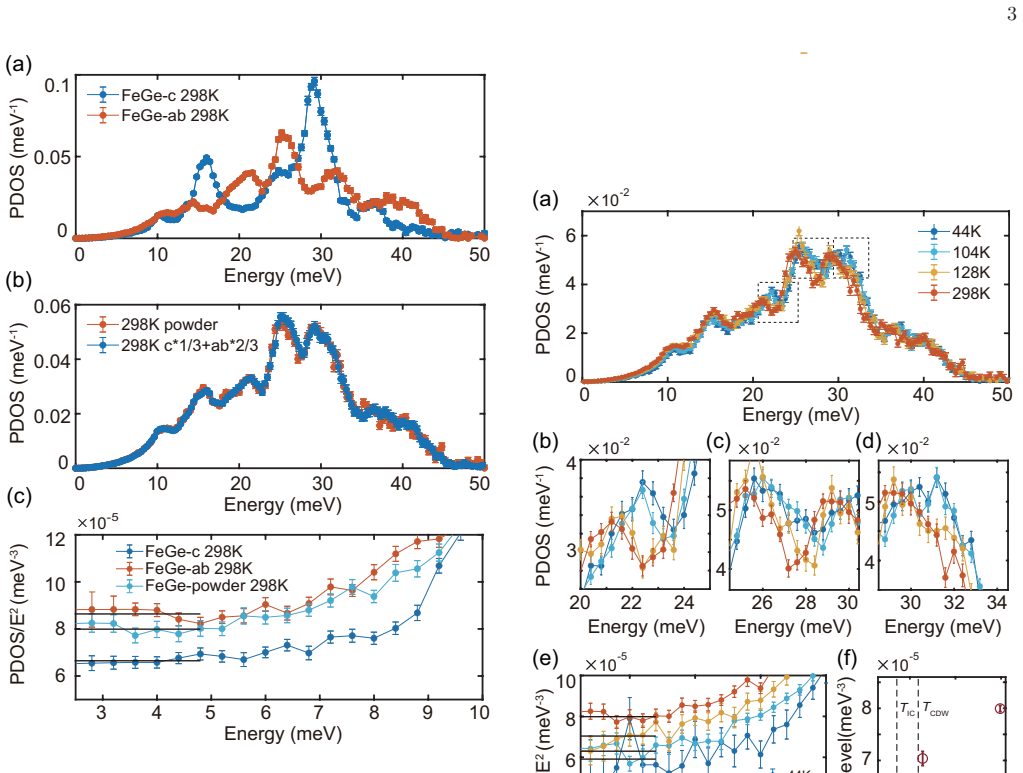
By aligning the incident X-rays with a particular crystal axis, NIS measurements selectively probe the partial PDOS polarized along this axis. Fig. 2(a) compares the c-axis and ab-plane polarized PDOS [gab(E) and gc(E)], revealing peaks at 16 meV and 29 meV with a dominant c-axis polarization, and peaks at 21 meV, 25 meV, 32 meV, and 40 meV with a dominan...
-
[3]
2(c)], giving ⟨vc⟩ = (3
07) × 10− 5 meV− 3 [Fig. 2(c)], giving ⟨vc⟩ = (3 . 25 ±
-
[4]
01) km/s and ⟨vab⟩ = (2 . 98 ± 0. 01) km/s. Note that within experimental uncertainties, these values fulfill the relationship 1 3 α c + 2 3 α ab = α , consistent with the overall agreement of PDOS in Fig. 2(b). To investigate the evolution of the Fe partial PDOS across TCDW and TIC, NIS measurements were performed on FeGe powders at several temperatures, ...
-
[5]
The overall features of the PDOS are not strongly affected by the transitions at TCDW and TIC, although optical modes around 22 meV, 27 meV, and 31 meV clearly harden upon entering the CDW phase [Fig. 3(a)]. For comparison, the optical modes at 16 meV and 40 meV do no change significantly in energy across TCDW. Zooming into the modes at 22 meV, 27 meV, and ...
2024
-
[6]
Neupert, M
T. Neupert, M. M. Denner, J.-X. Yin, R. Thomale, and M. Z. Hasan, Nature Physics 18, 137–143 (2021)
2021
-
[7]
J.-X. Yin, B. Lian, and M. Z. Hasan, Nature 612, 647–657 (2022)
2022
-
[8]
Y. Jiang, H. Hu, D. C˘ alug˘ aru, C. Felser, S. Blanco- Canosa, H. Weng, Y. Xu, and B. A. Bernevig, “Kagome Materials II: SG 191: FeGe as a LEGO Building Block for the Entire 1:6:6 series: hidden d-orbital decoupling of flat band sectors, effective models and interaction Hamil- tonians,” (2023), arXiv:2311.09290 [cond-mat]
arXiv 2023
-
[9]
Y. Wang, H. Wu, G. T. McCandless, J. Y. Chan, and M. N. Ali, Nature Reviews Physics 5, 635–658 (2023)
2023
-
[10]
S. D. Wilson and B. R. Ortiz, Nature Reviews Materials 9, 420–432 (2024)
2024
-
[11]
Y. Zhou, G. Ye, S. Luo, Y. Song, X. Lu, and H. Yuan, Su- perconductor Science and Technology 37, 103001 (2024)
2024
-
[12]
X. Teng, L. Chen, F. Ye, E. Rosenberg, Z. Liu, J.-X. Yin, Y.-X. Jiang, J. S. Oh, M. Z. Hasan, K. J. Neubauer, B. Gao, Y. Xie, M. Hashimoto, D. Lu, C. Jozwiak, A. Bostwick, E. Rotenberg, R. J. Birgeneau, J.-H. Chu, M. Yi, and P. Dai, Nature 609, 490 (2022) , publisher: Nature Publishing Group
2022
-
[13]
Yin, Y.-X
J.-X. Yin, Y.-X. Jiang, X. Teng, M. S. Hossain, S. Mar- danya, T.-R. Chang, Z. Ye, G. Xu, M. M. Denner, T. Neupert, B. Lienhard, H.-B. Deng, C. Setty, Q. Si, G. Chang, Z. Guguchia, B. Gao, N. Shumiya, Q. Zhang, T. A. Cochran, D. Multer, M. Yi, P. Dai, and M. Z. Hasan, Phys. Rev. Lett. 129, 166401 (2022)
2022
-
[14]
X. Teng, J. S. Oh, H. Tan, L. Chen, J. Huang, B. Gao, J.-X. Yin, J.-H. Chu, M. Hashimoto, D. Lu, C. Jozwiak, A. Bostwick, E. Rotenberg, G. E. Granroth, B. Yan, R. J. Birgeneau, P. Dai, and M. Yi, Nat. Phys. 19, 814 (2023) , publisher: Nature Publishing Group
2023
-
[15]
S. Yi, Z. Liao, Q. Wang, H. Ma, J. Liu, X. Teng, B. Gao, P. Dai, Y. Dai, J. Zhao, Y. Qi, B. Xu, and X. Qiu, Physical Review Letters 134, 086902 (2025)
2025
-
[16]
H. W. S. Arachchige, W. R. Meier, M. Marshall, T. Mat- suoka, R. Xue, M. A. McGuire, R. P. Hermann, H. Cao, and D. Mandrus, Physical Review Letters 129 (2022), 10.1103/physrevlett.129.216402
-
[17]
L. Chen, X. Teng, H. Tan, B. L. Winn, G. E. Granroth, F. Ye, D. H. Yu, R. A. Mole, B. Gao, B. Yan, M. Yi, and P. Dai, Nat Commun 15, 1918 (2024) , publisher: Nature Publishing Group
1918
-
[18]
H. Miao, T. T. Zhang, H. X. Li, G. Fabbris, A. H. Said, R. Tartaglia, T. Yilmaz, E. Vescovo, J.-X. Yin, S. Mu- rakami, X. L. Feng, K. Jiang, X. L. Wu, A. F. Wang, S. Okamoto, Y. L. Wang, and H. N. Lee, Nat Commun 14, 6183 (2023), number: 1 Publisher: Nature Publishing Group
2023
-
[19]
Wang, Phys
Y. Wang, Phys. Rev. Mater. 7, 104006 (2023) , publisher: American Physical Society
2023
-
[20]
X. Wu, X. Mi, L. Zhang, C.-W. Wang, N. Maraytta, X. Zhou, M. He, M. Merz, Y. Chai, and A. Wang, Phys. Rev. Lett. 132, 256501 (2024)
2024
-
[21]
C. Shi, Y. Liu, B. B. Maity, Q. Wang, S. R. Kotla, S. Ramakrishnan, C. Eisele, H. Agarwal, L. Noohine- jad, Q. Tao, B. Kang, Z. Lou, X. Yang, Y. Qi, X. Lin, Z.-A. Xu, A. Thamizhavel, G.-H. Cao, S. van Smaalen, S. Cao, and J.-K. Bao, Sci. China Phys. Mech. Astron. 67, 117012 (2024)
2024
-
[22]
Z. Chen, X. Wu, S. Zhou, J. Zhang, R. Yin, Y. Li, M. Li, J. Gong, M. He, Y. Chai, X. Zhou, Y. Wang, A. Wang, Y.-J. Yan, and D.-L. Feng, Nat Commun 15, 6262 (2024) , publisher: Nature Publishing Group
2024
-
[23]
M. L. Klemm, S. Siddique, Y.-C. Chang, S. Xu, Y. Xie, T. Legvold, M. T. Kiani, X. Teng, B. Gao, F. Ye, H. Cao, Y. Hao, W. Tian, H. Luetkens, M. Matsuda, D. Natelson, Z. Guguchia, C.-L. Huang, M. Yi, J. J. Cha, and P. Dai, Nature Communications 16 (2025), 10.1038/s41467-025-58583-y
-
[24]
M. L. Klemm, T. Zhang, B. L. Winn, F. Li, F. Ye, M. Matsuda, A. Maity, S. Xu, X. Teng, Y. Umemoto, B. Gao, M. Yi, and P. Dai, Physical Review B 112, 174422 (2025)
2025
-
[25]
Bernhard, B
J. Bernhard, B. Lebech, and O. Beckman, Journal of Physics F: Metal Physics 18, 539–552 (1988)
1988
-
[26]
J. S. Oh, A. Biswas, M. L. Klemm, H. Tan, Y. Xie, B. Gao, M. Hashimoto, D. Lu, B. Yan, P. Dai, R. J. Birgeneau, and M. Yi, Science Advances 11 (2025), 10.1126/sciadv.adt2195
-
[27]
X. Teng, D. W. Tam, L. Chen, H. Tan, Y. Xie, B. Gao, G. E. Granroth, A. Ivanov, P. Bourges, B. Yan, M. Yi, and P. Dai, Phys. Rev. Lett. 133, 046502 (2024) , pub- lisher: American Physical Society
2024
-
[28]
Tan and B
H. Tan and B. Yan, Phys. Rev. B 111, 045160 (2025)
2025
-
[29]
Wille, H
H.-C. Wille, H. Franz, R. R¨ ohlsberger, W. A. Caliebe, and F.-U. Dill, Journal of Physics: Conference Series 217, 012008 (2010)
2010
-
[30]
Kohn and A
V. Kohn and A. Chumakov, Hyperfine Interactions 125, 205–221 (2000)
2000
-
[31]
Kresse and J
G. Kresse and J. Furthm¨ uller, Phys. Rev. B 54, 11169 (1996). 8
1996
-
[32]
P. E. Bl¨ ochl,Phys. Rev. B 50, 17953 (1994)
1994
-
[33]
J. P. Perdew, K. Burke, and M. Ernzerhof, Phys. Rev. Lett. 77, 3865 (1996)
1996
-
[34]
Togo and I
A. Togo and I. Tanaka, Scripta Materialia 108, 1 (2015)
2015
-
[35]
J. Ma, C. Shi, Y. Cao, Y. Zhang, Y. Li, J. Liao, J. Wang, W. Jiao, H. Guo, C. Xu, S. Cao, J. Dai, J.-K. Bao, and Y. Li, Sci. China Phys. Mech. Astron. 68, 237412 (2025)
2025
-
[36]
A. I. Chumakov, A. Bosak, and R. R¨ uffer, Physical Re- view B 80 (2009), 10.1103/physrevb.80.094303
-
[37]
V. Ksenofontov, G. Wortmann, A. I. Chumakov, T. Gasi, S. Medvedev, T. M. McQueen, R. J. Cava, and C. Felser, Physical Review B 81 (2010), 10.1103/phys- revb.81.184510
-
[38]
D. Subires, A. Kar, A. Korshunov, C. A. Fuller, Y. Jiang, H. Hu, D. C˘ alug˘ aru, C. McMonagle, C. Yi, S. Roychowdhury, W. Schnelle, C. Shekhar, J. Strempfer, A. Jana, I. Vobornik, J. Dai, M. Tallarida, D. Chernyshov, A. Bosak, C. Felser, B. A. Bernevig, and S. Blanco-Canosa, Nature Communications 16 (2025), 10.1038/s41467-025-58725-2
-
[39]
Y. Wang, C. Xu, Z. Wu, H. Rao, Z. Shan, Y. Liu, G. Cao, M. Smidman, M. Shi, H. Yuan, T. Wu, X. Chen, C. Cao, and Y. Song, Phys. Rev. Lett. 136, 136401 (2026)
2026
-
[40]
Soft Mode Origin of Charge Ordering in Superconduct- ing Kagome CsV $ 3$Sb$ 5$,
P. H. McGuinness, F. Henssler, M. Alkorta, M. J. G. von Westarp, A. Korshunov, A. Bosak, D. Ishikawa, A. Q. R. Baron, M. Merz, A.-A. Haghighirad, M. G. Vergniory, S.-M. Souliou, R. Heid, I. Errea, and M. L. Tacon, “Soft Mode Origin of Charge Ordering in Superconduct- ing Kagome CsV $ 3$Sb$ 5$,” (2025), arXiv:2510.19790 [cond-mat]
Pith/arXiv arXiv 2025
-
[41]
S. Cao, C. Xu, H. Fukui, T. Manjo, Y. Dong, M. Shi, Y. Liu, C. Cao, and Y. Song, Nature Communications 14, 7671 (2023)
2023
-
[42]
Korshunov, H
A. Korshunov, H. Hu, D. Subires, Y. Jiang, D. C˘ alug˘ aru, X. Feng, A. Rajapitamahuni, C. Yi, S. Roychowdhury, M. G. Vergniory, J. Strempfer, C. Shekhar, E. Vescovo, D. Chernyshov, A. H. Said, A. Bosak, C. Felser, B. A. Bernevig, and S. Blanco-Canosa, Nature Communica- tions 14, 6646 (2023)
2023
-
[43]
F. Z. Yang, X. Huang, H. Tan, A. Kundu, S. Kim, M. Thinel, J. Ingham, A. Rajapitamahuni, Y. Q. Cai, C. Nelson, E. Vescovo, W. R. Meier, D. Mandrus, B. R. Ortiz, A. N. Pasupathy, B. Yan, and H. Miao, Physical Review B 112, 245113 (2025)
2025
-
[44]
M. Seto, R. Masuda, S. Higashitaniguchi, S. Kitao, Y. Kobayashi, C. Inaba, T. Mitsui, and Y. Yoda, Phys. Rev. Lett. 102, 217602 (2009)
2009
-
[45]
M. Seto, J. Phys. Soc. Jpn. 82, 021016 (2013)
2013
-
[46]
Yoshida and G
Y. Yoshida and G. Langouche, eds., Modern M¨ ossbauer Spectroscopy: New Challenges Based on Cutting-Edge Techniques , Topics in Applied Physics, Vol. 137 (Springer Singapore)
-
[47]
Tomiyoshi, H
S. Tomiyoshi, H. Yamamoto, and H. Watanabe, J. Phys. Soc. Jpn. 21, 709 (1966) , publisher: The Physical Society of Japan
1966
-
[48]
Lennart H¨ aggstr¨ om, Tore Ericsson, Roger W¨ appling, and Erik Karlsson, Phys. Scr. 11, 55 (1975)
1975
-
[49]
Nexus - nuclear elastic x-ray scattering uni- versal software,
L. Bocklage, “Nexus - nuclear elastic x-ray scattering uni- versal software,” (2024)
2024
-
[50]
C. Shi, W. Hou, H. Deng, B. Patra, S. R. Kotla, Y. Liu, S. Ramakrishnan, C. Eisele, H. Agarwal, L. Noohinejad, J.-Y. Liu, T. Yang, G. Liu, B. B. Maity, Q. Wang, Z. Lin, B. Kang, W. Yang, Y. Li, Z. Yang, Y. Chen, X. Li, Y. Li, Y. Qi, A. Thamizhavel, W. Ren, G.-H. Cao, J.-X. Yin, B. Singh, X. Liu, S. Van Smaalen, S. Cao, and J.-K. Bao, Communications Physic...
2025
discussion (0)
Sign in with ORCID, Apple, or X to comment. Anyone can read and Pith papers without signing in.