Searching for cosmic vortices
Pith reviewed 2026-06-27 08:47 UTC · model grok-4.3
The pith
A white dwarf passing a black hole forms an accretion disc with quantized vortices that produce flickering electromagnetic signals on few-second timescales while the receding star emits gravitational waves.
A machine-rendered reading of the paper's core claim, the machinery that carries it, and where it could break.
Core claim
The paper claims that modeling the white dwarf as a Bose-Fermi droplet and evolving the system with quantum hydrodynamic equations shows that mass loss at periastron creates an accretion disc with quantized vortices. These vortices manifest as strong electromagnetic radiation signals exhibiting characteristic flickering patterns on a timescale of a few seconds. As the white dwarf recedes, vortices along its surface elongate its geometry, causing it to rotate and emit gravitational waves.
What carries the argument
Quantized vortices that form both in the accretion disc around the black hole and along the surface of the receding white dwarf, obtained from the quantum hydrodynamic evolution of the Bose-Fermi droplet model.
If this is right
- The accretion disc produces strong electromagnetic radiation with flickering patterns changing on a timescale of a few seconds.
- Vortices on the white dwarf surface elongate its geometry, causing rotation and gravitational wave emission as the star recedes.
- The white dwarf moves away from the black hole while carrying surface vortices that sustain the elongated rotating shape.
- These electromagnetic and gravitational signals arise directly from the mass lost during the periastron passage.
Where Pith is reading between the lines
- Electromagnetic surveys could search for the predicted few-second flickering in X-ray or optical data from white-dwarf disruption candidates.
- Gravitational-wave detectors might record the emission if the vortex-driven elongation is large enough.
- The same quantum-hydrodynamic treatment might be applied to other compact-object encounters to test whether vortices appear under different mass or composition conditions.
- Detection of both the flickering and the gravitational waves from one event would link the disc and stellar-surface vortex populations.
Load-bearing premise
The white dwarf can be accurately modeled as a Bose-Fermi droplet whose evolution is captured by quantum hydrodynamic equations, and that mass loss during periastron passage forms an accretion disc containing quantized vortices whose electromagnetic and gravitational signatures follow directly from that model.
What would settle it
Absence of electromagnetic flickering signals varying on timescales of a few seconds in observations of candidate white-dwarf tidal disruption events near black holes, or lack of associated gravitational-wave emission from the departing white dwarf.
Figures
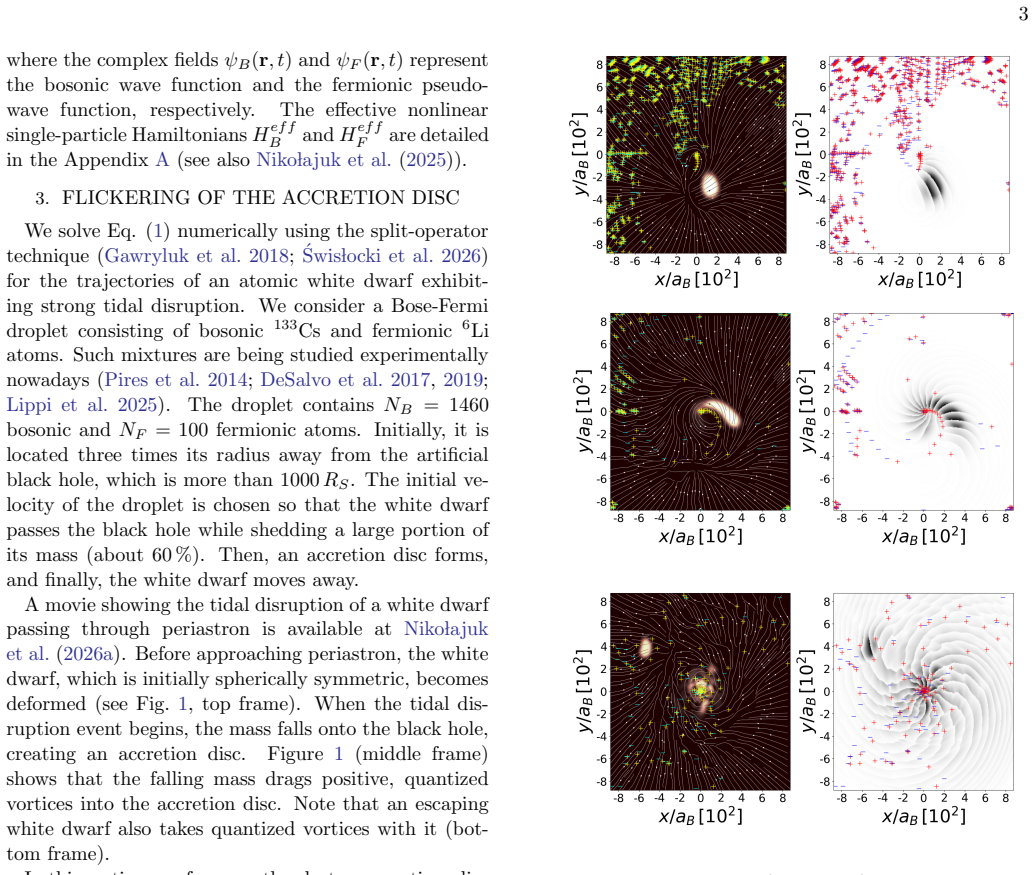
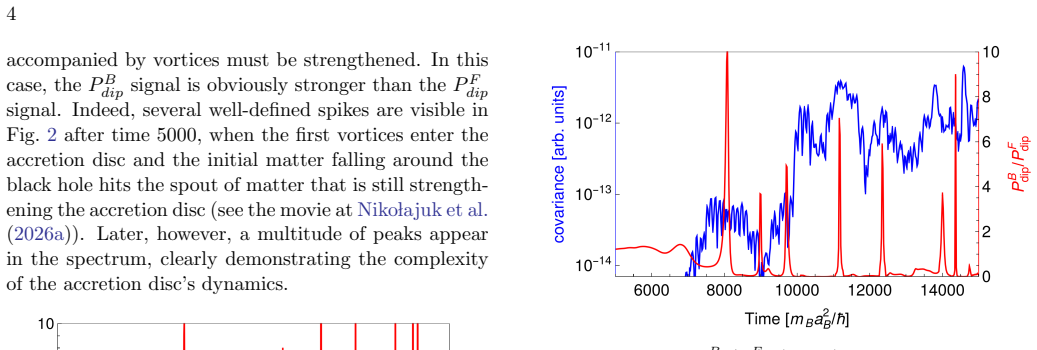
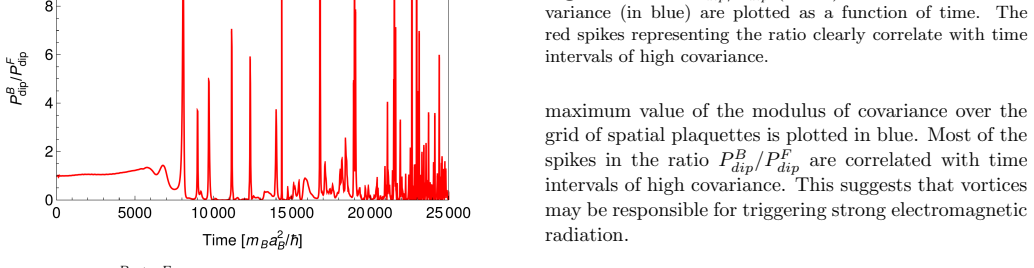
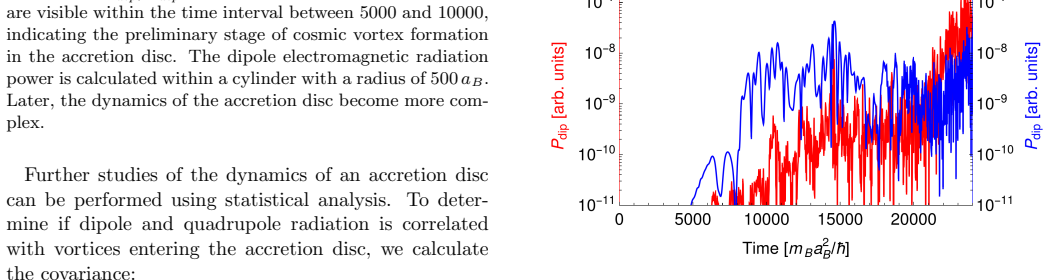
read the original abstract
Our study focuses on the strong tidal disruption of a cold helium white dwarf passing a black hole. We model the white dwarf as a Bose-Fermi droplet and use quantum hydrodynamic equations to simulate the binary system's evolution. As the white dwarf passes through periastron, it loses a significant amount of mass. This mass falls onto the black hole and forms an accretion disc. Quantized vortices appear in the accretion disc, manifesting as strong electromagnetic radiation signals that exhibit characteristic flickering patterns changing on a timescale of a few seconds. Meanwhile, the white dwarf moves away from the black hole. As the white dwarf moves through space, vortices run along its surface. This elongates its geometry, causing it to rotate and emit gravitational waves.
Editorial analysis
A structured set of objections, weighed in public.
Referee Report
Summary. The manuscript claims that modeling a cold helium white dwarf as a Bose-Fermi droplet with quantum hydrodynamic equations during strong tidal disruption by a black hole leads to mass loss forming an accretion disc containing quantized vortices. These vortices produce strong electromagnetic radiation with characteristic flickering on timescales of a few seconds. The remaining white dwarf develops surface vortices that elongate its geometry, induce rotation, and generate gravitational waves.
Significance. If the modeling assumptions were shown to hold, the work would propose novel multi-messenger signatures (EM flickering plus GWs) from white-dwarf tidal disruptions that link quantum hydrodynamics to observable astrophysical signals. The approach is conceptually distinctive in applying a Bose-Fermi droplet description to a compact object, but the absence of validation, parameter choices, or comparison to standard TDE treatments limits its immediate significance.
major comments (2)
- [Abstract and modeling description] Abstract and modeling description: the central claim that quantized vortices form in the post-periastron accretion disc and directly produce the reported EM flickering signals rests on the unexamined extension of the quantum hydrodynamic equations (used for the initial cold WD) to the stripped material. No derivation or citation establishes that this material remains a degenerate Bose-Fermi system once it forms a disc, in contrast to standard hot, ionized TDE disc models treated with MHD or hydrodynamics where quantized circulation is not expected.
- [Abstract and results on white-dwarf evolution] Abstract and results on white-dwarf evolution: the assertion that surface vortices elongate the white dwarf, cause rotation, and emit gravitational waves is presented without quantitative support (e.g., no equations for the elongation timescale, angular momentum transfer, or resulting GW strain), rendering the GW prediction unassessable and load-bearing for the multi-messenger claim.
minor comments (2)
- [Abstract] The abstract supplies no equations, simulation parameters, or validation checks, which hinders immediate evaluation of the quantitative claims even at a high level.
- Notation for the Bose-Fermi droplet and quantum hydrodynamic equations should be defined explicitly on first use to improve readability for readers outside the immediate subfield.
Simulated Author's Rebuttal
We thank the referee for the detailed report and the opportunity to clarify our work. We address each major comment below, agreeing where additional justification is needed and outlining the planned revisions.
read point-by-point responses
-
Referee: [Abstract and modeling description] Abstract and modeling description: the central claim that quantized vortices form in the post-periastron accretion disc and directly produce the reported EM flickering signals rests on the unexamined extension of the quantum hydrodynamic equations (used for the initial cold WD) to the stripped material. No derivation or citation establishes that this material remains a degenerate Bose-Fermi system once it forms a disc, in contrast to standard hot, ionized TDE disc models treated with MHD or hydrodynamics where quantized circulation is not expected.
Authors: The manuscript applies the quantum hydrodynamic equations to the full binary evolution, including the mass stripped at periastron that forms the disc, under the assumption that the cold helium material retains sufficient degeneracy for quantized vortices to persist. We acknowledge that the current text does not include an explicit derivation or additional citations addressing the transition to disc conditions versus standard hot TDE models. In revision we will add a subsection on model assumptions, including estimates of post-stripping density and temperature regimes and references to prior work on quantum fluid descriptions in compact-object contexts, to make the extension explicit. revision: yes
-
Referee: [Abstract and results on white-dwarf evolution] Abstract and results on white-dwarf evolution: the assertion that surface vortices elongate the white dwarf, cause rotation, and emit gravitational waves is presented without quantitative support (e.g., no equations for the elongation timescale, angular momentum transfer, or resulting GW strain), rendering the GW prediction unassessable and load-bearing for the multi-messenger claim.
Authors: The referee is correct that the gravitational-wave claim currently rests on a qualitative description of surface vortices and elongation without accompanying equations or estimates. The simulation shows the geometric change and induced rotation, but quantitative details such as timescale, angular-momentum transfer, and strain are not provided. We will revise the relevant section to include order-of-magnitude calculations for the elongation timescale based on vortex motion, a simple angular-momentum estimate, and a quadrupole-formula strain estimate for the rotating elongated body. revision: yes
Circularity Check
No circularity: model application yields simulation outputs without definitional reduction
full rationale
The paper applies quantum hydrodynamic equations to a Bose-Fermi droplet model of the white dwarf and reports simulation outcomes for mass loss, disc formation, and vortex appearance. No equations, parameter fits, or self-citations are shown that define the target signatures (flickering EM signals or GW emission) directly in terms of the inputs. The claims follow from running the stated model rather than renaming or fitting the same quantities. The derivation chain is therefore self-contained against external benchmarks.
Axiom & Free-Parameter Ledger
Reference graph
Works this paper leans on
-
[1]
URL https: //link.aps.org/doi/10.1103/PhysRevLett.116.061102
Abbott, B. P., Abbott, R., Abbott, T. D., et al. 2016, PhRvL, 116, 061102, doi: 10.1103/PhysRevLett.116.061102
-
[2]
G., C´ orsico, A
Althaus, L. G., C´ orsico, A. H., Isern, J., & Garc´ ıa-Berro, E. 2010, Astron. Astrophys. Rev., 18, 471
2010
-
[3]
Arcodia, R., Merloni, A., Nandra, K., et al. 2021, Nature, 592, 704, doi: 10.1038/s41586-021-03394-6 Armas Padilla, M., Corral-Santana, J. M., Borghese, A., et al. 2023, A&A, 677, A186, doi: 10.1051/0004-6361/202346797
-
[4]
Ball, J. A., Wheeler, J. A., & Firemen, E. L. 1973, Reviews of Modern Physics, 45, 333, doi: 10.1103/RevModPhys.45.333
-
[5]
Baynham, C. F. A., Hobson, R., Buchmueller, O., et al. 2025, arXiv e-prints, arXiv:2504.09158, doi: 10.48550/arXiv.2504.09158
work page internal anchor Pith review Pith/arXiv arXiv doi:10.48550/arxiv.2504.09158 2025
-
[6]
A., & Rokhsar, D
Butts, D. A., & Rokhsar, D. S. 1999, Nature, 397, 327
1999
-
[7]
2026, ApJ, 1000, 95, doi: 10.3847/1538-4357/ae4876 C´ orsico, A
Chakraborty, J., Masterson, M., Mummery, A., et al. 2026, ApJ, 1000, 95, doi: 10.3847/1538-4357/ae4876 C´ orsico, A. H., Althaus, L. G., Miller Bertolami, M. M., &
-
[8]
Kepler, S. O. 2019, Astron. Astrophys. Rev., 27, 7
2019
-
[9]
Czerny, B., Niko lajuk, M., Piasecki, M., & Kuraszkiewicz, J. 2001, MNRAS, 325, 865, doi: 10.1046/j.1365-8711.2001.04522.x
-
[10]
C., Bahramian, A., Naoz, S., et al
Dage, K. C., Bahramian, A., Naoz, S., et al. 2024, MNRAS, 529, 1347, doi: 10.1093/mnras/stae578
-
[11]
J., Patel, K., Cai, G., & Chin, C
DeSalvo, B. J., Patel, K., Cai, G., & Chin, C. 2019, Nature, 568, 61, doi: 10.1038/s41586-019-1055-0
-
[12]
J., Patel, K., Johansen, J., & Chin, C
DeSalvo, B. J., Patel, K., Johansen, J., & Chin, C. 2017, PhRvL, 119, 233401, doi: 10.1103/PhysRevLett.119.233401
-
[13]
K., & Deb, B
Dey, B. K., & Deb, B. M. 1998, Int. J. Quantum Chem., 70, 441
1998
-
[14]
Domps, A., Reinhard, P. G., & Suraud, E. 1998, PhRvL, 80, 5520, doi: 10.1103/PhysRevLett.80.5520
-
[15]
1998, Astron
Ergma, E., & Fedorova, A. 1998, Astron. Astrophys., 338, 69 Fr¨ olich, H. 1967, Physica, 37, 215
1998
-
[16]
2009, JCAP, 2009, 017, doi: 10.1088/1475-7516/2009/05/017
Gabadadze, G., & Pirtskhalava, D. 2009, JCAP, 2009, 017, doi: 10.1088/1475-7516/2009/05/017
-
[17]
Gabadadze, G., & Rosen, R. A. 2008a, JCAP, 2008, 030, doi: 10.1088/1475-7516/2008/10/030 —. 2008b, Physics Letters B, 658, 266, doi: 10.1016/j.physletb.2007.08.058
-
[18]
2018, Int
Brewczyk, M. 2018, Int. J. Comput. Math., 95, 2143
2018
-
[19]
2021, MNRAS, 508, 3463, doi: 10.1093/mnras/stab2818 Gonz´ alez-Mart´ ın, O., & Vaughan, S
Georgakakis, A., Papadakis, I., & Paolillo, M. 2021, MNRAS, 508, 3463, doi: 10.1093/mnras/stab2818 Gonz´ alez-Mart´ ın, O., & Vaughan, S. 2012, A&A, 544, A80, doi: 10.1051/0004-6361/201219008
-
[20]
T., Karpiuk, T., Brewczyk, M., & Rz¸ a˙ zewski, K
Grochowski, P. T., Karpiuk, T., Brewczyk, M., & Rz¸ a˙ zewski, K. 2017, PhRvL, 119, 215303, doi: 10.1103/PhysRevLett.119.215303 —. 2020, PhRvL, 125, 103401, doi: 10.1103/PhysRevLett.125.103401
-
[21]
Irwin, J. A., Maksym, W. P., Sivakoff, G. R., et al. 2016, Nature, 538, 356, doi: 10.1038/nature19822 10
-
[22]
2020, New Journal of Physics, 22, 103025, doi: 10.1088/1367-2630/abbcef
Karpiuk, T., Gajda, M., & Brewczyk, M. 2020, New Journal of Physics, 22, 103025, doi: 10.1088/1367-2630/abbcef
-
[23]
2021, Scientific Reports, 11, 2286, doi: 10.1038/s41598-021-81707-5
Karpiuk, T., Niko lajuk, M., Gajda, M., & Brewczyk, M. 2021, Scientific Reports, 11, 2286, doi: 10.1038/s41598-021-81707-5
-
[24]
Krolik, J. H., & Piran, T. 2011, ApJ, 743, 134, doi: 10.1088/0004-637X/743/2/134
-
[25]
2025, Few-Body Syst., 66, 1
Lippi, E., Gerken, M., H¨ afner, S., et al. 2025, Few-Body Syst., 66, 1
2025
-
[26]
Astronomy and Astrophysics , author =
Liu, Z., Malyali, A., Krumpe, M., et al. 2023, A&A, 669, A75, doi: 10.1051/0004-6361/202244805
-
[27]
1927, Zeitschrift fur Physik, 40, 322, doi: 10.1007/BF01400372
Madelung, E. 1927, Zeitschrift fur Physik, 40, 322, doi: 10.1007/BF01400372
-
[28]
2008, Gravitational waves (Oxford University Press)
Maggiore, M. 2008, Gravitational waves (Oxford University Press)
2008
-
[29]
H., & Deb, B
March, N. H., & Deb, B. M. 1987, The single-particle density in physics and chemistry (Academic Press, London)
1987
-
[30]
2003, ApJ, 593, 96, doi: 10.1086/375330
Markowitz, A., Edelson, R., Vaughan, S., et al. 2003, ApJ, 593, 96, doi: 10.1086/375330
-
[31]
Fender, R. P. 2006, Nature, 444, 730, doi: 10.1038/nature05389
-
[32]
Miller-Jones, J. C. A., Strader, J., Heinke, C. O., et al. 2015, MNRAS, 453, 3918
2015
-
[33]
Miniutti, G., Saxton, R. D., Giustini, M., et al. 2019, Nature, 573, 381, doi: 10.1038/s41586-019-1556-x
-
[34]
Vito, M. A. 2010, Physics Letters B, 683, 119, doi: 10.1016/j.physletb.2009.12.011 Niko lajuk, M., Karpiuk, T., & Brewczyk, M. 2026a. https://youtu.be/UDbM1FjWyDI —. 2026b. https://youtube.com/shorts/r7 2MVDvwEM Niko lajuk, M., Karpiuk, T., Ducci, L., & Brewczyk, M. 2025, ApJ, 980, 256, doi: 10.3847/1538-4357/adae8c
-
[35]
Nikolajuk, M., Papadakis, I. E., & Czerny, B. 2004, MNRAS, 350, L26, doi: 10.1111/j.1365-2966.2004.07829.x Paczy´ nsky, B., & Wiita, P. J. 1980, A&A, 88, 23
-
[36]
2014, PhRvL, 112, 250404, doi: 10.1103/PhysRevLett.112.250404
Pires, R., Ulmanis, J., H¨ afner, S., et al. 2014, PhRvL, 112, 250404, doi: 10.1103/PhysRevLett.112.250404
-
[37]
2019, SciPost Physics, 6, 079, doi: 10.21468/SciPostPhys.6.6.079
Rakshit, D., Karpiuk, T., Brewczyk, M., & Gajda, M. 2019, SciPost Physics, 6, 079, doi: 10.21468/SciPostPhys.6.6.079
-
[38]
2022, Physics Reports, 988, 1
Saumon, D., Blouin, S., & Tremblay, P.-E. 2022, Physics Reports, 988, 1
2022
-
[39]
The physics of compact objects
Shapiro, S. L., & Teukolsky, S. A. 1983, Black holes, white dwarfs and neutron stars. The physics of compact objects (A Wiley-Interscience Publication), doi: 10.1002/9783527617661
-
[40]
2019, ApJL, 871, L17, doi: 10.3847/2041-8213/aafc64
Shen, R.-F. 2019, ApJL, 871, L17, doi: 10.3847/2041-8213/aafc64
-
[41]
Sivakoff, G. R., Sarazin, C. L., & Jord´ an, A. 2005, ApJL, 624, L17, doi: 10.1086/430374
-
[42]
2021, MNRAS, 507, 330 ´Swis locki, T., Gawryluk, K., Brewczyk, M., & Karpiuk, T
Stoop, M., van den Eijnden, J., Degenaar, N., et al. 2021, MNRAS, 507, 330 ´Swis locki, T., Gawryluk, K., Brewczyk, M., & Karpiuk, T. 2026, Comput. Phys. Commun., 318, 109897
2021
-
[43]
2022, A&A, 661, A68, doi: 10.1051/0004-6361/202142662
Tiengo, A., Esposito, P., Toscani, M., et al. 2022, A&A, 661, A68, doi: 10.1051/0004-6361/202142662
-
[44]
Tutukov, A. V., & Fedorova, A. V. 2007, Astronomy Reports, 51, 847, doi: 10.1134/S1063772907100095
-
[45]
Uttley, P., McHardy, I. M., & Papadakis, I. E. 2002, MNRAS, 332, 231, doi: 10.1046/j.1365-8711.2002.05298.x
-
[46]
2002, PhRvA, 66, 063604, doi: 10.1103/PhysRevA.66.063604
Viverit, L., & Giorgini, S. 2002, PhRvA, 66, 063604, doi: 10.1103/PhysRevA.66.063604
-
[47]
Wong, C.-Y., & McDonald, J. A. 1977, PhRvC, 16, 1196, doi: 10.1103/PhysRevC.16.1196
discussion (0)
Sign in with ORCID, Apple, or X to comment. Anyone can read and Pith papers without signing in.