Schubert Calculus and uniform property Gamma
Pith reviewed 2026-06-27 07:29 UTC · model grok-4.3
The pith
A nuclear C*-algebra lacks uniform property Γ because a quadratic Schubert calculus obstruction from determinantal Schur classes persists through its inductive construction and blocks trace comparison of projections.
A machine-rendered reading of the paper's core claim, the machinery that carries it, and where it could break.
Core claim
The author constructs a nuclear C*-algebra in which every bundle map between certain equal-rank vector bundles vanishes somewhere, using Thom-Porteous theory of degeneracy loci. Quadratic Schubert calculus shows that the associated determinantal Schur classes remain nonzero through the inductive system of homogeneous C*-algebras. This prevents projections from being compared by traces in the uniform tracial completion, yielding an algebra without uniform property Γ. The classes live in degree proportional to the square of the forced rank loss, forcing quadratic dimension growth in the constituent algebras.
What carries the argument
The non-vanishing of determinantal Schur classes (Thom-Porteous classes) across an inductive system of homogeneous C*-algebras, which enforces vanishing of bundle maps and obstructs trace comparison of projections.
If this is right
- The resulting algebra is simple, separable, unital and nuclear yet lacks uniform property Γ.
- Dimension growth in the homogeneous building blocks is quadratic in the forced rank loss.
- The obstruction arises from forcing bundle maps to vanish rather than from the absence of large trivial subbundles.
- Uniform property Γ is equivalent to the ability to compare projections by traces in the uniform tracial completion for this class of algebras.
Where Pith is reading between the lines
- The same persistence argument might apply to other regularity properties such as strict comparison when dimension growth is controlled.
- One could test whether every nuclear C*-algebra with linear dimension growth must have uniform property Γ by attempting to build a counterexample with slower growth.
- The method supplies a concrete geometric criterion that could decide the presence of uniform property Γ for other inductive systems of homogeneous algebras.
Load-bearing premise
The Thom-Porteous classes arising from the determinantal Schur classes remain non-zero after passage through the inductive system of homogeneous C*-algebras.
What would settle it
A computation showing that the relevant Thom-Porteous class becomes zero in the inductive limit would show the obstruction does not persist and the algebra might satisfy uniform property Γ.
Figures
read the original abstract
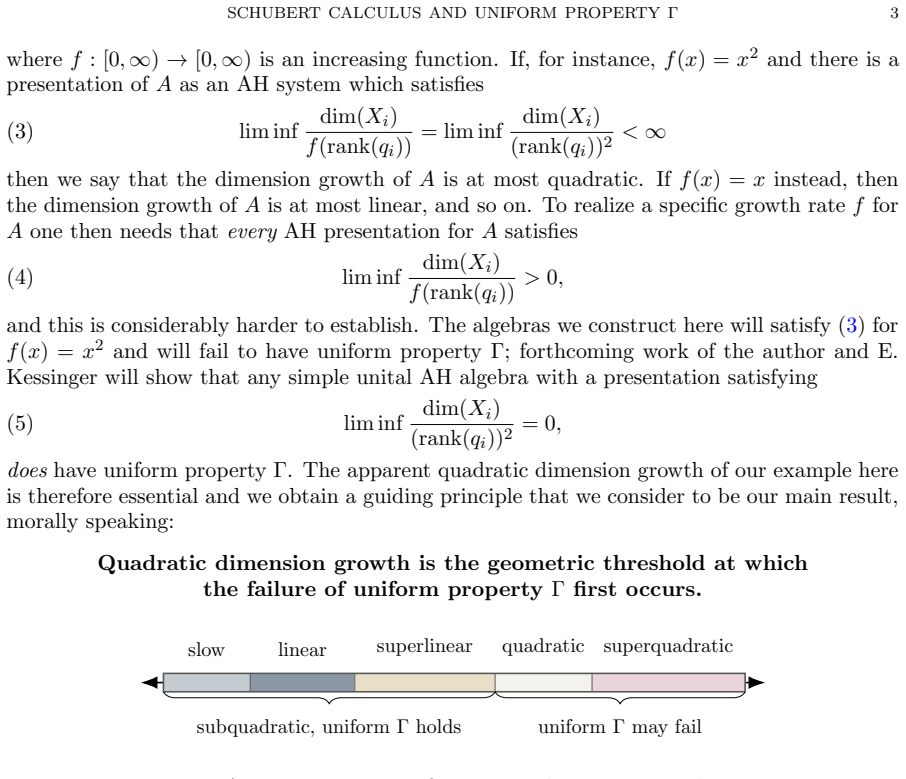
We construct a simple, separable, unital, nuclear C$^*$-algebra without uniform property $\Gamma$. The construction is based on a new topological obstruction arising from the Thom-Porteous theory of degeneracy loci. Constructions of pathological nuclear C$^*$-algebras over the past 30 years have used Chern class calculations introduced by Villadsen to obstruct the existence of large trivial subbundles. Here, by contrast, we use determinantal Schur classes to force every bundle map between certain equal-rank vector bundles to vanish somewhere on the base space. A quadratic Schubert calculus computation shows that this obstruction can persist across an inductive system and ultimately obstructs the comparison of projections by traces in the uniform tracial completion. The relevant Thom-Porteous classes live in degree proportional to the square of the forced rank loss, which in turn forces dimension growth of the same order in the constituent homogeneous C$^*$-algebras of our example. This identifies a new geometric threshold in the structure theory of nuclear C$^*$-algebras, linking the presence or absence of uniform property $\Gamma$ to quadratic dimension growth.
Editorial analysis
A structured set of objections, weighed in public.
Referee Report
Summary. The manuscript constructs a simple, separable, unital, nuclear C*-algebra without uniform property Γ. The construction relies on a new topological obstruction from Thom-Porteous theory of degeneracy loci, using determinantal Schur classes to force every bundle map between equal-rank vector bundles to vanish somewhere. A quadratic Schubert calculus computation is invoked to show that this obstruction persists across an inductive system of homogeneous C*-algebras, ultimately obstructing comparison of projections by traces in the uniform tracial completion and forcing quadratic dimension growth in the constituent algebras.
Significance. If the central claims hold, the work supplies a new obstruction mechanism for nuclear C*-algebras that links absence of uniform property Γ to quadratic dimension growth, extending earlier Chern-class techniques. The explicit use of Schubert calculus to verify persistence of Thom-Porteous classes offers a concrete computational bridge between topology and C*-algebra structure theory.
major comments (2)
- [Abstract] Abstract (paragraph on persistence of the obstruction): the claim that the Thom-Porteous classes remain nonzero after passage through the inductive system is load-bearing for the main theorem, yet the quadratic Schubert calculus computation is asserted without explicit equations, cycle representatives, or verification that the classes survive each bonding map of the system.
- [Construction] Construction of the inductive system: no explicit verification is supplied that the direct limit remains nuclear and simple once the dimension growth is imposed by the degree of the Thom-Porteous classes; this check is required to confirm the algebra meets the stated hypotheses.
minor comments (1)
- [Abstract] The abstract states that the classes live in degree proportional to the square of the forced rank loss; a brief reference to the precise degree formula or Schubert calculus identity used would improve readability.
Simulated Author's Rebuttal
We thank the referee for the positive evaluation of the work's significance and for the constructive major comments. We address each point below and will revise the manuscript accordingly to provide the requested explicit details.
read point-by-point responses
-
Referee: [Abstract] Abstract (paragraph on persistence of the obstruction): the claim that the Thom-Porteous classes remain nonzero after passage through the inductive system is load-bearing for the main theorem, yet the quadratic Schubert calculus computation is asserted without explicit equations, cycle representatives, or verification that the classes survive each bonding map of the system.
Authors: We agree that the persistence claim is central and that the current presentation of the quadratic Schubert calculus is condensed. In the revised manuscript we will expand the relevant section (or add an appendix) to include the explicit determinantal Schur class equations, the cycle representatives on the appropriate flag varieties, and a direct verification that the classes remain nonzero after each bonding map. These additions will make the computation fully traceable without altering the underlying argument. revision: yes
-
Referee: [Construction] Construction of the inductive system: no explicit verification is supplied that the direct limit remains nuclear and simple once the dimension growth is imposed by the degree of the Thom-Porteous classes; this check is required to confirm the algebra meets the stated hypotheses.
Authors: We concur that explicit verification is needed. Nuclearity of the direct limit follows at once from the nuclearity of each homogeneous stage and the stability of nuclearity under inductive limits; we will insert a short paragraph stating this standard fact. For simplicity we will add a verification paragraph showing that the chosen bonding maps ensure the limit is simple, appealing to the density of the images of the finite-stage unitaries and the fact that the dimension growth does not introduce nontrivial ideals. These clarifications will be placed in the construction section. revision: yes
Circularity Check
No circularity; obstruction derived from independent Schubert calculus computation
full rationale
The paper's derivation uses determinantal Schur classes and a quadratic Schubert calculus computation to establish persistence of the Thom-Porteous obstruction through the inductive system of homogeneous C*-algebras. This step is presented as an external topological verification (standard in algebraic geometry) rather than a reduction to fitted parameters, self-citations, or definitional equivalence within the paper. No load-bearing claim reduces by construction to the paper's own inputs; the non-vanishing result is computed independently of the C*-algebra construction itself. The overall argument therefore remains self-contained against external benchmarks.
Axiom & Free-Parameter Ledger
axioms (1)
- standard math Standard results of Thom-Porteous theory and Schubert calculus apply to the degeneracy loci of the bundle maps under consideration.
Reference graph
Works this paper leans on
-
[1]
Alboiu and J
M. Alboiu and J. Lutley , title =. M\"
-
[2]
Amrutam and D
T. Amrutam and D. Gao and S. Kunnawalkam Elayavalli and G. Patchell , title =. Invent. Math. , volume =
-
[3]
an Huef and D
A. an Huef and D. P. Williams , title =. Int. Math. Res. Not. IMRN , number =
-
[4]
Anantharaman-Delaroche , title =
C. Anantharaman-Delaroche , title =. Math. Scand. , volume =
-
[5]
Anantharaman-Delaroche , title =
C. Anantharaman-Delaroche , title =. Math. Ann. , volume =
-
[6]
Anantharaman-Delaroche and J
C. Anantharaman-Delaroche and J. Renault , title =. 2000 , note =
2000
-
[7]
Ando and E
H. Ando and E. Kirchberg , title =. J. Lond. Math. Soc. (2) , volume =
-
[8]
Antoine and F
R. Antoine and F. Perera and L. Robert and H. Thiel , title =. Duke Math. J. , volume =
-
[9]
Antoine and F
R. Antoine and F. Perera and L. Robert and H. Thiel , title =. J. Funct. Anal. , volume =
-
[10]
Antoine and F
R. Antoine and F. Perera and H. Thiel , title =. Mem. Amer. Math. Soc. , volume =
-
[11]
Antoine and F
R. Antoine and F. Perera and H. Thiel and E. Vilalta , title =. 2024 , eprint =
2024
-
[12]
Ara and K
P. Ara and K. R. Goodearl and K. C. O'Meara and E. Pardo , title =. Israel J. Math. , volume =
-
[13]
Ara and K
P. Ara and K. R. Goodearl and K. C. O'Meara and R. Raphael , title =. Pacific J. Math. , volume =
-
[14]
Ara and F
P. Ara and F. Perera and A. S. Toms , title =. Aspects of operator algebras and applications , series =
-
[15]
R. J. Archbold and J. Spielberg , title =. Proc. Edinburgh Math. Soc. (2) , volume =
-
[16]
Atkinson and I
S. Atkinson and I. Goldbring and S. Kunnawalkam Elayavalli , title =. Adv. Math. , volume =
-
[17]
Austin and A
K. Austin and A. Mitra , title =. New York J. Math. , volume =
-
[18]
Barlak and X
S. Barlak and X. Li , title =. Adv. Math. , volume =
-
[19]
Barlak and G
S. Barlak and G. Szab\'. Rokhlin actions of finite groups on. Trans. Amer. Math. Soc. , volume =
-
[20]
F. P. Baudier and B. M. Braga and I. Farah and A. Khukhro and A. Vignati and R. Willett , title =. Invent. Math. , volume =
-
[21]
E. B\'. On actions of amenable groups on. J. Funct. Anal. , volume =
-
[22]
Bentmann and R
R. Bentmann and R. Meyer , title =. Doc. Math. , volume =
-
[23]
D. H. Bisch , title =. Trans. Amer. Math. Soc. , volume =
-
[24]
Blackadar , title =
B. Blackadar , title =. Math. Scand. , volume =
-
[25]
Blackadar , title =
B. Blackadar , title =. Operator algebras and applications,
-
[26]
Blackadar , title =
B. Blackadar , title =. Ann. of Math. (2) , volume =
-
[27]
Blackadar , title =
B. Blackadar , title =
-
[28]
Blackadar , title =
B. Blackadar , title =. Operator algebras and applications , series =
-
[29]
Blackadar , title =
B. Blackadar , title =. 2006 , note =
2006
-
[30]
Blackadar and J
B. Blackadar and J. Cuntz , title =. Amer. J. Math. , volume =
-
[31]
Blackadar and D
B. Blackadar and D. E. Handelman , title =. J. Functional Analysis , volume =
-
[32]
Blackadar and E
B. Blackadar and E. Kirchberg , title =. Math. Ann. , volume =
-
[33]
Blackadar and E
B. Blackadar and E. Kirchberg , title =. Pacific J. Math. , volume =
-
[34]
Blanchard and E
E. Blanchard and E. Kirchberg , title =. J. Operator Theory , volume =
-
[35]
Blanchard and E
E. Blanchard and E. Kirchberg , title =. J. Funct. Anal. , volume =
-
[36]
Blanchard and R
E. Blanchard and R. Rohde and M. R. Properly infinite. J. Noncommut. Geom. , volume =
-
[37]
C. B\". Isomorphism and. J. Funct. Anal. , volume =
-
[38]
Bosa and N
J. Bosa and N. P. Brown and Y. Sato and A. Tikuisis and S. White and W. Winter , title =. Mem. Amer. Math. Soc. , volume =
-
[39]
Bosa and J
J. Bosa and J. Gabe and A. Sims and S. White , title =. Adv. Math. , volume =
-
[40]
Bouwen , title =
B. Bouwen , title =. 2020 , note =
2020
-
[41]
Boyle and D
M. Boyle and D. E. Handelman , title =. Israel J. Math. , volume =
-
[42]
Brake and W
L. Brake and W. Winter , title =. Bull. Lond. Math. Soc. , volume =
-
[43]
Bratteli , title =
O. Bratteli , title =. Trans. Amer. Math. Soc. , volume =
-
[44]
Bratteli and A
O. Bratteli and A. Kishimoto , title =. Q. J. Math. , volume =
-
[45]
Breuillard and M
E. Breuillard and M. Kalantar and M. Kennedy and N. Ozawa , title =. Publ. Math. Inst. Hautes \'
-
[46]
L. G. Brown , title =. Operator algebras and applications,
-
[47]
L. G. Brown and G. K. Pedersen , title =. J. Funct. Anal. , volume =
-
[48]
L. G. Brown and G. K. Pedersen , title =. J. Reine Angew. Math. , volume =
-
[49]
N. P. Brown , title =. J. Funct. Anal. , volume =
-
[50]
N. P. Brown , title =. Hokkaido Math. J. , volume =
-
[51]
N. P. Brown , title =. Mem. Amer. Math. Soc. , volume =
-
[52]
N. P. Brown and J. R. Carri\'. Decomposable approximations revisited , booktitle =
-
[53]
N. P. Brown and N. Ozawa , title =
-
[54]
N. P. Brown and F. Perera and A. S. Toms , title =. J. Reine Angew. Math. , volume =
-
[55]
N. P. Brown and A. S. Toms , title =. Int. Math. Res. Not., IMRN , year =
-
[56]
Buss and S
A. Buss and S. Echterhoff and R. Willett , title =
-
[57]
Cameron and E
J. Cameron and E. Christensen and A. M. Sinclair and R. R. Smith and S. White and A. D. Wiggins , title =. Duke Math. J. , volume =
-
[58]
T. M. Carlsen and A. Dor-On and S. r. Eilers , title =. Anal. PDE , volume =
-
[59]
J. R. Carri\'. On groups with quasidiagonal. J. Funct. Anal. , volume =
-
[60]
J. R. Carri\'on and J. Gabe and C. Schafhauser and A. Tikuisis and S. White , title =. 2023 , eprint =
2023
-
[61]
J. R. Carri\'on and J. Gabe and C. Schafhauser and A. Tikuisis and S. White , title =
-
[62]
J. R. Carri\'. A topology on. J. Lond. Math. Soc. (2) , volume =
-
[63]
Castillejos and J
J. Castillejos and J. R. Carri\'o. Tracially complete. 2023 , eprint =
2023
-
[64]
Castillejos and S
J. Castillejos and S. Evington , title =. Anal. PDE , volume =
-
[65]
Castillejos and S
J. Castillejos and S. Evington and A. Tikuisis and S. White , title =. Int. Math. Res. Not. IMRN , number =
-
[66]
Castillejos and S
J. Castillejos and S. Evington and A. Tikuisis and S. White and W. Winter , title =. Invent. Math. , volume =
-
[67]
Chabert and S
J. Chabert and S. Echterhoff and H. Oyono-Oyono , title =. Geom. Funct. Anal. , volume =
-
[68]
Chakraborty and S
S. Chakraborty and S. Echterhoff and J. Kranz and S. Nishikawa , title =. Math. Ann. , volume =
-
[69]
Champetier and V
C. Champetier and V. Guirardel , title =. Israel J. Math. , volume =
-
[70]
M. D. Choi and E. G. Effros , title =. Ann. of Math. (2) , volume =
-
[71]
Christensen , title =
E. Christensen , title =. Acta Math. , volume =
-
[72]
Christensen and A
E. Christensen and A. M. Sinclair and R. R. Smith and S. White , title =. Geom. Funct. Anal. , volume =
-
[73]
Christensen and A
E. Christensen and A. M. Sinclair and R. R. Smith and S. A. White and W. Winter , title =. Acta Math. , volume =
-
[74]
M. S. Christensen , title =. Math. Scand. , volume =
-
[75]
L. O. Clark and J. Fletcher and A. an Huef , title =. Expo. Math. , volume =
-
[76]
C. T. Conley and S. C. Jackson and D. Kerr and A. S. Marks and B. Seward and R. D. Tucker-Drob , title =. Math. Ann. , volume =
-
[77]
Connes , title =
A. Connes , title =. Ann. Sci. \'
-
[78]
Connes , title =
A. Connes , title =. Ann. of Math. (2) , volume =
-
[79]
Connes , title =
A. Connes , title =. Acta Sci. Math. (Szeged) , volume =
-
[80]
Connes , title =
A. Connes , title =. Adv. Math. , volume =
discussion (0)
Sign in with ORCID, Apple, or X to comment. Anyone can read and Pith papers without signing in.