Materealistic? How European energy system models exceed raw material reserves
Pith reviewed 2026-06-27 07:37 UTC · model grok-4.3
The pith
Decarbonised European energy models exceed population shares of global reserves for seven materials.
A machine-rendered reading of the paper's core claim, the machinery that carries it, and where it could break.
Core claim
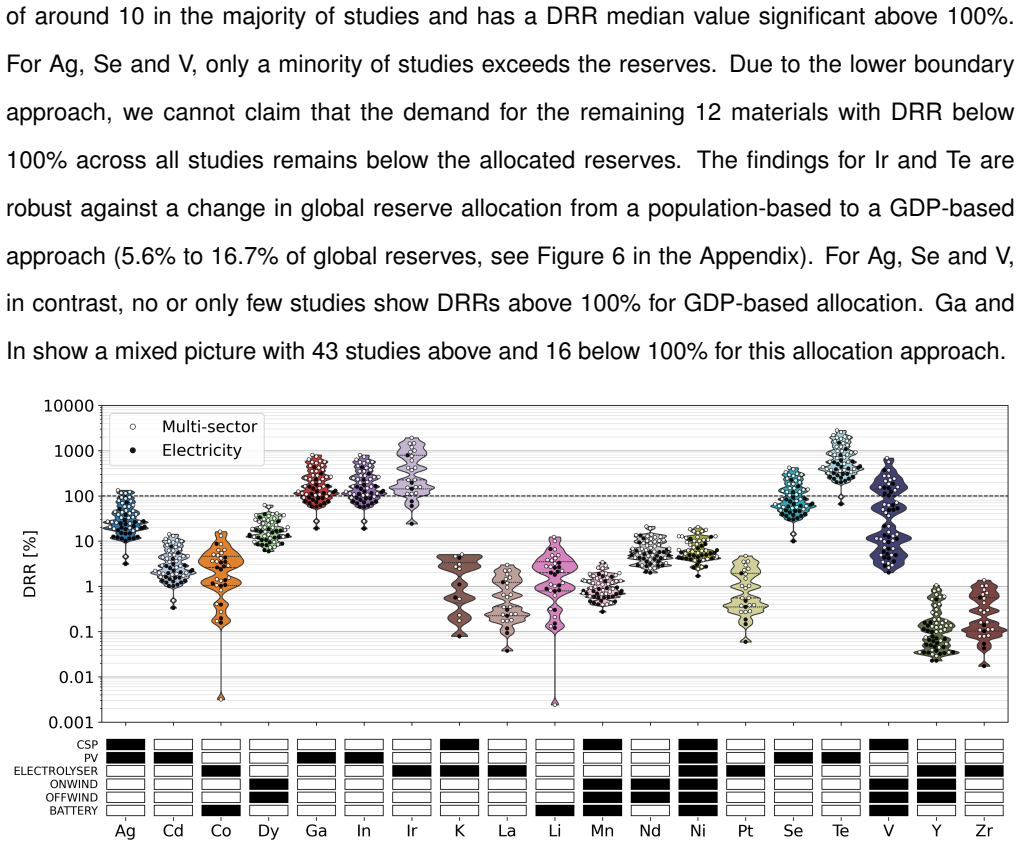
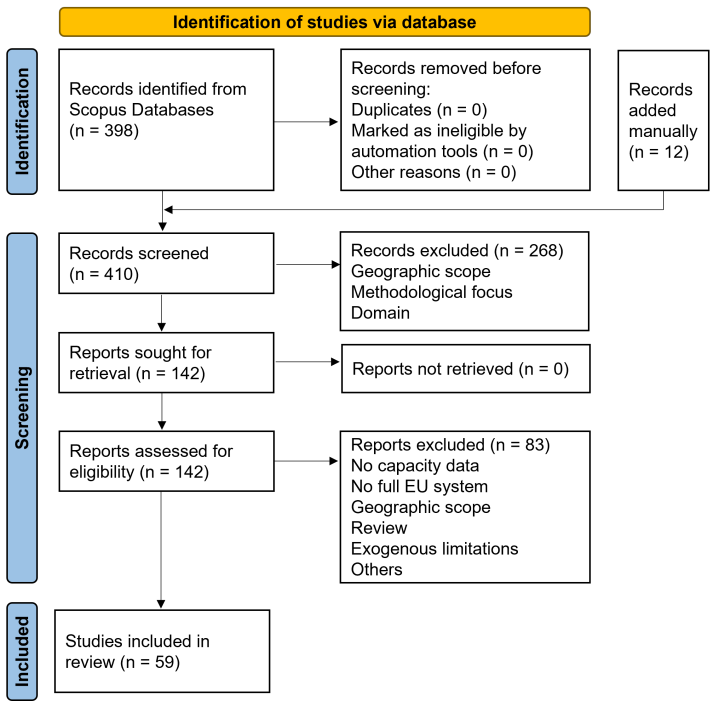
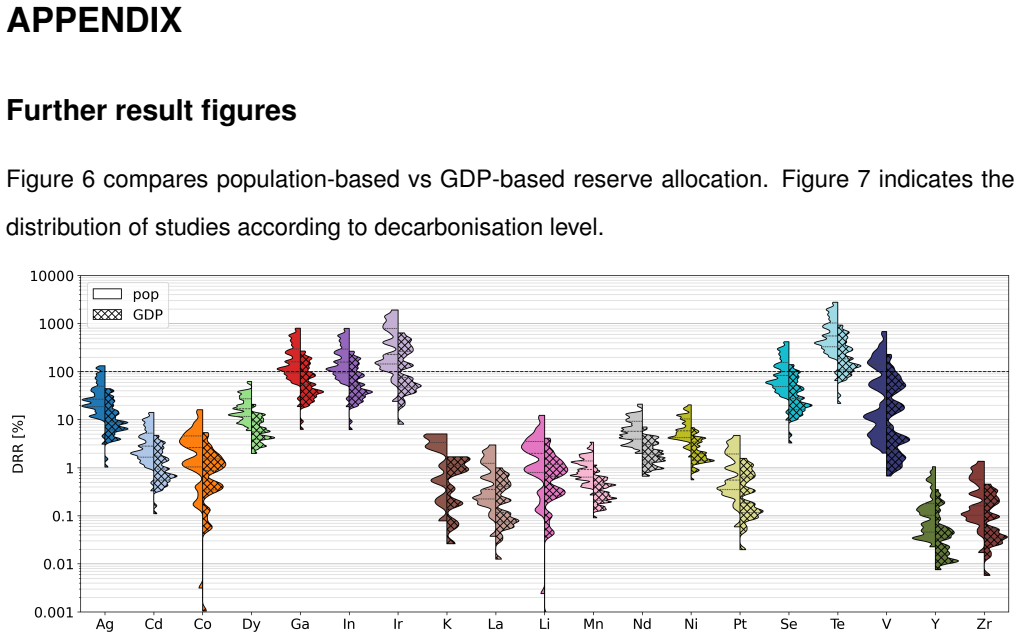
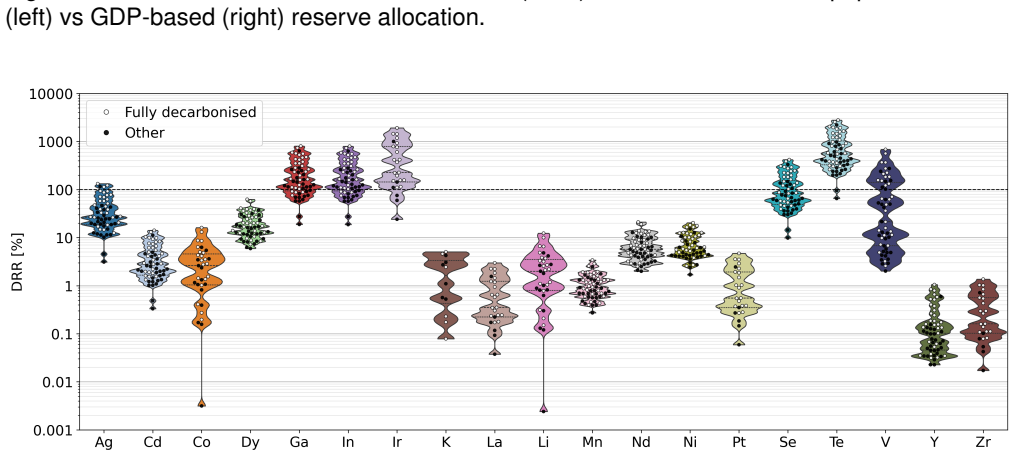
A systematic review of 59 highly decarbonised European energy system modelling studies combined with quantitative ex-post assessment of material demands for five key technologies and nineteen materials finds that material demands exceed Europe's population-based shares of current global reserves for gallium, indium, iridium and tellurium, less pronounced for silver, selenium and vanadium, particularly when multiple sectors of the energy system are considered.
What carries the argument
Ex-post material demand assessment applied to the 59 studies, using material intensities for five key technologies and nineteen materials, then compared directly to Europe's population-proportional share of global reserves.
If this is right
- Material shortfalls become larger when electricity, heat and transport are all included in the models.
- Non-energy uses of the same materials increase the overall scarcity pressure.
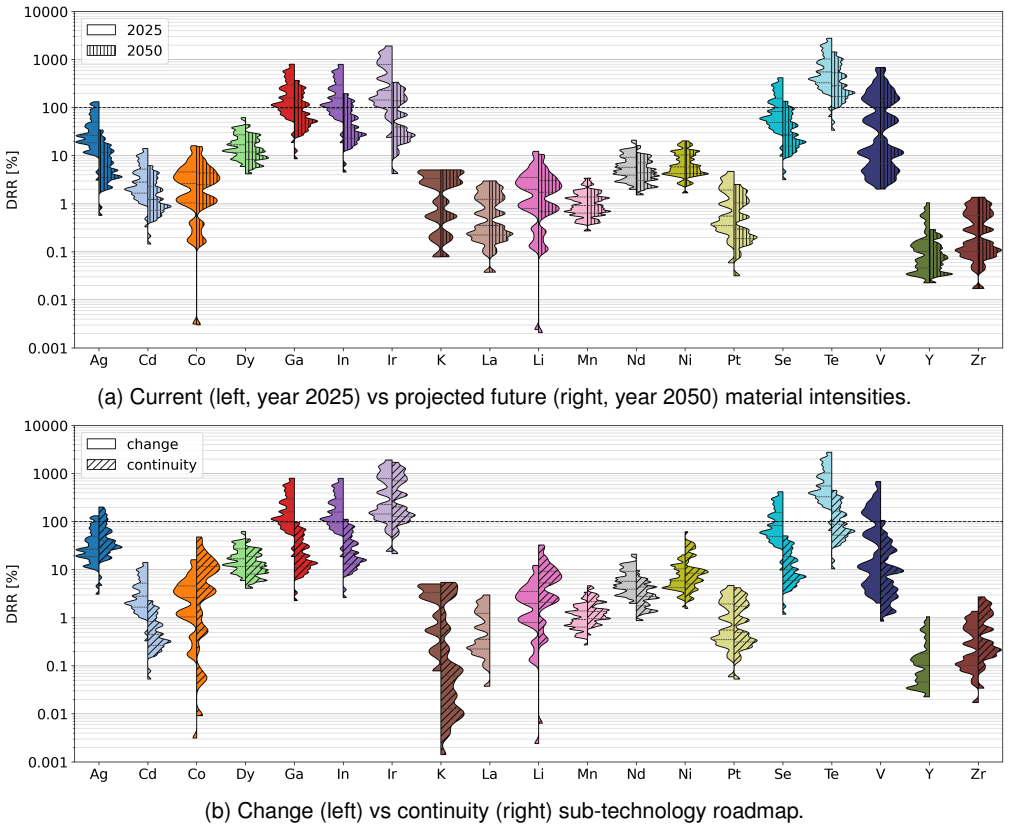
- Technological innovation can either reduce or raise material requirements depending on the direction of change.
- Efficiency, recycling and expanded reserves only partly relieve the identified shortages.
- Energy sufficiency measures are needed to reach sustainability in the energy-material system.
Where Pith is reading between the lines
- Future energy system studies will need to incorporate material constraints from the start rather than treating them as an afterthought.
- European policy targets may require explicit trade-offs between deployment speed and material availability.
- Global coordination on recycling and new mining will be necessary if European scenarios are to be realised without major shortfalls.
Load-bearing premise
The material intensity numbers taken from the studies accurately describe the technologies that would be built, and population proportion is the right way to decide how much of the world's reserves Europe can count on.
What would settle it
New data showing that the actual material requirements per unit of installed capacity for the modelled technologies are substantially lower than the intensities used in the ex-post calculations.
Figures
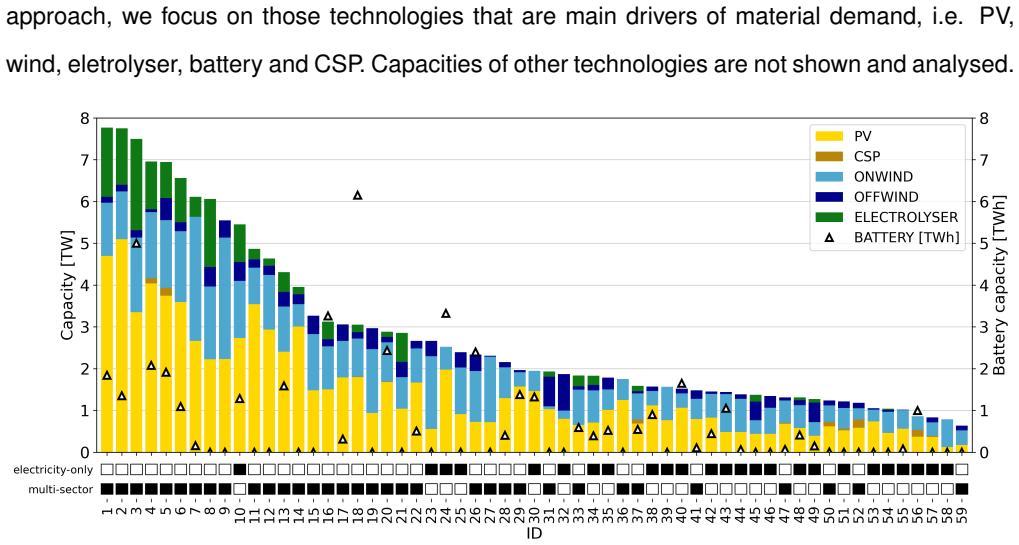
read the original abstract
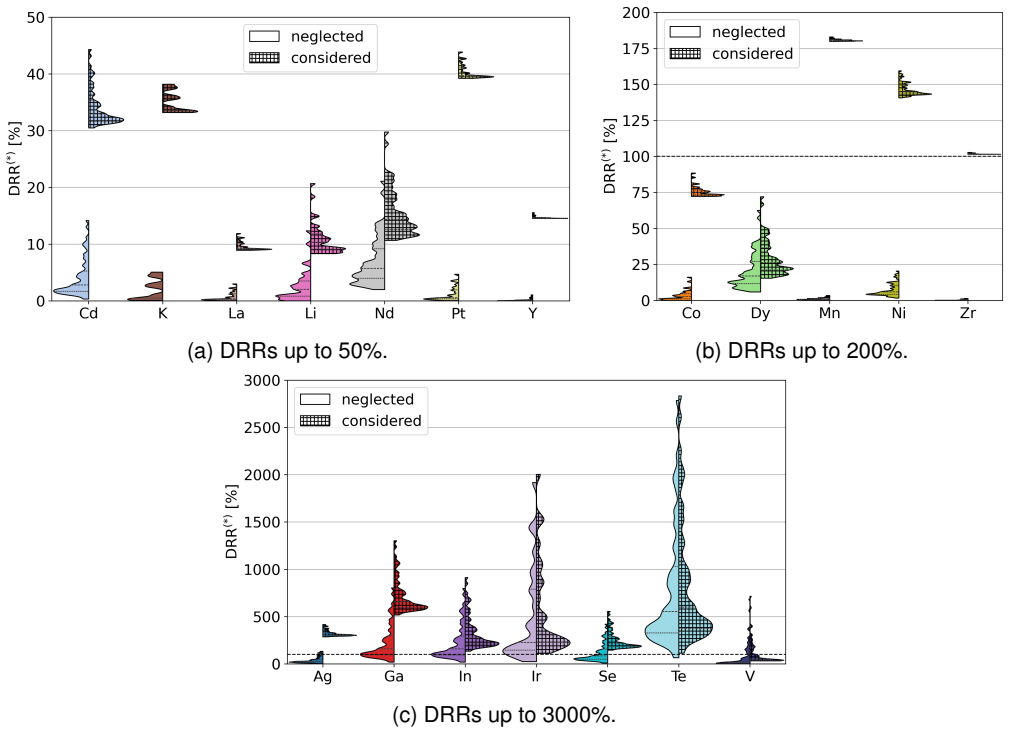
Decarbonising energy systems reduces emissions and fossil fuel dependency, but expanding renewables increases demands for critical raw materials. Most energy system models, however, neglect material demands, putting the material feasibility of energy scenarios at question. We combine a systematic review of 59 highly decarbonised European energy system modelling studies with a quantitative ex-post assessment of material demands for 5 key technologies and 19 materials. We find that material demands exceed Europe's population-based shares of current global reserves for seven materials (Ga, In, Ir, Te; less pronounced for Ag, Se, V), in particular if multiple sectors of the energy system are considered. Competing non-energy demand further amplifies the scarcity, while technological innovation can either alleviate or intensify it. We conclude that energy efficiency, recycling, expanding reserves and technological innovation may only partly address the identified shortages and call for energy sufficiency measures to achieve sustainability in the energy-material nexus.
Editorial analysis
A structured set of objections, weighed in public.
Referee Report
Summary. The paper conducts a systematic review of 59 highly decarbonised European energy system modelling studies, performs an ex-post quantitative assessment of material demands for 5 key technologies and 19 materials, and concludes that these demands exceed Europe's population-based shares of current global reserves for seven materials (Ga, In, Ir, Te; less pronounced for Ag, Se, V), especially when multiple sectors are considered. It further notes that competing non-energy demand amplifies scarcity while innovation can alleviate or intensify it, and calls for energy sufficiency measures.
Significance. If the population-based allocation metric is accepted as appropriate, the findings would indicate material constraints that could limit the feasibility of many published European decarbonization pathways, strengthening the case for integrating material limits into energy system modeling. The systematic review of 59 studies supplies a broad evidence base, and the ex-post approach enables cross-model comparison; these are clear strengths.
major comments (2)
- [Abstract] Abstract and implied Methods: the central claim that demands 'exceed' Europe's population-based shares of global reserves for Ga, In, Ir, Te (and less so Ag, Se, V) is load-bearing on the choice of population proportion as the allocation metric, yet no justification is supplied for why this demographic share is the correct benchmark for material feasibility when global supply is determined by markets, contracts, and extraction economics rather than fixed population allocations.
- [Abstract] Abstract: the ex-post material demand calculations for the 59 studies are presented without visible error bars, sensitivity checks on material intensities, or details on study selection criteria and intensity derivation; this directly affects whether the seven-material exceedance result is robust.
minor comments (2)
- The title 'Materealistic?' is informal for a journal submission; a more descriptive title would improve clarity.
- Notation for the 19 materials and 5 technologies should be defined explicitly in a table or methods subsection to aid readability.
Simulated Author's Rebuttal
We thank the referee for their thoughtful review and constructive comments on our manuscript. We address each major comment below and propose revisions where appropriate.
read point-by-point responses
-
Referee: [Abstract] Abstract and implied Methods: the central claim that demands 'exceed' Europe's population-based shares of global reserves for Ga, In, Ir, Te (and less so Ag, Se, V) is load-bearing on the choice of population proportion as the allocation metric, yet no justification is supplied for why this demographic share is the correct benchmark for material feasibility when global supply is determined by markets, contracts, and extraction economics rather than fixed population allocations.
Authors: We agree that the choice of allocation metric requires explicit justification. The population-based share is employed as a normative benchmark to evaluate the equity of material demands under a fair per-capita distribution of global reserves, which is pertinent for assessing the global sustainability implications of European energy scenarios. This approach is common in studies of resource equity and planetary boundaries. We will add a subsection in the Methods explaining this rationale, supported by relevant citations. revision: yes
-
Referee: [Abstract] Abstract: the ex-post material demand calculations for the 59 studies are presented without visible error bars, sensitivity checks on material intensities, or details on study selection criteria and intensity derivation; this directly affects whether the seven-material exceedance result is robust.
Authors: The study selection criteria are detailed in Section 2 following the PRISMA framework, and material intensity data sources are described in Section 3 with values provided in the supplementary information. However, we acknowledge the absence of explicit sensitivity analyses and error bars in the main results. We will incorporate sensitivity checks on key material intensities and report uncertainty ranges in the revised manuscript to enhance the robustness assessment. revision: yes
Circularity Check
No circularity: ex-post comparison uses independent external data
full rationale
The paper conducts a systematic review of 59 external studies and performs ex-post material demand calculations using published model outputs and global reserve data. No self-definitional equations, fitted parameters renamed as predictions, or load-bearing self-citations appear in the derivation. The exceedance findings for Ga, In, Ir, Te and others are obtained by direct comparison to population-based reserve shares without reducing to the paper's own inputs by construction. The allocation metric choice is a modeling assumption open to critique but does not create circularity under the defined patterns.
Axiom & Free-Parameter Ledger
free parameters (1)
- population-based allocation fraction
axioms (2)
- domain assumption Current published global reserve figures are accurate and stable benchmarks for comparison
- domain assumption Material intensity coefficients for the five key technologies are representative and transferable across the 59 studies
Reference graph
Works this paper leans on
-
[1]
Global Critical Minerals Outlook 2025
International Energy Agency. Global Critical Minerals Outlook 2025. Tech. Rep. IEA Paris (2025). URL:https://www.iea.org/reports/ global-critical-minerals-outlook-2025
2025
-
[2]
Schulze, K., Heinrichs, H., Weinand, J.M., and Stolten, D. (2024). From fossil fuels to metals and minerals: Navigating global resource challenges in the energy transition. Cell Reports Sustainability1, 100239. doi:10.1016/j.crsus.2024.100239
-
[3]
European Parliament (2024). Regulation (EU) 2024/1252 of the European Parliament and of the Council of 11 April 2024 establishing a framework for ensuring a secure and sustainable supply of critical raw materials and amending Regulations (EU) No 168/2013, (EU) 2018/858, (EU) 2018/1724 and (EU) 2019/1020Text with EEA relevance. . URL: https://eur-lex.europ...
2024
-
[4]
Berthet, E., Lavalley, J., Anquetil-Deck, C., Ballesteros, F ., Stadler, K., Soytas, U., Hauschild, M., and Laurent, A. (2024). Assessing the social and environmental impacts of critical mineral supply chains for the energy transition in Europe. Global Environmental Change86, 102841. doi:10.1016/j.gloenvcha.2024.102841
-
[5]
Carrara, S., Bobba, S., Blagoeva, D., Alves Dias, P ., Cavalli, A., Georgitzikis, K., Grohol, M., Itul, A., Kuzov, T., Latunussa, C., Lyons, L., Malano, G., Maury, T., Prior Arce, ´A., Somers, J., Telsnig, T., Veeh, C., Wittmer, D., Black, C., Pennington, D., Christou, M. Supply chain analysis and material demand forecast in strategic technologies and sec...
-
[6]
The Role of Critical Minerals in Clean Energy Transitions
International Energy Agency. The Role of Critical Minerals in Clean Energy Transitions. World Energy Outlook Special Report Interna- tional Energy Agency Paris (2021). URL:https://www.iea.org/reports/ the-role-of-critical-minerals-in-clean-energy-transitions. 21
2021
-
[7]
Study on the Critical Raw Materials for the EU 2023: Final Report
European Commission (2023). Study on the Critical Raw Materials for the EU 2023: Final Report. LU: Publications Office. URL:https://data.europa.eu/doi/10.2873/725585
-
[8]
Critical Materials Assessment
Bauer, D.J., Smith, B.J., and Nguyen, R.T. Critical Materials Assessment. Technical Re- port U.S. Department of Energy (2023). URL:https://www.energy.gov/sites/default/ files/2023-07/doe-critical-material-assessment_07312023.pdf
2023
-
[9]
UK 2024 critical- ity assessment
Mudd, G., Josso, P ., Shaw, R., Luce, A., Singh, N., Horn, S., Bide, T., Currie, D., Elliott, H., Grant, H., Halkes, R., Idoine, N., Mitchell, C., Price, F ., and Petavratzi, E. UK 2024 critical- ity assessment. Open Report OR/24/047 British Geological Survey (2024). URL:https: //www.ukcmic.org/downloads/reports/ukcmic-2024-criticality-assessment.pdf
2024
-
[10]
Pfenninger, S., Hawkes, A., and Keirstead, J. (2014). Energy systems modeling for twenty- first century energy challenges. Renewable and Sustainable Energy Reviews33, 74–86. doi:10.1016/j.rser.2014.02.003
-
[11]
Vai, A., Colucci, G., Nicoli, M., and Savoldi, L. (2025). May the availability of critical raw materials affect the security of energy systems? An analysis for risk-aware energy plan- ning with TEMOA-Italy. Materials Today Energy48, 101805. doi:10.1016/j.mtener. 2025.101805
-
[12]
Colucci, G., Finke, J., Bertsch, V., Di Cosmo, V., and Savoldi, L. (2025). Combined assess- ment of material and energy supply risks in the energy transition: A multi-objective energy system optimization approach. Applied Energy388, 125647. doi:10.1016/j.apenergy. 2025.125647
-
[13]
Rauner, S., and Budzinski, M. (2017). Holistic energy system modeling combining multi- objective optimization and life cycle assessment. Environmental Research Letters12, 124005. doi:10.1088/1748-9326/aa914d
-
[14]
Tokimatsu, K., Wachtmeister, H., McLellan, B., Davidsson, S., Murakami, S., H¨o¨ok, M., Y a- suoka, R., and Nishio, M. (2017). Energy modeling approach to the global energy-mineral nexus: A first look at metal requirements and the 2 ◦C target. Applied Energy207, 494–
2017
-
[15]
doi:10.1016/j.apenergy.2017.05.151. 22
-
[16]
Tokimatsu, K., H ¨o¨ok, M., McLellan, B., Wachtmeister, H., Murakami, S., Y asuoka, R., and Nishio, M. (2018). Energy modeling approach to the global energy-mineral nexus: Exploring metal requirements and the well-below 2 ◦C target with 100 percent renewable energy. Applied Energy225, 1158–1175. doi:10.1016/j.apenergy.2018.05.047
-
[17]
Brown, T., H ¨orsch, J., and Schlachtberger, D. (2018). PyPSA: Python for Power System Analysis. Journal of Open Research Software6, 4. doi:10.5334/jors.188
-
[18]
Pfenninger, S., and Pickering, B. (2018). Calliope: A multi-scale energy systems modelling framework. Journal of Open Source Software3, 825. doi:10.21105/joss.00825
-
[20]
Martin, N., Talens-Peir ´o, L., Villalba-M´endez, G., Nebot-Medina, R., and Madrid-L´opez, C. (2023). An energy future beyond climate neutrality: Comprehensive evaluations of transi- tion pathways. Applied Energy331, 120366. doi:10.1016/j.apenergy.2022.120366
-
[21]
Junne, T., Simon, S., Buchgeister, J., Saiger, M., Baumann, M., Haase, M., Wulf, C., and Naegler, T. (2020). Environmental Sustainability Assessment of Multi-Sectoral Energy Transformation Pathways: Methodological Approach and Case Study for Germany. Sus- tainability12, 8225. doi:10.3390/su12198225
-
[22]
Fuss, M., and Xu, L. (2021). Unintended Environmental Impacts at Local and Global Scale—Trade-Offs of a Low-Carbon Electricity System. In D. M ¨ost, S. Schreiber, A. Herbst, M. Jakob, A. Martino, and W.R. Poganietz, eds. The Future European Energy System pp. 237–255.. Cham: Springer International Publishing. ISBN 978-3-030-60913-9 978-3-030-60914-6 pp. 23...
-
[23]
Moreau, V., Dos Reis, P .C., and Vuille, F . (2019). Enough Metals? Resource Con- straints to Supply a Fully Renewable Energy System. Resources8, 29. doi:10.3390/ resources8010029. 23
2019
-
[24]
Schlichenmaier, S., and Naegler, T. (2022). May material bottlenecks hamper the global energy transition towards the 1.5 ◦C target? Energy Reports8, 14875–14887. doi:10. 1016/j.egyr.2022.11.025
2022
-
[25]
Koljonen, T., Lehtil ¨a, A., Kiviranta, K., Koponen, K., and Simil ¨a, L. (2024). Modelling of demands of selected minerals and metals in clean energy transition with 1.5–2.0 ◦C mit- igation targets. In M. Labriet, K. Espegren, G. Giannakidis, and B. ´O Gallach ´oir, eds. Aligning the Energy Transition with the Sustainable Development Goals: Key Insights ...
-
[26]
Schulze, K., Kullmann, F ., Weinand, J.M., and Stolten, D. (2024). Overcoming the chal- lenges of assessing the global raw material demand of future energy systems. Joule8, 1936–1957. doi:10.1016/j.joule.2024.05.016
-
[27]
Montana, F ., Cellura, M., Silvestre, M.L.D., Longo, S., Luu, L.Q., Sanseverino, E.R., and Scium`e, G. (2024). Assessing Critical Raw Materials and Their Supply Risk in Energy Technologies—A Literature Review. Energies18. doi:10.3390/en18010086
-
[28]
Wortmann, B., Stolten, D., and Heinrichs, H. (2025). Critical Iridium Demands arising from future Expansion of Proton Exchange Membrane Electrolysis. arXiv. doi:10.48550/ ARXIV.2509.05357
arXiv 2025
-
[29]
Critical materials: Batteries for electric vehicles
IRENA. Critical materials: Batteries for electric vehicles. Tech. Rep. International Renew- able Energy Agency Abu Dhabi (2024). URL:https://www.irena.org/Publications/ 2024/Sep/Critical-materials-Batteries-for-electric-vehicles
2024
-
[30]
Material requirements for electricity grids
Nohl, L., Finck, R., Magnani, N., Volkanovski, A., Black, C., and Tzimas, E. Material requirements for electricity grids. Tech. Rep. JRC143190 European Commission, Joint Research Centre (2025). URL:https://publications.jrc.ec.europa.eu/repository/ handle/JRC143190
2025
-
[31]
Smart Is Not Smart Enough!
David, M., and Koch, F . (2019). “Smart Is Not Smart Enough!” Anticipating Critical Raw Material Use in Smart City Concepts: The Example of Smart Grids. Sustainability11,
2019
-
[32]
doi:10.3390/su11164422. 24
-
[33]
Michaelis, J., Vogel, B., Strunz, S., Lucht, W., Dahms, H., Dornack, C., Geissler, A., Hertin, J., Hoffart, F ., Kemfert, C., Klein, M., K¨ock, W., Lage, J., Marquard, E., Schmalz, S., Set- tele, J., Sommer, B., Weiss, S., and Wiegand, S. (2024). Sufficiency as a “Strategy of the Enough”: Curbing ecological crises and injustices. A summary of the German A...
-
[34]
Wiese, F ., Taillard, N., Balembois, E., Best, B., Bourgeois, S., Campos, J., Cordroch, L., Djelali, M., Gabert, A., Jacob, A., Johnson, E., Meyer, S., Munk ´acsy, B., Pagliano, L., Quoilin, S., Roscetti, A., Thema, J., Thiran, P ., Toledano, A., Vogel, B., Zell-Ziegler, C., and Marignac, Y . (2024). The key role of sufficiency for low demand-based carbon...
-
[35]
Nitsch, F ., Wetzel, M., Gils, H.C., and Nienhaus, K. (2024). The future role of Carnot batteries in Central Europe: Combining energy system and market perspective. Journal of Energy Storage85, 110959. doi:10.1016/j.est.2024.110959
-
[36]
Recycling of Critical Minerals
International Energy Agency. Recycling of Critical Minerals. A World Energy Outlook Special Report IEA Paris (2024). URL:https://www.iea.org/reports/ recycling-of-critical-minerals
2024
-
[37]
U.S. Geological Survey. Mineral commodity summaries 2026. Tech. Rep. USGS (2026). doi:10.3133/mcs2026
-
[38]
Buarque Andrade, L., Frenzel, M., Bookhagen, B., Kresse, C., Schmidt, M., Nassar, N., Alonso, E., Shojaeddini, E., and Sandmann, D. (2024). From exploration to production: Understanding the development dynamics of lithium mining projects. Resources Policy 99, 105423. doi:10.1016/j.resourpol.2024.105423
-
[39]
Page, M.J., McKenzie, J.E., Bossuyt, P .M., Boutron, I., Hoffmann, T.C., Mulrow, C.D., Shamseer, L., Tetzlaff, J.M., Akl, E.A., Brennan, S.E., Chou, R., Glanville, J., Grimshaw, J.M., Hr ´objartsson, A., Lalu, M.M., Li, T., Loder, E.W., Mayo-Wilson, E., McDonald, S., McGuinness, L.A., Stewart, L.A., Thomas, J., Tricco, A.C., Welch, V.A., Whiting, P ., and...
-
[40]
Scopus Database
Elsevier (2026). Scopus Database. . URL:https://www.scopus.com
2026
-
[41]
Bertsch, V., Finke, J., Esser, K., Plaga, L.S., Mersch, M., Stelzer, J., Atakan, B., Fichtner, W., Markides, C.N., and Sioshansi, R. (2025). How can energy-system mod- els inform technology development? Insights for emerging energy-storage technolo- gies. International Journal of Electrical Power & Energy Systems173, 111360. doi: 10.1016/j.ijepes.2025.111360
-
[42]
Pedersen, T.T., Gøtske, E.K., Dvorak, A., Andresen, G.B., and Victoria, M. (2022). Long- term implications of reduced gas imports on the decarbonization of the European energy system. Joule6, 1566–1580. doi:10.1016/j.joule.2022.06.023
-
[43]
Rahdan, P ., Zeyen, E., and Victoria, M. (2025). Strategic deployment of solar photovoltaics for achieving self-sufficiency in Europe throughout the energy transition. Nature Commu- nications16, 6259. doi:10.1038/s41467-025-61492-9
-
[44]
Zeyen, E., Victoria, M., and Brown, T. (2023). Endogenous learning for green hydrogen in a sector-coupled energy model for Europe. Nature Communications14, 3743. doi: 10.1038/s41467-023-39397-2
-
[45]
Rahdan, P ., Zeyen, E., Gallego-Castillo, C., and Victoria, M. (2024). Distributed photo- voltaics provides key benefits for a highly renewable European energy system. Applied Energy360, 122721. doi:10.1016/j.apenergy.2024.122721
-
[46]
Gøtske, E.K., Andresen, G.B., Neumann, F ., and Victoria, M. (2024). Designing a sector- coupled European energy system robust to 60 years of historical weather data. Nature Communications15, 10680. doi:10.1038/s41467-024-54853-3
-
[47]
Neumann, F ., Zeyen, E., Victoria, M., and Brown, T. (2023). The potential role of a hydro- gen network in Europe. Joule7, 1793–1817. doi:10.1016/j.joule.2023.06.016
-
[48]
Pickering, B., Lombardi, F ., and Pfenninger, S. (2022). Diversity of options to eliminate 26 fossil fuels and reach carbon neutrality across the entire European energy system. Joule 6, 1253–1276. doi:10.1016/j.joule.2022.05.009
-
[49]
Lux, B., and Pfluger, B. (2020). A supply curve of electricity-based hydrogen in a decarbonized European energy system in 2050. Applied Energy269, 115011. doi: 10.1016/j.apenergy.2020.115011
-
[50]
Wu, F ., Muller, A., and Pfenninger, S. (2023). Strategic uses for ancillary bioenergy in a carbon-neutral and fossil-free 2050 European energy system. Environmental Research Letters18, 014019. doi:10.1088/1748-9326/aca9e1
-
[51]
Bussar, C., St ¨ocker, P ., Cai, Z., Moraes Jr., L., Magnor, D., Wiernes, P ., Bracht, N.V., Moser, A., and Sauer, D.U. (2016). Large-scale integration of renewable energies and impact on storage demand in a European renewable power system of 2050—Sensitivity study. Journal of Energy Storage6, 1–10. doi:10.1016/j.est.2016.02.004
-
[52]
Morales-Espa ˜na, G., Hern ´andez-Serna, R., Tejada-Arango, D.A., and Weeda, M. (2024). Impact of large-scale hydrogen electrification and retrofitting of natural gas infrastructure on the European power system. International Journal of Electrical Power & Energy Sys- tems155, 109686. doi:10.1016/j.ijepes.2023.109686
-
[53]
Gawlick, J., and Hamacher, T. (2023). Impact of coupling the electricity and hydrogen sector in a zero-emission European energy system in 2050. Energy Policy180, 113646. doi:10.1016/j.enpol.2023.113646
-
[54]
Akhmetov, Y ., Fedotova, E., and Frysztacki, M.M. (2025). Flattening the peak demand curve through energy efficient buildings: A holistic approach towards net-zero carbon. Applied Energy384, 125421. doi:10.1016/j.apenergy.2025.125421
-
[55]
Victoria, M., Zhu, K., Brown, T., Andresen, G.B., and Greiner, M. (2020). Early decarbon- isation of the European energy system pays off. Nature Communications11, 6223. doi: 10.1038/s41467-020-20015-4
-
[56]
Aliasghari, P ., G¨oke, L., and Egging-Bratseth, R. (2025). The potential of electrified trans- 27 port for enhancing flexibility in integrated renewable energy systems. Energy Reports13, 3379–3401. doi:10.1016/j.egyr.2025.03.002
-
[57]
Dunkel, P ., Kl ¨utz, T., Linßen, J., and Stolten, D. (2025). Towards Hydrogen Autarky? Evaluating Import Costs and Domestic Competitiveness in European Energy Strategies. arXiv. doi:10.48550/ARXIV.2510.04669
-
[58]
Kern, T., and Kigle, S. (2022). Modeling and evaluating bidirectionally chargeable electric vehicles in the future European energy system. Energy Reports8, 694–708. doi:10. 1016/j.egyr.2022.10.277
2022
-
[59]
Johanndeiter, S., Helist ¨o, N., Kiviluoma, J., and Bertsch, V. (2024). Price Formation and Intersectoral Distributional Effects in a Fully Decarbonised European Electricity Market. SSRN. doi:10.2139/ssrn.4887442
-
[60]
Blumberg, G., Broll, R., and Weber, C. (2022). The impact of electric vehicles on the future European electricity system – A scenario analysis. Energy Policy161, 112751. doi: 10.1016/j.enpol.2021.112751
-
[61]
Johanndeiter, S., Helist ¨o, N., and Bertsch, V. (2025). Does the difference make a differ- ence? Evaluating Contracts for Difference design in a fully decarbonised European elec- tricity market. Resource and Energy Economics83, 101495. doi:10.1016/j.reseneeco. 2025.101495
-
[62]
Seck, G.S., Hache, E., Sabathier, J., Guedes, F ., Reigstad, G.A., Straus, J., Wolfgang, O., Ouassou, J.A., Askeland, M., Hjorth, I., Skjelbred, H.I., Andersson, L.E., Douguet, S., Villavicencio, M., Tr ¨uby, J., Brauer, J., and Cabot, C. (2022). Hydrogen and the de- carbonization of the energy system in europe in 2050: A detailed model-based analysis. Re...
-
[63]
Misconel, S., Z ¨ophel, C., and M ¨ost, D. (2021). Assessing the value of demand response in a decarbonized energy system – A large-scale model application. Applied Energy299, 117326. doi:10.1016/j.apenergy.2021.117326. 28
-
[64]
Dom ´ınguez, R., Vitali, S., Carri ´on, M., and Moriggia, V. (2021). Analysing decarboniz- ing strategies in the European power system applying stochastic dominance constraints. Energy Economics101, 105438. doi:10.1016/j.eneco.2021.105438
-
[65]
Child, M., Kemfert, C., Bogdanov, D., and Breyer, C. (2019). Flexible electricity genera- tion, grid exchange and storage for the transition to a 100% renewable energy system in Europe. Renewable Energy139, 80–101. doi:10.1016/j.renene.2019.02.077
-
[66]
Pleßmann, G., and Blechinger, P . (2017). How to meet EU GHG emission reduction tar- gets? A model based decarbonization pathway for Europe’s electricity supply system until
2017
-
[67]
Energy Strategy Reviews15, 19–32. doi:10.1016/j.esr.2016.11.003
-
[68]
Yueksel-Erguen, I., Most, D., Wyrwoll, L., Schmitt, C., and Zittel, J. (2025). Model- ing the transition of the multimodal pan-European energy system including an inte- grated analysis of electricity and gas transport. Energy Systems16, 1187–1232. doi: 10.1007/s12667-023-00637-5
-
[69]
Zhu, K., Victoria, M., Brown, T., Andresen, G., and Greiner, M. (2019). Impact of CO2 prices on the design of a highly decarbonised coupled electricity and heating system in Europe. Applied Energy236, 622–634. doi:10.1016/j.apenergy.2018.12.016
-
[70]
H ¨artel, P ., and Korp˚as, M. (2017). Aggregation Methods for Modelling Hydropower and Its Implications for a Highly Decarbonised Energy System in Europe. Energies10, 1841. doi: 10.3390/en10111841
-
[71]
Junne, T., Cao, K.K., Miskiw, K.K., Hottenroth, H., and Naegler, T. (2021). Considering Life Cycle Greenhouse Gas Emissions in Power System Expansion Planning for Europe and North Africa Using Multi-Objective Optimization. Energies14, 1301. doi:10.3390/ en14051301
2021
-
[72]
Heggarty, T., Bourmaud, J.Y ., Girard, R., and Kariniotakis, G. (2024). Assessing the rela- tive impacts of maximum investment rate and temporal detail in capacity expansion models applied to power systems. Energy290, 130231. doi:10.1016/j.energy.2024.130231. 29
-
[73]
Helgeson, B., and Peter, J. (2020). The role of electricity in decarbonizing European road transport – Development and assessment of an integrated multi-sectoral model. Applied Energy262, 114365. doi:10.1016/j.apenergy.2019.114365
-
[74]
Backe, S., Skar, C., Del Granado, P .C., Turgut, O., and Tomasgard, A. (2022). EMPIRE: An open-source model based on multi-horizon programming for energy transition analyses. SoftwareX17, 100877. doi:10.1016/j.softx.2021.100877
-
[75]
Caglayan, D.G., Heinrichs, H.U., Robinius, M., and Stolten, D. (2021). Robust design of a future 100% renewable european energy supply system with hydrogen infrastructure. International Journal of Hydrogen Energy46, 29376–29390. doi:10.1016/j.ijhydene. 2020.12.197
-
[76]
Mutke, J., Plaga, L.S., and Bertsch, V. (2023). Influence of bioenergy and transmission ex- pansion on electrical energy storage requirements in a gradually decarbonized European power system. Journal of Cleaner Production419, 138133. doi:10.1016/j.jclepro. 2023.138133
-
[77]
B ´eres, R., Van Der Wel, A., Fattahi, A., and Van Den Broek, M. (2024). The impact of national policies on Europe-wide power system transition towards net-zero 2050. Energy 310, 133216. doi:10.1016/j.energy.2024.133216
-
[78]
Van Greevenbroek, K., Grochowicz, A., Zeyringer, M., and Benth, F .E. (2025). Trading off regional and overall energy system design flexibility in the net-zero transition. Nature Sustainability8, 629–641. doi:10.1038/s41893-025-01556-2
-
[79]
Sasanpour, S., Cao, K.K., Gils, H.C., and Jochem, P . (2021). Strategic policy targets and the contribution of hydrogen in a 100% renewable European power system. Energy Re- ports7, 4595–4608. doi:10.1016/j.egyr.2021.07.005
-
[80]
Pedersen, T.T., Victoria, M., Rasmussen, M.G., and Andresen, G.B. (2021). Modeling all alternative solutions for highly renewable energy systems. Energy234, 121294. doi: 10.1016/j.energy.2021.121294. 30
-
[81]
Mara ˜n´on-Ledesma, H., and Tomasgard, A. (2019). Analyzing Demand Response in a Dynamic Capacity Expansion Model for the European Power Market. Energies12, 2976. doi:10.3390/en12152976
discussion (0)
Sign in with ORCID, Apple, or X to comment. Anyone can read and Pith papers without signing in.