Efficient and Robust Online Learning to Rank in Decentralized Systems
Pith reviewed 2026-06-27 08:14 UTC · model grok-4.3
The pith
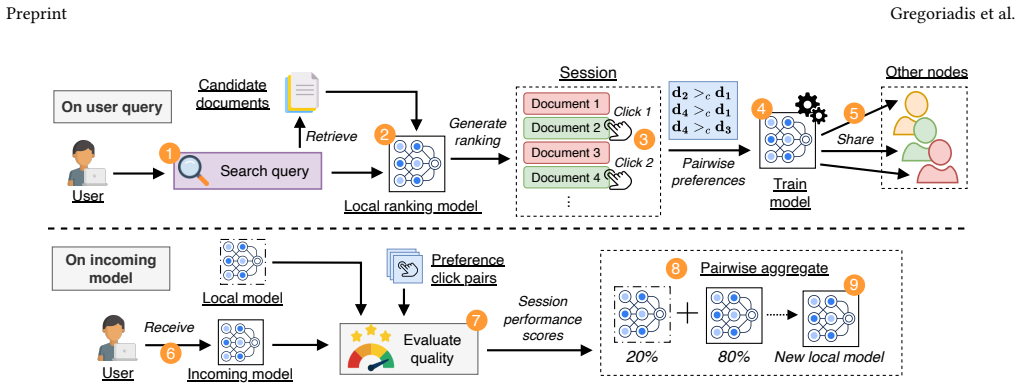
RankGuard aggregates a decentralized ranking model only if it better explains the user's private click history after position bias correction.
A machine-rendered reading of the paper's core claim, the machinery that carries it, and where it could break.
Core claim
RankGuard is a decentralized OLTR framework in which each node evaluates every incoming model against its private click history after position-bias correction and aggregates the update only when the new model explains the observed clicks better than the current local model; this rule supplies both robustness to poisoning and the first formal convergence guarantee for any decentralized OLTR algorithm.
What carries the argument
The acceptance test that compares how well an incoming model explains the user's position-bias-corrected private click history versus the current local model.
If this is right
- The algorithm is guaranteed to converge under the stated conditions.
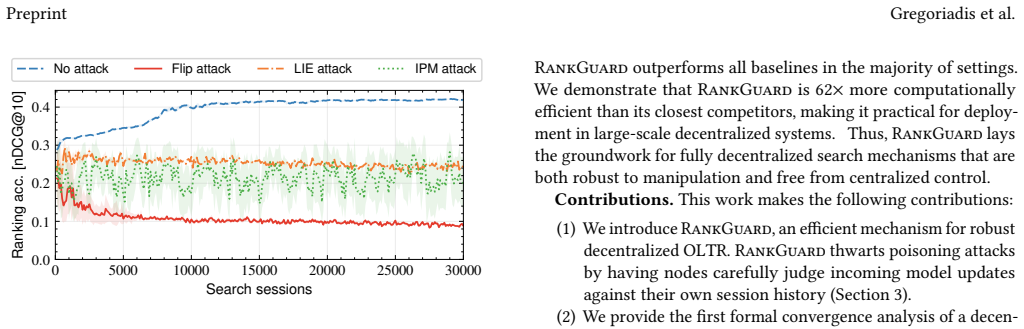
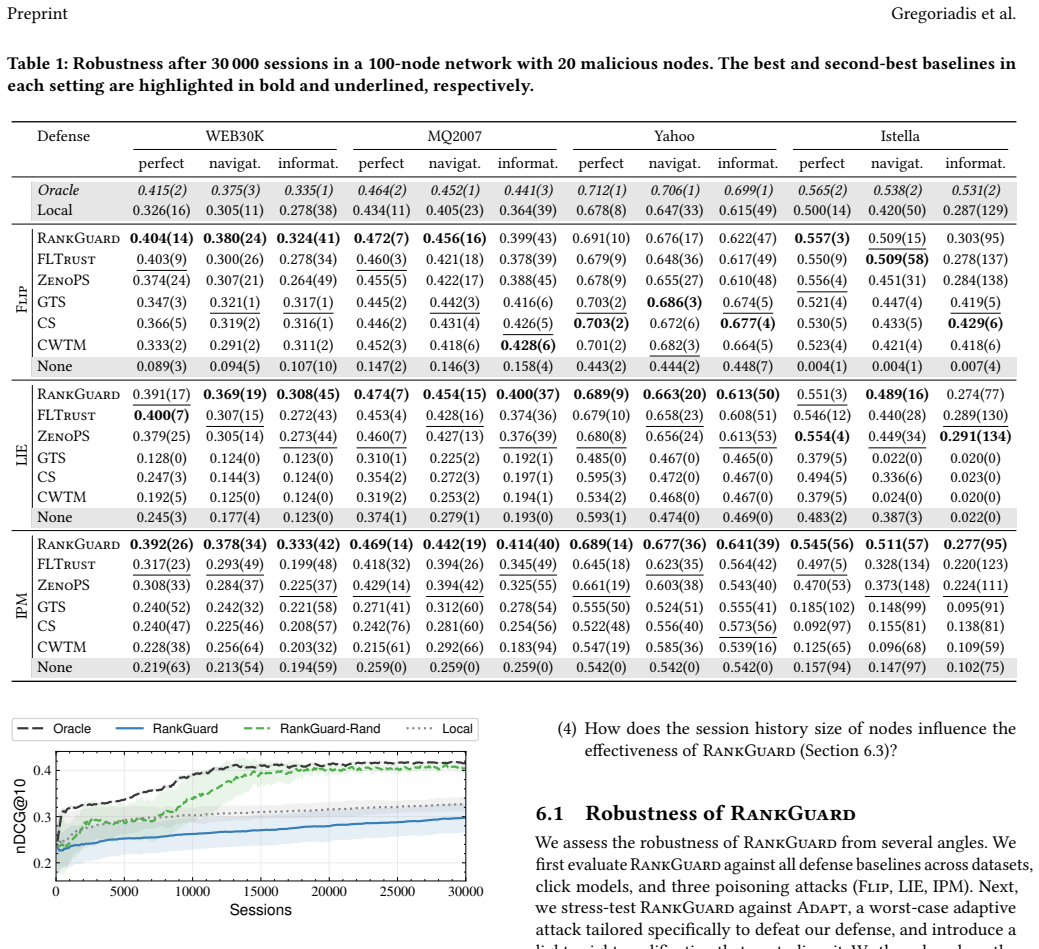
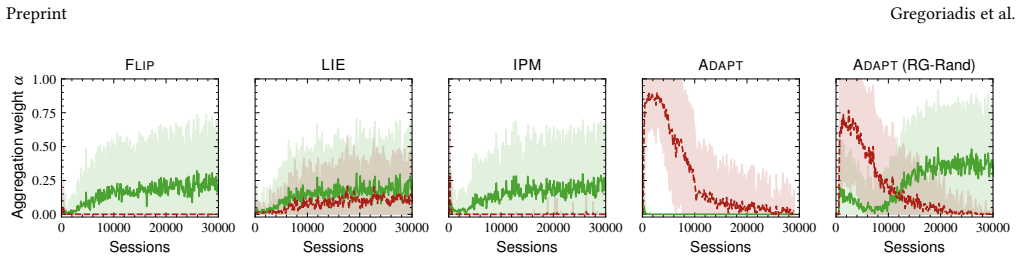
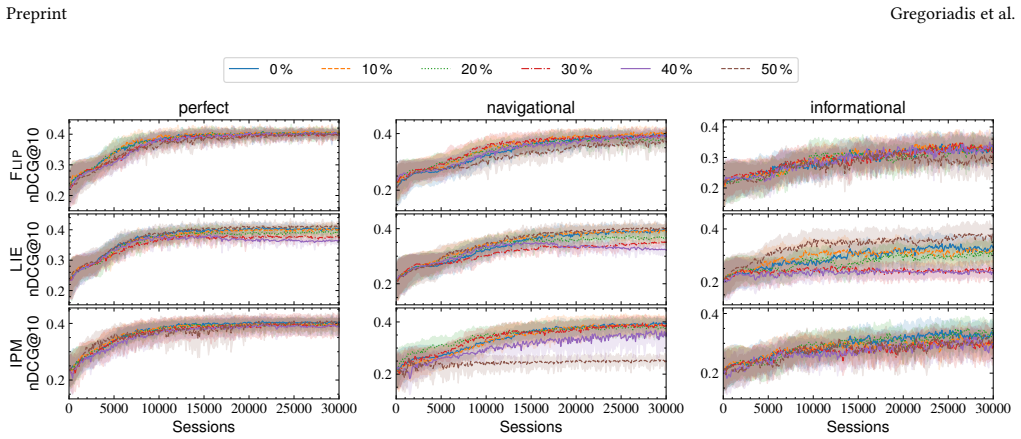
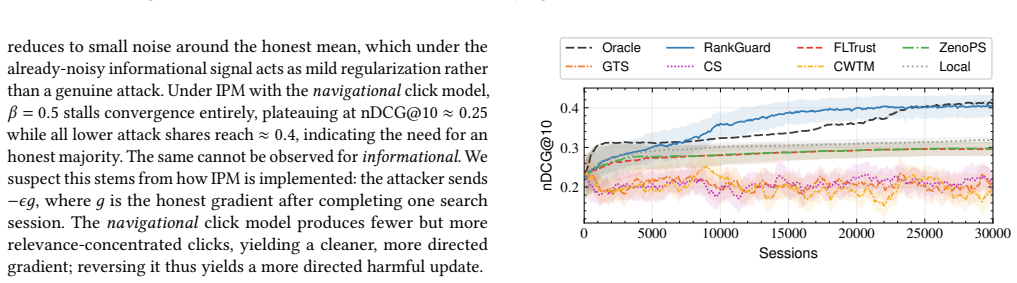
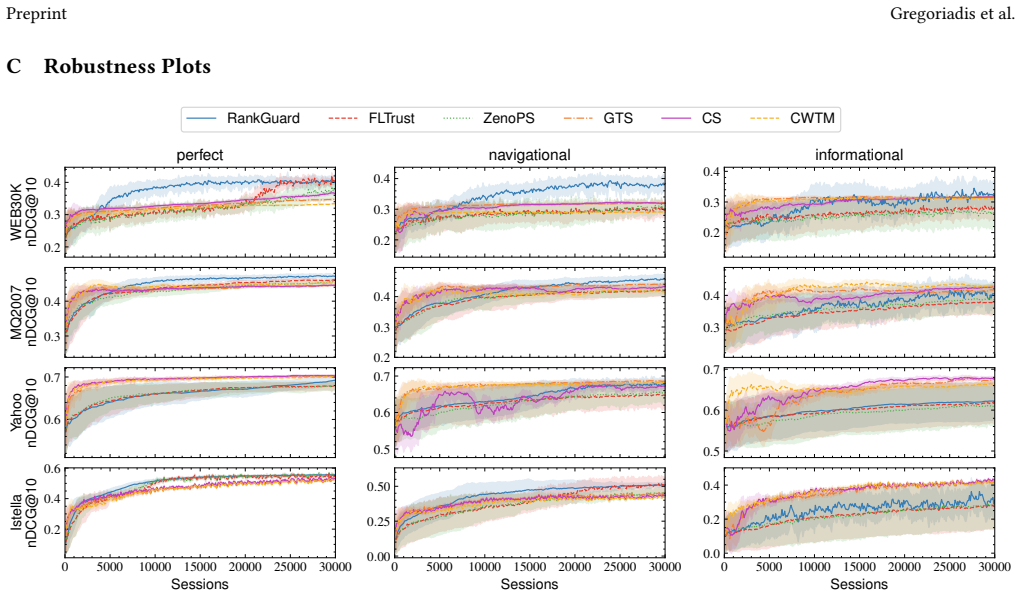
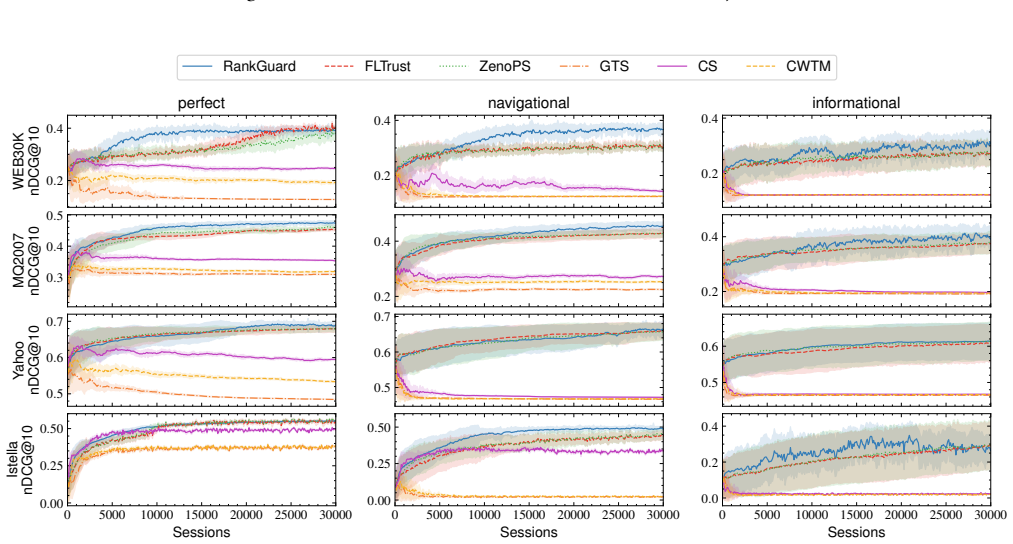
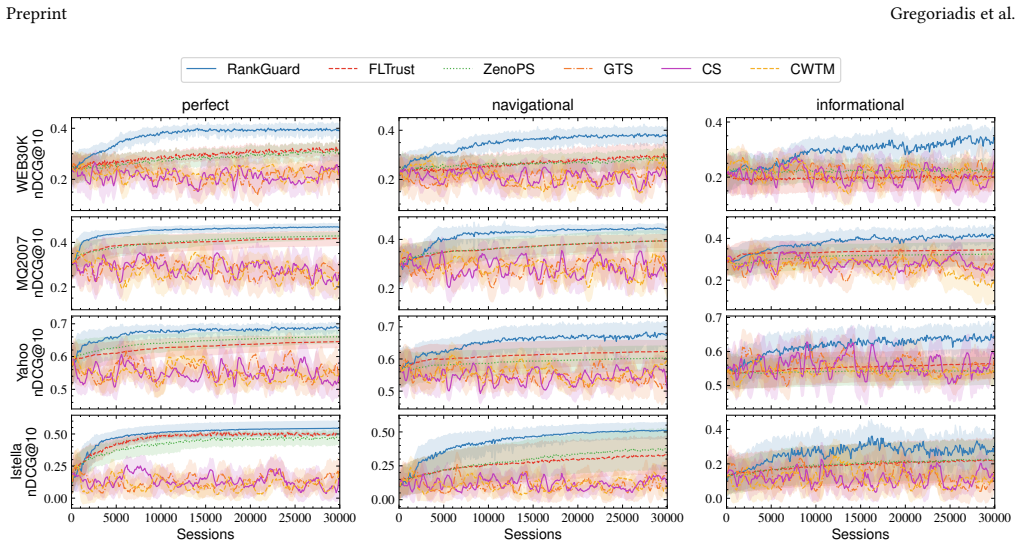
- It resists four poisoning attacks, including a strong adaptive attack, across four standard benchmarks.
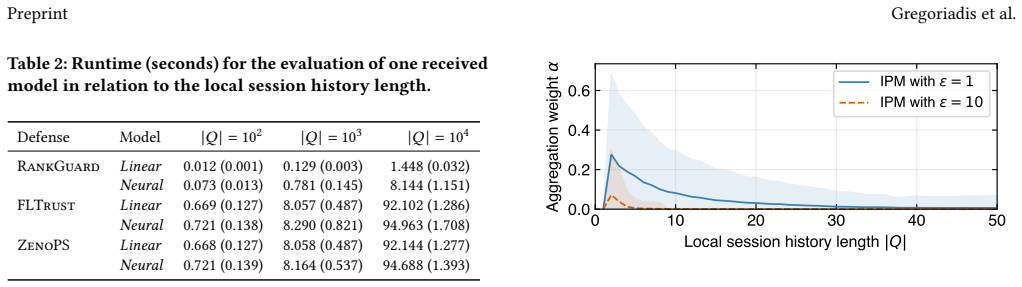
- It outperforms prior defenses in most tested settings while using up to 62 times less computation.
- The same acceptance rule works with three different click models.
Where Pith is reading between the lines
- The same local-data test could be applied to other decentralized learning tasks where each participant holds private interaction logs.
- Stronger or more accurate position-bias correction would directly tighten the defense without changing the aggregation logic.
- The method reduces reliance on any single trusted server, which may matter for recommendation systems that must operate across distrusting organizations.
Load-bearing premise
A user's private click history, once corrected for position bias, supplies a reliable signal of whether an incoming model will genuinely improve local ranking quality.
What would settle it
A concrete counter-example would be an attack that produces a model passing the acceptance test on every honest node's history yet produces measurably worse ranking quality on held-out queries from those same nodes.
Figures
read the original abstract
In Online Learning to Rank (OLTR), ranking models are trained directly from live user interactions, but existing systems rely on a trusted central server to collect and process these interactions. This leaves operators free to introduce biases that conflict with user interests. Decentralized learning offers an attractive alternative, allowing users to collaboratively train a shared ranking model by exchanging model updates directly with one another, without any central authority. In such settings, however, malicious nodes can send poisoned model updates that degrade the ranking quality of honest nodes. We introduce RankGuard, a decentralized OLTR framework in which users collaboratively train ranking models and exchange model updates directly with other nodes. RankGuard defends against poisoning attacks by carefully evaluating incoming models against the user's own private click history, corrected for position bias. An incoming model is only aggregated if it better explains the user's past interactions than the current local model, making it fundamentally hard for malicious nodes to craft updates that pass this test without also genuinely helping the user. We derive a theoretical convergence guarantee of RankGuard. To the best of our knowledge, this is the first formal convergence analysis of a decentralized OLTR algorithm. We evaluate RankGuard against four poisoning attacks, including a powerful adaptive attack, using four standard benchmarks and three click models. RankGuard outperforms all baselines in most settings while being up to 62x more efficient than its closest competitors.
Editorial analysis
A structured set of objections, weighed in public.
Referee Report
Summary. The paper proposes RankGuard, a decentralized OLTR framework where nodes exchange model updates directly and aggregate an incoming model only if it yields higher likelihood on the user's private position-bias-corrected click history than the current local model. It claims this makes poisoning fundamentally difficult, derives a theoretical convergence guarantee (asserted to be the first formal analysis for decentralized OLTR), and reports empirical outperformance against four poisoning attacks (including adaptive) on four benchmarks and three click models, with up to 62x efficiency gains.
Significance. If the convergence guarantee holds under the stated assumptions and the filtering rule translates to genuine ranking-quality improvement, the result would be significant: it provides the first formal convergence analysis for decentralized OLTR and a practical defense against poisoning without a trusted server. The efficiency claims and multi-attack evaluation would further strengthen its contribution to robust decentralized collaborative ranking.
major comments (2)
- [Abstract and implied §3] Abstract and implied §3 (filtering rule): the claim that it is 'fundamentally hard for malicious nodes to craft updates that pass this test without also genuinely helping the user' rests on the position-bias-corrected history being an unbiased proxy for true preferences. The provided stress-test note correctly identifies that modest misspecification in the click model (examination probabilities, user-specific bias, or drift) could allow an adversary to maximize the corrected surrogate likelihood while degrading true NDCG; this assumption is load-bearing for both the robustness claim and the interpretation of the convergence guarantee.
- [Convergence analysis (abstract)] Convergence analysis (abstract): the guarantee is presented as derived rather than fitted, yet the abstract-only status and lack of an explicit statement on whether the bound applies to the corrected likelihood surrogate or to ranking quality under the real click process leaves open whether the result supports the central claim of genuine user benefit. A concrete test (e.g., relating the surrogate optimum to held-out NDCG) would be required to close this gap.
minor comments (1)
- The efficiency claim ('up to 62x more efficient') should specify the exact metric, baseline, and experimental conditions in the main text or a table for reproducibility.
Simulated Author's Rebuttal
Thank you for the constructive feedback on our manuscript. We address each major comment point by point below, indicating where revisions will be incorporated.
read point-by-point responses
-
Referee: [Abstract and implied §3] Abstract and implied §3 (filtering rule): the claim that it is 'fundamentally hard for malicious nodes to craft updates that pass this test without also genuinely helping the user' rests on the position-bias-corrected history being an unbiased proxy for true preferences. The provided stress-test note correctly identifies that modest misspecification in the click model (examination probabilities, user-specific bias, or drift) could allow an adversary to maximize the corrected surrogate likelihood while degrading true NDCG; this assumption is load-bearing for both the robustness claim and the interpretation of the convergence guarantee.
Authors: We agree that the filtering rule's effectiveness relies on the click model providing a reasonable proxy, and the manuscript already includes a stress-test note acknowledging potential misspecification effects. Our multi-benchmark, multi-click-model experiments demonstrate that RankGuard retains strong poisoning resistance and ranking performance in practice. We will revise the abstract and theory sections to more explicitly state the modeling assumptions and discuss their implications for robustness and convergence. revision: partial
-
Referee: [Convergence analysis (abstract)] Convergence analysis (abstract): the guarantee is presented as derived rather than fitted, yet the abstract-only status and lack of an explicit statement on whether the bound applies to the corrected likelihood surrogate or to ranking quality under the real click process leaves open whether the result supports the central claim of genuine user benefit. A concrete test (e.g., relating the surrogate optimum to held-out NDCG) would be required to close this gap.
Authors: The convergence guarantee is formally derived for the decentralized update process under the position-bias-corrected likelihood objective, following standard practice in OLTR theory. This surrogate is the natural objective for the algorithm. To address the gap, we will add an explicit clarification in the abstract and theory section, and include a new experiment relating surrogate likelihood to held-out NDCG in the revised manuscript. revision: yes
Circularity Check
No circularity: theoretical convergence claim is independent of fitted parameters
full rationale
The paper states that it derives a theoretical convergence guarantee for RankGuard as the first formal analysis of decentralized OLTR, with the aggregation decision defined directly from likelihood comparison on the user's position-bias-corrected private clicks. No equations or steps are shown that reduce the guarantee to a quantity defined by the same fitted parameters used in experiments, nor is any uniqueness theorem imported via self-citation. The derivation chain is presented as self-contained against external benchmarks rather than forced by construction or renaming of known results.
Axiom & Free-Parameter Ledger
Reference graph
Works this paper leans on
-
[1]
Alex Auvolat, Yérom-David Bromberg, Davide Frey, Djob Mvondo, and François Taïani. 2023. Basalt: A rock-solid byzantine-tolerant peer sampling for very large decentralized networks. InProceedings of the 24th International Middleware Conference. 111–123
2023
-
[2]
Gilad Baruch, Moran Baruch, and Yoav Goldberg. 2019. A Little Is Enough: Circumventing Defenses For Distributed Learning. InAdvances in Neural Infor- mation Processing Systems 32: Annual Conference on Neural Information Processing Systems 2019, NeurIPS 2019, December 8-14, 2019, Vancouver, BC, Canada, Hanna M. Wallach, Hugo Larochelle, Alina Beygelzimer, ...
2019
-
[3]
Yacine Belal, Mohamed Maouche, Sonia Ben Mokhtar, and Anthony Simonet- Boulogne. 2025. Granite: a byzantine-resilient dynamic gossip learning frame- work.ArXiv preprintabs/2504.17471 (2025). https://arxiv.org/abs/2504.17471
Pith/arXiv arXiv 2025
-
[4]
Yacine Belal, Mohamed Maouche, Sonia Ben Mokhtar, and Anthony Simonet- Boulogne. 2025. Inferring communities of interest in collaborative learning-based recommender systems. In2025 IEEE 45th International Conference on Distributed Computing Systems (ICDCS). IEEE, 505–515
2025
-
[5]
Enrique Tomás Martínez Beltrán, Mario Quiles Pérez, Pedro Miguel Sánchez Sánchez, Sergio López Bernal, Gérôme Bovet, Manuel Gil Pérez, Grego- rio Martínez Pérez, and Alberto Huertas Celdrán. 2023. Decentralized federated learning: Fundamentals, state of the art, frameworks, trends, and challenges.IEEE Communications Surveys & Tutorials25, 4 (2023), 2983–3013
2023
-
[6]
Juan Benet. 2014. Ipfs-content addressed, versioned, p2p file system.arXiv preprint arXiv:1407.3561(2014)
Pith/arXiv arXiv 2014
-
[7]
Sayan Biswas, Antoine Boutet, Davide Frey, Romaric Gaudel, Rachid Guerraoui, Maxime Jacovella, Anne-Marie Kermarrec, Dimitri Lerévérend, François Taïani, and Martijn de Vos. 2026. Your Neighbors Know: Leveraging Local Neighborhoods for Backdoor Detection in Decentralized Learning.arXiv preprint arXiv:2605.19969 (2026)
Pith/arXiv arXiv 2026
-
[8]
Sayan Biswas, Mathieu Even, Anne-Marie Kermarrec, Laurent Massoulié, Rafael Pires, Rishi Sharma, and Martijn de Vos. 2025. Noiseless Privacy-Preserving Decentralized Learning.Proceedings on Privacy Enhancing Technologies(2025)
2025
-
[9]
Sayan Biswas, Anne-Marie Kermarrec, Alexis Marouani, Rafael Pires, Rishi Sharma, and Martijn De Vos. 2025. Boosting asynchronous decentralized learning with model fragmentation. InProceedings of the ACM on Web Conference 2025. 685–696
2025
-
[10]
Peva Blanchard, El Mahdi El Mhamdi, Rachid Guerraoui, and Julien Stainer. 2017. Machine Learning with Adversaries: Byzantine Tolerant Gradient Descent. InAd- vances in Neural Information Processing Systems 30: Annual Conference on Neural Information Processing Systems 2017, December 4-9, 2017, Long Beach, CA, USA, Is- abelle Guyon, Ulrike von Luxburg, Sam...
2017
-
[11]
Christopher J. C. Burges, Tal Shaked, Erin Renshaw, Ari Lazier, Matt Deeds, Nicole Hamilton, and Gregory N. Hullender. 2005. Learning to rank using gradient descent. InMachine Learning, Proceedings of the Twenty-Second International Conference (ICML 2005), Bonn, Germany, August 7-11, 2005 (ACM International Conference Proceeding Series, Vol. 119), Luc De ...
-
[12]
Xiaoyu Cao, Minghong Fang, Jia Liu, and Neil Zhenqiang Gong. 2021. FLTrust: Byzantine-robust Federated Learning via Trust Bootstrapping. In28th Annual Network and Distributed System Security Symposium, NDSS 2021, virtually, Febru- ary 21-25, 2021. The Internet Society. https://www.ndss-symposium.org/ndss- paper/fltrust-byzantine-robust-federated-learning-...
2021
-
[13]
Zhe Cao, Tao Qin, Tie-Yan Liu, Ming-Feng Tsai, and Hang Li. 2007. Learning to rank: from pairwise approach to listwise approach. InMachine Learning, Proceedings of the Twenty-Fourth International Conference (ICML 2007), Corvallis, Oregon, USA, June 20-24, 2007 (ACM International Conference Proceeding Series, Vol. 227), Zoubin Ghahramani (Ed.). ACM, 129–13...
-
[14]
Olivier Chapelle and Yi Chang. 2011. Yahoo! learning to rank challenge overview. InProceedings of the learning to rank challenge. PMLR, 1–24
2011
-
[15]
Olivier Chapelle and Ya Zhang. 2009. A dynamic bayesian network click model for web search ranking. InProceedings of the 18th International Conference on World Wide Web, WWW 2009, Madrid, Spain, April 20-24, 2009, Juan Quemada, Gonzalo León, Yoëlle S. Maarek, and Wolfgang Nejdl (Eds.). ACM, 1–10. doi:10. 1145/1526709.1526711
arXiv 2009
-
[16]
European Commission. 2024. Commission opens formal proceedings against TikTok on election risks under the Digital Services Act. Press release IP/24/6487. Available from https://ec.europa.eu/commission/presscorner/detail/en/ip_24_ 6487
2024
-
[17]
Domenico Dato, Sean MacAvaney, Franco Maria Nardini, Raffaele Perego, and Nicola Tonellotto. 2022. The Istella22 Dataset: Bridging Traditional and Neural Learning to Rank Evaluation. InSIGIR ’22: The 45th International ACM SIGIR Conference on Research and Development in Information Retrieval, Madrid, Spain, July 11 - 15, 2022, Enrique Amigó, Pablo Castell...
arXiv 2022
-
[18]
Martijn de Vos, Sadegh Farhadkhani, Rachid Guerraoui, Anne-Marie Kermar- rec, Rafael Pires, and Rishi Sharma. 2023. Epidemic Learning: Boosting De- centralized Learning with Randomized Communication. InAdvances in Neural Information Processing Systems 36: Annual Conference on Neural Information Pro- cessing Systems 2023, NeurIPS 2023, New Orleans, LA, USA...
2023
-
[19]
Trinh Viet Doan, Tat Dat Pham, Markus Oberprieler, and Vaibhav Bajpai. 2020. Measuring decentralized video streaming: A case study of dtube. In2020 IFIP Networking Conference (Networking). IEEE, 118–126
2020
-
[20]
John R Douceur. 2002. The sybil attack. InInternational workshop on peer-to-peer systems. Springer, 251–260
2002
-
[21]
Tim Draws, Nava Tintarev, Ujwal Gadiraju, Alessandro Bozzon, and Benjamin Timmermans. 2021. This Is Not What We Ordered: Exploring Why Biased Search Result Rankings Affect User Attitudes on Debated Topics. InSIGIR ’21: The 44th International ACM SIGIR Conference on Research and Development in Information Retrieval, Virtual Event, Canada, July 11-15, 2021,...
-
[22]
El-Mahdi El-Mhamdi, Rachid Guerraoui, Arsany Guirguis, Lê Nguyên Hoang, and Sébastien Rouault. 2020. Genuinely distributed byzantine machine learning. InProceedings of the 39th Symposium on Principles of Distributed Computing. 355–364
2020
-
[23]
Ahmed Roushdy Elkordy, Saurav Prakash, and Salman Avestimehr. 2022. Basil: A fast and Byzantine-resilient approach for decentralized training.IEEE Journal on Selected Areas in Communications40, 9 (2022), 2694–2716
2022
-
[24]
Robert Epstein and Ronald E Robertson. 2015. The search engine manipulation effect (SEME) and its possible impact on the outcomes of elections.Proceedings of the national academy of sciences112, 33 (2015), E4512–E4521
2015
-
[25]
Robert Epstein, Ronald E Robertson, David Lazer, and Christo Wilson. 2017. Suppressing the search engine manipulation effect (SEME).Proceedings of the ACM on Human-Computer Interaction1, CSCW (2017), 1–22
2017
-
[26]
Mathieu Even, Anastasia Koloskova, and Laurent Massoulié. 2024. Asynchronous sgd on graphs: a unified framework for asynchronous decentralized and federated optimization. InInternational Conference on Artificial Intelligence and Statistics. PMLR, 64–72
2024
-
[27]
Cheng Fang, Zhixiong Yang, and Waheed U Bajwa. 2022. BRIDGE: Byzantine- resilient decentralized gradient descent.IEEE Transactions on Signal and Infor- mation Processing over Networks8 (2022), 610–626
2022
-
[28]
Minghong Fang, Xiaoyu Cao, Jinyuan Jia, and Neil Gong. 2020. Local model poisoning attacks to {Byzantine-Robust} federated learning. In29th USENIX security symposium (USENIX Security 20). 1605–1622
2020
-
[29]
Minghong Fang, Zifan Zhang, Hairi, Prashant Khanduri, Jia Liu, Songtao Lu, Yuchen Liu, and Neil Gong. 2024. Byzantine-robust decentralized federated learning. InProceedings of the 2024 on ACM SIGSAC Conference on Computer and Communications Security. 2874–2888
2024
-
[30]
Chiara Farronato, Andrey Fradkin, and Alexander MacKay. 2023. Self- preferencing at Amazon: evidence from search rankings. InAEA Papers and Proceedings, Vol. 113. American Economic Association 2014 Broadway, Suite 305, Nashville, TN 37203, 239–243
2023
-
[31]
Chao Feng, Alberto Huertas Celdrán, Janosch Baltensperger, Enrique Tomás Martínez Beltrán, Pedro Miguel Sánchez Sánchez, Gérôme Bovet, and Burkhard Stiller. 2024. Sentinel: An aggregation function to secure decentralized federated Preprint Gregoriadis et al. learning. InECAI 2024: 27th European Conference on Artificial Intelligence, 19– 24 October 2024, S...
2024
-
[32]
Renaud Gaucher, Aymeric Dieuleveut, and Hadrien Hendrikx. 2024. Unified breakdown analysis for byzantine robust gossip.ArXiv preprintabs/2410.10418 (2024). https://arxiv.org/abs/2410.10418
arXiv 2024
-
[33]
Amirata Ghorbani and James Zou. 2019. Data shapley: Equitable valuation of data for machine learning. InInternational conference on machine learning. PMLR, 2242–2251
2019
-
[34]
Anindya Ghose, Panagiotis G Ipeirotis, and Beibei Li. 2014. Examining the impact of ranking on consumer behavior and search engine revenue.Management Science60, 7 (2014), 1632–1654
2014
-
[35]
Marcel Gregoriadis, Rowdy M Chotkan, Petru Neague, and Johan Pouwelse. 2025. SwarmSearch: Decentralized Search Engine with Self-Funding Economy. In2025 IEEE 50th Conference on Local Computer Networks (LCN). IEEE, 1–10
2025
-
[36]
Marcel Gregoriadis, Quinten Stokkink, and Johan Pouwelse. 2025. Decentralized adaptive ranking using transformers. InProceedings of the 5th Workshop on Machine Learning and Systems. 12–18
2025
-
[37]
Rachid Guerraoui, Anne-Marie Kermarrec, Anastasiia Kucherenko, Rafael Pinot, and Martijn de Vos. 2024. Peerswap: A peer-sampler with randomness guarantees. In2024 43rd International Symposium on Reliable Distributed Systems (SRDS). IEEE, 271–281
2024
-
[38]
Barbara Guidi, Andrea Michienzi, and Laura Ricci. 2022. Evaluating the decentral- isation of filecoin. InProceedings of the 3rd international workshop on distributed infrastructure for the common good. 13–18
2022
-
[39]
Shangwei Guo, Tianwei Zhang, Han Yu, Xiaofei Xie, Lei Ma, Tao Xiang, and Yang Liu. 2021. Byzantine-resilient decentralized stochastic gradient descent.IEEE Transactions on Circuits and Systems for Video Technology32, 6 (2021), 4096–4106
2021
-
[40]
Lie He, Sai Praneeth Karimireddy, and Martin Jaggi. 2022. Byzantine-robust decentralized learning via clippedgossip.ArXiv preprintabs/2202.01545 (2022). https://arxiv.org/abs/2202.01545
arXiv 2022
-
[41]
Katja Hofmann, Shimon Whiteson, and Maarten de Rijke. 2013. Balancing ex- ploration and exploitation in listwise and pairwise online learning to rank for information retrieval.Information Retrieval16, 1 (2013), 63–90
2013
-
[42]
Kalervo Järvelin and Jaana Kekäläinen. 2002. Cumulated gain-based evaluation of IR techniques.ACM Transactions on Information Systems (TOIS)20, 4 (2002), 422–446
2002
-
[43]
Thorsten Joachims, Laura Granka, Bing Pan, Helene Hembrooke, and Geri Gay
-
[44]
Accurately interpreting clickthrough data as implicit feedback. InProceed- ings of the 28th Annual International ACM SIGIR Conference on Research and Devel- opment in Information Retrieval(Salvador, Brazil)(SIGIR ’05). Association for Com- puting Machinery, New York, NY, USA, 154–161. doi:10.1145/1076034.1076063
-
[45]
Thorsten Joachims, Adith Swaminathan, and Tobias Schnabel. 2017. Unbiased Learning-to-Rank with Biased Feedback. InProceedings of the Tenth ACM Inter- national Conference on Web Search and Data Mining, WSDM 2017, Cambridge, United Kingdom, February 6-10, 2017, Maarten de Rijke, Milad Shokouhi, Andrew Tomkins, and Min Zhang (Eds.). ACM, 781–789. doi:10.114...
-
[46]
Eugene Kharitonov. 2019. Federated Online Learning to Rank with Evolution Strategies. InProceedings of the Twelfth ACM International Conference on Web Search and Data Mining, WSDM 2019, Melbourne, VIC, Australia, February 11-15, 2019, J. Shane Culpepper, Alistair Moffat, Paul N. Bennett, and Kristina Lerman (Eds.). ACM, 249–257. doi:10.1145/3289600.3290968
-
[47]
Anastasia Koloskova, Nicolas Loizou, Sadra Boreiri, Martin Jaggi, and Sebastian Stich. 2020. A unified theory of decentralized SGD with changing topology and local updates. InInternational conference on machine learning. PMLR, 5381–5393
2020
-
[48]
Chang Li and Maarten de Rijke. 2019. Cascading Non-Stationary Bandits: Online Learning to Rank in the Non-Stationary Cascade Model. InProceedings of the Twenty-Eighth International Joint Conference on Artificial Intelligence, IJCAI 2019, Macao, China, August 10-16, 2019, Sarit Kraus (Ed.). ijcai.org, 2859–2865. doi:10. 24963/ijcai.2019/396
2019
-
[49]
Xiangru Lian, Ce Zhang, Huan Zhang, Cho-Jui Hsieh, Wei Zhang, and Ji Liu
-
[50]
Can Decentralized Algorithms Outperform Centralized Algorithms? A Case Study for Decentralized Parallel Stochastic Gradient Descent. InAdvances in Neu- ral Information Processing Systems 30: Annual Conference on Neural Information Processing Systems 2017, December 4-9, 2017, Long Beach, CA, USA, Isabelle Guyon, Ulrike von Luxburg, Samy Bengio, Hanna M. Wa...
2017
-
[51]
Tie-Yan Liu. 2010. Learning to rank for information retrieval. InProceeding of the 33rd International ACM SIGIR Conference on Research and Development in Information Retrieval, SIGIR 2010, Geneva, Switzerland, July 19-23, 2010, Fabio Crestani, Stéphane Marchand-Maillet, Hsin-Hsi Chen, Efthimis N. Efthimiadis, and Jacques Savoy (Eds.). ACM, 904. doi:10.114...
-
[52]
Harrie Oosterhuis and Maarten de Rijke. 2018. Differentiable Unbiased On- line Learning to Rank. InProceedings of the 27th ACM International Conference on Information and Knowledge Management, CIKM 2018, Torino, Italy, October 22-26, 2018, Alfredo Cuzzocrea, James Allan, Norman W. Paton, Divesh Srivas- tava, Rakesh Agrawal, Andrei Z. Broder, Mohammed J. Z...
-
[53]
Róbert Ormándi, István Hegedűs, and Márk Jelasity. 2013. Gossip learning with linear models on fully distributed data.Concurrency and Computation: Practice and Experience25, 4 (2013), 556–571
2013
-
[54]
Bing Pan, Helene Hembrooke, Thorsten Joachims, Lori Lorigo, Geri Gay, and Laura Granka. 2007. In Google we trust: Users’ decisions on rank, position, and relevance.Journal of computer-mediated communication12, 3 (2007), 801–823
2007
-
[55]
Krishna Pillutla, Sham M Kakade, and Zaid Harchaoui. 2022. Robust aggregation for federated learning.IEEE Transactions on Signal Processing70 (2022), 1142– 1154
2022
-
[56]
Frances A Pogacar, Amira Ghenai, Mark D Smucker, and Charles LA Clarke. 2017. The positive and negative influence of search results on people’s decisions about the efficacy of medical treatments. InProceedings of the ACM SIGIR International Conference on Theory of Information Retrieval. 209–216
2017
-
[57]
Tao Qin and Tie-Yan Liu. 2013. Introducing LETOR 4.0 Datasets.CoRR abs/1306.2597 (2013). http://arxiv.org/abs/1306.2597
Pith/arXiv arXiv 2013
-
[58]
Atul Singh, T-W Ngan, Peter Druschel, and Dan S Wallach. 2006. Eclipse attacks on overlay networks: Threats and defenses. InProceedings IEEE INFOCOM 2006. 25th IEEE international conference on computer communications
2006
-
[59]
Ousmane Touat, Jezekael Brunon, Yacine Belal, Julien Nicolas, César Sabater, Mohamed Maouche, and Sonia Ben Mokhtar. 2025. Exposing the Vulnerability of Decentralized Learning to Membership Inference Attacks Through the Lens of Graph Mixing. InProceedings of the 26th International Middleware Conference. 180–194
2025
-
[60]
Raluca M Ursu. 2018. The power of rankings: Quantifying the effect of rankings on online consumer search and purchase decisions.Marketing Science37, 4 (2018), 530–552
2018
-
[61]
Shuyi Wang, Bing Liu, Shengyao Zhuang, and Guido Zuccon. 2021. Effective and privacy-preserving federated online learning to rank. InProceedings of the 2021 ACM SIGIR international conference on theory of information retrieval. 3–12
2021
-
[62]
Shuyi Wang and Guido Zuccon. 2023. An analysis of untargeted poisoning attack and defense methods for federated online learning to rank systems. InProceedings of the 2023 ACM SIGIR International Conference on Theory of Information Retrieval. 215–224
2023
-
[63]
Stefanie Warnat-Herresthal, Hartmut Schultze, Krishnaprasad Lingadahalli Shastry, Sathyanarayanan Manamohan, Saikat Mukherjee, Vishesh Garg, Ravi Sarveswara, Kristian Händler, Peter Pickkers, N Ahmad Aziz, et al. 2021. Swarm learning for decentralized and confidential clinical machine learning.Nature594, 7862 (2021), 265–270
2021
-
[64]
Cong Xie, Oluwasanmi Koyejo, and Indranil Gupta. 2019. Fall of Empires: Breaking Byzantine-tolerant SGD by Inner Product Manipulation. InProceed- ings of the Thirty-Fifth Conference on Uncertainty in Artificial Intelligence, UAI 2019, Tel A viv, Israel, July 22-25, 2019 (Proceedings of Machine Learning Re- search, Vol. 115), Amir Globerson and Ricardo Sil...
2019
-
[65]
Cong Xie, Oluwasanmi Koyejo, and Indranil Gupta. 2022. Zenops: A distributed learning system integrating communication efficiency and security.Algorithms 15, 7 (2022), 233
2022
-
[66]
Cong Xie, Sanmi Koyejo, and Indranil Gupta. 2020. Zeno++: Robust Fully Asyn- chronous SGD. InProceedings of the 37th International Conference on Machine Learning, ICML 2020, 13-18 July 2020, Virtual Event (Proceedings of Machine Learn- ing Research, Vol. 119). PMLR, 10495–10503. http://proceedings.mlr.press/v119/ xie20c.html
2020
-
[67]
Caiyi Yang and Javad Ghaderi. 2024. Byzantine-Robust Decentralized Learning via Remove-then-Clip Aggregation. InThirty-Eighth AAAI Conference on Artificial Intelligence, AAAI 2024, Thirty-Sixth Conference on Innovative Applications of Artificial Intelligence, IAAI 2024, Fourteenth Symposium on Educational Advances in Artificial Intelligence, EAAI 2014, Fe...
-
[68]
Zhixiong Yang and Waheed U Bajwa. 2019. ByRDiE: Byzantine-resilient dis- tributed coordinate descent for decentralized learning.IEEE Transactions on Signal and Information Processing over Networks5, 4 (2019), 611–627
2019
-
[69]
Bartlett
Dong Yin, Yudong Chen, Kannan Ramchandran, and Peter L. Bartlett. 2018. Byzantine-Robust Distributed Learning: Towards Optimal Statistical Rates. In Proceedings of the 35th International Conference on Machine Learning, ICML 2018, Stockholmsmässan, Stockholm, Sweden, July 10-15, 2018 (Proceedings of Machine Learning Research, Vol. 80), Jennifer G. Dy and A...
2018
-
[70]
Yisong Yue and Thorsten Joachims. 2009. Interactively optimizing informa- tion retrieval systems as a dueling bandits problem. InProceedings of the 26th Annual International Conference on Machine Learning, ICML 2009, Montreal, Que- bec, Canada, June 14-18, 2009 (ACM International Conference Proceeding Series, Vol. 382), Andrea Pohoreckyj Danyluk, Léon Bot...
discussion (0)
Sign in with ORCID, Apple, or X to comment. Anyone can read and Pith papers without signing in.