Towards Practical Field-Level Inference for Weak Lensing
Pith reviewed 2026-06-27 08:47 UTC · model grok-4.3
The pith
Field-level inference from weak lensing maps extracts significantly more cosmological information than power-spectrum methods alone.
A machine-rendered reading of the paper's core claim, the machinery that carries it, and where it could break.
Core claim
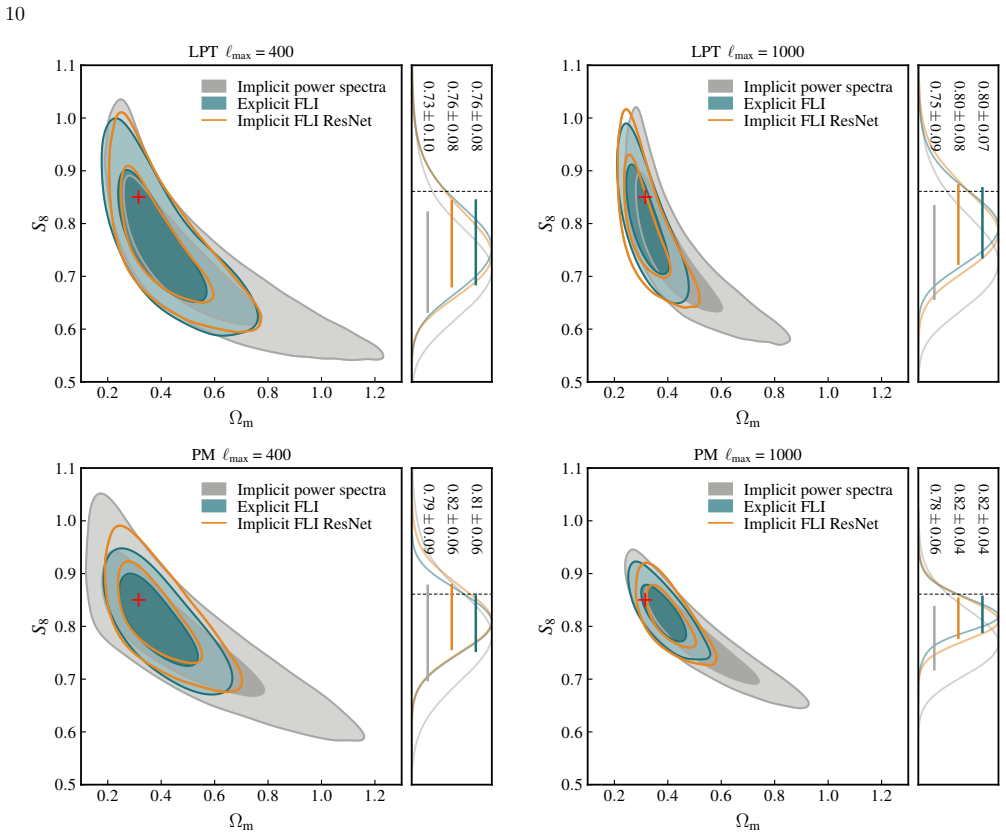
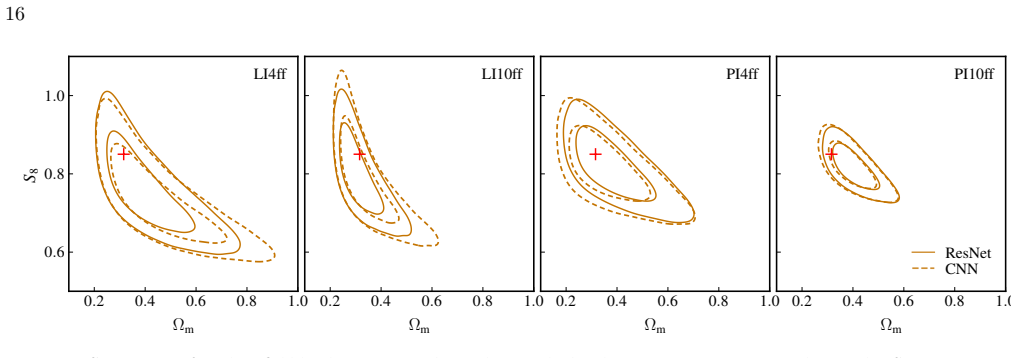
Field-level inference using 8-million-parameter forward models based on Lagrangian perturbation theory and particle-mesh N-body evolution produces posteriors that agree between implicit and explicit methods and deliver significant gains in cosmological information relative to power-spectrum analyses performed with the same pipeline, with the largest improvements appearing when small scales are retained in the particle-mesh models.
What carries the argument
Field-level inference, the direct or summary-based comparison of observed weak lensing maps to forward-modeled maps generated from the same cosmological parameters.
If this is right
- Including small scales in the particle-mesh forward model increases the information gain over power spectra more than Lagrangian perturbation theory models do.
- Implicit and explicit field-level methods produce nearly identical posteriors when applied to the same simulated maps.
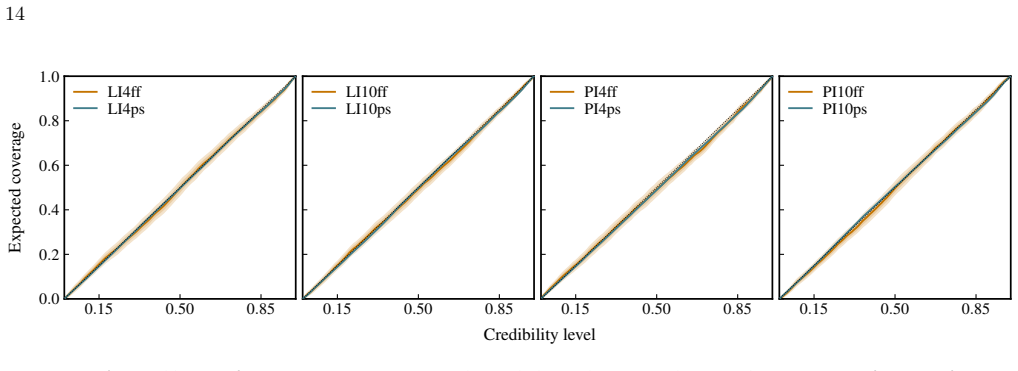
- Coverage tests on the implicit analyses confirm that the recovered posteriors are statistically well calibrated.
- Remaining modeling and computational challenges must be solved before particle-mesh-based explicit field-level inference can be used on real observations.
Where Pith is reading between the lines
- The demonstrated gains suggest that map-level methods could help resolve parameter tensions if the forward models are later extended to include baryonic physics.
- Similar field-level comparisons could be applied to other two-point-limited probes such as galaxy clustering to test whether the information gain generalizes.
- If the calibration holds on real data, the approach would allow tighter joint constraints when combined with other cosmological datasets without double-counting two-point information.
Load-bearing premise
The chosen forward models capture enough of the true nonlinear features in real weak lensing maps that differences between map-level and power-spectrum constraints reflect genuine extra information rather than model mismatch.
What would settle it
Running the same field-level pipeline on actual survey data and obtaining cosmological constraints that are statistically consistent with power-spectrum results from the same data, or that disagree with independent probes at a level larger than expected from the reported gains.
Figures
read the original abstract
Nonlinear structure growth generates higher-order correlations and morphological features in the cosmic density field that cannot be fully characterized by two-point statistics. Upcoming surveys will measure these features with greater precision, making it essential to develop methods capable of extracting as much cosmological information as possible from them. Field-level inference (FLI) is one such approach, in which cosmological parameters are constrained by comparing observed maps to forward-modeled maps, either directly or through learned summaries that retain map-level information. In this work, we compare FLI with power-spectrum-based inference using the same forward-modeling pipeline for generating weak lensing maps, with the goal of quantifying the gain from map-level analysis relative to two-point statistics. We perform this comparison with both implicit and explicit inference methods, using 8-million-parameter forward models based on Lagrangian perturbation theory and particle-mesh (PM) N-body evolution. The two FLI approaches yield closely consistent posteriors; this agreement, together with coverage tests confirming the calibration of the implicit analyses, gives us confidence in the recovered field-level constraints. Relative to the power-spectrum-based analyses, these results show significant gains in cosmological information, especially when small scales are included in the PM-based forward model. We then discuss the remaining challenges that must be addressed before PM-based explicit FLI can be applied to observational datasets.
Editorial analysis
A structured set of objections, weighed in public.
Referee Report
Summary. The manuscript compares field-level inference (FLI) using implicit and explicit methods against power-spectrum-based inference for weak lensing cosmology. Both FLI approaches employ the same 8-million-parameter forward models based on Lagrangian perturbation theory and particle-mesh N-body evolution. The two FLI methods produce closely consistent posteriors, with coverage tests confirming calibration of the implicit analyses. Relative to the power-spectrum analyses, FLI yields significant gains in cosmological information, especially when small scales are included in the PM-based forward model. Remaining challenges for applying explicit PM-based FLI to observational data are discussed.
Significance. If the reported gains hold within the controlled setting, the work is significant for demonstrating a practical, apples-to-apples quantification of map-level information gain over two-point statistics using an identical forward-modeling pipeline. Explicit credit is due for the agreement between implicit and explicit FLI approaches together with the coverage tests that support calibration; these elements strengthen in the field-level constraints. The discussion of remaining challenges for real-data application is also a strength, as it frames the results appropriately for an upcoming-survey context.
minor comments (2)
- [Abstract] Abstract: the statement that the results 'show significant gains... especially when small scales are included' would be more informative if it included a quantitative measure (e.g., factor by which credible-interval widths shrink or change in figure-of-merit) rather than a qualitative descriptor.
- [Results on small scales] The section on PM forward-model results: the claim that gains increase when small scales are included would benefit from an explicit statement of the PM force-resolution cutoff (in h/Mpc) and a brief note on how this cutoff was chosen relative to the scales where the power-spectrum baseline is evaluated.
Simulated Author's Rebuttal
We thank the referee for their positive summary of the manuscript, recognition of the significance of the apples-to-apples comparison between field-level and power-spectrum inference, and the recommendation for minor revision. The report correctly notes the consistency between implicit and explicit FLI methods as well as the coverage tests. No specific major comments were provided in the report.
Circularity Check
No significant circularity in derivation or comparison chain
full rationale
The paper compares field-level inference against power-spectrum inference on an identical LPT+PM forward model (8M parameters) and reports information gains from the map-level approach. The abstract and described pipeline contain no self-definitional steps, no fitted parameters renamed as predictions, no load-bearing self-citations, and no ansatz smuggling. The central result is a direct empirical comparison of two inference methods applied to the same simulated maps, with internal consistency checks (posterior agreement and coverage tests) that do not reduce to the inputs by construction. This is a standard non-circular methods comparison.
Axiom & Free-Parameter Ledger
axioms (1)
- domain assumption Lagrangian perturbation theory and particle-mesh N-body models accurately reproduce the higher-order statistics of weak lensing fields
Reference graph
Works this paper leans on
-
[1]
Data compression and inference in cosmology with self-supervised machine learning. , keywords =. doi:10.1093/mnras/stad3646 , archivePrefix =. 2308.09751 , primaryClass =
-
[2]
arXiv preprint arXiv:1605.08803 , year=
Density estimation using real nvp , author=. arXiv preprint arXiv:1605.08803 , year=
-
[3]
Proceedings of the IEEE conference on computer vision and pattern recognition , pages=
Deep residual learning for image recognition , author=. Proceedings of the IEEE conference on computer vision and pattern recognition , pages=
-
[4]
Fast likelihood-free cosmology with neural density estimators and active learning
Fast likelihood-free cosmology with neural density estimators and active learning. , keywords =. doi:10.1093/mnras/stz1960 , archivePrefix =. 1903.00007 , primaryClass =
work page internal anchor Pith review Pith/arXiv arXiv doi:10.1093/mnras/stz1960 1903
-
[5]
Beyond the 3rd moment: a practical study of using lensing convergence CDFs for cosmology with DES Y3. , keywords =. doi:10.1093/mnras/stad3118 , archivePrefix =. 2308.03863 , primaryClass =
-
[6]
Cosmological constraints using Minkowski functionals from the first year data of the Hyper Suprime-Cam. , keywords =. doi:10.1093/mnras/staf257 , archivePrefix =. 2410.00401 , primaryClass =
-
[7]
Cosmological cross-correlations and nearest neighbour distributions. , keywords =. doi:10.1093/mnras/stab961 , archivePrefix =. 2102.01184 , primaryClass =
-
[8]
Advances in Neural Information Processing Systems , volume=
Information maximization in noisy channels: A variational approach , author=. Advances in Neural Information Processing Systems , volume=
-
[9]
Weak gravitational lensing. , keywords =. doi:10.1016/S0370-1573(00)00082-X , archivePrefix =. astro-ph/9912508 , primaryClass =
work page internal anchor Pith review Pith/arXiv arXiv doi:10.1016/s0370-1573(00)00082-x
-
[10]
Field-Level Inference with Microcanonical Langevin Monte Carlo. arXiv e-prints , keywords =. doi:10.48550/arXiv.2307.09504 , archivePrefix =. 2307.09504 , primaryClass =
-
[11]
Statistics and computing , volume=
Non-linear regression models for Approximate Bayesian Computation , author=. Statistics and computing , volume=. 2010 , publisher=
2010
-
[12]
Map-based cosmology inference with weak lensing - information content and its dependence on the parameter space. , keywords =. doi:10.1093/mnrasl/slad160 , archivePrefix =. 2307.00070 , primaryClass =
-
[13]
Bayesian mass mapping with weak lensing data using KARMMA -- validation with simulations and application to Dark Energy Survey Year 3 data. arXiv e-prints , keywords =. doi:10.48550/arXiv.2403.05484 , archivePrefix =. 2403.05484 , primaryClass =
-
[14]
James Bradbury and Roy Frostig and Peter Hawkins and others , title =
-
[15]
Investigating the Impact of Model Misspecification in Neural Simulation-based Inference. arXiv e-prints , keywords =. doi:10.48550/arXiv.2209.01845 , archivePrefix =. 2209.01845 , primaryClass =
-
[16]
Embedding realistic surveys in simulations through volume remapping
Embedding Realistic Surveys in Simulations Through Volume Remapping. , keywords =. doi:10.1088/0067-0049/190/2/311 , archivePrefix =. 1003.3178 , primaryClass =
work page internal anchor Pith review Pith/arXiv arXiv doi:10.1088/0067-0049/190/2/311
-
[17]
Dark Energy Survey Year 1 results: curved-sky weak lensing mass map. , keywords =. doi:10.1093/mnras/stx3363 , adsurl =
-
[18]
Weak lensing scattering transform: dark energy and neutrino mass sensitivity. , keywords =. doi:10.1093/mnras/stab2102 , archivePrefix =. 2103.09247 , primaryClass =
-
[19]
Cosmological constraints from weak lensing scattering transform using HSC Y1 data. , keywords =. doi:10.1088/1475-7516/2025/01/006 , archivePrefix =. 2404.16085 , primaryClass =
-
[20]
Core Cosmology Library: Precision Cosmological Predictions for LSST. , keywords =. doi:10.3847/1538-4365/ab1658 , archivePrefix =. 1812.05995 , primaryClass =
-
[21]
The LSST Dark Energy Science Collaboration (DESC) Science Requirements Document. arXiv e-prints , keywords =. doi:10.48550/arXiv.1809.01669 , archivePrefix =. 1809.01669 , primaryClass =
-
[22]
Euclid preparation. XXVIII. Forecasts for ten different higher-order weak lensing statistics. , keywords =. doi:10.1051/0004-6361/202346017 , archivePrefix =. 2301.12890 , primaryClass =
-
[23]
arXiv preprint arXiv:1506.02169 , year=
Approximating likelihood ratios with calibrated discriminative classifiers , author=. arXiv preprint arXiv:1506.02169 , year=
-
[24]
The frontier of simulation-based inference. Proceedings of the National Academy of Science , keywords =. doi:10.1073/pnas.1912789117 , archivePrefix =. 1911.01429 , primaryClass =
-
[25]
NeurIPS 2024 Workshop: Machine Learning and the Physical Sciences , year=
Joint cosmological parameter inference and initial condition reconstruction with Stochastic Interpolants , author=. NeurIPS 2024 Workshop: Machine Learning and the Physical Sciences , year=
2024
-
[26]
Hyper Suprime-Cam Year 3 results: Cosmology from cosmic shear power spectra. , keywords =. doi:10.1103/PhysRevD.108.123519 , archivePrefix =. 2304.00701 , primaryClass =
-
[27]
2017 , eprint=
Density estimation using Real NVP , author=. 2017 , eprint=
2017
-
[28]
Dark energy survey year 3 results: cosmological constraints from the analysis of cosmic shear in harmonic space. , keywords =. doi:10.1093/mnras/stac1826 , archivePrefix =. 2203.07128 , primaryClass =
-
[29]
FastPM: a new scheme for fast simulations of dark matter and halos
FASTPM: a new scheme for fast simulations of dark matter and haloes. , keywords =. doi:10.1093/mnras/stw2123 , archivePrefix =. 1603.00476 , primaryClass =
work page internal anchor Pith review Pith/arXiv arXiv doi:10.1093/mnras/stw2123
-
[30]
Cosmological constraints from noisy convergence maps through deep learning , volume=
Cosmological constraints from noisy convergence maps through deep learning. , keywords =. 2018. doi:10.1103/PhysRevD.98.123518 , primaryClass =
-
[31]
Precision matrix expansion - efficient use of numerical simulations in estimating errors on cosmological parameters. , primaryClass = "astro-ph.IM", keywords =. doi:10.1093/mnras/stx2566 , adsurl =
-
[32]
, year = 2018, month = jul, volume = 98, number = 2, eid =
Density split statistics: Joint model of counts and lensing in cells. , year = 2018, month = jul, volume = 98, number = 2, eid =. doi:10.1103/PhysRevD.98.023508 , adsurl =
-
[33]
CFHTLenS: cosmological constraints from a combination of cosmic shear two-point and three-point correlations. , keywords =. 2014. doi:10.1093/mnras/stu754 , primaryClass =
-
[34]
Dark Energy Survey Year 3 results: cosmology with moments of weak lensing mass maps - validation on simulations. , keywords =. doi:10.1093/mnras/staa2680 , archivePrefix =. 1911.05568 , primaryClass =
-
[35]
Dark Energy Survey Year 3 results: simulation-based cosmological inference with wavelet harmonics, scattering transforms, and moments of weak lensing mass maps II. Cosmological results. arXiv e-prints , keywords =. doi:10.48550/arXiv.2405.10881 , archivePrefix =. 2405.10881 , primaryClass =
-
[36]
Dark Energy Survey Year 3 results: Simulation-based cosmological inference with wavelet harmonics, scattering transforms, and moments of weak lensing mass maps. Validation on simulations. , keywords =. doi:10.1103/PhysRevD.109.063534 , archivePrefix =. 2310.17557 , primaryClass =
-
[37]
An improved fitting formula for the dark matter bispectrum. , primaryClass = "astro-ph.CO", year = 2012, month = feb, volume = 2, eid =. doi:10.1088/1475-7516/2012/02/047 , adsurl =
-
[38]
Dark Energy Survey Year 3 Results: Cosmological constraints from second- and third-order shear statistics. , keywords =. doi:10.1103/sxlz-t9gb , archivePrefix =. 2508.14018 , primaryClass =
-
[39]
The Open Journal of Astrophysics , keywords =
Minkowski Functionals in Joint Galaxy Clustering & Weak Lensing Analyses. The Open Journal of Astrophysics , keywords =. doi:10.21105/astro.2206.03877 , archivePrefix =. 2206.03877 , primaryClass =
-
[40]
Cosmic shear cosmology beyond two-point statistics: a combined peak count and correlation function analysis of DES-Y1. , keywords =. doi:10.1093/mnras/stab1623 , archivePrefix =. 2012.02777 , primaryClass =
-
[41]
and Sellentin, Elena and de Mijolla, Damien and Vianello, Alvise , year=
Massive data compression for parameter-dependent covariance matrices. , keywords =. doi:10.1093/mnras/stx2326 , adsurl =
-
[42]
doi:10.48550/arXiv.2110.06581 , keywords =
A Trust Crisis In Simulation-Based Inference? Your Posterior Approximations Can Be Unfaithful. arXiv e-prints , keywords =. doi:10.48550/arXiv.2110.06581 , archivePrefix =. 2110.06581 , primaryClass =
-
[43]
The No-U-Turn Sampler: Adaptively Setting Path Lengths in Hamiltonian Monte Carlo
The No-U-Turn Sampler: Adaptively Setting Path Lengths in Hamiltonian Monte Carlo. arXiv e-prints , keywords =. doi:10.48550/arXiv.1111.4246 , archivePrefix =. 1111.4246 , primaryClass =
work page internal anchor Pith review Pith/arXiv arXiv doi:10.48550/arxiv.1111.4246
-
[44]
Hoffman and Andrew Gelman , title =
Matthew D. Hoffman and Andrew Gelman , title =. Journal of Machine Learning Research , year =
-
[45]
Field-level Neural Network Emulator for Cosmological N-body Simulations. , keywords =. doi:10.3847/1538-4357/acdb6c , archivePrefix =. 2206.04594 , primaryClass =
-
[46]
Jasche, Jens and Kitaura, Francisco S. , year=. Fast Hamiltonian sampling for large-scale structure inference: Fast Hamiltonian sampling , volume=. Monthly Notices of the Royal Astronomical Society , publisher=. doi:10.1111/j.1365-2966.2010.16897.x , number=
-
[47]
Jasche, Jens and Wandelt, Benjamin D. , year=. Bayesian physical reconstruction of initial conditions from large-scale structure surveys , volume=. Monthly Notices of the Royal Astronomical Society , publisher=. doi:10.1093/mnras/stt449 , number=
-
[48]
Deep learning dark matter map reconstructions from DES SV weak lensing data. , keywords =. doi:10.1093/mnras/staa127 , archivePrefix =. 1908.00543 , primaryClass =
-
[49]
Monthly Notices of the Royal Astronomical Society , volume=
Likelihood-free inference with neural compression of DES SV weak lensing map statistics , author=. Monthly Notices of the Royal Astronomical Society , volume=. 2021 , publisher=
2021
-
[50]
Kabalan, Wassim and Lanusse, François and Boucaud, Alexandre and Aubourg, Eric , title =. 2026 , publisher =. doi:10.21105/joss.08852 , url =
-
[51]
doi:10.1093/mnras/stw2070 , Journal =
-
[52]
Information content of weak lensing power spectrum and bispectrum: including the non-Gaussian error covariance matrix. , primaryClass = "astro-ph.CO", keywords =. doi:10.1093/mnras/sts340 , adsurl =
-
[53]
Patrick Kidger , year=
-
[54]
Cosmology with cosmic shear observations: a review
Cosmology with cosmic shear observations: a review. Reports on Progress in Physics , keywords =. doi:10.1088/0034-4885/78/8/086901 , archivePrefix =. 1411.0115 , primaryClass =
work page internal anchor Pith review Pith/arXiv arXiv doi:10.1088/0034-4885/78/8/086901
-
[55]
and Haiman, Zoltán and May, Morgan , year=
, Keywords =. doi:10.1103/PhysRevD.81.043519 , Eid =
-
[56]
Probing cosmology with weak lensing Minkowski functionals. , keywords =. 2012. doi:10.1103/PhysRevD.85.103513 , primaryClass =
-
[57]
Forecasting the power of higher order weak-lensing statistics with automatically differentiable simulations. , keywords =. doi:10.1051/0004-6361/202346888 , archivePrefix =. 2305.07531 , primaryClass =
-
[58]
Optimal neural summarization for full-field weak lensing cosmological implicit inference. , keywords =. doi:10.1051/0004-6361/202451535 , archivePrefix =. 2407.10877 , primaryClass =
-
[59]
Systematic-free inference of the cosmic matter density field from SDSS3-BOSS data
Lavaux, Guilhem and Jasche, Jens and Leclercq, Florent. Systematic-free inference of the cosmic matter density field from SDSS3-BOSS data. 2019. arXiv:1909.06396
arXiv 2019
-
[60]
2023 , eprint=
Sampling-Based Accuracy Testing of Posterior Estimators for General Inference , author=. 2023 , eprint=
2023
-
[61]
pmwd: A Differentiable Cosmological Particle-Mesh N -body Library. arXiv e-prints , keywords =. doi:10.48550/arXiv.2211.09958 , archivePrefix =. 2211.09958 , primaryClass =
-
[62]
Journal of Computational Physics , keywords =
Perturbation-theory informed integrators for cosmological simulations. Journal of Computational Physics , keywords =. doi:10.1016/j.jcp.2024.113201 , archivePrefix =. 2301.09655 , primaryClass =
-
[63]
DISCO-DJ II: a differentiable particle-mesh code for cosmology
DISCO-DJ II: a differentiable particle-mesh code for cosmology. arXiv e-prints , keywords =. doi:10.48550/arXiv.2510.05206 , archivePrefix =. 2510.05206 , primaryClass =
work page internal anchor Pith review Pith/arXiv arXiv doi:10.48550/arxiv.2510.05206
-
[64]
Cosmological Constraints From Weak Lensing Peak Statistics With CFHT Stripe 82 Survey
Cosmological constraints from weak lensing peak statistics with Canada-France-Hawaii Telescope Stripe 82 Survey. , keywords =. doi:10.1093/mnras/stv784 , archivePrefix =. 1412.3683 , primaryClass =
work page internal anchor Pith review Pith/arXiv arXiv doi:10.1093/mnras/stv784
-
[65]
doi:10.1103/PhysRevD.91.063507 , Eid =
, Keywords =. doi:10.1103/PhysRevD.91.063507 , Eid =
-
[66]
The Open Journal of Astrophysics , keywords =
Almanac: Weak Lensing power spectra and map inference on the masked sphere. The Open Journal of Astrophysics , keywords =. doi:10.21105/astro.2210.13260 , archivePrefix =. 2210.13260 , primaryClass =
-
[67]
Weak lensing for precision cosmology
Weak Lensing for Precision Cosmology. , keywords =. doi:10.1146/annurev-astro-081817-051928 , archivePrefix =. 1710.03235 , primaryClass =
work page internal anchor Pith review Pith/arXiv arXiv doi:10.1146/annurev-astro-081817-051928
-
[68]
Cosmology from weak lensing peaks and minima with Subaru Hyper Suprime-Cam Survey first-year data. , keywords =. doi:10.1093/mnras/stae098 , archivePrefix =. 2308.10866 , primaryClass =
-
[69]
Constraining cosmology with shear peak statistics: tomographic analysis
Constraining cosmology with shear peak statistics: tomographic analysis. , keywords =. doi:10.1051/0004-6361/201425164 , archivePrefix =. 1506.02192 , primaryClass =
work page internal anchor Pith review Pith/arXiv arXiv doi:10.1051/0004-6361/201425164
-
[70]
arXiv e-prints , archivePrefix = "arXiv", eprint =
Dark Energy Survey Year 1 Results: Wide field mass maps via forward fitting in harmonic space. arXiv e-prints , archivePrefix = "arXiv", eprint =
-
[71]
Handbook of Markov Chain Monte Carlo , year = 2011, pages =
MCMC Using Hamiltonian Dynamics. Handbook of Markov Chain Monte Carlo , year = 2011, pages =. doi:10.1201/b10905 , adsurl =
-
[72]
Cosmology from HSC Y1 weak lensing data with combined higher-order statistics and simulation-based inference. , keywords =. doi:10.1103/PhysRevD.111.083510 , archivePrefix =. 2409.01301 , primaryClass =
-
[73]
Advances in neural information processing systems , volume=
Fast -free inference of simulation models with bayesian conditional density estimation , author=. Advances in neural information processing systems , volume=
-
[74]
Proceedings of the Twenty-Second International Conference on Artificial Intelligence and Statistics , pages =
Sequential Neural Likelihood: Fast Likelihood-free Inference with Autoregressive Flows , author =. Proceedings of the Twenty-Second International Conference on Artificial Intelligence and Statistics , pages =. 2019 , editor =
2019
-
[75]
Emulating the CFHTLenS weak lensing data: Cosmological constraints from moments and Minkowski functionals. , keywords =. 2015. doi:10.1103/PhysRevD.91.103511 , primaryClass =
-
[76]
Astronomy and Computing , archivePrefix = "arXiv", eprint =
Mocking the weak lensing universe: The LensTools Python computing package. Astronomy and Computing , archivePrefix = "arXiv", eprint =. doi:10.1016/j.ascom.2016.06.001 , adsurl =
-
[77]
Bayesian forward modelling of cosmic shear data. , keywords =. doi:10.1093/mnras/stab204 , archivePrefix =. 2011.07722 , primaryClass =
-
[78]
Lifting weak lensing degeneracies with a field-based likelihood. , keywords =. doi:10.1093/mnras/stab3234 , archivePrefix =. 2108.04825 , primaryClass =
-
[79]
Field-level inference of cosmic shear with intrinsic alignments and baryons. arXiv e-prints , keywords =. doi:10.48550/arXiv.2304.04785 , archivePrefix =. 2304.04785 , primaryClass =
-
[80]
BULLFROG: multi-step perturbation theory as a time integrator for cosmological simulations. , keywords =. doi:10.1088/1475-7516/2025/02/020 , archivePrefix =. 2409.19049 , primaryClass =
discussion (0)
Sign in with ORCID, Apple, or X to comment. Anyone can read and Pith papers without signing in.