Effect of Additively Manufactured Wall Lattice Structures on Flashback Limits in a Hydrogen Jet Flame Combustor
Pith reviewed 2026-06-27 08:08 UTC · model grok-4.3
The pith
Additively manufactured lattice walls in a hydrogen jet flame nozzle improve flashback resistance primarily through cooling by unburnt mixture flowing through the porous structure.
A machine-rendered reading of the paper's core claim, the machinery that carries it, and where it could break.
Core claim
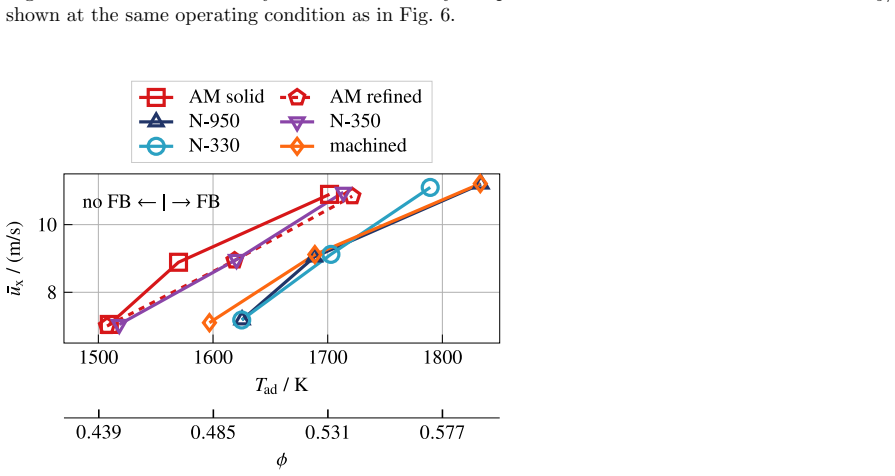
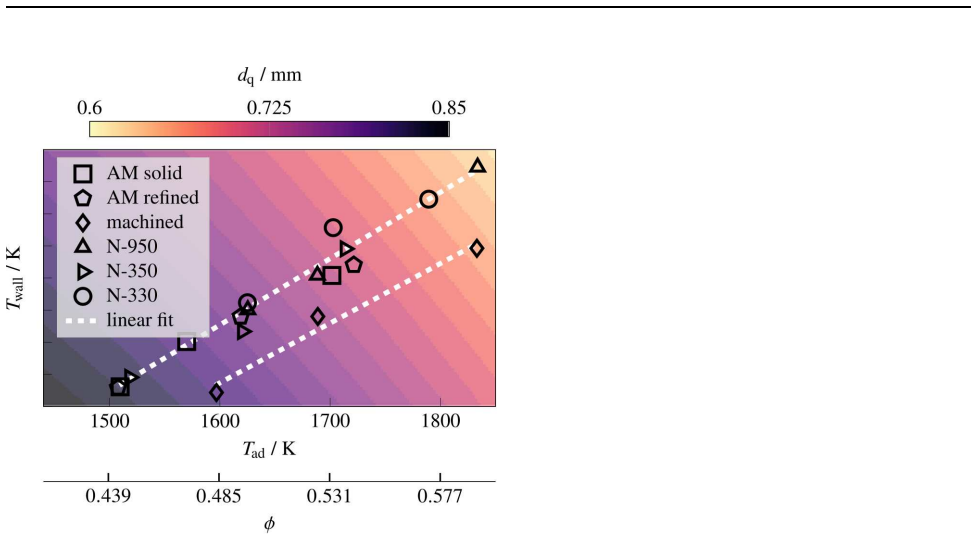
The nozzle with the coarsest porous wall structure significantly improved the flashback resistance compared to a nozzle with a solid wall. The primary mitigation mechanism was a cooling effect by unburnt mixture flowing through the porous media. Flow fields and flame shapes showed only minor effects from wall modifications, preserving general flow characteristics across configurations, while combustion-chamber dynamics remained dominated by large-scale coherent structures in the shear layer, specifically Kelvin-Helmholtz instabilities. The findings confirmed that the integration of lattice structures through additive manufacturing provides a viable strategy for hydrogen flashback mitigation
What carries the argument
Body-centered cubic lattice structures in the mixing-duct walls that permit unburnt mixture to flow through and cool the wall surface.
If this is right
- The approach works under the tested conditions of atmospheric pressure, pure hydrogen, and Reynolds numbers 9,000–12,000.
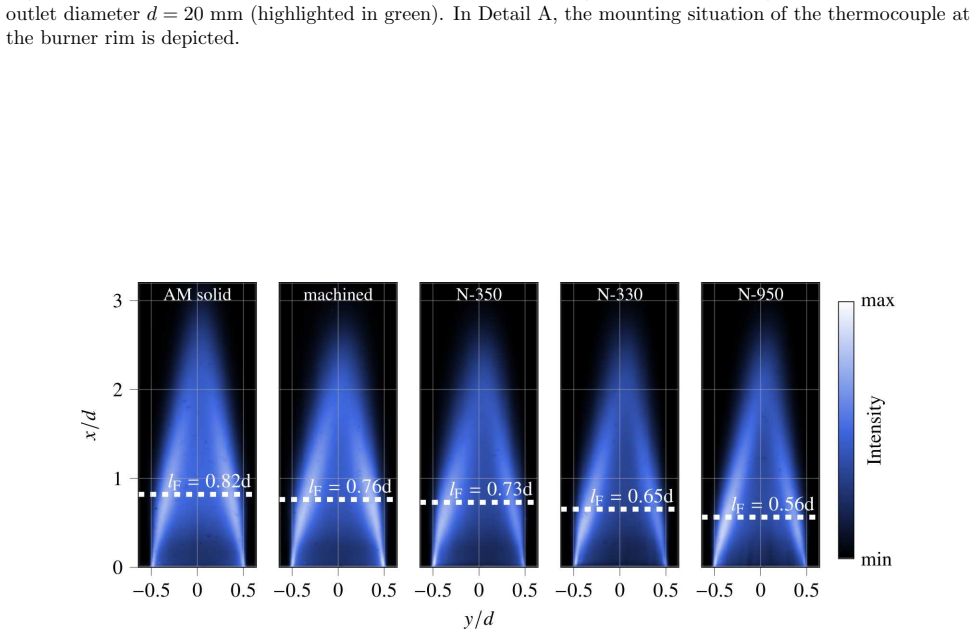
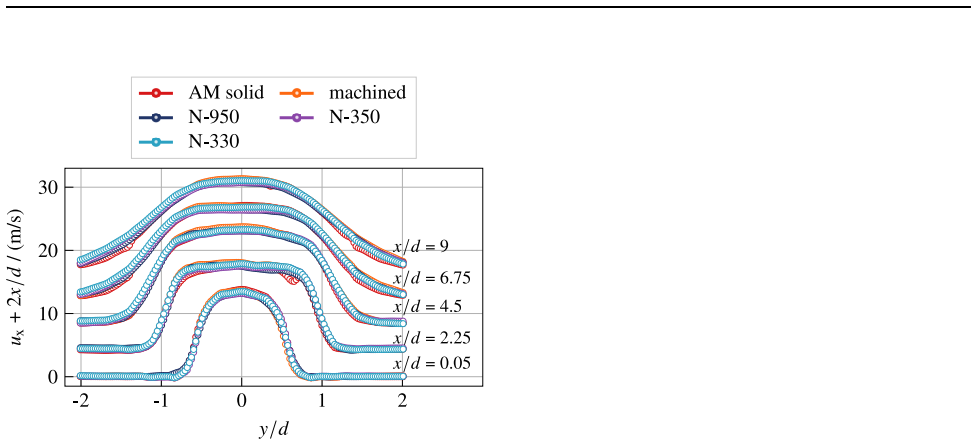
- General flow characteristics and flame shapes stay similar across solid and lattice configurations.
- Coarser lattice parameters (lower volume fraction, larger strut diameter) produce stronger flashback resistance than finer ones.
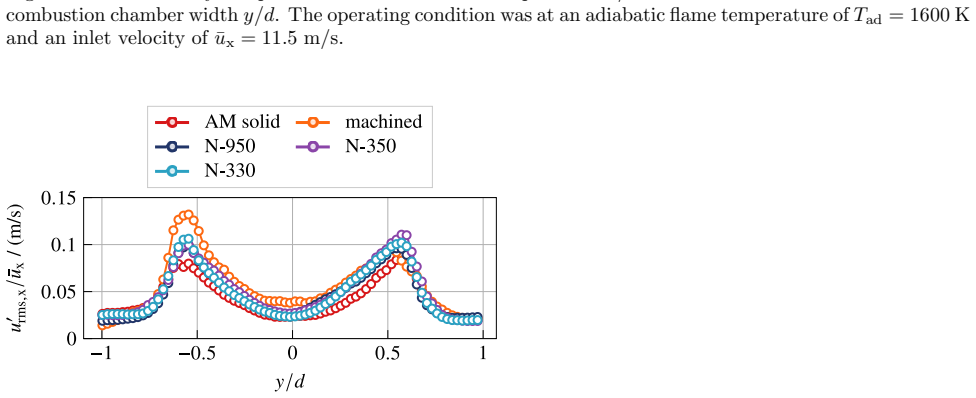
- The dominant instability mechanism in the chamber remains Kelvin-Helmholtz structures in the shear layer regardless of wall type.
Where Pith is reading between the lines
- The same lattice approach could be tested in other burner geometries where wall temperature controls flashback.
- Blocking or enabling the through-flow in the lattice while keeping the wall geometry identical would isolate the cooling contribution from any geometric effects.
- Extending the tests to elevated pressure or to hydrogen–air mixtures would check whether the cooling benefit scales to practical operating conditions.
- The method might be combined with other flashback controls such as boundary-layer suction or catalytic coatings to achieve larger safety margins.
Load-bearing premise
The measured gain in flashback resistance is produced by the lattice-induced cooling rather than by small unintended differences in manufacturing tolerance, surface roughness, or internal flow geometry.
What would settle it
Direct wall-temperature measurements showing no cooling difference between the coarsest lattice nozzle and the solid wall, or an experiment in which porous flow is blocked yet flashback resistance remains equally improved, would show the cooling mechanism is not the cause.
Figures
read the original abstract
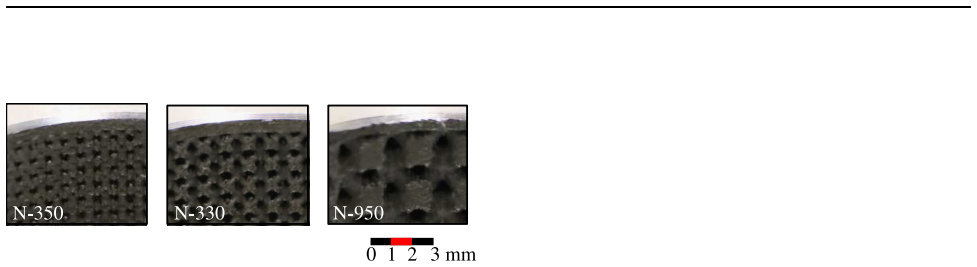
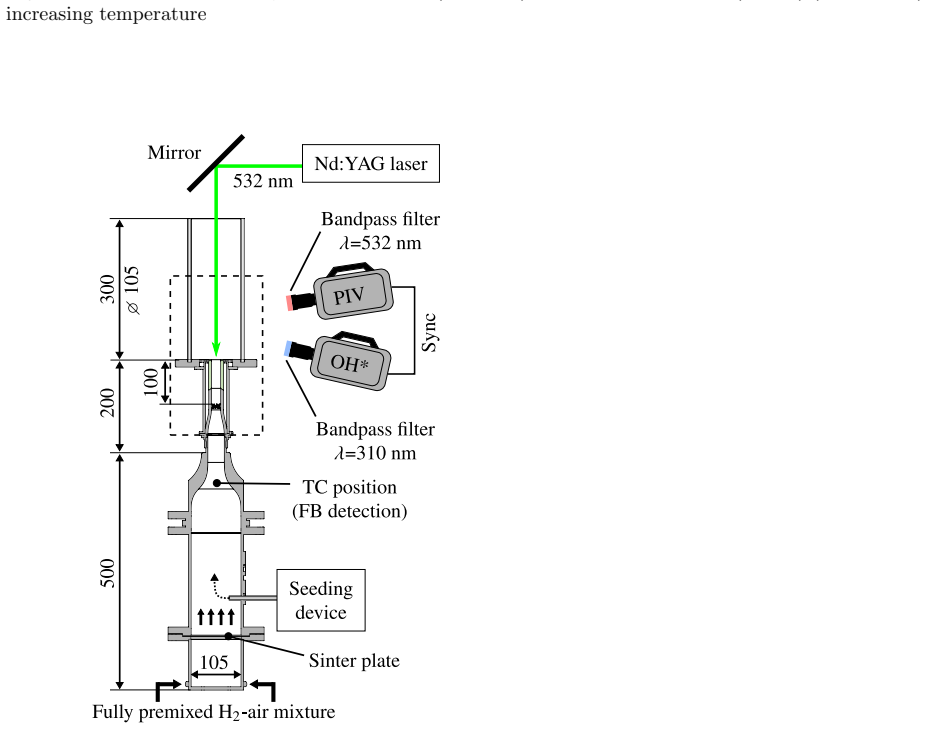
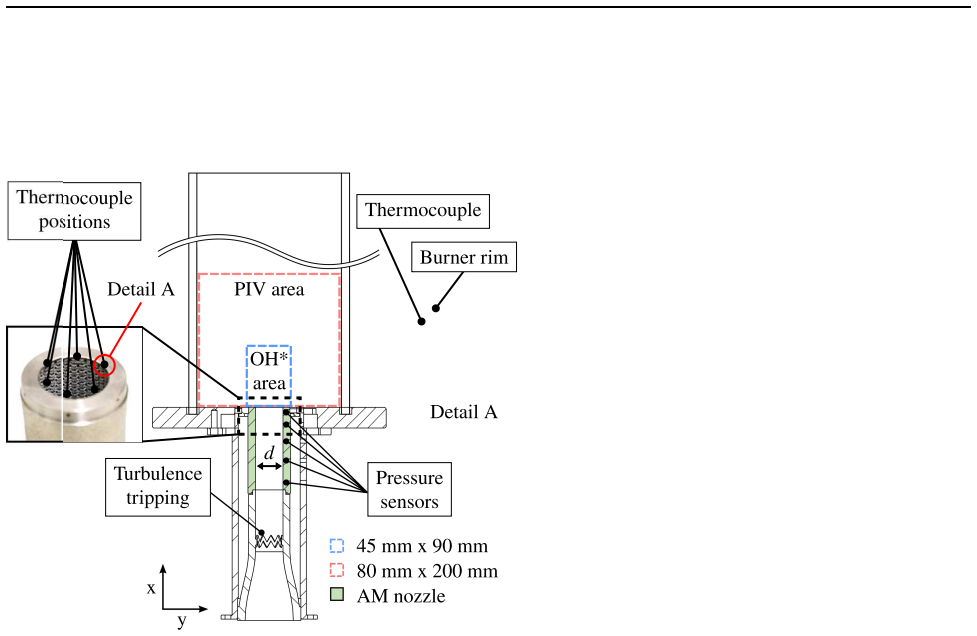
This study investigated how additively manufactured nozzles with body-centered cubic lattice structures reduce the flame flashback propensity in a hydrogen jet flame burner. Five different configurations of a jet flame combustor were investigated, with a focus on mixing duct walls incorporating porous media. The nozzles were manufactured by the powder bed fusion of metals using a laser beam process. The lattice parameters were varied by the volume fraction and the strut diameter. For the experiments, pure hydrogen was used as fuel under atmospheric conditions at various equivalence ratios and Reynolds numbers of 9,000 - 12,000. Flow field measurements, flame imaging, and spectral proper orthogonal decomposition of the flame dynamics were employed to identify possible transition mechanisms from a stable operation to flashback. The flow fields and the flame shapes showed only minor effects from wall modifications, preserving general flow characteristics across configurations. The flow dynamics in the combustion chamber were dominated by large-scale coherent structures in the shear layer, specifically Kelvin-Helmholtz instabilities. The results demonstrated that the nozzle with the coarsest porous wall structure significantly improved the flashback resistance compared to a nozzle with a solid wall. It is concluded that the primary mitigation mechanism was a cooling effect by unburnt mixture flowing through the porous media. The findings confirmed that the integration of lattice structures through additive manufacturing provides a viable strategy for hydrogen flashback mitigation by manipulating the coupled interaction between the flame and the thermal conditions of the wall.
Editorial analysis
A structured set of objections, weighed in public.
Referee Report
Summary. The manuscript experimentally compares five additively manufactured hydrogen jet-flame nozzles whose mixing-duct walls incorporate body-centered-cubic lattice structures of varying volume fraction and strut diameter. Flow-field PIV, flame imaging, and SPOD show only minor differences across configurations; the coarsest lattice nozzle nevertheless exhibits a markedly higher flashback limit than the solid-wall reference. The authors conclude that the improvement arises primarily from cooling of the wall by unburnt mixture flowing through the porous lattice.
Significance. If the reported improvement is robust and the cooling mechanism is confirmed, the work supplies a concrete, AM-enabled design route for raising flashback margins in hydrogen combustors without major changes to the bulk flow field. The result is directly relevant to safe operation of hydrogen-fired gas turbines.
major comments (3)
- [Abstract, §4] Abstract and §4 (results): the central claim that the coarsest lattice improves flashback resistance 'primarily' via cooling by unburnt mixture through the porous media is not supported by any wall or near-wall temperature measurements. Only flow-field data are shown, which exhibit only minor differences; without temperature data the cooling attribution remains an inference rather than a demonstrated mechanism.
- [§2, §3] §2 (experimental methods) and §3 (manufacturing): all nozzles are produced by the same LPBF process, yet no quantitative bounds are given on actual strut diameter, surface roughness, or effective permeability deviations from nominal lattice parameters. These uncontrolled variations could alter flashback limits independently of the intended porous-flow cooling and are not ruled out by the reported data.
- [§4] §4 (flashback limits): the improvement is described as 'significant' but no error bars, repeatability statistics, or number of independent runs are reported for the flashback equivalence-ratio or velocity thresholds. Without these, it is impossible to judge whether the observed difference exceeds manufacturing or measurement variability.
minor comments (2)
- [Abstract, §2] The abstract states Reynolds numbers of 9,000–12,000 but does not specify whether these are based on the mixing-duct hydraulic diameter or another reference length; this should be clarified in §2.
- [Figures] Figure captions and axis labels in the flow-field and SPOD panels should explicitly state the color scale and normalization used for the velocity or mode amplitude fields.
Simulated Author's Rebuttal
We thank the referee for the constructive comments, which help strengthen the manuscript. We address each major comment below, indicating where revisions will be made to clarify inferences, discuss manufacturing aspects, and improve statistical reporting.
read point-by-point responses
-
Referee: [Abstract, §4] Abstract and §4 (results): the central claim that the coarsest lattice improves flashback resistance 'primarily' via cooling by unburnt mixture through the porous media is not supported by any wall or near-wall temperature measurements. Only flow-field data are shown, which exhibit only minor differences; without temperature data the cooling attribution remains an inference rather than a demonstrated mechanism.
Authors: We agree that the cooling mechanism is inferred rather than directly measured. The PIV results demonstrate only minor flow-field differences across nozzles, indicating that the flashback improvement is unlikely to stem from bulk aerodynamic changes. Combined with the porous lattice permitting unburnt mixture permeation, cooling remains the most plausible explanation. We will revise the abstract and §4 to state that the improvement 'is attributed primarily to cooling... inferred from the similarity of the flow fields' and add a sentence recommending future near-wall temperature measurements for confirmation. revision: partial
-
Referee: [§2, §3] §2 (experimental methods) and §3 (manufacturing): all nozzles are produced by the same LPBF process, yet no quantitative bounds are given on actual strut diameter, surface roughness, or effective permeability deviations from nominal lattice parameters. These uncontrolled variations could alter flashback limits independently of the intended porous-flow cooling and are not ruled out by the reported data.
Authors: Nominal lattice parameters (volume fraction and strut diameter) are provided in §3, and all nozzles were produced in a single build with identical LPBF settings. Post-fabrication metrology was not conducted. We will add a paragraph in §3 noting typical LPBF dimensional tolerances (approximately ±0.15 mm for strut diameter) and surface roughness values from literature for similar Ti-6Al-4V lattices, together with a brief discussion that such variations are unlikely to account for the observed flashback difference. We cannot supply new quantitative bounds without additional measurements. revision: partial
-
Referee: [§4] §4 (flashback limits): the improvement is described as 'significant' but no error bars, repeatability statistics, or number of independent runs are reported for the flashback equivalence-ratio or velocity thresholds. Without these, it is impossible to judge whether the observed difference exceeds manufacturing or measurement variability.
Authors: We will revise §4 to report the number of independent flashback tests performed per configuration (five repeats) and include error bars representing one standard deviation of the measured flashback equivalence ratios and velocities. The experimental procedure already involved incremental variation of equivalence ratio until flashback, with the process repeated to assess repeatability. revision: yes
Circularity Check
No circularity: purely experimental study with no derivations or fitted predictions
full rationale
The paper reports experimental measurements of flashback limits, flow fields, and flame dynamics across five nozzle configurations manufactured with varying lattice parameters. All central claims (improved flashback resistance for the coarsest lattice, minor flow-field effects, dominance of Kelvin-Helmholtz structures) are grounded directly in the acquired data rather than any model, equation, or prediction that reduces to its own inputs. No self-citations, ansatzes, or uniqueness theorems appear as load-bearing steps. The interpretive conclusion that cooling via porous flow is the primary mechanism is an inference from the measurements, not a circular derivation. The work is therefore self-contained against external benchmarks with no circularity.
Axiom & Free-Parameter Ledger
axioms (1)
- domain assumption The powder-bed fusion process produces lattice struts whose effective porosity and surface finish match the nominal CAD geometry closely enough that differences in flashback behavior can be attributed to the intended lattice parameters.
Reference graph
Works this paper leans on
-
[1]
Further Studies of the Structure and Stability of Burner Flames
Guenther von Elbe and Morris Mentser. “Further Studies of the Structure and Stability of Burner Flames”. In: J. Chemical Phys. (1945)
1945
-
[2]
Reynolds number effects with in the development region of a turbulent round free jet
H. Fellouah, C.G. Ball, and A. Pollard. “Reynolds number effects with in the development region of a turbulent round free jet”. In: International Journal of Heat and Mass Transfer 52.17 (2009). issn: 0017-
2009
-
[3]
doi: https://doi.org/10.1016/j.ijheatmasstransfer.2009.03.029
-
[4]
Christian Eichler, Georg Baumgartner, and Thomas Sattelmayer . “Experimental Investigation of Turbu- lent Boundary Layer Flashback Limits for Premixed Hydrogen-Air Fla mes Confined in Ducts”. In: J. Eng. Gas Turb. Power (2011). doi: 10.1115/1.4004149
-
[5]
The preferred mode of incompressible jets: lin ear frequency response analysis
X. Garnaud et al. “The preferred mode of incompressible jets: lin ear frequency response analysis”. In: Journal of Fluid Mechanics 716 (2013). doi: 10.1017/jfm.2012.540
-
[6]
Zhixuan Duan et al. “Influence of Burner Material, Tip Temperatu re, and Geometrical Flame Con- figuration on Flashback Propensity of H2-Air Jet Flames”. In: J. Eng. Gas Turb. Power (2014). doi: 10.1115/1.4025359
-
[7]
Boeck, and Thomas Sattelmaye r
Georg Baumgartner, Lorenz R. Boeck, and Thomas Sattelmaye r. “Experimental Investigation of the Transition Mechanism From Stable Flame to Flashback in a Generic Prem ixed Combustion System With High-Speed Micro-Particle Image Velocimetry and Micro-PLIF Combin ed With Chemiluminescence Imag- ing”. In: Journal of Engineering for Gas Turbines and Power 138.2...
-
[8]
Flashb ack Propensity of Turbulent Hy- drogen–Air Jet Flames at Gas Turbine Premixer Conditions
Alireza Kalantari, Elliot Sullivan-Lewis, and Vincent McDonell. “Flashb ack Propensity of Turbulent Hy- drogen–Air Jet Flames at Gas Turbine Premixer Conditions”. In: Journal of Engineering for Gas Turbines and Power 138.6 (Nov. 2015). issn: 0742-4795. doi: 10.1115/1.4031761
-
[9]
Analytic prediction of unconfined bound- ary layer flashback limits in premixed hydrogen–air flames
Vera Hoferichter, Christoph Hirsch, and Thomas Sattelmayer. “Analytic prediction of unconfined bound- ary layer flashback limits in premixed hydrogen–air flames”. In: Combustion Theory and Modelling 21.3 (2017). doi: 10.1080/13647830.2016.1240832
-
[10]
Alireza Kalantari and Vincent McDonell. “Boundary layer flashbac k of non-swirling premixed flames: Mechanisms, fundamental research, and recent advances”. In : Progress in Energy and Combustion Science 61 (2017). issn: 0360-1285. doi: https://doi.org/10.1016/j.pecs.2017.03.001
-
[11]
Cantera: An object-oriented software toolkit for chemical kinetics, thermody- namics, and transport processes
David G Goodwin et al. “Cantera: An object-oriented software toolkit for chemical kinetics, thermody- namics, and transport processes”. In: Zenodo (2018)
2018
-
[12]
Hidemasa Kosaka et al. “Wall heat fluxes and CO formation/oxida tion during laminar and turbulent side-wall quenching of methane and DME flames”. In: International Journal of Heat and Fluid Flow 70 (2018). issn: 0142-727X. doi: https://doi.org/10.1016/j.ijheatfluidflow.2018.01.009. 22 Jaeschke et al
-
[13]
Superior fuel and operational flexibility of s equential combustion in Ansaldo Energia gas turbines
Andrea Ciani et al. “Superior fuel and operational flexibility of s equential combustion in Ansaldo Energia gas turbines”. In: Journal of the Global Power and Propulsion Society 3 (2019). doi: 10.33737/jgpps/110717
-
[14]
Direct numerical simulation of turbulent conjugate heat transfer in a porous-walled duct flow
Y. Kuwata, K. Tsuda, and K. Suga. “Direct numerical simulation of turbulent conjugate heat transfer in a porous-walled duct flow”. In: Journal of Fluid Mechanics 904 (2020). doi: 10.1017/jfm.2020.669
-
[15]
Operation of SGT-60 0 (24 MW) DLE Gas Turbine With Over 60 % H2 in Natural Gas
Rikard Magnusson and Mats Andersson. “Operation of SGT-60 0 (24 MW) DLE Gas Turbine With Over 60 % H2 in Natural Gas”. In: Turbo Expo: Power for Land, Sea, and Air Volume 9: Oil and Gas Applications; Organic Rankine Cycle Power Systems; Steam Turbine (Sept. 2020) . doi: 10.1115/GT2020-16332
-
[16]
Instability of forced planar liqu id jets: mean field analysis and nonlinear simulation
S. Schmidt and K. Oberleithner. “Instability of forced planar liqu id jets: mean field analysis and nonlinear simulation”. In: Journal of Fluid Mechanics 883 (2020), A7. doi: 10.1017/jfm.2019.855
-
[17]
Characte ristics of turbulent square duct flows over porous media
Kazuhiko Suga, Yuki Okazaki, and Yusuke Kuwata. “Characte ristics of turbulent square duct flows over porous media”. In: Journal of Fluid Mechanics 884 (2020). doi: 10.1017/jfm.2019.914
-
[18]
Numerical study of the influence of wall rough ness on laminar boundary layer flash- back
Shuyu Ding et al. “Numerical study of the influence of wall rough ness on laminar boundary layer flash- back”. In: Phys. Rev. Fluids 6 (2 Feb. 2021). doi: 10.1103/PhysRevFluids.6.023201
-
[19]
I. Gibson et al. Additive Manufacturing Technologies. Engineering. Springer Cham, 2021. isbn: 9783030561260. doi: https://doi.org/10.1007/978-3-030-56127-7
-
[20]
Andrea Gruber et al. “Direct Numerical Simulation of hydrogen c ombustion at auto-ignitive conditions: Ignition, stability and turbulent reaction-front velocity”. In: Combustion and Flame 229 (2021), p. 111385. issn: 0010-2180. doi: https://doi.org/10.1016/j.combustflame.2021.02.031
-
[21]
Ukhwa Jin and Kyu Tae Kim. “Experimental investigation of combu stion dynamics and NOx/CO emis- sions from densely distributed lean-premixed multinozzle CH4/C3H8/ H2/air flames”. In: Combustion and Flame 229 (2021). issn: 0010-2180. doi: https://doi.org/10.1016/j.combustflame.2021.111410
-
[22]
Combustion dynamics of multi-eleme nt lean-premixed hydrogen-air flame ensemble
Hyebin Kang and Kyu Tae Kim. “Combustion dynamics of multi-eleme nt lean-premixed hydrogen-air flame ensemble”. In: Combustion and Flame 233 (2021). issn: 0010-2180. doi: https://doi.org/10.1016/j.combustfl
-
[23]
David Noble et al. “Assessment of Current Capabilities and Near- Term Availability of Hydrogen-Fired Gas Turbines Considering a Low-Carbon Future”. In: Journal of Engineering for Gas Turbines and Power 143.4 (Feb. 2021). issn: 0742-4795. doi: 10.1115/1.4049346
-
[24]
Thorsten Zirwes et al. “Numerical Study of Quenching Distance s for Side-Wall Quenching Using Detailed Diffusion and Chemistry”. In: Flow, turbulence and combustion 106 (2021). issn: 1386-6184, 1573-1987. doi: 10.1007/s10494-020-00215-0
-
[25]
Synergistic inte ractions of thermodiffusive instabilities and turbulence in lean hydrogen flames
Lukas Berger, Antonio Attili, and Heinz Pitsch. “Synergistic inte ractions of thermodiffusive instabilities and turbulence in lean hydrogen flames”. In: Combustion and Flame 244 (2022). issn: 0010-2180. doi: https://doi.org/10.1016/j.combustflame.2022.112254
-
[26]
Experimental and Numerical Advancement of the MGT Combustor Towards Higher Hydrogen Capabilities
Bernhard ´Cosi´ c et al. “Experimental and Numerical Advancement of the MGT Combustor Towards Higher Hydrogen Capabilities”. In: Turbo Expo: Power for Land, Sea, and Air Volume 3B: Combustion, Fuels, and Emissions (2022). doi: 10.1115/GT2022-82110. 23 Jaeschke et al
-
[27]
Linear instability of a premixed slot flame: Flam e transfer function and resolvent analysis
Chuhan Wang et al. “Linear instability of a premixed slot flame: Flam e transfer function and resolvent analysis”. In: Combustion and Flame 240 (2022). issn: 0010-2180. doi: https://doi.org/10.1016/j.combustflame.20
-
[28]
Jan Paul Beuth et al. “Thermoacoustic Characterization of a P remixed Multi Jet Burner for Hydrogen and Natural Gas Combustion”. In: Journal of Engineering for Gas Turbines and Power 146.4 (Dec. 2023). doi: 10.1115/1.4063692
-
[29]
Alexander Jaeschke et al. “Experimental Investigation of a Mu lti Tube Burner for Premixed Hydrogen and Natural Gas Low Emission Combustion”. In: Journal of Engineering for Gas Turbines and Power 145.12 (Oct. 2023). issn: 0742-4795. doi: 10.1115/1.4063378
-
[30]
Filippo Fruzza et al. “The importance of Soret effect, preferen tial diffusion, and conjugate heat transfer for flashback limits of hydrogen-fueled perforated burners”. In : Proceedings of the Combustion Institute 40 (2024). issn: 1540-7489. doi: https://doi.org/10.1016/j.proci.2024.105581
-
[31]
100% H2 DLE Gas Turbine Combustion T echnology Platform Development
Sebastian Hermeth et al. “100% H2 DLE Gas Turbine Combustion T echnology Platform Development”. In: Proceedings of ASME Turbo Expo 2024 . Turbo Expo: Power for Land, Sea, and Air Volume 3B: Combustion, Fuels, and Emissions (June 2024). doi: 10.1115/GT2024-128517
-
[32]
Akiba, T., Sano, S., Yanase, T., Ohta, T., and Koyama, M
Ianos Psomoglou et al. “Influence of AM Generated Burner Sur face Roughness on NOx Emissions and Op- erability of Hydrogen-Rich Fuels”. In: Combustion Science and Technology (2024). doi: 10.1080/00102202.2024.239069
-
[33]
On the adequacy of OH* as heat release marker for hydrogen–air flames
Francesco G. Schiavone et al. “On the adequacy of OH* as heat release marker for hydrogen–air flames”. In: Proceedings of the Combustion Institute 40.1 (2024). issn: 1540-7489. doi: https://doi.org/10.1016/j.proci.2024.10
-
[34]
Hydrogen-fueled gas turbines in future ener gy system
Haiqin Zhou et al. “Hydrogen-fueled gas turbines in future ener gy system”. In: International Journal of Hydrogen Energy 64 (2024). issn: 0360-3199. doi: https://doi.org/10.1016/j.ijhydene.2024.03.327
-
[35]
Holger Ax et al. “Investigation of Critical Operating Conditions f or Hydrogen Flames Under Typical Gas Turbine Conditions”. In: Proceedings Turbo Expo. Turbo Expo Volume 3A: Combustion, Fuels and Emissions (June 2025). doi: 10.1115/GT2025-152427
-
[36]
Alexander Jaeschke, Dominik Wassmer, and Christian Oliver Pasc hereit. “Influence of Variable Fuel Staging on the Flow Structures in a Multi-Jet Burner Operated on Le an-Premixed Hydrogen”. In: Proceedings Turbo Expo. Turbo Expo Volume 3B: Combustion, Fuels and Emissions (June 2025 ). doi: 10.1115/GT2025-153254
-
[37]
Nu merical analysis of quenching dis- tance in laminar premixed hydrogen and methane flames
Tahsin Berk Kıymaz, Nijso Beishuizen, and Jeroen van Oijen. “Nu merical analysis of quenching dis- tance in laminar premixed hydrogen and methane flames”. In: Fuel 396 (2025). issn: 0016-2361. doi: https://doi.org/10.1016/j.fuel.2025.135111
-
[38]
Investigation of Flashback Limit s and Detection Strategies for Jet- Stabilized Hydrogen Flames
Philipp Maximilian zur Nedden et al. “Investigation of Flashback Limit s and Detection Strategies for Jet- Stabilized Hydrogen Flames”. In: Proceedings Turbo Expo. Turbo Expo Volume 3A: Combustion, Fuels and Emissions (June 2025). doi: 10.1115/GT2025-152906
-
[39]
Boundary layer flashback limits a nd flame dynamics of turbulent pre- mixed hydrogen-air flames
Jaehyun Park and Kyu Tae Kim. “Boundary layer flashback limits a nd flame dynamics of turbulent pre- mixed hydrogen-air flames”. In: Combustion and Flame 273 (2025). issn: 0010-2180. doi: https://doi.org/10.1016/j.c 24 Jaeschke et al
work page doi:10.1016/j.c 2025
-
[40]
P. Porath et al. “Low velocity streaks combined with intrinsic flam e instabilities provoke boundary layer flashback in a turbulent premixed jet-stabilized hydrogen flame”. I n: Combustion and Flame 278 (2025). issn: 0010-2180. doi: https://doi.org/10.1016/j.combustflame.2025.114236
-
[41]
GE Vernova validates 100 percent hydrogen-fueled DLN combu stor technology aiming to decarbonize its industrial B- and E-Class gas turb ines, GE Vernova News
GE Vernova press release. GE Vernova validates 100 percent hydrogen-fueled DLN combu stor technology aiming to decarbonize its industrial B- and E-Class gas turb ines, GE Vernova News. https://www.gevernova.com/news/ dln-combustor-technology-aiming-6 . 2025. (Visited on 11/27/2025)
2025
-
[42]
Surface Roughness Effects on the Operability and Performance of a Hydrogen Jet Burner
Robin Vivoli et al. “Surface Roughness Effects on the Operability and Performance of a Hydrogen Jet Burner”. In: Journal of Engineering for Gas Turbines and Power 148 (Oct. 2025). doi: 10.1115/1.4069474
-
[43]
Low-frequency streaky struct ures in turbulent hydrogen jet flames
Jakob G.R. von Saldern et al. “Low-frequency streaky struct ures in turbulent hydrogen jet flames”. In: Combustion and Flame 278 (2025). issn: 0010-2180. doi: https://doi.org/10.1016/j.combustflame.2025.114231
-
[44]
GRI-Mech 3.0
Gregory P. Smith et al. “GRI-Mech 3.0”. In: (). url: http://www.me.berkeley.edu/gri_mech/. 25 Jaeschke et al
discussion (0)
Sign in with ORCID, Apple, or X to comment. Anyone can read and Pith papers without signing in.