Photon Cycling and Laser Cooling of an Asymmetric Top Molecule
Pith reviewed 2026-06-27 07:32 UTC · model grok-4.3
The pith
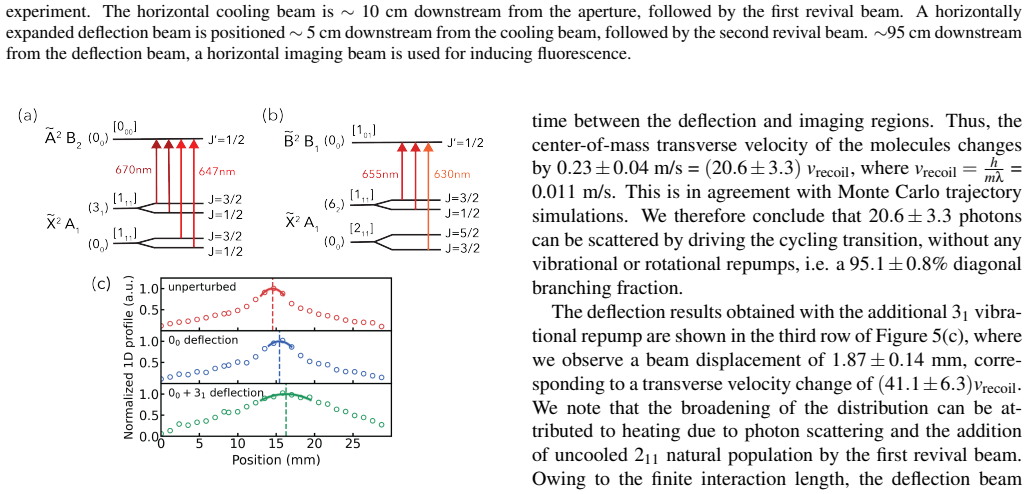
Laser cooling is demonstrated on the asymmetric top molecule CaNH2 with vibrational closure after 41 photons scattered
A machine-rendered reading of the paper's core claim, the machinery that carries it, and where it could break.
Core claim
Two-dimensional magnetically-assisted Sisyphus laser cooling of CaNH2 is realized. Vibrational state closure is achieved with 41.1 ± 6.3 photon scatters using optical pumping of the X[3_1] state. Photon-cycling measurements show good agreement with branching ratios determined by dispersed fluorescence spectroscopy. Rotational closure is maintained by driving the X[1_11] → A [0_00] transition. The observed absence of additional state leakage channels broadens the scope of molecular laser cooling to include ATMs.
What carries the argument
Magnetically-assisted Sisyphus cooling on the X[1_11] to A[0_00] transition combined with optical pumping of the X[3_1] state to close vibrational levels
Load-bearing premise
The photon-cycling measurements combined with dispersed fluorescence spectroscopy fully capture and rule out all possible state leakage channels beyond those already considered.
What would settle it
Detection of unexpected fluorescence lines or additional state losses in higher-sensitivity spectroscopy or longer-duration photon-cycling experiments on CaNH2.
Figures
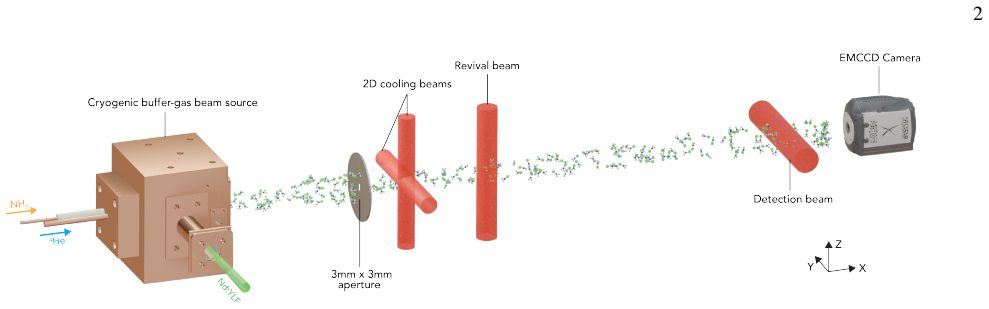
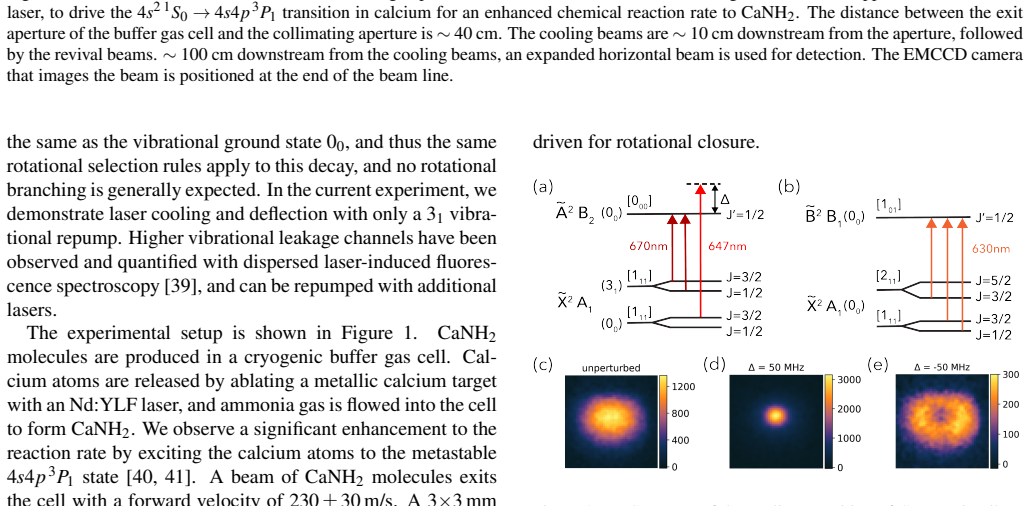
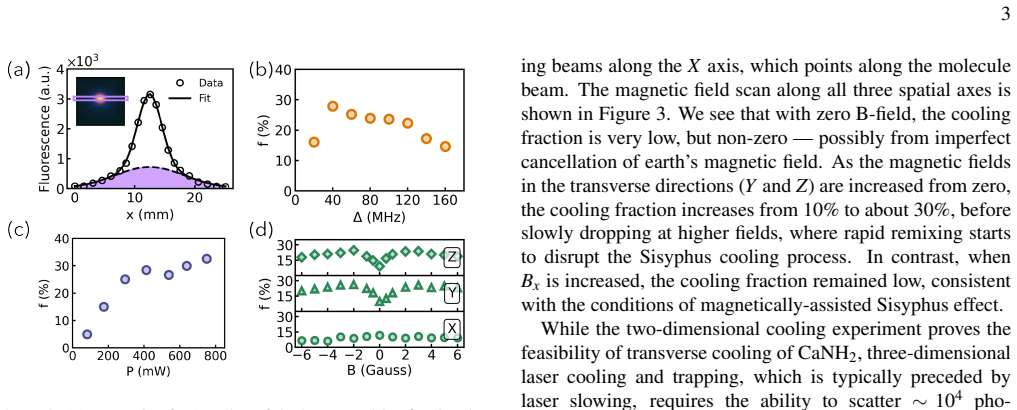
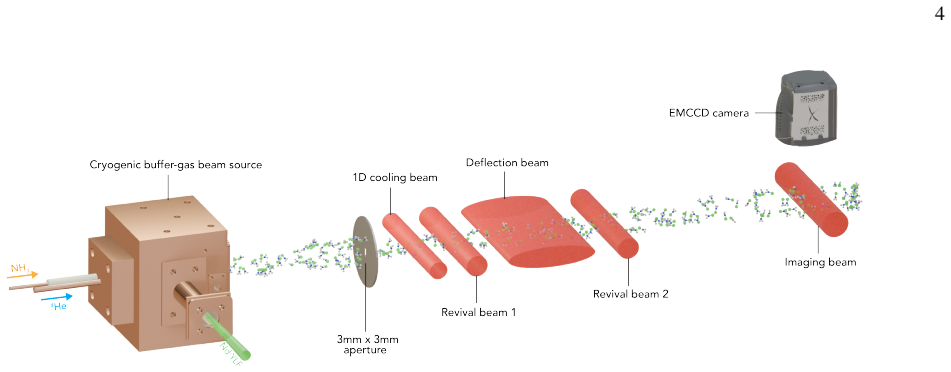
read the original abstract
We realize two-dimensional magnetically-assisted Sisyphus laser cooling of an asymmetric top molecule (ATM), calcium monoamide (CaNH$_2$). Vibrational state closure is achieved with $41.1 \pm 6.3$ photons scatters using optical pumping of the $X[3_1]$ state. Photon-cycling measurements show good agreement with branching ratios determined by dispersed fluorescence spectroscopy. Rotational closure is maintained by driving the $X[1_{11}] \to A [0_{00}]$ transition. The observed absence of additional state leakage channels broadens the scope of molecular laser cooling to include ATMs, which are the most general geometric class of molecules and possess the richest internal structure. Future applications of quantum controlled ATMs include new quantum information platforms and searches for physics beyond the Standard Model.
Editorial analysis
A structured set of objections, weighed in public.
Referee Report
Summary. The manuscript claims to demonstrate two-dimensional magnetically-assisted Sisyphus laser cooling of the asymmetric top molecule CaNH₂. Vibrational state closure is achieved with 41.1 ± 6.3 photon scatters using optical pumping of the X[3₁] state. Photon-cycling measurements are reported to agree with branching ratios from dispersed fluorescence spectroscopy. Rotational closure is maintained by driving the X[1₁₁] → A[0₀₀] transition. The authors conclude that the observed absence of additional state leakage channels extends molecular laser cooling to asymmetric top molecules, the most general geometric class with the richest internal structure.
Significance. If substantiated, the result would be significant as it extends laser cooling techniques to asymmetric top molecules, which have the most complex internal structure among molecular geometric classes. This could enable new platforms for quantum information and searches for physics beyond the Standard Model using quantum-controlled ATMs.
major comments (2)
- [Abstract] Abstract: The reported value of 41.1 ± 6.3 photons and the stated agreement with branching ratios are presented without any methods description, data tables, or error analysis, making it impossible to verify the central claim that vibrational closure is achieved and that no additional leakage channels exist.
- [Abstract] Abstract: The manuscript does not quantify the detection limit or sensitivity for weak or dark leakage channels outside the probed X[3₁] and rotational manifold; in the dense rotational structure of an asymmetric top, this leaves open the possibility of unaccounted loss channels at the 10^{-3}–10^{-4} level that would undermine sustained photon cycling.
minor comments (1)
- The spectroscopic state notation (X[3₁], X[1₁₁], A[0₀₀]) should include a brief definition or reference to standard asymmetric-top conventions for clarity.
Simulated Author's Rebuttal
We thank the referee for their thoughtful review and for highlighting areas where the presentation of our results can be strengthened. We address each major comment below and will revise the manuscript accordingly to improve clarity and verifiability while preserving the core claims supported by the data.
read point-by-point responses
-
Referee: [Abstract] Abstract: The reported value of 41.1 ± 6.3 photons and the stated agreement with branching ratios are presented without any methods description, data tables, or error analysis, making it impossible to verify the central claim that vibrational closure is achieved and that no additional leakage channels exist.
Authors: The abstract is intentionally concise and does not contain detailed methods, tables, or error analysis, as is standard for the format. These elements are provided in the main text: the photon scatter number and its uncertainty are derived from time-of-flight and fluorescence measurements detailed in the 'Experimental Methods' and 'Photon Cycling Measurements' sections, with error analysis based on Poisson statistics and run-to-run variations reported in the associated figures and text. Branching ratio agreement is shown via direct comparison in the 'Dispersed Fluorescence' section, including a table of measured intensities versus calculated values. We agree the abstract could better signpost these details and will revise it to reference the relevant sections and briefly note the measurement basis. revision: partial
-
Referee: [Abstract] Abstract: The manuscript does not quantify the detection limit or sensitivity for weak or dark leakage channels outside the probed X[3₁] and rotational manifold; in the dense rotational structure of an asymmetric top, this leaves open the possibility of unaccounted loss channels at the 10^{-3}–10^{-4} level that would undermine sustained photon cycling.
Authors: We agree that explicit quantification of detection limits for potential dark leakage channels is important given the rotational density of asymmetric tops. The current manuscript discusses the overall sensitivity of the fluorescence imaging system in the methods but does not provide a dedicated upper-limit calculation for unobserved channels. We will add a new paragraph in the results section that derives the detection limit from the signal-to-noise ratio, the absence of population in additional probed states, and the total photon scatter number, establishing an upper bound below 10^{-3} per cycle for any unaccounted loss. revision: yes
Circularity Check
No circularity: experimental results rest on direct photon-cycling counts and fluorescence spectra, not on derivations or self-citations.
full rationale
The paper reports experimental measurements of photon scattering (41.1 ± 6.3) on the X[1_11]–A[0_00] transition in CaNH2, vibrational closure via X[3_1] pumping, and branching ratios from dispersed fluorescence. The central claim—that no additional leakage channels are observed—follows directly from these data without any equations, fitted parameters renamed as predictions, or load-bearing self-citations. No derivation chain exists to inspect for self-definition or reduction to inputs. The work is self-contained against external benchmarks (observed counts and spectra) and receives the default non-finding score.
Axiom & Free-Parameter Ledger
Reference graph
Works this paper leans on
-
[1]
Graham, Y
T. Graham, Y . Song, J. Scott, C. Poole, L. Phuttitarn, K. Jooya, P. Eichler, X. Jiang, A. Marra, B. Grinkemeyer,et al., Nature 604, 457 (2022)
2022
-
[2]
Bluvstein, S
D. Bluvstein, S. J. Evered, A. A. Geim, S. H. Li, H. Zhou, T. Manovitz, S. Ebadi, M. Cain, M. Kalinowski, D. Hangleiter, et al., Nature626, 58 (2024)
2024
-
[3]
Luciuk, S
C. Luciuk, S. Trotzky, S. Smale, Z. Yu, S. Zhang, and J. H. Thywissen, Nature Physics12, 599 (2016)
2016
-
[4]
Ebadi, T
S. Ebadi, T. T. Wang, H. Levine, A. Keesling, G. Semeghini, A. Omran, D. Bluvstein, R. Samajdar, H. Pichler, W. W. Ho, et al., Nature595, 227 (2021)
2021
-
[5]
Saint-Jalm, P
R. Saint-Jalm, P. C. Castilho, É. Le Cerf, B. Bakkali-Hassani, J.-L. Ville, S. Nascimbene, J. Beugnon, and J. Dalibard, Physi- cal Review X9, 021035 (2019)
2019
-
[6]
C. D. Marciniak, T. Feldker, I. Pogorelov, R. Kaubruegger, D. V . Vasilyev, R. van Bijnen, P. Schindler, P. Zoller, R. Blatt, and T. Monz, Nature603, 604 (2022)
2022
-
[7]
M. C. Marshall, D. A. R. Castillo, W. J. Arthur-Dworschack, A. Aeppli, K. Kim, D. Lee, W. Warfield, J. Hinrichs, N. V . Nardelli, T. M. Fortier,et al., Physical Review Letters135, 033201 (2025)
2025
-
[8]
Aeppli, K
A. Aeppli, K. Kim, W. Warfield, M. S. Safronova, and J. Ye, Physical Review Letters133, 023401 (2024)
2024
-
[9]
R. H. Parker, C. Yu, W. Zhong, B. Estey, and H. Müller, Science 360, 191 (2018)
2018
-
[10]
Parker, M
R. Parker, M. Dietrich, M. Kalita, N. Lemke, K. Bailey, M. Bishof, J. Greene, R. Holt, W. Korsch, Z.-T. Lu,et al., Phys- ical Review Letters114, 233002 (2015)
2015
-
[11]
Kozyryev, Z
I. Kozyryev, Z. Lasner, and J. M. Doyle, Physical Review A 103, 043313 (2021)
2021
-
[12]
Katori, T
H. Katori, T. Ido, and M. Kuwata-Gonokami, Journal of the Physical Society of Japan68, 2479 (1999)
1999
-
[13]
Kuwamoto, K
T. Kuwamoto, K. Honda, Y . Takahashi, and T. Yabuzaki, Phys- ical Review A60, R745 (1999)
1999
-
[14]
M. Lu, N. Q. Burdick, S. H. Youn, and B. L. Lev, Physical review letters107, 190401 (2011)
2011
-
[15]
Uhlenberg, J
G. Uhlenberg, J. Dirscherl, and H. Walther, Physical Review A 62, 063404 (2000)
2000
-
[16]
Griesmaier, J
A. Griesmaier, J. Werner, S. Hensler, J. Stuhler, and T. Pfau, Physical Review Letters94, 160401 (2005)
2005
-
[17]
Baker, W
C. Baker, W. Bertsche, A. Capra, C. Carruth, C. Cesar, M. Charlton, A. Christensen, R. Collister, A. C. Mathad, S. Eriksson,et al., Nature592, 35 (2021)
2021
-
[18]
Glöggler, N
L. Glöggler, N. Gusakova, B. Rienäcker, A. Camper, R. Car- avita, S. Huck, M. V olponi, T. Wolz, L. Penasa, V . Krumins, et al., Physical Review Letters132, 083402 (2024)
2024
-
[19]
Zhelyazkova, A
V . Zhelyazkova, A. Cournol, T. E. Wall, A. Matsushima, J. J. Hudson, E. Hinds, M. Tarbutt, and B. Sauer, Physical Review A89, 053416 (2014)
2014
-
[20]
E. S. Shuman, J. F. Barry, and D. DeMille, Nature467, 820 (2010)
2010
-
[21]
A. L. Collopy, S. Ding, Y . Wu, I. A. Finneran, L. Anderegg, B. L. Augenbraun, J. M. Doyle, and J. Ye, Physical review let- ters121, 213201 (2018)
2018
-
[22]
Padilla-Castillo, J
J. Padilla-Castillo, J. Cai, P. Agarwal, P. Kukreja, R. Thomas, B. G. Sartakov, S. Truppe, G. Meijer, and S. Wright, Physical Review Letters135, 243401 (2025)
2025
-
[23]
N. B. Vilas, C. Hallas, L. Anderegg, P. Robichaud, A. Winnicki, D. Mitra, and J. M. Doyle, Nature606, 70 (2022)
2022
-
[24]
Z. D. Lasner, A. Frenett, H. Sawaoka, L. Anderegg, B. Augen- braun, H. Lampson, M. Li, A. Lunstad, J. Mango, A. Nasir, et al., Physical Review Letters134, 083401 (2025)
2025
-
[25]
A. M. Kaufman and K.-K. Ni, Nature Physics17, 1324 (2021)
2021
-
[26]
Y . Bao, S. S. Yu, L. Anderegg, E. Chae, W. Ketterle, K.-K. Ni, and J. M. Doyle, Science382, 1138 (2023)
2023
-
[27]
C. M. Holland, Y . Lu, and L. W. Cheuk, Science382, 1143 (2023)
2023
-
[28]
Mitra, K
D. Mitra, K. Leung, and T. Zelevinsky, Physical Review A105, 040101 (2022)
2022
-
[29]
Jansen, H
P. Jansen, H. L. Bethlem, and W. Ubachs, The Journal of chem- ical physics140(2014)
2014
-
[30]
Anderegg, N
L. Anderegg, N. B. Vilas, C. Hallas, P. Robichaud, A. Jad- babaie, J. M. Doyle, and N. R. Hutzler, Science382, 665 (2023)
2023
-
[31]
Robichaud, C
P. Robichaud, C. Hallas, J. Tao, G. Lee, N. B. Vilas, and J. M. Doyle, Nature , 1 (2026)
2026
-
[32]
Frenett, Z
A. Frenett, Z. Lasner, L. Cheng, and J. M. Doyle, Physical Re- view A110, 022811 (2024)
2024
-
[33]
B. L. Augenbraun, J. M. Doyle, T. Zelevinsky, and I. Kozyryev, Physical Review X10, 031022 (2020)
2020
-
[34]
G.-Z. Zhu, D. Mitra, B. L. Augenbraun, C. E. Dickerson, M. J. Frim, G. Lao, Z. D. Lasner, A. N. Alexandrova, W. C. Camp- bell, J. R. Caram, J. M. Doyle, and E. R. Hudson, Nature Chem- istry14, 995 (2022)
2022
-
[35]
Mitra, Z
D. Mitra, Z. D. Lasner, G.-Z. Zhu, C. E. Dickerson, B. L. Au- genbraun, A. D. Bailey, A. N. Alexandrova, W. C. Campbell, J. R. Caram, E. R. Hudson,et al., The Journal of Physical Chemistry Letters13, 7029 (2022)
2022
-
[36]
B. L. Augenbraun, S. Burchesky, A. Winnicki, and J. M. Doyle, The Journal of Physical Chemistry Letters13, 10771 (2022)
2022
-
[37]
Burchesky,Engineered collisions, molecular qubits, and laser cooling of asymmetric top molecules(Harvard University, 2023)
S. Burchesky,Engineered collisions, molecular qubits, and laser cooling of asymmetric top molecules(Harvard University, 2023)
2023
-
[38]
Wójcik, H
P. Wójcik, H. Zhou, T. Khvorost, G.-Z. Zhu, G. Lao, J. R. Caram, A. N. Alexandrova, E. R. Hudson, W. C. Campbell, and A. I. Krylov, The Journal of Chemical Physics164(2026)
2026
-
[39]
Mango, G
J. Mango, G. K. Li, G. Lee, N. B. Vilas, A. Frenett, L. An- deregg, and J. M. Doyle (2026), unpublished
2026
-
[40]
Bopegedera, C
A. Bopegedera, C. Brazier, and P. Bernath, Journal of Physical Chemistry91, 2779 (1987)
1987
-
[41]
Jadbabaie, N
A. Jadbabaie, N. H. Pilgram, J. Kłos, S. Kotochigova, and N. R. Hutzler, New Journal of Physics22, 022002 (2020). 6
2020
-
[42]
Emile, R
O. Emile, R. Kaiser, C. Gerz, H. Wallis, A. Aspect, and C. Cohen-Tannoudji, Journal de Physique II3, 1709 (1993)
1993
-
[43]
Vadachkoria, Q
S. Vadachkoria, Q. Lei, T. C. Steimle, and M. C. Heaven, The Journal of Physical Chemistry Letters16, 3309 (2025). Supplemental Material:Photon Cycling and Laser Cooling of an Asymmetric Top Molecule Grace K. Li,1, 2,∗ Giseok Lee,1, 2 Jack Mango,1, 2 Hana Lampson,1, 2 YongWoong Lee,3 Winston Wang,1, 2 Avikar Periwal,1, 2, 4 Nathaniel B. Vilas,5 Alexander ...
2025
discussion (0)
Sign in with ORCID, Apple, or X to comment. Anyone can read and Pith papers without signing in.