Constraining the Geometry of Galactic Dark Matter with Gaia Data Release 3
Pith reviewed 2026-06-27 08:54 UTC · model grok-4.3
The pith
Gaia DR3 data indicate that the Milky Way's dark matter is distributed in a flattened disk rather than a spherical halo.
A machine-rendered reading of the paper's core claim, the machinery that carries it, and where it could break.
Core claim
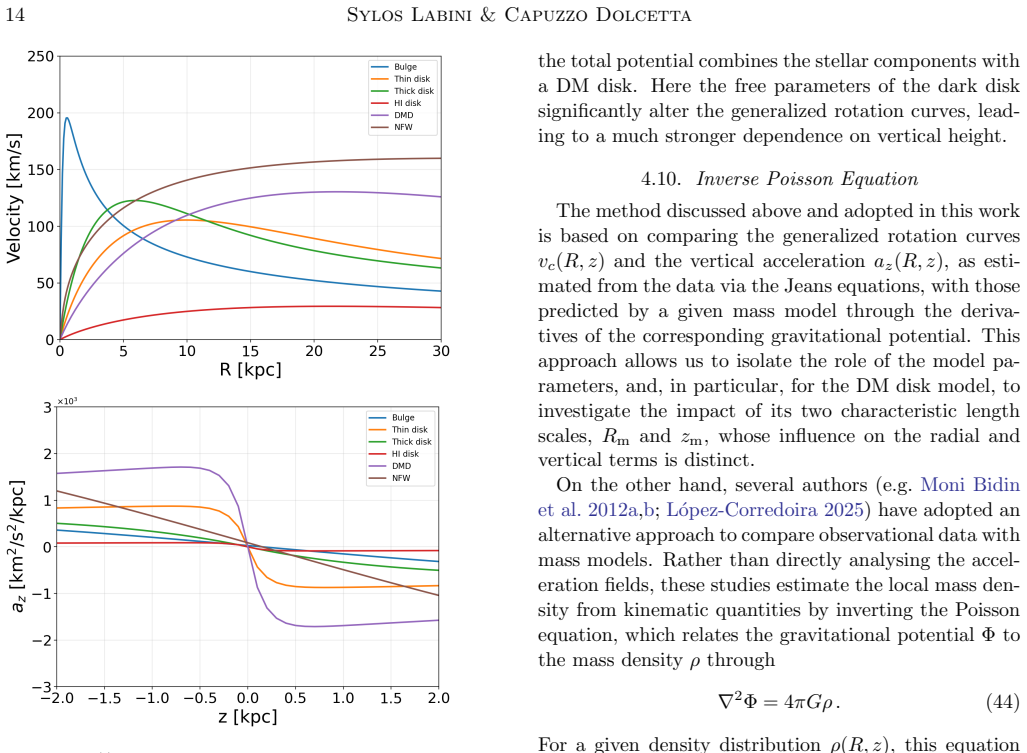
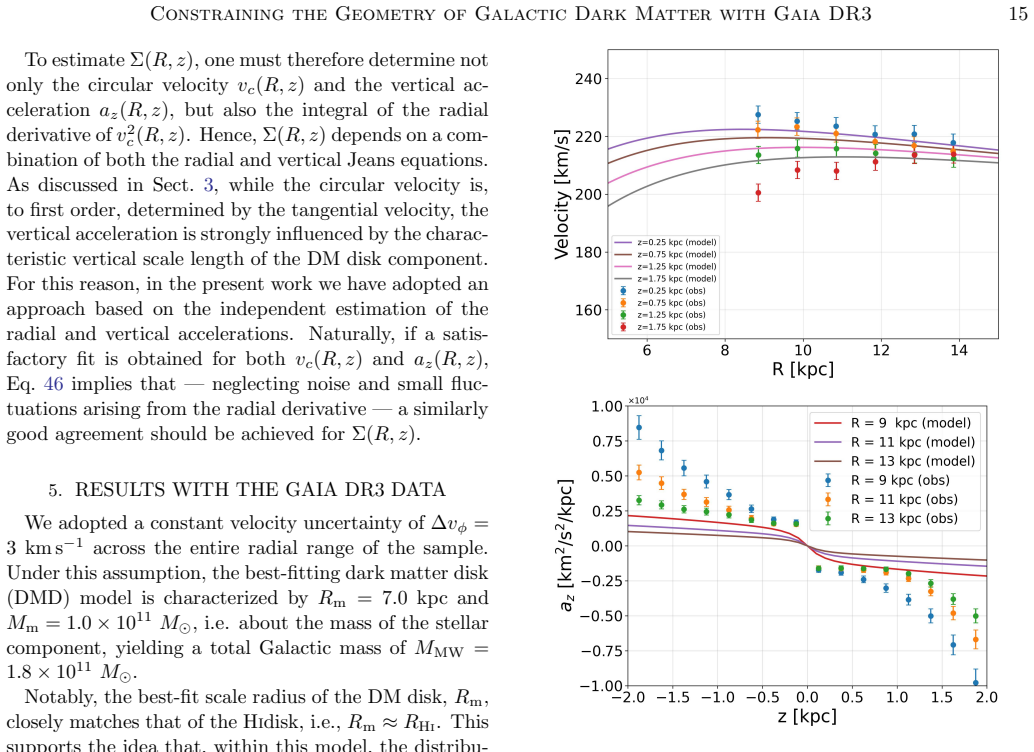
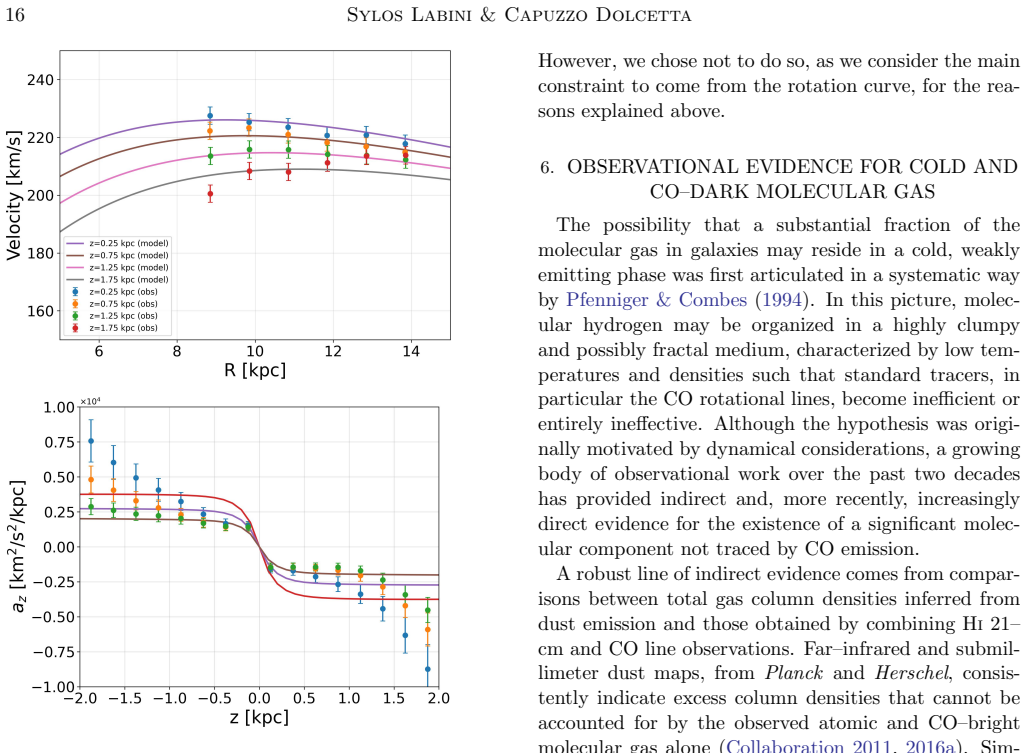
Models including the observed stellar components together with a spherical DM halo fail to reproduce both the pronounced variation of v_c(R,z) with height and the observed behavior of a_z(R,z). Spherical halos with scale radius around 15 kpc contribute negligibly to the off-plane rotation curve and vertical acceleration in the inner disk. Models in which DM is confined to a flattened, disk-like configuration predict substantial contributions to both quantities and yield markedly better agreement with the Gaia DR3 measurements.
What carries the argument
The vertical acceleration a_z(R,z) and off-plane rotation curve v_c(R,z) extracted from Gaia DR3, used to test predictions from stellar mass models combined with either spherical or flattened dark matter distributions.
If this is right
- Spherical halos with scale radius near 15 kpc add almost nothing to the off-plane dynamics inside 14 kpc.
- Disk-like dark matter supplies the dominant contribution to both the observed vertical gradients and the height variation of the rotation curve.
- The data are inconsistent with the standard assumption that dark matter resides in a spherical halo in the solar neighborhood.
Where Pith is reading between the lines
- If dark matter follows the stellar disk, its total mass within the solar circle could be lower than halo-based estimates imply.
- Repeating the same analysis on external edge-on galaxies with comparable kinematic data could test whether flattened dark matter is common or unique to the Milky Way.
Load-bearing premise
The vertical acceleration a_z(R,z), despite model-dependent systematics up to 20 percent, remains accurate enough to distinguish spherical from disk-like dark matter geometries when combined with the stellar mass model.
What would settle it
New measurements showing that the height dependence of the rotation curve or the vertical acceleration matches the predictions of a spherical halo model within the reported uncertainties would falsify the preference for disk-like dark matter.
Figures
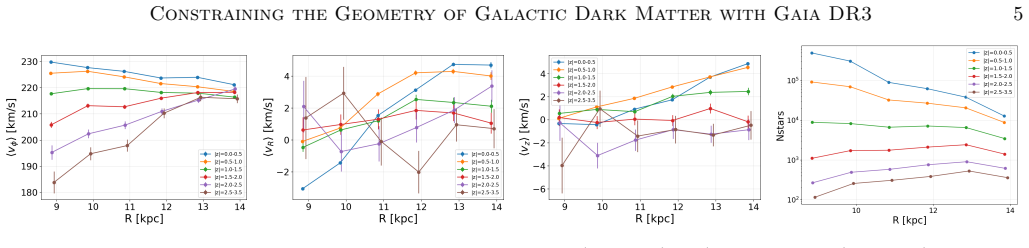
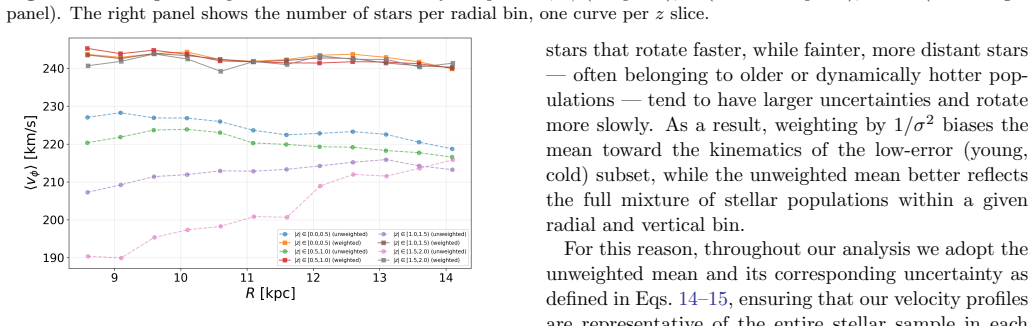
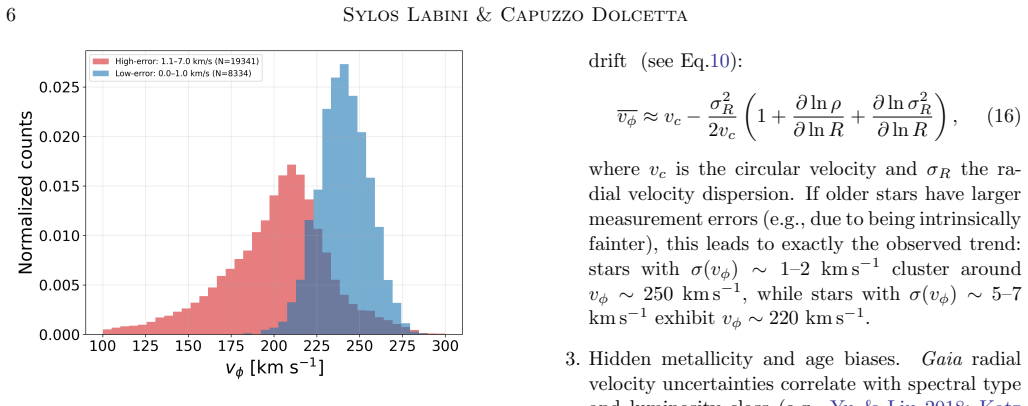
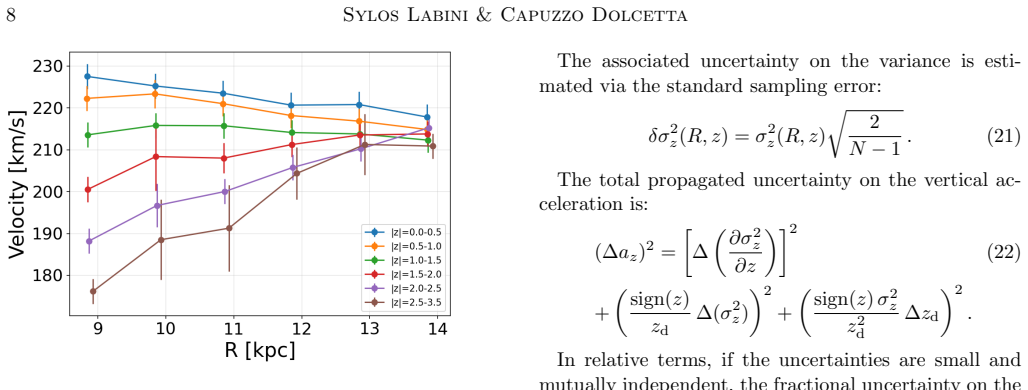
read the original abstract
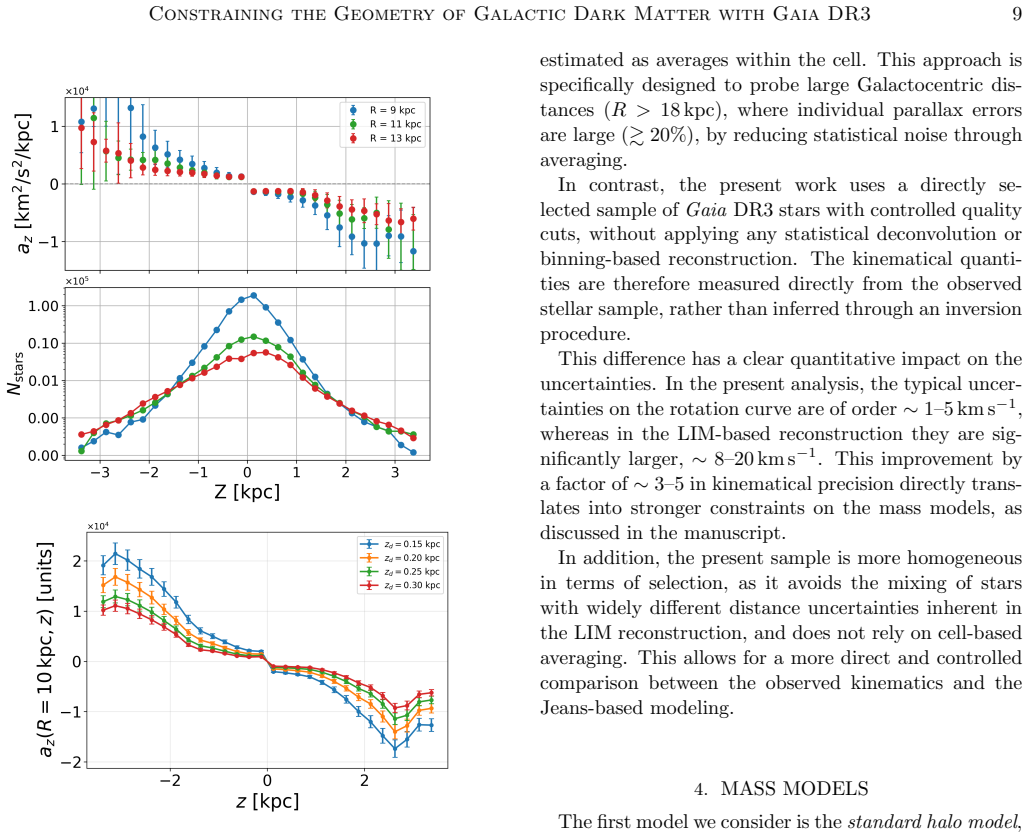
We derive both the mid-plane and off-plane rotation curves, $v_c(R,z)$, and the vertical acceleration, $a_z(R,z)$, of the Milky Way (MW) using \textit{Gaia}~DR3 data over the ranges of vertical heights $z \in (-2,2)\,$ kpc and galactocentric distances $R \in (8.5,14)$ kpc where the velocity components are determined with high precision, i.e., with an error $< 5\%$. In contrast, the vertical acceleration $a_z(R,z)$ is dominated by model-dependent systematics, with uncertainties of up to $\sim 20\%$. This level of accuracy allows us to place stringent constraints on the geometry of the MW's dark matter (DM) distribution, as the vertical gradients of the gravitational potential attain their maximum within this range of radial and vertical distances corresponding to the characteristic scales of the disk. We find that models including the observed stellar components together with a spherical DM halo fail to reproduce both the pronounced variation of $v_c(R,z)$ with height and the observed behavior of $a_z(R,z)$. In particular, spherical halos with a scale radius of $r_s \sim 15$ kpc contribute negligibly to the off-plane rotation curve and vertical acceleration in the inner disk, leaving these features primarily determined by the stellar mass distribution. Conversely, models in which DM is confined to a flattened, disk-like configuration predict substantial contributions to both $v_c(R,z)$ and $a_z(R,z)$, resulting in a markedly better agreement with the data. We conclude that disk-like DM distributions are strongly favored over spherical halo models. Forthcoming Gaia data releases will enable even more stringent tests of the geometry and distribution of the MW's DM component.
Editorial analysis
A structured set of objections, weighed in public.
Referee Report
Summary. The paper derives mid-plane and off-plane Milky Way rotation curves v_c(R,z) and vertical accelerations a_z(R,z) from Gaia DR3 over 8.5 < R < 14 kpc and |z| < 2 kpc. It reports velocity precision <5% but a_z systematics up to ~20%, claims that spherical DM halos (r_s ~15 kpc) contribute negligibly and fail to match the observed z-dependence, while disk-like DM distributions match substantially better, and concludes that disk-like DM is strongly favored.
Significance. If the central claim holds after proper uncertainty propagation, the result would be significant for Milky Way dynamics, as it would indicate that the DM distribution deviates from the standard spherical halo at the disk scale height and could constrain galaxy formation models.
major comments (3)
- [Abstract] Abstract: the statement that spherical halos 'contribute negligibly' to off-plane v_c and a_z is presented without the explicit decomposition or subtraction of the stellar mass model that would allow a reader to verify the residual signal attributed to DM geometry.
- [Abstract] Abstract: no propagation of the stated ~20% model-dependent systematics in a_z(R,z) into the model comparison (e.g., via residuals, likelihood ratios, or posterior odds) is shown, so it is unclear whether the reported preference for disk-like DM exceeds the systematic floor.
- [Abstract] Abstract: the claim that spherical halos with r_s ~15 kpc leave the signal 'primarily determined by the stellar mass distribution' requires a quantitative demonstration that the observed z-variation of v_c exceeds what the stellar disk alone can produce within the quoted errors.
minor comments (1)
- The ranges of R and z are given but no table or figure of the actual binned v_c or a_z values is referenced in the abstract, which would aid assessment of the data quality.
Simulated Author's Rebuttal
We thank the referee for their careful reading and constructive comments. We address each major comment below and agree that revisions to the abstract are needed to strengthen the presentation of our claims.
read point-by-point responses
-
Referee: [Abstract] Abstract: the statement that spherical halos 'contribute negligibly' to off-plane v_c and a_z is presented without the explicit decomposition or subtraction of the stellar mass model that would allow a reader to verify the residual signal attributed to DM geometry.
Authors: We agree that an explicit decomposition would improve clarity for readers. The full manuscript (Section 4 and Figures 4-5) compares the data to stellar-only models versus stellar plus spherical DM, showing the negligible additional contribution from the halo. We will revise the abstract to explicitly reference this decomposition and briefly describe the subtraction procedure. revision: yes
-
Referee: [Abstract] Abstract: no propagation of the stated ~20% model-dependent systematics in a_z(R,z) into the model comparison (e.g., via residuals, likelihood ratios, or posterior odds) is shown, so it is unclear whether the reported preference for disk-like DM exceeds the systematic floor.
Authors: The referee is correct that the abstract does not demonstrate propagation of the ~20% systematics into the model comparison. The main text incorporates these systematics in the error budget and model fits, but we will revise the abstract to state that the preference for disk-like DM persists after including the full systematic floor, and add a supplementary figure showing residuals with systematic uncertainties. revision: yes
-
Referee: [Abstract] Abstract: the claim that spherical halos with r_s ~15 kpc leave the signal 'primarily determined by the stellar mass distribution' requires a quantitative demonstration that the observed z-variation of v_c exceeds what the stellar disk alone can produce within the quoted errors.
Authors: We will add the requested quantitative demonstration to the revised abstract, noting that the observed vertical gradient in v_c exceeds the stellar-disk-only prediction by >3 sigma given the <5% velocity precision (supported by the analysis in Section 3.2). This addresses the need for explicit comparison within the quoted errors. revision: yes
Circularity Check
No circularity: derivation from Gaia DR3 data is self-contained
full rationale
The paper derives v_c(R,z) and a_z(R,z) directly from Gaia DR3 velocity data over the stated (R,z) ranges and compares the resulting gradients to forward predictions from standard stellar mass models plus either spherical halos or disk-like DM. No equations define a quantity in terms of itself, no fitted parameters are relabeled as independent predictions, and no self-citations supply load-bearing uniqueness theorems or ansatzes. The model comparison therefore rests on external observational inputs and conventional mass models rather than reducing to the paper's own fitted values or prior claims by construction.
Axiom & Free-Parameter Ledger
Reference graph
Works this paper leans on
-
[1]
Ackermann, M. e. a. 2012, Astrophysical Journal, 750, 3
2012
-
[2]
2008, Galactic Dynamics, 2nd edn
Binney, J., & Tremaine, S. 2008, Galactic Dynamics, 2nd edn. (Princeton University Press)
2008
-
[3]
1978, PhD thesis, University of Groningen, Netherlands —
Bosma, A. 1978, PhD thesis, University of Groningen, Netherlands —. 1981, Astron.J., 86, 1791, doi: 10.1086/113062 Chrob´ akov´ a,ˇZ., Nagy, R., & L´ opez-Corredoira, M. 2022, Astron.Astrophys., 664, A58, doi: 10.1051/0004-6361/202243296
-
[4]
2011, Astronomy and Astrophysics, 536, A19 —
Collaboration, P. 2011, Astronomy and Astrophysics, 536, A19 —. 2016a, Astronomy and Astrophysics, 586, A132 —. 2016b, Astronomy and Astrophysics, 594, A28
2011
-
[5]
and Rix, Hans-Walter and Ness, Melissa K
Eilers, A.-C., Hogg, D. W., Rix, H.-W., & Ness, M. K. 2019, Astrophys.J., 871, 120, doi: 10.3847/1538-4357/aaf648
-
[6]
Elsanhoury, W. H., Nouh, M. I., & Rassem, M. A. 2023, Astronomische Nachrichten, 344, 47, doi: 10.1002/asna.20220083
-
[7]
Freeman, K. C. 1970, Astrophys.J., 160, 811, doi: 10.1086/150474 Gaia Collaboration, Prusti, T., de Bruijne, J. H. J., et al. 2016, Astron.Astrophys., 595, A1, doi: 10.1051/0004-6361/201629272 Gaia Collaboration, Brown, A. G. A., Vallenari, A., et al. 2018, Astron.Astrophys., 616, A1, doi: 10.1051/0004-6361/201833051 —. 2021a, Astron.Astrophys., 649, A1, ...
-
[8]
A., Casandjian, J.-M., & Terrier, R
Grenier, I. A., Casandjian, J.-M., & Terrier, R. 2005, Science, 307, 1292
2005
-
[9]
Hessman, F. V., & Ziebart, M. 2011, Astron.Astrophys., 532, A121, doi: 10.1051/0004-6361/201117199
-
[10]
2001, MNRAS, 327, 799, doi: 10.1046/j.1365-8711.2001.04769.x
Hoekstra, H., van Albada, T. S., & Sancisi, R. 2001, Mon.Not.R.Astr.Soc., 323, 453, doi: 10.1046/j.1365-8711.2001.04214.x
-
[11]
Hogg, D. W., Myers, A. D., & Bovy, J. 2010, ApJ, 725, 2166, doi: 10.1088/0004-637X/725/2/2166
-
[12]
Detection of the Keplerian decline in the Milky Way rotation curve , volume=
Jiao, Y., Hammer, F., Wang, H., et al. 2023, Astron.Astrophys., 678, A208, doi: 10.1051/0004-6361/202347513 Juri´ c, M., Ivezi´ c,ˇZ., Brooks, A., et al. 2008, Astrophys.J., 673, 864, doi: 10.1086/523619
-
[13]
Kalberla, P. M. W., & Dedes, L. 2008, Astron.Astrophys., 487, 951, doi: 10.1051/0004-6361:20079240
-
[14]
2019, Astronomy & Astrophysics, 622, A205, doi: 10.1051/0004-6361/201833273
Katz, D., Sartoretti, P., Cropper, M., et al. 2019, Astronomy & Astrophysics, 622, A205, doi: 10.1051/0004-6361/201833273
-
[15]
2023, A&A, 674, A5, doi: 10.1051/0004-6361/202244220 L´ opez-Corredoira, M
Katz, D., Sartoretti, P., Guerrier, A., et al. 2023, A&A, 674, A5, doi: 10.1051/0004-6361/202244220 L´ opez-Corredoira, M. 2025, Astrophys.J, 978, 45, doi: 10.3847/1538-4357/ad94f5
-
[16]
Merritt, D., Graham, A. W., Moore, B., Diemand, J., & Terzi´ c, B. 2006, Astronom.J., 132, 2685, doi: 10.1086/508988 Moni Bidin, C., Carraro, G., & M´ endez, R. A. 2012a, Astrophys.J., 747, 101, doi: 10.1088/0004-637X/747/2/101 Moni Bidin, C., Carraro, G., M´ endez, R. A., & Smith, R. 2012b, Astrophys.J., 751, 30, doi: 10.1088/0004-637X/751/1/30
-
[17]
Navarro, J. F., Frenk, C. S., & White, S. D. M. 1997, Astrophys.J., 490, 493, doi: 10.1086/304888 Constraining the Geometry of Galactic Dark Matter with Gaia DR319
-
[18]
Ou, X., Eilers, A.-C., Necib, L., & Frebel, A. 2024, Mon.Not.R.Astr.Soc., 528, 693, doi: 10.1093/mnras/stae034
-
[19]
1994, Astronomy and Astrophysics, 285, 94
Pfenniger, D., & Combes, F. 1994, Astronomy and Astrophysics, 285, 94
1994
-
[20]
Reach, W. T. e. a. 2017, Astrophysical Journal, 851, 119
2017
-
[21]
1999, Astrophys.Sp.Sci., 269, 59, doi: 10.1023/A:1017007620742
Sancisi, R. 1999, Astrophys.Sp.Sci., 269, 59, doi: 10.1023/A:1017007620742
-
[22]
Albada, T. S. 2012, Mon.Not.R.Astr.Soc., 425, 2299, doi: 10.1111/j.1365-2966.2012.21599.x Sylos Labini, F. 2024, Astrophys.J., 976, 185, doi: 10.3847/1538-4357/ad88f1 Sylos Labini, F., Capuzzo-Dolcetta, R., De Marzo, G., &
-
[23]
Straccamore, M. 2025, Astron.Astrophys., 693, A248, doi: 10.1051/0004-6361/202452556 Sylos Labini, F., Chrob´ akov´ a,ˇZ., Capuzzo-Dolcetta, R., & L´ opez-Corredoira, M. 2023, Astrophys.J., 945, 3, doi: 10.3847/1538-4357/acb92c Sylos Labini, F., De Marzo, G., Straccamore, M., & Comer´ on, S. 2024, Mon.Not.R.Astr.Soc., 527, 2697, doi: 10.1093/mnras/stad3278
-
[24]
2023, Astrophys.J., 942, 12, doi: 10.3847/1538-4357/aca27c
Wang, H.-F., Chrob´ akov´ a,ˇZ., L´ opez-Corredoira, M., & Sylos Labini, F. 2023, Astrophys.J., 942, 12, doi: 10.3847/1538-4357/aca27c
-
[25]
2018, Monthly Notices of the Royal Astronomical Society, 475, 1093, doi: 10.1093/mnras/stx3117
Yu, J., & Liu, C. 2018, Monthly Notices of the Royal Astronomical Society, 475, 1093, doi: 10.1093/mnras/stx3117
-
[26]
Zucker, C. e. a. 2025, Nature Astronomy 20Sylos Labini & Capuzzo Dolcetta APPENDIX A POISSON SOLVER We solve the axisymmetric Poisson equation for the gravitational potential Φ(R, z) in cylindrical coordinates: 1 R ∂ ∂R R ∂Φ ∂R + ∂2Φ ∂z2 = 4πG ρ(R, z),(1) whereGis the gravitational constant andρis the mass density. The solver assumes axial symmetry (∂/∂ϕ=...
2025
discussion (0)
Sign in with ORCID, Apple, or X to comment. Anyone can read and Pith papers without signing in.