Two pathways to diapycnal mixing in strongly stratified flows with no initial vertical shear
Pith reviewed 2026-06-27 07:55 UTC · model grok-4.3
The pith
Horizontal shear instabilities in strongly stratified flows inevitably generate vertical shear that triggers small-scale Kelvin-Helmholtz instabilities at large buoyancy Reynolds number.
A machine-rendered reading of the paper's core claim, the machinery that carries it, and where it could break.
Core claim
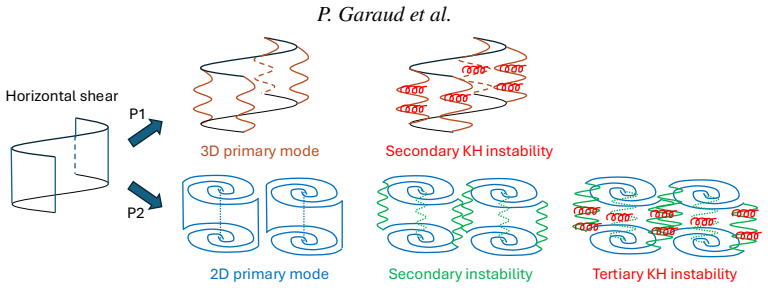
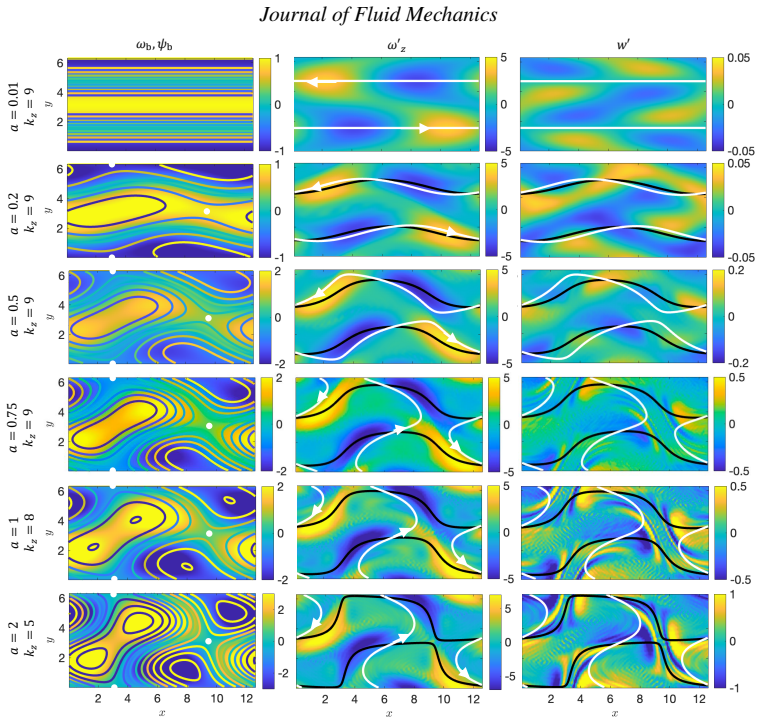
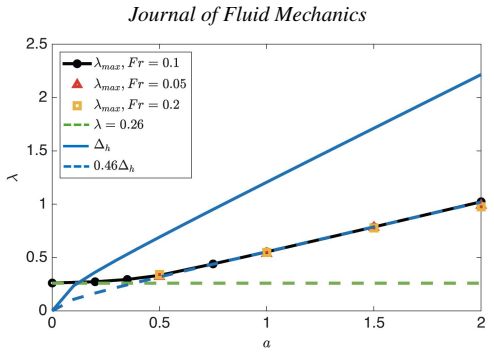
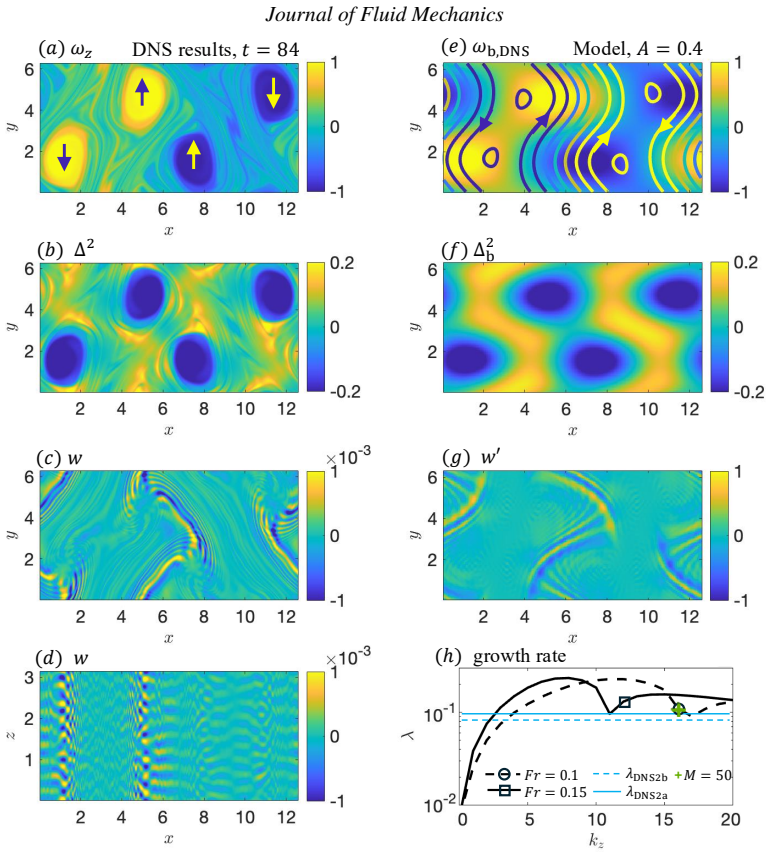
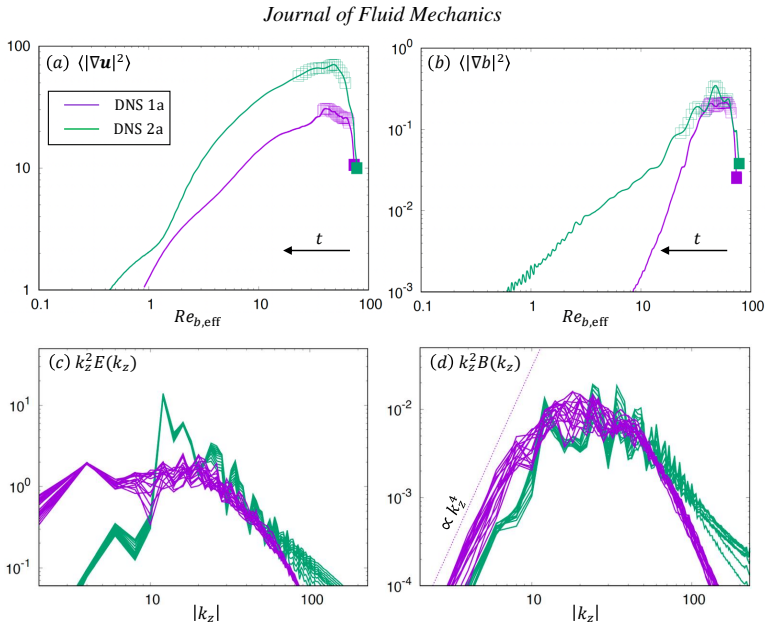
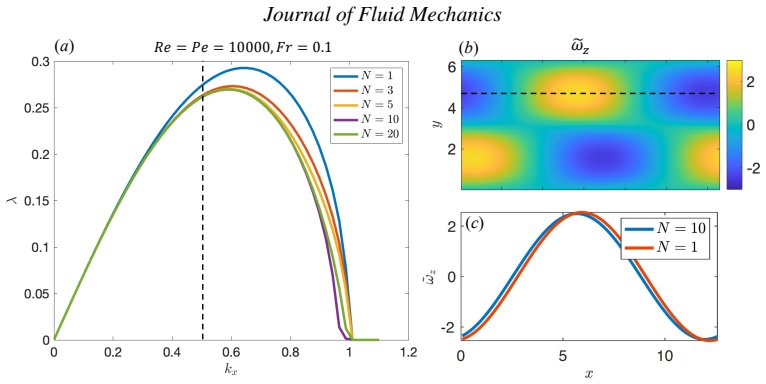
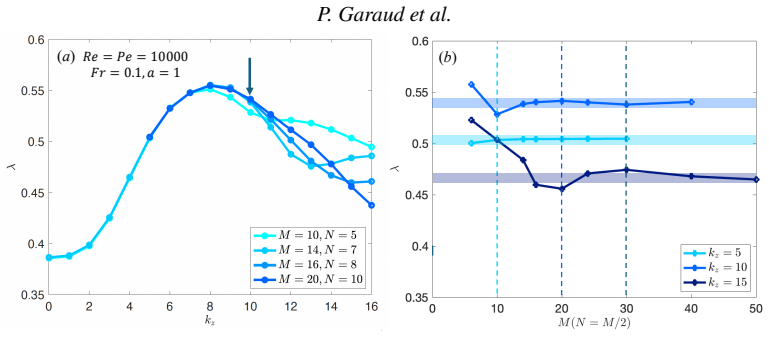
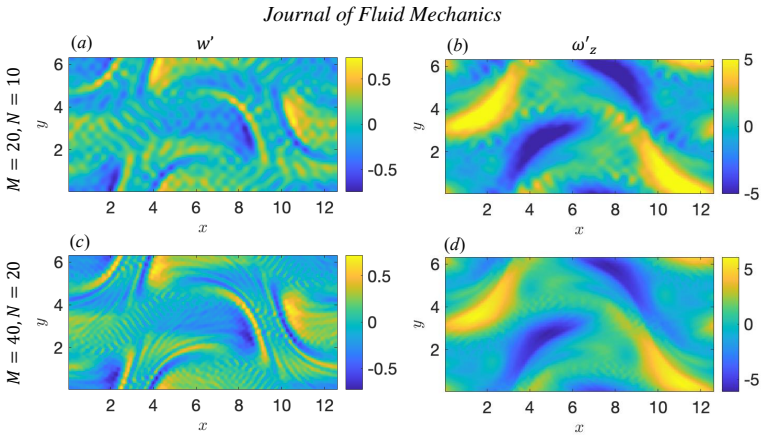
In low Froude number, high Reynolds number horizontally-sheared stratified flows with no initial vertical shear, vertical shear emerges either directly from vertically-modulated eigenmodes of the primary instability or indirectly via nonlinear evolution into long-lived columnar vortices followed by three-dimensional hyperbolic instabilities; this vertical shear then drives secondary or tertiary small-scale Kelvin-Helmholtz instabilities on the buoyancy scale at sufficiently large buoyancy Reynolds number Re_b, producing diapycnal mixing whose efficiency depends on which pathway is taken.
What carries the argument
Spontaneous emergence of vertical shear as a by-product of horizontal shear instabilities, which then triggers small-scale Kelvin-Helmholtz instabilities on the buoyancy scale once Re_b is large.
If this is right
- Diapycnal mixing occurs in strongly stratified flows even without any initial vertical shear once the buoyancy Reynolds number is sufficiently large.
- The two pathways excite different ranges of vertical scales and therefore produce different peak mixing efficiencies.
- Horizontal shear instabilities remain active and can drive turbulence even when the mean Richardson number is large or formally infinite.
- The final step in both pathways is the onset of small-scale Kelvin-Helmholtz instabilities on the buoyancy scale.
- A vertically-invariant primary mode can first produce a long-lived time-dependent two-dimensional vortical flow before three-dimensional instabilities generate vertical shear.
Where Pith is reading between the lines
- These pathways may account for observed mixing in oceanic regions where horizontal shear from currents or eddies is present but vertical shear is weak.
- The scale selection difference between pathways could guide the development of mixing parameterizations that depend on the dominant horizontal shear geometry.
- Similar sequences might appear in other high-Reynolds-number stratified systems such as atmospheric jets or stellar interiors when horizontal shear is the only available energy source.
- Extending the simulations to include background rotation or variable stratification could reveal whether the pathways remain robust or are suppressed.
Load-bearing premise
The direct numerical simulations fully resolve the secondary and tertiary instabilities without significant numerical dissipation or domain-size effects altering the emergence of vertical shear or the measured mixing efficiencies.
What would settle it
A well-resolved simulation at large Re_b in which vertical shear fails to appear from the horizontal shear instability or in which the observed mixing efficiency matches neither of the two described pathways.
Figures
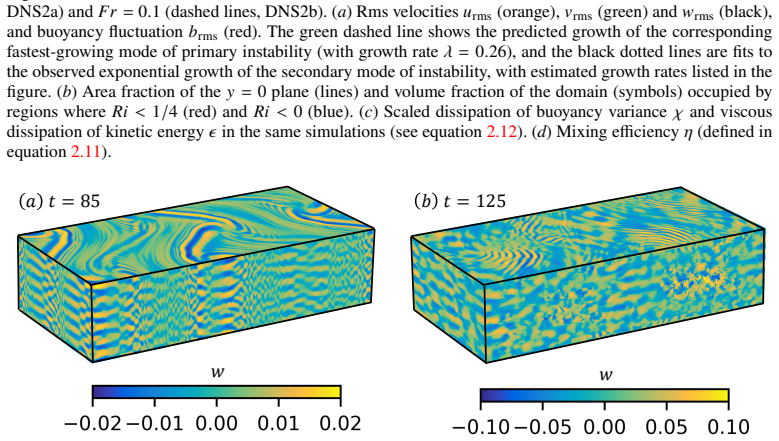
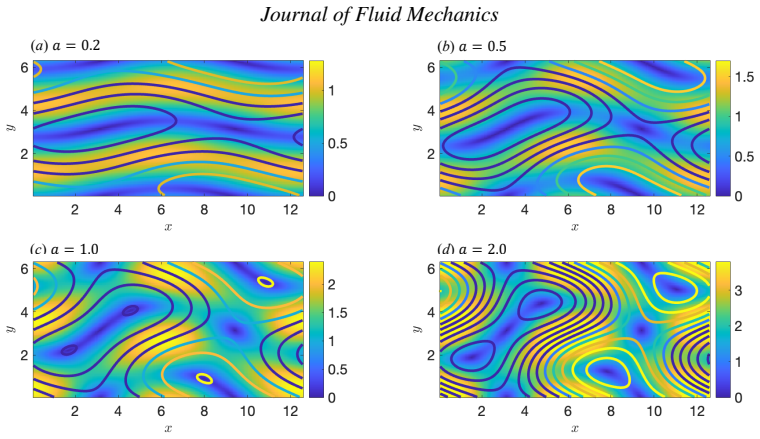
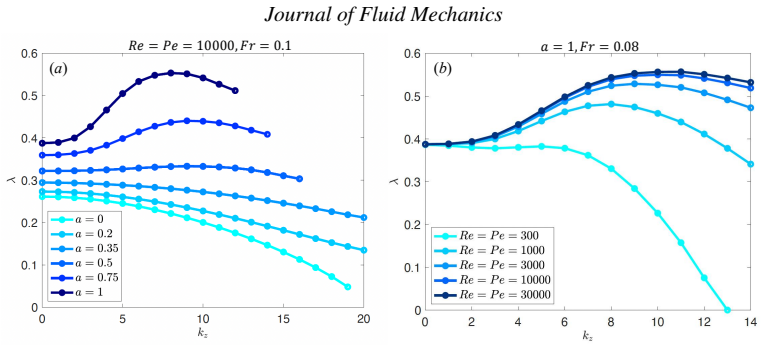
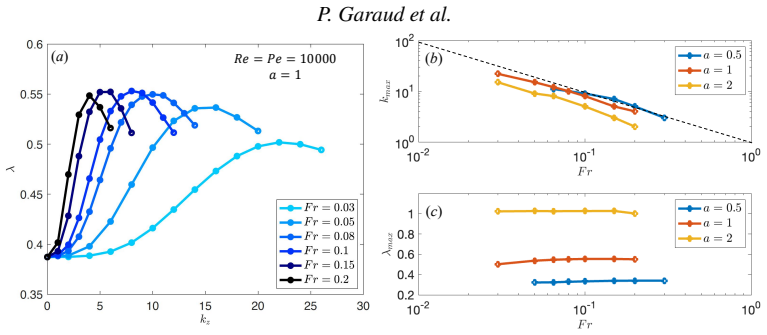
read the original abstract
While vertically-sheared stratified flows have been studied extensively, their horizontally-sheared counterparts have received considerably less attention. Yet, horizontal shear instabilities remain active even when the mean Richardson number is large or even formally infinite, and can drive turbulence in strongly stratified (low Froude number) flows at sufficiently high Reynolds number. In this work, we combine linear theory with direct numerical simulations to investigate two pathways to turbulence in low Froude / high Reynolds number horizontally-sheared flow with no initial vertical shear. In the first pathway, vertical shear emerges directly from vertically-modulated eigenmodes of the primary horizontal shear instability, and becomes unstable to secondary small-scale Kelvin-Helmholtz (KH) instabilities on the buoyancy scale at sufficiently large buoyancy Reynolds number $Re_b$. In the second pathway, a vertically-invariant eigenmode of the primary horizontal shear instability initially dominates, causing the background flow to evolve nonlinearly into a long-lived time-dependent two-dimensional (columnar) vortical flow. The vortices are subsequently unstable to secondary three-dimensional hyperbolic instabilities from which vertical shear emerges, which is finally unstable to tertiary small-scale KH instabilities on the buoyancy scale at sufficiently large $Re_b$. This shows that the emergence of vertical shear driving small-scale KH instabilities is an inevitable by-product of horizontal shear instabilities in strongly stratified flows at sufficiently large $Re_b$. However, we also find that the two pathways excite different ranges of vertical scales, which results in different peak mixing efficiencies.
Editorial analysis
A structured set of objections, weighed in public.
Referee Report
Summary. The manuscript combines linear stability theory with direct numerical simulations to examine mixing in horizontally sheared, strongly stratified flows (low Froude number) that have no initial vertical shear. It identifies two pathways to diapycnal mixing: (1) vertically modulated eigenmodes of the primary horizontal shear instability that directly generate vertical shear, which then becomes unstable to small-scale Kelvin-Helmholtz (KH) instabilities once the buoyancy Reynolds number Re_b is sufficiently large; (2) a vertically invariant eigenmode that evolves into long-lived columnar vortices, which undergo secondary hyperbolic instabilities that generate vertical shear, followed by tertiary KH instabilities at large Re_b. The central claim is that emergence of vertical shear (and subsequent KH mixing) is an inevitable byproduct of horizontal shear instabilities at large enough Re_b, although the pathways excite different vertical scales and therefore produce different peak mixing efficiencies.
Significance. If the numerical results are robust, the work clarifies how horizontal shear alone can sustain diapycnal mixing in strongly stratified regimes relevant to geophysical flows, without requiring initial vertical shear. The distinction between the two pathways and their differing efficiencies supplies a concrete, falsifiable prediction that could be tested in future simulations or experiments. The integration of linear theory to interpret the DNS evolution is a methodological strength.
major comments (2)
- [DNS section] DNS section (implicit in the abstract and linear-theory discussion): the headline claim that vertical shear and buoyancy-scale KH instabilities emerge 'inevitably' at large Re_b rests on the simulations faithfully capturing the secondary and tertiary instabilities. No explicit resolution criteria (e.g., grid points per buoyancy length, verification that local Ri < 1/4 is resolved without excessive numerical dissipation, or checks against domain-height artifacts) are reported. Insufficient vertical resolution or domain size could suppress the small-scale KH or artificially constrain the vertical scales, directly affecting the reported difference in peak mixing efficiencies between pathways.
- [Results on the two pathways] Results on the two pathways: the assertion that the pathways excite 'different ranges of vertical scales' and therefore different peak mixing efficiencies is load-bearing for the paper's novelty. Without tabulated quantitative diagnostics (e.g., spectra of vertical shear or mixing efficiency versus Re_b for each pathway) or convergence tests with respect to domain height, it remains unclear whether the efficiency contrast is physical or an artifact of the chosen vertical domain.
minor comments (1)
- [Abstract] The abstract states that the second pathway produces a 'long-lived time-dependent two-dimensional (columnar) vortical flow,' but the transition criterion from the primary eigenmode to this state is not quantified; a brief statement of the relevant time scale or amplitude threshold would improve clarity.
Simulated Author's Rebuttal
We thank the referee for their positive evaluation of the work's significance and for the constructive comments on the DNS methodology and quantitative support for the two pathways. We address each major comment below and will revise the manuscript to incorporate the requested details and diagnostics.
read point-by-point responses
-
Referee: [DNS section] DNS section (implicit in the abstract and linear-theory discussion): the headline claim that vertical shear and buoyancy-scale KH instabilities emerge 'inevitably' at large Re_b rests on the simulations faithfully capturing the secondary and tertiary instabilities. No explicit resolution criteria (e.g., grid points per buoyancy length, verification that local Ri < 1/4 is resolved without excessive numerical dissipation, or checks against domain-height artifacts) are reported. Insufficient vertical resolution or domain size could suppress the small-scale KH or artificially constrain the vertical scales, directly affecting the reported difference in peak mixing efficiencies between pathways.
Authors: We agree that explicit documentation of resolution criteria is necessary to substantiate the claims of inevitability at large Re_b. In the revised manuscript we will add a dedicated paragraph (or subsection) reporting: (i) grid points per buoyancy length (typically >10 in the vertical), (ii) verification that local gradient Richardson numbers below 1/4 are adequately resolved without excessive numerical dissipation, and (iii) domain-height sensitivity tests confirming that the observed pathways and efficiency differences persist when the vertical domain is doubled. These checks were performed during the original study and will now be reported explicitly. revision: yes
-
Referee: [Results on the two pathways] Results on the two pathways: the assertion that the pathways excite 'different ranges of vertical scales' and therefore different peak mixing efficiencies is load-bearing for the paper's novelty. Without tabulated quantitative diagnostics (e.g., spectra of vertical shear or mixing efficiency versus Re_b for each pathway) or convergence tests with respect to domain height, it remains unclear whether the efficiency contrast is physical or an artifact of the chosen vertical domain.
Authors: The linear stability analysis already quantifies the distinct vertical wavenumbers of the two eigenmodes, and the DNS spectra reflect the subsequent nonlinear evolution. To make the efficiency contrast fully quantitative and demonstrably robust, the revision will include: (i) tabulated spectra of vertical shear for representative cases of each pathway, (ii) mixing efficiency plotted versus Re_b for both pathways, and (iii) explicit convergence tests with respect to vertical domain height showing that the peak efficiencies remain distinct. These additions will be placed in a new figure or table and accompanying text. revision: yes
Circularity Check
No significant circularity; results emerge from linear eigenmode analysis plus DNS of the governing equations
full rationale
The paper derives its central claims (two distinct pathways to vertical shear and KH mixing) directly from linear stability analysis of the horizontally sheared base flow followed by DNS evolution of the Navier-Stokes-Boussinesq equations at low Fr/high Re_b. No parameters are fitted to data and then relabeled as predictions; no uniqueness theorems or ansatzes are imported via self-citation; the reported differences in vertical scales and mixing efficiencies are outputs of the simulations rather than inputs. The derivation chain is therefore self-contained against the external benchmark of the governing PDEs and does not reduce to its own assumptions by construction.
Axiom & Free-Parameter Ledger
free parameters (1)
- buoyancy Reynolds number threshold
axioms (2)
- domain assumption Boussinesq approximation holds for the density variations considered
- standard math Navier-Stokes equations accurately describe the fluid motion
Reference graph
Works this paper leans on
-
[1]
Exploiting self-organized criticality in strongly stratified turbulence , author=. J. Fluid Mech. , volume=. 2022 , publisher=
2022
-
[2]
Journal of the Atmospheric Sciences , year = 1983, month = mar, volume =
Stratified Turbulence and the Mesoscale Variability of the Atmosphere. Journal of the Atmospheric Sciences , year = 1983, month = mar, volume =
1983
-
[3]
and Garaud, P
Cocusse, M. and Garaud, P. and Liu, C. and Caulfield, C.P. , title =. 2026 , note =
2026
-
[4]
and Garaud, P
Cocusse, M. and Garaud, P. and Liu, C. and Caulfield, C.P. , title =
-
[5]
and Garaud, P
Rajkotia-Zaheer, F. and Garaud, P. and Chini, G. and Caulfield, C.P. , title =
-
[6]
and Hirota, M
Hattori, Y. and Hirota, M. , year =. Stability of two-dimensional Taylor–Green vortices in rotating stratified fluids , volume =. J. Fluid Mech. , doi =
-
[7]
Scale-Dependent Models for Atmospheric Flows , author=. Annu. Rev. Fluid Mech. , volume=
-
[8]
and D'Asaro, E.A
Gregg, M.C. and D'Asaro, E.A. and Riley, J.J. and Kunze, E. , title =. Annu. Rev. Mar. Sci. , volume =
-
[9]
Balmforth, N. J. and Young, Y.-N. , year=. Stratified Kolmogorov flow , volume=. doi:10.1017/S0022111002006371 , journal=
-
[10]
Caulfield , title =
C.P. Caulfield , title =. Annu. Rev. Fluid Mech. , year =
-
[11]
Dynamics of a stratified shear layer with horizontal shear , author=. J. Fluid Mech. , volume=. 2006 , publisher=
2006
-
[12]
Nonlinear evolution of the zigzag instability in stratified fluids: a shortcut on the route to dissipation , author=. J. Fluid Mech. , volume=. 2008 , publisher=
2008
-
[13]
Howland, C. J. and Taylor, J. R. and Caulfield, C. P. , year=. Mixing in forced stratified turbulence and its dependence on large-scale forcing , volume=. doi:10.1017/jfm.2020.383 , journal=
-
[14]
Waite, M. L. and Bartello, P. , year=. Stratified turbulence dominated by vortical motion , volume=. doi:10.1017/S0022112004000977 , journal=
-
[15]
Instability and breakdown of a vertical vortex pair in a strongly stratified fluid , author=. J. Fluid Mech. , volume=. 2008 , publisher=
2008
-
[16]
Jackson, P. R. and Rehmann, C. R. , year =. J. Phys. Oceanogr. , volume =
-
[17]
and Garaud, P
Cope, L. and Garaud, P. and Caulfield, C.P. , journal=. The dynamics of stratified horizontal shear flows at low. 2020 , pages=
2020
-
[18]
Numerical validation of scaling laws for stratified turbulence. J. Fluid Mech. , keywords =. doi:10.1017/jfm.2024.531 , archivePrefix =. 2404.05896 , primaryClass =
-
[19]
Non-ideal instabilities in sinusoidal shear flows with a streamwise magnetic field. J. Fluid Mech. , keywords =. doi:10.1017/jfm.2022.782 , archivePrefix =. 2204.10875 , primaryClass =
-
[20]
Goldilocks mixing in oceanic shear-induced turbulent overturns , author=. J. Fluid Mech. , volume=. 2022 , pages=
2022
-
[21]
Self-organised criticality of turbulence in strongly stratified mixing layers , author=. J. Fluid Mech. , volume=. 2018 , pages=
2018
-
[22]
Marginal instability and deep cycle turbulence in the eastern equatorial Pacific Ocean , author=. Geophys. Res. Lett. , volume=. 2013 , pages =
2013
-
[23]
Journal of Fluid Mechanics , year = 2021, month = jan, volume =
Instability of vertically stratified horizontal plane Poiseuille flow. Journal of Fluid Mechanics , year = 2021, month = jan, volume =
2021
-
[24]
Journal of Fluid Mechanics , author=
The stability of thermally stratified plane Poiseuille flow , volume=. Journal of Fluid Mechanics , author=. 1968 , pages=. doi:10.1017/S0022112068002326 , number=
-
[25]
Self-organized criticality in geophysical turbulence , author=. Sci. Reports , volume=. 2019 , pages =
2019
-
[26]
, journal=
Garaud, P. , journal=. Horizontal shear instabilities at low. 2020 , publisher=
2020
-
[27]
Critical balance and scaling of strongly stratified turbulence at low Prandtl number. J. Fluid Mech. , keywords =. doi:10.1017/jfm.2023.6 , archivePrefix =
-
[28]
The linear instability of the stratified plane Couette flow. J. Fluid Mech. , keywords =. doi:10.1017/jfm.2018.556 , archivePrefix =. 1711.11312 , primaryClass =
work page internal anchor Pith review Pith/arXiv arXiv doi:10.1017/jfm.2018.556 2018
-
[29]
Evolution of a stratified rotating shear layer with horizontal shear. Part I. Linear stability. J. Fluid Mech. , year = 2012, month = jul, volume =. doi:10.1017/jfm.2012.183 , adsurl =
-
[30]
Potylitsin, P. G. and Peltier, W. R. , year=. Stratification effects on the stability of columnar vortices on the f-plane , volume=. doi:10.1017/S0022112097007726 , journal=
-
[31]
, author=
On the Boussinesq approximation for a compressible fluid. , author=. Astrophys. J. , volume=
-
[32]
The small-Peclet-number approximation in stellar radiative zones
The small-P \'e clet-number approximation in stellar radiative zones. doi:10.48550/arXiv.astro-ph/9908182 , archivePrefix =
work page internal anchor Pith review Pith/arXiv arXiv doi:10.48550/arxiv.astro-ph/9908182
-
[33]
Leblanc, S. , title =. Physics of Fluids , volume =. 1997 , month =. doi:10.1063/1.869427 , url =
-
[34]
Instability criteria for the flow of an inviscid incompressible fluid , author =. Phys. Rev. Lett. , volume =. 1991 , month =. doi:10.1103/PhysRevLett.66.2204 , url =
-
[35]
Comments on Astrophysics and Space Physics , keywords =
Instabilities of Differential Rotation. Comments on Astrophysics and Space Physics , keywords =
-
[36]
Journal of Geophysical Research , volume=
Thermal turbulence at very small Prandtl number , author=. Journal of Geophysical Research , volume=. 1962 , publisher=
1962
-
[37]
Zero-Prandtl-number convection , author=. J. Fluid Mech. , volume=. 1992 , publisher=
1992
-
[38]
Multi-Dimensional Processes In Stellar Physics , pages=
Turbulence in stably stratified radiative zone , author=. Multi-Dimensional Processes In Stellar Physics , pages=
-
[39]
Astronomy and Astrophysics , volume=
Circulation and turbulence in rotating stars , author=. Astronomy and Astrophysics , volume=
-
[40]
Scaling analysis and simulation of strongly stratified turbulent flows , author=. J. Fluid Mech. , volume=. 2007 , publisher=
2007
-
[41]
Stratified turbulence forced with columnar dipoles: numerical study , author=. J. Fluid Mech. , volume=. 2015 , publisher=
2015
-
[42]
and Davidson, P.A
Maffioli, A. and Davidson, P.A. , journal=. Dynamics of stratified turbulence decaying from a high buoyancy. 2016 , publisher=
2016
-
[43]
Instability and breakdown of a vertical vortex pair in a strongly stratified fluid. J. Fluid Mech. , year = 2008, month = jan, volume =. doi:10.1017/S0022112008001912 , adsurl =
-
[44]
Theoretical analysis of the zigzag instability of a vertical columnar vortex pair in a strongly stratified fluid. J. Fluid Mech. , year = 2000, month = sep, volume =. doi:10.1017/S0022112000001166 , adsurl =
-
[45]
Three-dimensional stability of a vertical columnar vortex pair in a stratified fluid. J. Fluid Mech. , year = 2000, month = sep, volume =. doi:10.1017/S0022112000001178 , adsurl =
-
[46]
Self-similarity of strongly stratified inviscid flows , author=. Phys. 2001 , publisher=
2001
-
[47]
Physical Review Fluids , volume=
Journey to the center of stars: The realm of low Prandtl number fluid dynamics , author=. Physical Review Fluids , volume=. 2021 , publisher=
2021
-
[48]
Symposium-International Astronomical Union , volume=
Rotational instabilities and stellar evolution , author=. Symposium-International Astronomical Union , volume=. 1974 , organization=
1974
-
[49]
Excitation of Gravity Waves by Fingering Convection, and the Formation of Compositional Staircases in Stellar Interiors. ApJ , keywords =. doi:10.1088/0004-637X/808/1/89 , archivePrefix =
-
[50]
Dynamics of Atmospheres and Oceans , year = 1999, month = dec, volume =
Turbulent mixing in a stratified fluid. Dynamics of Atmospheres and Oceans , year = 1999, month = dec, volume =. doi:10.1016/S0377-0265(99)00025-1 , adsurl =
-
[51]
Spontaneous layering in stratified turbulent Taylor-Couette flow. J. Fluid Mech. , year = 2013, month = apr, volume =. doi:10.1017/jfm.2013.85 , adsurl =
-
[52]
The stability of stratified spatially periodic shear flows at low P \'e clet number. Physics of. doi:10.1063/1.4928164 , archivePrefix =
-
[53]
Geophysical and Astrophysical Fluid Dynamics , keywords =
The Onset of Shear Instability in Stars. Geophysical and Astrophysical Fluid Dynamics , keywords =. doi:10.1080/03091927708240377 , adsurl =
-
[54]
Shear layer instability in a highly diffusive stably stratified atmosphere. Astron. Astrophys. , keywords =. doi:10.48550/arXiv.astro-ph/9908184 , archivePrefix =
work page internal anchor Pith review Pith/arXiv arXiv doi:10.48550/arxiv.astro-ph/9908184
-
[55]
Royal Society of London Proceedings Series A , year = 1920, month = jul, volume = 97, pages =
The Supply of Energy from and to Atmospheric Eddies. Royal Society of London Proceedings Series A , year = 1920, month = jul, volume = 97, pages =. doi:10.1098/rspa.1920.0039 , adsurl =
-
[56]
arXiv e-prints , keywords =
The combined effects of vertical and horizontal shear instabilities. arXiv e-prints , keywords =
-
[57]
Godoy-Diana, R. and Chomaz, J.-M. and Billant, P. , title=. 2004 , pages=. doi:10.1017/S0022112004008067 , journal=
-
[58]
Annual Review of Fluid Mechanics , keywords =
Recent Developments in Theories of Inhomogeneous and Anisotropic Turbulence. Annual Review of Fluid Mechanics , keywords =. doi:10.1146/annurev-fluid-120720-031006 , archivePrefix =
-
[59]
The stability of a thermally radiating stratified shear layer. J. Fluid Mech. , year = 1973, month = jan, volume =. doi:10.1017/S0022112073002144 , adsurl =
-
[60]
The effects of radiative transfer on turbulent flow of a stratified fluid. J. Fluid Mech. , year = 1958, month = jan, volume =. doi:10.1017/S0022112058000501 , adsurl =
-
[61]
Mixing in Stars. Ann. Rev. Ast. Astrophys. , year = 1997, month = jan, volume =. doi:10.1146/annurev.astro.35.1.557 , adsurl =
-
[62]
Angular Momentum Transport in Stellar Interiors. Ann. Rev. Ast. Astrophys. , keywords =. doi:10.1146/annurev-astro-091918-104359 , archivePrefix =
-
[63]
Deep Sea Research A , keywords =
Abyssal recipes. Deep Sea Research A , keywords =. doi:10.1016/0011-7471(66)90602-4 , adsurl =
-
[64]
Deep Sea Research A , keywords =
The formation of layers in a uniformly stirred density gradient. Deep Sea Research A , keywords =. doi:10.1016/0198-0149(89)90009-5 , adsurl =
-
[65]
Turbulent mixing in stratified fluids: layer formation and energetics. J. Fluid Mech. , year = 1994, month = jan, volume =. doi:10.1017/S0022112094003915 , adsurl =
-
[67]
and White, N
Falder, M. and White, N. J. and Caulfield, C. P. , journal=. Seismic imaging of rapid onset of stratified turbulence in the. 2016 , publisher=
2016
-
[68]
Flow, Turbul
A direct numerical study of transport and anisotropy in a stably stratified turbulent flow with uniform horizontal shear , author=. Flow, Turbul. Combust. , volume=. 2000 , publisher=
2000
-
[69]
Underlying physics of mixing efficiency for shear-forced, stratified turbulence , author=. Phys. Rev. Fluids , volume=. 2023 , publisher=
2023
-
[70]
On the stability of heterogeneous shear flows. J. Fluid Mech. , year = 1961, month = jan, volume =. doi:10.1017/S0022112061000317 , adsurl =
-
[71]
Sensitivity of stratified turbulence to the buoyancy Reynolds number. J. Fluid Mech. , year = 2013, month = jun, volume =. doi:10.1017/jfm.2013.170 , adsurl =
-
[72]
Annual Review of Fluid Mechanics , year = 2008, month = jan, volume =
Density Stratification, Turbulence, but How Much Mixing?. Annual Review of Fluid Mechanics , year = 2008, month = jan, volume =. doi:10.1146/annurev.fluid.39.050905.110314 , adsurl =
-
[73]
Layer formation in horizontally forced stratified turbulence: connecting exact coherent structures to linear instabilities. J. Fluid Mech. , keywords =. doi:10.1017/jfm.2017.661 , archivePrefix =
-
[74]
Large-scale characteristics of stratified wake turbulence at varying Reynolds number , author =. Phys. Rev. Fluids , volume =. 2019 , month =. doi:10.1103/PhysRevFluids.4.084802 , url =
-
[75]
Experimental evidence for a new instability of a vertical columnar vortex pair in a strongly stratified fluid. J. Fluid Mech. , year = 2000, month = sep, volume =. doi:10.1017/S0022112000001154 , adsurl =
-
[76]
2001, MNRAS, 327, 799, doi: 10.1046/j.1365-8711.2001.04769.x
Latitudinal shear instability in the solar tachocline. MNRAS , keywords =. doi:10.1046/j.1365-8711.2001.04245.x , adsurl =
-
[77]
2022 , institution=
Exploiting Marginal Stability in Slow-Fast Quasilinear Dynamical Systems , author=. 2022 , institution=
2022
-
[78]
Proceedings of the Royal Society A , volume=
Multiple scales analysis of slow--fast quasi-linear systems , author=. Proceedings of the Royal Society A , volume=. 2019 , publisher=
2019
-
[79]
, title =
Shah, K.S. , title =
-
[80]
Statistical state dynamics of vertically sheared horizontal flows in two-dimensional stratified turbulence , author=. J. Fluid Mech. , volume=. 2018 , publisher=
2018
-
[81]
Statistical state dynamics analysis of buoyancy layer formation via the Phillips mechanism in two-dimensional stratified turbulence , author=. J. Fluid Mech. , volume=. 2019 , publisher=
2019
discussion (0)
Sign in with ORCID, Apple, or X to comment. Anyone can read and Pith papers without signing in.